Market Snapshot
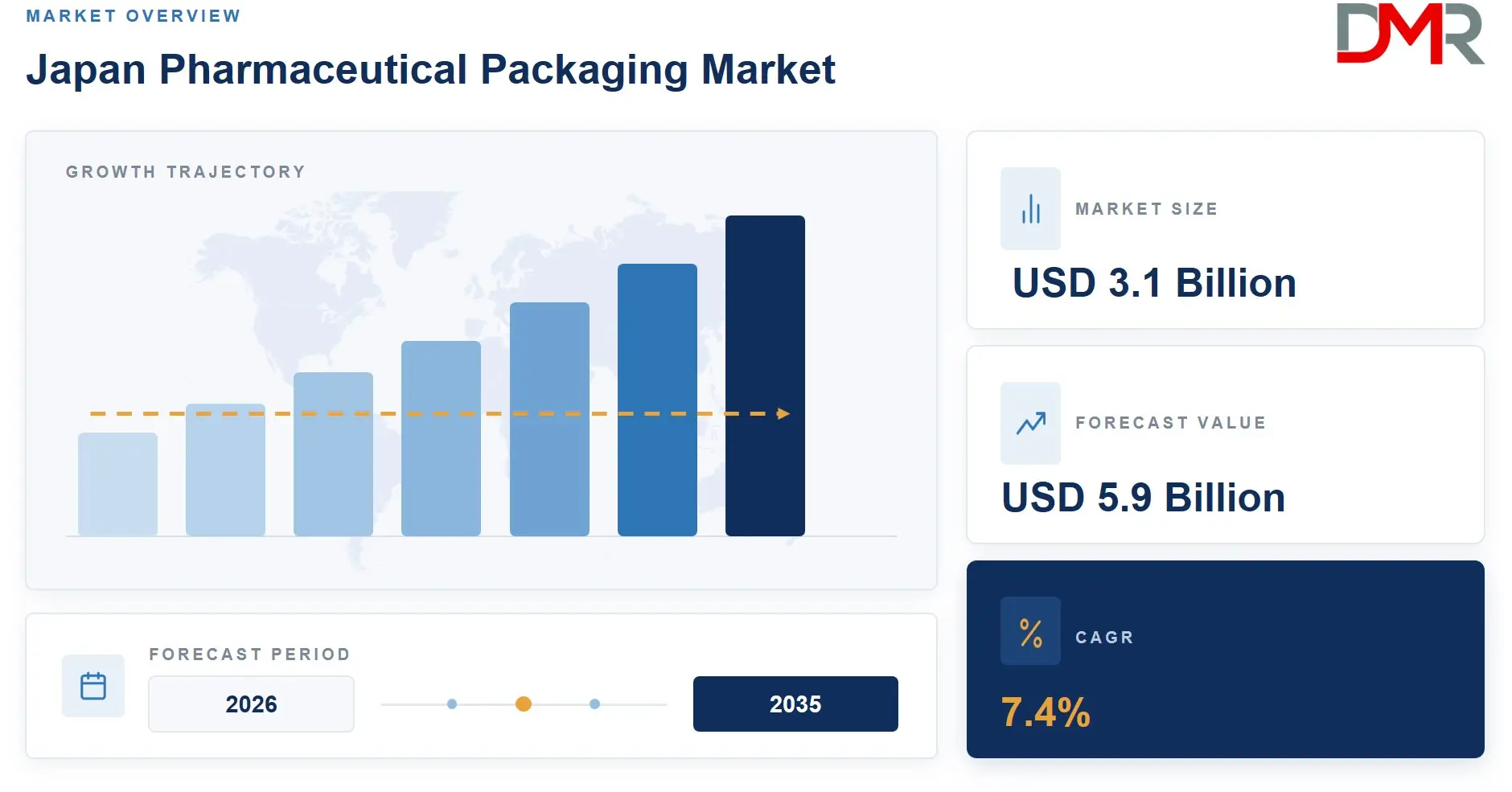
- Market Size (2026): USD 3.1 Bn
- Forecast Value (2035): USD 5.9 Bn
- CAGR (2026-2035): 7.4%
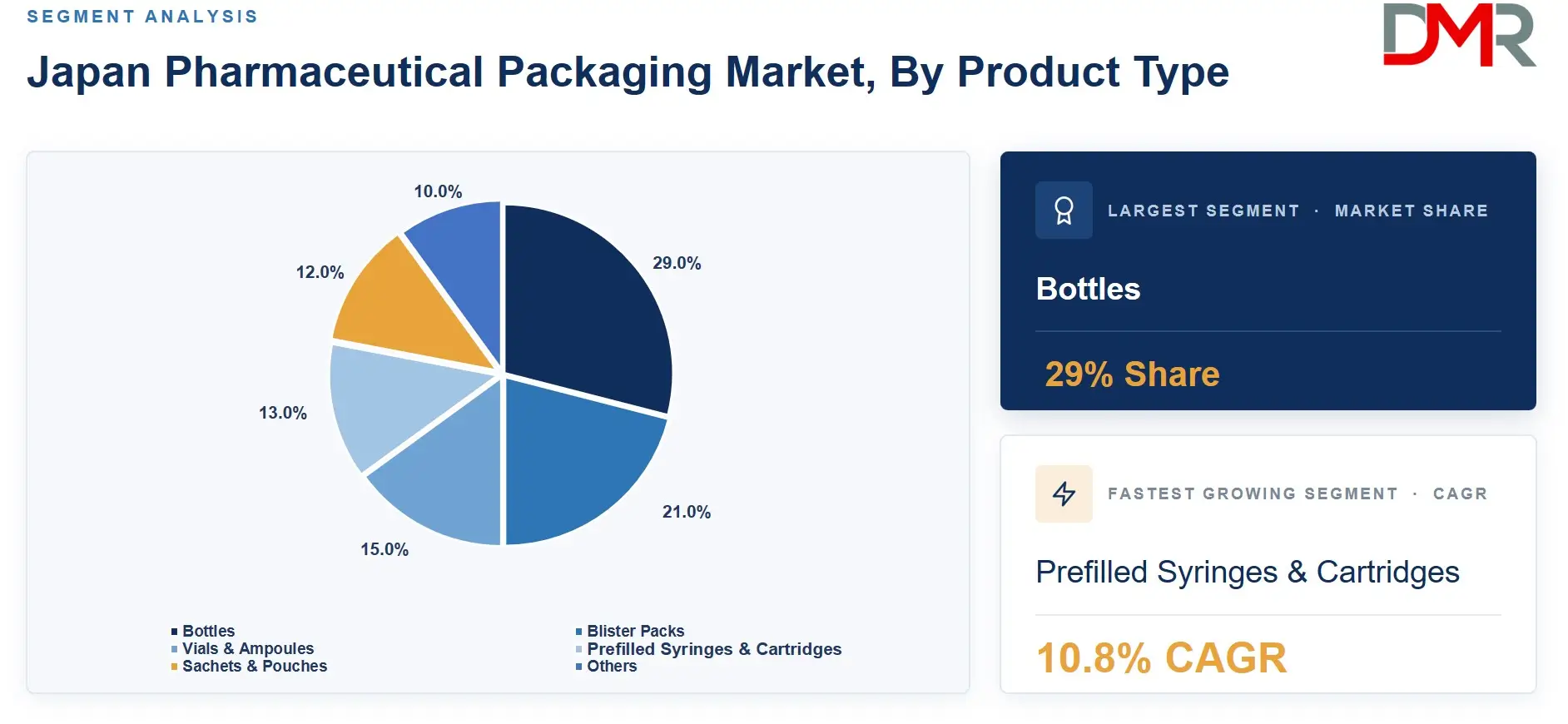
- Leading Product Type (2026): Bottles, around 29%
- Leading Material (2026): Plastics & Polymers, close to 43%
- Key Players: TOPPAN Holdings Inc., Dai Nippon Printing Co., Ltd., Mitsubishi Gas Chemical Company, Inc. and others
What is Japan Pharmaceutical Packaging Market and its Market Size?
The Japan Pharmaceutical Packaging Market size is estimated to reach USD 3.1 Bn in 2026 and is further anticipated to reach USD 5.9 Bn by 2035, at a CAGR of 7.4%. Demand covers packaging consumed inside Japan for prescription medicines, over-the-counter products, biologics, vaccines, specialty therapies and clinical supply. It includes primary packs that contact the drug, secondary packs used for protection and information, and tertiary formats used for controlled distribution.
ℹ
To learn more about this report –
Download Your Free Sample Report Here
Japanese pharmaceutical packaging combines a mature medicine market with unusually demanding requirements for quality assurance, legibility, patient usability and traceability. Common formats include PTP blister packs, bottles, glass vials, ampoules, prefilled syringes, cartridges, pouches, labels and cartons. Suppliers compete not only on material conversion but also on barrier performance, extractables and leachables control, container closure integrity, serialization support and compatibility with automated filling lines.
The figures in this report represent demand generated within Japan rather than worldwide revenue earned by Japanese packaging companies. Domestic consumption is shaped by an aging population, a high prescription volume, growing use of self-injection and biologic therapies, and continuing pressure on manufacturers to reduce packaging waste without weakening moisture, oxygen, light or microbial protection. This boundary keeps the sizing tied to packs entering the Japanese pharmaceutical supply chain.
Structural change is moving value toward higher specification containers and smarter packaging. Cyclic olefin polymers, high barrier films, ready-to-use sterile components, tamper evidence, RFID and NFC enabled labels, and mono-material PTP concepts are gaining attention. At the same time, manufacturers must preserve machinability and patient opening performance, making material substitution more complex than in ordinary consumer packaging.
Use Cases
- High Volume Oral Solid Dose Production: Generic and branded drug manufacturers deploy PTP blister packs and bottles to protect tablets and capsules from humidity while supporting automated inspection and cartoning. Better barrier selection reduces stability risk and permits efficient distribution through wholesalers, hospitals and community pharmacies.
- Biologic and Injectable Drug Filling: Sterile drug producers use vials, prefilled syringes, cartridges and elastomeric closures for sensitive injectable products. Packaging systems must maintain container closure integrity through filling, storage and transport, which shifts purchasing toward validated components with low particulate and extractables profiles.
- Hospital Medication Management: Hospitals and pharmacy supply chains use unit dose labels, tamper evidence and machine readable identifiers to improve inventory control and reduce handling errors. Packaging becomes part of medication administration workflow rather than a passive container, particularly for high value and temperature sensitive therapies.
- Patient Centric Home Treatment: Pharmaceutical companies use easy-open blisters, prefilled devices, calendar packs and information rich labels for elderly patients and people managing chronic disease at home. Better usability can support adherence while reducing the need for repacking at pharmacies or additional handling by caregivers.
Key Takeaways
- Product Type Analysis: Bottles are expected to account for roughly 29% of 2026 revenue, supported by oral solid dose and liquid medicine volumes.
- Material Analysis: Plastics & Polymers are projected to represent approximately 43% of 2026 demand because of weight, forming flexibility and broad compatibility.
- Demand Concentration: Primary packaging is set to hold nearly 67% of 2026 value as sterile and barrier critical formats carry higher specification requirements.
- Injectable Shift: Prefilled Syringes & Cartridges are forecast to expand at a CAGR of 10.8% through 2035 as self-administration and biologics gain share.
- Sustainability Transition: Paper & Paperboard is projected to grow at a CAGR of 9.2%, supported by lightweight secondary packs and material reduction programs.
- Digital Packaging: Smart labels and authentication features are moving from pilot use toward targeted deployment in high value medicines, hospital logistics and traceability workflows.
How AI/Gen AI is Transforming the Japan Pharmaceutical Packaging Market?
AI adoption is concentrated in inspection, forecasting and documentation rather than in the physical pack itself. Computer vision models can identify print defects, seal contamination, missing components, cosmetic vial defects and label mismatches at line speed. Machine learning also helps converters forecast resin, glass and foil demand, which matters when pharmaceutical customers require qualified materials and cannot switch suppliers quickly.
Generative AI is beginning to assist regulated documentation, artwork review and change control, but human approval remains necessary because packaging text can affect patient safety and regulatory compliance. The larger near-term opportunity is connecting data from vision systems, serialization equipment and manufacturing execution systems so quality teams can detect drift earlier.
- Computer Vision Inspection: Models classify seal, print, label and container defects and route questionable packs for review.
- Demand Forecasting: Machine learning links medicine production schedules with packaging component requirements to reduce shortages and excess qualified inventory.
- LLM Document Processing: Controlled language tools assist comparison of artwork, specifications, change requests and supplier documents before specialist review.
- Predictive Maintenance: Equipment data is used to anticipate wear on forming, filling, sealing and inspection assets that can affect pack quality.
Key Drivers in the Japan Pharmaceutical Packaging Market
Growth is being pulled by changes in therapy mix and by the operational requirements of a tightly controlled pharmaceutical supply chain.
- Expansion of Biologics, Specialty Medicines and Self-Administration: Higher value therapies require containers with stronger barrier, sterility and device compatibility performance than conventional secondary packaging. This pushes demand toward vials, cartridges, prefilled syringes, specialty polymers and engineered elastomer closures. Prefilled Syringes & Cartridges are expected to grow at 10.8% from 2026 to 2035, faster than the overall industry, as manufacturers seek dose accuracy and patient convenience. Packaging suppliers that can support component qualification, low particulate performance, container closure integrity and cold chain handling gain a larger role in drug development and lifecycle management.
- Aging Population and Medication Intensity: Japan's older patient base increases consumption of chronic disease medicines while raising the importance of readable, easy-to-handle and adherence-oriented packs. Bottles are projected to hold around 29% of 2026 product type revenue, reflecting their continuing role in tablets, capsules and liquids. However, demand is shifting toward formats that combine protection with easier opening, unit dosing and clearer information. Pharmaceutical companies therefore evaluate packaging on human factors as well as cost, creating opportunities for redesigned closures, calendar packs, high contrast labeling and compact formats suited to home treatment.
Restraints in the Japan Pharmaceutical Packaging Market
Packaging changes are expensive to qualify, and the sector faces a difficult balance between environmental goals and pharmaceutical protection requirements.
- Qualification Burden and Long Change Cycles: A material substitution can trigger stability work, line trials, extractables and leachables assessment, transport testing and regulatory documentation. Primary packaging is expected to represent nearly 67% of 2026 value, so a large portion of spending sits in formats where failure directly threatens product quality. This makes drug manufacturers cautious about changing resins, coatings, glass compositions or closure systems solely for cost or sustainability reasons. Smaller converters can struggle with validation resources, while pharmaceutical companies may maintain dual inventories during transition, slowing adoption even when a new material has a clear environmental advantage.
- Raw Material, Energy and Precision Manufacturing Costs: Pharmaceutical grade glass, barrier polymers, aluminum, elastomers and sterile components require tighter specifications than ordinary packaging materials. Glass is projected to expand at a CAGR of 8.7% through 2035, but high temperature production and defect control keep the cost base exposed to energy and quality expenses. Japan also relies on globally connected supply chains for specialized resins, films and processing equipment. Currency movement or disruptions can raise procurement costs, while customers resist frequent price changes because packaging is embedded in approved product economics.
Growth Opportunities in the Japan Pharmaceutical Packaging Market
White space is strongest where packaging solves a measurable quality, sustainability or workflow problem without forcing pharmaceutical manufacturers to compromise validation.
- Mono-Material and Aluminum-Reduced PTP Systems: Blister packaging is deeply embedded in Japan's oral dose market, creating a large installed base for improved PTP structures. Blister Packs are projected to grow at 8.9% from 2026 to 2035 as converters introduce high barrier polymer structures, recyclable lidding concepts and designs that preserve push-through opening behavior. The opportunity is not simply replacing aluminum. Suppliers need to match moisture protection, printability, seal performance and machinability while giving pharmaceutical customers a credible recycling or material reduction pathway. Successful systems can scale across multiple drug portfolios after qualification.
- Smart Labels for Traceability and Hospital Workflow: Digital identification can connect packaging to inventory, authentication, opening status and patient information. Clinical Trial & Specialty Drugs are forecast to expand at 10.1% through 2035, creating an attractive niche because individual packs carry high value and often require tighter chain of custody. NFC, RFID, serialized codes and tamper sensing can support hospital stock management and specialty distribution. Suppliers that integrate labels with cloud data, secure identity and pharmaceutical artwork services can capture value beyond printing while reducing the burden of separate hardware and software vendors.
Trends in the Japan Pharmaceutical Packaging Market
Current shifts center on material simplification, sterile ready-to-use components and packaging that carries more data without becoming harder for patients to use.
- Move Toward High Barrier Transparent Polymers: Pharmaceutical developers increasingly evaluate cyclic olefin polymer and multilayer plastic systems for drugs that need low breakage risk, transparency and controlled gas or moisture transmission. Plastics & Polymers are expected to account for close to 43% of 2026 material revenue. The trend is particularly relevant to advanced therapies and injectable formats where glass remains important but is not ideal for every cold chain or protein interaction profile. Material suppliers are differentiating through barrier layers, low adsorption surfaces and sterilization compatibility rather than commodity resin pricing.
- Convergence of Sustainability and Digitalization: Packaging development teams are trying to reduce material complexity while adding machine readable information, authentication and traceability. Secondary packaging is projected to grow at 8.1% through 2035 as cartons and labels become platforms for variable data, digital instructions and supply chain identification. This creates design tension because additional inks, labels or electronic components can complicate recycling. Suppliers are responding with thinner structures, water based printing, removable or minimal labels and digital features reserved for medicines where traceability value justifies the added component.
Research Scope and Analysis
Segment performance is assessed across product type, material, packaging level and application. Each axis identifies where 2026 revenue is concentrated and which sub-segment is moving fastest through 2035, linking the positions to therapy mix, qualification requirements, patient use and packaging technology.
ℹ
To learn more about this report –
Download Your Free Sample Report Here
By Product Type
Bottles are projected to hold the largest product type share in 2026, accounting for around 29% of revenue, because they remain economical and familiar for tablets, capsules, powders and pharmaceutical liquids. Their installed filling base and broad availability of child resistant, senior friendly and moisture management closures support continued use. Growth, however, is concentrated in Prefilled Syringes & Cartridges, which are forecast to expand at a CAGR of 10.8% between 2026 and 2035. Biologics, self-injection and dose accuracy requirements are pulling drug manufacturers toward ready-to-fill and ready-to-use systems. These formats also shift more packaging value into precision glass or polymer barrels, plungers, stoppers, needle systems and validated sterile handling.
By Material
Plastics & Polymers are expected to lead the material mix in 2026 with approximately 43% of revenue, supported by low weight, design flexibility and extensive use across bottles, blisters, pouches, closures and device components. High barrier coatings and cyclic olefin materials are also widening the performance range of pharmaceutical plastics. The steeper trajectory sits with Paper & Paperboard, growing at a CAGR of 9.2% from 2026 to 2035. Pharmaceutical companies are reducing unnecessary plastic in secondary packs, redesigning cartons for lower material use and improving recyclability. Growth is strongest where fiber based formats can replace non-contact packaging without changing the validated primary container or exposing the medicine to new stability risk.
By Packaging Level
Primary packaging is set to represent nearly 67% of 2026 market value because bottles, blisters, vials, ampoules, syringes and closures directly protect drug stability and therefore carry the highest specification burden. Sterility, barrier performance and container closure integrity make these components difficult to commoditize. Growth, however, is concentrated in Secondary Packaging at a CAGR of 8.1% through 2035. Cartons, labels and inserts are absorbing more variable data, anti-counterfeit features, digital instructions and patient support information. The shift toward smaller specialty drug batches also increases artwork complexity and change frequency, favoring digital printing and late-stage customization. Tertiary Packaging grows more steadily because transport formats remain important but carry less value per medicine unit.
By Application
Oral Drugs are projected to hold roughly 46% of 2026 application revenue, reflecting Japan's large installed base of tablets and capsules distributed through hospitals, clinics and community pharmacies. PTP blisters and bottles dominate this flow because they combine unit protection, familiarity and efficient packing. The faster growth is expected in Clinical Trial & Specialty Drugs, advancing at a CAGR of 10.1% between 2026 and 2035. Smaller batches, high unit values, temperature sensitivity and complex labeling increase packaging spend per dose. Specialty therapies also require stronger chain of custody and more frequent packaging changes, supporting serialized labels, tamper evidence, cold chain compatible containers and flexible short-run secondary packaging.
The Japan Pharmaceutical Packaging Market Report is Segmented Based on the Following
By Product Type
- Bottles
- Blister Packs
- Vials & Ampoules
- Prefilled Syringes & Cartridges
- Sachets & Pouches
- Others
By Material
- Plastics & Polymers
- Glass
- Paper & Paperboard
- Aluminum
- Rubber & Elastomers
- Others
By Packaging Level
- Primary Packaging
- Secondary Packaging
- Tertiary Packaging
- Others
By Application
- Oral Drugs
- Injectables
- Biologics & Biosimilars
- OTC Medicines
- Clinical Trial & Specialty Drugs
- Others
Competitive Landscape
Competition in Japan spans diversified printing and packaging groups, pharmaceutical container specialists, glass and polymer technology suppliers, and global firms serving injectable drug platforms. Domestic suppliers benefit from close engineering relationships, Japanese language artwork capability and familiarity with local quality expectations. Global companies compete through proprietary vial, syringe, closure and barrier technologies, often targeting biologics and export-oriented drug programs. The strongest strategies combine material science with validation support, sterile component readiness, digital traceability and sustainability redesign. Consolidation is less important than qualification depth because pharmaceutical customers are reluctant to change an approved container system without a clear performance or supply benefit. As therapy portfolios become more specialized, suppliers able to support both high volume oral dose packaging and lower volume high value injectable formats are positioned to capture a larger share of customer spending.
Some of the Prominent Players in the Japan Pharmaceutical Packaging Market Are
- TOPPAN Holdings Inc.
- Dai Nippon Printing Co., Ltd.
- Mitsubishi Gas Chemical Company, Inc.
- Nipro Corporation
- Terumo Corporation
- Toyo Seikan Group Holdings, Ltd.
- Oji Holdings Corporation
- Nippon Paper Industries Co., Ltd.
- Rengo Co., Ltd.
- Fujimori Kogyo Co., Ltd.
- Hosokawa Yoko Co., Ltd.
- Takemoto Yohki Co., Ltd.
- Daiwa Can Company
- Taisei Kako Co., Ltd.
- Amcor plc
- Gerresheimer AG
- SCHOTT Pharma AG & Co. KGaA
- West Pharmaceutical Services, Inc.
- Berry Global Group, Inc.
- AptarGroup, Inc.
- SGD Pharma
- Stevanato Group S.p.A.
- Nemera
- Datwyler Holding Inc.
- TekniPlex, Inc.
- Klöckner Pentaplast
- Constantia Flexibles
- CCL Industries Inc.
- UFlex Limited
- Bormioli Pharma S.p.A.
- DWK Life Sciences GmbH
- ACG
- Bilcare Limited
- Origin Pharma Packaging
- Sharp Services, LLC
- PCI Pharma Services
- Nelipak Healthcare Packaging
- Sonoco Products Company
- TricorBraun
- Drug Plastics & Glass Co., Inc.
- Other Key Players
Recent Developments
- In December 2025, TOPPAN Holdings completed the transfer of patented brittle lidding material technology for push-through blister packs from Asahi Kasei, strengthening its ability to develop aluminum-free and mono-material PTP systems for pharmaceutical customers.
- In July 2025, Dai Nippon Printing developed a barrier polypropylene lidding film intended to replace aluminum foil in PTP packaging, creating a mono-material structure designed around the printability, sealing and barrier requirements of the Japanese pharmaceutical market.
- In June 2025, Dai Nippon Printing introduced a transparent moisture-absorbing plastic sheet for PTP packs used with moisture-sensitive orally disintegrating tablets, reducing dependence on separate desiccants while allowing patients and inspectors to see the packaged dose.
- In January 2025, Mitsubishi Gas Chemical's OXYCAPT multilayer pharmaceutical container received a packaging innovation award, highlighting Japanese development of transparent high-barrier polymer containers suited to oxygen-sensitive drugs, cold storage and advanced therapy applications.
- In September 2024, TOPPAN Digital developed a dual-frequency UHF and NFC tamper-detection label for healthcare and pharmaceutical use, combining long-range logistics reading with smartphone access and opening detection in a single label architecture.
- In June 2024, TOPPAN presented aluminum-reduction packaging, transparent high-barrier films and smart packaging solutions for pharmaceutical applications, reinforcing the convergence of recyclable structures, authentication and traceability in its healthcare packaging portfolio.
Report Details
| Report Characteristics |
| Market Size (2026) |
USD 3.1 Bn |
| Forecast Value (2035) |
USD 5.9 Bn |
| CAGR (2026-2035) |
7.4% |
| Historical Data |
2021 - 2025 |
| Forecast Data |
2026 - 2035 |
| Base Year |
2025 |
| Segments Covered |
By Product Type, By Material, By Packaging Level, and By Application |
| Regional Coverage |
Japan |
Frequently Asked Questions
How big is the Japan Pharmaceutical Packaging Market?
▾ Japan pharmaceutical packaging demand is estimated at USD 3.1 Bn in 2026. The value includes primary, secondary and tertiary packaging consumed for medicines within Japan, covering oral solid doses, injectables, biologics, OTC products and specialty therapies. Primary containers account for the largest value because they carry direct drug protection and validation requirements.
What is the growth rate of the Japan Pharmaceutical Packaging Market?
▾ The industry is forecast to expand at a CAGR of 7.4% from 2026 to 2035. Growth is supported by higher specification injectable packaging, patient centric formats, material redesign and digital traceability. Mature oral dose packaging continues to provide a stable base, while specialty containers and prefilled delivery formats lift value per packaged dose.
What is driving demand in the Japan Pharmaceutical Packaging Market?
▾ Demand is being driven by Japan's medication-intensive healthcare system, growth in biologics and specialty therapies, and the need for packaging that works well for older patients. Drug manufacturers are also seeking recyclable structures, lower material use, stronger traceability and validated containers that tolerate cold chain, sterilization and automated filling requirements.
Which product type holds the largest share in the Japan Pharmaceutical Packaging Market?
▾ Bottles are expected to hold the leading product type position in 2026 with a share of roughly 29%. Their scale comes from established use across tablets, capsules, powders and pharmaceutical liquids. Blisters remain strategically important, while prefilled syringes and cartridges are growing faster as self-administration and biologic therapies increase.
Which material is growing fastest in Japan pharmaceutical packaging?
▾ Paper & Paperboard is projected to record a CAGR of 9.2% from 2026 to 2035. Growth is concentrated in cartons, inserts and other non-contact components where pharmaceutical companies can reduce plastic and improve recyclability without changing the validated primary container. Barrier polymers and pharmaceutical glass also remain important for sensitive medicines.
Who are the key players in the Japan Pharmaceutical Packaging Market?
▾ Prominent participants include TOPPAN Holdings Inc., Dai Nippon Printing Co., Ltd., Mitsubishi Gas Chemical Company, Inc., Nipro Corporation, Terumo Corporation, Gerresheimer AG and SCHOTT Pharma AG & Co. KGaA. Competition centers on barrier performance, sterile components, packaging usability, material sustainability, quality support and compatibility with pharmaceutical filling operations.
What is the outlook for the Japan Pharmaceutical Packaging Market through 2035?
▾ The Japan Pharmaceutical Packaging Market is expected to become more specialized as injectable therapies, high barrier polymers, smart labels and recyclable PTP concepts gain adoption. Suppliers that can document material safety, support validation and preserve line performance will have an advantage. Sustainability will influence purchasing, but drug protection and patient safety will remain the decisive design constraints.