Market Overview
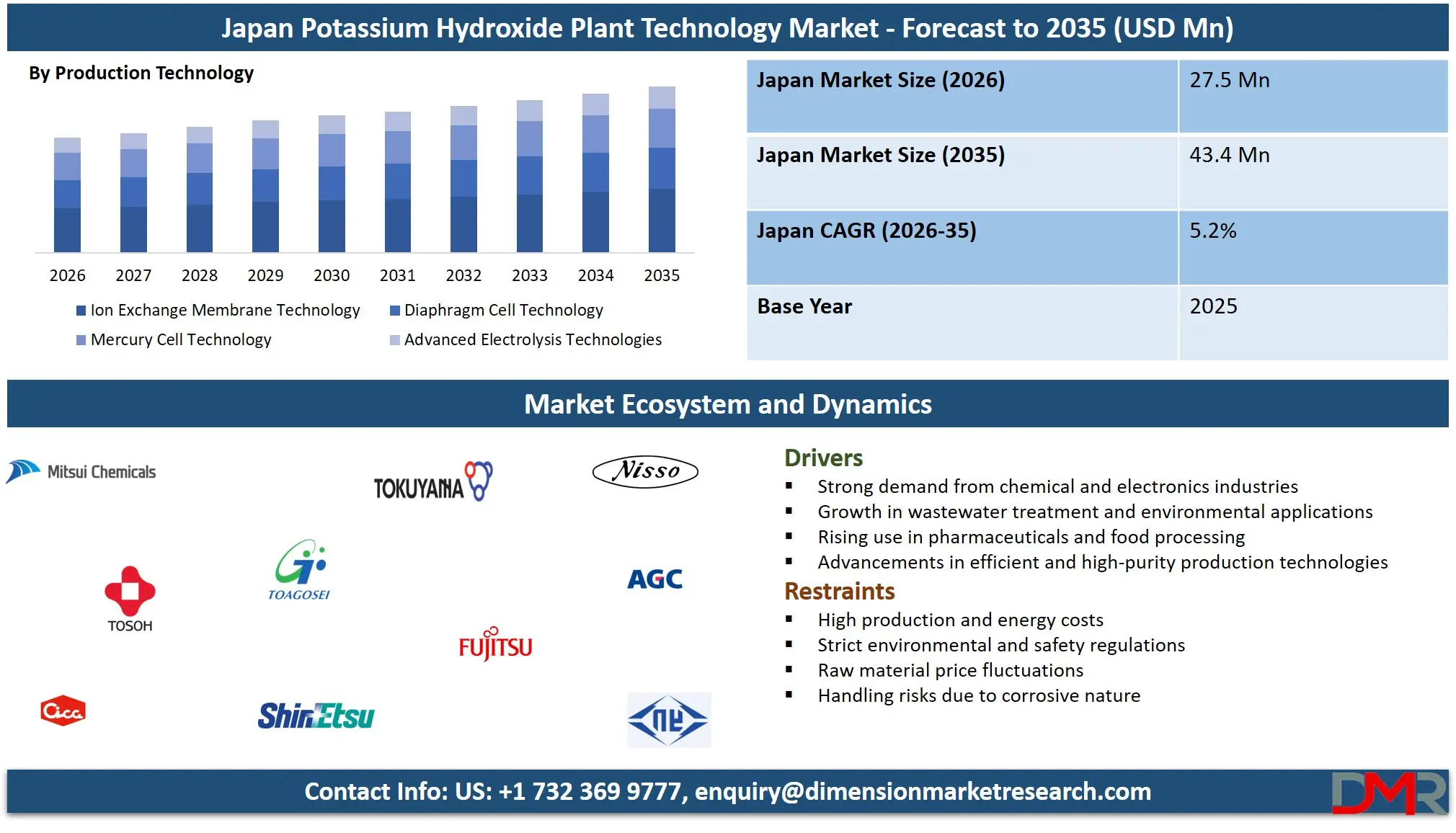
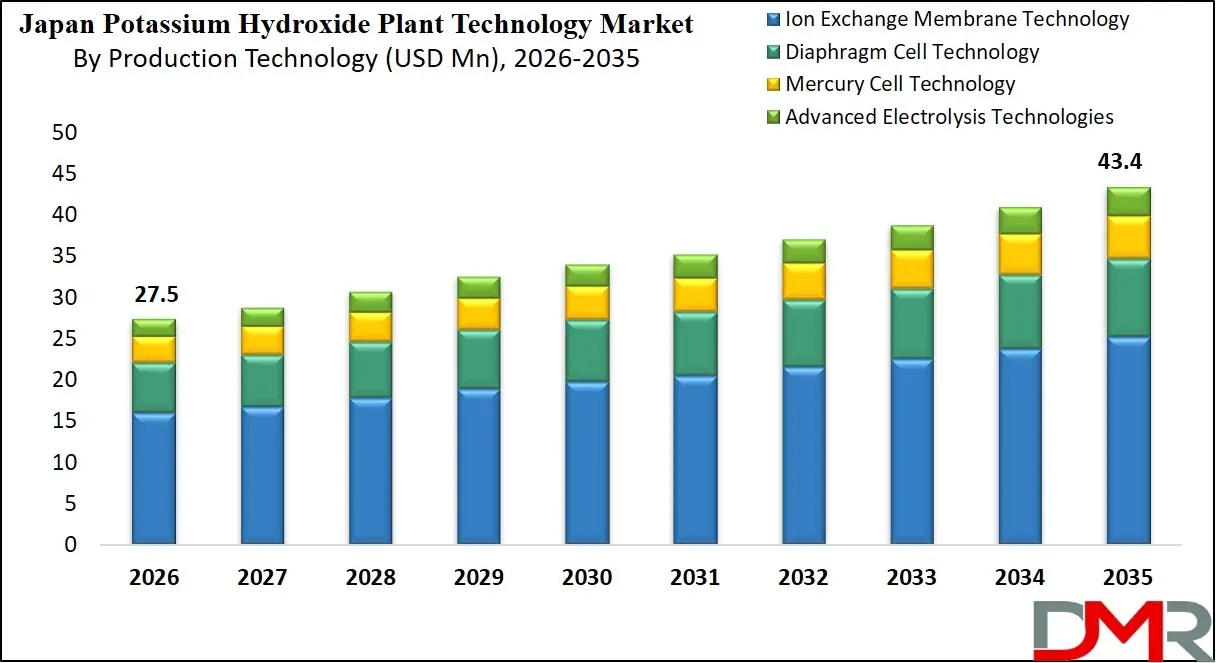
The Japan Potassium Hydroxide Plant Technology Market size is projected to reach USD 27.5 million in 2026 and grow at a compound annual growth rate of 5.2% to reach a value of USD 43.4 million in 2035.
ℹ
To learn more about this report –
Download Your Free Sample Report Here
The technology for the production of potassium hydroxide is the set of procedures, technologies, and engineering innovations adopted in the production process of KOH, a substance that is very basic in nature and has wide applications in chemicals, agriculture, batteries, and food industry.
It mainly comprises the electrolytic process of potassium chloride through membrane electrolysis, diaphragm electrolysis, or mercury electrolysis. The development of new electrolytic technologies, energy efficiency, and high purity in the production of potassium hydroxide is playing a pivotal role in the modernization of its technology.
ℹ
To learn more about this report –
Download Your Free Sample Report Here
Japan Potassium Hydroxide Plant Technology Market: Key Takeaways & Influencing Factors
- Market Growth: The Japan Potassium Hydroxide Plant Technology Market size is expected to grow by USD 14.6 million, at a CAGR of 5.2%, during the forecasted period of 2027 to 2035.
- By Production Technology: The ion exchange membrane technology segment is anticipated to get the majority share of the Japan Potassium Hydroxide Plant Technology market in 2026.
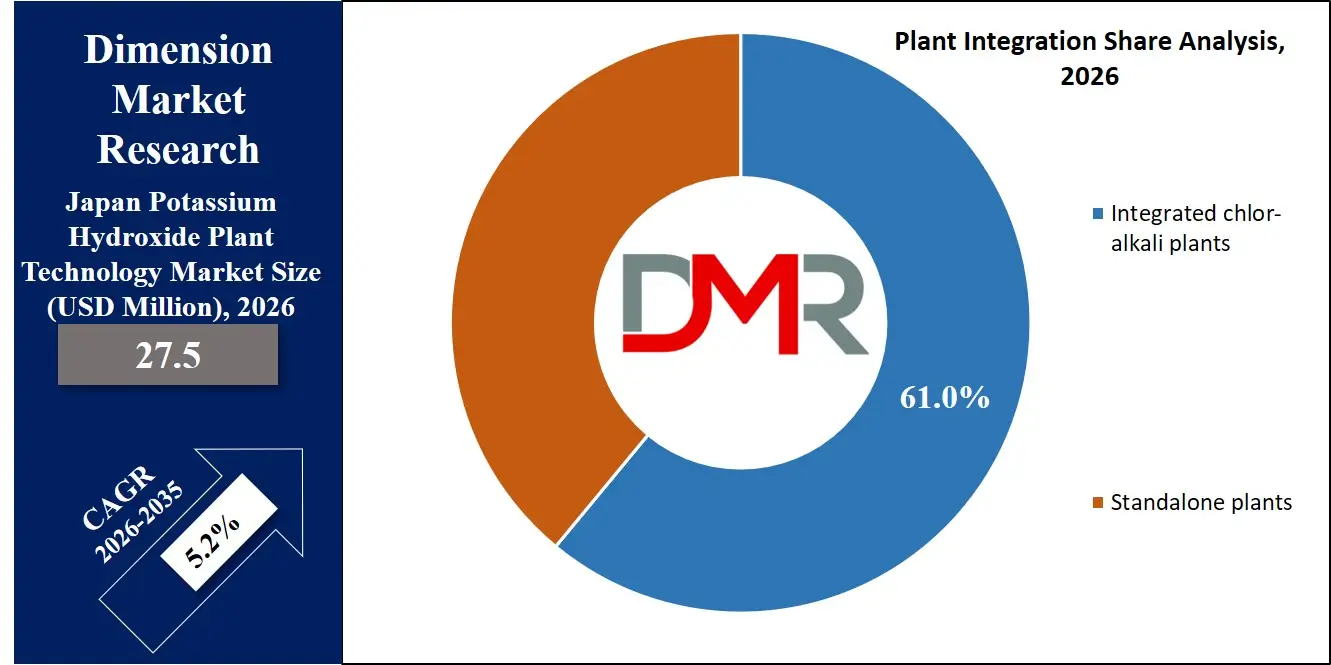
- By Plant Integration: The integrated chlor-alkali plants segment is expected to get the largest revenue share in 2026 in the Japan Potassium Hydroxide Plant Technology market.
- Use Cases: Some of the use cases of Potassium Hydroxide Plant Technology include agricultural applications, battery production, and more.
- Japan Ministry of Economy, Trade and Industry reported in 2025 that Japan's chlor-alkali production capacity utilization exceeded 85%, reflecting strong demand for electrolysis-based chemical outputs.
- International Energy Agency stated in 2024 that electricity consumption in chemical manufacturing accounts for nearly 15% of total industrial energy use in advanced economies like Japan.
- Japan Chemical Industry Association noted in 2026 that over 60% of chemical plants in Japan have adopted membrane-based electrolysis technologies for improved efficiency and environmental compliance.
- Ministry of Environment Japan highlighted in 2025 that industrial emissions from chemical plants declined by approximately 12% due to adoption of cleaner production technologies.
Japan Potassium Hydroxide Plant Technology Market: Use Cases
- Chemical Manufacturing: Potassium hydroxide is extensively used in producing potassium-based chemicals, soaps, and detergents. Advanced plant technologies enable consistent quality and higher yields, supporting large-scale chemical synthesis while reducing energy consumption and emissions in industrial operations.
- Agriculture Applications: KOH is a key ingredient in liquid fertilizers and pH regulators. Modern plant technologies ensure high-purity output, improving crop yield efficiency and supporting precision agriculture practices across Japan's technologically advanced farming sector.
- Battery Production: Potassium hydroxide is crucial in alkaline batteries and emerging energy storage solutions. Advanced electrolysis technologies enable production of ultra-pure KOH, which enhances battery performance and supports the transition toward renewable energy systems.
- Food Processing & Pharmaceuticals: High-purity potassium hydroxide is used in food additives and pharmaceutical formulations. Sophisticated plant technologies ensure compliance with stringent safety and purity standards, supporting regulated industries with consistent and contaminant-free production.
Market Dynamic
Driving Factors in the Japan Potassium Hydroxide Plant Technology Market
Shift Toward Energy-Efficient Electrolysis Technologies
Energy savings and carbon footprint reduction have been important factors that have resulted in the development of modern potash plants in Japan. The use of membrane electrolysis and zero-gap technology helps conserve energy by using less electricity than conventional technologies. There are several government initiatives in place that encourage the use of more efficient production methods.
Growing Demand from Electronics and Battery Industries
The dominance of Japan in the manufacture of electronic and battery products has created an increased demand for high purity potassium hydroxide. The sophisticated nature of the plants makes it necessary for them to be able to control impurities. This is creating the need for increased investment in electrolysis plants.
Restraints in the Japan Potassium Hydroxide Plant Technology Market
High Capital Investment and Modernization Costs
Improvement or installation of new processes involves significant capital investment. It may prove difficult for small and medium enterprises to invest in technologies like membrane or zero-gap because of financial problems. Financial challenges in complying with tough environmental regulations add to the reluctance to invest in more efficient technologies.
Environmental and Regulatory Constraints
The stringent environmental rules enforced in Japan discourage the use of outdated technology, like the mercury cell process. Although environmentally friendly, this poses difficulties for old facilities that must be modernized or closed. Such changes may result in complications due to the associated expenses and disruption of production.
Opportunities in the Japan Potassium Hydroxide Plant Technology Market
Adoption of Green Hydrogen and Renewable Energy Integration
Renewable energy sources coupled with electrolysis are a major area where potential lies. Harnessing solar energy and/or wind energy for electrolysis will not only cut down emissions but will also lead to cost savings. It is in line with decarbonization targets set by the Japanese government.
Expansion in High-Purity and Specialty Chemical Production
The rising demand for ultra-high purity potassium hydroxide in electronics and pharmaceuticals provides growth opportunities. The adoption of modern manufacturing facilities that ensure uniformity and contamination-free products is becoming popular, enabling manufacturers to access the lucrative specialty chemicals market.
Trends in the Japan Potassium Hydroxide Plant Technology Market
Transition to Membrane and Zero-Gap Electrolysis Systems
There is an evident trend away from the older mercury and diaphragm cells towards membrane and zero gap electrolysis techniques. Such techniques have advantages over the former in that they are more efficient, environmentally friendly, and produce a superior product.
Digitalization and Automation in Plant Operations
Plant operations are revolutionized by the adoption of technology in the form of digital surveillance, AI-enabled predictive maintenance, and automation controls. The use of such innovations improves efficiency, reduces machine downtime, and maximizes resource efficiency in potassium hydroxide manufacturing plants.
Impact of Artificial Intelligence in Japan Potassium Hydroxide Plant Technology Market
AI technology is revolutionizing plant operations through the prediction of maintenance and increased efficiency through reduced downtime. Through the use of AI technologies, the parameters of electrolysis processes are optimized for energy efficiency and product consistency. AI technologies are also useful in forecasting demand and optimizing logistics to avoid wastage. Furthermore, AI helps in making process improvements through the use of machine learning algorithms.
Impact of Iran War on Japan Potassium Hydroxide Plant Technology Market
Conflicts like those in Iran can affect global energy sources, raising the cost of electricity and other materials necessary for the electrolysis process. Unstable supply chains also result in problems with obtaining potassium chloride and machinery parts. Higher energy costs could mean that production will be postponed, but at the same time, it motivates Japan to adopt efficient production methods.
Research Scope and Analysis
By Production Technology Analysis
Ion Exchange Membrane technology is anticipated to be the leader of the market with around 58% of the market in 2026 because of the energy efficiency and environmental sustainability of the method as well as compliance with the strict laws enforced in Japan. The ability to achieve high purity of potassium hydroxide renders this technology ideal for use in electronics and medicine. Advanced Electrolysis techniques including zero gap systems are the fastest growing segment, owing to their potential to consume less energy and thereby reduce expenses.
By Plant Capacity Analysis
Plants larger than 200 TPD will account for about 52% of the market in 2026 due to the advantages of large-scale production and the ability to cater to the high demand of the industry sector. Plants in this category possess efficient integration capacity and automation technologies, which minimize the cost of production per unit. On the other hand, medium-scale plants are anticipated to be the fastest-growing category due to their adaptability and cost-effectiveness.
By Product Grade Analysis
The industrial-grade potassium hydroxide market is expected to dominate with a share of 55% in 2026, thanks to its extensive application in the chemical, agricultural, and industrial sectors. Due to the cost-effectiveness of the product and its high consumption rate, it will continue to rule. Nonetheless, the high purity/electronic grade segment will be registering strong growth, owing to growing demand in semiconductors and batteries with low levels of impurities.
By Plant Integration Analysis
ℹ
To learn more about this report –
Download Your Free Sample Report Here
The integrated chlor-alkali plants are expected to hold a major market share of 61% in 2026 owing to the advantages they have in terms of optimizing their resources and cutting down operational costs because of their co-production capabilities. On the other hand, standalone plants are increasingly being used because of their benefits in terms of flexibility and lower capital costs.
By End-Use Industry Analysis
It is estimated that the chemicals market will account for the maximum market share of 48%. This is attributed to the widespread usage of potassium hydroxide in chemical manufacturing processes. Moreover, the energy & batteries market is anticipated to exhibit the highest growth rate owing to the increasing application of advanced plants. This is primarily due to the growing consumption of alkaline batteries.
The Japan Potassium Hydroxide Plant Technology Market Report is segmented on the basis of the following:
By Production Technology
- Ion Exchange Membrane Technology
- Cation Exchange Membrane (CEM)
- Anion Exchange Membrane (AEM)
- Hybrid Membrane Systems
- Diaphragm Cell Technology
- Asbestos Diaphragm
- Non-Asbestos Diaphragm
- Mercury Cell Technology
- Advanced Electrolysis Technologies
- Zero-gap Electrolysis
- Oxygen Depolarized Cathode (ODC)
By Plant Capacity
- Small Scale (<50 TPD)
- Medium Scale (50–200 TPD)
- Large Scale (>200 TPD)
By Product Grade
- Industrial Grade
- High Purity / Electronic Grade
- Food & Pharmaceutical Grade
By Plant Integration
- Standalone Plants
- Integrated Chlor-Alkali Plants
By End-Use Industry
- Chemicals
- Agriculture
- Energy & Batteries
- Food & Pharmaceuticals
- Electronics & Semiconductors
Competitive Landscape
The Japan Potassium Hydroxide Plant Technology Market is defined by its significant barriers to entry in terms of high capital investment, stringent regulations, and technological competency. Businesses are concentrating on improving their technology through the use of energy-efficient electrolytic systems, research & development, and strategic alliances. The core competencies that help them gain an edge in the market include process efficiency, purity of products, and sustainability.
ℹ
To learn more about this report –
Download Your Free Sample Report Here
Some of the prominent players in the Japan Potassium Hydroxide Plant Technology are:
- Tosoh Corporation
- AGC Inc. (Asahi Glass Co.)
- Tokuyama Corporation
- Shin-Etsu Chemical Co., Ltd.
- Kanto Denka Kogyo Co., Ltd.
- Nippon Soda Co., Ltd.
- Toagosei Co., Ltd.
- Kanto Chemical Co., Inc.
- Fujifilm Corporation
- Nacalai Tesque, Inc.
- Mitsubishi Chemical Group
- Sumitomo Chemical Co., Ltd.
- Mitsui Chemicals, Inc.
- Resonac Holdings Corporation
- ADEKA Corporation
- Denka Company Limited
- Ube Corporation
- Osaka Soda Co., Ltd.
- Showa Denko Materials Co., Ltd.
- Nippon Light Metal Holdings
- Other Key Players
Report Details
| Report Characteristics |
| Market Size (2026) |
USD 27.5 Mn |
| Forecast Value (2035) |
USD 43.3 Mn |
| CAGR (2026–2035) |
5.2% |
| Historical Data |
2021 – 2025 |
| Forecast Data |
2027 – 2035 |
| Base Year |
2025 |
| Estimate Year |
2026 |
| Report Coverage |
Market Revenue Estimation, Market Dynamics, Competitive Landscape, Growth Factors and etc. |
| Segments Covered |
By Production Technology (Ion Exchange Membrane Technology, Diaphragm Cell Technology, Mercury Cell Technology, Advanced Electrolysis Technologies), By Plant Capacity (Small Scale (<50 TPD), Medium Scale (50–200 TPD), Large Scale (>200 TPD)), By Product Grade (Industrial Grade, High Purity / Electronic Grade, Food & Pharmaceutical Grade), By Plant Integration (Standalone Plants, Integrated Chlor-Alkali Plants), By End-Use Industry (Chemicals, Agriculture, Energy & Batteries, Food & Pharmaceuticals, Electronics & Semiconductors) |
| Country Coverage |
Japan |
| Prominent Players |
Tosoh Corporation, AGC Inc. (Asahi Glass Co.), Tokuyama Corporation, Shin-Etsu Chemical Co., Ltd., Kanto Denka Kogyo Co., Ltd., Nippon Soda Co., Ltd., Toagosei Co., Ltd., Kanto Chemical Co., Inc., Fujifilm Corporation, Nacalai Tesque, Inc., Mitsubishi Chemical Group, Sumitomo Chemical Co., Ltd., Mitsui Chemicals, Inc., Resonac Holdings Corporation, ADEKA Corporation, Denka Company Limited, Ube Corporation, Osaka Soda Co., Ltd., Showa Denko Materials Co., Ltd., Nippon Light Metal Holdings, and Other Key Players |
| Purchase Options |
We have three licenses to opt for: Single User License (Limited to 1 user), Multi-User License (Up to 5 Users) and Corporate Use License (Unlimited User) along with free report customization equivalent to 0 analyst working days, 3 analysts working days and 5 analysts working days respectively. |
Frequently Asked Questions
How big is the Japan Potassium Hydroxide Plant Technology Market?
▾ The Japan Potassium Hydroxide Plant Technology Market size is expected to reach USD 27.5 million by 2026 and is projected to reach USD 43.4 million by the end of 2035.
Who are the key players in the Japan Potassium Hydroxide Plant Technology Market?
▾ Some of the major key players in the Japan Potassium Hydroxide Plant Technology Market include Tosoh, AGC, Nippon, and others.
What is the growth rate in the Japan Potassium Hydroxide Plant Technology Market?
▾ The market is growing at a CAGR of 5.2 percent over the forecasted period.