What is the Japan Power Management IC Market Size?
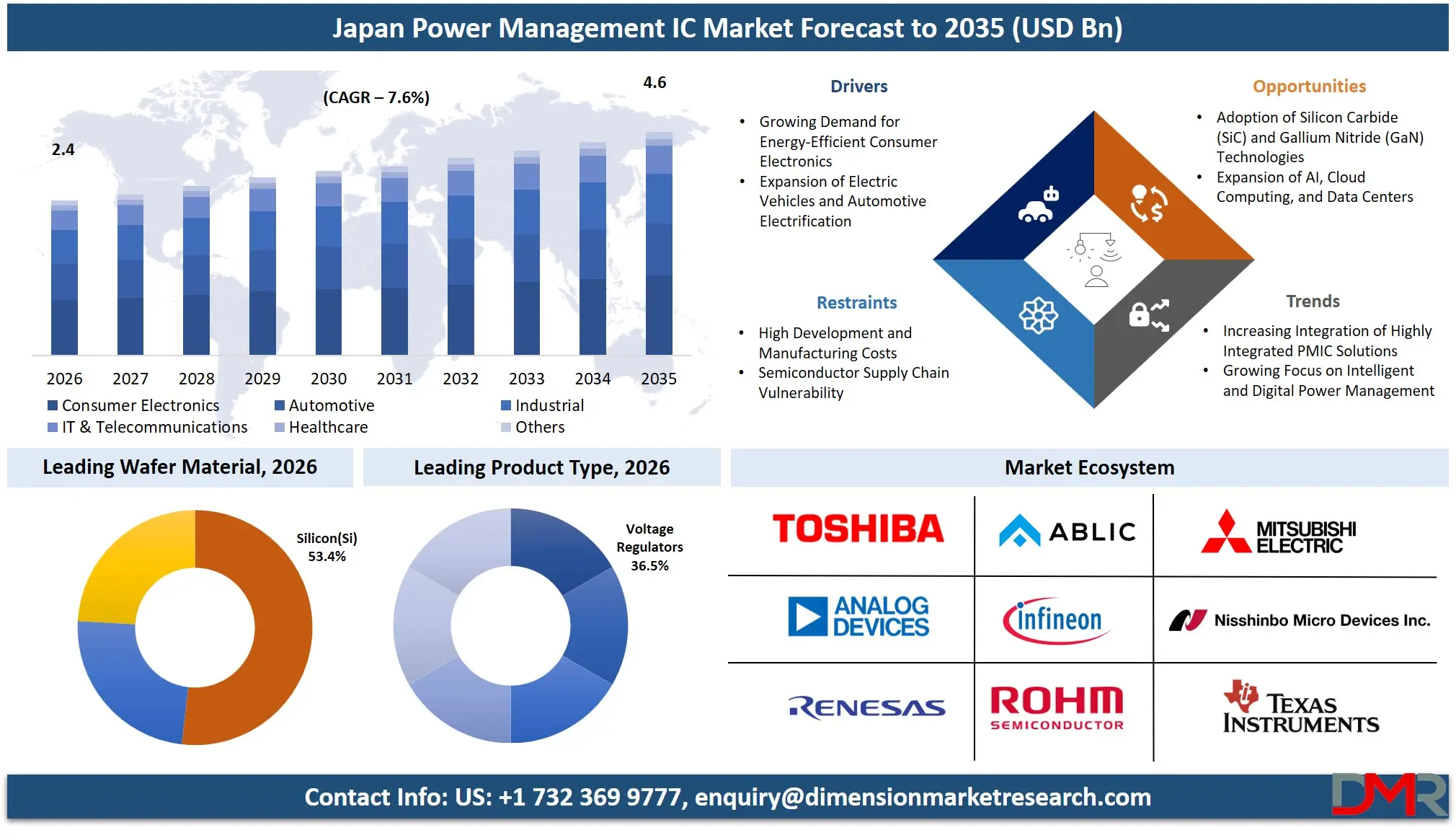
The Japan Power Management IC Market is expected to reach a value of USD 2.4 billion in 2026, and it is further anticipated to reach USD 4.6 billion by 2035, growing at a CAGR of 7.6% during the forecast period.
ℹ
To learn more about this report –
Download Your Free Sample Report Here
The power management IC market in Japan has witnessed impressive growth, driven by the nation's push for energy efficiency and its leadership in automotive and industrial electronics. The power management IC market in Japan consists of voltage regulators, battery management ICs, and integrated PMICs utilizing silicon, silicon carbide, and gallium nitride wafers to manage power requirements across various electronic systems. The rise in demand for power-efficient solutions in electric vehicles and factory automation, as well as the growing complexity of consumer electronics, has necessitated advanced power management IC development. The entities carrying out such semiconductor designs and the end-product manufacturers are the major drivers in this industry. Integrated PMICs and wide-bandgap semiconductor-based solutions continue to be the dominant forms of products due to their efficiency and thermal performance.
Key Takeaways
- Market Size & Forecast: Based on forecasts, the size of the market for Japan's power management ICs will experience growth and will attain a value of USD 2.4 billion by 2026, expanding steadily to USD 4.6 billion by 2035 due to crucial factors such as the rapid electrification of the automotive fleet and a national mandate for carbon neutrality.
- Growth Rate & Outlook: It is predicted that the market will register a CAGR of 7.6%, which will be attributed to the presence of important growth factors, such as a high concentration of semiconductor R&D and an increased need for energy-efficient infrastructure in a technologically advanced society.
- Primary Growth Drivers: Important growth factors will include the proliferation of electric vehicles requiring sophisticated battery and motor control systems, increased government focus on renewable energy and smart grids, and a large number of electronics manufacturers driving innovation in compact, high-efficiency PMICs.
- Key Market Trends: The market trends are mainly related to the adoption of wide-bandgap materials like gallium nitride and silicon carbide for high-frequency and high-temperature applications; integration of intelligent digital control in power management for AI-driven energy optimization, and increased interest in wireless charging and energy harvesting ICs, reflecting Japan's leadership in miniaturization and robotics.
- By Product Type Analysis: The power management IC market in Japan is driven by integrated PMICs, which reduce component count and board space in densely packed devices. Battery management ICs are critical for the safety and longevity of lithium-ion batteries in electric vehicles, while voltage regulators remain a fundamental component across all electronic applications.
- By Wafer Material Analysis: The market is poised to dominated by silicon-based ICs, but the segment for silicon carbide and gallium nitride wafers is projected to grow fastest, driven by their superior efficiency in automotive inverters and power supplies for data centers and telecom infrastructure.
What is the Power Management IC?
A power management IC can be described as a specific type of semiconductor that controls, converts, distributes, and monitors electrical power in an electronic system. Unlike discrete power components, an integrated PMIC provides a compact and efficient solution that manages the power flow from a source to multiple loads. This is done through functions like voltage conversion using switching or linear regulators, battery charging and monitoring, and power sequencing. Considering Japan's focus on high-density electronics and electric vehicles, advanced power management ICs require sophisticated designs that can handle high power levels while maintaining thermal stability and efficiency, often involving wide-bandgap materials like gallium nitride.
Use Cases
- Power Management for Electric Vehicles: An automotive-grade battery management IC monitors cell voltage and temperature to ensure safe operation and maximize range, while motor control ICs precisely drive the traction inverter, a solution widely adopted by automotive manufacturers and their tier-1 suppliers.
- Efficient Power Delivery in Data Centers: A gallium nitride-based integrated PMIC provides high-efficiency AC-DC and DC-DC conversion for server racks, significantly reducing energy loss and cooling requirements, a critical need for IT and telecommunications infrastructure.
- Compact Integration in Wearable Devices: A single-chip integrated PMIC manages battery charging, power path management, and multiple regulated voltage rails for processors, sensors, and displays, enabling the extreme miniaturization required in smartwatches and hearables.
- Intelligent Motor Control in Factory Automation: Motor control ICs integrating real-time diagnostics and efficient drive stages enable precise and energy-saving operation of robotic arms and conveyor systems, essential for Japan's Industry 4.0 push.
How AI is Transforming the Power Management IC Market?
The impact of AI on the Japanese power management IC market centers on optimizing power conversion topologies and enabling predictive system-level energy management. AI-driven design tools are used to explore millions of potential architectures for integrated PMICs, creating novel designs that maximize efficiency for specific load profiles in AI processors. AI-based adaptive control algorithms embedded within power ICs predict load changes and dynamically adjust switching frequencies and gate drive voltages, achieving optimal efficiency in real-time without human intervention.
Furthermore, the role of AI in system implementation is critical. In data centers and smart buildings, AI algorithms aggregate data from thousands of power management IC sensors across servers and HVAC systems to orchestrate energy consumption, shaving peak loads and minimizing carbon footprint. For electric vehicles, AI-enhanced battery management ICs utilize deep learning to improve state-of-charge and state-of-health estimation, leading to more accurate range prediction and proactive safety management.
Market Dynamics
Key Drivers in the Japan Power Management IC Market
Growing Demand for Energy-Efficient Consumer Electronics
The rapid expansion of smartphones, tablets, laptops, wearables, gaming devices, and smart home electronics is the dominant driver of Japan's Power Management IC market. These devices require highly efficient voltage regulation, battery management, and power conversion solutions to maximize battery life while maintaining high performance. Consumers increasingly demand compact products with fast charging and lower energy consumption, encouraging manufacturers to integrate advanced PMICs. Japan's strong consumer electronics manufacturing base, continuous innovation in semiconductor technology, and widespread adoption of AI-enabled portable devices further strengthen demand. This sustained growth ensures consumer electronics remain the primary force driving Power Management IC adoption across Japan.
Expansion of Electric Vehicles and Automotive Electrification
Automotive electrification is another dominant growth driver for Japan's Power Management IC market. Electric vehicles, hybrid vehicles, and advanced driver assistance systems require sophisticated power management solutions for battery management, power distribution, charging systems, infotainment, and safety electronics. Japanese automotive manufacturers continue investing heavily in vehicle electrification and energy-efficient technologies to meet emission reduction targets and improve vehicle performance. Increasing semiconductor content per vehicle, combined with advancements in battery technology and onboard electronics, significantly boosts PMIC demand. Continuous innovation in automotive electronics ensures this sector remains one of the strongest contributors to long-term market expansion.
Restraints in the Japan Power Management IC Market
High Development and Manufacturing Costs
High research, development, and manufacturing costs remain a dominant restraint in Japan's Power Management IC market. Designing advanced PMICs requires continuous investment in semiconductor process technologies, product miniaturization, thermal management, testing, and packaging. Manufacturers must maintain high reliability while improving efficiency and reducing power consumption, increasing engineering complexity. Fabrication facilities require substantial capital expenditure, while advanced process nodes further elevate production costs. Smaller semiconductor companies often face financial challenges in competing with larger global manufacturers. These economic barriers can slow innovation cycles, delay commercialization, and limit the widespread availability of advanced power management integrated circuits.
Semiconductor Supply Chain Vulnerability
Supply chain instability continues to be a significant restraint affecting Japan's Power Management IC industry. Manufacturing depends on stable supplies of semiconductor wafers, specialty materials, packaging components, and fabrication equipment sourced through complex global supply networks. Geopolitical tensions, logistics disruptions, and fluctuations in raw material availability may impact production schedules and increase manufacturing costs. Even with Japan's strong semiconductor ecosystem, dependence on international suppliers exposes manufacturers to external risks. Longer lead times, inventory shortages, and volatile component pricing can affect product delivery, reducing operational flexibility and slowing expansion across automotive, industrial, and consumer electronics applications.
Growth Opportunities in the Japan Power Management IC Market
Adoption of Silicon Carbide (SiC) and Gallium Nitride (GaN) Technologies
The growing commercialization of Silicon Carbide and Gallium Nitride technologies presents the most significant growth opportunity for Japan's Power Management IC market. These wide-bandgap semiconductor materials provide superior efficiency, higher switching frequencies, reduced heat generation, and improved power density compared with conventional silicon devices. Their increasing adoption across electric vehicles, renewable energy systems, industrial automation, and high-speed charging infrastructure creates substantial demand for advanced PMIC solutions. Japan's leadership in semiconductor materials, power electronics, and automotive manufacturing positions domestic companies to capitalize on this technological transition and strengthen global competitiveness in next-generation power management applications.
Expansion of AI, Cloud Computing, and Data Centers
Rapid growth in artificial intelligence, cloud computing, and hyperscale data centers creates substantial opportunities for Power Management IC manufacturers in Japan. AI processors, networking equipment, storage systems, and high-performance servers require highly efficient voltage regulation and power conversion technologies to optimize performance while minimizing energy consumption. Increasing investments in digital infrastructure and edge computing continue driving demand for advanced PMIC solutions capable of supporting higher computing loads. Japan's digital transformation initiatives and growing adoption of AI across industries further expand market potential. This trend is expected to generate sustained long-term demand for innovative power management technologies.
Trends in the Japan Power Management IC Market
Increasing Integration of Highly Integrated PMIC Solutions
A dominant trend in Japan's Power Management IC market is the integration of multiple power management functions into highly compact integrated circuits. Modern PMICs increasingly combine voltage regulation, battery charging, power sequencing, thermal protection, and monitoring capabilities within a single chip. This integration reduces component count, minimizes circuit board size, improves energy efficiency, and lowers manufacturing costs. Consumer electronics, automotive systems, industrial equipment, and communication devices increasingly require compact, multifunctional power solutions. Continuous advances in semiconductor packaging and chip integration technologies are accelerating adoption of highly integrated PMICs throughout Japan's electronics ecosystem.
Growing Focus on Intelligent and Digital Power Management
Manufacturers are increasingly developing intelligent Power Management ICs equipped with digital control, real-time monitoring, adaptive voltage regulation, and predictive thermal management capabilities. These smart PMICs optimize power consumption dynamically while improving system reliability and operational efficiency. Integration with artificial intelligence, Internet of Things platforms, and industrial automation systems enables advanced energy management across consumer electronics, automotive, telecommunications, and industrial applications. Japan's emphasis on energy conservation, digital manufacturing, and smart infrastructure continues accelerating adoption of intelligent power management technologies. This transition toward digitally controlled PMICs is becoming one of the defining trends shaping future market development.
Research Scope and Analysis
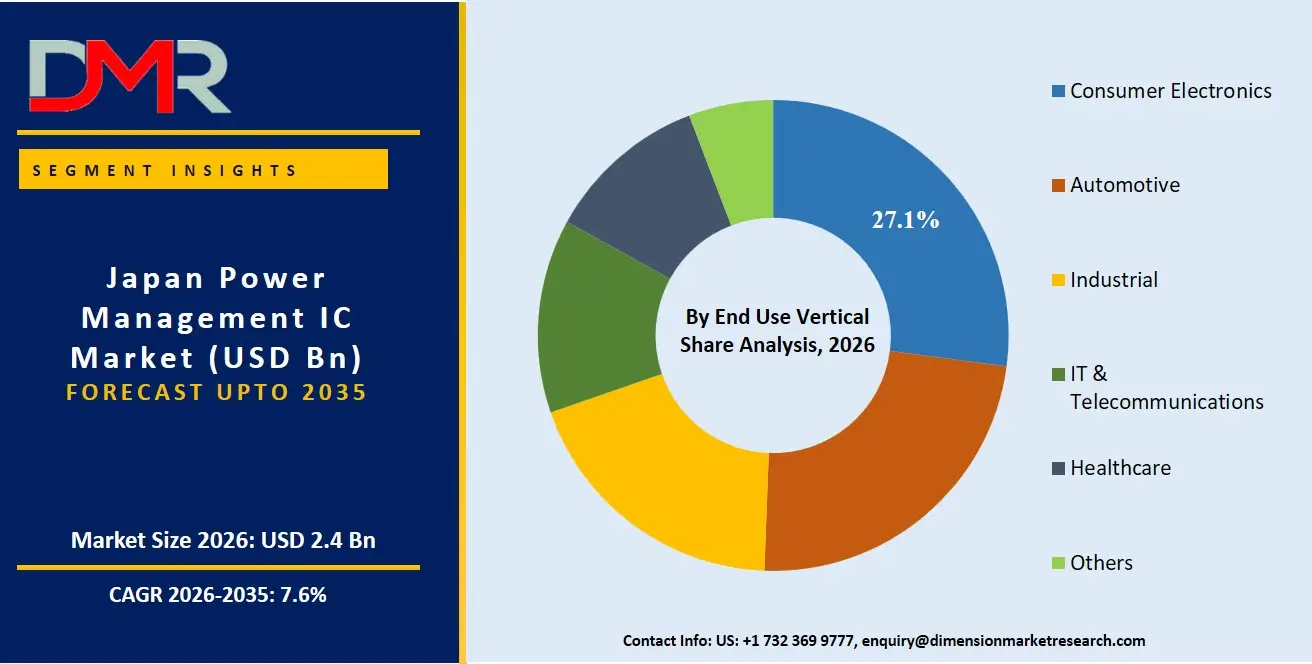
The Japan Power Management IC Market is segmented by Product Type (Voltage Regulators, Battery Management ICs, Integrated PMICs, Motor Control ICs, Energy Management ICs, Others), Wafer Material (Silicon, Silicon Carbide, Gallium Nitride), and End Use Vertical (Consumer Electronics, Automotive, Industrial, IT & Telecommunications, Healthcare, and Others), addressing diverse power efficiency and energy management requirements across industries.
ℹ
To learn more about this report –
Download Your Free Sample Report Here
By Product Type Analysis
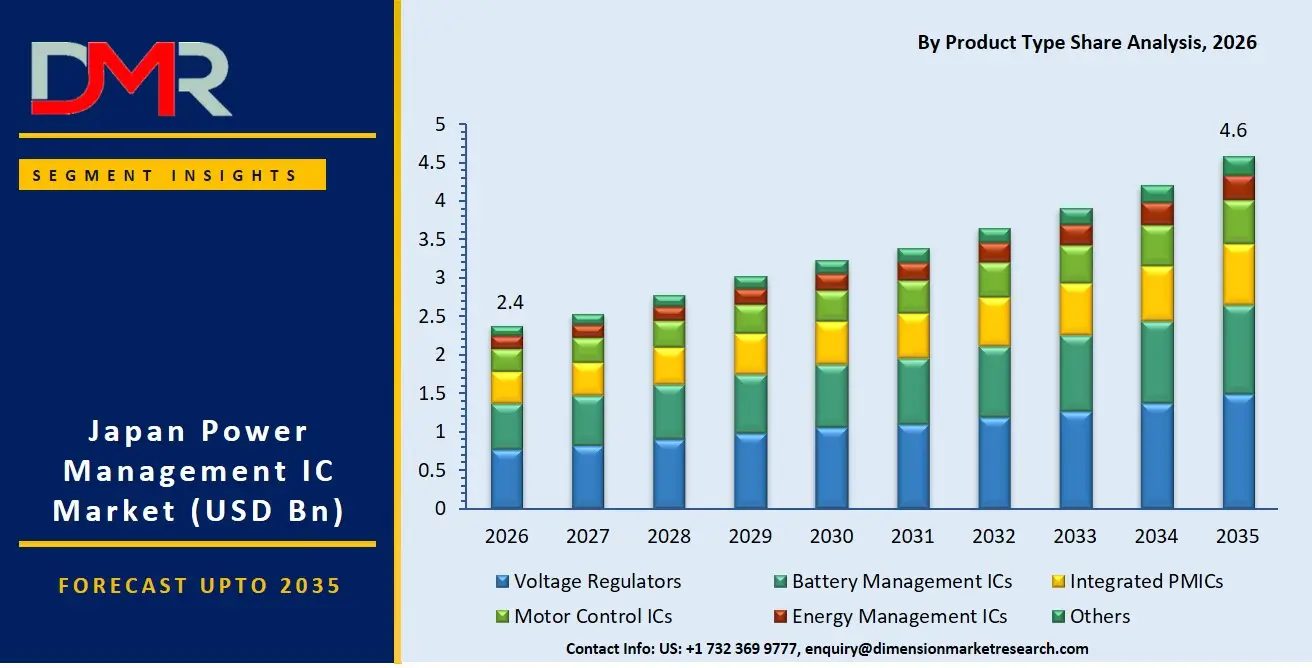
Voltage Regulators is projected to dominate the Japan Power Management IC market because they are fundamental components in nearly every electronic device, ensuring stable voltage supply and protecting sensitive circuits from fluctuations. Their widespread use across consumer electronics, automotive systems, industrial automation, telecommunications equipment, and healthcare devices creates consistently high demand.
ℹ
To learn more about this report –
Download Your Free Sample Report Here
Switching regulators, in particular, are increasingly adopted due to their superior energy efficiency and compact design. Japan's leadership in semiconductor manufacturing, automotive electronics, and advanced consumer devices further strengthens this segment. Continuous innovation toward lower power consumption, miniaturization, and higher efficiency ensures Voltage Regulators remain the largest product category in Japan's Power Management IC market.
By Wafer Material Analysis
Silicon is poised to dominate the Japan Power Management IC market because it offers an optimal balance of performance, manufacturing maturity, reliability, and cost-effectiveness. Most power management integrated circuits for smartphones, consumer electronics, automotive systems, and industrial equipment continue to be fabricated using silicon-based semiconductor technology. Japan possesses a well-established silicon semiconductor ecosystem supported by advanced fabrication facilities and extensive supply chains. Although Silicon Carbide and Gallium Nitride are expanding in high-power applications, silicon remains the preferred material for high-volume PMIC production due to its scalability, proven manufacturing processes, and broad compatibility with existing electronic designs, ensuring continued market leadership.
By End Use Vertical Analysis
Consumer Electronics is projected to dominate the Japan Power Management IC market due to the country's strong demand for smartphones, laptops, televisions, gaming devices, wearables, and other portable electronic products. Power management ICs are essential for optimizing battery life, improving energy efficiency, managing charging functions, and supporting compact device designs. Continuous product innovation, rapid technology upgrades, and increasing consumer preference for energy-efficient electronics drive sustained demand. Japan's globally recognized electronics manufacturers and advanced semiconductor ecosystem further support widespread PMIC adoption. The expanding integration of artificial intelligence, high-performance processors, and fast-charging technologies reinforces Consumer Electronics as the leading end-use segment in the Japanese market.
The Japan Power Management IC Market Report is segmented on the basis of the following:
By Product Type
- Voltage Regulators
- Linear Regulators
- Switching Regulators
- Battery Management ICs
- Integrated PMICs
- Motor Control ICs
- Energy Management ICs
- Others
By Wafer Material
- Silicon (Si)
- Silicon Carbide (SiC)
- Gallium Nitride (GaN)
By End Use Vertical
- Consumer Electronics
- Smartphones and Tablets
- Laptops
- Televisions
- Wearables
- Others
- Automotive
- Engine Management
- Infotainment Systems
- Others
- Industrial
- Factory Automation
- Energy Management Systems
- Others
- IT & Telecommunications
- Servers
- Data Centers
- Networking Equipment
- Others
- Healthcare
- Others
Competitive Landscape
The nature of competition in the Japan power management IC market has become very dynamic, given the diverse range of multinational integrated device manufacturers operating in the space, as well as Japanese semiconductor giants and agile domestic fabless firms focusing on niche, high-performance applications. Strategic alliances with major automotive tier-1 suppliers and electronics OEMs would be crucial for the company, as they help secure long-term design-in contracts and get early validation of their innovative wide-bandgap process technologies. The trend of consolidation is growing at a rapid pace, as global analog chip leaders seek acquisitions to strengthen their battery management IC or gallium nitride portfolios for the automotive megatrend. IP differentiators such as proprietary gate driver architectures, advanced packaging know-how, and system-level energy optimization algorithms are playing an increasingly significant role compared to a traditional standalone component performance.
Some of the prominent players in the Japan Power Management IC Market are:
- Renesas Electronics Corporation
- ROHM Co., Ltd.
- Toshiba Electronic Devices & Storage Corporation
- Mitsubishi Electric Corporation
- Nisshinbo Micro Devices Inc.
- ABLIC Inc.
- Analog Devices, Inc.
- Texas Instruments Incorporated
- Infineon Technologies AG
- STMicroelectronics N.V.
- onsemi
- NXP Semiconductors N.V.
- Microchip Technology Incorporated
- MaxLinear, Inc.
- Monolithic Power Systems, Inc.
- Diodes Incorporated
- MediaTek Inc.
- Qualcomm Incorporated
- Silergy Corp.
- Vicor Corporation
- Other Key Players
Recent Developments
- July 2025: Renesas Electronics Corporation introduced its 650V Gen IV Plus GaN FET portfolio, targeting AI data centers, industrial power systems, renewable energy, battery storage systems, and EV charging infrastructure with higher power efficiency.
- February 2026: ROHM Co., Ltd. expanded its strategic partnership with TSMC to establish an integrated gallium nitride (GaN) power device manufacturing and production framework, strengthening supply capabilities for AI servers and electric vehicle applications.
- March 2026: ROHM Co., Ltd., Toshiba Corporation, and Mitsubishi Electric Corporation announced discussions to integrate their power semiconductor businesses to enhance Japan's competitiveness in advanced power semiconductor technologies.
Report Details
| Report Characteristics |
| Market Size (2026) |
USD 2.4 Bn |
| Forecast Value (2035) |
USD 4.6 Bn |
| CAGR (2026–2035) |
7.6% |
| Historical Data |
2021 – 2025 |
| Forecast Data |
2027 – 2035 |
| Base Year |
2025 |
| Estimate Year |
2026 |
| Segments Covered |
By Product Type, By Wafer Material, and By End Use Vertical |
| Country Coverage |
Japan |
Frequently Asked Questions
How big is the Japan Power Management IC Market?
▾ The Japan Power Management IC market is poised to be valued at USD 2.4 billion in 2026 and is projected to reach USD 4.6 billion by 2035, driven by the universal need for higher energy efficiency and the electrification of society, from transportation to smart infrastructure.
What is the CAGR of the Japan Power Management IC Market from 2026 to 2035?
▾ The market is expected to grow at a CAGR of 7.6% from 2026 to 2035, reflecting the accelerating demand for advanced power solutions in automotive and industrial sectors, underpinned by Japan's strong manufacturing base.
What factors are driving the growth of the Japan Power Management IC Market?
▾ Key drivers include the rapid proliferation of electric and hybrid vehicles, Japan’s stringent national top-runner energy efficiency programs, and the complex power delivery requirements of advanced AI, 5G, and data center infrastructure.
What are the major trends in the Japan Power Management IC Market?
▾ Major trends include the transition from silicon to wide-bandgap materials like gallium nitride and silicon carbide for high-efficiency power conversion, the rise of digitally-controlled PMICs with AI-driven adaptive power management, and advanced system-in-package integration for extreme miniaturization.
Who are the key players in the Japan Power Management IC Market?
▾ Key players in the Japan Power Management IC Market include Renesas Electronics, ROHM Semiconductor, Toshiba, Mitsubishi Electric, Texas Instruments, and Infineon Technologies, driving innovation through R&D, new material development, and close co-engineering partnerships with automotive and industrial customers.
How is the Japan Power Management IC Market segmented?
▾ The market is segmented by Product Type, Wafer Material, and End Use Vertical.