Market Overview
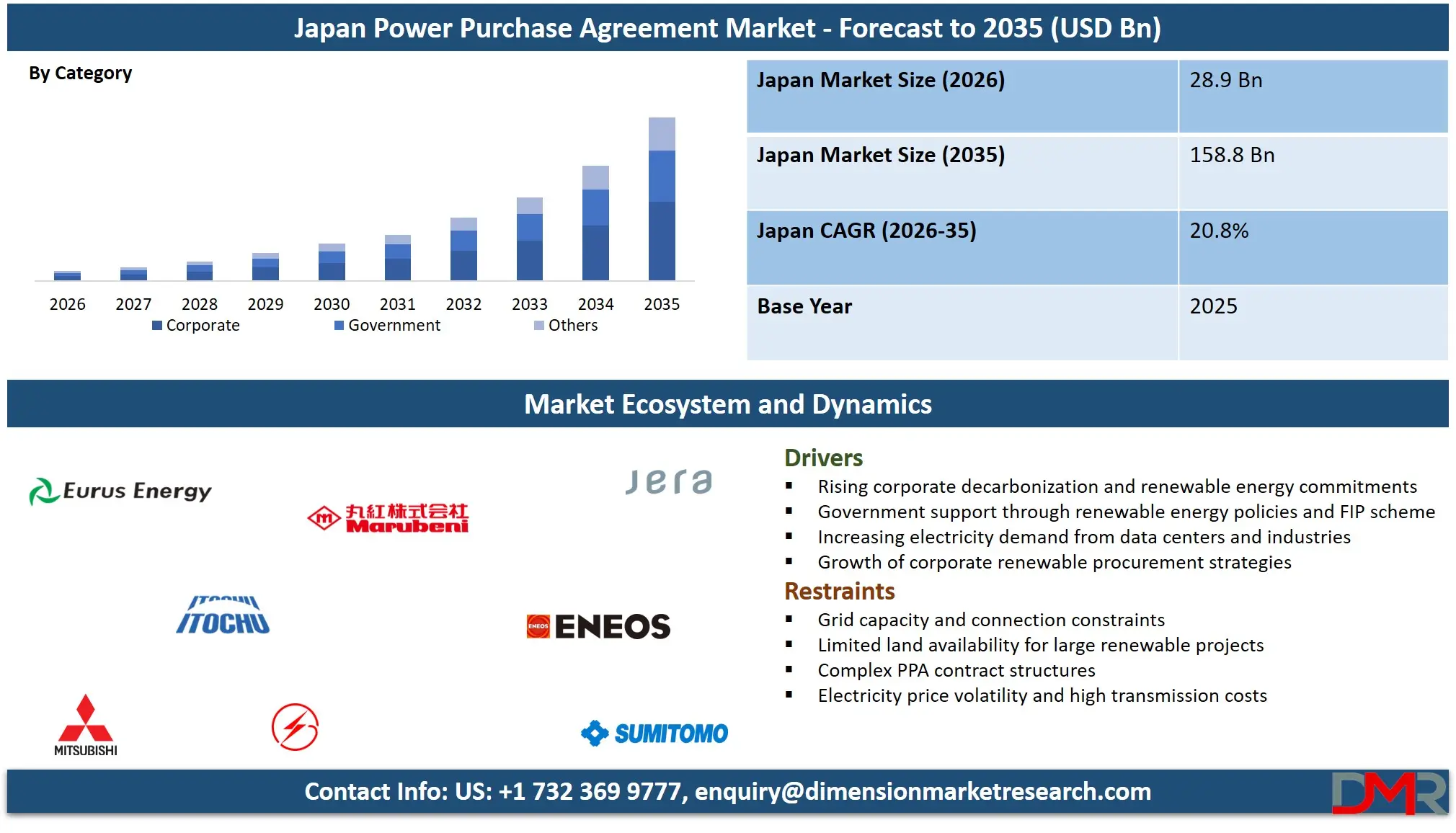
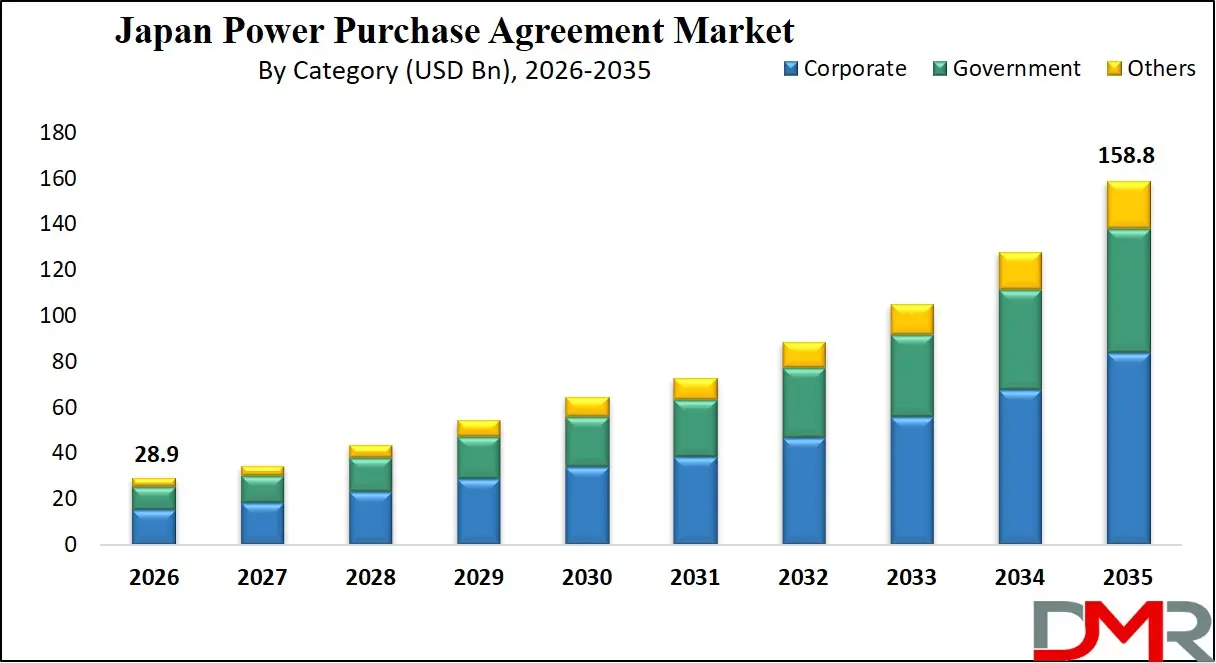
The Japan Power Purchase Agreement Market size is projected to reach USD 28.9 billion in 2026 and grow at a compound annual growth rate of 20.8% to reach a value of USD 158.8 billion in 2035.
ℹ
To learn more about this report –
Download Your Free Sample Report Here
A Power Purchase Agreement (PPA) refers to a long-term contractual arrangement in which an electricity buyer agrees to purchase power directly from a power producer at predetermined pricing and terms. These agreements are typically signed between renewable energy developers and corporate or institutional buyers seeking stable electricity supply and predictable energy costs. PPAs may involve different structures such as physical delivery, virtual settlement, or portfolio arrangements, depending on grid access, regulatory policies, and project configuration. They commonly support renewable energy sources including solar, wind, hydropower, and geothermal projects, helping ensure revenue certainty for developers while allowing buyers to meet long-term energy procurement strategies.
Japan’s evolving electricity market has encouraged broader adoption of such contractual frameworks as businesses increasingly prioritize energy security and sustainability commitments. Liberalization of the power sector and the expansion of renewable capacity have supported greater participation from corporate buyers, utilities, and government agencies. Enterprises are increasingly turning toward off-site renewable procurement models and virtual settlement structures to diversify energy sourcing. As Japan accelerates its transition toward low-carbon energy systems, these agreements are becoming an essential mechanism to facilitate renewable investment and long-term electricity supply planning.
ℹ
To learn more about this report –
Download Your Free Sample Report Here
In recent years, corporate renewable procurement initiatives, policy reforms, and decarbonization targets have strengthened the role of structured power purchasing contracts in Japan’s energy ecosystem. Large corporations are committing to renewable energy sourcing goals, prompting increased demand for flexible procurement models such as off-site and virtual contracts. Meanwhile, utilities and developers are forming strategic partnerships to expand renewable project pipelines. Regulatory adjustments related to grid access, energy trading frameworks, and carbon reduction commitments are also influencing the adoption of innovative contractual structures across Japan’s evolving electricity landscape.
Japan Power Purchase Agreement Market: Key Takeaways
- Market Growth: The Japan Power Purchase Agreement Market size is expected to grow by USD 124.5 billion, at a CAGR of 20.8%, during the forecasted period of 2027 to 2035.
- By Category: The corporate segment is anticipated to get the majority share of the Japan Power Purchase Agreement market in 2026.
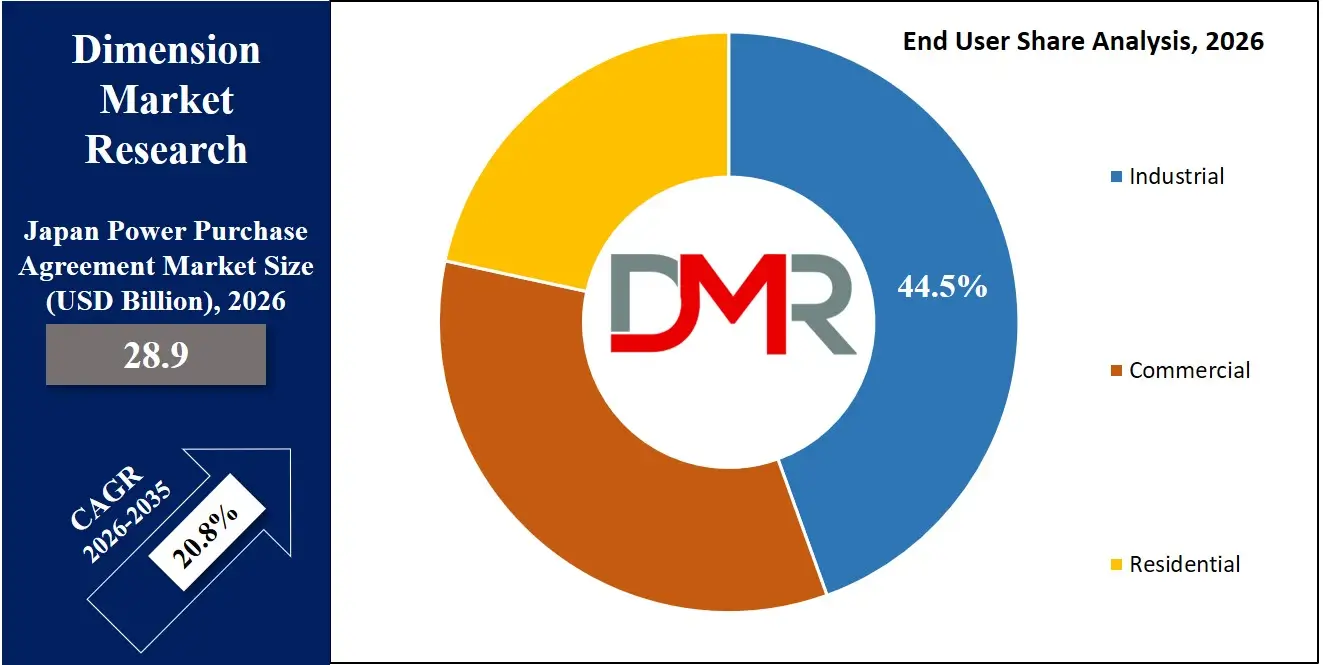
- By End User: The industrial segment is expected to get the largest revenue share in 2026 in the Japan Power Purchase Agreement market.
- Use Cases: Some of the use cases of power purchase agreement include industrial energy cost management, corporate renewable procurement, and more.
Japan Power Purchase Agreement Market: Use Cases
- Corporate Renewable Procurement: Large corporations in Japan utilize PPAs to secure renewable electricity for long-term sustainability goals. These agreements help companies stabilize electricity prices while reducing carbon footprints and aligning with global climate commitments such as RE100 initiatives.
- Renewable Project Financing: Energy developers rely on long-term PPAs to secure predictable revenue streams that support project financing. Financial institutions view these agreements as risk-mitigation mechanisms, enabling investment in large-scale renewable projects such as solar and wind farms.
- Industrial Energy Cost Management: Manufacturing industries use PPAs to hedge against electricity price volatility. Fixed pricing arrangements allow companies to forecast operational costs more accurately and improve long-term financial planning.
- Government Renewable Procurement: Public institutions adopt PPAs to procure clean energy for public infrastructure such as transportation systems, municipal buildings, and public utilities while supporting national decarbonization goals.
- Off-site Renewable Energy Supply: Organizations unable to install renewable infrastructure onsite utilize off-site PPAs to source electricity from remote renewable energy facilities connected through the grid.
- Carbon Reduction Programs: PPAs help corporations meet environmental targets by directly linking electricity consumption with renewable generation, supporting carbon neutrality strategies.
- Grid Stabilization and Energy Diversification: Long-term power purchasing contracts contribute to balanced electricity supply by encouraging diversified renewable generation across multiple regions and technologies.
Stats & Facts
- International Energy Agency (IEA) reported that Japan generated approximately 1,083 TWh of electricity in 2024, with renewable sources contributing more than 26% of total power generation.
- Japan Ministry of Economy, Trade and Industry (METI) stated that renewable energy accounted for over 22% of Japan’s total energy mix in 2024, reflecting continuous growth in solar and wind capacity.
- International Renewable Energy Agency (IRENA) recorded that Japan’s total installed renewable energy capacity surpassed 147 GW in 2024.
- Japan Agency for Natural Resources and Energy reported that solar power represented around 10% of Japan’s electricity generation in 2024, making it one of the country’s largest renewable sources.
- International Energy Agency (IEA) noted that Japan’s electricity demand reached around 985 TWh in 2024, driven by industrial and commercial consumption.
- Japan Ministry of Economy, Trade and Industry (METI) indicated that the country plans to increase renewable energy’s share to 36–38% of total electricity generation by 2030.
- International Renewable Energy Agency (IRENA) estimated Japan’s installed solar capacity exceeded 87 GW in 2024, placing it among the world’s leading solar markets.
- Japan Wind Power Association (JWPA) reported that Japan’s cumulative wind power capacity reached over 5.8 GW in 2024.
- Japan Ministry of Environment stated that the country aims to reduce greenhouse gas emissions by 46% by 2030 compared with 2013 levels.
- International Energy Agency (IEA) reported that Japan imported nearly 87% of its primary energy supply in 2024, highlighting the importance of domestic renewable generation.
- World Bank noted that Japan’s electricity access rate remained 100% in 2024, ensuring full nationwide coverage.
- Japan Ministry of Economy, Trade and Industry (METI) recorded that corporate renewable procurement initiatives in Japan expanded significantly with more than 1,000 companies participating in renewable electricity programs by 2025.
Market Dynamic
Driving Factors in the Japan Power Purchase Agreement Market
Expansion of Corporate Renewable Energy Procurement
Corporate demand for renewable electricity is one of the strongest drivers of the Japan Power Purchase Agreement market. Large Japanese corporations are increasingly committing to sustainability initiatives and carbon neutrality goals, prompting them to secure long-term renewable electricity through structured agreements with energy producers. These contracts enable companies to stabilize energy prices while supporting environmental commitments and global initiatives such as renewable electricity sourcing programs. Many multinational corporations operating in Japan are also adopting global sustainability standards, which further accelerates demand for renewable procurement contracts. As electricity market liberalization continues and renewable capacity expands, corporate buyers are expected to play an increasingly central role in shaping long-term energy purchasing strategies across the country.
Policy Support and Energy Market Liberalization
Government policy reforms and electricity market liberalization have significantly strengthened the adoption of power purchase agreements in Japan. Over the past decade, Japan has gradually opened its electricity market to encourage competition and diversify energy supply sources. Regulatory frameworks supporting renewable energy development, grid connectivity, and energy trading have enabled developers and corporate buyers to enter long-term electricity contracts. Additionally, national decarbonization goals and renewable energy expansion plans have increased incentives for renewable power generation. These policies help reduce market uncertainties for investors while encouraging utilities and independent producers to develop renewable projects backed by stable contractual frameworks.
Restraints in the Japan Power Purchase Agreement Market
Grid Constraints and Infrastructure Limitations
Despite growing demand for renewable procurement, grid infrastructure limitations remain a challenge in the Japan Power Purchase Agreement market. Renewable energy projects often require transmission capacity and grid upgrades to deliver electricity efficiently to end users. In certain regions of Japan, grid congestion and limited transmission capacity can restrict the integration of new renewable projects into the power system. These constraints may delay project development timelines or increase infrastructure costs for developers. Furthermore, geographic disparities in renewable resource availability and electricity demand can complicate energy distribution, requiring additional investments in grid modernization and energy storage systems.
Complex Contractual and Regulatory Structures
Another key challenge affecting the market is the complexity of contractual frameworks and regulatory requirements associated with power purchase agreements. Negotiating long-term electricity contracts involves multiple stakeholders including developers, utilities, corporate buyers, and regulatory authorities. Differences in pricing mechanisms, settlement models, and risk allocation can make agreements complex to structure and implement. Additionally, evolving energy policies and regulatory adjustments may create uncertainty for long-term contracts. Smaller organizations may lack the expertise or financial capacity to participate in sophisticated procurement structures, which can slow the broader adoption of renewable purchasing agreements in Japan’s energy market.
Opportunities in the Japan Power Purchase Agreement Market
Expansion of Offshore Wind and Large-Scale Renewable Projects
Japan’s increasing investment in offshore wind and large-scale renewable projects presents a significant opportunity for the power purchase agreement market. Offshore wind projects require long-term electricity purchasing commitments to secure financing and ensure revenue stability. As Japan accelerates its renewable energy transition, developers are actively exploring long-term procurement contracts with utilities, corporations, and government agencies. Offshore wind farms, in particular, offer high generation capacity and stable output compared with some other renewable technologies. These projects are expected to stimulate new contractual frameworks and long-term partnerships between energy producers and electricity buyers.
Growth of Corporate Sustainability Commitments
Another major opportunity lies in the rapid expansion of corporate sustainability commitments across Japan’s business landscape. Companies across manufacturing, technology, retail, and financial services sectors are adopting environmental, social, and governance (ESG) strategies that prioritize renewable electricity procurement. Power purchase agreements provide an efficient pathway for organizations to meet renewable energy targets while maintaining predictable energy costs. As corporate sustainability reporting and carbon reduction standards become more stringent globally, businesses operating in Japan are likely to expand their use of renewable procurement contracts to strengthen environmental credentials and align with international climate initiatives.
Trends in the Japan Power Purchase Agreement Market
Increasing Adoption of Virtual and Off-site Agreements
Virtual and off-site power purchase agreements are becoming increasingly popular across Japan’s electricity market. These contractual models allow organizations to procure renewable electricity without requiring direct physical delivery from a renewable project to their facilities. Instead, electricity is supplied through the grid while financial settlements ensure that renewable generation is matched with consumption. This approach enables companies located in urban areas with limited space for renewable installations to participate in large-scale renewable procurement. The flexibility offered by virtual and off-site agreements has significantly expanded participation from corporate buyers across multiple industries.
Integration of Digital Energy Management Systems
Digitalization is transforming the management and optimization of long-term electricity procurement contracts. Advanced energy management systems and digital monitoring tools allow organizations to track renewable generation, electricity consumption, and carbon reduction performance in real time. These digital solutions improve transparency, enhance contract management, and support more accurate forecasting of energy demand. Energy analytics platforms are also helping organizations evaluate procurement strategies and optimize renewable energy sourcing across multiple facilities. As digital technologies continue to evolve, they are expected to play an increasingly important role in supporting efficient energy procurement frameworks within Japan’s electricity market.
Impact of Artificial Intelligence in Japan Power Purchase Agreement Market
- Predictive Energy Demand Forecasting: AI-driven analytics help organizations forecast electricity demand with greater accuracy, enabling better structuring of long-term power purchasing contracts and reducing energy procurement risks.
- Renewable Generation Optimization: Machine learning algorithms analyze weather patterns and generation data to optimize renewable energy output, improving the reliability of electricity supplied under contractual agreements.
- Contract Risk Assessment: AI tools assist companies in evaluating pricing structures, financial risks, and contract terms, helping stakeholders design more efficient power purchase agreements.
- Grid Load Management: AI-enabled grid management systems monitor electricity flows and predict demand fluctuations, helping integrate renewable energy projects associated with long-term purchasing contracts.
- Energy Trading Automation: Artificial intelligence supports automated electricity trading platforms that allow buyers and sellers to manage contract settlements and energy transactions more efficiently.
- Carbon Tracking and Reporting: AI systems track renewable electricity consumption and carbon emissions reductions, enabling organizations to meet sustainability reporting standards.
- Asset Performance Monitoring: Energy developers use AI to monitor renewable energy infrastructure performance, ensuring stable electricity supply under long-term contracts.
- Price Forecasting Models: AI-based predictive models analyze electricity market trends and fuel price fluctuations to forecast future energy costs and optimize procurement strategies.
- Renewable Portfolio Optimization: Advanced algorithms help companies manage multiple renewable procurement contracts across various locations, maximizing energy efficiency and cost savings.
Research Scope and Analysis
By Type Analysis
Physical Delivery PPAs represent the leading segment within the Japan Power Purchase Agreement market due to their direct electricity supply structure and regulatory compatibility with Japan’s power grid system. In this model, renewable electricity generated from a specific facility is physically delivered to the buyer through the transmission network. The structure provides greater transparency regarding renewable energy sourcing and supports corporate sustainability reporting. Large manufacturing and industrial companies frequently adopt physical delivery contracts because they ensure stable electricity supply while supporting long-term cost predictability. Additionally, utilities and independent power producers prefer this model as it provides stable revenue streams and clear generation-to-consumption relationships. Ongoing expansion of solar and wind farms in Japan further supports adoption of this contract structure. As renewable infrastructure grows across multiple regions, physical delivery agreements are expected to remain dominant, accounting for approximately 41.7% of the market share in 2026.
Virtual PPAs are emerging as the fastest-growing segment due to their flexibility and ability to serve companies located far from renewable generation facilities. These agreements involve financial settlements rather than direct electricity delivery, allowing organizations to procure renewable energy while continuing to receive electricity from local utilities. Corporate buyers increasingly prefer virtual arrangements because they eliminate geographic constraints and enable participation in large-scale renewable projects across Japan. Multinational corporations and technology firms are particularly adopting this model as part of global renewable energy procurement strategies. As Japan’s energy trading mechanisms evolve and regulatory frameworks continue to mature, virtual PPAs are expected to witness strong growth in the coming years.
By Location Analysis
Off-site installations dominate the Japan Power Purchase Agreement market due to the scalability and higher energy generation potential of large renewable projects located outside corporate premises. Off-site facilities typically include large solar parks, wind farms, and hydroelectric stations connected to the national grid. These projects enable energy developers to generate electricity at a much larger scale compared with on-site systems installed at corporate facilities. Off-site agreements also allow companies located in urban areas with limited space to access renewable energy from remote locations. Growing investments in solar farms and offshore wind facilities across Japan further strengthen the role of off-site agreements in the renewable procurement ecosystem. Due to these advantages, the off-site segment is projected to account for around 63.4% of the market share in 2026.
On-site PPAs are gaining traction as organizations seek to generate renewable energy directly at their facilities. In this model, developers install renewable energy systems such as rooftop solar panels or small wind turbines on a customer’s property while maintaining ownership and operational responsibility. The electricity generated is then consumed directly by the host facility. On-site agreements are particularly attractive for commercial buildings, industrial plants, and warehouses with large rooftop spaces. Companies benefit from reduced electricity costs and enhanced energy independence while avoiding upfront capital investments. With increasing adoption of distributed renewable energy systems and energy efficiency initiatives, on-site PPAs are expected to grow steadily.
By Category Analysis
Corporate buyers represent the largest category in the Japan Power Purchase Agreement market as businesses increasingly prioritize renewable energy procurement. Companies across industries such as manufacturing, technology, and retail are adopting long-term power purchasing contracts to achieve sustainability targets and manage electricity costs. Corporate participation is also driven by global environmental commitments and investor pressure to reduce carbon emissions. Large multinational firms operating in Japan are particularly active in signing renewable procurement agreements with developers. Corporate demand is expected to remain strong due to rising ESG adoption and energy price volatility, leading the segment to hold approximately 52.8% market share in 2026.
Government organizations are emerging as a rapidly expanding category within the market. Public institutions and municipal authorities are increasingly adopting renewable electricity procurement strategies to support national climate targets. Government infrastructure such as transportation networks, public buildings, and administrative facilities require significant electricity consumption, making long-term renewable energy procurement beneficial for cost management and environmental objectives. Public sector participation also plays a crucial role in accelerating renewable energy adoption by creating stable demand for electricity from renewable projects. As national decarbonization policies strengthen, government procurement through structured agreements is expected to grow further.
By Deal Type Analysis
Wholesale agreements dominate the Japan Power Purchase Agreement market due to their large transaction volumes and participation from major utilities and corporate buyers. In wholesale arrangements, electricity generated by renewable projects is sold in bulk quantities, typically through energy traders or electricity retailers before reaching end consumers. This model supports large-scale renewable projects that require substantial off-take agreements to secure financing. Wholesale contracts also allow corporations to procure renewable electricity at competitive prices while benefiting from economies of scale. Ongoing expansion of renewable energy capacity in Japan further reinforces the importance of wholesale procurement frameworks. As a result, the wholesale segment is expected to account for about 46.2% of the market share in 2026.
Retail agreements are witnessing rapid growth as smaller businesses and commercial consumers begin participating in renewable energy procurement programs. Retail electricity providers increasingly offer renewable energy packages backed by long-term power purchase agreements with renewable energy developers. These contracts allow end-users to access clean electricity without directly negotiating agreements with power producers. As awareness of renewable energy procurement increases and electricity markets continue to evolve, retail arrangements are expected to expand significantly, particularly among medium-sized enterprises and commercial establishments.
By Capacity Analysis
Large-scale projects with capacity above 100 MW represent the dominant segment within the Japan Power Purchase Agreement market. These projects include utility-scale solar farms, offshore wind installations, and major hydropower facilities capable of generating substantial electricity output. Such projects require long-term purchasing agreements to ensure stable revenue streams and attract financing from institutional investors. Large corporations and utilities typically sign contracts with these projects to secure consistent renewable electricity supply for multiple facilities. Due to the scale and efficiency of large renewable installations, this segment is expected to maintain leadership, accounting for approximately 38.6% of the market share in 2026.
Projects with capacity ranging between 50 and 100 MW are growing rapidly as developers explore mid-scale renewable projects that balance investment requirements with generation potential. These installations are particularly suitable for regional electricity supply and corporate procurement programs. Medium-scale renewable projects can be deployed faster than very large installations while still delivering significant electricity output. Increasing participation from regional businesses and local governments is expected to drive growth in this segment over the coming years.
By Application Analysis
Solar power represents the largest application segment in the Japan Power Purchase Agreement market due to Japan’s extensive solar infrastructure and supportive policy environment. Large-scale solar parks and distributed rooftop installations have expanded rapidly across the country over the past decade. Solar projects offer relatively short construction timelines and predictable electricity generation patterns, making them highly attractive for long-term power purchasing contracts. Corporate buyers also prefer solar-based agreements because they align well with daytime electricity demand patterns in commercial facilities. Continued expansion of solar installations across Japan is expected to sustain its leadership, with the segment projected to account for around 48.9% of the market share in 2026.
Wind energy is emerging as one of the fastest-growing applications in Japan’s renewable procurement landscape. The country is increasingly investing in both onshore and offshore wind projects to diversify its renewable energy mix. Offshore wind farms, in particular, offer higher generation capacity and stable wind conditions compared with many onshore locations. As these projects require long-term electricity purchasing commitments to secure financing, they are expected to drive increased adoption of power purchase agreements. Growing government support for offshore wind development is also accelerating growth in this segment.
By End User Analysis
Industrial consumers represent the largest end-user segment within the Japan Power Purchase Agreement market due to their high electricity consumption and strong focus on cost management. Manufacturing industries such as automotive, electronics, chemicals, and heavy machinery require stable electricity supply to maintain production operations. Long-term renewable electricity procurement contracts help these industries hedge against energy price volatility while supporting sustainability initiatives. Many large industrial companies in Japan have committed to carbon neutrality targets, further driving demand for renewable energy procurement agreements. Due to these factors, the industrial segment is projected to account for approximately 44.5% of the market share in 2026.
ℹ
To learn more about this report –
Download Your Free Sample Report Here
Commercial establishments are increasingly adopting renewable electricity procurement strategies to enhance sustainability performance and reduce operational costs. Offices, retail centers, data centers, and hospitality facilities require significant electricity for daily operations. Long-term renewable energy procurement agreements allow these organizations to secure stable electricity pricing while reducing environmental impact. Growing awareness of environmental responsibility among businesses and consumers is encouraging commercial organizations to adopt renewable electricity sourcing strategies, supporting the expansion of this segment.
The Japan Power Purchase Agreement Market Report is segmented on the basis of the following:
By Type
- Physical Delivery PPA
- Virtual PPA
- Portfolio PPA
- Block Delivery PPA
- Others
By Location
By Category
- Corporate
- Government
- Others
By Deal Type
By Capacity
- Up to 20 MW
- 20–50 MW
- 50–100 MW
- Above 100 MW
By Application
- Solar
- Wind
- Geothermal
- Hydropower
- Carbon Capture and Storage
- Others
By End-User
- Commercial
- Residential
- Industrial
Competitive Landscape
The Japan Power Purchase Agreement market is characterized by evolving competition driven by renewable energy expansion and electricity market liberalization. Market participants focus on developing diversified renewable portfolios, forming strategic partnerships, and expanding project pipelines to secure long-term electricity supply contracts.
ℹ
To learn more about this report –
Download Your Free Sample Report Here
Companies are investing heavily in renewable infrastructure development and digital energy management technologies to strengthen operational efficiency and contract transparency. Long-term contract structuring, pricing optimization, and risk management strategies are becoming key competitive differentiators. Additionally, collaboration between energy developers, utilities, financial institutions, and corporate buyers plays a critical role in expanding renewable project financing and strengthening the overall ecosystem for renewable electricity procurement in Japan.
Some of the prominent players in the Japan Power Purchase Agreement are:
- Mitsubishi Corporation
- Sumitomo Corporation
- Marubeni Corporation
- Mitsui & Co.
- Itochu Corporation
- JERA
- ENEOS Renewable Energy
- Shizen Energy
- Pacifico Energy
- Renova Inc.
- Eurus Energy Holdings
- SB Energy (SoftBank Energy)
- West Holdings Corporation
- Tokyo Electric Power Company (TEPCO)
- Kansai Electric Power Company
- Chubu Electric Power
- Tohoku Electric Power
- Kyushu Electric Power
- Shikoku Electric Power
- Hokuriku Electric Power
- Other Key Players
Recent Developments
- In June 2025, Mitsubishi Corporation expanded its renewable electricity procurement portfolio by signing multiple long-term power purchase agreements with solar and wind project developers across Japan. The agreements are designed to support the company’s broader sustainability strategy and supply renewable electricity to its industrial operations and corporate facilities. The initiative includes investments in renewable infrastructure and long-term electricity procurement frameworks aimed at improving energy cost stability
- In February 2025, Tokyo Electric Power Company (TEPCO) announced a strategic renewable energy procurement partnership with several corporate buyers in Japan to expand long-term renewable electricity supply contracts. The agreement focuses on providing solar and wind energy through structured power purchase agreements designed to support corporate decarbonization goals. The initiative aims to accelerate renewable energy adoption while providing stable electricity pricing for participating organizations.
Report Details
| Report Characteristics |
| Market Size (2026) |
USD 28.9 Bn |
| Forecast Value (2035) |
USD 158.8 Bn |
| CAGR (2026–2035) |
20.8% |
| Historical Data |
2021 – 2025 |
| Forecast Data |
2027 – 2035 |
| Base Year |
2025 |
| Estimate Year |
2026 |
| Report Coverage |
Market Revenue Estimation, Market Dynamics, Competitive Landscape, Growth Factors and etc. |
| Segments Covered |
By Type (Physical Delivery PPA, Virtual PPA, Portfolio PPA, Block Delivery PPA, Others), By Location (On-site, Off-site), By Category (Corporate, Government, Others), By Deal Type (Wholesale, Retail, Others), By Capacity (Up to 20 MW, 20–50 MW, 50–100 MW, Above 100 MW), By Application (Solar, Wind, Geothermal, Hydropower, Carbon Capture and Storage, Others), By End-User (Commercial, Residential, Industrial) |
| Regional Coverage |
North America – The US and Canada; Europe – Germany, The UK, France, Russia, Spain, Italy, Benelux, Nordic, & Rest of Europe; Asia-Pacific – China, Japan, South Korea, India, ANZ, ASEAN, Rest of APAC; Latin America – Brazil, Mexico, Argentina, Colombia, Rest of Latin America; Middle East & Africa – Saudi Arabia, UAE, South Africa, Turkey, Egypt, Israel, & Rest of MEA |
| Prominent Players |
Mitsubishi Corporation, Sumitomo Corporation, Marubeni Corporation, Mitsui & Co., Itochu Corporation, JERA, ENEOS Renewable Energy, Shizen Energy, Pacifico Energy, Renova Inc., Eurus Energy Holdings, SB Energy (SoftBank Energy), West Holdings Corporation, Tokyo Electric Power Company (TEPCO), Kansai Electric Power Company, Chubu Electric Power, Tohoku Electric Power, Kyushu Electric Power, Shikoku Electric Power, Hokuriku Electric Power, and Other Key Players |
| Purchase Options |
We have three licenses to opt for: Single User License (Limited to 1 user), Multi-User License (Up to 5 Users) and Corporate Use License (Unlimited User) along with free report customization equivalent to 0 analyst working days, 3 analysts working days and 5 analysts working days respectively. |
Frequently Asked Questions
How big is the Japan Power Purchase Agreement Market?
▾ The Japan Power Purchase Agreement Market size is expected to reach USD 28.9 billion by 2026 and is projected to reach USD 158.8 billion by the end of 2035.
Who are the key players in the Japan Power Purchase Agreement Market?
▾ Some of the major key players in the Japan Power Purchase Agreement Market include Mitsubishi, JERA, Sumitomo and others
What is the growth rate in the Japan Power Purchase Agreement Market?
▾ The market is growing at a CAGR of 20.8 percent over the forecasted period.