What is the Programmatic Advertising Market Size?
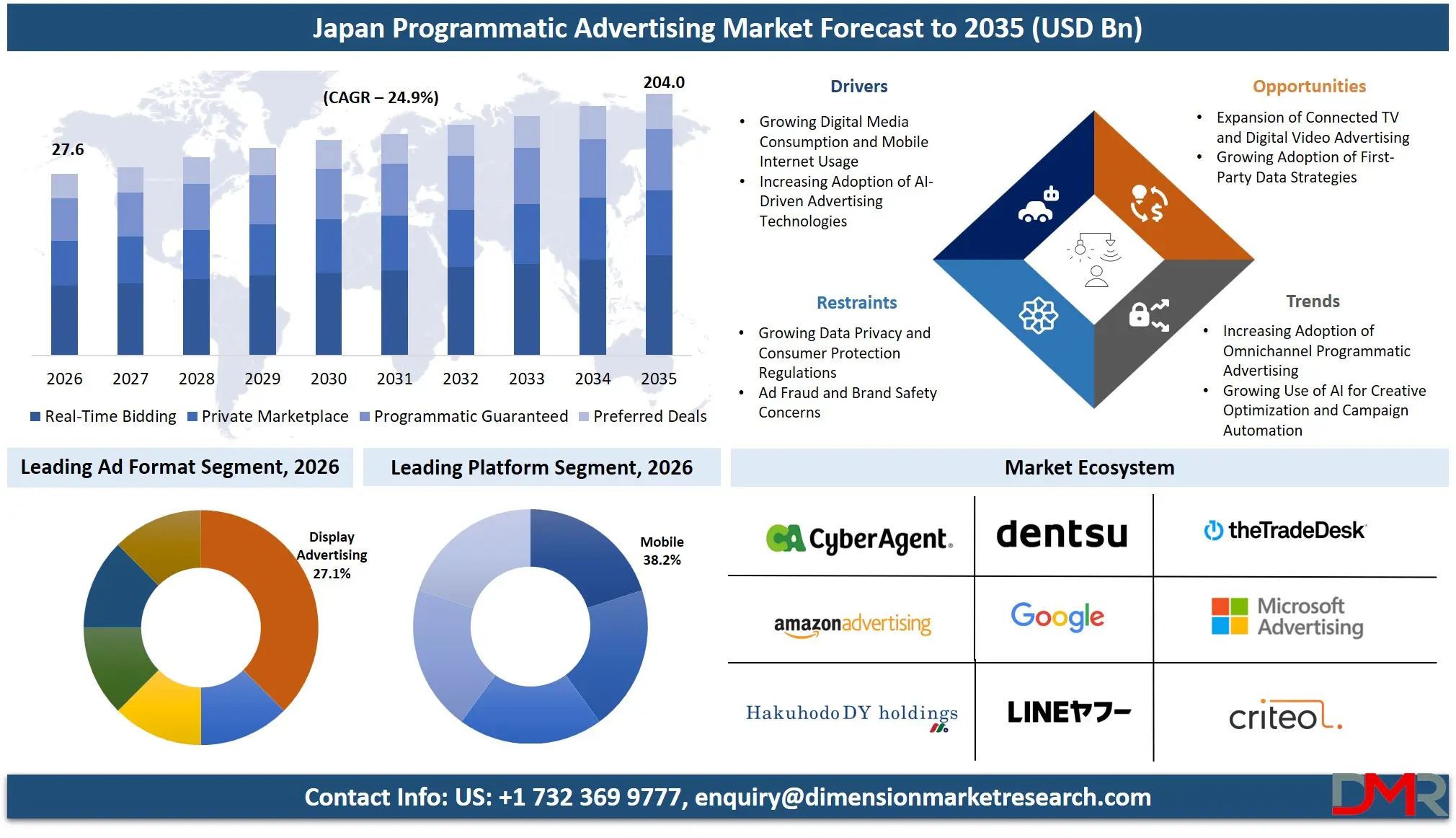
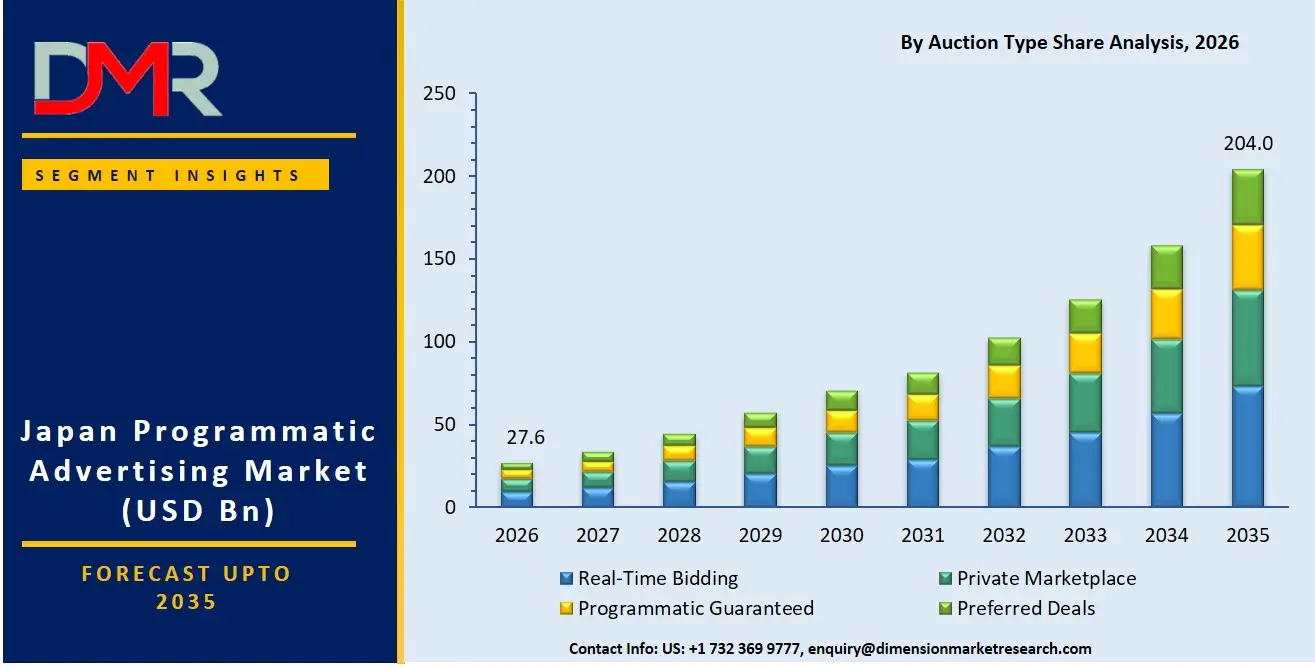
The Japan Programmatic Advertising Market is expected to reach a value of USD 27.6 billion in 2026, and it is further anticipated to reach USD 204.0 billion by 2035, growing at a robust CAGR of 24.9% during the forecast period.
ℹ
To learn more about this report –
Download Your Free Sample Report Here
The programmatic advertising market in Japan has witnessed exponential growth, solidifying the nation's position as a leader in marketing technology and data-driven consumer engagement across the Asia-Pacific region. The market consists of automated bidding and placement of digital ads through real-time auctions, private deals, and guaranteed inventory, utilizing sophisticated demand-side platforms (DSPs) and supply-side platforms (SSPs). The surge in mobile-first consumption, the maturation of connected TV (CTV), and the imperative for hyper-personalized brand messaging amongst Japan's digitally native demographic have fundamentally shifted advertising budgets toward programmatic channels. Ad tech intermediaries, agency trading desks, and first-party data-rich publishers are the major drivers in this industry. First-price auction dynamics and privacy-compliant contextual targeting approaches continue to be the dominant forms of trading due to their efficiency and addressability in a post-third-party-cookie environment.
Key Takeaways
- Market Size & Forecast: Japan's programmatic advertising market is projected to reach USD 27.6 billion in 2026 and USD 204.0 billion by 2035, driven by rapid digital advertising adoption, expanding connected TV usage, growing retail media networks, and AI-powered campaign automation.
- Growth Rate & Outlook: The market is expected to register a CAGR of 24.9%, supported by increasing programmatic ad spending, omnichannel marketing strategies, AI-enabled campaign optimization, stronger retail media ecosystems, and rising investments in data-driven advertising technologies.
- Primary Growth Drivers: Key growth drivers include widespread smartphone adoption, increasing digital media consumption, rapid growth of connected TV advertising, expanding retail media networks, AI-powered audience targeting, dynamic creative optimization, and greater enterprise investment in automated advertising platforms.
- Key Market Trends: Major trends include increasing adoption of programmatic guaranteed advertising, rapid expansion of connected TV campaigns, growing programmatic digital out-of-home advertising, AI-driven bid optimization, first-party data strategies, and omnichannel advertising across multiple digital platforms.
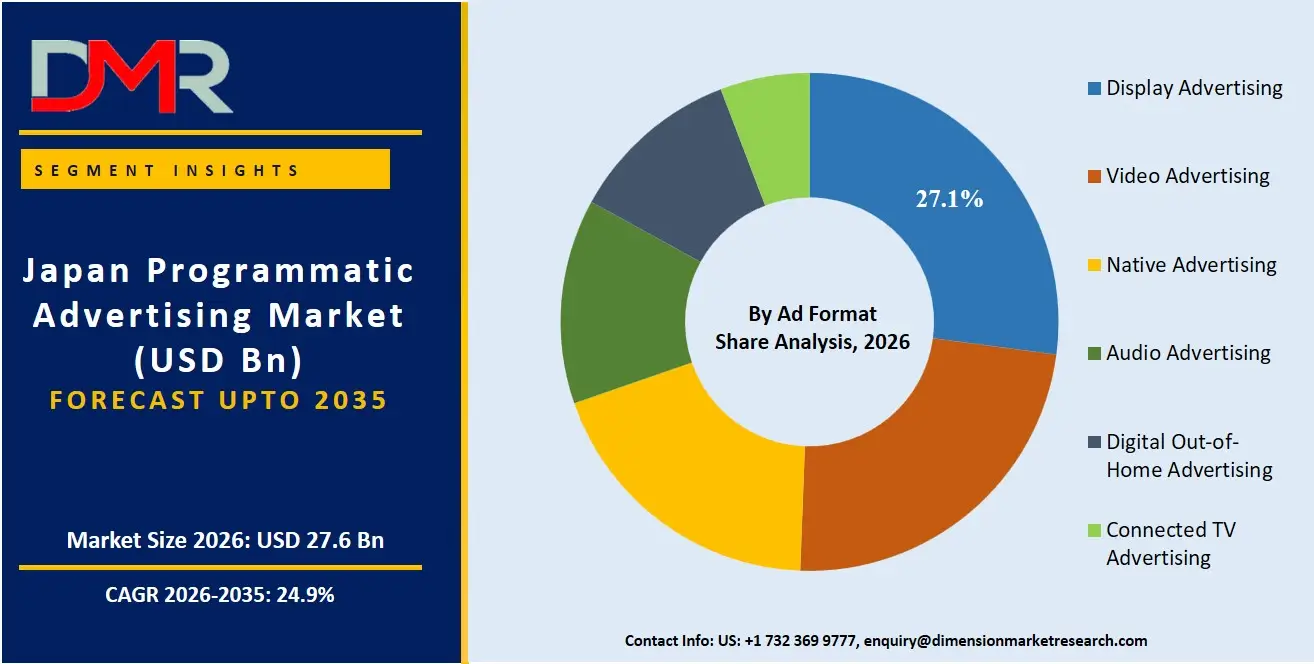
- By Ad Format Analysis: Video Advertising are poised to dominate the market due to higher consumer engagement, expanding streaming platform adoption, superior storytelling capabilities, and increasing advertiser investment in connected TV, online video, and AI-optimized programmatic video campaigns across digital channels.
- By Platform Analysis: Mobile is expected to dominate the Japan programmatic advertising market, supported by high smartphone penetration, increasing mobile commerce, app-based advertising, location-based targeting, real-time consumer engagement, and continuous growth in mobile internet usage across diverse demographic groups.
What is the Programmatic Advertising?
Programmatic advertising can be described as the algorithmic purchase and sale of digital advertising space in real-time. Unlike the traditional manual process of requests for proposals (RFPs) and human negotiations, programmatic advertising leverages machine learning and artificial intelligence to automate the ad delivery to a specific audience at the optimal time and cost. This is executed through two primary transaction models: real-time bidding (RTB), an open auction environment where impressions are bought instantly, and programmatic direct, which involves automated guaranteed or preferred deals for fixed-price, reserved inventory. Considering Japan's fast-track digital transformation and high programmatic literacy among marketers, header bidding technologies and server-to-server integrations have become essential to maximize yield for publishers and reduce latency for advertisers.
Use Cases
- Retail Media & E-Commerce Monetization: Retail conglomerates and e-commerce platforms adopt programmatic guaranteed deals to allow brands to bid on sponsored product listings and on-site display inventory, leveraging first-party shopper data to close the loop between advertising exposure and point-of-sale conversions.
- Connected TV & Addressable Audiences: Media companies and broadcasters apply private marketplace (PMP) deals to offer household-level targeting on premium smart TV inventory, providing advertisers with the engagement metrics of linear TV combined with the precision of digital measurement.
- Digital Out-of-Home (DOOH) Automation: Transit operators and outdoor media owners utilize programmatic pipes to trigger dynamic digital billboard creatives based on real-time environmental data, such as weather conditions or local traffic density, optimizing ad relevance in high-footfall areas.
- Omnichannel Consumer Retargeting: Automotive and travel brands leverage demand-side platforms to orchestrate sequential messaging across mobile audio, native ads, and desktop video, re-engaging users who have shown purchase intent without exceeding frequency caps.
How AI is Transforming the Programmatic Advertising Market?
The impact of AI on the Japanese programmatic advertising market covers the elimination of ad fraud through anomaly detection, as well as the creation of generative AI ad variations at scale. Speaking about trading efficiency, AI-driven prediction tools analyze bidstream data to forecast optimal bid prices, reducing cost-per-acquisition (CPA) for advertisers while maximizing ad revenue for publishers. AI-based identity resolution helps connect disparate device IDs into cohesive user profiles without relying on invasive personal identifiers.
Furthermore, the role of AI in creative logistics and campaign management is profound. Thus, while constructing omnichannel campaigns, generative AI algorithms explore large volumes of creative assets to assemble tailored native advertising formats that fit the look and feel of different publisher environments. AI-driven assistants assist with budget allocation by simulating market conditions, evaluating cross-channel attribution models, and providing an overview of media mix modeling outcomes.
Market Dynamics
Key Drivers in the Japan Programmatic Advertising Market
Growing Digital Media Consumption and Mobile Internet Usage
Japan's rapidly expanding digital media ecosystem is driving strong demand for programmatic advertising solutions. Consumers increasingly spend time on smartphones, streaming platforms, social media, online gaming, and digital news portals, creating more advertising inventory across multiple channels. Advertisers leverage programmatic platforms to deliver highly targeted campaigns using real-time audience insights and behavioral data. Mobile-first consumer habits, high internet penetration, and expanding digital commerce further encourage businesses to shift advertising budgets from traditional media toward automated digital channels. As brands seek measurable campaign performance and higher customer engagement, programmatic advertising adoption continues accelerating across Japan's digital economy.
Increasing Adoption of AI-Driven Advertising Technologies
Artificial intelligence is significantly transforming Japan's programmatic advertising market by enabling automated audience targeting, bid optimization, campaign personalization, and predictive analytics. AI-powered demand-side platforms help advertisers improve campaign efficiency by analyzing consumer behavior, demographics, browsing history, and purchasing patterns in real time. Machine learning algorithms continuously optimize bidding strategies to maximize return on advertising investment while reducing wasted impressions. Japanese enterprises increasingly integrate AI into digital marketing operations to improve customer acquisition and brand engagement. Continuous innovation in advertising technologies strengthens the adoption of intelligent programmatic platforms across diverse industry sectors throughout Japan.
Restraints in the Japan Programmatic Advertising Market
Growing Data Privacy and Consumer Protection Regulations
Increasing data privacy requirements present a significant challenge for Japan's programmatic advertising market. Advertisers must comply with evolving regulations governing personal information, consumer consent, data collection, and digital tracking practices. Stricter privacy expectations limit the availability of third-party data used for audience targeting and campaign optimization. Organizations must invest in privacy-compliant advertising technologies, first-party data strategies, and transparent data governance frameworks. Compliance costs and operational complexity continue increasing as digital advertising regulations evolve. These regulatory requirements may slow implementation and reduce targeting precision for certain programmatic advertising campaigns across Japan.
Ad Fraud and Brand Safety Concerns
Ad fraud remains a major restraint affecting confidence in Japan's programmatic advertising ecosystem. Invalid traffic, bot-generated impressions, click fraud, domain spoofing, and fraudulent advertising placements reduce campaign effectiveness and waste marketing budgets. Advertisers also face growing concerns regarding brand safety when advertisements appear alongside inappropriate or misleading content. These risks require continuous investment in fraud detection technologies, verification platforms, artificial intelligence, and trusted advertising exchanges. Although industry standards continue improving, maintaining transparency and ensuring high-quality advertising environments remain ongoing challenges that influence advertiser confidence and long-term market expansion.
Growth Opportunities in the Japan Programmatic Advertising Market
Expansion of Connected TV and Digital Video Advertising
Connected TV and digital video advertising present significant growth opportunities in Japan as consumers increasingly adopt streaming platforms and internet-enabled television services. Programmatic technologies enable advertisers to deliver highly personalized video campaigns based on audience demographics, viewing behavior, and content preferences. Premium video inventory provides improved engagement, stronger brand recall, and measurable campaign performance. Growing investments by broadcasters, streaming providers, and advertisers in addressable television advertising continue expanding available programmatic opportunities. As connected television viewership rises, demand for automated video advertising solutions is expected to accelerate substantially across Japan.
Growing Adoption of First-Party Data Strategies
The transition toward privacy-focused digital advertising creates major opportunities for first-party data-driven programmatic campaigns. Japanese enterprises increasingly collect customer information through loyalty programs, mobile applications, e-commerce platforms, websites, and CRM systems to improve advertising effectiveness while complying with privacy regulations. First-party data enables more accurate audience segmentation, personalized messaging, and higher conversion rates without relying heavily on third-party cookies. Technology providers offering customer data platforms, identity resolution, and privacy-compliant advertising solutions are well positioned to benefit from this industry transformation as organizations modernize their digital marketing strategies.
Trends in the Japan Programmatic Advertising Market
Increasing Adoption of Omnichannel Programmatic Advertising
A major trend shaping Japan's programmatic advertising market is the growing adoption of omnichannel advertising strategies that integrate mobile, desktop, connected television, digital out-of-home, audio, and retail media campaigns. Advertisers increasingly seek unified platforms capable of delivering consistent customer experiences across multiple digital touchpoints. Advanced campaign management systems optimize audience targeting, budget allocation, and performance measurement across channels. This integrated approach improves customer engagement, enhances brand consistency, and increases marketing efficiency. Omnichannel programmatic advertising continues gaining momentum as Japanese consumers interact with brands through diverse digital platforms.
Growing Use of AI for Creative Optimization and Campaign Automation
Artificial intelligence is increasingly being integrated into programmatic advertising workflows to automate creative generation, audience segmentation, bid management, and campaign optimization. AI-powered systems dynamically personalize advertisements based on user preferences, browsing behavior, purchasing intent, and contextual signals. Automated optimization improves click-through rates, conversion performance, and advertising efficiency while reducing manual campaign management. Japanese advertisers continue investing in generative AI, predictive analytics, and machine learning technologies to maximize marketing effectiveness. This growing reliance on intelligent automation is becoming one of the defining trends shaping the future of Japan's programmatic advertising market.
Research Scope and Analysis
The Japan Programmatic Advertising Market is segmented by Auction Type, Ad Format, Platform, Deployment, Enterprise Size, and End User. It covers automated bidding models, diverse digital advertising formats, multiple delivery platforms, cloud and on-premises deployment, organizations of different sizes, and industries including retail, media, BFSI, automotive, healthcare, telecommunications, education, government, and others.
ℹ
To learn more about this report –
Download Your Free Sample Report Here
By Auction Type Analysis
Real-Time Bidding is poised to dominate the Japan Programmatic Advertising market because it enables advertisers to purchase digital advertising inventory through automated, data-driven auctions in milliseconds. Japanese brands increasingly rely on RTB to improve campaign efficiency, optimize advertising budgets, and deliver highly targeted advertisements across websites, mobile applications, and connected devices.
ℹ
To learn more about this report –
Download Your Free Sample Report Here
Advanced audience segmentation, artificial intelligence, and real-time analytics enhance bidding accuracy and maximize return on advertising investment. Growing digital media consumption, expanding mobile internet usage, and increased adoption of demand-side platforms further strengthen RTB's market leadership, making it the preferred auction model among advertisers and publishers throughout Japan.
By Ad Format Analysis
Display Advertising is expected to dominate the Japan Programmatic Advertising market due to its widespread adoption across websites, mobile applications, news portals, and e-commerce platforms. Advertisers extensively use display ads to increase brand awareness, customer engagement, and product visibility while benefiting from automated audience targeting and campaign optimization. Rich media formats, responsive designs, and data-driven personalization improve advertising effectiveness across multiple digital channels. Strong investments by retailers, financial institutions, and consumer brands in digital marketing continue driving demand for display advertising. Its broad reach, cost efficiency, and compatibility with programmatic technologies maintain its leadership within Japan's digital advertising ecosystem.
By Platform Analysis
The Mobile platform is expected to dominate the Japan Programmatic Advertising market because smartphones represent the primary channel for digital content consumption, online shopping, social media engagement, and video streaming. High smartphone penetration and widespread 5G connectivity enable advertisers to deliver personalized, location-based, and real-time advertising experiences. Mobile applications generate extensive consumer behavior data that improves audience targeting and campaign performance. Japanese consumers increasingly access entertainment, financial services, and retail platforms through mobile devices, encouraging advertisers to allocate larger portions of digital marketing budgets toward mobile programmatic campaigns, making mobile the dominant advertising platform.
By Deployment Analysis
Cloud-Based deployment is expected to dominate the Japan Programmatic Advertising market because it enables advertisers, agencies, and publishers to manage campaigns through scalable, flexible, and cost-efficient platforms. Cloud infrastructure supports real-time bidding, audience analytics, campaign automation, and artificial intelligence-driven optimization without requiring significant on-premises investments. Organizations benefit from centralized data management, continuous software updates, seamless integration with advertising platforms, and faster deployment of marketing campaigns. Growing adoption of cloud technologies across Japan's digital economy further accelerates demand for cloud-based advertising solutions, reinforcing their position as the preferred deployment model for programmatic advertising operations.
By Enterprise Size Analysis
Large Enterprises is anticipated to dominate the Japan Programmatic Advertising market because they maintain substantial digital marketing budgets, extensive customer databases, and sophisticated advertising strategies. These organizations invest heavily in AI-powered campaign optimization, audience segmentation, omnichannel marketing, and real-time advertising technologies to improve customer acquisition and brand engagement. Large enterprises also operate across multiple digital platforms, requiring advanced programmatic solutions capable of managing complex advertising campaigns at scale. Strong investments in data analytics, customer relationship management, and marketing automation further support widespread adoption, making large enterprises the leading contributors to Japan's programmatic advertising market revenue.
By End User Analysis
Retail & E-Commerce is projected to dominate the Japan Programmatic Advertising market because retailers increasingly depend on personalized digital advertising to attract customers, increase online sales, and strengthen brand loyalty. Programmatic advertising enables businesses to deliver highly targeted advertisements based on browsing behavior, purchasing history, demographics, and consumer preferences. Growing online shopping activity, mobile commerce adoption, and demand for personalized customer experiences continue driving advertising investments across digital channels. AI-powered audience targeting, dynamic creative optimization, and performance-based advertising improve marketing effectiveness while maximizing return on investment, making retail and e-commerce the largest end-user segment in Japan's programmatic advertising market.
The Japan Programmatic Advertising Market Report is segmented on the basis of the following:
By Auction Type
- Real-Time Bidding
- Private Marketplace
- Programmatic Guaranteed
- Preferred Deals
By Ad Format
- Display Advertising
- Video Advertising
- Native Advertising
- Audio Advertising
- Digital Out-of-Home Advertising
- Connected TV Advertising
By Platform
- Mobile
- Desktop
- Connected TV
- Digital Out-of-Home
- Others
By Deployment
By Enterprise Size
- Large Enterprises
- Small & Medium Enterprises
By End User
- Retail & E-Commerce
- Media & Entertainment
- Banking, Financial Services & Insurance
- Automotive
- Travel & Hospitality
- Healthcare
- Telecommunications
- Consumer Goods
- Education
- Government
- Other End User
Competitive Landscape
The nature of competition in the Japan programmatic advertising market has become very dynamic, given the diverse range of independent ad tech pure-plays operating in the space, as well as Japanese internet conglomerates and global walled gardens focusing on identity solutions. Strategic alliances with major telecom operators and local data providers would be crucial for the company, as they help gain access to deterministic match keys and early validation of the company's contextual intelligence platform. The trend of consolidation is growing at a rapid pace, as global enterprise software giants are acquiring local Japanese SSPs and retail media tech startups specializing in in-store digital bridge solutions in order to stay in business. IP differentiators such as proprietary identity spines, privacy-enhancing computation, and shopper propensity models are playing an increasingly significant role compared to a traditional seat on a DSP.
Some of the prominent players in the Japan Programmatic Advertising Market are:
- CyberAgent, Inc.
- Dentsu Group Inc.
- Hakuhodo DY Holdings Inc.
- LINE Yahoo Corporation
- Criteo
- The Trade Desk
- Google LLC
- Amazon Ads
- Microsoft Advertising
- Meta Platforms, Inc.
- Magnite
- PubMatic
- OpenX
- Index Exchange
- DoubleVerify
- Integral Ad Science
- Nexxen
- FreakOut Holdings, Inc.
- SMN Corporation
- MicroAd, Inc.
- Other Key Players
Recent Developments
- April 2026: LINE Yahoo Corporation launched LY Ads, integrating LINE Ads and Yahoo! JAPAN Display Ads into a unified advertising platform, enabling advertisers to execute programmatic campaigns across both ecosystems through a single interface.
- March 2026: Dentsu Inc. reported that Japan's internet advertising expenditure exceeded 50% of total advertising spending for the first time in 2025, driven by strong growth in video, social media, and connected TV advertising, reinforcing the expansion of the country's programmatic advertising ecosystem.
- September 2025: Dentsu partnered with Index Exchange and Chalice AI to develop an AI-enabled NextGen programmatic advertising ecosystem, enhancing supply-path optimization, algorithmic bidding, and AI-powered campaign performance.
Frequently Asked Questions
How big is the Japan Programmatic Advertising Market?
▾ The Japan Programmatic Advertising market is poised to be valued at USD 27.6 billion in 2026 and is projected to reach USD 204.0 billion by 2035, driven by the universal need for automated, measurable media transactions and a cultural shift towards digital-first content engagement.
What is the CAGR of the Japan Programmatic Advertising Market from 2026 to 2035?
▾ The market is expected to grow at a CAGR of 24.9% from 2026 to 2035, reflecting the accelerating shift of TV budgets to digital video and the nation's unique mobile-centric publishing ecosystem enabling faster market access for diverse ad formats.
What factors are driving the growth of the Japan Programmatic Advertising Market?
▾ Key drivers include Japan’s rapid transition to a cookie-less identity infrastructure, the escalating media consumption on smartphones and CTV, and a deep ecosystem of ad tech innovation in supply-path optimization and AI-driven creative personalization.
What are the major trends in the Japan Programmatic Advertising Market?
▾ Major trends include the development of data clean rooms for retail media interoperability, the shift toward programmatic guaranteed deals for CTV inventory, and a strong focus on digital out-of-home automation and attention-based measurement metrics.
Who are the key players in the Japan Programmatic Advertising Market?
▾ Key players in the Japan Programmatic Advertising Market include Dentsu, CyberAgent, The Trade Desk, Google, Amazon Ads, Hakuhodo DY, Magnite, PubMatic, and Yahoo! JAPAN, driving innovation through identity solutions, supply-side curation, and omnichannel trading activities.
How is the Japan Programmatic Advertising Market segmented?
▾ The market is segmented by Auction Type, Ad Format, Platform, Deployment, Enterprise Size, and End User.