Japan Ready-to-Eat Food Processing Equipment Market Snapshot
- Market Size, 2026: USD 0.75 billion
- Market Size, 2035: USD 1.27 billion
- CAGR, 2026–2035: 6.0%
- Leading Equipment Type: Packaging & Sealing Equipment, 23%
- Leading Processing Stage: Packaging & Final Handling, 27%
- Leading Food Type: Ready-to-Eat Meals, 31%
- Leading Automation Level: Fully Automated, 62%
- Fastest-Growing Segment: Plant-Based Ready-to-Eat Products, 7.8% CAGR
What is the Japan Ready-to-Eat Food Processing Equipment and its Market Size?
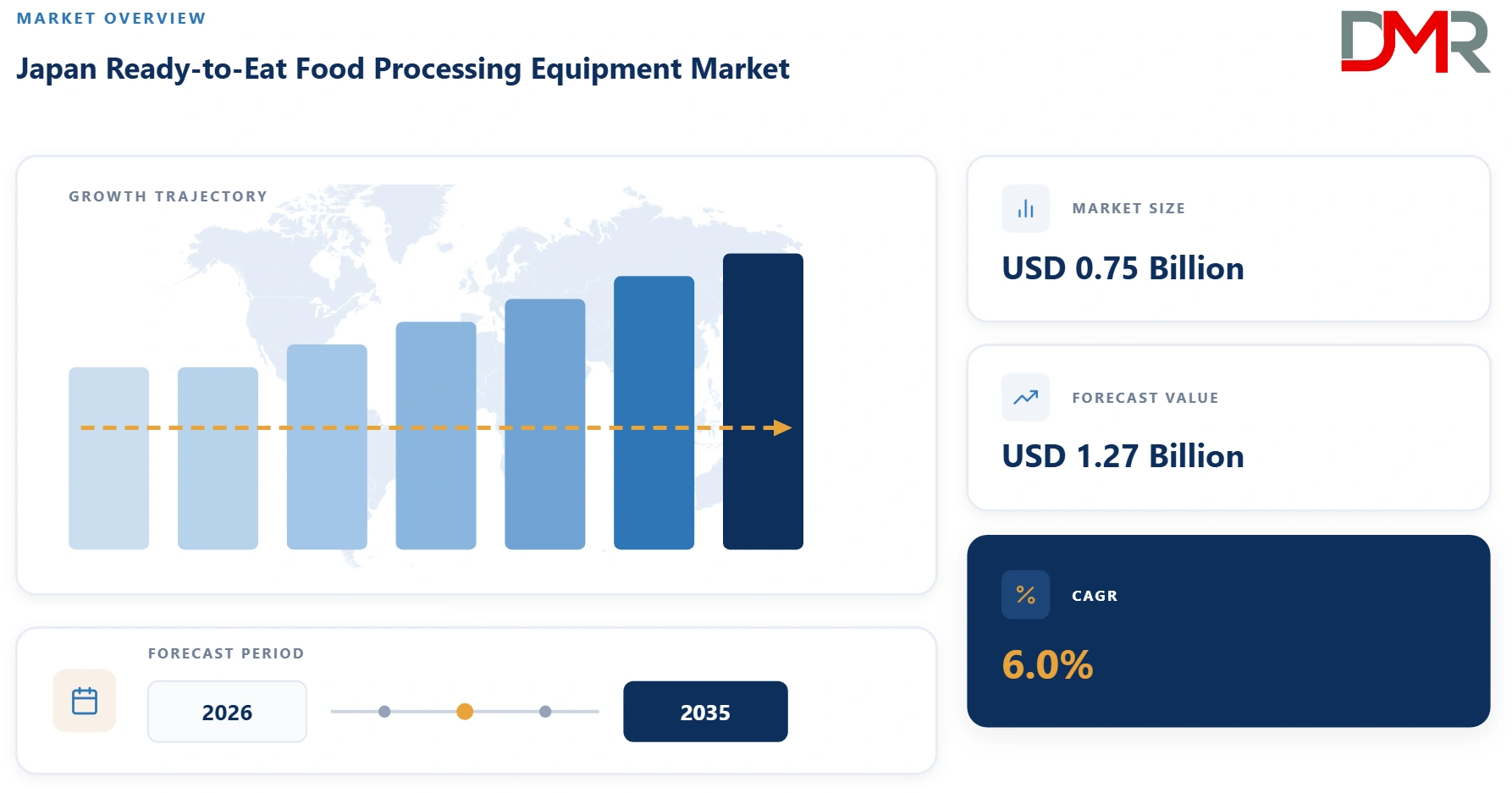
The Japan ready-to-eat food processing equipment market is estimated at USD 750 million in 2026 and is projected to reach approximately USD 1.27 billion by 2035, representing a 6.0% CAGR.
ℹ
To learn more about this report –
Download Your Free Sample Report Here
Japan's ready-to-eat food processing equipment market comprises machinery, integrated production lines, inspection systems, automation technologies and supporting equipment used to manufacture foods intended for consumption with minimal or no additional preparation. It covers equipment for ingredient preparation, cooking, mixing, forming, filling, chilling, freezing, weighing, inspection, packaging, sealing, labeling and sanitation.
Major applications include bento meals, prepared side dishes, noodles, sandwiches, sushi, processed meat and seafood, frozen meals, bakery products, sauces and plant-based foods. The market serves food manufacturers, contract manufacturers, convenience-store suppliers, retailers and commercial kitchens. Its core value proposition is enabling high-volume, hygienic, consistent and labor-efficient production while meeting Japan's demanding quality and food-safety requirements.
Use Cases
- Bento and prepared-meal production: Automated cooking, portioning, filling and sealing for high-volume convenience-store meals.
- Convenience-store food manufacturing: High-speed production of rice balls, sandwiches, noodles, salads and prepared side dishes.
- Frozen ready-meal processing: Cooking, cooling, freezing, weighing and packaging complete meals for retail distribution.
- Processed meat and seafood: Cutting, forming, cooking, portioning and inspection of protein-based ready-to-eat products.
- Plant-based meal production: Automated mixing, forming, cooking and packaging of increasingly diverse meat alternatives.
- Retail food preparation: Compact equipment enabling supermarkets and food retailers to manufacture meals closer to consumers.
Key Takeaways
- Market size: The market is estimated at USD 750 million in 2026, reaching USD 1.27 billion by 2035.
- Growth rate: The market is projected to expand at approximately 6.0% CAGR through 2035.
- Key drivers: Labor shortages, rising wage costs, demand for convenience foods, aging households, food-safety requirements and production modernization are the principal growth catalysts.
- Segment dominance: Packaging and sealing equipment leads equipment categories, while fully automated systems account for the majority of automation-related spending.
- Food-type leadership: Ready-to-eat meals remain the largest application because of Japan's highly developed bento, convenience-store and prepared-food ecosystem.
- Fastest growth: Plant-based ready-to-eat products are expected to grow fastest, at approximately 7.8% CAGR, albeit from a smaller installed-equipment base.
How AI/Gen AI is Transforming the Japan Ready-to-Eat Food Processing Equipment Market?
AI, IoT, machine vision and robotics are increasingly being integrated across Japanese ready-to-eat production lines. Applications include robotic picking and handling, automated weighing, AI-assisted inspection, predictive maintenance, production monitoring and recipe/line optimization. Japan's Ministry of Agriculture, Forestry and Fisheries is explicitly supporting the adoption of robots, AI and IoT to address food-manufacturing labor shortages.
The technology impact extends beyond labor reduction. Automated inspection can improve consistency and reduce false rejects, while connected machinery enables real-time monitoring of throughput, yield, downtime and equipment health. Anritsu's XR76 X-ray inspection platform, for example, was designed to improve detection while reducing false detection and reinspection requirements.
Key Drivers in the Japan Ready-to-Eat Food Processing Equipment Market
Severe Food-Manufacturing Labor Shortages
Japan's demographic structure is creating a persistent shortage of manufacturing workers, particularly for repetitive, physically demanding and hygiene-intensive food-processing activities. Food production is particularly difficult to automate because products can be soft, irregularly shaped, sticky or fragile, while hygiene requirements constrain conventional industrial automation. MAFF identifies labor shortages as a serious challenge and emphasizes robots, AI and IoT as mechanisms for improving productivity.
Structural Expansion of Ready-to-Eat and Convenience Foods
Japan's ready-to-eat market benefits from aging, smaller households, dual-income families and consumer preference for time-saving meal solutions. NIPPN identifies convenience, shorter cooking times, aging, declining birthrates and increasing single-person households as structural drivers of its ready-made-meal business.
Restraints in the Japan Ready-to-Eat Food Processing Equipment Market
High Capital Cost and Integration Complexity
Advanced ready-to-eat production lines require substantial capital expenditure because equipment must often be integrated across cooking, conveying, weighing, filling, inspection, packaging and sanitation stages. The challenge is greater for SMEs that operate shorter production runs or manufacture highly customized products. Automation also requires line engineering, software integration, worker training and maintenance capabilities. Japan's food-processing industry contains a large number of smaller manufacturers, making return-on-investment calculations a significant purchasing hurdle. Imported machinery can additionally face installation, localization and service requirements.
Product Variability and Stringent Hygiene Requirements
Ready-to-eat foods range from rice and noodles to sauces, vegetables, meat and seafood, each exhibiting different physical properties. Machines must handle fragile, sticky or irregular products without damaging appearance or compromising portion accuracy. At the same time, Japanese manufacturers must maintain high sanitation standards and comply with HACCP-oriented production practices. MAFF notes that food characteristics and stringent safety requirements historically make automation more difficult than in conventional manufacturing.
Growth Opportunities in the Japan Ready-to-Eat Food Processing Equipment Market
AI-Enabled Autonomous Production Lines
AI-based vision, robotic manipulation and machine-learning process control offer a major opportunity for suppliers. Instead of simply automating individual tasks, manufacturers can connect inspection, weighing, recipe control, production scheduling and maintenance into a unified production environment. This enables manufacturers to optimize throughput and yield while reducing operator intervention. Ishida's strategy emphasizes AI-enabled automation, equipment data utilization and predictive maintenance.
Flexible Equipment for SMEs and Multi-SKU Production
Japan's ready-to-eat sector is characterized by frequent product launches, seasonal foods and changing consumer preferences. This creates demand for modular machines that can accommodate different trays, films, recipes and portion sizes without lengthy changeovers. Compact semi-automatic equipment also provides an accessible entry point for smaller manufacturers. Ishida, for example, markets compact semi-automatic weighing solutions specifically for ready meals and pre-cut vegetables.
Trends in the Japan Ready-to-Eat Food Processing Equipment Market
Shift From Labor Saving Toward Autonomous Manufacturing
The Japanese market is moving beyond isolated automation toward interconnected production lines capable of operating with minimal human intervention. Food manufacturers increasingly seek robots, connected machinery, automated inspection and production-management software as one integrated system.
Premiumization and Product Diversification
Japanese consumers increasingly expect ready-to-eat products to provide freshness, quality, nutrition and variety rather than simply convenience. This is encouraging manufacturers to introduce premium bento, specialty noodles, plant-based foods, healthier prepared meals and higher-quality frozen products. NIPPN specifically identifies product diversification, food safety, sustainability and technological improvements as growth factors for the ready-made-meal sector.
Research Scope and Analysis
The market is segmented By Equipment Type, By Processing Stage, By Food Type and By Automation Level. Estimates reflect equipment revenue attributable specifically to Japanese ready-to-eat food manufacturing, including machinery sold as standalone units and integrated production-line components.
ℹ
To learn more about this report –
Download Your Free Sample Report Here
By Equipment Type Analysis
Packaging & Sealing Equipment is estimated to be the dominant equipment category in 2026, accounting for approximately 23% of market revenue, supported by the enormous volume of bento, prepared meals, chilled foods and frozen products requiring retail-ready packaging. Tray sealers, wrappers, automated labeling systems and case packers are particularly important because shelf life, presentation and leak prevention directly affect product economics. Cooking & Thermal Processing Equipment, with an estimated 17% share, represents the second-largest category because cooking remains central to bento, prepared side dishes, meat and seafood meals. Inspection & Quality Control Equipment is projected to be the fastest-growing equipment category at approximately 7.1% CAGR, driven by stricter quality requirements, labor shortages and the deployment of machine vision and X-ray systems. Anritsu's XR76, for example, targets higher inspection sensitivity and lower false detection on high-speed food lines.
By Processing Stage Analysis
Packaging & Final Handling represents the largest processing-stage category, with an estimated 27% share in 2026, because virtually every commercial ready-to-eat product requires automated or semi-automated weighing, sealing, labeling, inspection and case handling before distribution. Cooking & Thermal Processing follows at approximately 21%, reflecting the importance of cooking, baking, frying, steaming and thermal treatment in prepared foods. Freezing is expected to be the fastest-growing stage at around 6.8% CAGR, supported by continued growth in frozen complete meals and the expansion of chilled/frozen retail infrastructure. Japan's frozen-food market has grown for several consecutive years, while demand for chilled and frozen products is rising across supermarkets, convenience stores and drugstores.
By Food Type Analysis
Ready-to-Eat Meals lead the food-type segment with an estimated 31% share in 2026, reflecting Japan's mature bento, prepared-meal and convenience-store ecosystem. The segment encompasses boxed meals, prepared rice dishes, noodles, complete frozen meals and multi-component meal trays. Ready-to-Eat Snacks represent the second-largest category at approximately 16%, supported by packaged convenience foods and portion-controlled products. Plant-Based Ready-to-Eat Products are projected to be the fastest-growing category, with approximately 7.8% CAGR, although from a relatively smaller installed-equipment base. Japan's plant-based market has attracted growing corporate participation and consumer interest associated with sustainability and ethical consumption.
By Automation Level Analysis
Fully Automated equipment is estimated to account for approximately 62% of 2026 market revenue, making it the dominant automation category. Its leadership reflects Japan's high labor costs, worker shortages and the economics of high-volume convenience-food manufacturing. Integrated automated lines can combine portioning, filling, inspection, packaging and labeling while maintaining consistent output. The Semi-Automated category accounts for approximately 38%, remaining important among SMEs, contract manufacturers and manufacturers with highly variable product portfolios. However, fully automated solutions are expected to grow faster, at approximately 6.7% CAGR, as return-on-investment conditions improve and robotics become easier to integrate. MAFF has introduced programs specifically aimed at supporting labor-saving technologies, including AI and robotic machinery, while METI has established initiatives to facilitate regional robot adoption.
By Equipment Scale Analysis
Large-Scale Equipment dominated the Japan Ready-to-Eat Food Processing Equipment Market in 2026, accounting for an estimated 58% share, driven by strong demand from high-volume food manufacturers, convenience-store suppliers and large prepared-food production facilities. Large-scale systems enable continuous production, higher throughput, automated quality control and lower labor requirements, making them particularly suitable for bento meals, frozen foods, processed meat, seafood and prepared side dishes. Small & Medium-Scale Equipment represented approximately 42% of the market and is expected to be the fastest-growing sub-segment, expanding at around 6.8% CAGR from 2026 to 2035. Growth is supported by SMEs and contract manufacturers seeking modular, flexible and cost-effective automation for shorter production runs and multiple SKUs. Demand for compact equipment is also increasing as smaller producers gradually transition from manual to automated operations without investing in complete production lines.
By End User Analysis
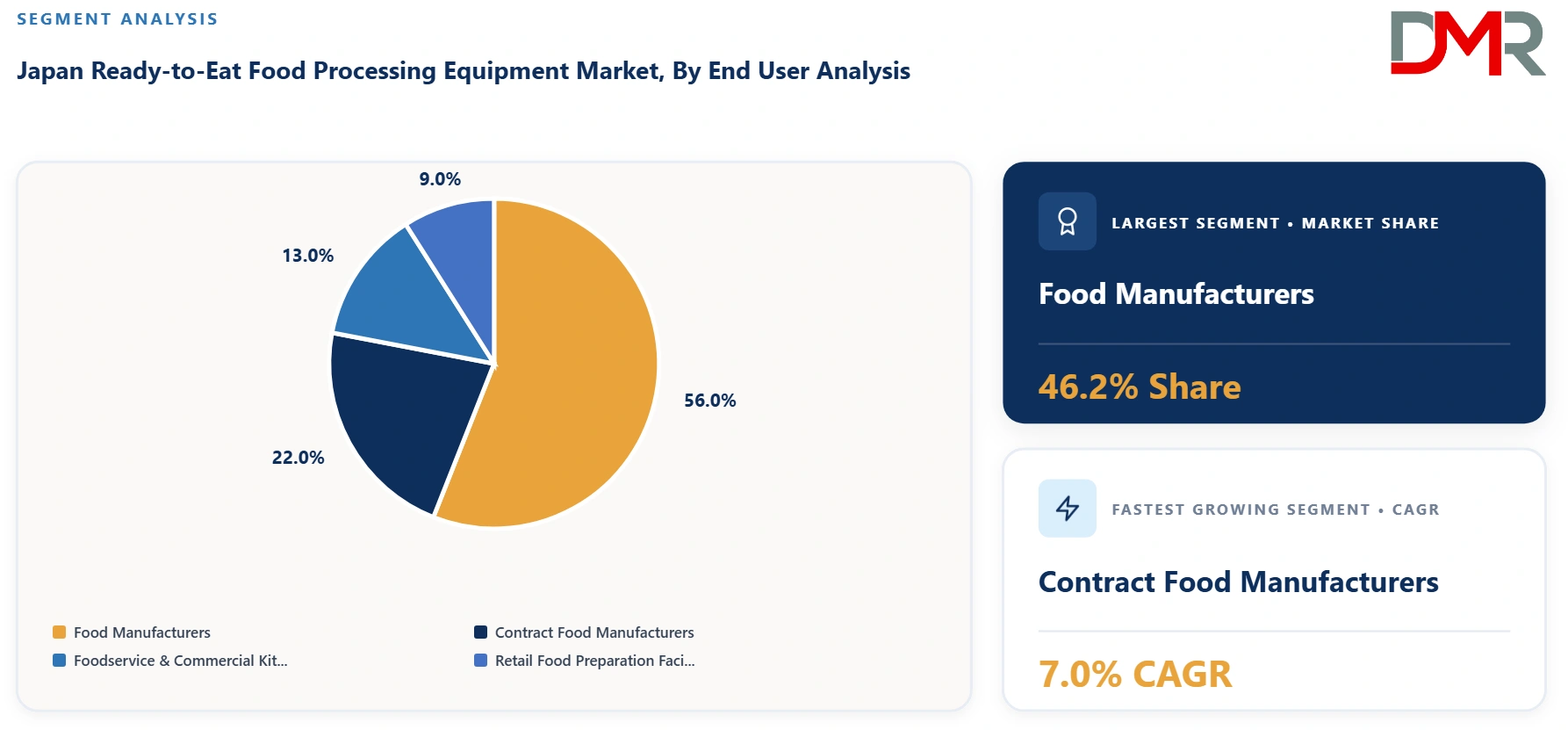
Food Manufacturers were the leading end-user segment in the Japan Ready-to-Eat Food Processing Equipment Market in 2026, accounting for approximately 56% share. Their dominance is supported by high-volume production requirements, increasing labor costs, strict food-safety standards and the need for consistent product quality. Contract Food Manufacturers represented the second-largest segment, with approximately 22% share, as food brands and retailers increasingly outsource ready-to-eat production to specialized manufacturers. Contract Food Manufacturers are also expected to be the fastest-growing end-user segment, registering approximately 7.0% CAGR from 2026 to 2035, driven by demand for flexible production capacity, multi-SKU manufacturing and outsourced meal preparation. Foodservice & Commercial Kitchens accounted for around 13%, while Retail Food Preparation Facilities represented approximately 9% of the market in 2026.
The Japan Ready-to-Eat Food Processing Equipment Market Report is segmented on the basis of the following:
By Equipment Type
- Food Preparation Equipment
- Cooking & Thermal Processing Equipment
- Mixing & Blending Equipment
- Forming & Shaping Equipment
- Filling & Portioning Equipment
- Cooling & Chilling Equipment
- Freezing Equipment
- Packaging & Sealing Equipment
- Inspection & Quality Control Equipment
- Cleaning & Sanitation Equipment
By Processing Stage
- Raw Material Preparation
- Ingredient Processing & Formulation
- Cooking & Thermal Processing
- Forming & Portioning
- Cooling & Chilling
- Freezing
- Inspection & Quality Control
- Packaging & Final Handling
By Food Type
- Ready-to-Eat Meals
- Ready-to-Eat Snacks
- Processed Meat & Poultry
- Seafood Products
- Bakery & Confectionery Products
- Dairy-Based Ready-to-Eat Products
- Plant-Based Ready-to-Eat Products
- Prepared Fruits & Vegetables
- Soups, Sauces & Prepared Foods
By Automation Level
- Semi-Automated
- Fully Automated
By Equipment Scale
- Small & Medium-Scale
- Large-Scale
By End User
- Food Manufacturers
- Contract Food Manufacturers
- Foodservice & Commercial Kitchens
- Retail Food Preparation Facilities
Regulatory Landscape
Japan's ready-to-eat equipment market is strongly influenced by food-safety, sanitation, labeling and HACCP-related requirements. Food manufacturers increasingly require machinery designed for hygienic operation, easy cleaning, contamination prevention and traceability. Regulatory pressure therefore favors stainless-steel equipment, automated inspection, data logging and validated process controls. MAFF has also recognized the need for guidance around hygienic deployment of robots and smart technologies in food manufacturing.
The regulatory environment is therefore less a barrier to equipment demand than a catalyst for higher-quality systems. Suppliers able to demonstrate sanitation, traceability, inspection accuracy and documented compliance can command premiums, while suppliers lacking Japanese service and validation capabilities may struggle with adoption.
Investment and White Space Analysis
Investment opportunities are strongest in integrated automation, robotic handling, AI inspection, flexible packaging and compact modular systems. Japan's food-processing machinery market remains attractive, with imports accounting for approximately 55.5% of machinery-for-food-processing demand in 2024, indicating meaningful opportunities for international technology suppliers despite strong domestic competition.
White space exists particularly between manual production and expensive fully integrated factories. SMEs need modular systems capable of gradual automation, while large convenience-food suppliers require higher-speed, data-connected lines. Additional opportunities include remote diagnostics, predictive maintenance, vision-based quality control, energy-efficient refrigeration and equipment capable of handling plant-based and multi-component meals.
Competitive Landscape
The Japan ready-to-eat food processing equipment market is moderately concentrated but technologically fragmented, with global machinery groups competing alongside highly specialized Japanese engineering companies. Competition centers on reliability, hygiene, automation, precision, service responsiveness and integration capabilities rather than price alone. Leading suppliers increasingly differentiate through complete production-line solutions spanning weighing, filling, inspection, packaging and labeling. Ishida has particularly strong exposure to ready meals, offering weighing, inspection, distribution, topping, packing and labeling technologies.
Some of the prominent players in the Japan Ready-to-Eat Food Processing Equipment Market are:
- Oshikiri Machinery
- Ishida
- Yamato Scale
- Mitsubishi Heavy Industries Food & Packaging Machinery
- Nisshin Seifun Group
- Shibaura Machine
- T. Hasegawa
- Fuji Machinery
- Suzumo Machinery
- Nantsune
- Nakanishi Manufacturing
- Fuji Electric
- Hanagata Corporation
- Furukawa MFG
- Kajuwara Kogyo
- Kitazawa Sangyo
- AIHO
- FMI Corporation
- Takaki Machinery
- Shikoku Kakoki
- Shibuya Corporation
- Tsubakimoto Kogyo
- Sato Shoji
- Satake Corporation
- Taisei Kogyo
- Hiraga Manufacturing
- Nichimo
- Kajiwara
- Hoshizaki Corporation
- Hokuto Corporation
- Arahata Food Machine
- Asahi Giken
- Nantsune
- M&E
- Naomi
- Ohmichi
- Radix
- Hisaka Works
- Miura
- Samson
- Other Key Players
Recent Developments
- June 2025: At FOOMA JAPAN 2025, Anritsu showcased the XR76 X-ray inspection system alongside rapid microbiological measurement, odor inspection, production visualization and quality-data management technologies, highlighting the convergence of automated inspection and digital food manufacturing.
- May 2025: Ishida expanded its focus on AI-driven automation and factory DX, targeting the transition from labor-saving operations toward increasingly unmanned production while using equipment data for performance optimization, remote monitoring and predictive maintenance.
- April 2025: NIPPN introduced advanced production equipment within its ready-made-meal operations to improve product quality and production efficiency, while pursuing additional capacity expansion and labor-saving automation across its food manufacturing facilities.
- April 2025: Anritsu launched Japanese sales of its XR76 series X-ray inspection machine, offering enhanced detection sensitivity and reduced false detection for high-speed food-production lines.
- March 2025: Ishida continued strengthening its ready-meal equipment portfolio with automated weighing, portioning, inspection, tray sealing and distribution solutions designed for complex multi-component meals and rapid product changeovers.
Report Details
| Report Characteristics |
| Market Size (2026) |
USD 0.75 Bn |
| Forecast Value (2035) |
USD 1.27 Bn |
| CAGR (2026–2035) |
6.0% |
| Historical Data |
2021 – 2025 |
| Forecast Data |
2026 – 2035 |
| Base Year |
2025 |
| Segments Covered |
By Equipment Type, By Processing Stage, By Food Type, By Automation Level, By Equipment Scale, By End User |
| Country Coverage |
Japan |
Frequently Asked Questions
What is the Japan Ready-to-Eat Food Processing Equipment Market size in 2026?
▾ The Japan Ready-to-Eat Food Processing Equipment Market is estimated at USD 750 million in 2026.
What will the Japan Ready-to-Eat Food Processing Equipment Market size be in 2035?
▾ The Japan Ready-to-Eat Food Processing Equipment Market is projected to reach approximately USD 1.27 billion by 2035.
What is the CAGR of the Japan Ready-to-Eat Food Processing Equipment Market?
▾ The Japan Ready-to-Eat Food Processing Equipment Market is expected to expand at a 6.0% CAGR from 2026 to 2035.
What are the key growth drivers of the Japan Ready-to-Eat Food Processing Equipment Market?
▾ Labor shortages, rising automation adoption, convenience-food demand, aging demographics, food-safety requirements and manufacturing modernization are driving market growth.
Which segment dominates the Japan Ready-to-Eat Food Processing Equipment Market?
▾ Packaging & Sealing Equipment is the leading equipment-type segment, accounting for an estimated 23% market share in 2026.
Which is the fastest-growing segment in the Japan Ready-to-Eat Food Processing Equipment Market?
▾ Plant-Based Ready-to-Eat Products are projected to be the fastest-growing segment, with an estimated 7.8% CAGR from 2026 to 2035.
What are the major trends in the Japan Ready-to-Eat Food Processing Equipment Market?
▾ AI-enabled automation, robotics, machine vision, IoT connectivity, predictive maintenance, flexible production lines and intelligent inspection are major market trends.
Who are the key players in the Japan Ready-to-Eat Food Processing Equipment Market?
▾ Key players include Ishida, Anritsu, Omori Machinery, Shibuya Corporation, Yamato Scale and Fuji Machinery, alongside other domestic and international equipment suppliers.