Market Snapshot
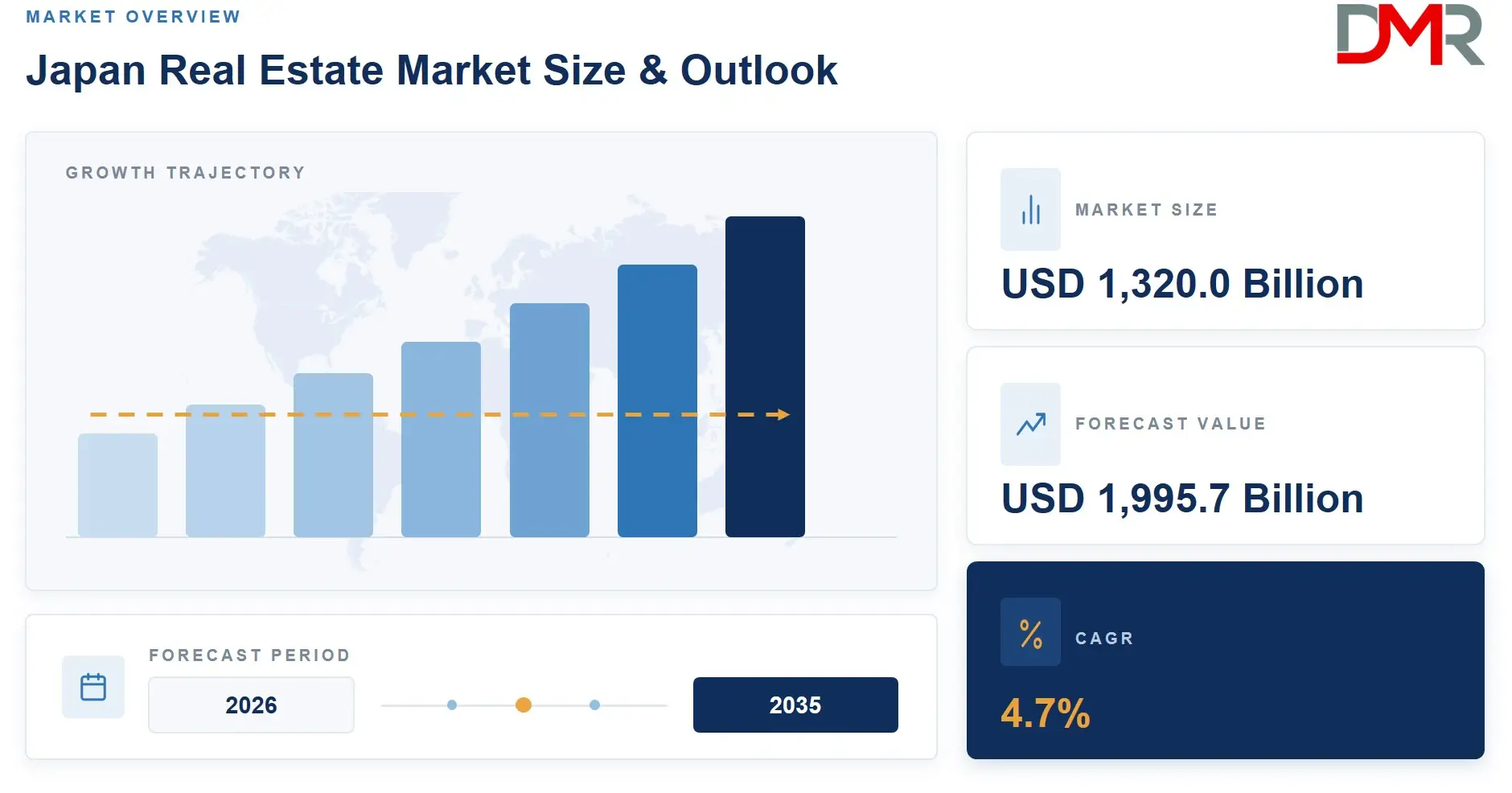
- Market Size (2026): USD 1320.0 Bn
- Forecast Value (2035): USD 1995.7 Bn
- CAGR (2026-2035): 4.7%
- Leading Property Type (2026): Residential, approximately 46%
- Leading Business (2026): Rental, around 55%
- Key Players: Mitsubishi Estate, Mitsui Fudosan, Daiwa House Industry and others
What is the Japan Real Estate Market and its Market Size?
The Japan Real Estate Market size is estimated to reach USD 1320.0 Bn in 2026 and is further anticipated to reach USD 1995.7 Bn by 2035, at a CAGR of 4.7%.
ℹ
To learn more about this report –
Download Your Free Sample Report Here
This assessment covers income-producing and transacted property across residential, commercial, industrial, logistics, hospitality and land assets within Japan. It includes rental revenue, sales activity, development-related value and professional property services where those activities are directly tied to real estate ownership or occupation.
Residential property remains the broadest demand pool because households, landlords and institutional owners generate recurring rental flows as well as replacement and redevelopment activity. Commercial offices, retail assets and hotels respond more directly to employment, tourism, business formation and urban footfall, while logistics and industrial facilities track manufacturing, parcel delivery and inventory network redesign.
Tokyo and the wider Kanto area set pricing and liquidity benchmarks, but demand is becoming more selective rather than uniformly national. Station-oriented redevelopment, seismic renewal, energy performance requirements and data-center construction are redirecting capital toward assets with durable cash flow and reliable infrastructure.
Population ageing and vacant housing create a two-speed market. Prime urban stock can command investment and redevelopment capital, while smaller cities require renovation, conversion, public-private partnerships and better asset management to prevent obsolescence. Rising financing costs also make underwriting quality more important than headline appreciation.
Use Cases
- Household Rental Housing: Residential landlords and operators use apartment portfolios to provide long-term accommodation near employment and transit nodes. Professional management improves occupancy, maintenance response and tenant retention, especially where ageing households prefer managed homes over owner-occupied properties.
- Urban Office Redevelopment: Corporate real estate teams and developers consolidate fragmented buildings into energy-efficient office clusters. The approach addresses outdated floor plates and seismic requirements while creating flexible space for hybrid work, retail frontage and services that support higher-quality urban employment districts.
- Regional Logistics Networks: Logistics companies and manufacturers deploy distribution facilities near ports, expressways and consumption centers. Larger, better-located warehouses reduce delivery distance and improve inventory control, while regional projects spread capacity beyond the most constrained metropolitan submarkets.
- Hospitality and Resort Assets: Hotel operators, railway groups and real estate funds acquire or reposition properties in destinations with durable domestic and inbound visitation. Renovation, branded operations and mixed-use planning can convert underused stock into accommodation, food service and experiential assets.
Key Takeaways
- Market Size & Share: Japan real estate revenue is estimated at USD 1320.0 Bn in 2026 and is projected to reach USD 1995.7 Bn by 2035.
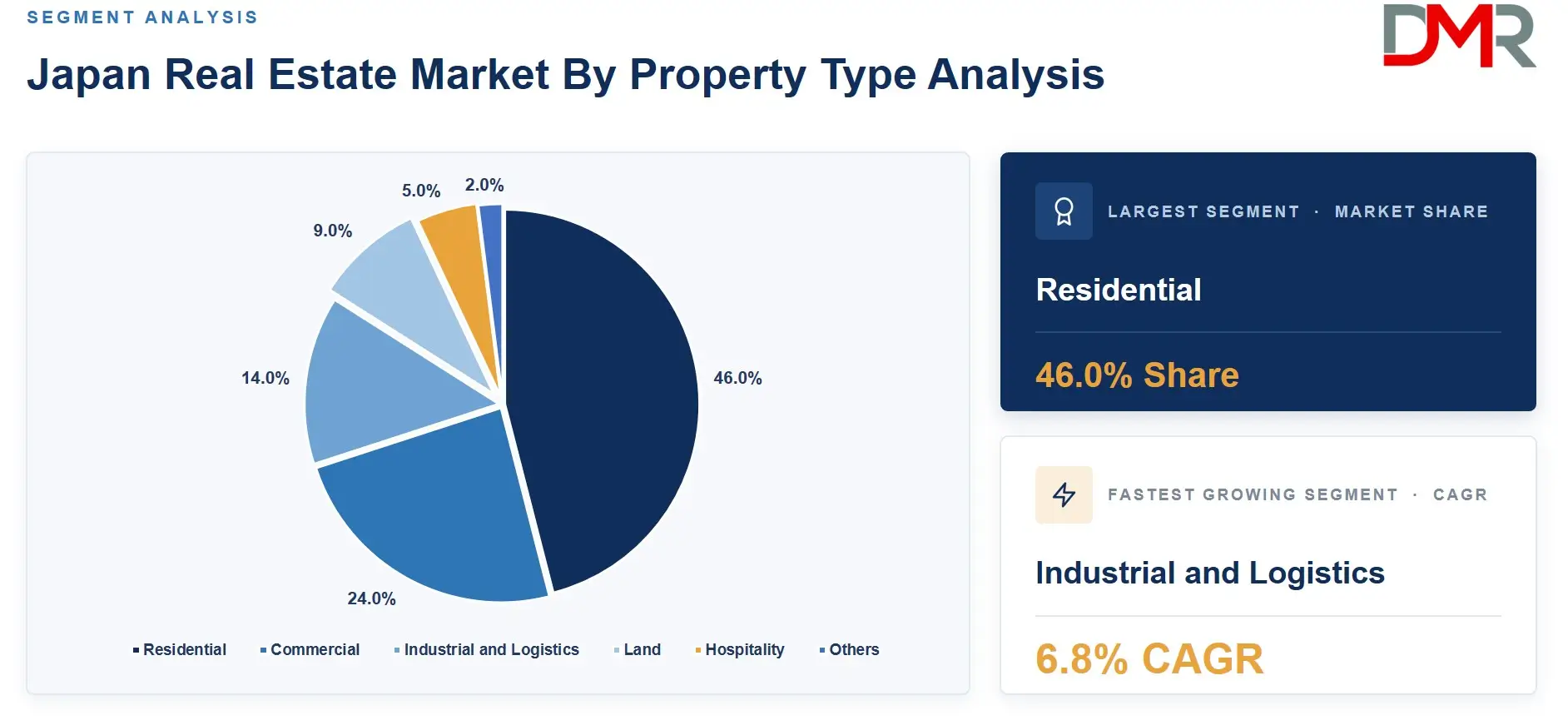
- Property Type Analysis: Residential is set to represent approximately 46% of 2026 revenue, while logistics and industrial property grows at a CAGR of 6.8%.
- Demand Concentration: Kanto is expected to account for around 39% of 2026 activity, reflecting its employment base, transport connectivity and capital-market depth.
- Digital Infrastructure: Data centers and digital infrastructure are projected to expand at a CAGR of 8.6% between 2026 and 2035.
- Rental Economics: Rental transactions are anticipated to hold close to 55% of 2026 business activity, supported by institutional ownership and recurring income.
- Capital Discipline: The headline market growth rate is expected to remain at 4.7% from 2026 to 2035 as financing costs temper speculative development.
How AI/Gen AI is Transforming the Japan Real Estate Market?
Artificial intelligence is changing property operations first, not replacing the underlying asset decision. Computer vision can inspect exterior deterioration, occupancy and safety conditions from images, while predictive models combine rent, footfall, energy and maintenance records to prioritize interventions across portfolios.
Generative AI adds value where documents and fragmented records slow transactions. Japanese-language LLM document processing can extract lease clauses, summarize due diligence and flag missing permissions, while digital twins connect building systems with renovation scenarios. Adoption remains strongest among large owners with standardized data and clear governance.
- Lease Intelligence: LLM document processing classifies renewal dates, escalation clauses and tenant obligations.
- Asset Inspection: Computer vision identifies facade, roof and equipment anomalies before costly failures.
- Building Simulation: Digital twins test energy retrofits, seismic work and occupancy changes.
- Portfolio Planning: Generative design compares redevelopment layouts, capital budgets and expected operating outcomes.
Key Drivers in the Japan Real Estate Market
Demand is being shaped by urban concentration and the conversion of physical infrastructure to support new economic activity.
- Transit-Centered Urban Redevelopment: Employment, universities, hospitals and retail remain concentrated around rail networks, creating a reliable base for apartments, offices and mixed-use projects. Kanto is expected to account for approximately 39% of 2026 market activity because liquidity, tenant depth and financing access reinforce one another. Developers can cross-subsidize residential, commercial and public-realm improvements within large station-area schemes. This mechanism supports land assembly and asset replacement even when national population growth is weak, but it also leaves peripheral locations exposed to shrinking demand and lower resale liquidity.
- Digital Infrastructure and Logistics Demand: Cloud services, e-commerce fulfilment and industrial automation require power-secure sites, fiber connectivity and modern floor space. Data centers and digital infrastructure are projected to grow at a CAGR of 8.6% from 2026 to 2035, the fastest expansion among the selected end-use groups. Capacity constraints around electricity, land and permitting raise the value of well-positioned sites. Logistics investment benefits from the same network logic, as operators seek larger facilities near highways, ports and population centers to protect delivery performance.
Restraints in the Japan Real Estate Market
Structural demand does not remove the constraints imposed by demographics, funding and the physical condition of the building stock.
- Demographic and Vacancy Pressure: Population ageing and household contraction reduce the pool of potential occupants in many regional markets. Vacant homes may be inexpensive to acquire, yet title fragmentation, poor maintenance, demolition cost and limited local employment can prevent viable reuse. Residential property still represents approximately 46% of 2026 revenue, so weakness in ordinary housing has an outsized effect on the market. Investors therefore distinguish sharply between station-linked assets with renewal potential and remote stock where liquidity, insurance and renovation economics remain difficult.
- Higher Financing and Construction Costs: Gradually rising interest rates increase required yields and reduce the amount of debt a project can support. Materials, labor and specialist contractor shortages add pressure to replacement budgets, particularly for seismic upgrades and high-specification facilities. Developers may postpone schemes or reduce scope when rents cannot absorb higher costs. This brake is strongest in secondary cities and older commercial buildings, where regulatory compliance and refurbishment spending can exceed the value supported by local tenant demand.
Growth Opportunities in the Japan Real Estate Market
White space is emerging where owners can convert underused stock into assets aligned with infrastructure, demographic and operating needs.
- Regional Conversion and Managed Housing: Local authorities, railway companies and specialist operators can combine vacant houses, senior housing and serviced rental formats around regional stations. The opportunity is not a simple acquisition strategy. It depends on standardized renovation packages, local care partnerships and property management that can aggregate small assets into an investable operating portfolio.
- Energy and Seismic Retrofit Finance: Banks, insurers and real estate funds can create financing products tied to measured energy savings, resilience upgrades and tenant retention. Older office and multifamily stock offers a large retrofit pipeline, while disclosure requirements and corporate decarbonization goals improve the commercial case for better-performing buildings.
Trends in the Japan Real Estate Market
Buyer behavior is moving toward selective quality, operating income and infrastructure certainty rather than broad exposure to property appreciation.
- Institutionalization of Rental Housing: Funds and professional operators are increasing exposure to multifamily assets because standardized units provide recurring income, scalable management and clearer portfolio reporting. Competition is strongest for well-located buildings with efficient layouts, while poorly maintained stock faces a widening discount.
- Data Center and Urban Logistics Specialization: Real estate underwriting now gives greater weight to power availability, fiber routes, cooling design, loading geometry and disaster resilience. These requirements are making technical due diligence a core competitive capability and encouraging partnerships among developers, utilities, telecom providers and operators.
Research Scope and Analysis
Segment performance is assessed across property type, business model, end use, region and distribution channel. Each axis identifies where 2026 revenue is concentrated and which niche is moving fastest through 2035, helping buyers connect current scale with the next pool of investable demand.
ℹ
To learn more about this report –
Download Your Free Sample Report Here
By Property Type
Residential is expected to hold the largest share by property type in 2026, accounting for approximately 46% of revenue, supported by its installed base, transaction depth and established financing channels. Growth, however, is concentrated in Logistics and Industrial, which is projected to expand at a CAGR of 6.8% between 2026 and 2035 as institutional buyers respond to digital infrastructure demand, operating efficiency and changing tenant requirements. The contrast shows why current revenue concentration will not fully determine the next investment cycle.
By Business
Rental is expected to hold the largest share by business in 2026, accounting for approximately 55% of revenue, supported by its installed base, transaction depth and established financing channels. Growth, however, is concentrated in Property Management and Digital Brokerage, which is projected to expand at a CAGR of 7.9% between 2026 and 2035 as institutional buyers respond to digital infrastructure demand, operating efficiency and changing tenant requirements. The contrast shows why current revenue concentration will not fully determine the next investment cycle.
By End Use
Households is expected to hold the largest share by end use in 2026, accounting for approximately 48% of revenue, supported by its installed base, transaction depth and established financing channels. Growth, however, is concentrated in Data Centers and Digital Infrastructure, which is projected to expand at a CAGR of 8.6% between 2026 and 2035 as institutional buyers respond to digital infrastructure demand, operating efficiency and changing tenant requirements. The contrast shows why current revenue concentration will not fully determine the next investment cycle.
By Region
Kanto is expected to hold the largest share by region in 2026, accounting for approximately 39% of revenue, supported by its installed base, transaction depth and established financing channels. Growth, however, is concentrated in Kyushu and Okinawa, which is projected to expand at a CAGR of 6.9% between 2026 and 2035 as institutional buyers respond to digital infrastructure demand, operating efficiency and changing tenant requirements. The contrast shows why current revenue concentration will not fully determine the next investment cycle.
By Distribution Channel
Direct Institutional Investment is expected to hold the largest share by distribution channel in 2026, accounting for approximately 42% of revenue, supported by its installed base, transaction depth and established financing channels. Growth, however, is concentrated in Digital Platforms and Cross-Border Channels, which is projected to expand at a CAGR of 8.1% between 2026 and 2035 as institutional buyers respond to digital infrastructure demand, operating efficiency and changing tenant requirements. The contrast shows why current revenue concentration will not fully determine the next investment cycle.
The Japan Real Estate Market Report is Segmented Based on the Following
By Property Type
- Residential (46%)
- Commercial (24%)
- Industrial and Logistics (14%)
- Land (9%)
- Hospitality (5%)
- Others (2%)
By Business
- Rental (55%)
- Sales (29%)
- Property Management (9%)
- Development Services (4%)
- Others (3%)
By End Use
- Households (48%)
- Office Users (18%)
- Retail and Services (12%)
- Logistics Operators (10%)
- Hospitality (6%)
- Data Centers and Digital Infrastructure (4%)
- Others (2%)
By Region
- Kanto (39%)
- Kansai (23%)
- Chubu (13%)
- Kyushu and Okinawa (10%)
- Tohoku and Hokkaido (8%)
- Chugoku and Shikoku (5%)
- Others (2%)
By Distribution Channel
- Direct Institutional Investment (42%)
- Brokerage Networks (27%)
- Banks and Financial Intermediaries (14%)
- Digital Platforms and Cross-Border Channels (9%)
- Public and Community Channels (5%)
- Others (3%)
Competitive Landscape
Competition combines land access, financing capacity, development execution, tenant relationships and portfolio management. Large Japanese groups use integrated pipelines spanning development, leasing and asset services, while specialist REIT managers compete through disciplined acquisitions and operating performance. Global funds and logistics platforms add capital and technical expertise. Digital brokers and property-management companies are widening distribution, but local regulatory knowledge and relationships remain important. The market is therefore fragmented by asset class, with scale advantages in urban redevelopment and logistics alongside specialist positions in residential, hospitality and regional conversion.
Some of the Prominent Players in the Japan Real Estate Market Are,
- Mitsubishi Estate
- Mitsui Fudosan
- Sumitomo Realty & Development
- Tokyu Land Corporation
- Nomura Real Estate Holdings
- NTT Urban Development
- Daiwa House Industry
- Sekisui House
- Mori Trust
- Hulic
- Open House Group
- Japan Airport Terminal
- Ichigo
- United Urban Investment Corporation
- Japan Real Estate Investment Corporation
- Nippon Building Fund
- Global One Real Estate Investment
- Kenedix
- Advance Residence Investment
- Frontier Real Estate Investment
- Comforia Residential REIT
- LaSalle Logiport REIT
- GLP Japan
- Prologis Japan
- ESR
- Mapletree Investments
- Hankyu Hanshin Properties
- Keio Real Estate Development
- Kintetsu Real Estate
- Fukuoka Realty
- Aeon Mall
- MORI Building
- Daito Trust Construction
- Leopalace21
- Starts Corporation
- At Home
- SUUMO
- LIFULL
- JLL Japan
- CBRE Japan
- Other Key Players
Recent Developments
- In June 2026, Tokyo metropolitan authorities advanced station-area redevelopment and housing policy measures, reinforcing the pipeline for mixed-use projects and transit-linked residential supply.
- In April 2026, Japanese property operators expanded data-center and logistics site programs around power-secure corridors, increasing demand for specialized land and technical development partners.
- In November 2025, major institutional investors increased allocations to Japanese rental housing and logistics assets, directing capital toward recurring income and modern operating specifications.
- In August 2025, construction and real estate groups announced additional urban renewal initiatives, supporting replacement of ageing buildings and improving the commercial case for mixed-use density.
Report Details
| Report Characteristics |
| Market Size (2026) |
USD 1320.0 Bn |
| Forecast Value (2035) |
USD 1995.7 Bn |
| CAGR (2026–2035) |
4.7% |
| Historical Data |
2021–2025 |
| Forecast Data |
2026–2035 |
| Base Year |
2025 |
| Segments Covered |
By Property Type; By Business; By End Use; By Region; By Distribution Channel |
| Regional Coverage |
Japan |
Frequently Asked Questions
How big is the Japan Real Estate Market?
▾ The Japan Real Estate Market is estimated to reach USD 1320.0 Bn in 2026. The estimate includes residential, commercial, industrial, logistics, hospitality and land-related activity inside Japan, with rental, sales, development and property services captured according to the report boundary.
What is the growth rate of the Japan Real Estate Market?
▾ The market is projected to expand at a CAGR of 4.7% between 2026 and 2035, reaching USD 1995.7 Bn. Growth is supported by urban redevelopment, rental institutionalization, logistics modernization and digital infrastructure, while demographics and financing costs limit a faster national trajectory.
Which area holds the largest share in the Japan Real Estate Market?
▾ Kanto holds the largest internal regional position, accounting for approximately 39% of 2026 activity. Tokyo and surrounding prefectures concentrate employment, transport infrastructure, corporate headquarters, institutional capital and redevelopment opportunities, giving the area greater transaction liquidity than most other Japanese submarkets.
Who are the key players in the Japan Real Estate Market?
▾ Key participants include Mitsubishi Estate, Mitsui Fudosan, Sumitomo Realty & Development, Daiwa House Industry, Sekisui House, GLP Japan and Prologis Japan. The competitive set also includes REIT managers, railway-linked developers, brokers, property managers, global funds and specialist logistics operators.
Which property type leads the Japan real estate industry?
▾ Residential property is expected to lead by property type, holding approximately 46% of 2026 revenue. Its scale reflects the breadth of household demand, rental stock and replacement activity. Logistics and industrial property is expanding faster as supply chains require modern, connected facilities.