Market Overview
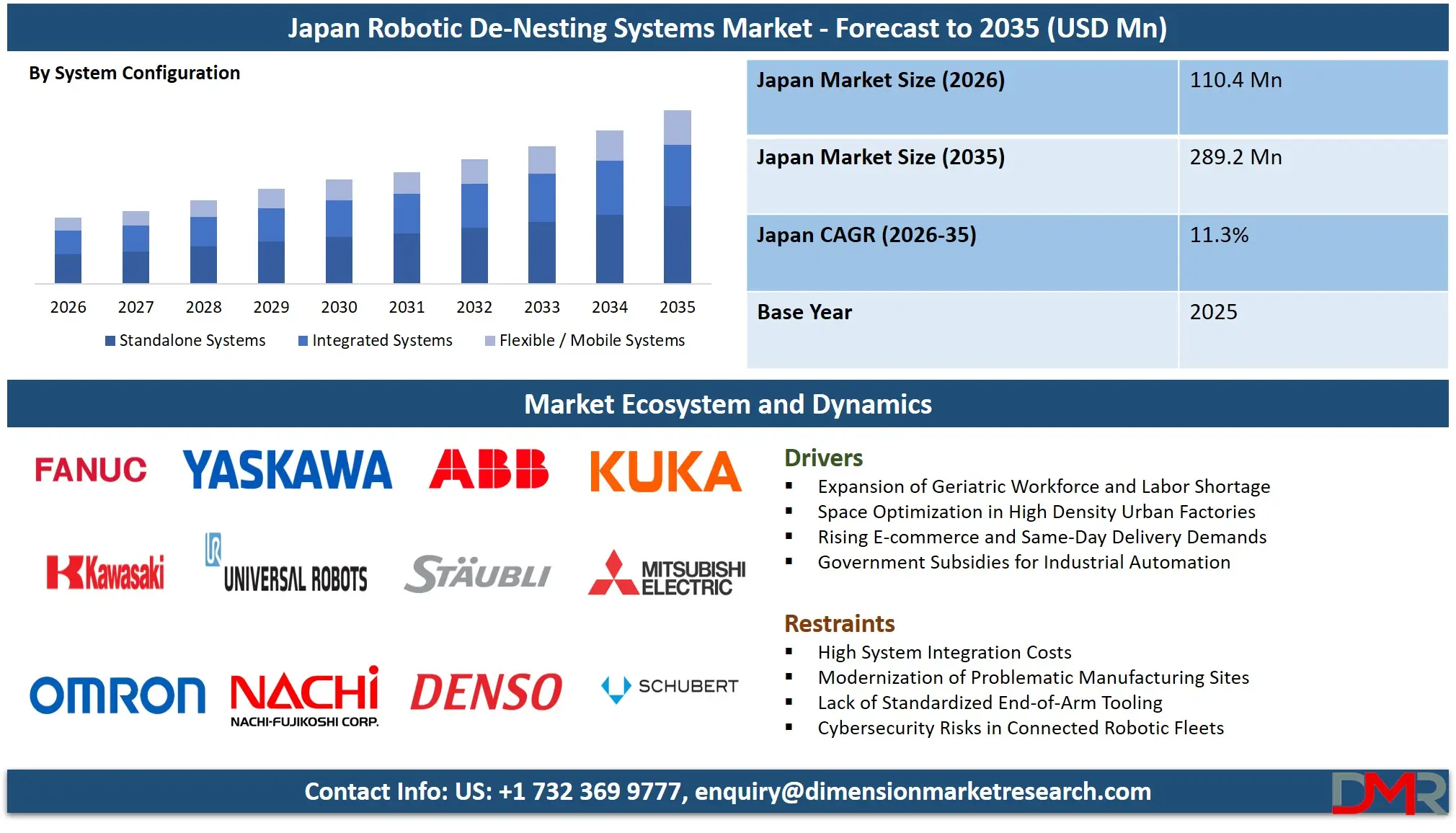
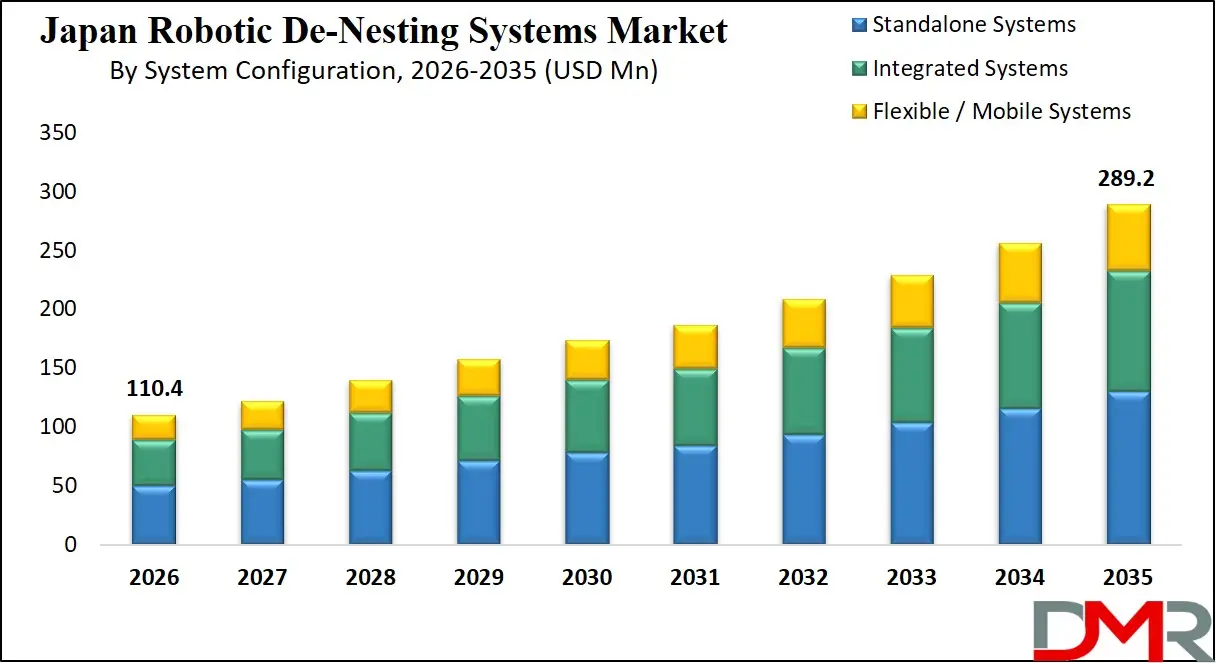
The Japan Robotic De-Nesting Systems Market size is expected to grow from USD 110.4 million in 2026 to USD 289.2 million in 2035, with a compound annual growth rate (CAGR) of 11.3% during the forecast period from 2026 to 2035.
ℹ
To learn more about this report –
Download Your Free Sample Report Here
Robotic de-nesting systems are automated machines that can separate nested products like trays, containers, or parts from a stack and place the individual items onto production or packaging lines. This is extensively used in the food and drink, drug, packaging, automotive, and electronics industries. These systems allow for increased operational throughput, decreased manual handling injuries, and reduced line downtime. They are often put to use in Japanese manufacturers' factories, logistics centers, and warehouses.
With high-precision engineering, a strong industrial automation culture, and labor shortages in Japan, the Japan robotic de-nesting market is highly advanced. The rise of e-commerce and just-in-time manufacturing is driving demand for high-speed, flexible de-nesting robots. AI-driven vision and collaborative robotics are increasingly being applied to mixed-product, high-mix, low-volume lines. End-of-arm tooling also has high levels of R&D, and the growth in automated logistics is also a trend across this industry.
ℹ
To learn more about this report –
Download Your Free Sample Report Here
Japan Robotic De-Nesting Systems Market: Key Takeaways & Other Influencing Factors
- Market Size Insights: The Japan Robotic De-Nesting Systems Market share is predicted to gain up to USD 2.4 billion by 2035, up from an estimated USD 1.2 billion in 2026, at a growth rate (CAGR) of 7.9% during the forecast period.
- Automatic Systems leading the way: Automatic robotic de-nesting systems are forecasted to dominate with almost 70.9% market share in 2026 of the product type segment, mainly due to their high demand for fully unattended operation and large-scale integration in high-throughput lines.
- Packaging as Primary Application Driver: Packaging leads applications with nearly a 40.1% share, driven by the growing use of automated tray and carton de-nesting in food and consumer goods lines.
- Manufacturing Leading End-User: Manufacturing dominates with a maximum share as an end-user at around 58.0% share, mainly attributed to growing adoption of robotic de-nesting in automotive and electronics assembly lines.
- Automation & Smart Vision Acceleration: More than 55% of Japanese manufacturing facilities have implemented AI-based visual servoing for de-nesting, enhancing demand for advanced robotic systems, leading to better changeover times and reduced product damage.
- Infrastructure Scale (METI): Japan has 2,850 large-scale manufacturing plants with automated packaging lines and an estimated 98,000 robotic de-nesting units installed, 8.4 million hours of annual automated operation, and 12 new robotics integration centers scheduled by 2030, and industrial automation infrastructure is growing well.
- Digital Adoption (JARA): 61% of logistics centers are equipped with robotic de-nesting integrated with warehouse management systems, and 18.7% of de-nesting tasks are performed via cloud-optimized robotic fleets, which is a fast-growing trend towards smart material handling.
Impact of the Iran conflict on the Japan Robotic De-Nesting Systems Market
The Iran war is actually increasing the price of costs on world supply chains and raw material, thus indirectly increasing the cost of robotic components in Japan due to higher engine motors or controller prices in China and increased logistics. However, the long-term need will not diminish since Japan is still on track to deploy next-generation flexible de-nesting systems and collaborative robots that support them in increasing production uptime while lowering dependence upon labor.
Japan Robotic De-Nesting Systems Market: Use Cases
- High-Speed Tray De-Nesting in Food Lines: Automatic tray de-nesting systems allow nested trays to be separated from within Japan's food manufacturing lines at high speed for bakery and ready-meal transfer, optimising line speeds whilst providing less direct manual intervention.
- De-Nesting for Pharmaceutical Blister Pack: Both semi-automatic and fully automatic systems take on the challenge of opening delicate pharmaceutical containers and blisters, sacrificing minimal sterility or throughput as well as product contact and risk of contamination.
- Automotive Parts Separation for Assembly: Robotic de-nesting extracts nested engine components and clips from totes, bringing them directly to the assembly robots, enabling efficient just-in-sequence feeding and error-proofing.
- E-Commerce Fulfillment and Logistics Hubs: Adjusting/de-nesting systems designed to be flexible/mobile are used in logistics and warehousing at these locations that help keep nested shipping trays/returnable containers separate, thus increasing order accuracy, increasing throughput rates, as well as overall efficiency in the material flow.
Japan Robotic De-Nesting Systems Market: Market Dynamics
Driving Factors in the Japan Robotic De-Nesting Systems Market
Expansion of Geriatric Workforce and Labor Shortage
With the escalating problem of labor shortage, particularly for manual work, in Japan, the demand is rising for robotic de-nester systems capable of performing repetitive, heavy work. In order to ensure high levels of uptime and fast changeover times as well as increased reliability, there has been an increasing trend for companies to use vision-guided auto de-nesters, robots, and hybrid stand-alone machines.
Space Optimization in High Density Urban Factories
Within the Japanese manufacturing environment, plants are forced to make use of compact and flexible de-nesting cells with storage because there is no room for expansion of existing plants and high costs of property ownership. Modular end-of-arm tooling and just-in-time robotic applications are becoming increasingly common as a means of maximizing available space usage.
Restraints in the Japan Robotic De-Nesting Systems Market
High System Integration Costs
The introduction of advanced robotics in de-nesting through the use of AI-driven vision systems and adjustable grips entails high upfront costs. The costs associated with system integration, changeover tooling, and personnel training could hinder their adoption in small-scale manufacturing operations and older plants.
Modernization of Problematic Manufacturing Sites
A significant number of manufacturing plants in Japan operate on an outdated conveyor belt system and controls that do not sufficiently support the installation of current de-nesting robots and vision systems. The modernization process is costly and cumbersome, posing obstacles to growth potential.
Opportunities in the Japan Robotic De-Nesting Systems Market
Cold Chain and Hygienic De-Nesting Logistics Development
The heightened focus on refrigerated and sanitized de-nesting techniques for medical supplies and food trays is creating possibilities for customized stainless-steel robots and robots that can be easily washed. Another trend being adopted by factories in the production processes is the adoption of inventory management tools and intelligent tool changers.
Expansion of Flexible/Mobile Systems & Smart Production Cells
The demand for flexible/scalable systems and AI-driven production planning is growing due to the increased adoption of flexible and mobile robotic cells. The advent of cloud computing and real-time data gathering, analysis, and maintenance techniques is opening up new market opportunities in Japan's industrial automation infrastructure.
Trends in the Japan Robotic De-Nesting Systems Market
Use of AI-Driven Vision and Collaborative De-Nestings
There is a trend toward utilizing AI-driven visual servoing and collaborative de-nesting robots, as it helps achieve greater flexibility in production and improves worker safety. It allows one to increase changeover time, reduce damages, and achieve more effective line configuration in advanced manufacturing facilities.
Implementation of Digital Manufacturing Monitoring Technologies
Industrial manufacturers are becoming digital, and their operations include implementing robot fleet monitoring, anomaly detection, and production monitoring through machine learning technologies. All of these new technologies can be combined with de-nesting robots in order to achieve better performance, gripper durability, and predictive maintenance.
Japan Robotic De-Nesting Systems Market: Research Scope and Analysis
Product Type Analysis
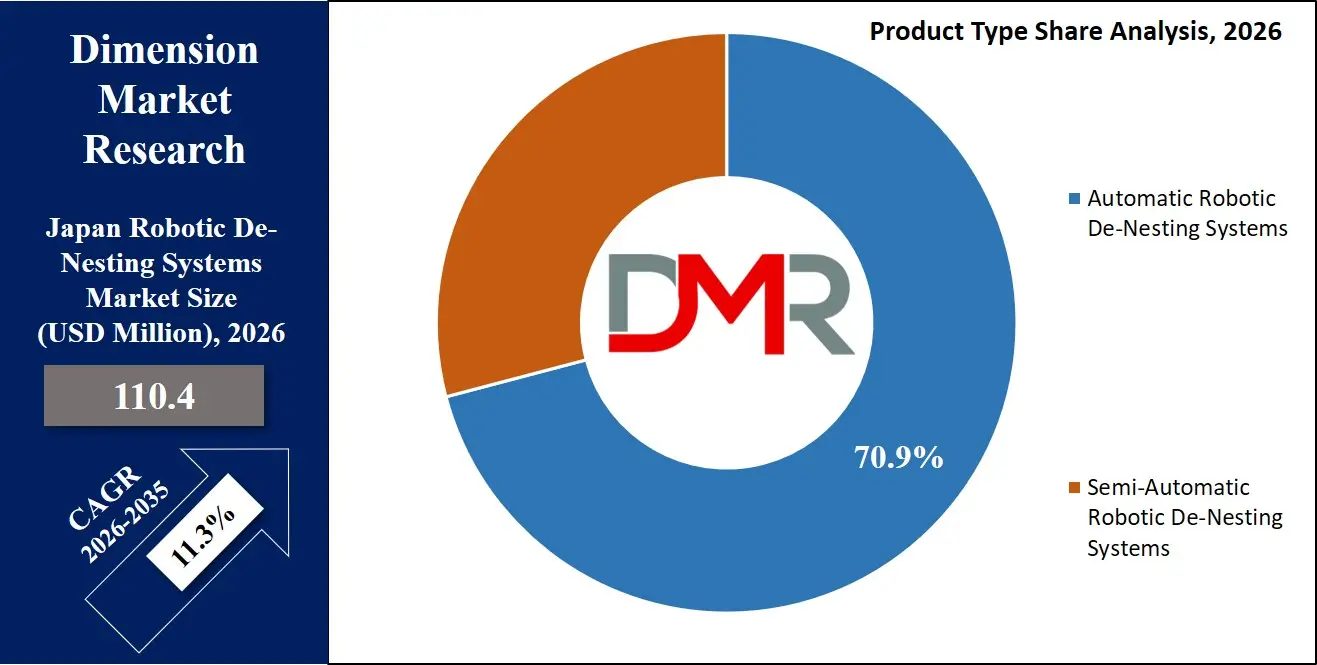
The Japan robotic de-nesting systems market is dominated by automatic robotic de-nesting systems, which occupy approximately 70.9% of the market in 2026 because of the extensive application in high-volume packaging lines and fully unattended manufacturing cells. This is followed by semi-automatic systems owing to their flexibility in mixed-product, low-volume runs.
ℹ
To learn more about this report –
Download Your Free Sample Report Here
There is a growing popularity of the use of automatic systems in food and beverage and electronics applications. The presence of constant innovation in the technologies of vision-guided and AI-based grippers also contributes to the superiority of automatic systems in the Japanese market.
By System Configuration Analysis
Integrated systems lead with approximately 44.8% share in 2026, favored for seamless communication with existing production lines and centralized control. Standalone systems are widely used in modular cells and retrofits. Flexible/mobile systems are gaining traction in logistics and warehousing. Other configurations include customized hybrid setups. The shift toward reconfigurable systems combining standalone flexibility with integrated data flow is emerging as a key trend in next-generation robotic de-nesting.
By Application Analysis
Packaging is expected to have a share of approximately 40.1% in 2026 because of the high volume of tray, carton, and container de-nesting in consumer goods. Food and beverage applications like bakery and ready-meal lines still hold a large share. The rising popularity of hygienic and pharmaceutical de-nesting is also increasing the proportion of specialized robotic systems in Japan.
By Distribution Channel Analysis
Direct sales represent the largest distribution channel with approximately 52.0% share in 2026, driven by complex integration needs and long-term service contracts. An aging Japanese industrial base with high technical requirements is expected to sustain demand for direct sales and value-added distribution. The growing preference for end-to-end automation solutions is further strengthening direct sales as the preferred channel for large-scale manufacturing clients.
By End User Analysis
Manufacturing is the end-user that is most dominant, with approximately 58.0% share in 2026, featuring the largest number of installations and high-tech automated cells. The growth of hybrid production-logistics facilities and automated micro-fulfillment centers is slowly changing the end-user environment of the Japanese industrial automation industry. Continued investment in smart factory initiatives across the automotive and electronics sectors is expected to sustain manufacturing's leading position throughout the forecast period.
The Japan Robotic De-Nesting Systems Market Report is segmented on the basis of the following:
By Product Type
- Automatic Robotic De-Nesting Systems
- Semi-Automatic Robotic De-Nesting Systems
By System Configuration
- Standalone Systems
- Integrated Systems
- Flexible / Mobile Systems
By Application
- Food and Beverage
- Pharmaceuticals
- Packaging
- Automotive
- Electronics
- Others
By Distribution Channel
- Direct Sales
- Distributors
- Online Sales
- Others
By End-User
- Manufacturing
- Logistics
- Warehousing
- Others
Impact of Artificial Intelligence in the Japan Robotic De-Nesting Systems Market
Artificial intelligence is changing the Japan robotic de-nesting systems market, as now it allows vision-based part recognition, optimal gripper path planning, and real-time anomaly detection during the de-nesting process because of the AI-based technologies that minimize product damage and reduce changeover time. Collaborative interventions have also been used in combination with AI to enhance throughput, precision, and operational efficiency in highly precision-focused Japanese production cells.
Moreover, AI supports predictive analysis of gripper wear and remote fleet monitoring based on continuous operational data to reduce unplanned downtime as well as improve the scheduling of preventative maintenance and the overall safety and scalability of robotic de-nesting systems.
Japan Robotic De-Nesting Systems Market: Competitive Landscape
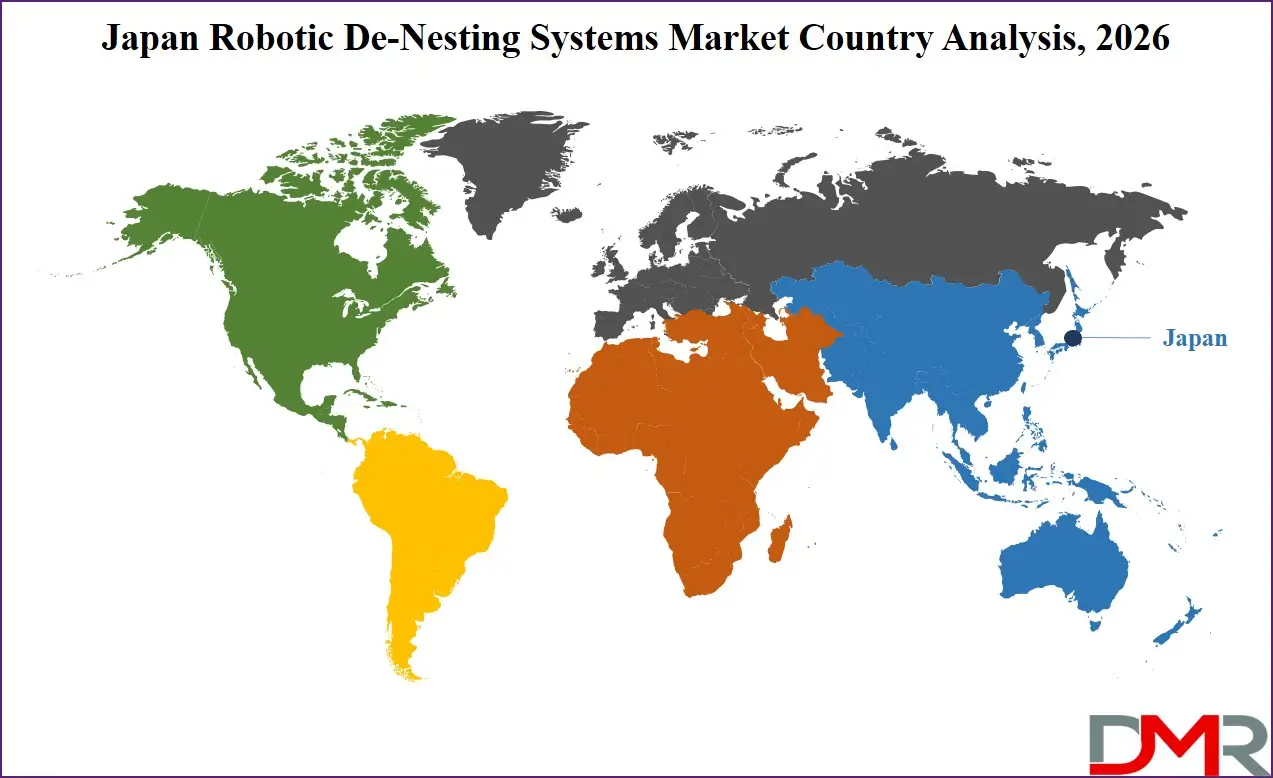
The Japan robotic de-nesting systems market is moderate in terms of level of consolidation and competition, with global and regional firms offering full ranges of automated handling equipment and end-of-arm tooling solutions. Competition is based on innovation, integration simplicity, and end-to-end de-nesting cells, including AI-guided and flexible/mobile systems.
ℹ
To learn more about this report –
Download Your Free Sample Report Here
The greatest needs are found in high-volume urban production centers where seismic compliance, engineering accuracy, and long-term system reliability are the distinguishing factors. Other competencies that companies employ to respond to different manufacturing and logistics needs are customization, cost efficiency, and ease of integration.
Some of the prominent players in the Japan Robotic De-Nesting Systems Market are:
- FANUC Corporation
- Yaskawa Electric Corporation
- ABB Ltd.
- KUKA AG
- Kawasaki Heavy Industries, Ltd.
- Mitsubishi Electric Corporation
- Omron Corporation
- DENSO Corporation
- Universal Robots A/S
- Stäubli International AG
- Yamaha Motor Co., Ltd.
- Nachi-Fujikoshi Corp.
- BluePrint Automation
- JLS Automation
- Brillopak Ltd.
- Schubert Group
- FlexLink
- Scott Automation & Robotics
- Shibuya Corporation
- PMI Kyoto Packaging Systems
- Other Key Players
Recent Developments in the Japan Robotic De-Nesting Systems Market
- March 2026: ABB Ltd. collaborated with NVIDIA to advance AI-enabled robotics and intelligent automation systems, supporting next-generation industrial applications such as material handling and flexible manufacturing.
- March 2026: FANUC Corporation announced a USD 90 million investment through its subsidiary FANUC America to build a new robot manufacturing and distribution facility in Michigan, aimed at expanding production capacity to meet rising global demand for automation solutions, including AI-enabled robotics and material handling systems.
- March 2025: KUKA AG introduced new autonomous mobile robotics (AMR) solutions such as the KMP 3000P, designed to enhance intralogistics and material handling efficiency through AI-enabled navigation and flexible load transport systems.
Report Details
| Report Characteristics |
| Market Size (2026) |
USD 110.4 Mn |
| Forecast Value (2035) |
USD 289.2 Mn |
| CAGR (2026–2035) |
11.3% |
| Historical Data |
2021 – 2025 |
| Forecast Data |
2027 – 2035 |
| Base Year |
2025 |
| Estimate Year |
2026 |
| Report Coverage |
Market Revenue Estimation, Market Dynamics, Competitive Landscape, Growth Factors and etc. |
| Segments Covered |
By Product Type (Automatic Robotic De-Nesting Systems, Semi-Automatic Robotic De-Nesting Systems), By System Configuration (Standalone Systems, Integrated Systems, Flexible / Mobile Systems), By Application (Food and Beverage, Pharmaceuticals, Packaging, Automotive, Electronics, Others), By Distribution Channel (Direct Sales, Distributors, Online Sales, Others), By End-User (Manufacturing, Logistics, Warehousing, Others) |
| Country Coverage |
Japan |
| Prominent Players |
FANUC Corporation, Yaskawa Electric Corporation, ABB Ltd., KUKA AG, Kawasaki Heavy Industries, Ltd., Mitsubishi Electric Corporation, Omron Corporation, DENSO Corporation, Universal Robots A/S, Stäubli International AG, Yamaha Motor Co., Ltd., Nachi-Fujikoshi Corp., BluePrint Automation, JLS Automation, Brillopak Ltd., Schubert Group, FlexLink, Scott Automation & Robotics, Shibuya Corporation, PMI Kyoto Packaging Systems, and Other Key Players |
| Purchase Options |
We have three licenses to opt for: Single User License (Limited to 1 user), Multi-User License (Up to 5 Users), and Corporate Use License (Unlimited User) along with free report customization equivalent to 0 analyst working days, 3 analysts working days and 5 analysts working days respectively. |
Frequently Asked Questions
How big is the Japan Robotic De-Nesting Systems Market?
▾ The Japan Robotic De-Nesting Systems Market size is estimated to have a value of USD 110.4 million in 2026 and is expected to reach USD 289.2 million by the end of 2035.
What is the growth rate in the Japan Robotic De-Nesting Systems Market in 2026?
▾ The market is growing at a CAGR of 11.3% over the forecasted period of 2026.
Who are the key players in the Japan Robotic De-Nesting Systems Market?
▾ Some of the major key players in the Japan Robotic De-Nesting Systems Market are FANUC Corporation, Yaskawa Electric Corporation, ABB Ltd., KUKA AG, Kawasaki Heavy Industries, Ltd., Mitsubishi Electric Corporation, and many others.