What is the Japan Smart Home Market Size?
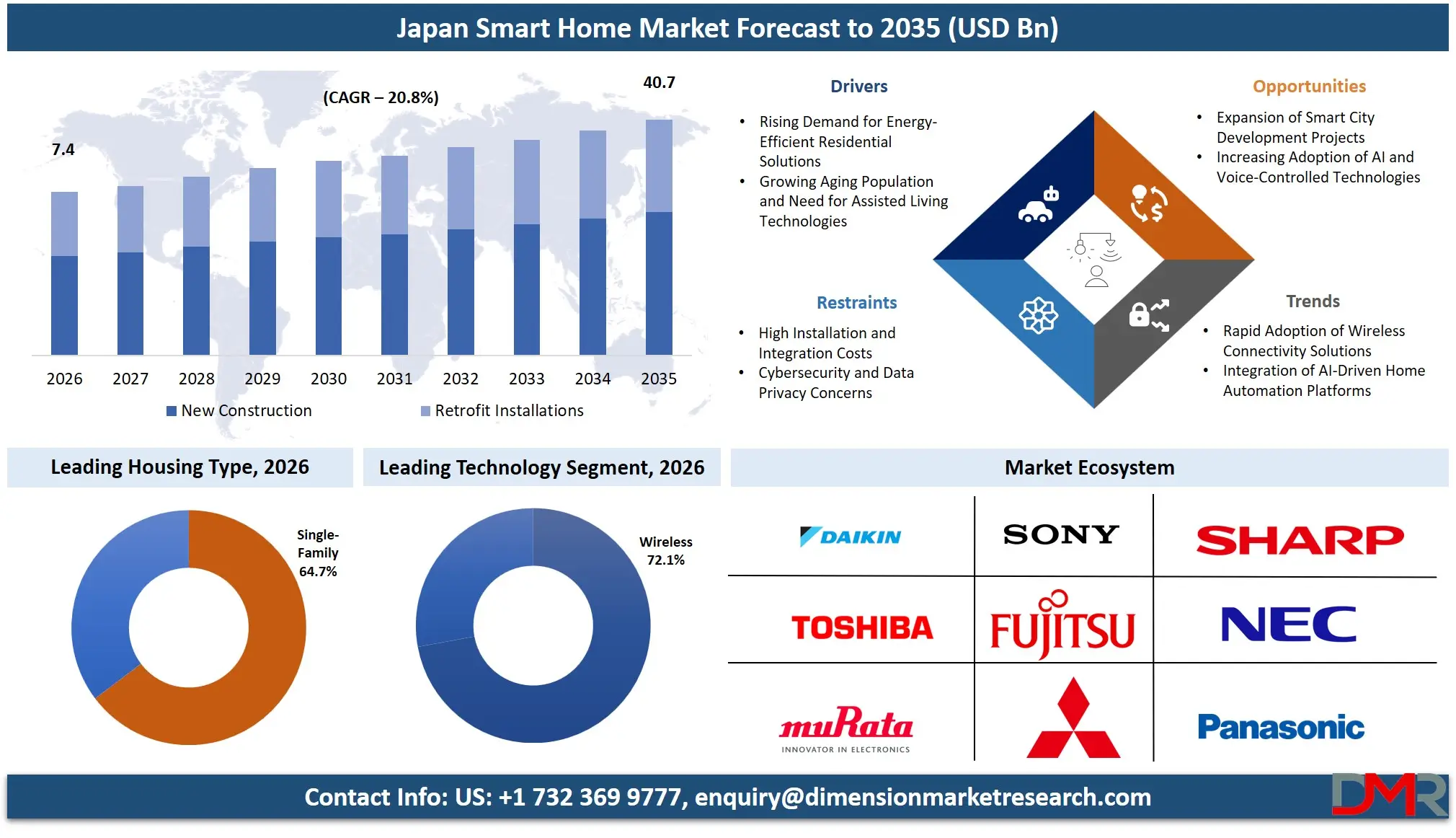
The Japan Smart Home Market size is expected to be USD 7.4 billion in 2026 and increase at a compound annual growth rate of 20.8% to USD 40.7 billion in 2035 owing to rising costs in electricity and goals in minimizing the country's carbon emissions.
ℹ
To learn more about this report –
Download Your Free Sample Report Here
The Japan Smart Home Market can be described as the industry that deals with the provision of interconnected and automated solutions that aim at making the living conditions convenient, secure, energy-efficient, and manageable. Such solutions include smart lighting, HVAC, smart security, smart appliances, entertainment solutions, and health monitoring solutions utilizing the IoT and AI technologies. The factors behind the growth of intelligent homes in Japan include smart cities development, demand for energy-efficient houses, and an aging population in Japan.
ℹ
To learn more about this report –
Download Your Free Sample Report Here
Key Takeaways
- Market Size & Forecast: The Japan Smart Home Market size is projected to reach USD 7.4 billion in 2026 and is anticipated to have a value of USD 40.7 billion in 2035.
- Growth Rate & Outlook: The Japan Smart Home Market size is set to grow at a compound annual growth rate of 20.8% during the forecast period of 2026 to 2035.
- Primary Growth Drivers: Some of the major growth drivers in the market are Energy-Efficient Home Technology Requirements Increasing in Demand, and more.
- Key Market Trends: Some of the major trends in the market are Increase in Fast Deployment of Wireless Connectivity Technology, and more.
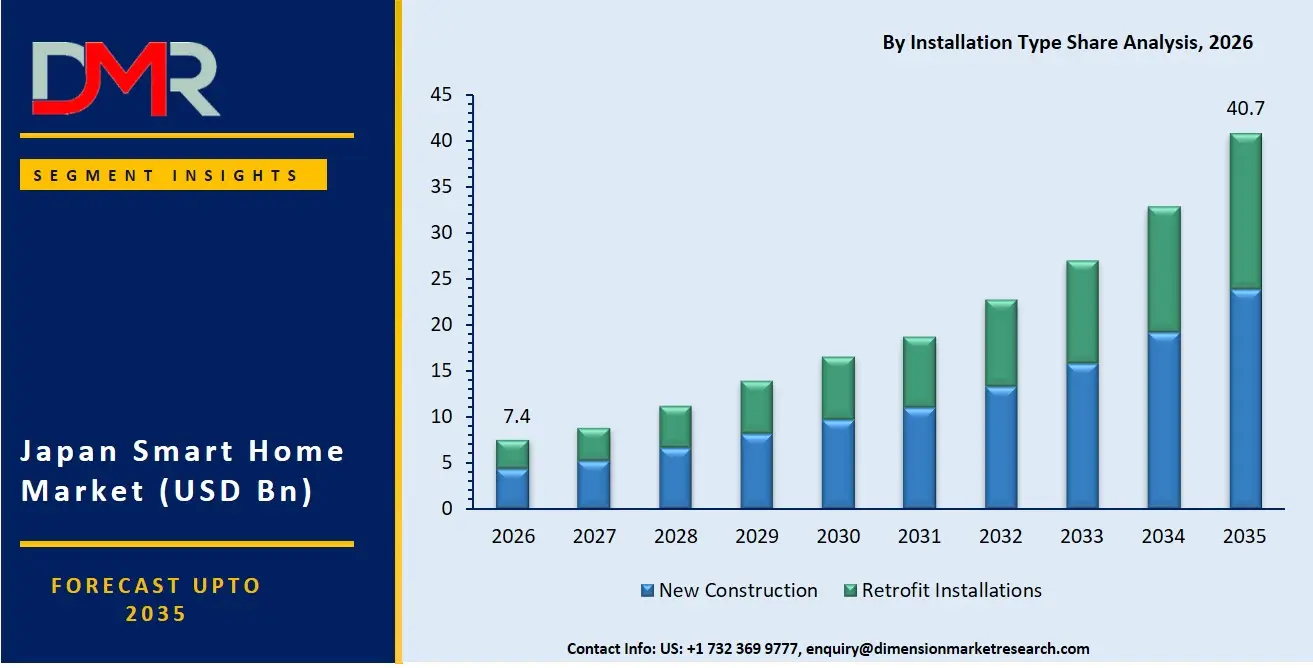
- By Installation Type: New Construction segment is anticipated to get the majority share of the Japan Smart Home Market in 2026.
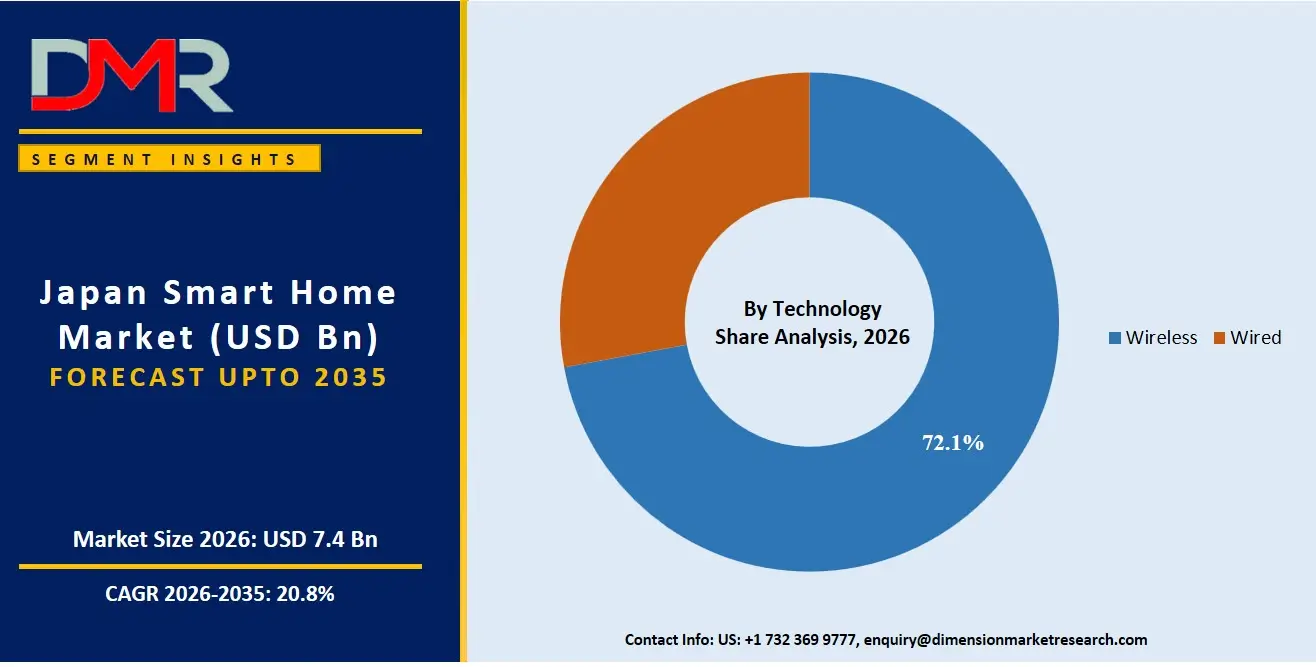
- By Technology: Wireless is expected to get the largest revenue share in 2026 in the Japan Smart Home Market.
- By Housing Type: Single Family segment is expected to get the largest revenue share in 2026 in the Japan Smart Home Market.
What is the Smart Home?
Smart home are the homes that makes use of interconnections among various devices, automation technology, sensors, software platforms, and Internet of Things-powered devices to offer enhanced convenience, safety, energy efficiency, and comfort within the residential premises. These include smart lighting, heating, ventilation and air conditioning (HVAC) control systems, entertainment centers, health care monitoring, and smart kitchen technology that are managed using mobile applications and voice commands. The significance of the market stems from demographic factors such as Japan's aging population, urbanization trends, increased cost of electricity, and widespread deployment of connected technologies. Growth drivers like artificial intelligence-powered automation, energy management technology, and wireless technology are pushing the growth of the market.
Use Cases
- Energy Efficiency Management: Connected smart thermostats and other devices used to manage the heating ventilation and air conditioning (HVAC) systems make smart houses more energy efficient, reducing energy expenses for the households and promoting sustainability objectives on a national level.
- Remote Health Care Systems for Elderly: The increasing proportion of senior population in Japan is creating an increased demand for home health monitoring solutions, making it possible for family members to track the health status of senior relatives remotely and improve their living quality.
- Home Security Solutions: Smart homes in Japan implement various security measures including smart cameras, advanced access control systems, and other technologies which help secure houses from any unauthorized access.
- Entertainment Devices Connectivity: Consumers increasingly rely on smart home entertainment ecosystems where all entertainment equipment is connected in order to provide more personalized and convenient user experience.
How AI Is Transforming the Japan Smart Home Market
Artificial intelligence is having a major impact on the evolution of smart home environments in Japan, through predictive automation, personalization of user experience, and intelligent energy management. Predictive automation involves the use of consumer behavior analysis to ensure that lighting, heating/cooling, entertainment, and appliance management is automated. In addition, voice-activated machine learning algorithms have been designed to enhance natural language processing for improved consumer convenience.
AI technologies have also been instrumental in boosting the safety and medical monitoring capabilities in smart homes. Smart surveillance technology, along with facial recognition capabilities, allows for real-time threat detection in homes. Wellness devices with AI capabilities have been designed to facilitate senior care and remote monitoring in case of emergencies.
Market Dynamic
Driving Factors in the Japan Smart Home Market
Energy-Efficient Home Technology Requirements Increasing in Demand
As a result of rising costs in electricity and goals in minimizing the country's carbon emissions, the Japanese are beginning to integrate intelligent technologies that allow them to save energy at home. This is facilitated by advanced technologies such as smart thermostats and HVAC (Heating, Ventilation, Air Conditioning).
Restraints in the Japan Smart Home Market
High Costs of Setup and Installation
The use of sophisticated smart homes comes at quite a price in terms of initial hardware and software integration. Consumers are generally deterred by the costly nature of implementing automated home systems. The process becomes even more difficult when it involves setting up connected devices within the pre-existing framework of old houses, which also drives up costs of setup.
Opportunities in the Japan Smart Home Market
Development of Smart City Initiatives
The current efforts by Japan towards developing smart cities have provided many possibilities regarding integrated residential automation systems. Current urban renewal plans are geared toward development of efficient infrastructures, interconnected living environments, and intelligent residential systems. The smart home is now seen as a key aspect of the digital ecosystem, thus facilitating the cooperation between technology firms and real estate and utilities organizations.
Trends in the Japan Smart Home Market
Fast Deployment of Wireless Connectivity Technology
Wireless connectivity solutions such as Wi-Fi, Zigbee, Bluetooth, and Matter systems have been widely adopted as replacements for conventional wired-based technology in smart homes. The popularity of wireless connectivity technology can be attributed to factors such as simplicity and ease of deployment, flexibility, and compatibility with mobile phones. It facilitates the addition of more smart devices in residential homes.
Research Scope and Analysis
This report includes various segments such as product type, installation type, technology, type of housing, and sales channel. This report studies market trends, technological developments, consumer acceptance, and other factors affecting the growth of this market. It further provides an overview of the demand for energy-saving, AI-based, and connectivity-based home systems in new constructions as well as existing housing in Japan.
ℹ
To learn more about this report –
Download Your Free Sample Report Here
By Product Type Analysis
The Security & Access Control segment is estimated to capture the dominant market share of about 27.8% in 2026, attributed to rising awareness amongst consumers about the safety of their homes, adoption of surveillance technology, and increasing need for remote monitoring services. Smart cameras, biometric access control systems, motion detectors, and mobile-controlled alarms have seen high acceptance in urban homes. In addition, improvements in technologies such as artificial intelligence-powered threat detection systems and cloud-based security systems are contributing to the growth of this segment. The Home Healthcare & Wellness segment is expected to be the fastest-growing segment in terms of CAGR in the Japanese home automation market, due to Japan's aging population base and preference for remote health management services. Smart monitoring devices for wellness purposes and connected healthcare apps are experiencing rapid adoption by elderly people.
By Installation Type Analysis
New Construction is anticipated to lead in terms of market share, occupying a share of about 58.4% in 2026, owing to increasing deployment of smart infrastructure in modern constructions and redevelopment. Increasing use of connected systems like automation of lighting, heating ventilation air conditioning, and security solutions in real estate development is resulting in greater property valuation as well as efficient energy consumption. The rising government mandates for sustainability have further driven the adoption of these solutions within new constructions. On the other hand, Retrofit Installations are predicted to grow at the highest rate due to growing demands of cost-effective methods to integrate smart infrastructure into old residences. Deployment of wireless systems and plug-and-play smart devices is making retrofitting easier and less complicated.
By Technology Analysis
Wireless Technologies are projected to capture about 72.1% market share in 2026 owing to the flexibility involved in installation, reduced infrastructure needs, and suitability for use in multiple connected devices. Wireless Technologies include Wi-Fi, Bluetooth, Zigbee, and Matter enabled networks that facilitate interconnectivity of smart appliances, smart lighting, and security systems. Wireless systems are more favored by consumers as they are easy to integrate into both new and existing homes. Cloud Computing and mobile-based application technologies are also enhancing the performance of wireless-based smart home systems. On the other hand, Wired Technologies still hold value for premium housing developments where consistency in connectivity and centralization of automation are key considerations. Increasing consumer interest in portable and application-operated products, however, will further boost the growth of wireless-based ecosystems in the coming years.
By Housing Type Analysis
Single-Family Home are expected to account for about 64.7% of the market share by 2026, owing to higher levels of flexibility in adopting integrated automation solutions and better financial capabilities of the consumers. Such homes usually enable the installation of various smart security systems, energy management solutions, and entertainment solutions on a comprehensive basis. The growing desire of consumers for personalized automation solutions is also contributing to adoption of such solutions amongst single-family homes. On the other hand, Multi-Family Home are projected to exhibit a high rate of growth, driven by urbanization that is creating the need for smart apartments and multi-family residential complexes.
By Sales Channel Analysis
Offline Sales are forecasted to occupy a dominant market share of about 61.5% in 2026, owing to the preference of consumers towards physical retail stores and professional consultation during complicated installations of smart home products. Electronic store owners, home automation specialist sellers, and showroom brands have become increasingly significant when it comes to displaying product compatibility, installation needs, and after-sales services offered. The trend amongst buyers is to obtain advice from professionals prior to making an informed decision with regard to integrating smart home products in their household, especially with high-end home automation technologies. Nevertheless, Online Sales will record the highest growth rate, attributable to growing adoption of e-commerce sites, digital knowledge among buyers, and increased connectivity of devices on e-commerce platforms.
The Japan Smart Home Market Report is segmented on the basis of the following:
By Product Type
- Security & Access Control
- Lighting Control
- HVAC Control
- Smart Appliances
- Entertainment & Other Controls
- Smart Kitchen
- Home Healthcare & Wellness
By Installation Type
- Retrofit Installations
- New Construction
By Technology
- Wireless Technologies
- Wired Technologies
By Housing Type
- Single-Family Home
- Multi-Family Home
By Sales Channel
- Online Sales
- Offline Sales
Competitive Landscape
There is a very strong competition in the Japan smart homes market, which is caused by technological advancements, integration within the ecosystem, and constant investment in connectivity within the residential sector. There is an increasing emphasis by companies in making devices more interoperable, developing better AI functionalities, and providing enhanced cybersecurity measures that ensure greater customer loyalty. Partnering with telecommunications, real estate, and energy companies is now commonplace for companies to increase their market presence. There is a high barrier to entry due to the large costs associated with research and development, as well as sophisticated technology needs.
Some of the prominent players in the Japan Smart Home are:
- Panasonic Holdings Corporation
- Sony Group Corporation
- Sharp Corporation
- Mitsubishi Electric Corporation
- Hitachi Ltd.
- Toshiba Corporation
- NEC Corporation
- SoftBank Group Corporation
- Rakuten Group Inc.
- LIXIL Corporation
- Daikin Industries Ltd.
- Fujitsu Limited
- Murata Manufacturing Co. Ltd.
- Omron Corporation
- Buffalo Inc.
- Iris Ohyama Inc.
- Balmuda Inc.
- Google LLC
- Amazon.com Inc.
- Apple Inc.
- Other Key Players
Recent Developments
- In April 2026, A strategic partnership between Hitachi, Ltd., and Nojima Corporation is geared towards reinforcing the performance of the Hitachi brand name in the market segment of household appliances within Japan. Through this cooperation, Nojima's experience in customer relations and retailing will be integrated with the manufacturing prowess of Hitachi, thus accelerating the availability of top-notch appliances among others.
- In March 2026, SEALSQ Corporation became an associate member of the ECHONET Consortium in order to promote the development of security standards for smart homes and energy management systems. With the help of the agreement, SEALSQ will utilize the INeS Public Key Infrastructure technology in order to improve device identity and security features on the ECHONET Lite platform.
- In December 2025, J:COM and Plume have launched J:COM's first Wi-Fi 7 service for residential customers in Japan, combining high-performance Wi-Fi 7 gateways with Plume's AI-powered cloud platform. The service is designed to deliver faster speeds, stronger connectivity, and improved coverage for increasingly connected households, particularly in dense urban environments, supporting the next generation of smart home devices across Japan.
Report Details
| Report Characteristics |
| Market Size (2026) |
USD 7.4 Bn |
| Forecast Value (2035) |
USD 40.7 Bn |
| CAGR (2026–2035) |
20.8% |
| Historical Period |
2021 – 2025 |
| Forecast Period |
2027 – 2035 |
| Base Year |
2025 |
| Estimate Year |
2026 |
| Segments Covered |
By Product Type, By Installation Type, By Technology, By Housing Type, By Sales Channel |
| Country Coverage |
Japan |
Frequently Asked Questions
How big is the Japan Smart Home Market?
▾ The Japan Smart Home Market size is expected to reach USD 7.4 billion by 2026 and is projected to reach USD 40.7 billion by the end of 2035.
What is the CAGR of the Japan Smart Home Market from 2026 to 2035?
▾ The market is growing at a CAGR of 20.8 percent over the forecasted period.
What factors are driving the growth of the Japan Smart Home Market?
▾ Energy-Efficient Home Technology Requirements Increasing in Demand, and more are the factors driving the growth of the Japan Smart Home Market.
What are the major trends in the Japan Smart Home Market?
▾ Fast Deployment of Wireless Connectivity Technology, and more are some of the major trends in the market.
Who are the key players in the Japan Smart Home Market?
▾ Some of the key players in the Japan Smart Home Market include Sony, Toshiba, NEC, and more
How is the Japan Smart Home Market segmented?
▾ The Japan Smart Home Market is segmented by product type, installation type, technology, housing type, sales channel.