What is the Japan Software-as-a-Service (SaaS) Market Size?
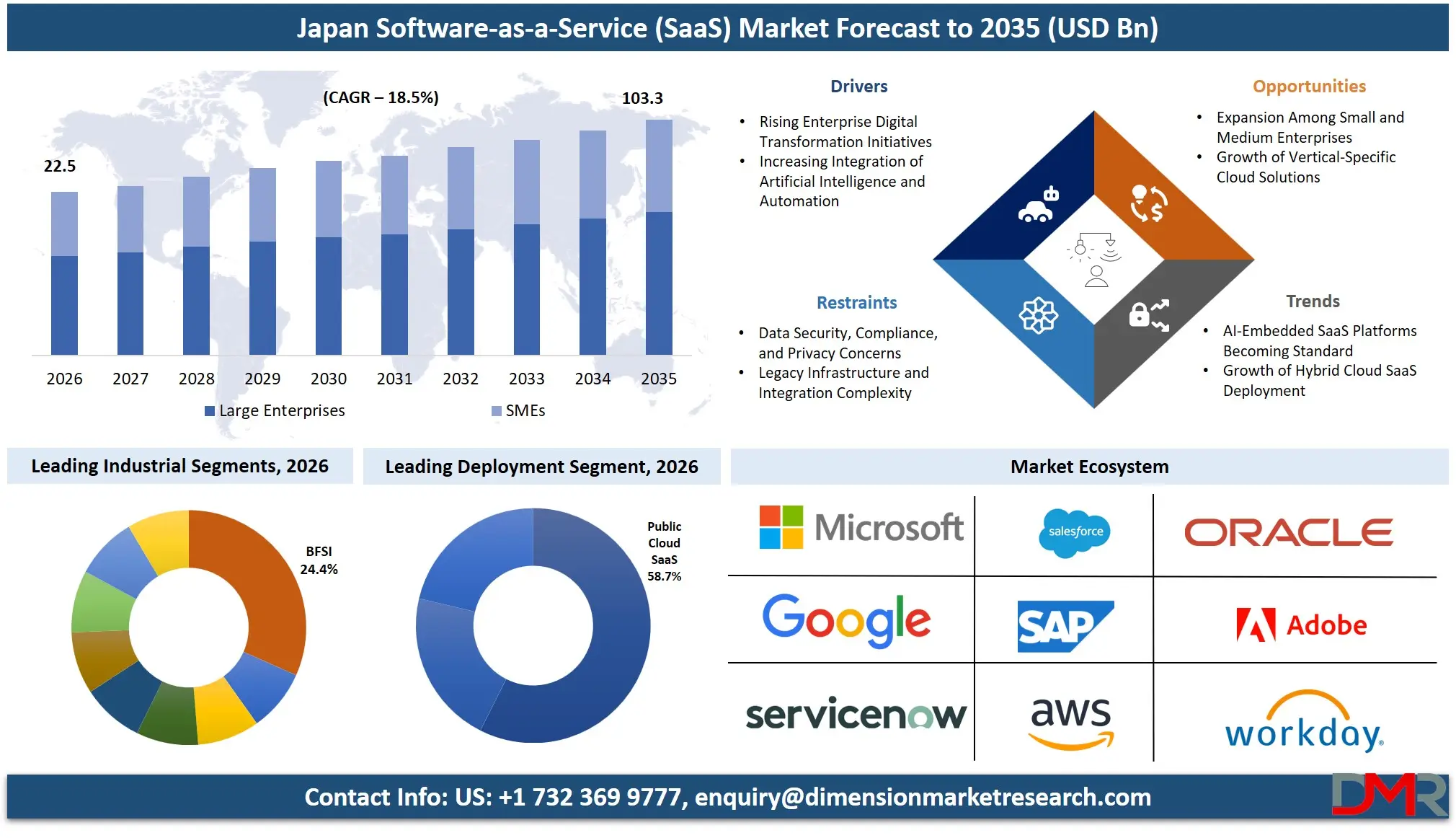
The Japan Software-as-a-Service (SaaS) Market size is expected to be USD 22.5 billion in 2026 and increase at a compound annual growth rate of 18.5% to USD 103.3 billion in 2035 owing to rising enterprise digital transformation initiatives.
ℹ
To learn more about this report –
Download Your Free Sample Report Here
The Japan Software-as-a-Service (SaaS) market encompasses cloud-based software solutions delivered through subscription models, enabling organizations to access applications over the internet without extensive on-premises infrastructure. The market includes enterprise applications, collaboration tools, customer management platforms, finance solutions, and industry-specific software that enhance operational efficiency and digital transformation. Growing cloud adoption, enterprise modernization, remote and hybrid work models, AI integration, cybersecurity enhancements, and increasing demand for scalable subscription-based software are accelerating market expansion. Businesses are prioritizing automation, data-driven decision-making, and flexible IT architectures, reinforcing SaaS as a cornerstone of Japan's evolving digital economy.
Key Takeaways
- Market Size & Forecast: The Japan Software-as-a-Service (SaaS) Market size is projected to reach USD 22.5 billion in 2026 and is anticipated to have a value of USD 103.3 billion in 2035.
- Growth Rate & Outlook: The Japan Software-as-a-Service (SaaS) Market size is set to grow at a compound annual growth rate of 18.5% during the forecast period of 2026 to 2035.
- Primary Growth Drivers: Some of the major growth drivers in the market are Rising Enterprise Digital Transformation Initiatives, and more.
- Key Market Trends: Some of the major trends in the market are Growth of Hybrid Cloud SaaS Deployment and more.
- By Organization Size Type: Large enterprises is expected to get the largest revenue share in 2026 in the Japan Software-as-a-Service (SaaS) Market.
- By Industrial Vertical Type: BFSI is expected to get the largest revenue share in 2026 in the Japan Software-as-a-Service (SaaS) Market.
- By Deployment Type: Public Cloud segment is expected to get the largest revenue share in 2026 in the Japan Software-as-a-Service (SaaS) Market.
What is the Software-as-a-Service (SaaS) Market?
Software-as-a-Service (SaaS) is a cloud computing model in which software applications are hosted by a service provider and delivered to users through the internet on a subscription basis. Users access applications via web browsers or dedicated interfaces without installing or maintaining underlying infrastructure. SaaS enables automatic updates, scalability, centralized data management, lower upfront costs, and seamless accessibility across devices, making it suitable for organizations of all sizes.
Use Cases
- Enterprise Business Operations: Organizations utilize SaaS platforms to streamline finance, procurement, human resources, and operational workflows through centralized applications. These solutions improve efficiency, reduce IT maintenance costs, enable real-time collaboration, and simplify software upgrades across distributed business environments.
- Customer Relationship Management: Businesses deploy SaaS-based CRM solutions to manage customer interactions, automate sales processes, analyze customer behavior, and improve marketing effectiveness. Cloud accessibility enables sales teams to work remotely while maintaining real-time visibility into customer pipelines.
- Collaboration and Workforce Productivity: Companies leverage SaaS collaboration platforms for document sharing, communication, project management, and virtual meetings. These applications support hybrid work environments by improving coordination, productivity, and secure information exchange among geographically dispersed employees.
- Industry-Specific Digital Transformation: Healthcare providers, manufacturers, retailers, financial institutions, and educational organizations adopt specialized SaaS solutions for compliance, workflow automation, analytics, inventory management, patient records, and customer engagement, enabling sector-specific operational improvements and innovation.
How AI Is Transforming the Japan Software-as-a-Service (SaaS) Market
Artificial intelligence is transforming SaaS platforms by introducing intelligent automation, predictive analytics, natural language processing, and personalized user experiences. AI-powered capabilities automate repetitive workflows, improve customer engagement, accelerate document processing, strengthen cybersecurity monitoring, and support faster business decision-making through advanced data analysis.
Generative AI is also enabling SaaS providers to develop intelligent assistants, automated reporting tools, coding support, knowledge management systems, and workflow optimization features. These innovations increase operational efficiency, reduce manual intervention, improve software usability, and enhance the overall value proposition of cloud-based enterprise applications across diverse industries.
Market Dynamic
Driving Factors in the Japan Software-as-a-Service (SaaS) Market
Rising Enterprise Digital Transformation Initiatives
Japanese enterprises are accelerating digital transformation strategies to modernize legacy systems and improve business agility. SaaS platforms reduce infrastructure complexity while enabling rapid software deployment, automatic updates, and flexible scalability. Organizations increasingly prioritize cloud-native applications to improve productivity, support hybrid work, enhance collaboration, and strengthen operational resilience. Continuous investments in digital technologies across both public and private sectors are creating sustained demand for SaaS adoption.
Restraints in the Japan Software-as-a-Service (SaaS) Market
Data Security, Compliance, and Privacy Concerns
Despite growing cloud adoption, many organizations remain cautious regarding sensitive data storage, regulatory compliance, and cybersecurity risks. Strict governance requirements and industry-specific regulations often require extensive security assessments before SaaS deployment. Concerns surrounding data residency, unauthorized access, and compliance management may delay cloud migration decisions, particularly among highly regulated industries including finance, healthcare, and government.
Opportunities in the Japan Software-as-a-Service (SaaS) Market
Expansion Among Small and Medium Enterprises
Small and medium-sized enterprises are increasingly recognizing SaaS as a cost-effective alternative to traditional software deployment. Subscription pricing, lower maintenance requirements, rapid implementation, and flexible scalability enable SMEs to access advanced business applications previously affordable only for large organizations. Growing digitalization among SMEs presents substantial long-term opportunities for SaaS providers across multiple application categories.
Trends in the Japan Software-as-a-Service (SaaS) Market
Growth of Hybrid Cloud SaaS Deployment
Many enterprises are adopting hybrid cloud deployment models that combine private infrastructure with public cloud environments. Hybrid SaaS enables organizations to balance security, compliance, scalability, and operational flexibility while supporting gradual migration from legacy systems. This deployment approach is becoming increasingly attractive for organizations managing sensitive workloads alongside modern cloud applications.
Research Scope and Analysis
The research scope covers comprehensive analysis of the Japan Software-as-a-Service (SaaS) market across deployment models, enterprise sizes, applications, and industry verticals. It evaluates market trends, technology adoption, competitive dynamics, growth drivers, restraints, opportunities, AI integration, customer demand patterns, and future investment potential to provide strategic insights into market performance and long-term development prospects.
ℹ
To learn more about this report –
Download Your Free Sample Report Here
By Deployment Model Analysis
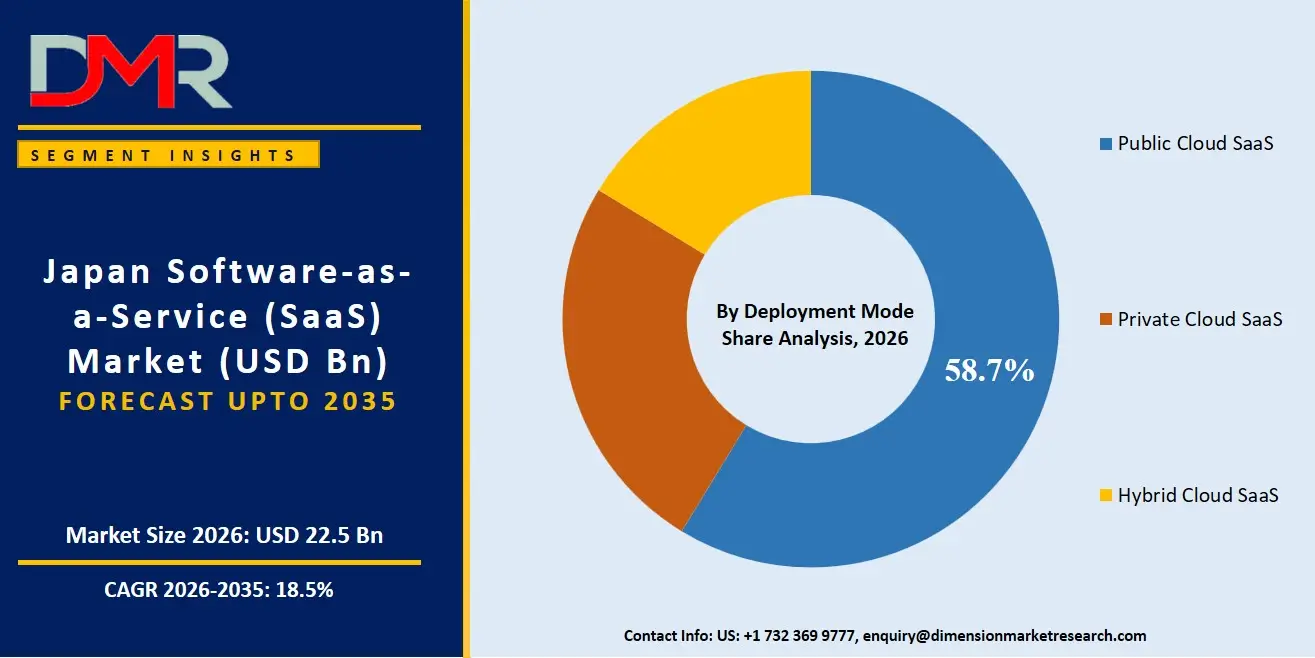
Public Cloud SaaS is estimated to account for 58.7% of the market share in 2026, making it the leading deployment model due to lower implementation costs, simplified management, continuous software updates, and rapid scalability. Organizations increasingly prefer public cloud platforms for collaboration, CRM, productivity, and business management applications because they reduce infrastructure investments while enabling flexible subscription models. Hybrid Cloud SaaS represents the fastest-growing deployment segment as enterprises seek to balance security, compliance, and scalability. Organizations handling sensitive workloads increasingly combine private infrastructure with public cloud applications, allowing gradual cloud migration while maintaining regulatory compliance and business continuity.
By Enterprise Size Analysis
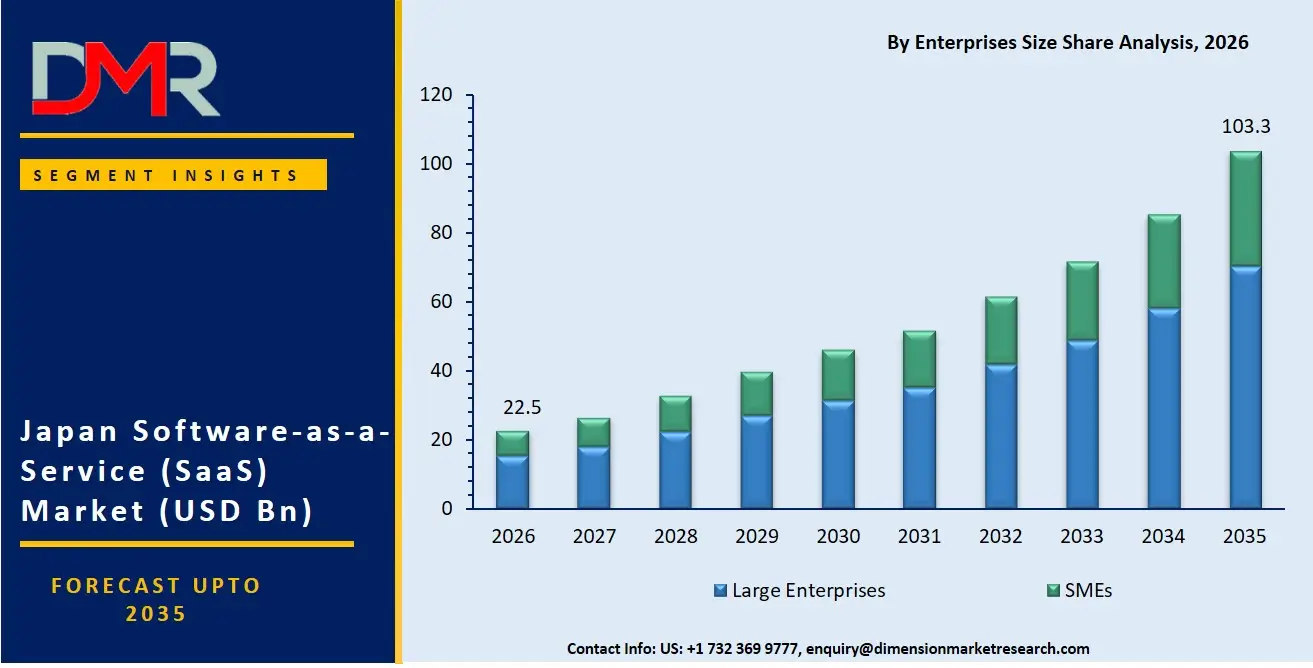
Large Enterprises are projected to hold approximately 67.9% of the market share in 2026 owing to extensive digital transformation investments, complex IT environments, and greater demand for enterprise-grade SaaS platforms. These organizations deploy cloud software across multiple departments to improve operational efficiency, analytics, compliance, and workforce collaboration.
ℹ
To learn more about this report –
Download Your Free Sample Report Here
Meanwhile, Small & Medium Enterprises are expected to record the fastest growth due to increasing awareness of subscription-based software, affordable pricing, simplified implementation, and government initiatives supporting SME digitalization. Growing access to cloud infrastructure enables SMEs to adopt advanced enterprise applications without significant capital investments.
By Application Analysis
Customer Relationship Management (CRM) is anticipated to capture 22.8% of the market share in 2026, supported by increasing enterprise focus on customer engagement, sales automation, marketing optimization, and data-driven relationship management. CRM solutions enable businesses to centralize customer information while improving service quality and sales efficiency. Marketing Automation is expected to emerge as the fastest-growing application segment as organizations increasingly invest in personalized digital marketing, campaign automation, AI-powered customer analytics, and omnichannel engagement strategies. Businesses continue expanding SaaS adoption to strengthen customer acquisition and retention initiatives.
By Industrial Vertical Analysis
Banking, Financial Services & Insurance (BFSI) is expected to account for 24.4% of the market share in 2026 due to strong investments in digital banking, regulatory compliance, cybersecurity, customer relationship management, and financial process automation. Financial institutions increasingly deploy SaaS platforms to improve operational efficiency while ensuring secure data management. Healthcare & Life Sciences is projected to become the fastest-growing industry vertical as healthcare organizations accelerate digital transformation, electronic health record modernization, telehealth expansion, compliance management, and AI-enabled clinical workflow optimization.
The Japan Software-as-a-Service (SaaS) Market Report is segmented on the basis of the following:
By Deployment Model
- Public Cloud SaaS
- Private Cloud SaaS
- Hybrid Cloud SaaS
By Enterprise Size
- Small & Medium Enterprises (SMEs)
- Large Enterprises
By Application
- Customer Relationship Management (CRM)
- Enterprise Resource Planning (ERP)
- Human Capital Management (HCM)
- Collaboration & Productivity
- Finance & Accounting
- Supply Chain Management (SCM)
- IT Service Management (ITSM)
- Marketing Automation
- Other Applications
By Industry Vertical
- Banking, Financial Services & Insurance (BFSI)
- Healthcare & Life Sciences
- Retail & E-commerce
- IT & Telecommunications
- Manufacturing
- Government & Public Sector
- Education
- Media & Entertainment
- Other Industry Verticals
Competitive Landscape
The competitive landscape is characterized by continuous innovation, platform differentiation, AI integration, and expanding cloud ecosystems. Market participants emphasize research and development, cybersecurity enhancements, industry-specific product customization, and strategic partnerships with cloud infrastructure providers and system integrators to strengthen market positioning. High customer retention, seamless integration capabilities, reliable technical support, and recurring subscription revenue provide important competitive advantages. Market entry barriers remain significant due to established customer relationships, compliance requirements, extensive product portfolios, and ongoing investments in artificial intelligence, automation, and cloud infrastructure.
Some of the prominent players in the global Japan Software-as-a-Service (SaaS) Market are:
- Microsoft
- Salesforce
- Oracle
- SAP
- Google Cloud
- Amazon Web Services
- Adobe
- ServiceNow
- Workday
- Zoom Communications
- Atlassian
- Zoho Corporation
- freee K.K.
- Cybozu
- Sansan
- Money Forward
- Rakus
- NTT DATA
- Fujitsu
- NEC Corporation
- Other Key Players
Recent Developments
- In May 2025, Salesforce announced its acquisition of Informatica in a transaction valued at approximately USD 8 billion, strengthening its enterprise data management and AI capabilities. The acquisition is designed to improve trusted enterprise data availability for AI-powered applications while expanding Salesforce's Data Cloud ecosystem. By combining Informatica's data integration, governance, metadata management, and quality capabilities with Salesforce's CRM and AI platforms, the company aims to deliver more reliable enterprise AI solutions and accelerate digital transformation initiatives for customers worldwide.
- In April 2025, Microsoft expanded its Microsoft 365 Copilot portfolio by introducing new autonomous AI agent capabilities that automate complex enterprise workflows across business applications. The update enables organizations to create customized AI agents capable of handling repetitive operational processes, improving productivity, and reducing manual intervention. The enhanced platform also introduced stronger enterprise governance, expanded integration capabilities, and improved collaboration features. These innovations reinforce Microsoft's SaaS strategy by embedding generative AI directly into enterprise productivity software used across global organizations.
- In January 2025, ServiceNow expanded its strategic partnership with NVIDIA to accelerate enterprise AI adoption through advanced AI agents and intelligent workflow automation. The collaboration focuses on integrating NVIDIA AI technologies into the ServiceNow platform to improve automation, productivity, customer service, and IT operations. The partnership enables enterprises to develop customized AI assistants capable of handling complex business processes while maintaining governance, security, and operational transparency. The initiative supports growing enterprise demand for intelligent SaaS platforms that combine workflow automation with generative AI capabilities.
Report Details
| Report Characteristics |
| Market Size (2026) |
USD 22.5 Bn |
| Forecast Value (2035) |
USD 103.3 Bn |
| CAGR (2026–2035) |
18.5% |
| Historical Period |
2021 – 2025 |
| Forecast Period |
2027 – 2035 |
| Base Year |
2025 |
| Estimate Year |
2026 |
| Segments Covered |
By Deployment Model, By Enterprise Size, By Application, By Industry Vertical |
| Country Coverage |
Japan |
Frequently Asked Questions
How big is the Japan Software-as-a-Service (SaaS) Market?
▾ The Japan Software-as-a-Service (SaaS) Market size is expected to reach USD 22.5 billion by 2026 and is projected to reach USD 103.3 billion by the end of 2035.
What is the CAGR of the Japan Software-as-a-Service (SaaS) Market from 2026 to 2035?
▾ The market is growing at a CAGR of 18.5 percent over the forecasted period.
What factors are driving the growth of the Japan Software-as-a-Service (SaaS) Market?
▾ Rising Enterprise Digital Transformation Initiatives, and more are the factors driving the growth of the Japan Software-as-a-Service (SaaS) Market.
What are the major trends in the Japan Software-as-a-Service (SaaS) Market?
▾ Growth of Hybrid Cloud SaaS Deployment, and more are some of the major trends in the market.
Who are the key players in the Japan Software-as-a-Service (SaaS) Market?
▾ Some of the key players in the Japan Software-as-a-Service (SaaS) Market include AWS, Google, SAP, and more.
How is the Japan Software-as-a-Service (SaaS) Market segmented?
▾ The Japan Software-as-a-Service (SaaS) Market is segmented by deployment model, enterprise size, application, industry vertical.