Market Overview
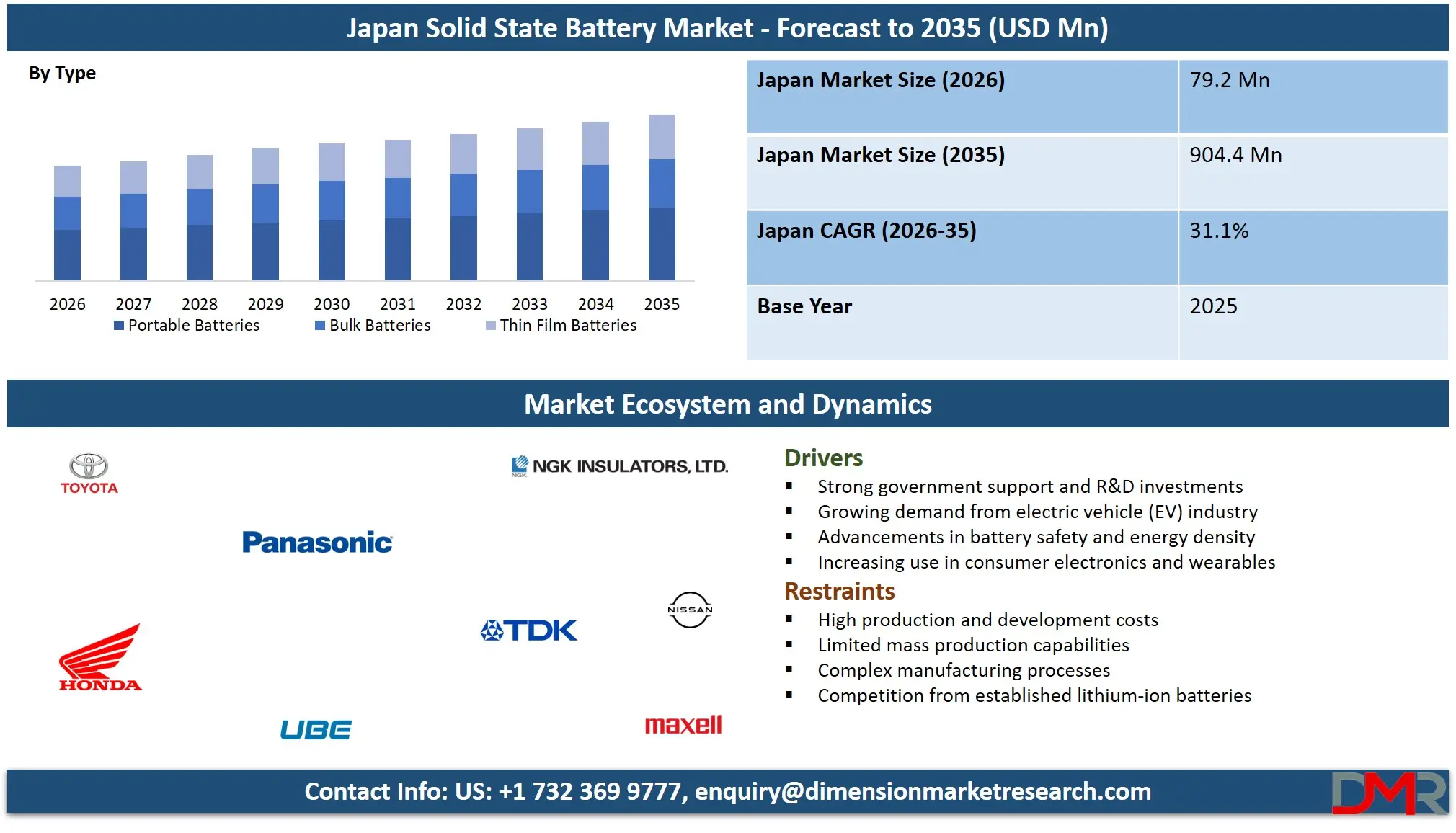
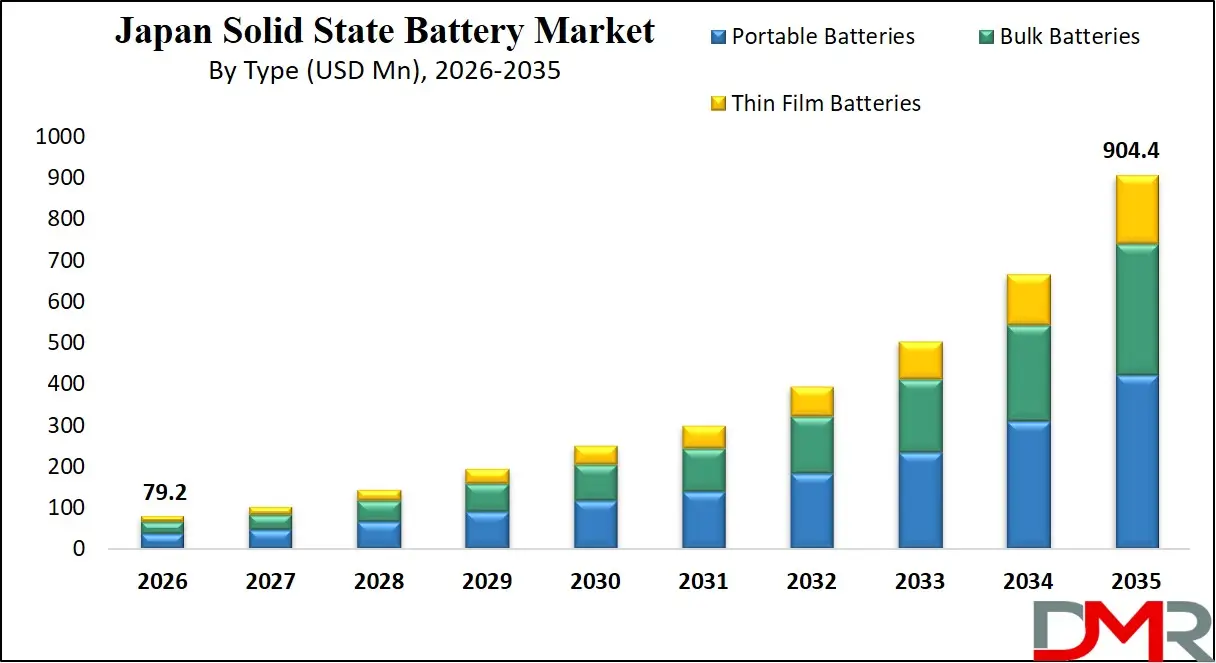
The Japan Solid State Battery Market size is projected to reach USD 79.2 million in 2026 and grow at a compound annual growth rate of 31.1% to reach a value of USD 904.4 million in 2035.
ℹ
To learn more about this report –
Download Your Free Sample Report Here
Solid-state battery refers to an advanced energy storage technology that uses solid electrolytes instead of liquid or gel-based electrolytes found in conventional lithium-ion batteries. These batteries offer higher energy density, improved safety, longer lifecycle, and faster charging capabilities. They are increasingly significant in next-generation applications such as electric vehicles, consumer electronics, and medical devices.
The market is evolving rapidly due to advancements in materials science, growing demand for high-performance batteries, and the global shift toward electrification and decarbonization. Emerging trends include miniaturization, enhanced thermal stability, and scalable manufacturing processes, supporting widespread commercial adoption.
ℹ
To learn more about this report –
Download Your Free Sample Report Here
Japan Solid State Battery Market: Key Takeaways & Influencing Factors
- Market Growth: The Japan Solid State Battery Market size is expected to grow by USD 803.0 million, at a CAGR of 31.1%, during the forecasted period of 2027 to 2035.
- By Type: The portable batteries segment is anticipated to get the majority share of the Japan Solid State Battery market in 2026.
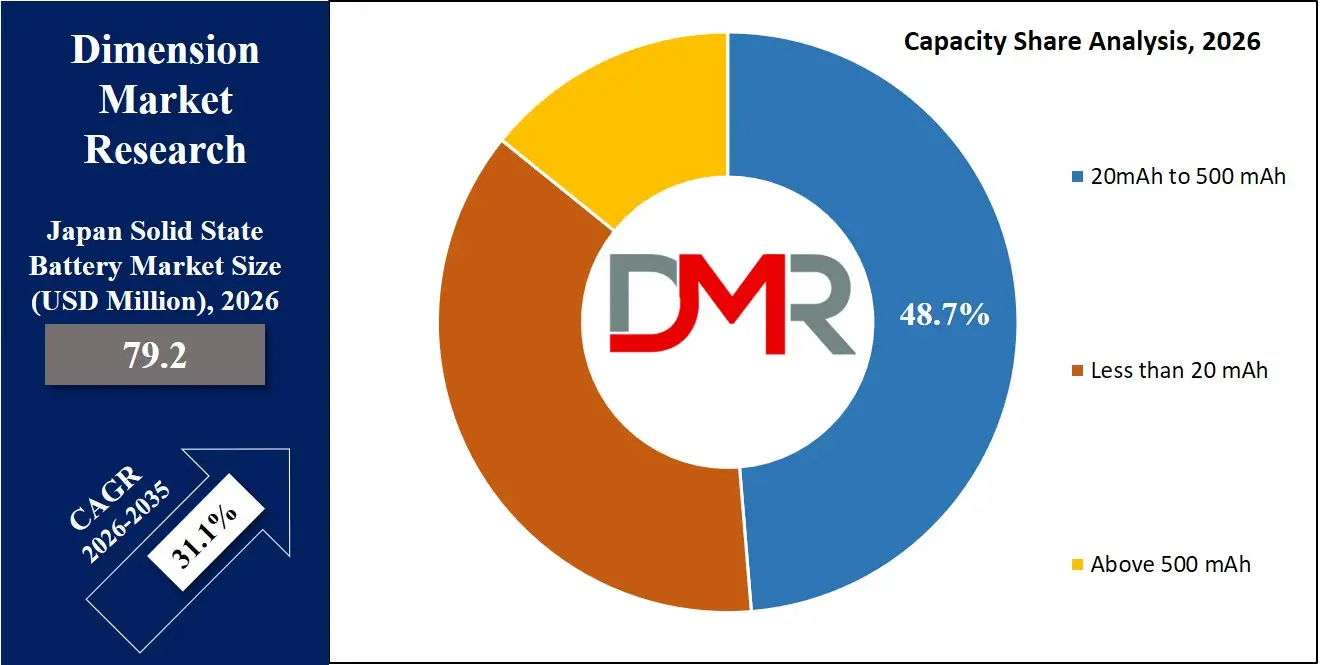
- By Capacity: The 200 mAh to 500 mAh segment is expected to get the largest revenue share in 2026 in the Japan Solid State Battery market.
- Use Cases: Some of the use cases of Solid State Battery include medical devices, consumer electronics, and more.
- Ministry of Economy, Trade and Industry (METI) reported in 2025 that Japan aims to commercialize solid-state batteries for EVs by 2027 under its Green Growth Strategy.
- International Energy Agency (IEA) stated in 2024 that advanced battery demand, including solid-state variants, is expected to grow over 30% annually through 2030.
- New Energy and Industrial Technology Development Organization (NEDO) highlighted in 2025 that Japan invested over ¥200 billion in next-generation battery R&D initiatives.
- Ministry of Internal Affairs and Communications (Japan) noted in 2024 that connected device usage growth exceeded 15% annually, driving demand for compact high-performance batteries.
Japan Solid State Battery Market: Use Cases
- Electric Vehicles: Solid-state batteries are transforming EVs by offering longer driving ranges, reduced charging times, and enhanced safety compared to lithium-ion batteries. These features make them highly suitable for Japan’s rapidly expanding EV ecosystem and sustainability goals.
- Consumer Electronics: Devices like smartphones, laptops, and wearables benefit from compact size, higher energy density, and improved durability, enabling longer usage and thinner designs aligned with consumer preferences.
- Medical Devices: Implantable and portable medical devices utilize solid-state batteries for their reliability, safety, and longevity, ensuring uninterrupted performance in critical healthcare applications.
- Aerospace Applications: High energy density and resistance to extreme conditions make these batteries ideal for satellites, drones, and other aerospace technologies requiring lightweight and durable power sources.
Market Dynamic
Driving Factors in the Japan Solid State Battery Market
Technological Advancements in Battery Materials
Continuous innovations in solid electrolytes, such as sulfide- and oxide-based materials, are significantly enhancing battery performance. These advancements improve energy density, thermal stability, and cycle life, making solid-state batteries more viable for commercial applications. Japanese companies and research institutions are heavily investing in R&D, accelerating breakthroughs and strengthening the country’s leadership in next-generation battery technologies.
Government Support and Electrification Initiatives
Japan’s strong policy framework promoting carbon neutrality and EV adoption is a major growth driver. Incentives, subsidies, and strategic collaborations between public and private sectors are encouraging large-scale production and innovation. These initiatives align with the country’s decarbonization targets, boosting demand for safer and more efficient battery technologies like solid-state systems.
Restraints in the Japan Solid State Battery Market
High Production Costs and Scalability Challenges
The manufacturing process of solid-state batteries remains complex and expensive due to advanced materials and precision engineering requirements. Scaling production to meet mass-market demand poses significant challenges, limiting widespread adoption. These high costs impact pricing strategies and restrict entry for smaller players in the market.
Material and Interface Limitations
Technical challenges such as interface instability between electrodes and solid electrolytes hinder performance consistency. Issues like dendrite formation and limited ionic conductivity in some materials affect reliability and efficiency. These constraints
Opportunities in the Japan Solid State Battery Market
Expansion in Electric Mobility Ecosystem
The rapid growth of EV infrastructure and demand for high-performance batteries present significant opportunities. Solid-state batteries can address range anxiety and safety concerns, making them ideal for next-generation vehicles. This creates strong potential for partnerships between automakers and battery manufacturers in Japan.
Emergence of Miniaturized Electronics and IoT Devices
Increasing adoption of IoT devices and wearable technologies is driving demand for compact, high-energy batteries. Solid-state batteries offer superior performance in small form factors, opening opportunities in niche segments such as smart healthcare devices and advanced consumer electronics.
Trends in the Japan Solid State Battery Market
Shift Toward All-Solid-State Battery Commercialization
Companies are transitioning from prototype development to commercialization of all-solid-state batteries. This trend is supported by pilot production lines and strategic alliances, indicating a shift toward large-scale deployment in automotive and electronics industries.
Integration of Advanced Manufacturing Technologies
Automation, AI-driven quality control, and precision engineering are being integrated into battery production processes. These technologies enhance efficiency, reduce defects, and support scalability, making solid-state battery manufacturing more cost-effective over time.
Impact of Artificial Intelligence in Japan Solid State Battery Market
Artificial intelligence is significantly enhancing battery research, design, and manufacturing processes. AI-driven simulations accelerate material discovery and optimize electrolyte compositions for better performance. Machine learning improves predictive maintenance and quality control in production lines, reducing defects and costs. AI also enables real-time monitoring of battery health, enhancing safety and lifecycle management. Additionally, it supports demand forecasting and supply chain optimization, improving operational efficiency. Overall, AI is accelerating innovation and commercialization in the solid-state battery ecosystem.
Impact of Iran War on Japan Solid State Battery Market
The Iran conflict influences global supply chains, particularly affecting raw material availability and energy prices. Increased geopolitical tensions lead to volatility in lithium and rare material sourcing, impacting production costs. Supply disruptions may slow manufacturing timelines and investment decisions. However, it also encourages Japan to strengthen domestic supply chains and invest in alternative materials, indirectly boosting innovation in solid-state battery technologies.
Research Scope and Analysis
By Type Analysis
Portable batteries are expected to dominate the Japan solid-state battery market with an estimated 46.3% share in 2026 due to their extensive use in consumer electronics and wearable devices. Their compact design and high energy density make them ideal for modern gadgets. Bulk batteries follow closely, driven by industrial and EV applications requiring large-scale energy storage. Thin film batteries are the fastest-growing segment, supported by their increasing use in medical implants and IoT devices due to flexibility and miniaturization advantages. Continuous innovation in thin-film deposition technologies is expected to accelerate adoption across specialized applications.
By Capacity Analysis
ℹ
To learn more about this report –
Download Your Free Sample Report Here
The 20 mAh to 500 mAh segment is projected to hold the largest share of 48.7% in 2026, driven by its suitability for consumer electronics, wearables, and medical devices. This range balances size and performance, making it versatile across multiple applications. The above 500 mAh segment is the fastest-growing, primarily due to rising demand in electric vehicles and industrial systems. Increasing investments in high-capacity battery solutions and advancements in solid electrolytes are contributing to the expansion of this segment in Japan.
By Application Analysis
Consumer electronics is expected to lead with a 34.5% market share in 2026 due to strong demand for compact and high-performance batteries in smartphones, laptops, and wearable devices. Electric vehicles represent the fastest-growing segment, fueled by Japan’s aggressive EV adoption targets and need for safer, longer-range batteries. Medical devices and aerospace applications are also gaining traction, supported by reliability and performance advantages of solid-state technology in critical environments.
By End User Industry Analysis
The electronics industry is projected to dominate the market with a 38.9% share in 2026, driven by continuous innovation and demand for advanced portable devices. Automotive is the fastest-growing segment due to increasing EV production and government support for electrification. Healthcare and aerospace industries are also expanding steadily, leveraging the safety and efficiency benefits of solid-state batteries in specialized applications. Industrial adoption is growing as companies seek durable and efficient energy storage solutions.
The Japan Solid State Battery Market Report is segmented on the basis of the following:
By Type
- Bulk Batteries
- Thin Film Batteries
- Portable Batteries
By Capacity
- Less than 20 mAh
- 20 mAh to 500 mAh
- Above 500 mAh
By Application
- Electric Vehicles
- Consumer Electronics
- Medical Devices
- Aerospace
- Wearables
- Energy Harvesting
- Industrial
By End User Industry
- Automotive
- Electronics
- Healthcare
- Aerospace & Defense
- Industrial
Competitive Landscape
The Japan Solid State Battery Market is characterized by intense competition driven by innovation, intellectual property, and technological expertise. Companies focus on extensive R&D investments, strategic collaborations, and pilot production scaling to maintain competitive advantage.
ℹ
To learn more about this report –
Download Your Free Sample Report Here
High entry barriers exist due to capital requirements and technological complexity. Partnerships between automotive and battery firms are common, while advancements in materials and manufacturing processes serve as key differentiators. Continuous innovation and early commercialization strategies are critical for sustaining market leadership.
Some of the prominent players in the Japan Solid State Battery are:
- Toyota Motor Corporation
- Panasonic Corporation
- Nissan Motor Corporation
- Honda Motor Co., Ltd.
- Toyota Industries Corporation
- Prime Planet Energy & Solutions
- GS Yuasa International Ltd.
- Toshiba Corporation
- Hitachi Zosen Corporation
- TDK Corporation
- Murata Manufacturing Co., Ltd.
- NGK Insulators Ltd.
- Maxell Ltd.
- Idemitsu Kosan Co., Ltd.
- Mitsui Kinzoku
- Sumitomo Metal Mining Co., Ltd.
- Asahi Kasei Corporation
- Toray Industries Inc.
- UBE Corporation
- Mitsubishi Chemical Group
- Other Key Players
Recent Developments
- In January 2026, ProLogium Technology has partnered with Kyushu Electric Power and Nakayama Iron Works to develop a 24 V solid-state battery module, showcased at CES 2026. The collaboration integrates ProLogium’s lithium ceramic cells, Kyushu’s energy expertise, and Nakayama’s machinery, forming a full value chain while enhancing safety by preventing thermal runaway through advanced electrolyte technology.
- In October 2025, Sumitomo Metal Mining Co., Ltd. and Toyota Motor Corporation signed a joint development agreement to enable mass production of cathode materials for all-solid-state batteries in battery electric vehicles. These next-generation batteries, consisting of a cathode, anode, and solid electrolyte, offer improved energy density, longer lifespan, faster charging, and higher output, supporting enhanced performance and extended driving range in future electric vehicles.
- In August 2025, Nissan Motor Co., Ltd. announced to partner with LiCAP Technologies, Inc. to advance cathode production technology for all-solid-state batteries. Their focus is on developing a dry electrode process that removes solvents, lowering costs and environmental impact. LiCAP’s Activated Dry Electrode® technology improves efficiency and performance, helping overcome mass production challenges and accelerating the commercialization of high-performance, cost-effective next-generation electric vehicles.
Report Details
| Report Characteristics |
| Market Size (2026) |
USD 79.2 Mn |
| Forecast Value (2035) |
USD 904.4 Mn |
| CAGR (2026–2035) |
31.1% |
| Historical Data |
2021 – 2025 |
| Forecast Data |
2027 – 2035 |
| Base Year |
2025 |
| Estimate Year |
2026 |
| Report Coverage |
Market Revenue Estimation, Market Dynamics, Competitive Landscape, Growth Factors and etc. |
| Segments Covered |
By Type (Bulk Batteries, Thin Film Batteries, Portable Batteries), By Capacity (Less than 20 mAh, 20 mAh to 500 mAh, Above 500 mAh), By Application (Electric Vehicles, Consumer Electronics, Medical Devices, Aerospace, Wearables, Energy Harvesting, Industrial), By End User Industry (Automotive, Electronics, Healthcare, Aerospace & Defense, Industrial) |
| Country Coverage |
Japan |
| Prominent Players |
Toyota Motor Corporation, Panasonic Corporation, Nissan Motor Corporation, Honda Motor Co., Ltd., Toyota Industries Corporation, Prime Planet Energy & Solutions, GS Yuasa International Ltd., Toshiba Corporation, Hitachi Zosen Corporation, TDK Corporation, Murata Manufacturing Co., Ltd., NGK Insulators Ltd., Maxell Ltd., Idemitsu Kosan Co., Ltd., Mitsui Kinzoku, Sumitomo Metal Mining Co., Ltd., Asahi Kasei Corporation, Toray Industries Inc., UBE Corporation, Mitsubishi Chemical Group, and Other Key Players |
| Purchase Options |
We have three licenses to opt for: Single User License (Limited to 1 user), Multi-User License (Up to 5 Users) and Corporate Use License (Unlimited User) along with free report customization equivalent to 0 analyst working days, 3 analysts working days and 5 analysts working days respectively. |
Frequently Asked Questions
How big is the Japan Solid State Battery Market?
▾ The Japan Solid State Battery Market size is expected to reach USD 79.2 million by 2026 and is projected to reach USD 904.4 million by the end of 2035.
Who are the key players in the Japan Solid State Battery Market?
▾ Some of the major key players in the Japan Solid State Battery Market include Toyota, Nissan, Honda, and others.
What is the growth rate in the Japan Solid State Battery Market?
▾ The market is growing at a CAGR of 31.1 percent over the forecasted period.