What is the Japan Southeast Asia Data Centre Market Size?
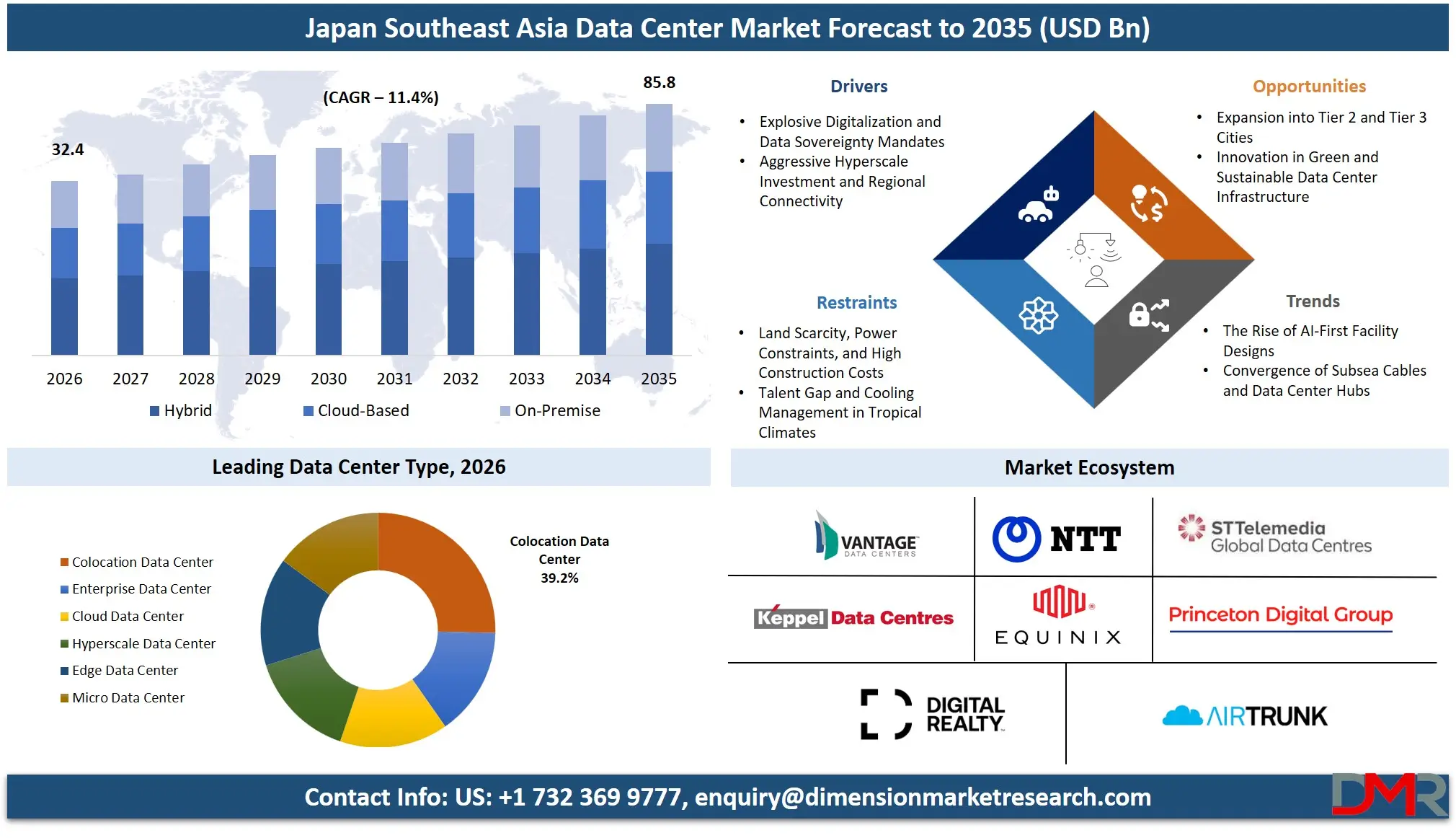
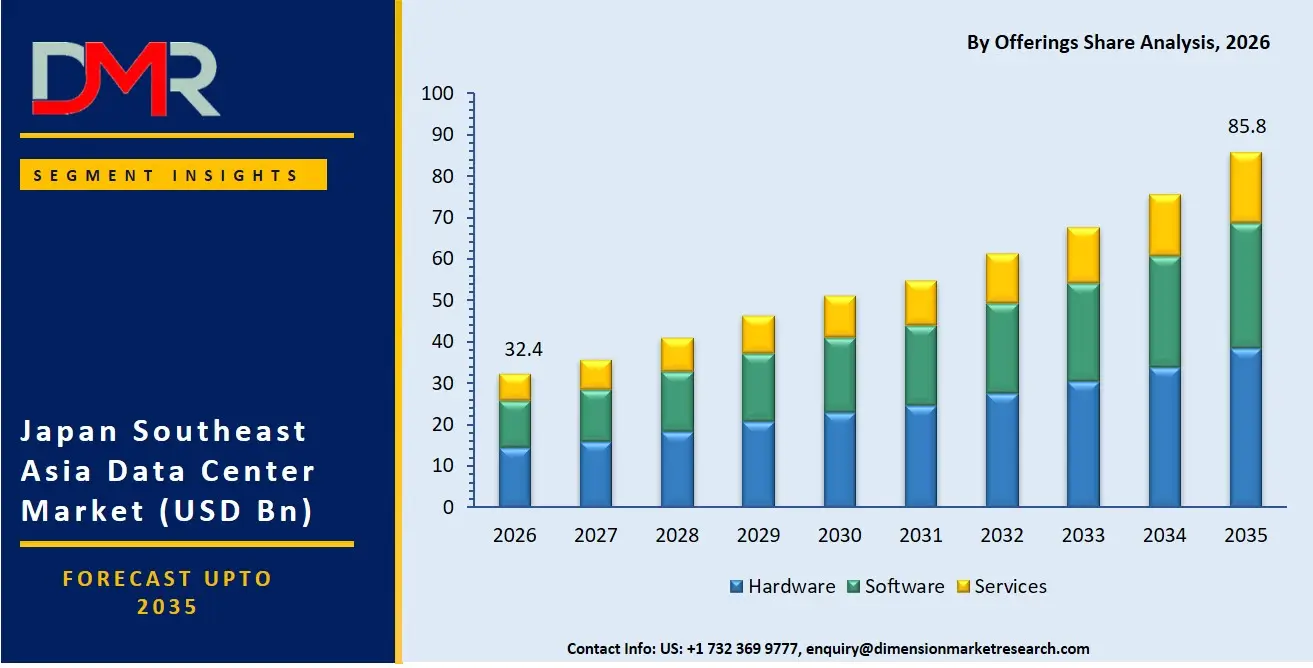
The Japan & Southeast Asia Data Centre Market is expected to reach a value of USD 32.4 billion in 2026, and it is further anticipated to surge to USD 85.8 billion by 2035, growing at a robust CAGR of 11.4% during the forecast period.
ℹ
To learn more about this report –
Download Your Free Sample Report Here
The data Centre market across Japan and Southeast Asia has witnessed explosive growth, driven by the region's accelerated digital transformation, the rapid expansion of hyperscale cloud regions, and the emergence of vibrant local digital economies. The market encompasses a comprehensive ecosystem of hardware, software, and services, supporting everything from massive cloud availability zones in Tokyo and Singapore to burgeoning edge infrastructure in Indonesia and Vietnam. The demand for low-latency connectivity, sovereign cloud solutions, and AI-ready infrastructure is catalyzing unprecedented investment in both mature and emerging markets. Liquid cooling, modular power systems, and managed colocation services are the dominant solution categories due to their operational efficiency and scalability in tropical and high-density environments.
Key Takeaways
- Market Size & Forecast: Based on forecasts, the Japan & Southeast Asia data Centre market will attain a value of USD 32.4 billion by 2026, expanding dramatically to USD 85.8 billion by 2035 due to two crucial factors: the rapid regional rollout of 5G networks and the exponential growth in data consumption from a young, digitally native population.
- Growth Rate & Outlook: It is predicted that the market will register a CAGR of 11.4%, which will be attributed to the presence of important growth factors, such as aggressive government digitalization mandates, the shift of enterprise workloads from on-premise to hybrid and cloud models, and the rise of Generative AI driving demand for high-density computing.
- Primary Growth Drivers: Important growth factors will include data localization and sovereignty laws being enacted across Southeast Asia, strong foreign direct investment from global hyperscale cloud service providers, and substantial improvements in subsea cable connectivity that position countries like Indonesia, Malaysia, and the Philippines as key interconnection hubs.
- Key Market Trends: The market trends are mainly related to the mass adoption of liquid cooling to manage thermal loads from AI training clusters; a surge in sustainable data Centre designs incorporating renewable energy PPAs and on-site solar; and the rise of sovereign cloud and colocation facilities designed to secure sensitive government and financial data in-country.
- By Offerings Analysis: The Japan & Southeast Asia data Centre market is driven by massive capital expenditure on hardware, specifically IT modules and liquid cooling infrastructure, while the services segment experiences rapid growth as enterprises outsource complex infrastructure management to managed service providers.
- By Data Centre Type Analysis: The Japan & Southeast Asia market is projected to be dominated by hyperscale and colocation data Centres, with cloud service providers building massive campuses in Japan and Singapore, while a parallel boom in edge data Centres supports the diverse archipelagic geographies of Indonesia and the Philippines.
What is the Data Centre?
The data Centre market can be described as the ecosystem of specialized facilities and their component supply chains dedicated to housing critical compute, network, and storage systems. Unlike generic commercial real estate, these facilities provide a highly engineered environment focused on uninterrupted power, precision cooling, and multi-layered physical security. This is achieved through two primary deployment models: on-premise enterprise data Centres for sensitive sovereign workloads and outsourced colocation/hyperscale facilities that provide scalable, cloud-adjacent capacity. Considering Norway's advanced sustainability agenda and cold climate, the Japan Southeast Asia market is a global pioneer in green data Centre design, requiring market authorization for novel liquid cooling deployments and participating in circular economy initiatives like heat reuse for district heating.
Use Cases
- Hyperscale Regional Cloud Hub Enablement: A global cloud service provider constructs a 150MW hyperscale data Centre campus in Johor, Malaysia, utilizing wholesale colocation shells, signing a long-term solar PPA, and deploying modular liquid-cooled IT modules to support its expanding AI and enterprise cloud services for the entire Southeast Asian region.
- Sovereign Financial Services Cloud: A consortium of banks in Indonesia deploys a hybrid model, maintaining an on-premise Tier IV data Centre for core banking regulatory compliance while using a nearby domestic cloud data Centre built by a local telecom provider for customer-facing digital applications.
- Telecom Edge Rollout in an Archipelago: A pan-ASEAN telecommunications operator deploys a network of far-edge micro data Centres across the islands of the Philippines, integrating them with regional edge hubs in Manila to deliver ultra-low-latency 5G services for mobile gaming, fintech, and port logistics.
- Manufacturing Industry 4.0 Migration: A Japanese manufacturing conglomerate with plants in Thailand and Vietnam migrates from legacy server rooms to a regional colocation facility in Bangkok, using managed data Centre services for integration and deployment of a hybrid cloud architecture for its real-time IoT analytics platform.
How AI is Transforming the Data Centre Market?
The impact of AI on the Japan & Southeast Asia data Centre market covers accelerating the design of high-density facilities, optimizing real-time operations, and fundamentally reshaping power and cooling architectures. Speaking about facility design, AI-driven prediction tools explore vast amounts of thermal and power data to develop novel precision liquid cooling systems that can support GPU clusters with rack densities exceeding 100kW without any hotspots, a critical advantage in tropical climates. AI-based automation and orchestration software allows predicting cooling system failures and optimizing power usage effectiveness (PUE) across massive campus footprints.
Furthermore, the role of AI in security and service delivery is quite important. Thus, while monitoring thousands of servers across multi-tenant colocation facilities, artificial intelligence algorithms help explore network traffic patterns to identify and quarantine sophisticated DDoS attacks in real-time. Last but not least, AI-driven analytics and optimization software assist colocation providers with dynamic capacity planning, simulating client growth across Tokyo, Singapore, and Jakarta hubs to provide an overview of infrastructure utilization and predictive maintenance schedules.
Market Dynamics
Key Drivers in the Japan & Southeast Asia Data Centre Market
Explosive Digitalization and Data Sovereignty Mandates
A rise in the number of internet users, widespread smartphone adoption, and thriving digital economies in Southeast Asia will form one of the major reasons for the increased demand for data Centre capacity. Governments across the region are simultaneously enacting strict data protection and localization laws, compelling cloud service providers and enterprises to store sensitive financial, healthcare, and citizen data within national borders. This regulatory push is forcing a rapid build-out of sovereign cloud and colocation facilities in key markets like Indonesia, Vietnam, and Malaysia, moving beyond traditional hubs like Singapore.
Aggressive Hyperscale Investment and Regional Connectivity
It should be noted that both Japan and Southeast Asia have become epiCentres for hyperscale investment. Global cloud giants are committing tens of billions of dollars to establish new cloud regions and availability zones in Tokyo, Osaka, Singapore, Jakarta, and Kuala Lumpur. This is further complemented by a wave of new high-capacity subsea fiber cables that directly link the region to the US West Coast, the Middle East, and Africa. These systems are known to provide diverse, low-latency connectivity, transforming countries like Malaysia and the Philippines from peripheral markets into central interconnection hubs.
Restraints in the Japan & Southeast Asia Data Centre Market
Land Scarcity, Power Constraints, and High Construction Costs
The development of large-scale campuses remains challenged by acute land scarcity and high real estate costs in Tier 1 hubs like Singapore and Tokyo. In Singapore, a temporary moratorium on new builds, though lifted, has led to highly selective project approvals with stringent PUE and renewable energy mandates. Meanwhile, in emerging markets like Jakarta and Manila, securing large contiguous plots with reliable, high-capacity grid power is a significant hurdle. The resulting reliance on on-site private substations and backup power systems dramatically increases construction complexity and capital expenditures.
Talent Gap and Cooling Management in Tropical Climates
The complexity involved in operating high-density facilities is exacerbated by a severe regional shortage of technically skilled data Centre engineers and technicians. The demand for professionals certified in liquid cooling maintenance, high-voltage electrical systems, and complex IT orchestration far outstrips supply, leading to resource hoarding and escalating costs for support and maintenance services. Additionally, the year-round high heat and humidity in Southeast Asia place an extreme burden on precision cooling systems. Managing a cost-effective water footprint and preventing corrosion while transitioning from air-based to liquid cooling remains a profound operational challenge.
Growth Opportunities in the Japan & Southeast Asia Data Centre Market
Expansion into Tier 2 and Tier 3 Cities
The increasing focus on edge computing and content delivery is providing immense opportunities for colocation and edge data Centres in secondary cities. As 5G networks expand, there is a growing need to place regional edge and micro data Centre infrastructure closer to population Centres to reduce backhaul latency. Companies in the colocation and telecom sector are making significant investments in developing pre-certified, modular facilities for cities like Surabaya, Cebu, and Chiang Mai. Moreover, these locations offer lower-cost land and power, giving operators a superior TCO for latency-sensitive workloads.
Innovation in Green and Sustainable Data Centre Infrastructure
Since the emergence of corporate net-zero commitments and rising energy costs, there seems to be a great deal of room for expansion in the field of green infrastructure. Following the success of renewable energy PPAs in Japan and Singapore, data Centre operators are increasingly working on integrating on-site solar, battery energy storage systems (BESS), and alternative backup fuels like hydrotreated vegetable oil (HVO) for generators. The use of liquid cooling for heat reuse in district cooling networks is becoming more popular. Furthermore, Japan offers one of the best environments for pioneering hydrogen fuel cell backup power systems, while Indonesia is exploring geothermal-powered data Centres.
Trends in the Japan & Southeast Asia Data Centre Market
The Rise of AI-First Facility Designs
The usage of AI-optimized hardware is becoming a defining trend in the regional construction landscape. Colocation and hyperscale operators have started designing campuses from the ground up for AI inferencing and training, which necessitates a shift from standard 7-10kW per rack to flexible zones supporting 50-150kW per rack. Innovations in direct-to-chip liquid cooling and immersion cooling have promoted a fundamental architectural shift. Production of such high-density, AI-ready halls is being considered standard by all major new developments to ensure their facilities remain relevant to hyperscale and enterprise AI clients.
Convergence of Subsea Cables and Data Centre Hubs
As observed in recent times, there has been an increasing focus by both cable consortia and data Centre operators on co-locating landing stations directly within carrier-neutral data Centre campuses. This involves, for instance, efforts by providers to build dedicated cable landing station meet-me rooms in their Johor and Batam facilities, bypassing traditional chokepoints in Singapore. Another trend that has emerged is that of strategic partnerships among local conglomerates, global data Centre operators, and telecom carriers. Strategic partnerships go a long way in ensuring the successful integration of subsea network capacity, quickening the deployment of new interconnection ecosystems, and streamlining the commercialization of pan-ASEAN connectivity.
Research Scope and Analysis
The Japan & Southeast Asia Data Centre Market is segmented by offerings into hardware (IT, power, and cooling modules), software, and services; by deployment model; by data Centre type; by Tier Standard level; by enterprise size; and by end users including cloud service providers, technology providers, telecom, BFSI, healthcare, and energy & utilities.
ℹ
To learn more about this report –
Download Your Free Sample Report Here
By Offerings Analysis
Hardware is expected to dominate the Japan & Southeast Asia Data Centre Market owing to continuous investments in hyperscale, colocation, and enterprise data Centre expansion. The deployment of AI-ready servers, high-performance storage, networking equipment, power distribution systems, UPS solutions, and advanced liquid and air cooling technologies accounts for the largest share of capital expenditure.
ℹ
To learn more about this report –
Download Your Free Sample Report Here
As operators across Japan, Singapore, Malaysia, Indonesia, and Thailand build higher-density facilities to support cloud computing, AI, and digital transformation, demand for energy-efficient hardware continues to outpace software and service spending.
By Deployment Model Analysis
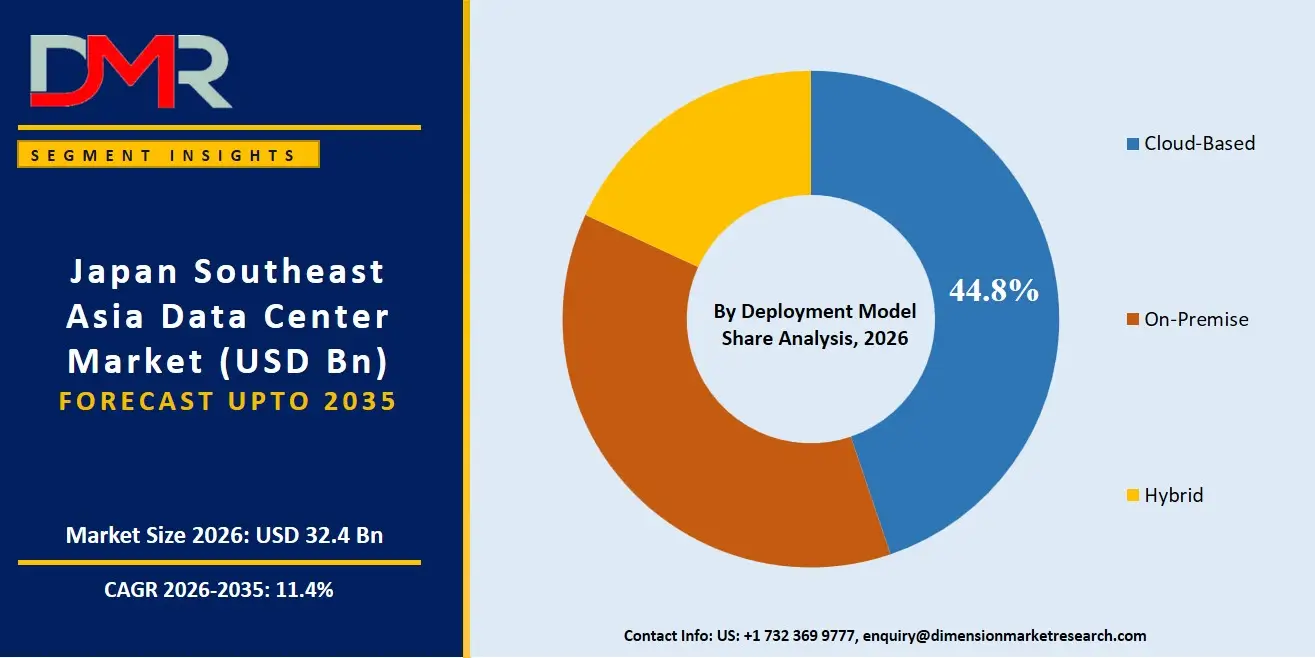
Cloud-based deployment is anticipated to dominate the Japan & Southeast Asia Data Centre Market as enterprises increasingly migrate business-critical applications to public, private, and hybrid cloud environments. Strong cloud adoption, digital transformation initiatives, expanding hyperscale investments, and growing AI workloads are accelerating cloud infrastructure development across the region. Organizations favor cloud deployment for its scalability, operational flexibility, lower infrastructure management costs, and enhanced disaster recovery capabilities, making it the leading deployment model.
By Data Centre Type Analysis
Colocation data Centres are poised to dominate the Japan & Southeast Asia Data Centre Market as enterprises increasingly prefer leasing secure and scalable infrastructure rather than investing in privately owned facilities. Rapid growth in cloud services, digital enterprises, and content delivery networks is driving demand for carrier-neutral, highly connected colocation facilities. Operators across Singapore, Malaysia, Indonesia, Japan, and the Philippines continue expanding capacity to meet rising enterprise and hyperscale requirements, reinforcing colocation as the largest market segment.
By Level (Tier Standard) Analysis
Tier 3 data Centres are expected to dominate the Japan & Southeast Asia Data Centre Market due to their optimal balance of reliability, redundancy, operational efficiency, and investment cost. These facilities provide concurrent maintainability with minimal downtime, making them the preferred choice for cloud providers, telecom operators, financial institutions, government agencies, and large enterprises. The majority of new commercial data Centre developments across the region are designed to Tier 3 standards, ensuring sustained market leadership.
By Enterprise Size Analysis
Large enterprises are projected to dominate the Japan & Southeast Asia Data Centre Market as they continue making substantial investments in cloud migration, AI infrastructure, cybersecurity, business continuity, and digital transformation. Multinational corporations, financial institutions, technology companies, telecom operators, and healthcare organizations require scalable, secure, and high-performance computing environments. Their significantly higher IT infrastructure spending compared to SMEs enables large enterprises to maintain the leading market share.
By End User Analysis
Cloud service providers are anticipated to dominate the Japan & Southeast Asia Data Centre Market by contributing the largest share of new capacity additions and infrastructure investments. The rapid expansion of hyperscale cloud regions, enterprise cloud adoption, AI and machine learning workloads, and SaaS platforms continues to drive demand for high-density, energy-efficient facilities. Leading global and regional cloud providers are expanding their presence across Japan, Singapore, Malaysia, Indonesia, and Thailand, making cloud service providers the dominant end-user segment in the regional market.
The Japan Southeast Asia Data Centre Market Report is segmented on the basis of the following:
By Offerings
- Hardware
- IT Modules
- Servers
- Storage Systems
- Networking Equipment
- Power Modules
- UPS Systems
- Power Distribution Units
- Backup Power Systems
- Cooling Modules
- Air-Based Cooling
- Liquid Cooling
- Precision Cooling Systems
- Software
- Monitoring & Management Tools
- Automation & Orchestration Software
- Backup & Disaster Recovery Software
- Security Software
- Virtualization Software
- Analytics & Optimization Software
- Services
- Design & Consulting
- Integration & Deployment
- Support & Maintenance
- Managed Data Centre Services
By Deployment Model
- Hybrid
- Cloud-Based
- On-Premise
By Data Centre Type
- Colocation Data Centre
- Retail Colocation
- Wholesale Colocation
- Enterprise Data Centre
- Cloud Data Centre
- Hyperscale Data Centre
- Edge Data Centre
- Micro Data Centre
By Level (Tier Standard)
- Tier 1
- Tier 2
- Tier 3
- Tier 4
By Enterprise Size
- Large Enterprises
- Small & Medium Enterprises (SMEs)
By End User
- Technology Providers
- Cloud Service Providers
- Telecom
- BFSI
- Healthcare
- Retail & E-commerce
- Entertainment & Media
- Energy & Utilities
Competitive Landscape
The nature of competition in the Japan & Southeast Asia data Centre market has become very dynamic, characterized by a high-stakes land grab between global hyperscalers building self-managed campuses, established US and Japanese colocation giants, and the rapid emergence of well-funded local champions. Strategic alliances with local power utilities, fiber network owners, and conglomerates with land banks would be crucial for international operators, as they help gain access to power approvals and secure prime zoned land. The trend of consolidation is growing at a rapid pace, as global infrastructure funds and real estate investment trusts are acquiring platforms of existing regional operators to instantly secure a development pipeline. IP differentiators such as proprietary designs for tropical cooling, a proven track record of securing renewable energy in complex power markets, and deep relationships with sovereign BFSI and public sector tenants are playing an increasingly significant role compared to traditional metrics of mere megawatt capacity.
Some of the prominent players in the Japan Southeast Asia Data Centre Market are:
- Equinix
- Digital Realty
- NTT Data
- ST Telemedia Global Data Centres (STT GDC)
- AirTrunk
- Keppel Data Centres
- Princeton Digital Group (PDG)
- Bridge Data Centres
- DayOne Data Centres
- Vantage Data Centres
- GDS Holdings
- CDC Data Centres
- STACK Infrastructure
- Colt Data Centre Services (Colt DCS)
- Yondr Group
- CtrlS DataCentres
- NEXTDC
- Goodman Group
- ePLDT (Vitro Data Centre)
- Telekom Malaysia
- Other Key Players
Recent Developments
- April 2026: Microsoft announced a US$10 billion investment in Japan (2026–2029) to expand AI and cloud infrastructure, strengthen cybersecurity partnerships, and develop domestic AI capabilities through new in-country data Centre capacity and collaborations with local partners.
- March 2025: Microsoft expanded its cloud infrastructure in Japan by introducing Azure High Performance Computing (HPC) capacity with NVIDIA GPUs, enhancing AI computing resources available within the country as part of its previously announced infrastructure investment.
- October 2024: Equinix announced its expansion into Thailand with plans to develop two International Business Exchange (IBX) data Centres in Bangkok, strengthening its Southeast Asia footprint and supporting growing regional demand for digital infrastructure.
Report Details
| Report Characteristics |
| Market Size (2026) |
USD 40.4 Bn |
| Forecast Value (2035) |
USD 68.3 Bn |
| CAGR (2026–2035) |
6.0% |
| The US Market Size (2026) |
USD 13.1 Bn |
| Historical Data |
2021 – 2025 |
| Forecast Data |
2027 – 2035 |
| Base Year |
2025 |
| Estimate Year |
2026 |
| Segments Covered |
By Product Type, By Microorganism, By Fermentation Process, By Production Scale, By Application, By End User |
| Regional Coverage |
North America – The US and Canada; Europe – Germany, The UK, France, Russia, Spain, Italy, Benelux, Nordic, & Rest of Europe; Asia-Pacific – China, Japan, South Korea, India, ANZ, ASEAN, Rest of APAC; Latin America – Brazil, Mexico, Argentina, Colombia, Rest of Latin America; Middle East & Africa – Saudi Arabia, UAE, South Africa, Turkey, Egypt, Israel, & Rest of MEA |
Frequently Asked Questions
How big is the Japan & Southeast Asia Data Centre Market?
▾ The Japan & Southeast Asia Data Centre market is poised to be valued at USD 32.4 billion in 2026 and is projected to reach USD 85.8 billion by 2035, driven by the universal need for sovereign, high-performance, and sustainable digital infrastructure to support a rapidly urbanizing and digitally native population.
What is the CAGR of the Japan & Southeast Asia Data Centre Market from 2026 to 2035?
▾ The market is expected to grow at a CAGR of 11.4% from 2026 to 2035, reflecting the accelerating influx of hyperscale investment, aggressive government digitalization policies, and the race to build AI-ready infrastructure across the region.
What factors are driving the growth of the Japan & Southeast Asia Data Centre Market?
▾ Key drivers include strict data sovereignty and localization laws, a massive wave of foreign direct investment from global cloud providers, and the explosive growth of the digital economy, fintech, and 5G-driven edge computing across the diverse ASEAN and Japanese markets.
What are the major trends in the Japan & Southeast Asia Data Centre Market?
▾ Major trends include the rise of AI-first facility designs that mandate liquid cooling, the convergence of subsea cable landing stations with carrier-neutral data Centre hubs, and a strong shift towards green, sustainable campuses with renewable microgrids and heat reuse technologies.
Who are the key players in the Japan & Southeast Asia Data Centre Market?
▾ Key players in the Japan & Southeast Asia Data Centre Market include hyperscalers like AWS, Microsoft, and Google; global colocation leaders like Equinix and Digital Realty; Asia-Pacific champions like NTT, STT GDC, AirTrunk, and Princeton Digital Group; and infrastructure vendors like Schneider Electric and Vertiv.
How is the Japan & Southeast Asia Data Centre Market segmented?
▾ The market is segmented by Offerings, Deployment Model, Data Centre Type, Level (Tier Standard), Enterprise Size, and End User.