Market Snapshot
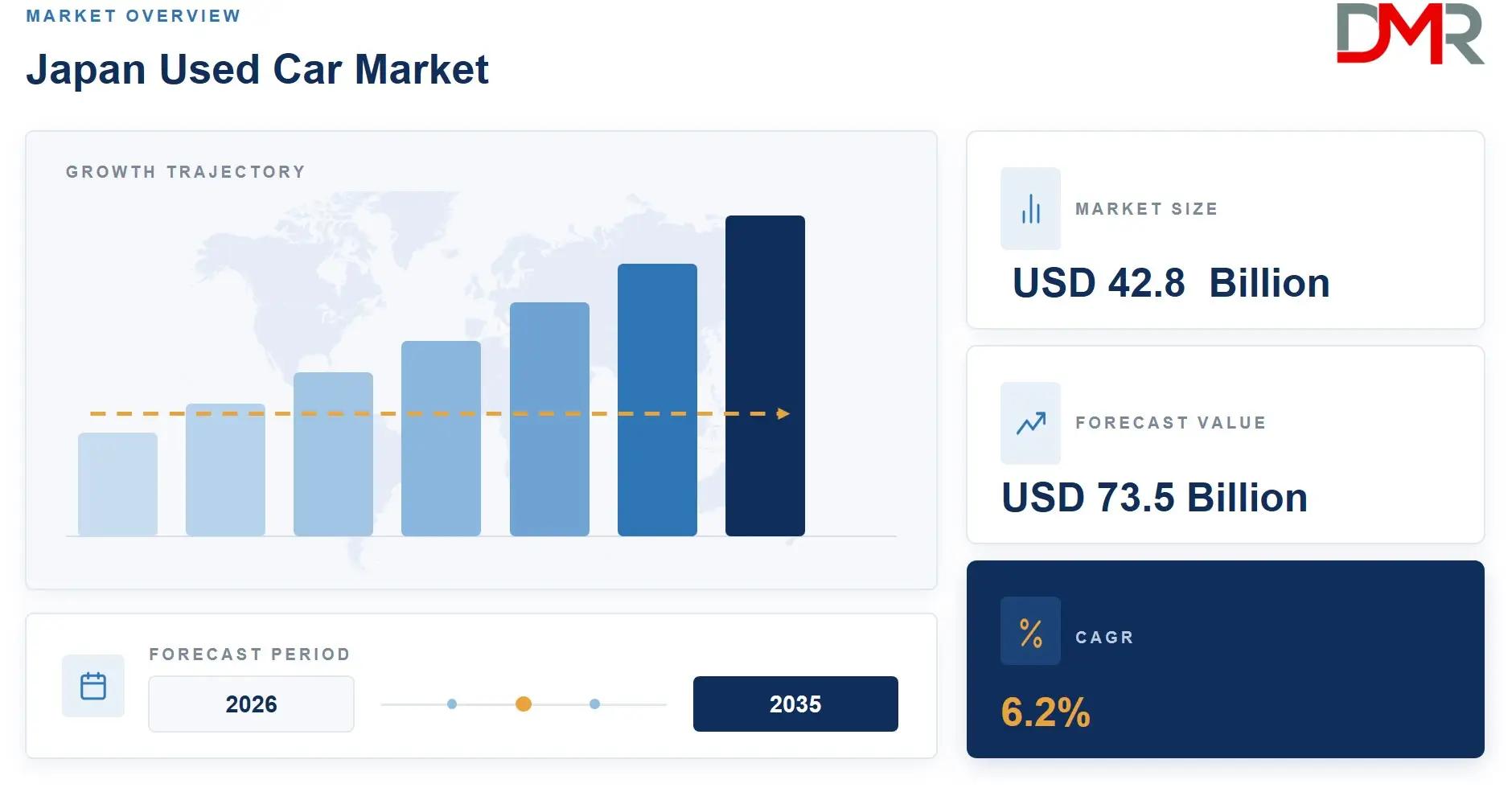
- Market Size (2026): USD 42.8 Bn
- Forecast Value (2035): USD 73.5 Bn
- CAGR (2026-2035): 6.2%
- Leading Vehicle Type (2026): Passenger Cars, around 72%
- Leading Vehicle Age (2026): 3 to 5 Years, close to 34%
- Key Players: USS Co., Ltd., IDOM Inc., NEXTAGE Co., Ltd. and others
What is Japan Used Car Market and its Market Size?
The Japan Used Car Market size is estimated to reach USD 42.8 Bn in 2026 and is further anticipated to reach USD 73.5 Bn by 2035, at a CAGR of 6.2%. Used vehicles in this report include passenger and commercial vehicles resold through dealer networks, auction houses, digital platforms and other organized channels after initial registration. The scope covers demand and transaction value inside Japan, not the worldwide revenue of Japanese exporters or automotive groups headquartered in the country.
ℹ
To learn more about this report –
Download Your Free Sample Report Here
Japan has a deep secondary vehicle ecosystem because inspection requirements, dense dealer coverage, high ownership standards and frequent replacement cycles continually return relatively well maintained vehicles to the resale pool. Shaken inspection economics can influence replacement decisions as vehicles age, while certified pre-owned programs give buyers a route to newer vehicles with inspection, warranty and service support. At the wholesale level, professional auctions provide price discovery and inventory movement between dealers, exporters and fleet remarketers.
Buyer economics are changing as new vehicle prices rise, delivery cycles normalize unevenly by model, and households compare total ownership cost more carefully. Hybrid vehicles are increasingly important in the resale mix because Japan has a large installed base of electrified vehicles, while battery electric vehicles remain a smaller but faster developing pool. Digital discovery has also reduced the dependence on physical forecourts by allowing buyers to compare mileage, inspection records, trim, financing and dealer reputation before visiting a store.
The market therefore sits between a mature domestic replacement cycle and a highly active remarketing system. Export demand can tighten wholesale supply for particular models, especially reliable right-hand-drive vehicles, compact cars, hybrids and commercial units. This interaction between domestic retail demand, dealer auctions and overseas buyers supports transaction liquidity, but it can also raise acquisition prices and compress dealer margins when auction competition intensifies.
Use Cases
- Household Vehicle Replacement: Individual buyers use franchised and independent dealers to replace aging cars without absorbing the full price of a new vehicle. Inspection history, mileage, warranty coverage and financing shape the purchase, while certified inventory reduces uncertainty for buyers who want predictable ownership costs.
- Dealer Inventory Replenishment: Retail dealers source vehicles from wholesale auctions and trade-ins to fill local gaps in model, age, mileage and price bands. Faster inventory turnover lets dealers respond to demand without carrying excessive stock, while auction data provides a reference point for acquisition and resale pricing.
- Commercial Fleet Renewal: Small businesses, delivery operators and service fleets acquire used vans and light commercial vehicles when utilization economics matter more than first ownership. Access to lower acquisition prices can shorten payback periods and allows operators to add capacity without committing the capital required for equivalent new vehicles.
- Export Remarketing: Export traders purchase suitable Japanese vehicles through auctions and dealer channels for resale in overseas markets. Vehicle condition, age rules, shipping economics and destination compliance determine which units move abroad, creating an additional demand outlet that can strengthen residual values for selected models.
Key Takeaways
- Market Size & Share: Domestic transaction value is projected at USD 42.8 Bn in 2026, supported by recurring replacement demand and a liquid remarketing infrastructure.
- Vehicle Type Analysis: Passenger cars are expected to represent roughly 72% of 2026 revenue because household transactions dominate the retail used vehicle base.
- Demand Concentration: Vehicles aged 3 to 5 years are set to account for approximately 34% of 2026 revenue, balancing residual value, condition and affordability.
- Digital Channel Shift: Online platforms are forecast to expand at a CAGR of 10.4% through 2035 as price comparison, remote appraisal and lead generation move further online.
- Electrification: Battery electric used vehicles are projected to grow at a CAGR of 11.3%, although battery health transparency remains important to buyer confidence.
- Export Pull: Export traders are expected to expand at a CAGR of 8.6%, adding competition for auction inventory that meets destination market rules.
How AI/Gen AI is Transforming the Japan Used Car Market?
AI is increasingly applied to the operational layers of used vehicle retail rather than changing the underlying product. Computer vision can support exterior damage detection, tire and panel assessment, photo quality control and standardized condition grading. Machine learning models can combine auction history, mileage, trim, seasonality and local demand to estimate acquisition prices and residual values, helping dealers decide what to bid and where to retail a vehicle.
Generative AI has a narrower but practical role in merchandising and workflow. It can convert inspection data into consistent listing descriptions, translate vehicle information for export customers, summarize service records and assist call centers with buyer questions. The strongest commercial value comes when these tools reduce appraisal time or inventory days rather than simply adding conversational interfaces.
- Computer Vision Appraisal: Image models flag visible body damage and support more consistent intake inspection.
- Residual Value Forecasting: Predictive models estimate likely resale prices by model, age, mileage, location and auction conditions.
- Document Processing: Language models summarize inspection notes, service histories and listing attributes for dealer staff.
- Inventory Matching: Recommendation systems rank vehicles against buyer budgets, preferred powertrains and ownership requirements.
Key Drivers in the Japan Used Car Market
Demand is supported by the economics of replacement and by the depth of Japan's organized remarketing network. Two forces are especially important because they affect both vehicle supply and buyer willingness to transact.
- Replacement Economics and High Quality Used Supply: Passenger cars are expected to account for around 72% of 2026 market revenue, reflecting the scale of household ownership and frequent trade-in activity. Japan's inspection and maintenance culture encourages owners to keep records and address defects, which can improve resale confidence. As new vehicle prices rise, a three to five year old vehicle can offer modern safety and convenience features without the depreciation attached to first ownership. Dealers can therefore position used inventory across multiple price bands while retaining financing, warranty and service revenue.
- Efficient Auction and Remarketing Infrastructure: Auction houses are projected to represent approximately 23% of sales-channel value in 2026, illustrating the importance of wholesale liquidity to the retail system. Large auction networks allow dealers and exporters to source inventory beyond their immediate trade-in base, while standardized grading and transaction data reduce search friction. Higher participation can improve price discovery and move vehicles quickly between regions. The same mechanism supports retail availability, although strong bidding from exporters can lift acquisition costs for domestic dealers.
Restraints in the Japan Used Car Market
Market maturity keeps growth disciplined, while vehicle condition, pricing and electrification introduce new forms of risk. These constraints affect margins as much as transaction volume.
- Wholesale Price Pressure and Margin Compression: Franchised dealers are expected to hold close to 29% of 2026 sales-channel revenue, but organized retailers still compete aggressively for desirable stock. When auction prices rise faster than retail prices, dealers must choose between thinner gross margins and slower inventory turnover. Export demand can amplify the pressure for specific models, while reconditioning, warranty and financing costs remain after acquisition. Smaller retailers with less data or purchasing scale are more exposed because a few mispriced vehicles can materially affect working capital.
- Battery Health and Residual Value Uncertainty: Battery electric vehicles are projected to represent only around 7% of 2026 fuel-type revenue even as the segment grows quickly. Used EV buyers need credible information on battery state of health, remaining warranty, charging compatibility and likely replacement cost. Inconsistent disclosure can widen bid-ask spreads and make dealers conservative when taking EVs in trade. Rapid changes in new EV pricing and battery technology can also reset residual values, making inventory risk harder to manage than for established gasoline and hybrid models.
Growth Opportunities in the Japan Used Car Market
White space is opening where digital retail, certified inventory and cross-border remarketing improve trust or reduce transaction friction. The opportunity is strongest in segments where information quality changes the buyer's willingness to pay.
- Digital Retail and Remote Transaction Workflows: Online platforms are forecast to grow at a CAGR of 10.4% from 2026 to 2035, faster than the headline market. Dealers can use digital appraisal, reservation, finance pre-qualification and remote documentation to widen their catchment area without matching that expansion with physical sites. Platforms that integrate verified condition data and dealer accountability can reduce buyer uncertainty. The commercial opportunity is not limited to direct online checkout; high-intent lead generation and faster stock matching can improve conversion while lowering the time vehicles remain unsold.
- Certified Hybrid and Younger Vehicle Programs: Vehicles up to three years old are forecast to expand at a CAGR of 8.1%, creating room for certified programs that compete with entry-level new cars. These vehicles can carry advanced driver assistance, connected features and remaining manufacturer warranty, while avoiding the steepest first-owner depreciation. Hybrid models add another trust advantage because Japanese buyers are familiar with the technology and the domestic installed base is large. Dealers that combine inspection, battery checks, service plans and transparent pricing can defend a premium over unverified inventory.
Trends in the Japan Used Car Market
Current change is visible in channel behavior, powertrain mix and the way condition information is packaged. These shifts are altering how dealers acquire, merchandise and price inventory.
- Shift Toward Data-Led Merchandising: Vehicles aged 3 to 5 years are projected to hold roughly 34% of 2026 revenue, making this age band especially important for pricing accuracy. Retailers increasingly use auction comparables, lead data, days-to-sale and local search behavior to decide which trims and price points to stock. This moves merchandising away from intuition toward faster repricing and inventory transfer. The result is a more transparent market for buyers, but also a more competitive one because dealers can identify underpriced inventory and changing demand sooner.
- Rising Role of Electrified Used Vehicles: Hybrid vehicles are expected to represent around 24% of fuel-type revenue in 2026, while battery electric vehicles carry the steeper growth trajectory. The resale conversation is moving from simple fuel economy toward battery condition, software support, charging access and long-term ownership cost. Dealers are responding by improving diagnostic capability and by separating high-confidence vehicles from uncertain stock. This trend should gradually create clearer residual-value benchmarks for electrified vehicles, which is necessary for financing and trade-in confidence.
Research Scope and Analysis
Segment performance is assessed across vehicle type, vehicle age, fuel type, sales channel and end user. Each axis identifies where 2026 revenue is concentrated and which sub-segment is moving fastest through 2035, together with the commercial mechanism behind that shift.
ℹ
To learn more about this report –
Download Your Free Sample Report Here
By Vehicle Type
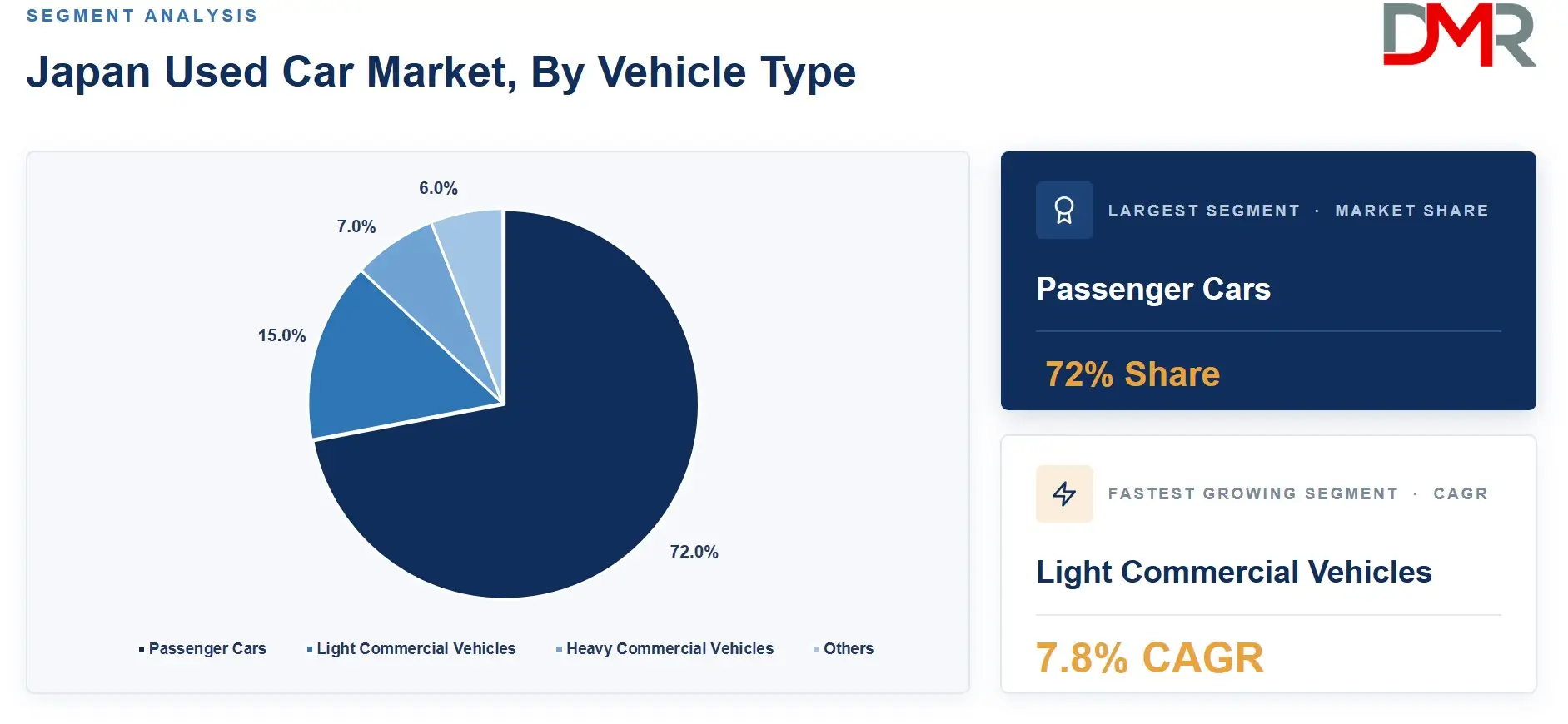
Passenger Cars are projected to hold the largest share by vehicle type in 2026, accounting for approximately 72% of revenue because private ownership creates the deepest pool of trade-ins and the broadest retail demand. Compact cars, kei cars, sedans, minivans and SUVs provide dealers with multiple price bands and high transaction frequency. Growth, however, is concentrated in Light Commercial Vehicles, expanding at a CAGR of 7.8% between 2026 and 2035. Small businesses, delivery operators and service fleets value used vans and pickups for lower upfront cost, while replacement demand remains tied to utilization rather than discretionary household spending. Export buyers also support selected commercial models, strengthening auction liquidity for vehicles with durable powertrains and practical configurations.
By Vehicle Age
Vehicles aged 3 to 5 Years are expected to lead the age segmentation in 2026 with a share of roughly 34%, since they combine meaningful depreciation with relatively current safety, infotainment and efficiency features. This band also fits certified pre-owned programs because service histories are easier to verify and remaining component life is more predictable. The steeper trajectory sits with Up to 3 Years vehicles, forecast to grow at a CAGR of 8.1% through 2035. Higher new vehicle prices increase the appeal of nearly new stock, while lease returns, dealer demonstrators and early trade-ins create supply. Buyers can obtain newer technology without taking the full first-owner depreciation hit, supporting premium used pricing.
By Fuel Type
Gasoline vehicles are projected to account for close to 54% of fuel-type revenue in 2026 because the installed fleet is large, servicing is familiar and resale benchmarks are well established. Broad model availability keeps gasoline vehicles liquid across urban and regional markets, even as electrified alternatives gain share. Growth, however, is concentrated in Battery Electric vehicles, expanding at a CAGR of 11.3% from 2026 to 2035. More first-generation EVs are entering the resale pool, and improved battery diagnostics can reduce uncertainty around remaining life. Falling new battery costs and broader charging availability should also improve used EV economics, although residual values will remain sensitive to technology cycles and new-vehicle pricing.
By Sales Channel
Franchised Dealers are set to represent around 29% of sales-channel revenue in 2026, supported by trade-in access, manufacturer-backed certification, financing and service networks. Their ability to bundle warranty and aftersales support is especially valuable for younger vehicles and buyers seeking lower condition risk. The fastest expansion is expected in Online Platforms, at a CAGR of 10.4% between 2026 and 2035. Buyers increasingly begin with digital comparison of price, mileage, trim and dealer reputation, while sellers can use remote appraisal and lead management to widen reach. The channel is evolving toward hybrid transactions in which discovery and qualification occur online, followed by inspection, delivery or final documentation through a physical dealer network.
By End User
Individual Buyers are projected to hold the largest end-user share in 2026 at approximately 68%, reflecting the scale of household replacement demand and Japan's diverse private vehicle fleet. Consumers span low-cost mobility buyers through customers seeking nearly new premium or hybrid vehicles, giving retailers a broad pricing ladder. Growth, however, is concentrated in Export Traders, which are forecast to expand at a CAGR of 8.6% through 2035. Japanese auction supply remains attractive in markets that value right-hand-drive vehicles, reliable powertrains and documented condition. Export demand can absorb older or model-specific inventory that has weaker domestic appeal, although freight disruption and destination rules can quickly change the economics.
The Japan Used Car Market Report is Segmented Based on the Following
By Vehicle Type
- Passenger Cars
- Light Commercial Vehicles
- Heavy Commercial Vehicles
- Others
By Vehicle Age
- Up to 3 Years
- 3 to 5 Years
- 5 to 8 Years
- Above 8 Years
- Others
By Fuel Type
- Gasoline
- Hybrid
- Diesel
- Battery Electric
- Others
By Sales Channel
- Franchised Dealers
- Independent Dealers
- Auction Houses
- Online Platforms
- Others
By End User
- Individual Buyers
- Fleet Operators
- Export Traders
- Rental and Leasing Companies
- Others
Competitive Landscape
Competition in Japan's used vehicle sector spans wholesale auction operators, nationwide retail chains, manufacturer-backed certified programs, online listing platforms and export specialists. Scale matters because high transaction volume improves pricing data, inventory sourcing and advertising efficiency, while local dealers compete through relationships and specialization. Large retailers are investing in standardized inspection, digital lead management, finance attachment and faster inventory rotation. Auction operators compete on venue coverage, dealer participation, grading confidence and remote bidding infrastructure. Exporters differentiate through destination knowledge, shipping coordination and multilingual sales support. The market remains fragmented at retail even though several national groups have substantial brand awareness, leaving room for specialist operators that can source distinctive vehicles or serve regional demand efficiently.
Some of the Prominent Players in the Japan Used Car Market Are
- USS Co., Ltd.
- IDOM Inc.
- NEXTAGE Co., Ltd.
- PROTO Corporation
- Aucnet Inc.
- ORIX Auto Corporation
- WECARS Co., Ltd.
- CarSeven Digital Development Co., Ltd.
- Apple Auto Network Co., Ltd.
- Toyota Motor Corporation
- Honda Motor Co., Ltd.
- Nissan Motor Co., Ltd.
- Mazda Motor Corporation
- Subaru Corporation
- Suzuki Motor Corporation
- Mitsubishi Motors Corporation
- Daihatsu Motor Co., Ltd.
- Isuzu Motors Limited
- Hino Motors, Ltd.
- Yanase & Co., Ltd.
- SBT Co., Ltd.
- BE FORWARD Co., Ltd.
- Autocom Japan Inc.
- Trust Co., Ltd.
- JPC Trade Co., Ltd.
- PicknBuy24.com
- Japan Partner Inc.
- Car From Japan Co., Ltd.
- Provide Cars Co., Ltd.
- Royal Trading Co., Ltd.
- Pacific Coast Auto
- Japan Car Direct
- TCV Corporation
- Goo-net Exchange
- Nikkyo Co., Ltd.
- Real Motor Japan
- Every Co., Ltd.
- ZervTek Co., Ltd.
- AA Japan
- Nichibo Japan Trading Co., Ltd.
- Other Key Players
Recent Developments
- In July 2026, USS reported higher year-on-year consignment and contract completion activity for June, alongside a higher average contracted vehicle price, indicating continued strength in Japan's wholesale auction environment.
- In May 2026, USS released its fiscal-year results and updated operating data, keeping dealer attention on auction throughput, contract rates and vehicle pricing as key indicators for inventory acquisition conditions.
- In March 2026, disruption around Middle East shipping routes affected Asian vehicle movements and increased uncertainty for Japanese used-car exporters that depend on Gulf destinations and transshipment channels.
- In December 2025, Japan closed a year in which used vehicle exports reached a new high, reinforcing the role of overseas demand in absorbing domestic remarketing supply and supporting auction competition.
- In September 2025, used-vehicle exporters and dealers continued to adapt sourcing toward high-demand compact, hybrid and commercial models as currency conditions and destination-market demand supported cross-border purchasing.
Report Details
| Report Characteristics |
| Market Size (2026) |
USD 42.8 Bn |
| Forecast Value (2035) |
USD 73.5 Bn |
| CAGR (2026-2035) |
6.2% |
| Historical Data |
2021 - 2025 |
| Forecast Data |
2026 - 2035 |
| Base Year |
2025 |
| Segments Covered |
By Vehicle Type, By Vehicle Age, By Fuel Type, By Sales Channel and By End User |
| Regional Coverage |
Japan |
Frequently Asked Questions
How big is the Japan Used Car Market?
▾ The Japan Used Car Market is estimated at USD 42.8 Bn in 2026. The estimate covers domestic used passenger and commercial vehicle transaction value across organized dealer, auction and online channels. It excludes the worldwide revenue of Japanese automotive groups and focuses on resale demand and remarketing activity occurring inside Japan.
What is the growth rate of the Japan Used Car Market?
▾ Japan's used vehicle sector is forecast to expand at a CAGR of 6.2% from 2026 to 2035. Growth is supported by replacement economics, digital retailing, stronger demand for younger used vehicles and a changing powertrain mix, while market maturity and wholesale price pressure keep the trajectory below high-growth automotive technology categories.
What is driving demand in the Japan Used Car Market?
▾ Demand is driven by the value gap between new and used vehicles, frequent trade-in cycles and the availability of well maintained inventory. Organized auctions make it easier for dealers to source vehicles nationally, while certified programs improve buyer confidence. Export purchasing can also support residual values for models that have strong demand outside Japan.
Which vehicle type holds the largest share?
▾ Passenger Cars are expected to remain the leading vehicle type, representing around 72% of market revenue in 2026. The segment benefits from Japan's large private vehicle base, frequent household replacement and a broad mix of kei cars, compact vehicles, minivans, sedans and SUVs that serve multiple price and lifestyle requirements.
Which sales channel is growing fastest?
▾ Online Platforms are forecast to record the fastest sales-channel expansion, at a CAGR of 10.4% between 2026 and 2035. Digital comparison, remote appraisal, finance pre-qualification and inventory matching reduce search friction. Most transactions are still likely to retain a physical component for inspection, delivery, documentation or aftersales support.
Who are the key players in the Japan Used Car Market?
▾ Key participants include USS Co., Ltd., IDOM Inc., NEXTAGE Co., Ltd., PROTO Corporation, Aucnet Inc., ORIX Auto Corporation and WECARS Co., Ltd. Competition also includes manufacturer-backed certified programs, independent dealers, auction networks, listing platforms and export specialists, creating a market structure that is nationally visible but still fragmented at retail.
What is the outlook for the Japan Used Car Market through 2035?
▾ The Japan Used Car Market is anticipated to reach USD 73.5 Bn by 2035. Digital retail tools, younger certified inventory and growing electrified vehicle availability should support value growth, while auction competition, battery residual-value uncertainty and changing export logistics will remain important variables for dealer margins and inventory strategy.