What is the Japan V2X Market Size?
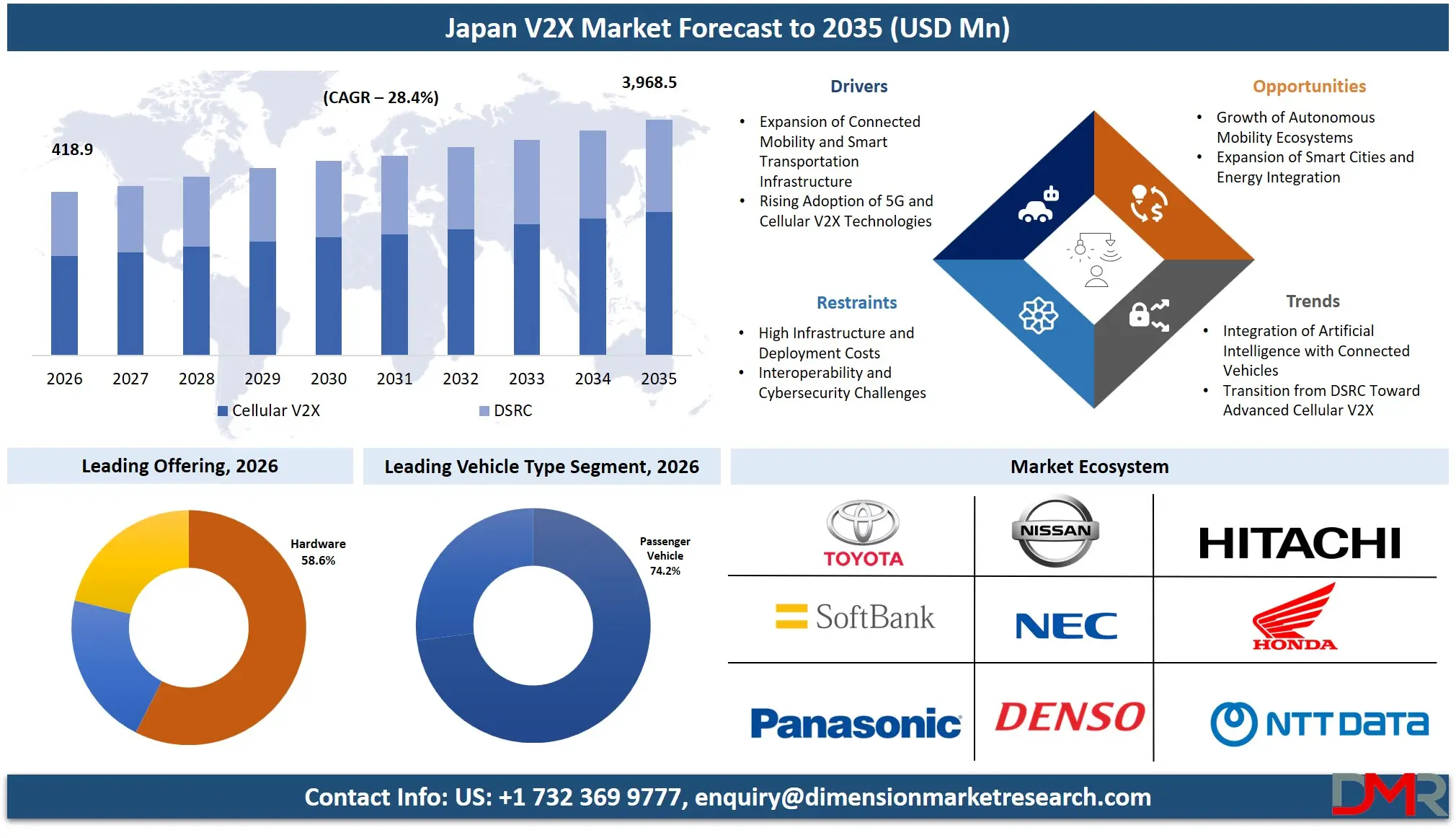
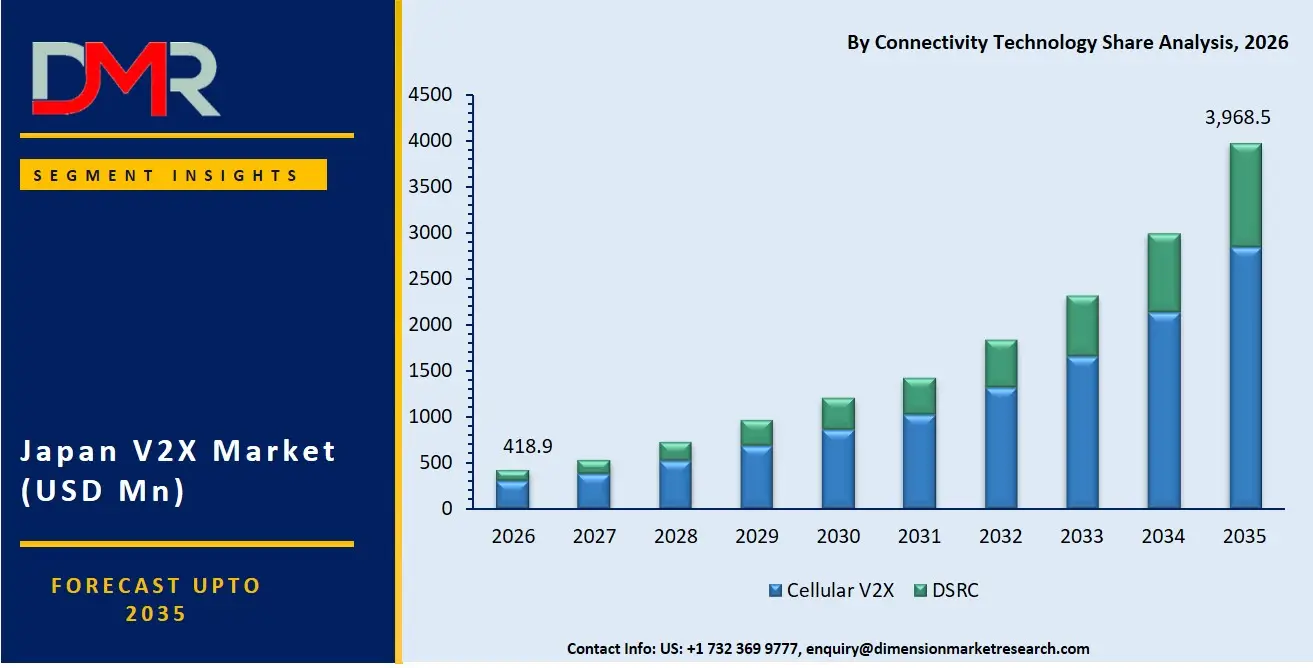
The Japan V2X Market size is expected to be USD 418.9 million in 2026 and increase at a compound annual growth rate of 28.0% to USD 3,968.5 million by 2035 owing to expansion of connected mobility and smart transportation infrastructure.
ℹ
To learn more about this report –
Download Your Free Sample Report Here
Vehicle-to-Everything (V2X) technology enables real-time wireless communication between vehicles, road infrastructure, pedestrians, networks, and power grids to improve transportation safety, efficiency, and automation. It comprises hardware, software, communication modules, connectivity technologies, and integration services that facilitate low-latency data exchange. The technology plays a pivotal role in connected mobility, intelligent transportation systems, and autonomous driving ecosystems. Growing deployment of 5G networks, increasing investments in smart transportation infrastructure, advancements in cooperative driving systems, and the integration of artificial intelligence into connected vehicles are accelerating adoption while strengthening Japan's position as a leader in next-generation mobility solutions.
Key Takeaways
- Market Size & Forecast: The Japan V2X Market size is projected to reach USD 418.9 million in 2026 and is anticipated to have a value of USD 3,968.5 million in 2035.
- Growth Rate & Outlook: The Japan V2X Market size is set to grow at a compound annual growth rate of 28.4% during the forecast period of 2026 to 2035.
- Primary Growth Drivers: Some of the major growth drivers in the market are Expansion of Connected Mobility and Smart Transportation Infrastructure, and more.
- Key Market Trends: Some of the major trends in the market are Integration of Artificial Intelligence with Connected Vehicles, and more.
- By Offering: Hardware segment is anticipated to get the majority share of the Japan V2X Market in 2026.
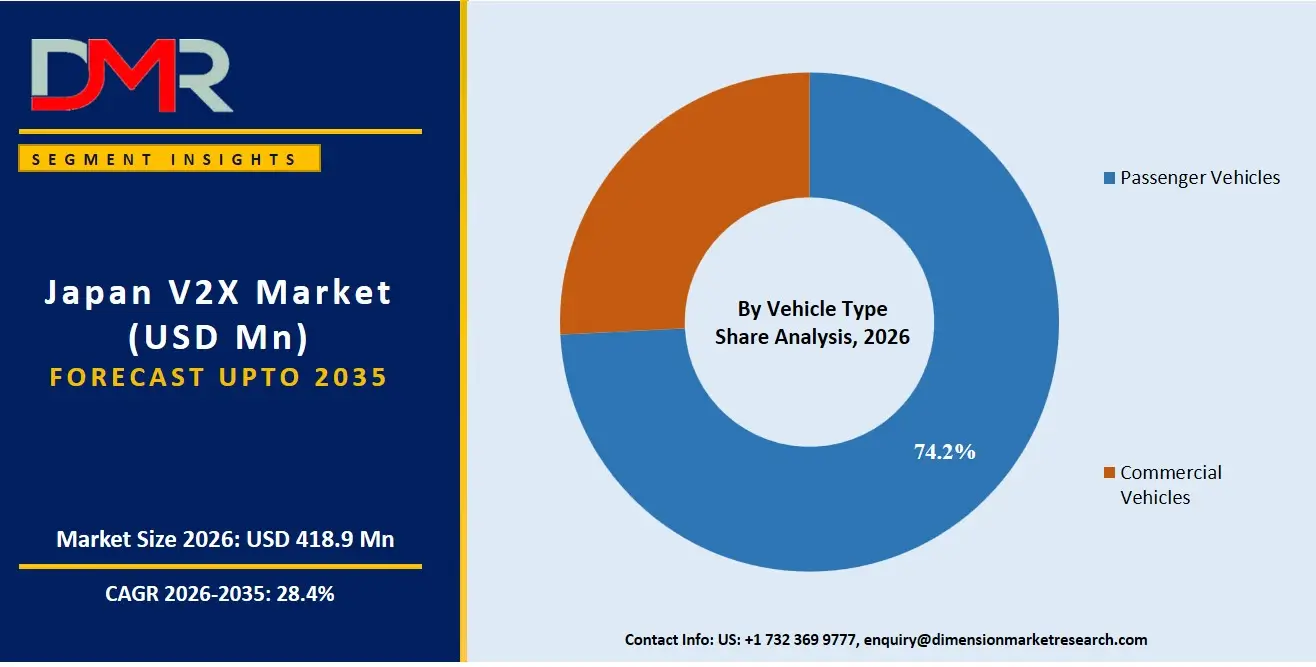
- By Vehicle Type: Passenger vehicle is expected to get the largest revenue share in 2026 in the Japan V2X Market.
- By Connectivity Technology Type: Cellular V2X segment is expected to get the largest revenue share in 2026 in the Japan V2X Market.
What is the V2X?
Vehicle-to-Everything (V2X) technology is an intelligent communication ecosystem that enables vehicles to exchange real-time data with other vehicles, road infrastructure, pedestrians, communication networks, and electrical grids using wireless communication technologies such as Dedicated Short-Range Communication (DSRC) and Cellular V2X (C-V2X). It encompasses hardware, software, connectivity platforms, and integration services that support advanced driver assistance systems, traffic management, autonomous driving, fleet operations, and smart energy applications.
Use Cases
- Road Safety & Collision Avoidance: V2X communication enables vehicles to exchange real-time information regarding speed, braking, road hazards, and blind-spot conditions. The technology significantly reduces accident risks by providing early warnings to drivers and advanced driver assistance systems, particularly at intersections and during adverse weather conditions.
- Intelligent Traffic Management: Connected vehicles continuously communicate with traffic infrastructure to optimize signal timing, reduce congestion, and recommend efficient travel routes. Municipal authorities benefit from real-time traffic analytics, enabling smoother transportation networks and lower vehicle emissions across urban environments.
- Autonomous & Cooperative Driving: Autonomous vehicles utilize V2X communication to coordinate maneuvers with surrounding vehicles and infrastructure. Cooperative awareness messages improve lane merging, adaptive cruising, and intersection navigation, enhancing operational safety while supporting higher levels of driving automation.
- Smart Charging & Vehicle-to-Grid Integration: Electric vehicles equipped with V2G capabilities communicate with utility networks to balance electricity demand and supply. This enables intelligent charging schedules, supports renewable energy integration, improves grid stability, and creates additional value streams for EV owners.
How AI Is Transforming the Japan V2X Market
Artificial intelligence significantly enhances V2X platforms by processing enormous volumes of real-time traffic, infrastructure, pedestrian, and vehicle data. AI algorithms enable predictive collision detection, intelligent route optimization, adaptive traffic signal management, and dynamic hazard recognition, improving transportation safety while minimizing congestion. Machine learning also strengthens vehicle perception by combining sensor information with V2X communication to support cooperative and autonomous driving.
AI additionally improves operational efficiency through predictive maintenance, intelligent network management, cybersecurity threat detection, and automated fleet optimization. Automotive manufacturers increasingly integrate AI with edge computing and cloud analytics to reduce communication latency, improve decision-making accuracy, optimize energy consumption for electric vehicles, and deliver personalized connected mobility services that enhance both driver experience and transportation system performance.
Market Dynamic
Driving Factors in the Japan V2X Market
Expansion of Connected Mobility and Smart Transportation Infrastructure
Japan continues to strengthen investments in intelligent transportation systems, connected highways, and digital road infrastructure that support large-scale V2X deployment. Increasing adoption of connected vehicles, government-backed smart city initiatives, and nationwide digital transformation programs encourage automotive manufacturers and technology providers to integrate advanced communication technologies into next-generation vehicles. These developments improve traffic efficiency, reduce road accidents, and establish favorable conditions for long-term V2X market growth.
Restraints in the Japan V2X Market
Interoperability and Cybersecurity Challenges
V2X environments involve communication among vehicles, infrastructure, telecommunications networks, and cloud platforms developed by multiple vendors. Ensuring interoperability between DSRC and C-V2X technologies while maintaining robust cybersecurity standards presents considerable technical challenges. Concerns regarding data privacy, system resilience, software vulnerabilities, and cyberattacks continue influencing purchasing decisions and regulatory requirements throughout the connected mobility ecosystem.
Opportunities in the Japan V2X Market
Growth of Autonomous Mobility Ecosystems
The increasing development of autonomous vehicles presents substantial opportunities for V2X adoption. Autonomous driving relies heavily on continuous communication with surrounding infrastructure, pedestrians, and nearby vehicles. As Japan expands autonomous mobility pilots, logistics automation, and smart transportation corridors, demand for integrated V2X solutions is expected to accelerate across passenger and commercial vehicle segments.
Trends in the Japan V2X Market
Integration of Artificial Intelligence with Connected Vehicles
Artificial intelligence increasingly supports predictive analytics, intelligent traffic management, adaptive routing, anomaly detection, and autonomous driving decisions within V2X ecosystems. AI-powered edge computing enables vehicles to process real-time communication data rapidly, improving decision-making accuracy while reducing communication latency for safety-critical transportation applications.
Research Scope and Analysis
The report evaluates the Japan V2X market across communication type, connectivity technology, offering, vehicle type, and application. It analyzes segment performance, emerging technology trends, growth drivers, competitive dynamics, and future adoption patterns, providing comprehensive insights into evolving market opportunities, demand trends, and strategic developments shaping the industry.
ℹ
To learn more about this report –
Download Your Free Sample Report Here
By Communication Type Analysis
Vehicle-to-Vehicle (V2V) is estimated to account for 36.8% of the Japan V2X market in 2026, making it the leading communication type due to its fundamental role in enabling direct communication between vehicles for collision prevention, cooperative awareness, emergency braking alerts, and lane-change assistance. V2V serves as the foundation for advanced driver assistance systems and higher levels of autonomous driving, leading to widespread integration in connected passenger vehicles and commercial fleets. Growing deployment of intelligent transportation infrastructure and increasing emphasis on road safety regulations further reinforce its market leadership. Meanwhile, Vehicle-to-Grid (V2G) is expected to be the fastest-growing segment during the forecast period. Rising electric vehicle adoption, expansion of renewable energy integration, and growing interest in bidirectional charging solutions are encouraging utilities and automotive manufacturers to deploy V2G technologies. These systems allow electric vehicles to communicate with the power grid, supporting demand response, energy storage optimization, and grid stabilization while creating new revenue opportunities for vehicle owners.
By Connectivity Technology Analysis
Cellular V2X (C-V2X) is projected to hold an estimated 71.4% share of the Japan V2X market in 2026, making it the dominant connectivity technology. Its leadership is attributed to superior communication range, lower latency, higher reliability, and seamless compatibility with existing 4G LTE and rapidly expanding 5G infrastructure.
ℹ
To learn more about this report –
Download Your Free Sample Report Here
C-V2X enables comprehensive communication between vehicles, road infrastructure, pedestrians, and cloud platforms while supporting advanced autonomous driving applications. The transition toward 5G NR-V2X is further accelerating adoption because it enables ultra-reliable, low-latency communication essential for safety-critical applications. Dedicated Short-Range Communication (DSRC) continues to serve legacy deployments and selected infrastructure projects but is witnessing comparatively slower expansion. Within the Cellular V2X category, 5G NR-V2X represents the fastest-growing technology as automotive manufacturers increasingly introduce software-defined and highly automated vehicles requiring high-speed connectivity and real-time data exchange.
By Offering Analysis
Hardware is expected to account for 58.6% of the Japan V2X market in 2026, maintaining the largest share owing to substantial investments in physical communication infrastructure and vehicle-mounted equipment. On-Board Units (OBUs), Roadside Units (RSUs), Telematics Control Units (TCUs), and communication modules form the technological backbone of V2X ecosystems, making hardware deployment essential before software and services can be effectively utilized. Increasing production of connected vehicles and nationwide expansion of smart transportation infrastructure continue supporting hardware demand. However, the Software segment is anticipated to register the fastest growth throughout the forecast period. Demand for V2X communication platforms, security and certificate management solutions, traffic analytics, cloud integration, and over-the-air software updates is increasing rapidly. As vehicles become increasingly software-defined, automotive manufacturers and mobility providers are investing heavily in intelligent software solutions that improve scalability, cybersecurity, interoperability, and real-time traffic management capabilities.
By Vehicle Type Analysis
Passenger Vehicles are projected to capture 74.2% of the Japan V2X market in 2026, representing the largest vehicle category. The dominance of this segment is driven by Japan's strong passenger vehicle production, growing consumer demand for advanced driver assistance systems, and increasing integration of connected mobility technologies into premium and mid-range vehicles. Automakers are actively incorporating V2X capabilities to enhance occupant safety, driving convenience, and autonomous driving readiness. Government support for connected transportation and smart mobility initiatives further encourages adoption within the passenger vehicle segment. Commercial Vehicles are expected to record the fastest growth during the forecast period as logistics operators, fleet managers, and public transportation agencies increasingly adopt connected communication systems for route optimization, predictive maintenance, driver safety monitoring, cargo tracking, and fleet efficiency improvements. Growth in e-commerce and intelligent logistics is expected to accelerate deployment across both light and heavy commercial vehicle categories.
By Application Analysis
Road Safety & Collision Avoidance is estimated to account for 31.5% of the Japan V2X market in 2026, making it the leading application segment. Increasing emphasis on reducing traffic accidents, improving pedestrian safety, and supporting advanced driver assistance systems continues driving investment in collision warning technologies. Real-time communication between vehicles, roadside infrastructure, and vulnerable road users enables rapid hazard detection and emergency response, making this application fundamental to connected mobility. Autonomous & Cooperative Driving is expected to emerge as the fastest-growing application during the forecast period. Continuous advancements in autonomous vehicle technologies, AI-powered perception systems, high-speed 5G communication, and cooperative maneuvering capabilities are encouraging wider deployment of V2X-enabled autonomous driving platforms. Growing investments in intelligent transportation infrastructure and connected mobility ecosystems further strengthen long-term growth prospects for this segment.
The Japan V2X Market Report is segmented on the basis of the following:
By Communication Type
- Vehicle-to-Vehicle (V2V)
- Vehicle-to-Infrastructure (V2I)
- Vehicle-to-Pedestrian (V2P)
- Vehicle-to-Network (V2N)
- Vehicle-to-Grid (V2G)
By Connectivity Technology
- Dedicated Short-Range Communication (DSRC)
- Cellular V2X (C-V2X)
By Offering
- Hardware
- On-Board Units (OBUs)
- Roadside Units (RSUs)
- Telematics Control Units (TCUs)
- Communication Modules & Antennas
- Software
- V2X Communication Software
- Security & Certificate Management
- Traffic & Data Management Software
- Services
- Integration & Deployment
- Managed & Maintenance Services
By Vehicle Type
- Passenger Vehicles
- Commercial Vehicles
- Light Commercial Vehicles (LCVs)
- Heavy Commercial Vehicles (HCVs)
By Application
- Road Safety & Collision Avoidance
- Traffic Management
- Autonomous & Cooperative Driving
- Fleet Management
- Smart Parking
- Electronic Toll Collection
- Emergency Vehicle Notification
- Smart Charging & Energy Management (V2G)
Competitive Landscape
The Japan V2X market is characterized by continuous technological innovation, strategic collaborations, and sustained investments in research and development aimed at strengthening connected mobility ecosystems. Market participants focus on enhancing interoperability, cybersecurity, cloud integration, and 5G-enabled communication capabilities to gain competitive advantages. High capital requirements, stringent automotive safety standards, and complex certification processes create significant entry barriers for new participants. Companies increasingly pursue partnerships with telecommunications providers, automotive manufacturers, semiconductor developers, infrastructure operators, and software vendors to accelerate commercialization, expand product portfolios, improve intelligent transportation solutions, and strengthen long-term market positioning within Japan's evolving connected vehicle ecosystem.
Some of the prominent players in the Japan V2X are:
- Toyota Motor Corporation
- Honda Motor Co., Ltd.
- Nissan Motor Co., Ltd.
- Denso Corporation
- Panasonic Holdings Corporation
- Hitachi, Ltd.
- NEC Corporation
- Mitsubishi Electric Corporation
- Fujitsu Limited
- SoftBank Corp.
- KDDI Corporation
- NTT DOCOMO, Inc.
- Suzuki Motor Corporation
- Subaru Corporation
- Mazda Motor Corporation
- Isuzu Motors Limited
- Hino Motors, Ltd.
- Aisin Corporation
- Alps Alpine Co., Ltd.
- Renesas Electronics Corporation
- Rohm Co., Ltd.
- Other Key Players
Recent Developments
- In July 2025, Toyota Motor Corporation, together with Foresight Autonomous Holdings, Eye-Net Mobile, SoftBank Corp., and TechnoCo. Ltd., announced research presented at the 2025 JSAE Annual Spring Congress demonstrating the potential of Vehicle-to-Network (V2N) technology for improving Advanced Driver Assistance Systems (ADAS). The research explored how smartphones and cloud connectivity can function as external sensors to detect hazards that conventional onboard sensors cannot identify, particularly in non-line-of-sight situations. The study highlighted the importance of communication latency, positioning accuracy, and real-time data exchange, reinforcing V2N's role in enhancing road safety and supporting future connected and autonomous mobility ecosystems.
- In April 2025, Toyota Motor Corporation, Waymo, and Woven by Toyota announced a strategic collaboration to accelerate next-generation autonomous driving technologies. The partnership focuses on jointly developing an advanced autonomous driving platform while integrating automated driving capabilities into future personally owned vehicles. The collaboration combines Toyota's automotive engineering expertise with Waymo's autonomous driving software and Woven's mobility technologies to enhance vehicle safety, connected mobility, and intelligent transportation solutions. The initiative is expected to accelerate deployment of advanced V2X communication capabilities that support cooperative driving, real-time traffic intelligence, and enhanced connected vehicle ecosystems across Japan and global markets.
- In February 2025, OMRON Social Solutions announced the KPEP-A-2 Series Multi-V2X system, with commercial availability beginning in April 2025. The solution integrates conventional V2X functionality with residential solar photovoltaic systems and electric vehicles into a unified energy management platform. Designed for residential applications, the system supports bidirectional power flow, optimized self-consumption of renewable energy, emergency backup power, and flexible installation configurations. The launch reflects Japan's growing emphasis on vehicle-to-home (V2H) and vehicle-to-grid (V2G) technologies, strengthening the country's smart energy ecosystem while expanding the practical applications of V2X beyond transportation into residential energy management.
Report Details
| Report Characteristics |
| Market Size (2026) |
USD 418.9 Mn |
| Forecast Value (2035) |
USD 3,968.5 Mn |
| CAGR (2026–2035) |
28.4% |
| Historical Period |
2021 – 2025 |
| Forecast Period |
2027 – 2035 |
| Base Year |
2025 |
| Estimate Year |
2026 |
| Segments Covered |
By Communication Type, By Connectivity Technology, By Offering, By Vehicle Type, By Application |
| Country Coverage |
Japan |
Frequently Asked Questions
How big is the Japan V2X Market?
▾ The Japan V2X Market size is expected to reach USD 418.9 million by 2026 and is projected to reach USD 3,968.5 million by the end of 2035.
What is the CAGR of the Japan V2X Market from 2026 to 2035?
▾ The market is growing at a CAGR of 28.4 percent over the forecasted period.
What factors are driving the growth of the Japan V2X Market?
▾ Expansion of Connected Mobility and Smart Transportation Infrastructure, and more are the factors driving the growth of the Japan V2X Market.
What are the major trends in the Japan V2X Market?
▾ Integration of Artificial Intelligence with Connected Vehicles, and more are some of the major trends in the market.
Who are the key players in the Japan V2X Market?
▾ Some of the key players in the Japan V2X Market include NEC, Honda, Hitachi, and more
How is the Japan V2X Market segmented?
▾ The Japan V2X Market is segmented by communication type, connectivity technology, offering, vehicle type, application.