What is the Japan Video Game Market Size?
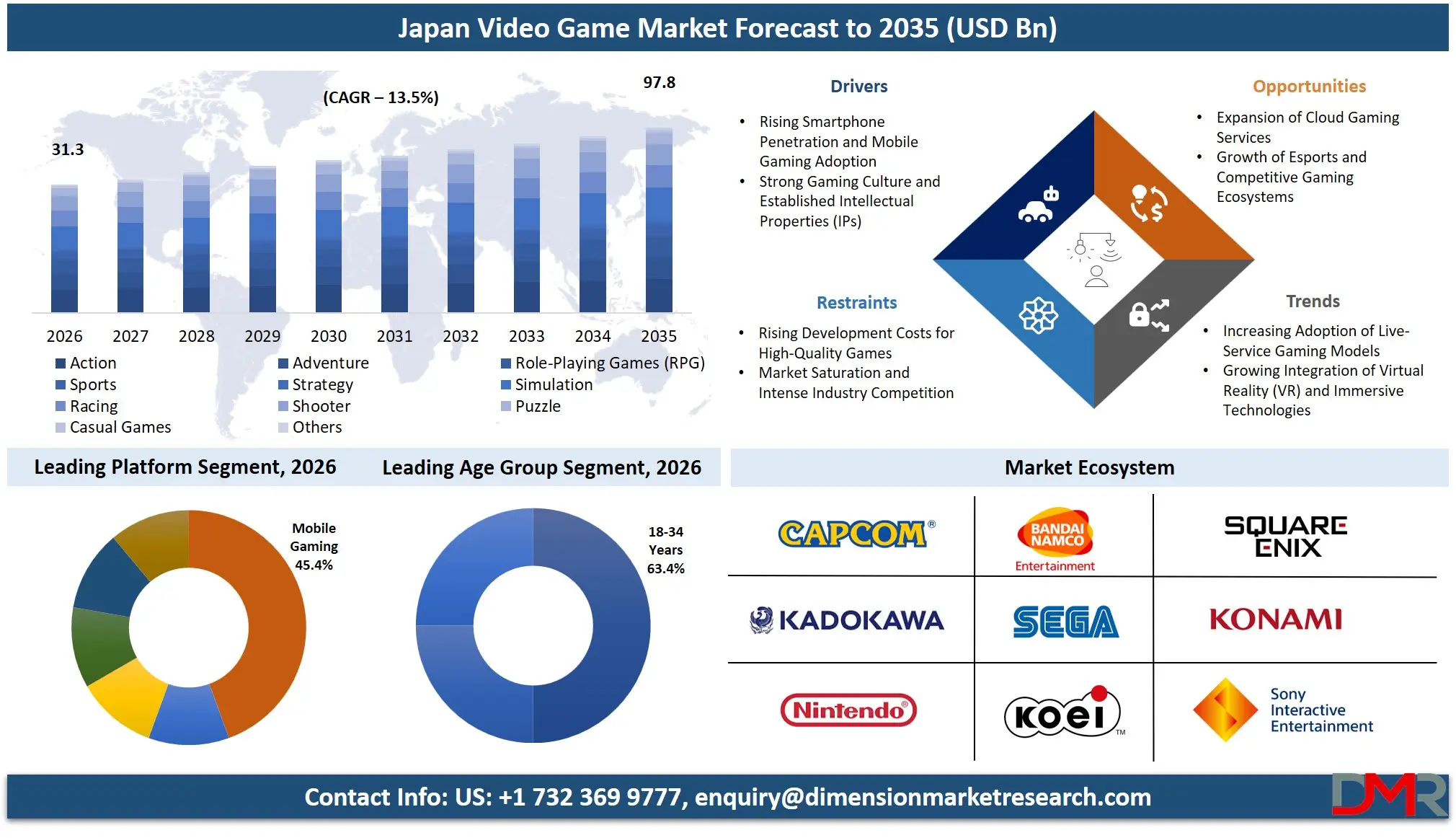
The Japan Video Game Market is projected to reach a valuation of USD 31.3 billion in 2026, and is further anticipated to expand to USD 97.8 billion by 2035, exhibiting a robust CAGR of 13.5% during the forecast period.
ℹ
To learn more about this report –
Download Your Free Sample Report Here
Japan being the home of famous video game franchises, as well as the place with a strong gaming culture, sees its market going through an epoch-making transformation due to the convergence of the home console market, the proliferation of mobile technologies, and immersive realities. The market covers areas ranging from the creation of games to their distribution through publishing, the creation of hardware, and esports, and caters to a population base that cuts across different age groups. The increased popularity of cross-platform games, live services, anime-like RPGs, and tournaments in esports has led to a need for advanced game engines and persistent online worlds.
ℹ
To learn more about this report –
Download Your Free Sample Report Here
Key Takeaways
- Market Size & Forecast: The Japan Video Game market is projected to reach USD 31.3 billion in 2026, expanding dramatically to USD 97.8 billion by 2035, driven by the combination of growth in microtransaction on mobile devices, generation of next-generation consoles, and the evolution of esports infrastructures.
- Growth Rate & Outlook: The market growth is forecasted to achieve a CAGR of 13.5% due to the fundamental change from one-off static games to live service games and the increasing intricacies of cross-platform identity management and cloud save compatibility.
- Primary Growth Drivers: The monetization of free-to-play games using in-game purchases, the popularity of gaming in mainstream entertainment thanks to VTubers and anime franchises, and the need for advanced engines for RPG and Action games will be some of the main growth drivers.
- Key Market Trends: The significant trends in the industry include the advent of cloud-based gaming in Smart TVs and mobile platforms in order to circumvent the limitations of hardware, the incorporation of machine learning algorithms for procedural content generation in adventure and simulation games, and the adoption of a subscription-based model in the publishing process.
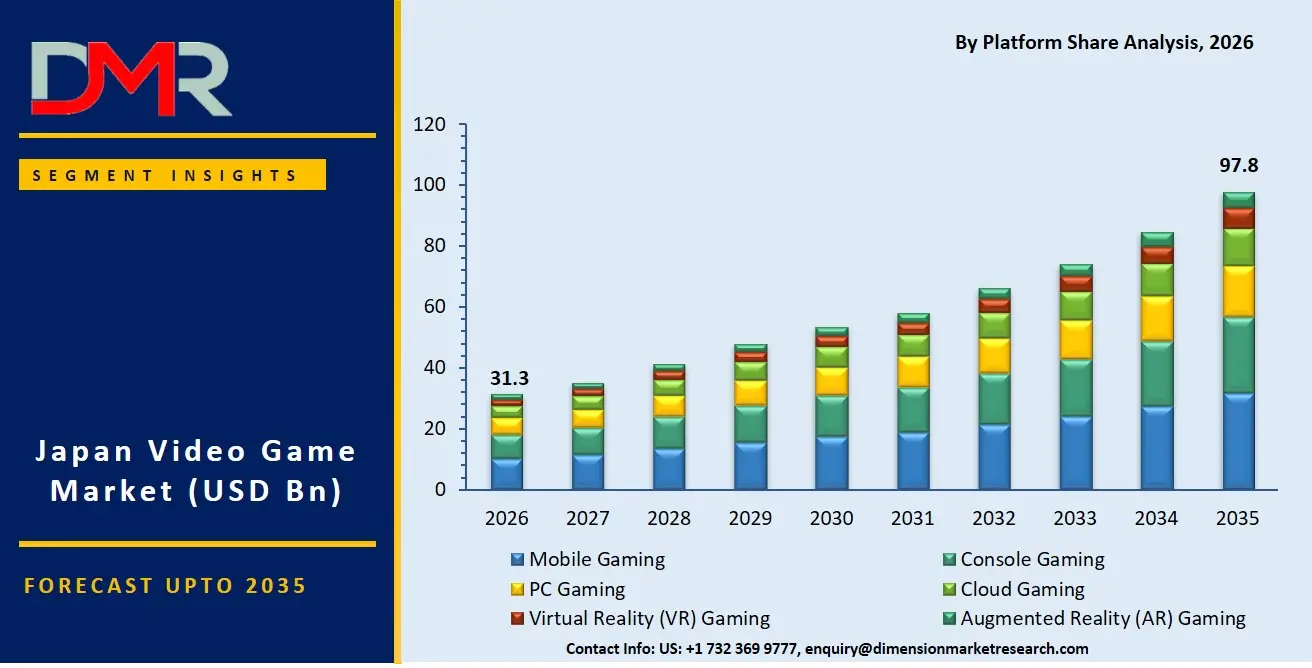
- By Platform Analysis: The dominance of mobile gaming in terms of market share is anticipated owing to the unrivaled number of installs and social interactions associated with the platform. Professional localization and porting services are needed to develop cross-save functionality across platforms, including Console and PC Gaming, along with mobile versions of the game.
- By Game Type Analysis: RPGs and Action games are the two categories of games which have generated the largest revenues in Japan because of their narrative complexity and intricate gameplay mechanics. The Simulation genre is currently the most rapidly growing segment, owing to the extensive monetization through purchase loops in idols and life simulations games.
What is the Video Game?
Video games are computer-based entertainment where a user interacts with digitally created images using a video game device like gaming console, personal computer, smartphone, tablet, or even VR system. Video games comprise images, sound effects, storylines, and gameplay to provide entertainment. They can be played either alone or with multiple people through the internet or even without the internet. The genres of video games include action games, adventure games, role-playing games, sports games, simulation games, strategic games, and puzzle games among others. In contemporary times, video games have grown beyond entertainment to be used for socialization, competitiveness, and education purposes.
Use Cases
- Cross-Platform IP Expansion for RPG Franchises: Major studios hire specialized development teams to adapt a flagship Console RPG into a Mobile Gaming title, using cloud saves to synchronize game states and allowing players to earn in-game currency on the go that translates to their home console experience.
- Esports Event Management in Multiplayer Games: Gaming cafés and event organizers utilize enterprise-grade infrastructure and coaching services to host large-scale tournaments for team-based Shooter and Strategy games, integrating real-time spectator modes and brand sponsorships.
- Educational Gamification through Simulation: Educational institutions deploy custom Simulation game engines to teach urban planning and language skills, using VR Headsets to create immersive historical environments that align with Japanese Ministry of Education guidelines.
- Virtual Reality Arcade Integration: Entertainment centers implement large-scale VR Gaming installations, using free-roam multiplayer systems to deliver location-based Action and Adventure experiences that consumers cannot replicate at home, thus driving foot traffic.
How AI is Transforming the Video Game Market?
AI technology is rapidly changing the Japanese gaming industry by boosting the speed of creation of assets related to characters and improving engagement. Procedural generation tools for RPG allow creating different side quests and realistic NPCs behavior, saving the time spent on the process, enabling the developer to concentrate more on the emotional storylines that make Japanese games well-known among international users. Additionally, matchmaking technologies in multiplayer games provide automatic team balancing, latency detection to ensure fair gameplay for users through matching them according to their skills, communication style, and other characteristics.
Another aspect influenced by AI is monetization and management of players' lifecycle. Machine learning algorithms in Free-to-Play and Microtransactions sectors examine consumer psychology in terms of spending to provide customized probabilities for gacha banners and virtual stores while complying with consumer protection law. Generative AI chatbots will be used in casual games as an assistant that develops depending on player interactions with it, forming unique relationships between the player and the game.
Market Dynamics
Key Drivers in the Japan Video Game Market
Rising Smartphone Penetration and Mobile Gaming Adoption
With the proliferation of smartphones, along with fast mobile internet, there has been an exponential increase in the development of Japan's video game industry. One of the key factors driving the industry forward is mobile gaming. This is due to the convenience that mobile gaming brings with itself. Not only does it provide access to the video game at all times but it also offers games free of cost, thus attracting gamers from all age groups. Role-playing games along with games based on gacha monetization have also become popular recently. With developers pouring huge sums into developing games for this platform, the future of mobile gaming looks bright indeed.
Strong Gaming Culture and Established Intellectual Properties
Japan has a very developed culture of gaming, which ensures continuous demand for video game content among multiple generations. Loyalty of consumers towards various franchise characters and established companies guarantees stability in the development of the gaming market in Japan. Video games from such genres as role-playing, action, and multiplayer appeal to Japanese players, resulting in high spending and player participation rates. Familiarity with the brands allows game producers to make continuous profits on sequels, DLCs, and various products associated with the games. Moreover, the importance of video games in entertainment culture is ensured by esports, online streams, and social networks. The gaming culture remains an important factor driving the Japanese video game industry.
Restraints in the Japan Video Game Market
Rising Development Costs for High-Quality Games
The increasing complexity of contemporary games has resulted in an increase in production costs. The developers have to spend vast amounts on graphic enhancements, big development teams, powerful game engines, cybersecurity, and frequent updates of content. In addition, the increasing demands of the consumers in terms of their expectations for immersion and realism make production harder. Higher costs create additional difficulties, especially for small and independent firms who cannot compete with more powerful publishing companies. Moreover, increased development time means greater risks and delays in achieving profits. Under these circumstances, the growing difficulty of controlling production costs is evident. This creates serious constraints on Japanese game development and production.
Market Saturation and Intense Competition
Competition is increasing within Japan's video game industry due to the vast range of games offered by various channels. Players have the choice from hundreds of thousands of games which limits new game titles from gaining traction and retaining players. Dominating game titles by large franchises take away a lot of spending by players leaving little room for smaller developers and new entrants in the industry. Furthermore, global game developers are beginning to aim at Japanese players thus adding to the level of competition. The high cost involved in attracting customers and reduced attention spans among other factors pose a challenge to developers.
Growth Opportunities in the Japan Video Game Market
Expansion of Cloud Gaming Services
Cloud gaming offers substantial growth potential through the ability to deliver gaming content to users directly using the streaming technique without having to invest in costly gaming hardware. Cloud gaming will provide an additional advantage of delivering quality gaming on smartphones, tablets, smart TVs, as well as less sophisticated gadgets. With better internet connectivity and improvements in cloud technology within Japan, the use of cloud gaming platforms will increase. Recurring payment methods associated with cloud gaming platforms create another source of income for the publisher and gaming platform providers. Cloud gaming removes limitations imposed by hardware and allows for cross-device gaming.
Growth of Esports and Competitive Gaming
The fast growth rate of the industry makes esports a promising area for the Japanese video game market. Competitive gaming brings together big crowds via competitions, streaming channels, sponsorships, and other forms of media content production. With more capital invested by game developers, technology firms, and media companies, the competitive gaming industry structure starts to improve in Japan. Younger demographics actively participate in competitive gaming, which positively influences audience growth. Competitions are a good stimulus for further gaming product sales since esports also create additional revenue streams from advertisements and sponsorship programs. The growing popularity of esports among people and the evolution of their professional gaming systems ensure that in the future, esports will become an important element of market expansion.
Trends in the Japan Video Game Market
Increasing Adoption of Live-Service Gaming Models
Live service games have become a prevalent trend in Japan's video game market because developers want to emphasize the importance of sustained engagement with the product. Such games feature ongoing updates, themed events, additional content, and community-based features to make players engage with the game. The live service approach allows for revenue generation through subscriptions, battle passes, and microtransactions. Gamers enjoy having access to new content and changing the gameplay experience, which helps increase retention. Live service business models have proven to be highly effective when used in mobile and online multiplayer games due to their communities.
Growing Integration of Virtual Reality and Immersive Technologies
Immersive gaming technologies, such as virtual reality, are taking an increasingly significant role in Japan's gaming industry. The development of VR technology, motion capture, and the creation of interactive content enable users to enjoy highly immersive and exciting games. Game developers are experimenting with new gameplay mechanisms that allow gamers to engage in social interactions and move physically in immersive gaming environments. The rising popularity among consumers of advanced entertainment options drives investments into games for VR devices and platforms compatible with the new technology. Increased device efficiency and cost-effectiveness contribute to increased access to new forms of gaming experiences. Although still accounting for a small share of the total gaming market, immersive gaming technologies have been growing in popularity.
Research Scope and Analysis
The Japan Video Game Market is segmented by platform into mobile, console, PC, cloud, VR and AR gaming, by game type, revenue model, distribution channel, player type and age group. The market also covers end users including individual consumers, gaming cafés and esports centers, educational institutions, and enterprises for training applications.
ℹ
To learn more about this report –
Download Your Free Sample Report Here
By Platform Analysis
Mobile gaming is expected to dominate the Japan video game market owing to the prevalence of smartphones in the country, internet connections, and consumer demand for convenience when it comes to entertainment. The Japanese players' preference towards mobile games is attributed to their portability and lower initial cost than console or PC games. Monetization strategies such as gacha, live-service games, and mobile role-playing games have immensely contributed to the generation of revenue through mobile platforms. There is also a wide range of audience demographics on mobile devices, from casual players to those that might not own gaming consoles. Regular game updates, social gaming, and online payment mechanisms enhance user retention.
By Game Type Analysis
Role-playing games are expected to be the dominant category in Japan's game type industry due to the deep-rooted nature of RPGs in the gaming culture of Japan. There exists an immense passion among Japanese gamers for immersive story lines, character development features, fictional environments, and strategic game mechanics. The popularity of RPGs among various generations of gamers has ensured steady revenue generation. Additionally, RPG games have high levels of user engagement and playtime, which ensure good monetization potential. Most RPG games offer great monetization options via downloadable content and in-game purchases. In addition, a number of RPG developers operate in the country. This ensures that role-playing games continue to make considerable revenue and sustain a steady stream of players in Japan.
By Revenue Model Analysis
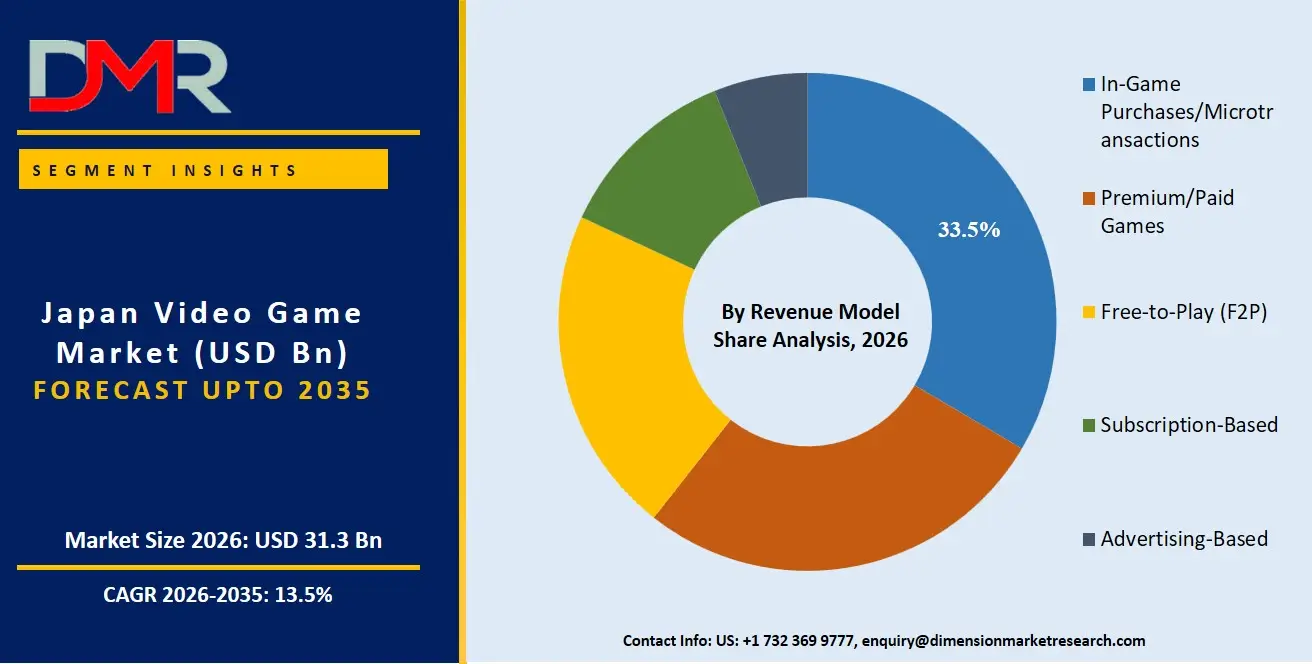
The segments which is projected to be dominant in the revenue model sector will be those of in-game purchases as well as microtransactions, since free-to-play games have gained prominence within the country. Consumers are becoming willing to purchase in-game content such as upgrades, characters, cosmetic additions, premium currencies as well as additional events for the purpose of improving their experience. This business model works because it creates revenue streams without necessitating consumers to make an upfront payment, thereby attracting huge user bases. It works effectively in mobile games due to the use of gacha systems in addition to live services. Content updates motivate repeat payments as well as retaining the gamers.
By Distribution Channel Analysis
It is expected that the digital distribution will hold a large share in the distribution channel sector as more people are opting for downloading games through online distribution channels rather than buying physical versions of the games. Online distribution channels are convenient, instantaneous, up-to-date, and can also offer a wider range of games. The rise in popularity of mobile gaming, online stores, cloud gaming, and broadband internet connectivity have led to this trend. It is also advantageous for developers as it reduces their cost of distribution as well as makes it easier for them to reach out to their customers. Frequent updating of content, downloading of expansion packs, and live services are also facilitated by digital distribution channels.
By Player Type Analysis
Gaming types expected to prevail in the gamers' type segment are single-player gaming, given the historical predisposition of Japanese consumers towards engaging in stories and having immersive gaming experiences. Gamers tend to like games with interesting stories to explore at their own convenience without having to engage in an ongoing online gaming process. Gaming types, such as adventure games, role-playing games, and simulation games, have led to the increased popularity of single-player gaming. Single-player gaming is also favored in Japanese cities due to the busyness of the city life, which requires people to find activities convenient and flexible. Although multiplayer gaming is increasingly popular, single-player gaming continues to attract many gamers and remains highly popular on both consoles and mobile devices.
By Age Group Analysis
The age group 18-34 years is poised to be prevalent in the Japanese video games market due to its being the most productive and affluent gamer group. This group has relatively higher proficiency in technology use and involvement in gaming culture, not to mention that they have more disposable income than other groups. They play mobile, console, and PC games, not to mention their participation in e-sports activities. Moreover, they make huge contributions towards expenditure on buying, subscriptions, and micro-transactions for games. Due to their involvement in various forms of entertainment, the age group makes huge demands in the gaming market.
By End User Analysis
The individual end-users are projected to comprise the biggest share of end users in the market due to the recreational nature of the games in Japan, which is popular among people of all ages. The availability of gaming equipment, including smartphones, consoles, and PCs, has made gaming easier at home and while on the commute for millions of users. Individual gamers constitute the majority of revenues generated through buying, subscribing to, and downloading games or any gaming content, and conducting in-game transactions. In addition, digitalization in gaming has led to increased interactions between gamers and game developers directly. Despite the growing popularity of gaming cafes, educational institutions, and corporate training, the number of users is much lower.
The Japan Video Game Market Report is segmented on the basis of the following:
By Platform
- Mobile Gaming
- Console Gaming
- PC Gaming
- Cloud Gaming
- Virtual Reality (VR) Gaming
- Augmented Reality (AR) Gaming
By Game Type
- Action
- Adventure
- Role-Playing Games (RPG)
- Sports
- Strategy
- Simulation
- Racing
- Shooter
- Puzzle
- Casual Games
- Others
By Revenue Model
- In-Game Purchases/Microtransactions
- Premium/Paid Games
- Free-to-Play (F2P)
- Subscription-Based
- Advertising-Based
By Distribution Channel
- Digital Distribution
- Physical Retail Distribution
By Player Type
- Single-Player
- Multiplayer
- Massively Multiplayer Online (MMO)
By Age Group
- Below 18 Years
- 18 - 34 Years
- 35 - Above 35 Years
By End User
- Individual Consumers
- Gaming Cafés & Esports Centers
- Educational Institutions
- Enterprises & Training Organizations
Competitive Landscape
The competitive environment of the Japan Video Game Market is a high-stakes arena where legacy iconography meets aggressive mobile upstarts. The key to longevity is the mastery of the "media mix" strategy, where publishing giants leverage a synergistic fusion of physical merchandise, music CDs, anime adaptations, and live events to construct an impermeable fandom around their core intellectual property. Market consolidation is accelerating as traditional console-focused publishers acquire successful mobile developers to absorb their agile live-ops methodologies and direct-to-consumer communication channels. Proprietary game engines, such as those designed for stylized cel-shading or turn-based combat logic, remain a significant barrier to entry and a source of competitive advantage, far outweighing generic technical graphics benchmarks in a market that prioritizes art direction over photorealism.
Some of the prominent players in the Japan Video Game Market are:
- Nintendo Co., Ltd.
- Sony Interactive Entertainment (Sony Group)
- Capcom Co., Ltd.
- Bandai Namco Entertainment
- SEGA Corporation
- Square Enix Holdings
- Konami Holdings Corporation
- Koei Tecmo Holdings
- FromSoftware (Kadokawa)
- GungHo Online Entertainment
- Cygames Inc.
- DeNA Co., Ltd.
- Gree Inc.
- Mixi Inc.
- Nexon (Japan operations)
- Marvelous Inc.
- Level-5 Inc.
- Atlus (SEGA subsidiary)
- CyberAgent, Inc.
- Other Key Players
Recent Developments
- January 2026: Sony Interactive Entertainment introduced the expansion of their subscription plan, which included cloud streaming services for classic games belonging to the genre of RPGs to Smart TVs using the AI upscaling technology to transform the retro pixel art into modern 4K displays without sacrificing their originality.
- November 2025: Square Enix set up an AI development unit within the company with the purpose of automating the localization process for Role-Playing Games (RPG), applying the neural machine translation and generating voices for simultaneous worldwide launches while preserving the subtle meanings needed by the Western audience.
- October 2025: Capcom improved its PC gaming offerings by purchasing a modding platform integration company that could help provide parity in frame data processing in Multiplayer action games on both PCs and Consoles.
Report Details
| Report Characteristics |
| Market Size (2026) |
USD 31.3 Bn |
| Forecast Value (2035) |
USD 97.8 Bn |
| CAGR (2026–2035) |
13.5% |
| Historical Data |
2021 – 2025 |
| Forecast Data |
2027 – 2035 |
| Base Year |
2025 |
| Estimate Year |
2026 |
| Segments Covered |
By Platform, By Game Type, By Revenue Model, By Distribution Channel, By Player Type, By Age Group, and By End User |
| Country Coverage |
Japan |
Frequently Asked Questions
How big is the Japan Video Game Market?
▾ The Japan Video Game market is poised to be valued at USD 31.3 billion in 2026 and is projected to reach USD 97.8 billion by 2035, driven by the universal integration of gaming culture, mobile monetization maturity, and next-generation console penetration.
What is the CAGR of the Japan Video Game Market from 2026 to 2035?
▾ The market is expected to grow at a CAGR of 13.5% from 2026 to 2035, reflecting the accelerating complexity of live-service game operations and the persistent expansion of digital distribution channels for premium entertainment content.
What factors are driving the growth of the Japan Video Game Market?
▾ Key drivers include the sophisticated gacha-based monetization of mobile RPGs, the massive cultural influence of anime and VTuber crossovers, and the technological shift toward high-fidelity cloud gaming and VR simulation experiences.
Which segment held the largest share of the Japan Video Game Market in 2026?
▾ Mobile Gaming held the largest share in 2026, driven by a mature smartphone infrastructure and a cultural preference for role-playing and simulation games optimized for daily commuter lifestyles.
Which segment is expected to grow the fastest in the Japan Video Game Market?
▾ Cloud Gaming is expected to grow the fastest, fueled by the widespread deployment of fiber-optic networks and the demand to play AAA console-quality Action and Adventure titles on portable devices and Smart TVs without dedicated hardware.
What are the major trends in the Japan Video Game Market?
▾ Major trends include the deep integration of AI for personalized NPC interactions, the rise of hybrid digital-physical collector's editions, the dominance of the in-game purchase revenue model, and the globalization of Japanese esports through multiplayer Online battle arenas.
Who are the key players in the Japan Video Game Market?
▾ Key players include legacy platform holders like Nintendo and Sony, publishing giants such as Square Enix, Capcom, and SEGA, and mobile entertainment leaders like CyberAgent (Cygames) and GungHo Online Entertainment.
How is the Japan Video Game Market segmented?
▾ The market is segmented by Platform, Game Type, Revenue Model, Distribution Channel, Player Type, Age Group, and End User.