Market Overview
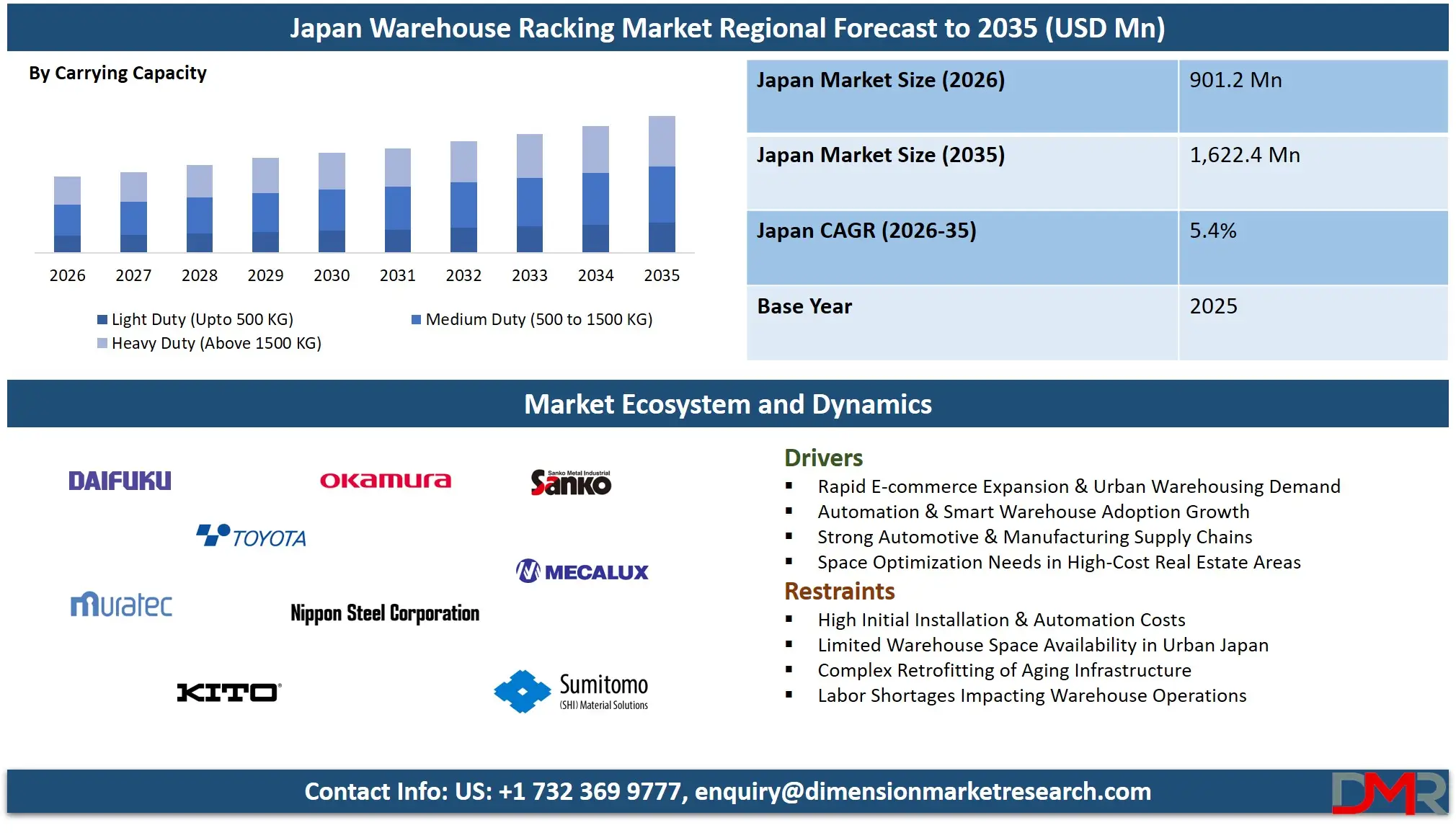
The Japan warehouse racking market size is estimated to reach USD 901.2 million in 2026 and is projected to grow at a CAGR of 5.4%, reaching USD 1,622.4 million by 2035, driven by rising demand for storage systems, pallet racking solutions, warehouse automation, and efficient material handling infrastructure.
ℹ
To learn more about this report –
Download Your Free Sample Report Here
Warehouse racking is a warehouse and distribution center storage system that makes organization and storage of goods through the use of pallet racks, shelf units, and automation systems. It enhances space optimization, inventory control, and material flow, as well as minimizes the handling time and operation expense. It is also very popular in retail, manufacturing, food processing, and third-party logistics sectors to stream supply chains. The market of the Japanese warehouse racking is well developed as it is guided by space, precision engineering, and lean inventory practices.
The urban warehouses are also on the demand side of high-density and modular storage systems. Robotics and intelligent tracking are some of the automation technologies that are increasing uptake, particularly in the e-commerce and retail sectors. The industry is also characterized by good automotive and electronics production and the growth of cold storage logistics.
ℹ
To learn more about this report –
Download Your Free Sample Report Here
Japan Warehouse Racking Market: Key Takeaways and Other Influencing Factors
- Strong Market Growth Outlook: The market is projected to grow from USD 901.2 million in 2026 to USD 1,622.4 million by 2035, reflecting steady expansion driven by logistics modernization and storage demand.
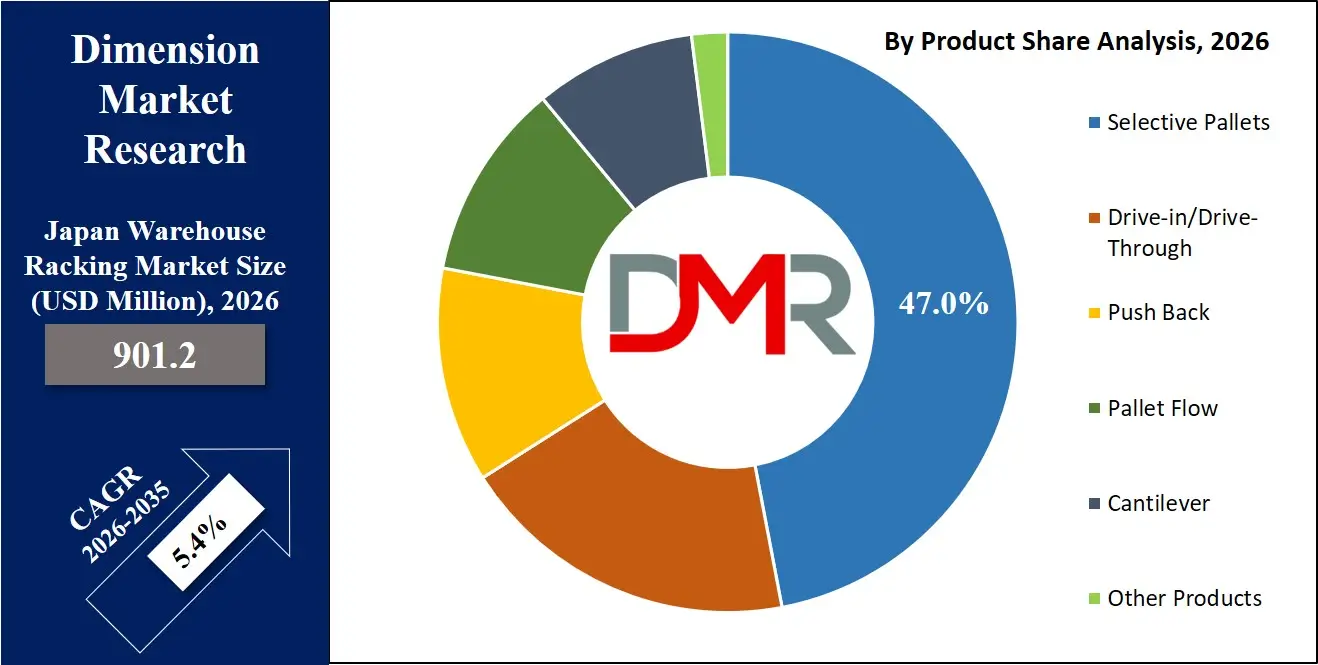
- Dominance of Selective Pallet Racking: Selective pallet racking leads the product segment with around 47.0% market share in 2026 due to flexibility and widespread adoption across industries.
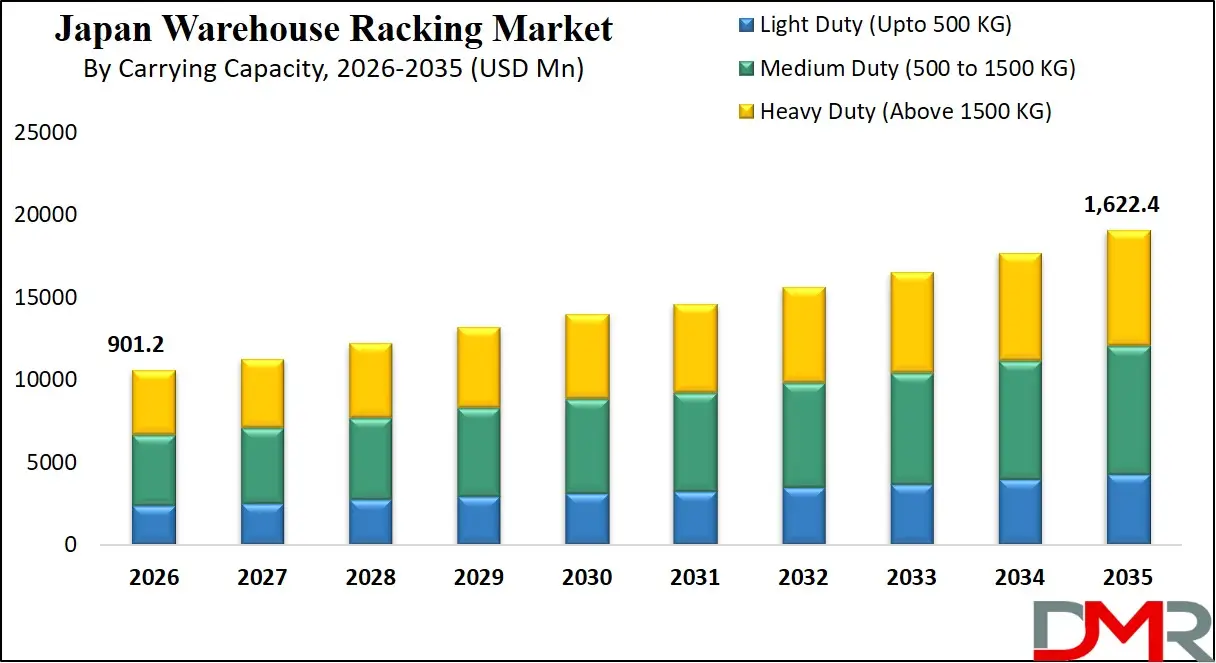
- Medium Duty Capacity Leads Usage: Medium duty racking systems account for approximately 41.0% share, driven by balanced load capacity and high usage in retail and e commerce storage.
- Retail Sector as Primary Demand Driver: Retail dominates applications with nearly 35.0% share, supported by rising e commerce volumes and high inventory turnover requirements.
- Automation & Smart Warehousing Acceleration: Over 60% logistics players adopting IoT and automation is accelerating demand for advanced racking, improving warehouse efficiency and space utilization.
- Infrastructure Scale (MLIT): Japan has 1,245 logistics parks and ~120 million sqm logistics space, with 13.2 million TEUs handled at Tokyo Port and 4 new logistics hubs planned by 2030, reflecting strong warehouse infrastructure growth.
- Digital Adoption (JETRO): About 63% of logistics firms use IoT systems and e-commerce makes up 12.3% of logistics activity, highlighting rapid shift toward smart logistics and automated warehouse racking demand.
- Strong Logistics Reach (MLIT & JETRO): Japan's logistics network serves 98% of the population and handles 1.2 trillion ton-km of freight, showing nationwide distribution strength and steady demand for warehousing infrastructure.
Japan Warehouse Racking Market: Use Cases
- E-commerce Fulfillment Centers: Warehouse racking systems support high SKU storage, fast picking, and efficient inventory management, enabling optimized space utilization and quick order fulfillment in Japan's e commerce logistics.
- Automotive Parts & JIT Logistics: Pallet racking products assist in arranging the parts and aiding the just in time inventory to enhance efficiency of material handling and supply chain flow in the automobile industry.
- Cold Storage and Food Logistics: High density racking of cold storage warehouses is employed to store perishable goods, which is more effective in terms of space optimization and efficient food supply chain.
- 3PL & Distribution Centers: This provides scalable racking systems and warehouse automation provided by third party logistics providers to enhance the storage capacity, inventory visibility and overall logistics efficiency.
Impact of Iran Conflict on the Japan Warehouse Racking Market
The Iran war is augmenting global transportation and energy prices, indirectly affecting the cost of warehouse racking systems in Japan by inflating the cost of steel and logistics costs but the long-term demand is not declining as Japan is still implementing high-density and automated warehouse racking to enhance efficiency and lower transportation expenses.
Japan Warehouse Racking Market: Market Dynamic
Driving Factors in the Japan Warehouse Racking Market
Expanding E-commerce & Omnichannel Logistics.
The growing e commerce environment in Japan is creating the need to have a state of the art warehouse racking system that can deliver high volume of orders and a wide range of SKUs. Companies are spending on pallet racks, automated storage systems, and warehouse management to enhance the speed of picking, accuracy of inventory and speed in order fulfillment. The movement towards omnichannel retail is also increasing the demand of scalable and flexible storage facilities.
High-Density Urban Area Space Optimization.
Low supply of land and high real estate prices in Japan are forcing companies to consider high density storage and vertical racking systems. There is also increasing usage of cantilever racking, pallet flow systems as well as compact shelving to ensure maximum use of the space available in the warehouse and also efficient handling of the materials and their accessibility.
Restraints in the Japan Warehouse Racking Market
High Initial Investment & Automation Costs
The adoption of automated warehouse racking systems, including robotics and ASRS, requires significant capital investment. Costs associated with installation, integration, and maintenance of material handling systems can limit adoption among small and medium enterprises.
Refurbishing Troubled Retirement Houses.
The Japanese warehouse systems are housed in antiquated warehouses not properly equipped with the modern racking systems and automation equipment. Enhancement of these infrastructures entails complicated redesigning, operational unavailability, and associated increased cost which can curtail expansion in the market.
Opportunities in the Japan Warehouse Racking Market
Cold Chain Logistics Growth.
The increased pressure of temperature controlled storage in the food and pharmaceutical industries is establishing potentials of the special warehouse racking system. The cold storage facilities are increasingly adopting high density pallet racking solutions and mobile shelving solutions to enhance the storage capacity and management of inventory.
Expansion of 3PL & Smart Warehousing.
Scalable racking systems and automation of the warehouse are increasingly in demand following the growing use of third party logistics providers. The adoption of IoT-based integration of solutions related to tracking, real time inventory visibility, and smart warehouse has been creating new growth opportunities in the Japanese logistics infrastructure.
Trends in the Japan Warehouse Racking Market
Adoption of Automated Storage & Retrieval Systems
There is a growing shift toward automated storage and retrieval systems combined with advanced pallet racking to improve warehouse efficiency. These systems enhance throughput, reduce labor dependency, and support high speed order processing in modern distribution centers.
Adoption of Digital Warehouse Technologies.
Warehouse operators are going to digital, using warehouse management systems, inventory optimization based on AI, and data analytics. These technologies are used with the racking systems to enhance the use of space and optimization of the material flow and predictive maintenance in the changing logistics environment in Japan.
Japan Warehouse Racking Market: Research Scope and Analysis
By Product Analysis
Selective pallet racking is expected to dominate the Japan warehouse racking market, holding around 47.0% share in 2026 due to its flexibility, cost efficiency, and direct access to individual pallets. It is widely used in retail, e-commerce, and manufacturing as it improves inventory management and order picking efficiency.
ℹ
To learn more about this report –
Download Your Free Sample Report Here
Its adaptability to different pallet sizes and easy integration with warehouse systems further supports adoption. Meanwhile, drive-in and drive-through racking systems are gaining traction for high-density storage needs, especially in cold storage and food logistics. However, their limited selectivity is balanced by strong space optimization benefits in Japan's space-constrained warehouses.
By Carrying Capacity Analysis
Medium-duty racking systems (500–1500 kg) are expected to lead the Japan warehouse racking market with around 41.0% share in 2026 due to their versatility, cost efficiency, and wide use across retail, e-commerce, electronics, and food logistics. They provide an optimal balance of storage capacity and space utilization while improving warehouse efficiency. Their compatibility with palletized goods, easy customization, and integration with warehouse management systems further support adoption. Heavy duty racking systems (above 1500 kg) are also important in automotive and industrial sectors for storing bulky and high-weight goods. Despite higher costs, they ensure strong durability and reliable storage in Japan's advanced logistics environment.
By Application Analysis
Retail is expected to dominate the Japan warehouse racking market with around 35.0% share in 2026 due to e-commerce growth, omnichannel retailing, and high inventory turnover needs, driving strong demand for efficient storage systems. Pallet racking, shelving, and automated storage are being more used by retailers with the aim of having more SKUs and to have the ability to fulfill orders in the shortest possible time. Simultaneously, food and beverage segment has a large portion as a result of increased cold chain logistics and rigorous storage of perishable foods. The most common racks to maximize the space, maintain product quality, and provide effective rotation of inventory in the Japanese logistics ecosystem are high-density racking, drive-in systems, and mobile shelving.
The Japan Warehouse Racking Market Report is segmented on the basis of the following:
By Product
- Selective Pallets
- Drive-in/Drive-Through
- Push Back
- Pallet Flow
- Cantilever
- Other Products
By Carrying Capacity
- Light Duty (Upto 500 KG)
- Medium Duty (500 to 1500 KG)
- Heavy Duty (Above 1500 KG)
By Application
- Retail
- Food & Beverage
- Automotive
- Packaging
- Manufacturing
- 3PL/Logistics
- Other Applications
Impact of Artificial Intelligence in the Japan Warehouse Racking Market
The Japan warehouse racking market is being altered by artificial intelligence, as it can make warehouses smarter, allocate storage space more efficiently, and track inventory levels in real-time due to AI-based technologies that save space and help cut down the time spent on picking up the goods.
It also combines with automation and robotics to increase throughput, precision and efficiency of operations in strongly precision-oriented Japanese warehouses. Also, AI facilitates predictive maintenance and demand forecasting on the basis of IoT data in order to minimize downtime, enhance inventory levels, and enhance the overall safety and scalability of the warehouse.
Japan Warehouse Racking Market: Competitive Landscape
The Japan warehouse racking market is of a moderate consolidation and competitive nature, the international and regional companies provide a whole package of storage and material handling solutions. Automation, innovation, and end-to-end warehouse systems, such as AS/RS and smart warehouse systems, drive competition.
ℹ
To learn more about this report –
Download Your Free Sample Report Here
The highest demand is in automated distribution centers where the seismic compliance, engineering accuracy, and reliability of the system are the distinguishing factors. Customization, cost efficiency, and the ability to install are also some of the competencies used by companies to address the varied needs of the industry.
Some of the prominent players in the Japan Warehouse Racking Market are:
- Daifuku Co., Ltd.
- Toyota Industries Corporation
- Murata Machinery, Ltd.
- KITO Corporation
- Okamura Corporation
- Nippon Steel Kowa Kizai Co., Ltd.
- Sanko Metal Industrial Co., Ltd.
- Sumitomo Heavy Industries Material Handling Systems
- Mecalux
- SSI Schaefer
- Jungheinrich AG
- Kardex Holding AG
- Gonvarri Material Handling
- Hannibal Industries
- Unarco Material Handling
- Nucor Corporation
- Interroll Group
- Dematic
- Swisslog
- AR Racking
- Other Key Players
Recent Developments in the Japan Warehouse Racking Market
- March 2026: SSI Schaefer showcased new automation driven warehouse solutions and award winning intralogistics products, focusing on advanced storage systems, robotics integration, and optimized material handling technologies.
- January 2026: SSI Schaefer announced a strategic partnership with Moffett Automation to develop free roaming pallet shuttle systems, improving high density storage, warehouse automation, and scalable racking solutions.
Report Details
| Report Characteristics |
| Market Size (2026) |
USD 901.2 Mn |
| Forecast Value (2035) |
USD 1,622.4 Mn |
| CAGR (2026–2035) |
5.4% |
| Historical Data |
2021 – 2025 |
| Forecast Data |
2027 – 2035 |
| Base Year |
2025 |
| Estimate Year |
2026 |
| Report Coverage |
Market Revenue Estimation, Market Dynamics, Competitive Landscape, Growth Factors and etc. |
| Segments Covered |
By Product (Selective Pallets, Drive-in/Drive-Through, Push Back, Pallet Flow, Cantilever, Other Products), By Carrying Capacity (Light Duty up to 500 KG, Medium Duty 500 to 1500 KG, Heavy Duty Above 1500 KG), and By Application (Retail, Food & Beverage, Automotive, Packaging, Manufacturing, 3PL/Logistics, Other Applications). |
| Country Coverage |
Japan |
| Prominent Players |
Daifuku Co., Ltd.; Toyota Industries Corporation; Murata Machinery, Ltd.; KITO Corporation; Okamura Corporation; Nippon Steel Kowa Kizai Co., Ltd.; Sanko Metal Industrial Co., Ltd.; Sumitomo Heavy Industries Material Handling Systems; Mecalux; SSI Schaefer; Jungheinrich AG; Kardex Holding AG; Gonvarri Material Handling; Hannibal Industries; Unarco Material Handling; Nucor Corporation; Interroll Group; Dematic; Swisslog; AR Racking, and Other Key Players |
| Purchase Options |
We have three licenses to opt for: Single User License (Limited to 1 user), Multi-User License (Up to 5 Users) and Corporate Use License (Unlimited User) along with free report customization equivalent to 0 analyst working days, 3 analysts working days and 5 analysts working days respectively. |
Frequently Asked Questions
How big is the Japan Warehouse Racking Market?
▾ The Japan Warehouse Racking Market size is estimated to have a value of USD 901.2 million in 2026 and is expected to reach USD 1,622.4 million by the end of 2035.
What is the growth rate in the Japan Warehouse Racking Market in 2026?
▾ The market is growing at a CAGR of 5.4% over the forecasted period of 2026.
Who are the key players in the Japan Warehouse Racking Market?
▾ Some of the major key players in the Japan Warehouse Racking Market are Daifuku Co., Ltd.; Toyota Industries Corporation; Murata Machinery, Ltd.; KITO Corporation; Okamura Corporation; Nippon Steel Kowa Kizai Co., Ltd.; Sanko Metal Industrial Co., Ltd.; Sumitomo Heavy Industries Material Handling Systems; Mecalux; SSI Schaefer; Jungheinrich AG; Kardex Holding AG; Gonvarri Material Handling, and many others.