Global K-12 Education Technology (EdTech) Market Snapshot
- Global K-12 Education Technology (EdTech) Market Size in 2026: USD 108.0 Bn
- Global K-12 Education Technology (EdTech) Market Size in 2035: USD 385.8 Bn
- Global CAGR from 2026 to 2035: 15.2%
- Classroom Learning is the leading Application segment in 2026: 24.8%
- Public K-12 Schools is the leading End User segment in 2026: 61.4%
- North America is the leading Region in 2026: 36.8%
What is the Global K-12 Education Technology (EdTech) and its Market Size?
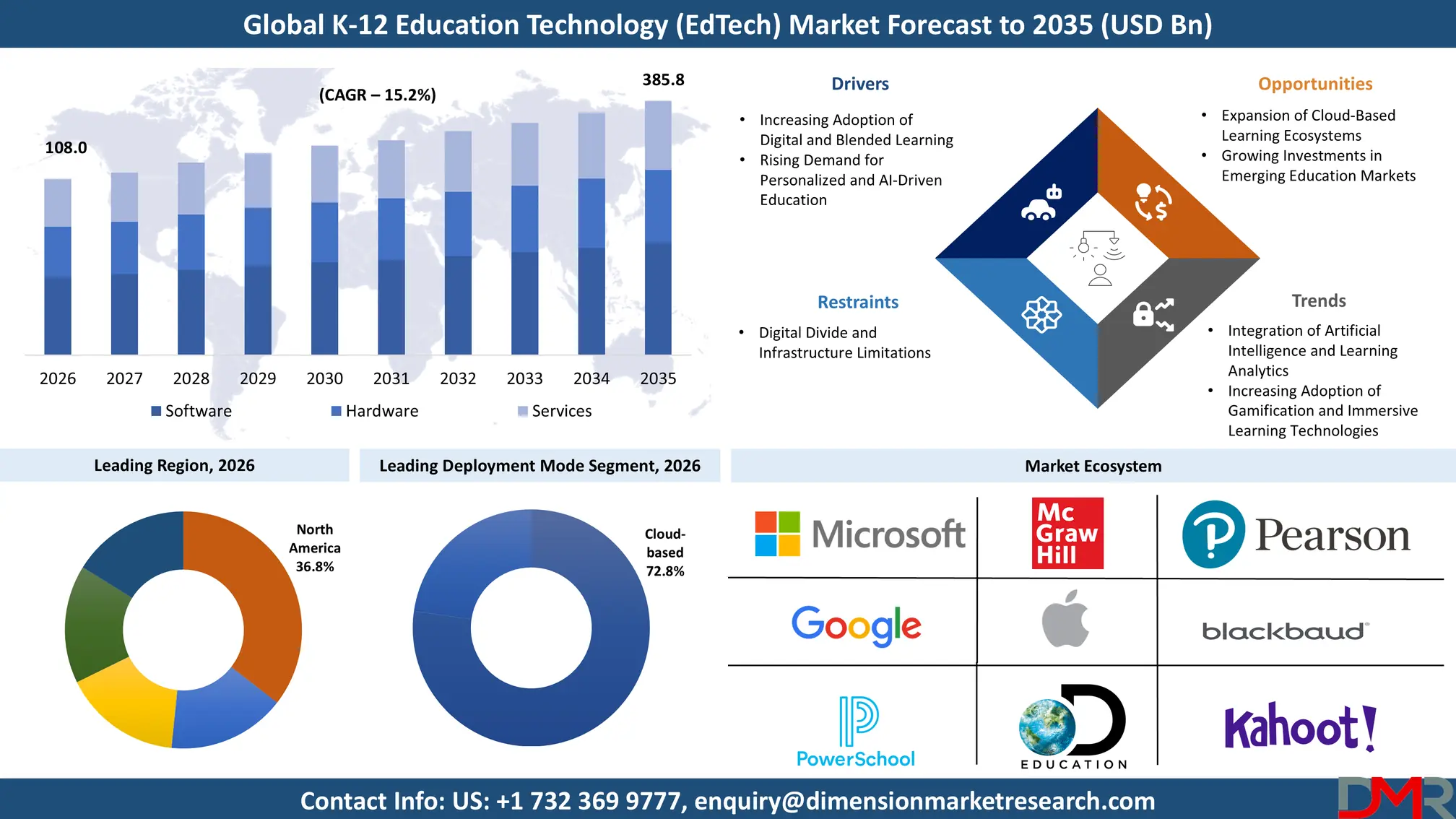
The Global K-12 Education Technology (EdTech) Market is projected to reach USD 108.0 billion in 2026 and grow at a compound annual growth rate of 15.2% to reach a value of USD 385.8 billion by 2035.
ℹ
To learn more about this report –
Download Your Free Sample Report Here
The fast digitization is transforming experiences through higher internet penetration and vast adoption of smart devices in classrooms. The players in the market provide courses, games, mobile apps, resources, and interactive devices for online learning for students and teachers in schools. These contain adaptive learning platform, learning management systems, collaborative platforms, administrative management systems and more services for the schools. By having digital devices like smartphones, laptops, tablets etc., students can be able download and watch educational videos and content to grow their learning. To enhance the quality of education, governments around the globe are also making investments in the educational sector to promote learning and access to education for every student.
Use Cases
- Personalized Learning for Students: It helps in providing AI-Powered Tutoring, adaptive learning paths, safe chatbots to fulfill various needs of the students.
- Teacher Assistance and Automation: This helps in giving automated grading, lesson planning assistants and writing progress tracking to review step by step drafting history of students.
- School Safety & Administration: It helps in checking behavior and wellness of student, look into access control and helps in content filtering by blocking harmful web across campus devices.
- Multilingual Learning Tools for Immigrants: AI-enable tools helps in providing instant translation & language learning support. These platforms help immigrant children absorb concepts in their native language while at the same time learning the regional medium of instruction.
Key Takeaways
- Market Size: The global K-12 Education Technology (EdTech) market is projected to reach USD 385.8 billion by 2035, growing from USD 108.0 billion in 2026.
- Growth Rate and Outlook: The market is expected to expand at a CAGR of 15.2% during the forecast period, driven by increasing digital transformation in K-12 education.
- Primary Growth Drivers: Rising adoption of AI-powered learning solutions, expanding e-learning platforms, increasing government investments in digital education, and growing demand for personalized and blended learning environments.
- By Application Analysis: Classroom Learning accounted for the largest market share of 24.8% in 2026, whereas Behavior & Classroom Analytics is expected to grow at the fastest 19.1% CAGR.
- By End User Analysis: Public K-12 Schools dominated the market with a 61.4% share in 2026, while Home Schools are anticipated to register the highest growth at an 18.3% CAGR.
- Regional Leadership: North America held the largest share of the global K-12 Education Technology (EdTech) market in 2026, while Asia Pacific is projected to be the fastest-growing regional market during the forecast period.
How AI/Gen AI is Transforming the K-12 Education Technology (EdTech) Market?
Generative AI is transforming K-12 education, providing various opportunities to reshape how students learn and how educators teach. With its ability to create personalized, adaptive, and inclusive learning materials, generative AI addresses the diverse needs of modern classrooms. The traditional "one-size-fits-all" education model is becoming outdated in a world where learners' needs, abilities, and contexts are more diverse than ever. Meeting these distinctive requirements calls for innovative solutions, and generative AI has emerged as a powerful tool to address this challenge. By having AI's ability to create adaptive, personalized content, educators can revolutionize the learning experience for K-12 students.
Key Drivers in the Global K-12 Education Technology (EdTech) Market
Increasing Adoption of Digital and Blended Learning
The rapid shift toward digital and blended learning models is a major driver of the global K-12 Education Technology (EdTech) market. Schools are increasingly integrating digital platforms, virtual classrooms, interactive content, and cloud-based learning management systems to enhance teaching effectiveness and student engagement. Governments and educational institutions are investing in smart classroom infrastructure, digital devices, and high-speed internet connectivity to support technology-enabled education. The growing need for flexible learning environments that combine in-person and online instruction has accelerated the adoption of EdTech solutions. These platforms also improve collaboration, streamline administrative tasks, and provide students with continuous access to educational resources, driving sustained market expansion.
Rising Demand for Personalized and AI-Driven Education
The growing emphasis on personalized learning experiences is accelerating the adoption of artificial intelligence and advanced analytics in K-12 education. AI-powered learning platforms can assess individual student performance, identify learning gaps, and recommend customized educational content based on learning pace and preferences. Adaptive learning technologies improve student engagement while helping teachers monitor academic progress more effectively. Educational institutions are increasingly leveraging predictive analytics, intelligent tutoring systems, and automated assessments to improve learning outcomes. As schools focus on delivering student-centric education and improving academic performance, demand for AI-enabled EdTech solutions continues to grow, creating strong momentum for market development worldwide.
Restraints in the Global K-12 Education Technology (EdTech) Market
Digital Divide and Infrastructure Limitations
Limited digital infrastructure and unequal access to technology remain significant challenges for the K-12 Education Technology market, particularly in developing and rural regions. Many schools continue to face inadequate internet connectivity, insufficient funding, and limited access to digital devices, restricting the implementation of advanced educational technologies. Differences in digital literacy among educators and students further slow technology adoption and reduce the effectiveness of online learning initiatives. High deployment and maintenance costs also discourage schools with limited budgets from investing in comprehensive EdTech solutions. These infrastructure and accessibility gaps continue to limit market penetration and create disparities in digital education adoption.
Growth Opportunities in the Global K-12 Education Technology (EdTech) Market
Expansion of Cloud-Based Learning Ecosystems
Cloud computing is creating significant growth opportunities for the K-12 Education Technology market by enabling scalable, cost-effective, and accessible learning environments. Cloud-based platforms allow schools to manage digital content, student records, assessments, and communication through centralized systems while reducing infrastructure costs. These solutions support remote learning, collaborative classrooms, and seamless software updates without requiring extensive on-site IT resources. Increasing adoption of Software-as-a-Service (SaaS) educational platforms enables schools to implement digital learning solutions more efficiently. As educational institutions continue their digital transformation initiatives, demand for cloud-enabled EdTech platforms is expected to rise steadily across global markets.
Growing Investments in Emerging Education Markets
Emerging economies present significant opportunities for EdTech providers due to expanding student populations, increasing government investments, and rising internet penetration. Many countries are prioritizing digital education initiatives to improve learning quality, increase educational accessibility, and prepare students with future-ready digital skills. Public-private partnerships are supporting the deployment of digital classrooms, affordable learning devices, and online educational platforms across underserved regions. The growing adoption of smartphones and affordable broadband services further supports digital learning expansion. These favorable developments create substantial opportunities for technology vendors to expand their presence and deliver innovative educational solutions in high-growth markets.
Trends in the Global K-12 Education Technology (EdTech) Market
Integration of Artificial Intelligence and Learning Analytics
Artificial intelligence and learning analytics are becoming central components of modern K-12 education. Schools are increasingly utilizing AI-powered tutoring systems, automated grading tools, predictive analytics, and intelligent recommendation engines to improve teaching efficiency and personalize student learning experiences. Learning analytics provide educators with real-time insights into student performance, attendance, and engagement, enabling early intervention for struggling learners. AI also supports curriculum optimization and administrative automation, reducing teachers' workloads. As educational institutions seek data-driven decision-making and personalized instruction, AI integration continues to emerge as one of the most influential trends shaping the global EdTech market.
Increasing Adoption of Gamification and Immersive Learning Technologies
Gamification, augmented reality (AR), virtual reality (VR), and interactive educational content are transforming student engagement in K-12 classrooms. Schools are adopting game-based learning platforms that encourage active participation, improve knowledge retention, and make complex concepts easier to understand. AR and VR technologies provide immersive educational experiences by enabling virtual science laboratories, historical simulations, and interactive field trips. These innovative learning methods foster collaboration, creativity, and problem-solving skills while increasing student motivation. As educators seek more engaging and experiential teaching approaches, the adoption of immersive learning technologies continues to expand across global K-12 education systems.
Research Scope and Analysis
The research scope of the K-12 Education Technology (EdTech) Market covers hardware, software, and service solutions supporting primary and secondary education. It analyzes market size, growth trends, technology adoption, deployment models, learning environments, end users, regional performance, competitive landscape, investment patterns, regulatory developments, and emerging innovations shaping digital teaching and personalized learning.
ℹ
To learn more about this report –
Download Your Free Sample Report Here
By Component Analysis
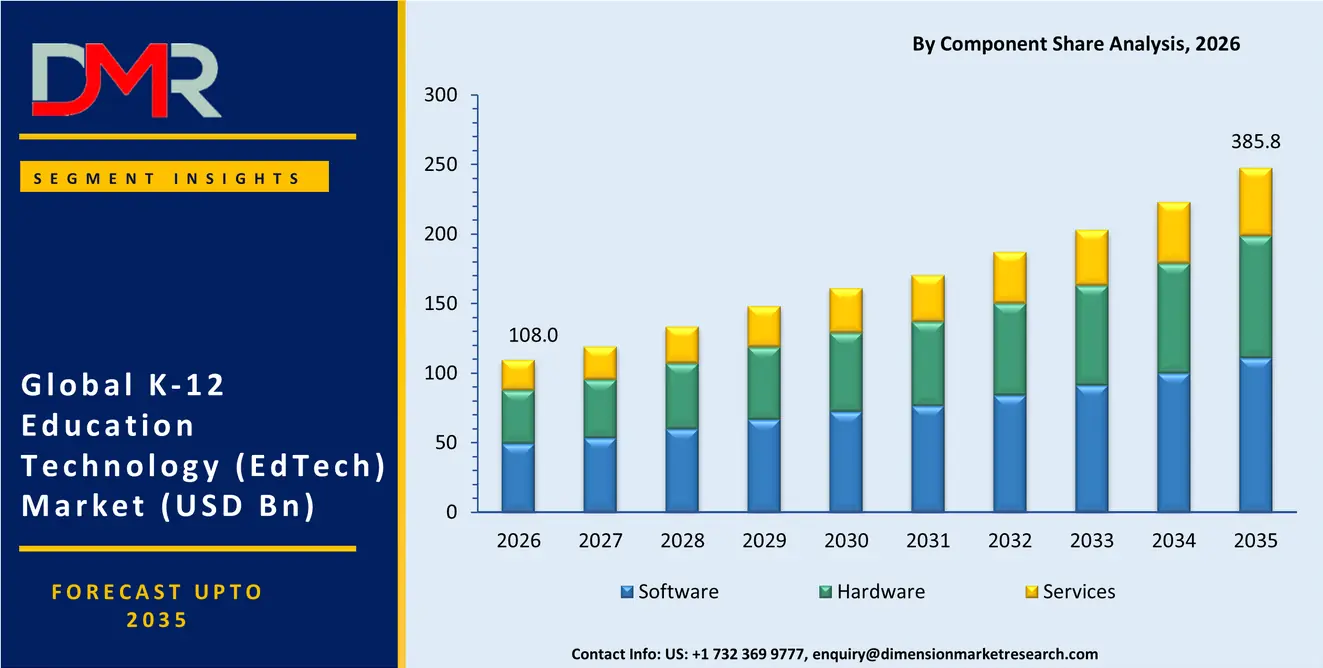
The software segment is set to lead the K-12 Education Technology (EdTech) market with a share of 48.5% in 2026, supported by rising adoption of digital learning platforms, learning management systems, and interactive educational applications. Schools use these tools to deliver lessons, track student progress, personalize instruction, and streamline classroom management across in-person and remote learning environments.
ℹ
To learn more about this report –
Download Your Free Sample Report Here
Applications built on proprietary schemas that are later adapted to Ed-Fi tend to expose structural inconsistencies that create problems in production. Moreover, the service segment is set to grow at a significant rate of 17.5% over the forecast period, as they are altered towards personalized learning demands, digital infrastructure upgrades, and AI integration. Also, these factors push schools to look for scalable software, managed administrative solutions and more.
By Deployment Mode Analysis
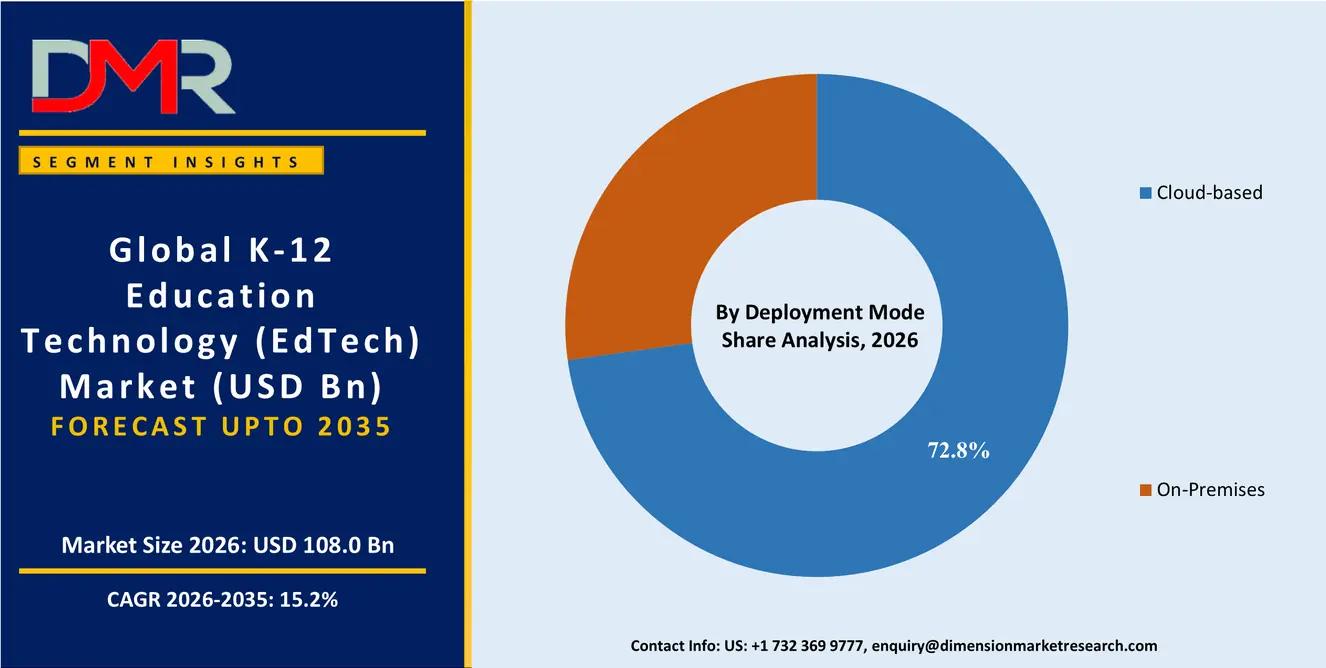
In terms of deployment, the cloud-based deployment is set to dominate the market with a share of 72.8% in 2026, as this type of deployment can be cost-optimized, scaled, and have better operational frequency. Also, schools are adopting a cloud structure to reduce local IT hardware overhead to handle remote setup and hybrid learning. This segment is also expected to grow rapidly over the forecast period, owing to easy scaling, simple management, and better data insights to make better choices. However, on-premises, although not having a vast share in the market, is still very much in demand due to data security, strict privacy compliance, and local network control.
By Learning Type Analysis
Asynchronous Learning is anticipated to dominate the market with a market share of 42.7% in 2026, as it provides flexibility to students to schedule their plans, learn at their own personalized pace, and expand remote accessibility to schools. In addition, blended and hybrid learning is set to grow at a rapid pace throughout the forecast period, with a CAGR of about 16.3%, mainly because of adaptive learning opportunities, infrastructural investment by governments, and dynamic classroom model.
By Application Analysis
Classroom Learning emerged as the leading application segment, accounting for 24.8% of the global K-12 Education Technology (EdTech) market share in 2026. Its dominance is attributed to the widespread adoption of digital classrooms, interactive learning platforms, and blended learning models that enhance student engagement and academic outcomes. Meanwhile, Behavior & Classroom Analytics is projected to register the fastest growth, expanding at a 19.1% CAGR during the forecast period, driven by increasing demand for data-driven insights, student performance monitoring, and personalized learning strategies.
By End User Analysis
Public K-12 Schools emerged as the leading end-user segment, accounting for 61.4% of the global K-12 Education Technology (EdTech) market share in 2026. The segment's dominance is driven by extensive government funding, widespread adoption of digital learning platforms, and large-scale implementation of smart classroom technologies across public education systems. Meanwhile, Home Schools are projected to register the fastest growth, expanding at a 18.3% CAGR during the forecast period, supported by increasing demand for flexible learning models, personalized education, and online homeschooling solutions.
The Global K-12 Education Technology (EdTech) Market Report is segmented on the basis of the following:
By Component
- Hardware
- Interactive Whiteboards
- Laptops & Tablets
- Projectors
- Others
- Software
- Learning Management Systems (LMS)
- Student Information Systems (SIS)
- Assessment & Testing Software
- Classroom Management Software
- STEM Learning Software
- Language Learning Software
- Game-based Learning Software
- Services
- Professional Development & Training
- Deployment & Integration
- Support & Maintenance
By Deployment Mode
By Learning Type
- Synchronous Learning
- Real-Time
- Live Classes
- Video Conferencing
- Asynchronous Learning
- Pre-Recorded Lectures
- Self-Paced Content
- Blended/Hybrid Learning
By Application
- Classroom Learning
- Remote Learning / Online Learning
- Curriculum Management
- Content Delivery & Digital Textbooks
- Communication & Collaboration
- Testing & Assessment
- Behavior & Classroom Analytics
- Student Performance Tracking
By End User
- Public K-12 Schools
- Private K-12 Schools
- Charter Schools
- Home Schools
Regional Analysis
North America is the Leading Region in the Global K-12 Education Technology (EdTech) Market
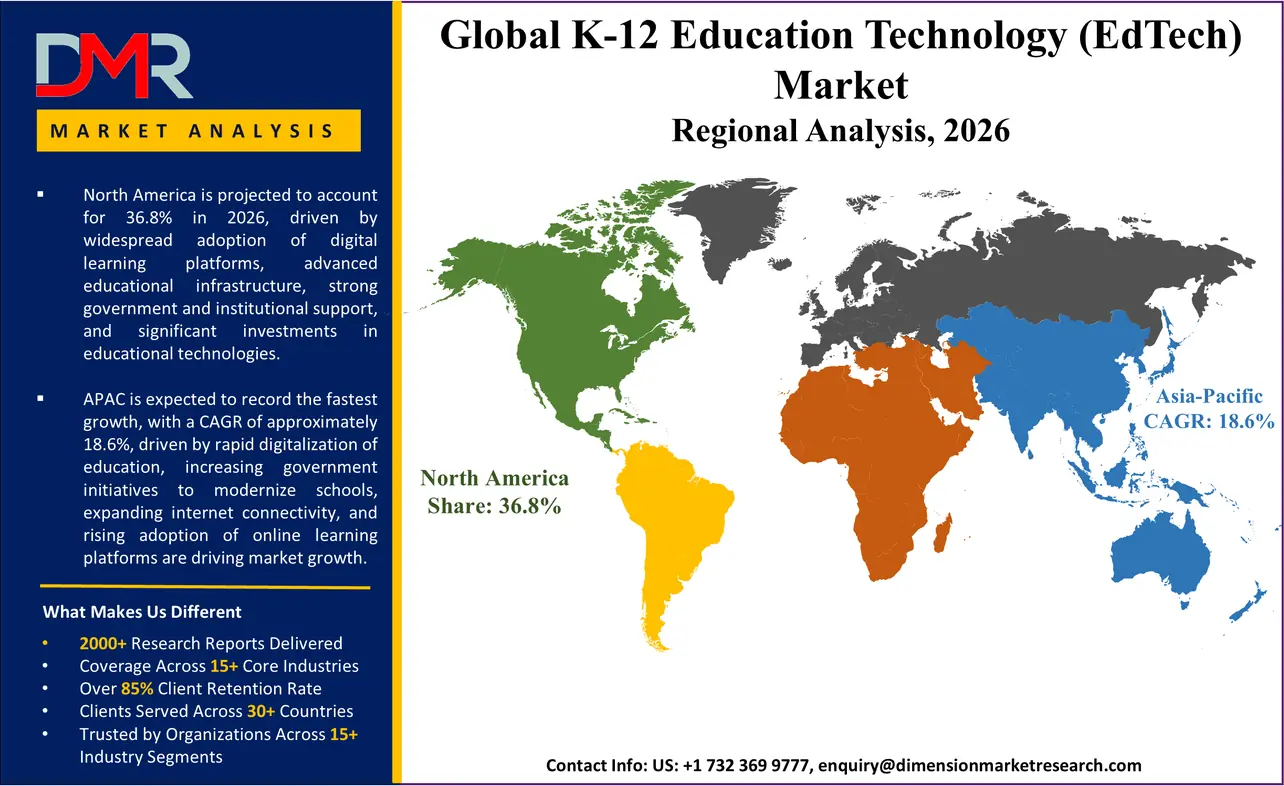
North America is the leading region in the global K-12 Education Technology (EdTech) market, accounting for 36.8% of the global market share in 2026. The region's leadership is driven by widespread adoption of digital learning platforms, advanced educational infrastructure, strong government and institutional support, and significant investments in educational technologies. High technology penetration, early adoption of AI-enabled learning solutions, and the presence of major EdTech companies continue to strengthen the region's market position.
ℹ
To learn more about this report –
Download Your Free Sample Report Here
Asia Pacific is the Fastest-Growing Region in the Global K-12 Education Technology (EdTech) Market
Asia Pacific is the fastest-growing region in the global K-12 Education Technology (EdTech) market, recording a CAGR of 18.6% during the forecast period. Rapid digitalization of education, increasing government initiatives to modernize schools, expanding internet connectivity, and rising adoption of online learning platforms are driving market growth. Growing investments in digital infrastructure, smart classrooms, and AI-enabled educational solutions continue to accelerate EdTech adoption across both developed and emerging economies in the region.
The Europe K-12 Education Technology (EdTech) Market
The Europe K-12 Education Technology (EdTech) Market is estimated to be valued at USD 27.8 billion in 2026 and is further anticipated to reach USD 96.6 billion by 2035 at a CAGR of 14.8%.
In Europe, the market is primarily driven by government modernization initiatives, rising demand for personalized learning, and high digital infrastructure readiness. Leading contributors like Germany, the UK, and France spearhead these digital transformations. Further, public funding & national digitization programs drive interactive classrooms and e-learning integration. Also, shifting teaching priorities, adaptive software and custom student progression models, as well as high baseline digital literacy and investments in smartboards and device penetration fuel expansion.
Latin America K-12 Education Technology (EdTech) Market
Latin America is growing, as there is rising smartphone and internet access, a major government support for digital classrooms, and the urgent need to fix basic learning gaps, as many students and families use mobile phones and wireless networks every day, making it easy to launch apps and online tools. Further, public programs are putting money into digital tools, teacher training, and school internet upgrades. Also, schools use new software to track student progress early and stop kids from leaving school, and develop programs focus on reading and math tools to help students catch up after the pandemic.
MEA K-12 Education Technology (EdTech) Market
The Middle East and Africa (MEA) K-12 Education Technology (EdTech) market is experiencing steady growth, driven by increasing digital transformation in schools, government investments in smart education, and expanding internet access. Rising adoption of e-learning platforms, interactive digital content, and AI-powered learning tools is enhancing student engagement and personalized education. Growing demand for remote and blended learning, supported by public-private initiatives, is expected to further accelerate market expansion across the region.
Major Countries Analysis
United States K-12 Education Technology (EdTech) Market
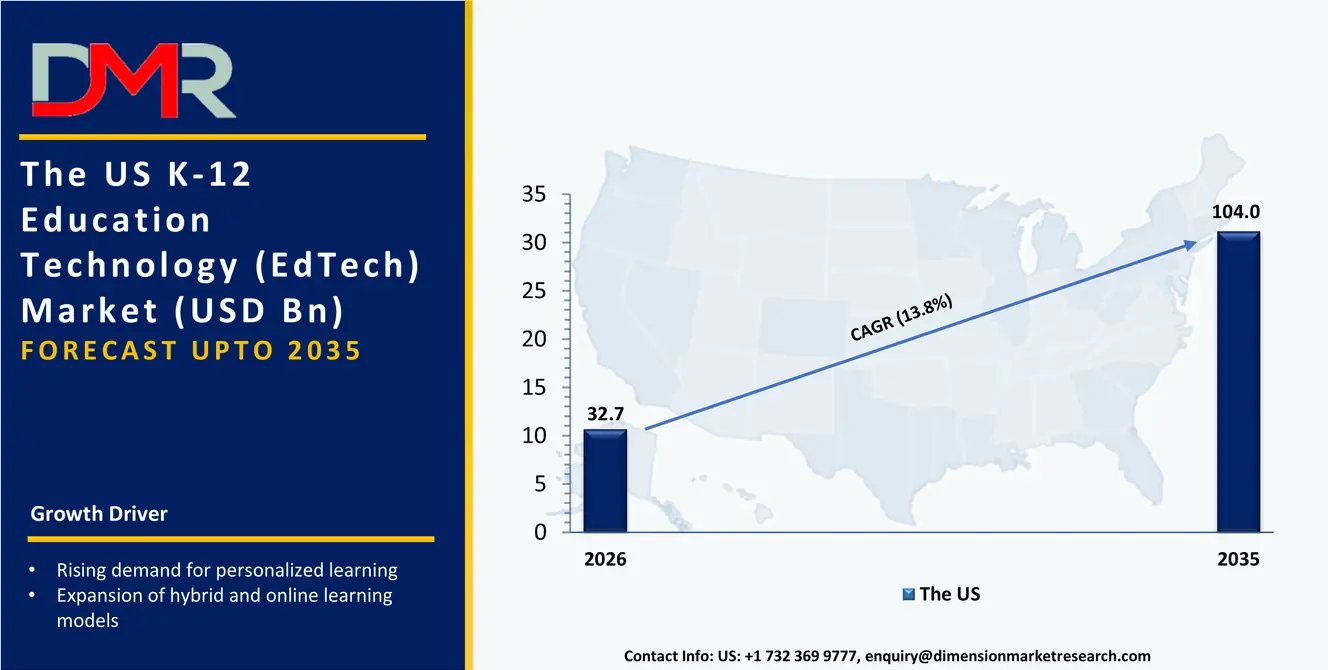
The United States K-12 Education Technology (EdTech) Market is valued at USD 32.7 billion in 2026 and is expected to reach USD 104.0 billion by 2035, registering a CAGR of approximately 13.8% from 2026 to 2035. The US market is growing due to rising demand for personalized learning, the expansion of hybrid and online learning models, and heavy investments in advanced tools like artificial intelligence.
ℹ
To learn more about this report –
Download Your Free Sample Report Here
Further, adaptive software and AI-driven platforms tailor lessons to each student's unique pace and skill level. In addition, flexibility needs and ongoing efforts to solve traditional staffing and teacher shortages fuel virtual options, whereas classrooms rapidly adopt cloud computing, digital e-books, STEM kits, and interactive smart displays over old blackboards. Moreover, strong public and private funding support modern infrastructure and high-speed internet connectivity across school districts
Japan K-12 Education Technology (EdTech) Market
The Japan K-12 Education Technology (EdTech) Market is valued at USD 4.4 billion in 2026 and is forecast to reach USD 13.0 billion by 2035, expanding at a CAGR of approximately 12.8% between 2026 and 2035. In Japan, the government's digital literacy initiatives like GIGA school programs, policies related to digital literacy and connectivity of high-speed internet throughout the regional schools. Also, administrative automation, cloud solutions and hybrid learning also play an important role towards the growth of the market.
Saudi Arabia K-12 Education Technology (EdTech) Market
The Saudi Arabia K-12 Education Technology (EdTech) Market is valued at USD 1.0 billion in 2026 and is forecast to reach USD 4.3 billion by 2035, expanding at a CAGR of approximately 17.6% between 2026 and 2035. The market is mainly driven by strategic goals set by the government like Vision 2030 that plans to modernize educational education system and digital literacy. Further, a high demand for cloud-based learning management system, interactive apps and virtual classrooms are also adding towards the growth of the market.
Investment and White Space Analysis
The K-12 Education Technology (EdTech) market continues to attract strong investment as schools accelerate digital transformation, AI-powered learning, adaptive assessment, and cloud-based classroom management solutions. Venture capital and strategic investors are increasingly prioritizing platforms that demonstrate measurable learning outcomes, teacher productivity gains, and scalable subscription models.
Significant white space remains in affordable AI tutoring, special education technologies, multilingual digital content, cybersecurity for educational institutions, rural connectivity solutions, and data-driven student wellness platforms. Emerging economies also present substantial untapped opportunities due to ongoing education digitization initiatives. However, longer procurement cycles, budget constraints, and the growing requirement to prove educational effectiveness create investment risks, encouraging vendors to emphasize evidence-based solutions, interoperability, and long-term value creation.
Technology Analysis
Technology innovation is transforming the K-12 Education Technology (EdTech) market through artificial intelligence, adaptive learning platforms, generative AI assistants, learning analytics, cloud infrastructure, immersive AR/VR content, and integrated learning management systems. Personalized learning experiences, automated grading, predictive student performance analytics, and intelligent content recommendations are improving educational efficiency while supporting teachers with administrative tasks.
Increased integration of cybersecurity, identity management, and interoperable digital ecosystems is enhancing platform reliability and data protection. Despite rapid innovation, challenges remain regarding digital equity, AI ethics, privacy compliance, teacher training, and infrastructure disparities across regions. Overall, continuous technological advancement is strengthening learning outcomes, expanding digital education accessibility, and accelerating long-term market growth.
By Region
North America
Europe
- Germany
- France
- The U.K.
- Italy
- Spain
- Rest of Europe
Asia-Pacific
- China
- Japan
- India
- Australia
- South Korea
- Rest of APAC
Latin America
- Mexico
- Brazil
- Rest of LATAM
Middle East & Africa
- Saudi Arabia
- The UAE
- South Africa
- Rest of MEA
Competitive Landscape
In the K12 education technology market, the key players are implementing the inorganic growth strategies like mergers & acquisitions, collaborations, and partnerships, so that they can allow to decentralize and improve their position in the market. Furthermore, the organisations are putting continuous efforts in the enhancing and developing the product. The key players also invested in their research and development area, to foster product innovation. Further, some of the organisations expanded their product portfolio by creating different and improved products. In these ways, the key organisations increased their customer base and made their strong presence in the market.
Some of the prominent players in the Global K-12 Education Technology (EdTech) Market are:
- BYJU’S
- PowerSchool
- Instructure
- D2L
- SMART Technologies
- Kahoot!
- McGraw Hill
- Pearson
- Chegg
- Duolingo
- Khan Academy
- Age of Learning
- Renaissance Learning
- Curriculum Associates
- Imagine Learning
- Discovery Education
- Houghton Mifflin Harcourt
- Savvas Learning Company
- Newsela
- Nearpod
- Quizlet
- IXL Learning
- BrainPOP
- Seesaw
- ClassDojo
- GoGuardian
- Clever
- Schoology
- Edmentum
- Amplify
- Turnitin
- Prodigy Education
- SplashLearn
- DreamBox Learning
- Newsela
- Varsity Tutors
- Cambium Learning Group
- Renaissance
- Edsby
- Toddle
- Other Key Players
Recent Developments
- In March 2026, Discovery Education announced the Discovery Education Connected Ecosystem, a unified K-12 framework that embeds AI, instructional resources, adaptive learning, and professional readiness directly into the everyday flow of teaching. Developed on more than 20 years of teaching and learning excellence and trusted by around half of U.S. K-12 schools, the Discovery Education Connected Ecosystem ("Ecosystem") delivers trusted curriculum, intelligent tools, and responsive partnership as a single coherent approach.
- In February 2026, Renaissance launched Renaissance Intelligence℠, the industry's first Education Intelligence System—a breakthrough, category-defining model of integrated learning technology created to transform personalization, simplify teacher workflows, and accelerate learning at scale.
- In February 2026, PowerSchool unveiled the 2026 K–12 EdTech Pulse, an annual national research study conducted in collaboration with Project Tomorrow. The report captures the perspectives of more than 1,300 educators and administrators and examines how school systems are adopting technology, data, and artificial intelligence (AI) to address their most urgent challenges and strengthen their schools. The 2026 K-12 EdTech Pulse is the latest edition of PowerSchool's annual national study, formerly known as the Education Focus Report.
- In November 2025, the American Institutes for Research (AIR) unveiled its AI in Education Network, a new collaborative research effort to study and inform how artificial intelligence (AI) is transforming K–12 education, which is part of a broader set of AIR initiatives to examine how AI impacts education, workforce development, and health.
Report Details
| Report Characteristics |
| Market Size (2026) |
USD 108.0 Bn |
| Forecast Value (2035) |
USD 385.8 Bn |
| CAGR (2026–2035) |
15.2% |
| Historical Period |
2021 – 2025 |
| Forecast Period |
2027 – 2035 |
| Base Year |
2025 |
| Estimate Year |
2026 |
| Segments Covered |
By Component, By Deployment Mode, By Learning Type, By Application, By End User |
| Regional Coverage |
North America – The US and Canada; Europe – Germany, The UK, France, Spain, Italy, & Rest of Europe; Asia-Pacific – China, Japan, South Korea, India, Australia, Rest of APAC; Latin America – Brazil, Mexico, Argentina, Colombia, Rest of Latin America; Middle East & Africa – Saudi Arabia, The UAE, South Africa, & Rest of MEA |
Frequently Asked Questions
How big is the K-12 Education Technology (EdTech) Market?
▾ The global K-12 Education Technology (EdTech) market is valued at USD 108.0 billion in 2026 and is expected to reach USD 385.8 billion by 2035, driven by increasing digital transformation, adoption of online learning platforms, and investments in educational technologies.
What is the CAGR of the K-12 Education Technology (EdTech) Market from 2026 to 2035?
▾ The global K-12 Education Technology (EdTech) market is projected to grow at a CAGR of 15.2% from 2026 to 2035, supported by rising demand for personalized learning, AI-enabled education solutions, and digital classroom infrastructure.
What factors are driving the growth of the K-12 Education Technology (EdTech) Market?
▾ Key growth drivers include increasing adoption of blended learning models, expansion of e-learning platforms, government initiatives supporting digital education, growing internet penetration, and rising demand for AI-powered personalized learning solutions.
What are the major trends in the K-12 Education Technology (EdTech) Market?
▾ Major trends include the integration of artificial intelligence, learning analytics, gamification, immersive learning technologies such as AR and VR, cloud-based education platforms, and adaptive learning solutions that enhance student engagement and outcomes.
Which region held the largest share of the K-12 Education Technology (EdTech) Market in 2026?
▾ North America held the largest share of the global K-12 Education Technology (EdTech) market in 2026, supported by advanced digital infrastructure, strong technology adoption, significant education investments, and the presence of leading EdTech companies.
Which region is expected to grow the fastest in the K-12 Education Technology (EdTech) Market?
▾ Asia Pacific is expected to be the fastest-growing region during the forecast period, driven by increasing digitalization of education, expanding internet connectivity, rising government initiatives, and growing demand for affordable online learning solutions.
Who are the key players in the K-12 Education Technology (EdTech) Market?
▾ Key players operating in the K-12 Education Technology (EdTech) market include BYJU’S, PowerSchool, Instructure, D2L, SMART Technologies, Kahoot!, McGraw Hill, Pearson, Chegg, Duolingo, Khan Academy, Age of Learning, Renaissance Learning, Curriculum Associates, Imagine Learning, Discovery Education, Houghton Mifflin Harcourt, Savvas Learning Company, Newsela, Nearpod, Quizlet, IXL Learning, BrainPOP, Seesaw, ClassDojo, GoGuardian, Clever, Edmentum, Amplify, Turnitin, and others.
How is the K-12 Education Technology (EdTech) Market segmented?
▾ The K-12 Education Technology (EdTech) market is segmented by Component, Deployment Mode, Learning Type, Technology Type, Application, and End User.