Market Overview
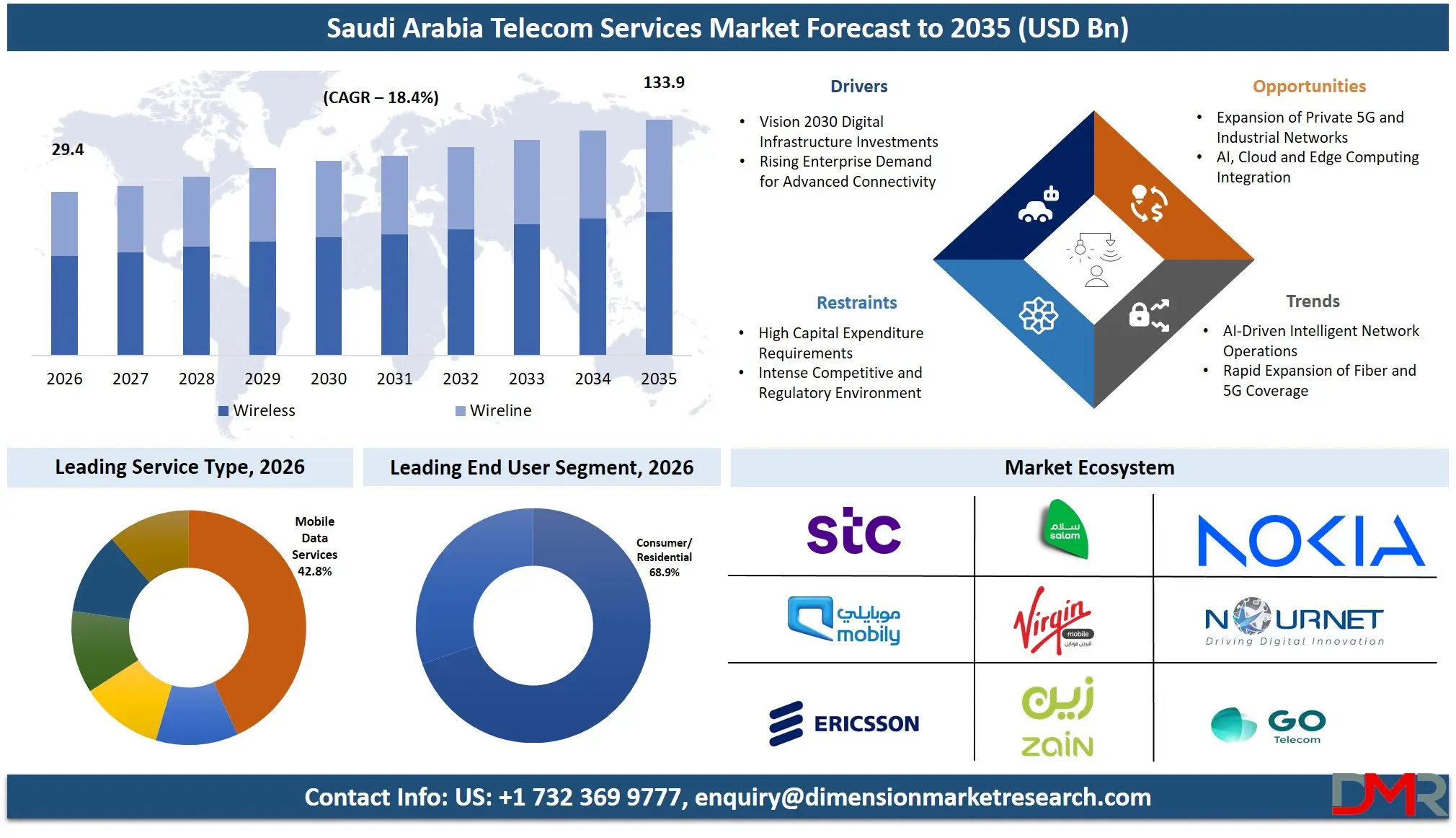
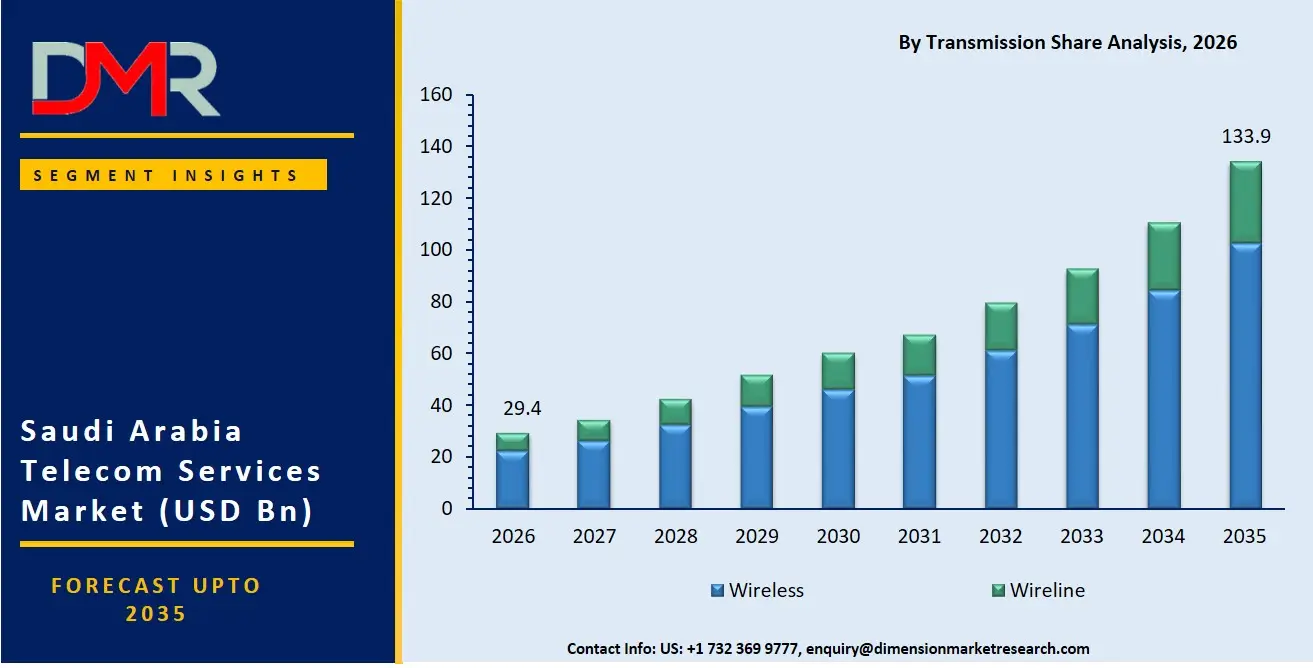
The Saudi Arabia Telecom Services Market is projected to reach USD 29.4 billion in 2026 and with a CAGR of 18.4%, it is expected reach a value of USD 133.9 billion by 2035.
ℹ
To learn more about this report –
Download Your Free Sample Report Here
Telecommunication services comprise fixed voice, mobile voice, mobile data, broadband internet, pay-TV, and machine-to-machine (M2M) connectivity delivered through wireline and wireless networks to consumers, enterprises, and public-sector organizations.
The industry forms the digital backbone supporting cloud computing, smart cities, e-government, financial services, healthcare, education, and industrial automation. Rapid deployment of 5G, nationwide fiber-optic expansion, AI-enabled network management, IoT adoption, and hyperscale data center investments are transforming service delivery. Growing digital transformation initiatives under Vision 2030 and increasing enterprise demand for secure, high-speed connectivity continue to accelerate innovation and market expansion.
Saudi Arabia Telecom Services Market is witnessing rapid transformation driven by accelerating digitalization across both public and private sectors. Strong government-led initiatives under Vision 2030 are enabling large-scale deployment of 5G networks, nationwide fiber-optic expansion, and advanced digital infrastructure to support a diversified digital economy.
ℹ
To learn more about this report –
Download Your Free Sample Report Here
Increasing demand for high-speed mobile data, cloud connectivity, and integrated communication services is reshaping service delivery across residential, enterprise, and government users. The market is further strengthened by rising adoption of IoT, AI-based network optimization, and hyperscale data center investments. These developments are enhancing connectivity, improving service quality, and supporting the Kingdom's transition toward a technology-driven, knowledge-based economy.
Saudi Arabia Telecom Services Market: Key Takeaways
- Market Growth: The Saudi Arabia Telecom Services Market size is expected to grow by USD 99.7 billion, at a CAGR of 18.4% during the forecasted period of 2026 to 2035.
- By Service Type: Mobile Data Services are predicted to dominate Saudi Arabia's telecom services market with highest revenue share in 2026.
- By Transmission: The wireless segment dominates the KSA telecom services market with highest revenue share in 2026.
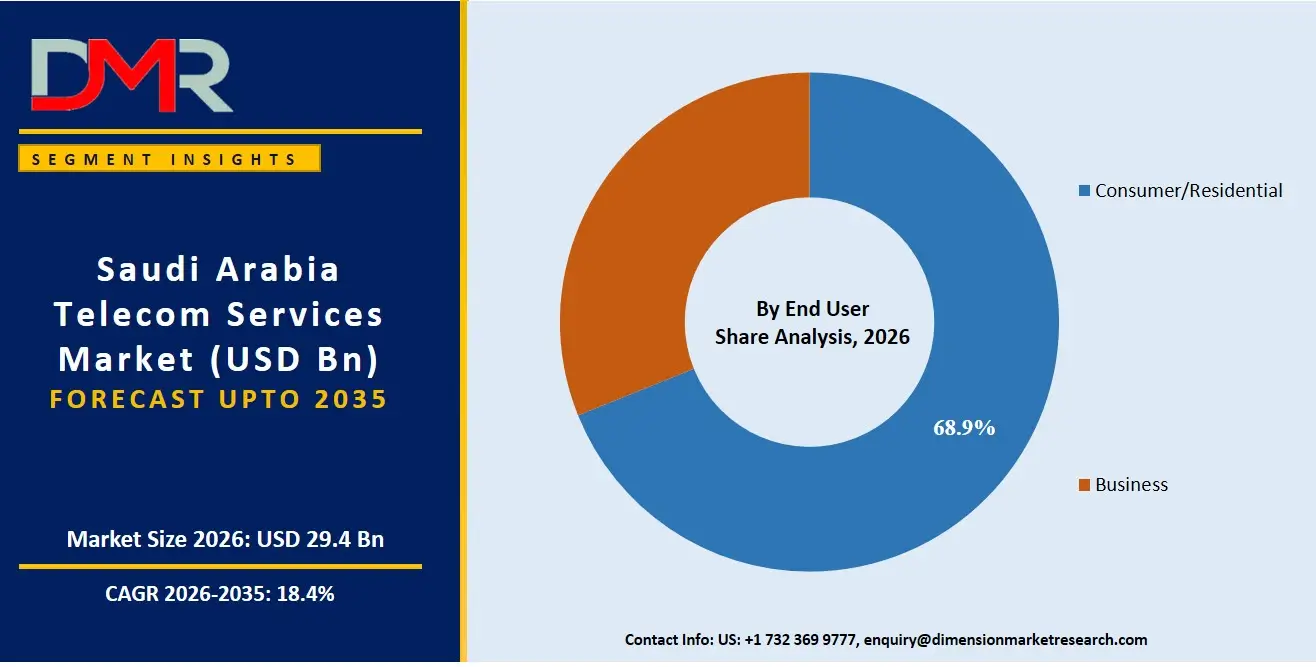
- By End User: The consumer /residential segment is predicted to dominate the KSA telecom services market with largest revenue share in 2026.
- Use Cases: Some of the use cases of Saudi Arabia Telecom Services include Smart City Connectivity, Enterprise Digital Transformation, and more
Saudi Arabia Telecom Services Market: Use Cases
- Smart City Connectivity: Telecom operators provide high-speed 5G and fiber connectivity supporting intelligent traffic systems, surveillance, smart utilities, and digital public services. These networks enable seamless communication among connected infrastructure while improving operational efficiency across large urban developments.
- Enterprise Digital Transformation: Businesses increasingly utilize mobile connectivity, cloud networking, SD-WAN, unified communications, and IoT services to improve productivity, enable hybrid work environments, strengthen cybersecurity, and support digital business operations across multiple locations.
- Industrial IoT Applications: Manufacturing, logistics, energy, and oil & gas companies deploy machine-to-machine communication and private wireless networks for predictive maintenance, automated monitoring, asset tracking, and operational optimization in industrial environments.
- Consumer Digital Entertainment: High-speed broadband and advanced mobile networks support UHD video streaming, cloud gaming, digital payments, e-learning, telemedicine, and social media applications, driving continuous growth in mobile data consumption.
Market Dynamic
Driving Factors in the Saudi Arabia Telecom Services Market
Vision 2030 Digital Infrastructure Investments
Saudi Arabia's Vision 2030 continues to accelerate investments in nationwide fiber networks, 5G infrastructure, hyperscale data centers, cloud computing, and smart city developments. Public and private sector collaboration encourages network modernization while supporting digital government, industrial automation, and enterprise connectivity. These initiatives substantially increase broadband penetration, mobile data consumption, and demand for advanced telecom solutions across every economic sector.
Rising Enterprise Demand for Advanced Connectivity
Organizations across banking, healthcare, manufacturing, retail, logistics, and government increasingly require secure, high-capacity communication networks. Growing adoption of IoT, cloud services, remote working environments, AI applications, and digital customer engagement drives investment in premium mobile data, fiber broadband, private 5G, and managed network services, creating sustainable revenue opportunities for telecom service providers.
Restraints in the Saudi Arabia Telecom Services Market
High Capital Expenditure Requirements
Deployment of nationwide fiber infrastructure, 5G radio equipment, edge computing facilities, and advanced network security requires significant capital investment. Continuous technology upgrades, spectrum acquisition costs, infrastructure maintenance, and evolving cybersecurity requirements increase operational expenditures, affecting profitability, especially for smaller telecom operators and new market entrants.
Intense Competitive and Regulatory Environment
Competition among established telecom providers places pressure on pricing strategies and customer retention. Regulatory compliance, quality-of-service standards, cybersecurity obligations, data localization requirements, and continuous infrastructure investments require operators to allocate considerable financial and technical resources, limiting flexibility for smaller participants while increasing operational complexity.
Opportunities in the Saudi Arabia Telecom Services Market
Expansion of Private 5G and Industrial Networks
Industrial digitalization creates substantial opportunities for private 5G deployments across manufacturing facilities, oil & gas operations, mining, logistics centers, airports, and smart ports. These dedicated networks improve automation, real-time monitoring, predictive maintenance, and operational safety, enabling telecom providers to diversify beyond traditional consumer services.
AI, Cloud and Edge Computing Integration
Increasing enterprise adoption of artificial intelligence, cloud-native applications, edge computing, and data analytics creates demand for low-latency, high-bandwidth telecom infrastructure. Operators can strengthen revenues by offering integrated connectivity, cloud networking, cybersecurity, and managed digital services tailored to enterprise digital transformation initiatives.
Trends in the Saudi Arabia Telecom Services Market
AI-Driven Intelligent Network Operations
Telecom providers increasingly implement AI-powered network optimization, predictive maintenance, automated customer support, fraud detection, and intelligent traffic management. These technologies reduce downtime, optimize bandwidth utilization, enhance customer satisfaction, and lower operating costs while improving overall service quality.
Rapid Expansion of Fiber and 5G Coverage
Nationwide deployment of fiber-to-the-home (FTTH) and extensive 5G rollout continue transforming broadband accessibility. Consumers increasingly rely on ultra-fast mobile internet, while enterprises adopt high-capacity connectivity supporting cloud computing, industrial automation, virtual collaboration, and digital transformation across multiple industries.
Impact of Artificial Intelligence in Saudi Arabia Telecom Services Market
Artificial intelligence is transforming telecom operations through predictive maintenance, automated network optimization, intelligent spectrum allocation, cybersecurity monitoring, and proactive fault detection. AI algorithms analyze massive network traffic volumes in real time, enabling operators to improve service reliability while minimizing operational costs and downtime.
AI also enhances customer experiences by powering virtual assistants, personalized service recommendations, intelligent billing support, fraud prevention, and customer behavior analytics. Telecom providers increasingly integrate AI into enterprise connectivity, IoT management, cloud services, and network planning, supporting faster decision-making while improving service quality and resource utilization across digital ecosystems.
Research Scope and Analysis
By Service Type Analysis
Mobile Data Services are projected to remain the leading service segment, accounting for an estimated 42.8% market share in 2026. Their dominance is supported by surging smartphone penetration, increasing 5G subscriptions, widespread adoption of unlimited mobile data plans, and continuous growth in bandwidth-intensive applications such as ultra-high-definition video streaming, cloud gaming, digital banking, remote working, and AI-powered mobile applications. Telecom operators continue expanding 5G standalone networks and enhancing spectrum efficiency to improve download speeds and network capacity, further strengthening the position of mobile data services. Enterprise mobility solutions, IoT connectivity, and mobile-first digital transformation initiatives across healthcare, retail, manufacturing, and government organizations also contribute significantly to demand. Meanwhile, Machine-to-Machine (M2M) Services are anticipated to register the fastest growth during the forecast period, driven by increasing deployment of connected sensors, industrial IoT platforms, smart utility networks, intelligent transportation systems, fleet management, and smart city infrastructure. Growing investments in Industry 4.0, predictive maintenance solutions, logistics automation, and connected healthcare devices are expected to accelerate M2M adoption, allowing this segment to steadily expand its contribution to overall telecom service revenues.
By Transmission Analysis
Wireless transmission is expected to lead the Saudi Arabia Telecom Services Market with an estimated 76.4% market share in 2026. The segment benefits from extensive nationwide deployment of 5G networks, broad 4G LTE coverage, increasing mobile broadband subscriptions, and strong consumer preference for wireless connectivity over traditional fixed-line services. Businesses are increasingly adopting wireless solutions to support hybrid work environments, cloud applications, IoT deployments, and real-time communications without extensive physical infrastructure. Wireless technologies also provide faster deployment, greater scalability, and lower installation complexity, making them attractive for residential, commercial, and industrial users. Continuous investments in network densification, spectrum optimization, and private 5G networks further reinforce segment leadership. Conversely, Wireline transmission is projected to experience the fastest growth within fixed infrastructure owing to accelerated fiber-to-the-home (FTTH) expansion, rising enterprise demand for ultra-high-speed broadband, increasing data center connectivity requirements, and the growing need for highly reliable, low-latency connections supporting cloud computing, AI workloads, and mission-critical business operations.
By End User Analysis
The Consumer/Residential segment is anticipated to account for an estimated 68.9% market share in 2026, maintaining its leadership due to the large subscriber base utilizing mobile voice, broadband internet, streaming services, digital entertainment platforms, online education, gaming, and digital financial services. Rising disposable incomes, widespread smartphone ownership, increasing household broadband penetration, and continuous expansion of 5G and fiber networks encourage higher data consumption among residential users.
ℹ
To learn more about this report –
Download Your Free Sample Report Here
Telecom operators continue introducing bundled offerings combining mobile, broadband, entertainment, and smart home services, further improving customer retention and average revenue per user. Meanwhile, the Business segment is expected to witness the fastest growth throughout the forecast period as organizations accelerate digital transformation initiatives. Demand for cloud connectivity, cybersecurity services, SD-WAN, unified communications, private wireless networks, IoT connectivity, edge computing, and managed telecom services continues increasing across sectors including banking, manufacturing, healthcare, logistics, energy, retail, and government, creating substantial opportunities for enterprise-focused telecom solutions.
The Saudi Arabia Telecom Services Market Report is segmented on the basis of the following:
By Service Type
- Fixed Voice Services
- Fixed Internet Access Services
- Mobile Voice Services
- Mobile Data Services
- Pay-TV Services
- Machine-to-Machine Services
By Transmission
By End User
- Consumer/Residential
- Business
Competitive Landscape
The Saudi Arabia Telecom Services Market is characterized by high entry barriers resulting from substantial capital investment requirements, spectrum licensing regulations, nationwide infrastructure deployment, and strict cybersecurity compliance standards. Market participants primarily compete through continuous 5G expansion, fiber-optic network modernization, digital service diversification, AI-enabled network management, enterprise cloud offerings, and customer experience improvements rather than price alone. Strategic partnerships with global technology providers, investments in hyperscale data centers, private 5G solutions, IoT platforms, fintech integration, and managed ICT services have become major competitive differentiators. Operators also emphasize digital ecosystems, sustainability initiatives, and infrastructure sharing to improve operational efficiency while supporting long-term growth and customer retention.
Some of the prominent players in the Saudi Arabia Telecom Services are:
- stc Group
- Mobily
- Zain KSA
- Salam
- GO Telecom
- Integrated Telecom Company
- Integrated Dawiyat
- NourNet
- Etihad Atheeb Telecom
- Virgin Mobile Saudi Arabia
- Lebara Saudi Arabia
- Saudi Net Link
- Sahara Net
- Zajil Telecom
- Ericsson
- Huawei
- Nokia
- Cisco
- ZTE
- Ciena
- Other Key Players
Recent Developments
- In February 2025, Saudi Telecom Company (stc) completed the transfer of ownership of Telecommunication Towers Company (TAWAL) into a newly established entity following its strategic agreement with the Public Investment Fund (PIF). The transaction finalized the combination of TAWAL and Golden Lattice Investment Company, creating one of the Middle East's largest independent telecommunications tower companies. Following completion, PIF held 54.38% ownership, stc retained 43.06%, while the remaining shares were owned by minority investors. To maintain its ownership stake, stc injected SAR 128.37 million into the new entity. The transaction is expected to improve infrastructure sharing, enhance tower utilization, accelerate 5G deployment, and strengthen long-term digital infrastructure development across Saudi Arabia.
- In February 2025, stc Group entered a strategic partnership with Nokia under the sponsorship of Saudi Arabia's Ministry of Communications and Information Technology (MCIT) to accelerate research, development, and future deployment of 6G technology. The collaboration focuses on AI-driven network architecture, advanced spectrum technologies, cloud-native telecommunications infrastructure, and participation in global 6G standardization initiatives. The partnership aims to build intelligent, scalable, and energy-efficient communication networks capable of supporting next-generation digital services, industrial automation, smart cities, and immersive applications. The initiative also strengthens Saudi Arabia's ambition to become a regional hub for advanced telecommunications innovation while supporting the country's Vision 2030 digital transformation objectives.
Report Details
| Report Characteristics |
| Market Size (2026) |
USD 29.4 Bn |
| Forecast Value (2035) |
USD 133.9 Bn |
| CAGR (2026–2035) |
18.4% |
| Historical Period |
2021 – 2025 |
| Forecast Period |
2027 – 2035 |
| Base Year |
2025 |
| Estimate Year |
2026 |
| Segments Covered |
By Service Type, By Transmission, By End User |
| Country Coverage |
Saudi Arabia |
Frequently Asked Questions
How big is the KSA Telecom Services Market?
▾ The KSA Telecom Services Market size is estimated to have a value of USD 23.4 billion in 2024 and is expected to reach USD 101.8 billion by the end of 2033.
Who are the key players in the KSA Telecom Services Market?
▾ Some of the major key players in the KSA Telecom Services Market are Mobily, Zain KSA, Integrated Telecom Company and many others.
What is the growth rate in the KSA Telecom Services Market?
▾ The market is growing at a CAGR of 17.7 percent over the forecasted period.