What is the Knowledge Graph Market?
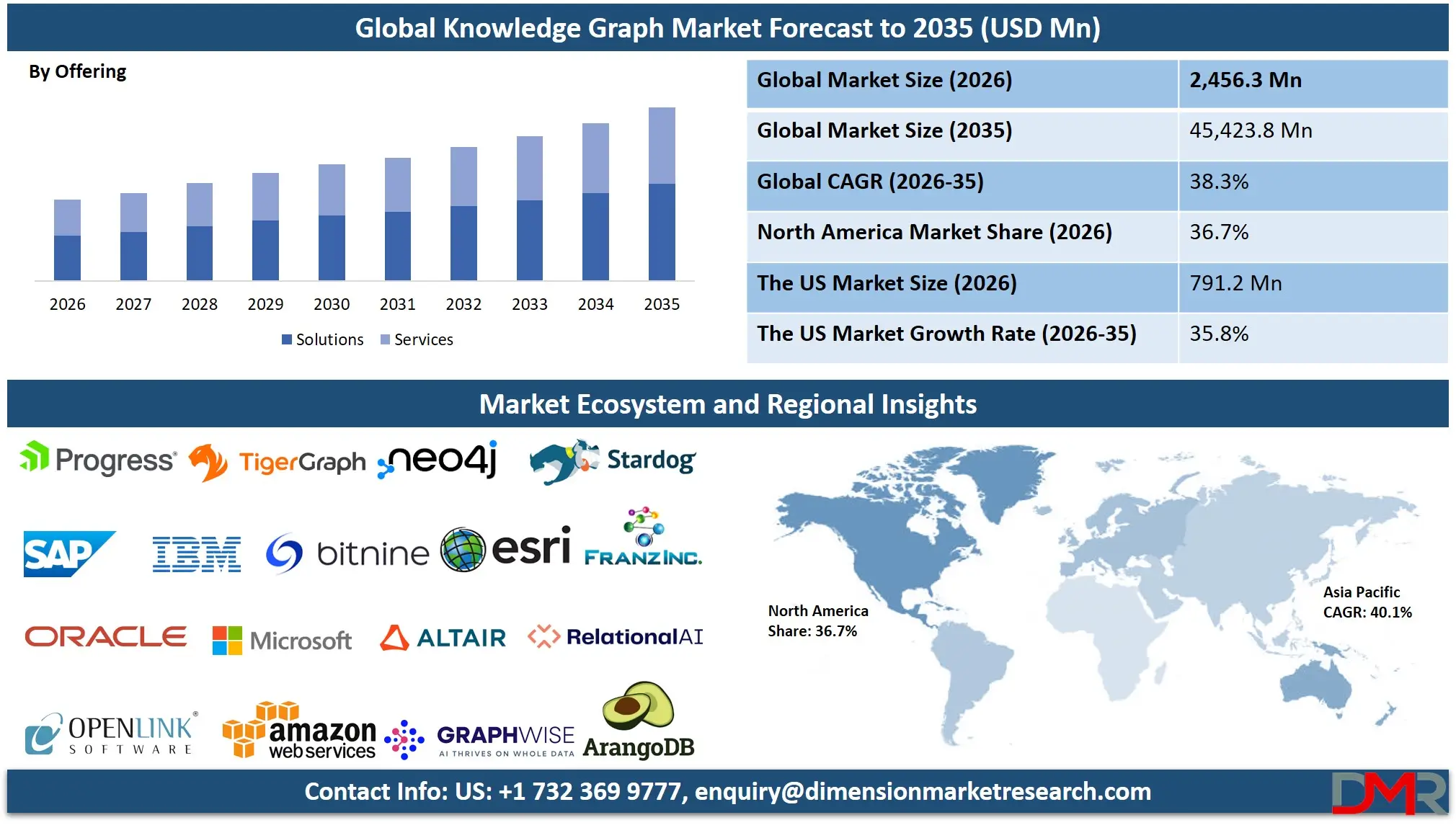
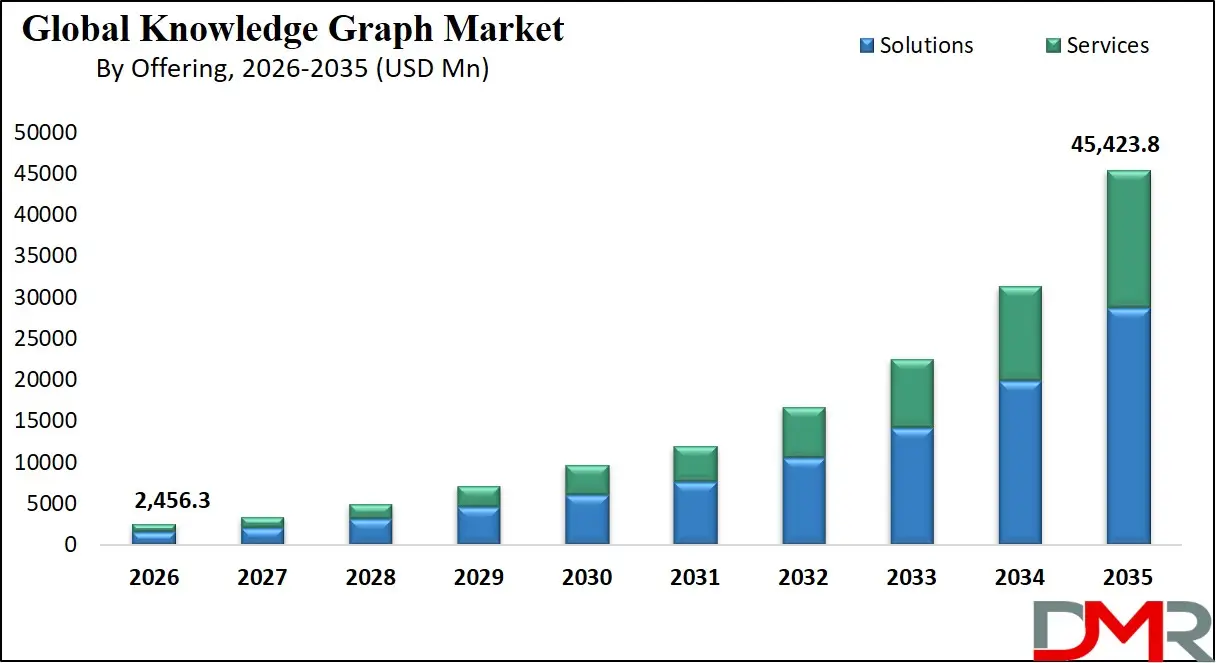
The Global Knowledge Graph Market is expected to reach a value of USD 2,456.3 million in 2026, and it is further anticipated to reach USD 45,423.8 million by 2035, growing at a CAGR of 38.3% during the forecast period.
ℹ
To learn more about this report –
Download Your Free Sample Report Here
There has been an exponential growth in the knowledge graph market space with corporations realizing the significance of using semantically-enhanced interconnected models that will support advanced uses cases of artificial intelligence applications and provide context-driven understanding of the data that exists across various isolated repositories.
The knowledge graph market space is made up of enterprise knowledge graph software, graph database engines, data integration and extraction software, ontology and taxonomy management software, knowledge management software, and an array of service offerings ranging from consulting to managed services. All these products and services, in combination, aid organizations in building intelligent data fabrics that represent entities, relationships, and properties in a machine readable fashion.
ℹ
To learn more about this report –
Download Your Free Sample Report Here
The US Knowledge Graph Market
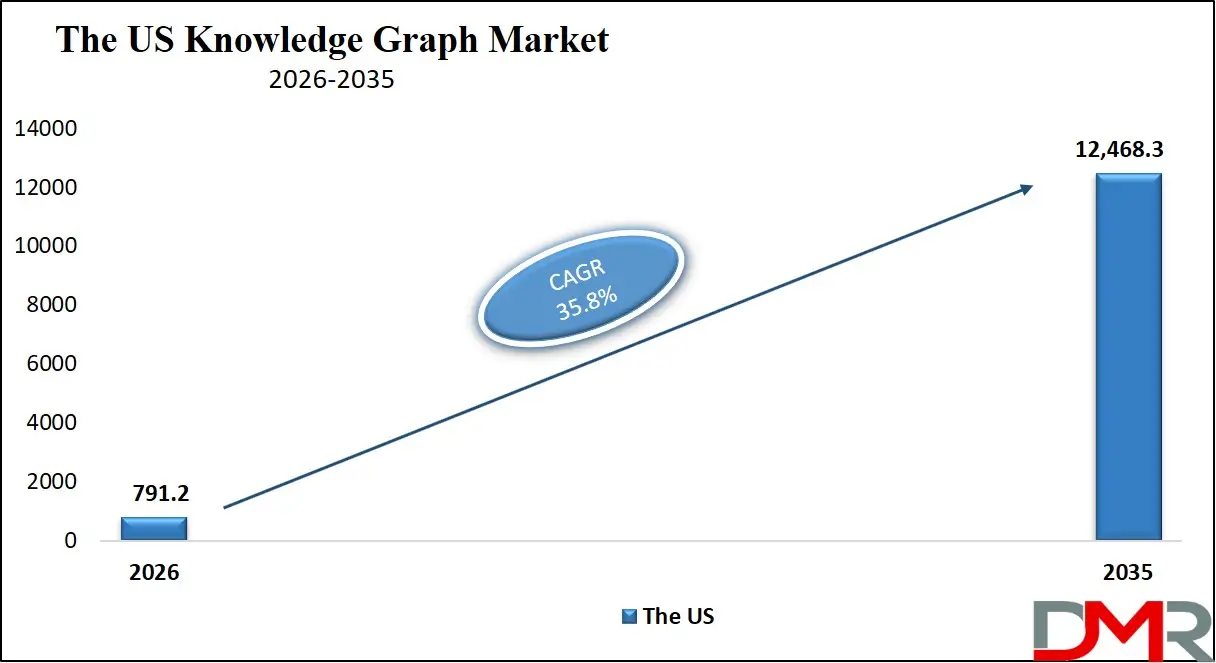
The US Knowledge Graph Market is projected to reach USD 791.2 million in 2026 at a compound annual growth rate of 35.8% over its forecast period, which is further expected to reach a market value of USD 12,468.3 million by 2035.
ℹ
To learn more about this report –
Download Your Free Sample Report Here
The United States remains the biggest and most technologically rich market of knowledge graph technologies, fueled by the aggressive AI innovation programs of the major technology corporations, the extensive venture capital investment in graph-native startups, and the general modernization efforts of the Fortune 500 companies aiming to establish the semantic backbone to their AI transformation programs. High demand in the US market has been defined by the need to have enterprise knowledge graph platforms that are built to interoperate with existing data lakehouse platforms and during hybrid deployments across cloud-based, on-premises and edge environments. The US market is seeing the especially good uptake of implementations based on Labeled Property Graph (LPG) models owing to their natural correspondence to the object-oriented programming paradigms and their solid support of complex, evolving schemas typical of enterprise applications.
The Europe Knowledge Graph Market
The Europe Knowledge Graph Market is estimated to be valued at USD 712.3 million in 2026 and is further anticipated to reach USD 13,172.9 million by 2035 at a CAGR of 38.1%. European market can be characterized by the high levels of data sovereignty, privacy protection, and regulatory compliance, which are the primary determinants of knowledge graph adoption trends and architectures in the region. The detailed regulatory frameworks, such as the General Data Protection Regulation (GDPR), the EU AI Act, and new data governance laws present specific needs to implement knowledge graphs that are able to offer clear data lineage, traceable inference paths, and fine-grained access control in accordance with privacy by design principles. Organizations in Europe, especially in Germany, France, and the Nordic countries, show high interests in Resource Description Framework (RDF) and semantic web standards because they have formal ontologies and logical consistency verification, as well as standard query interfaces using SPARQL.
The Japan Knowledge Graph Market
The Japan Knowledge Graph Market is projected to be valued at USD 246.5 million in 2026. It is further expected to witness robust growth, holding USD 3,824.8 million in 2035 at a CAGR of 35.6%. The Japanese market has its own unique features due to the specifics of the Japanese industrial system, linguistic factors, and effective national plans on transforming the Society 5.0. Japanese companies are deploying knowledge graph technologies as base elements of their digital transformation agendas, and are particularly interested in applications that retain and transform tacit organizational knowledge developed over decades of engineering and manufacturing excellence. The Japanese market exhibits a strong need of knowledge graph solutions, which offer strong support to process Japanese language, which involves recognition to identify entities, extract relationships, and semantically comprehend complicated technical documentation in Japanese. This linguistic aspect offers avenues of specialized solution providers that would provide ontology and taxonomy administration tools tailored to the Japanese business vocabulary, technical terms and the fine-grained hierarchical connections between the Japanese organizational and social structures.
Key Takeaways
- Market Size & Forecast: The Global Knowledge Graph market is projected to reach USD 2,456.3 million in 2026 and USD 45,423.8 million by 2035, fueled by generative AI adoption and demand for trustworthy AI.
- Growth Rate & Outlook: The market is expected to grow at a 38.3% CAGR, driven by knowledge graphs as semantic foundations for RAG architectures and the proliferation of graph database engines supporting real-time analytics.
- Primary Growth Drivers: Key drivers include integrating knowledge graphs with LLMs to reduce hallucination, unified data governance, semantic search demand, and capturing domain expertise amid workforce transitions and knowledge loss.
- Key Market Trends: Major trends include graph-native machine learning, knowledge graphs for self-service data discovery and personalization, integration with data fabric and mesh architectures, and automated ontology generation tools.
- By Deployment Mode Analysis: Cloud-based deployment model are poised to dominate this market on account of scalability and managed service offerings, and hybrid models become popular in heavily regulated industries that need to maintain semantic models.
- By Application Analysis: Data Governance & Master Data Management application are expected to dominate this market while Semantic Search & Conversational AI applications have the fastest growth potential to enable explainability from contextual enterprise data sources.
- By End User Analysis: BFSI is forecasted to emerge as dominate end user in this segment because of compliance issues and data integration complexities, whereas Manufacturing and Retail industries will see growth on account of product customization and logistics optimization, along with personalized customer experiences.
- Regional Leadership: North America is poised to dominate this market with 36.7% market share in 2026, backed by technological innovations, venture capital funding, and aggressive enterprise-wide AI implementation strategies.
What is the Knowledge Graph Market?
Knowledge Graphs is a new paradigm in the organization of complex, interconnected data to formulate, store, query and extract insights. Knowledge graphs explicitly represent the objects of interest to a business domain and the significant interactions among the objects of interest in contrast to traditional relational databases, which store data in fixed tables with predefined schemas, or document stores, which store data as isolated objects. The graph-based model provides a scalable, extensible semantic fabric, allowing structured information stored in transactional systems, semi-structured information stored in APIs and documents, and unstructured information stored in text, pictures, and other sources of content to be modeled as a unified semantic fabric, which can be queried.
Use Cases
- BFSI Fraud Detection and Anti-Money Laundering: Financial institutions apply knowledge graphs to model the complex transaction networks, accounts, and entities along with their connections to detect fraudulent behavior.
- Semantic Search and Conversational AI for Customer Experience: Businesses across industries leverage knowledge graphs to provide semantic search capabilities and conversational AI applications that understand user intents and relationships beyond keyword matching.
- Data Governance and Master Data Management in Large Enterprises: Multi-national corporations with complex federated data architectures leverage knowledge graphs as the semantic layer for implementing data governance initiatives across the entire enterprise.
- Product and Configuration Management in Manufacturing: Engineering-centric manufacturing industries utilize knowledge graphs to capture complex interrelationships within product designs such as bill of material dependencies, compatibility restrictions, variant configuration options, and engineering change history.
How AI is Transforming the Knowledge Graph Market
Artificial intelligence is radically reshaping the knowledge graph market on various fronts, and both developing effective new knowledge graph building and consumption capabilities, as well as defining knowledge graphs as critical infrastructure to reliable AI systems. This two-way interaction between AI and knowledge graphs is one of the most important dynamics that will influence the development of markets by 2035. Conventional methods of knowledge graph construction involved a great deal of manual work by domain experts and knowledge engineers to define ontologies, find entities, and extract relationships out of source data.
These labor-intensive processes are being drastically accelerated and automated with advanced AI methods, especially large language models and transformer-based architectures. The fine-tuning of LLM models to solve information extraction tasks can now recognize entities and relationships in unstructured text with similar accuracy as humans, allowing organizations to automatically build knowledge graphs over document repositories, technical literature, and internal communications that used to be unreachable to structured query and analysis.
Market Dynamics
Key Drivers in the Global Knowledge Graph Market
Integration of Generative AI and LLMs
The rapid enterprise adoption of generative AI capabilities has created an urgent and substantial demand for knowledge graph technologies as the foundational semantic infrastructure that makes AI systems trustworthy, accurate, and governable. Organizations that initially experimented with standalone LLM deployments quickly encountered the fundamental limitations of these systems: hallucinations that undermine credibility, inability to access proprietary enterprise knowledge, and lack of explainability that creates compliance and risk management concerns.
Implementation of Data Fabric and Data Mesh Architectures
The evolution of enterprise data architecture toward more distributed, federated patterns is driving substantial demand for knowledge graph technologies capable of providing semantic unification across decentralized data domains. Data fabric architectures aim to create virtual, intelligent data access layers that span hybrid and multi-cloud environments, and knowledge graphs serve as the ideal foundation for the metadata and semantic models that enable intelligent data discovery, automated data integration, and policy-based data governance.
Restraints in the Global Knowledge Graph Market
Specialized Skills Scarcity and Organizational Learning Curves
The knowledge graph market faces significant headwinds from the persistent scarcity of professionals with expertise in semantic technologies, graph data modeling, ontology engineering, and graph query languages. Unlike relational database skills that are widely available in the labor market, knowledge graph competencies remain concentrated in specialized academic communities, research institutions, and a relatively small population of experienced practitioners.
Integration Complexity with Legacy Data Ecosystems
Despite the compelling value propositions of knowledge graph technologies, organizations face substantial practical challenges when attempting to integrate these systems with deeply entrenched legacy data infrastructure. Enterprise data landscapes typically comprise hundreds or thousands of existing applications, databases, data warehouses, and analytics platforms, each with established data models, integration patterns, and operational processes.
Growth Opportunities in the Global Knowledge Graph Market
Industry-Specific Knowledge Graph Solutions
The knowledge graph market presents substantial growth opportunities for solution providers who develop pre-built ontologies, data integration connectors, and application templates tailored to specific industry verticals and high-value use cases. Organizations in BFSI, Healthcare and Life Sciences, Manufacturing, and other verticals face common knowledge modeling challenges that can be substantially accelerated through industry-specific starting points. These vertical accelerators represent a significant competitive differentiator and create opportunities for premium pricing based on demonstrated domain expertise and reduced time-to-value.
Managed Knowledge Graph Services
The operational complexity of deploying, scaling, and maintaining knowledge graph infrastructure creates substantial opportunities for managed service providers and cloud platform vendors offering fully managed knowledge graph and graph database capabilities. Many organizations recognize the strategic value of knowledge graph technologies but lack the specialized operational expertise to manage graph database clusters, optimize query performance, implement backup and disaster recovery procedures, and maintain high availability across distributed deployments.
Trends in the Global Knowledge Graph Market
Convergence of Knowledge Graphs
One of the most significant market trends is the growing convergence between knowledge graph technologies and vector database systems, reflecting the complementary strengths of symbolic knowledge representation and neural embedding approaches. Forward-looking platform vendors are developing integrated systems that maintain explicit entity and relationship structures alongside vector embeddings that capture semantic similarity and enable approximate nearest neighbor search.
Automated Knowledge Graph Construction
The application of large language models to automate traditionally manual knowledge engineering tasks is emerging as a transformative trend with profound implications for knowledge graph market economics. LLMs fine-tuned on domain-specific corpora can now propose ontology structures, identify entity types and relationship categories, and extract specific fact assertions from unstructured text with increasing accuracy. While human expert validation remains essential for high-stakes applications, AI-assisted knowledge graph construction is dramatically reducing the time and specialized expertise required to build initial knowledge models and maintain them as new information becomes available.
Research Scope and Analysis
By Offering Analysis
Solutions will be expected to dominate the offering segment of the global knowledge graph market and will capture the vast majority of the market value by 2035 due to the strategic value of owning and controlling the core technology platforms that make knowledge graph capabilities possible. Enterprise knowledge graph platforms form the most strategically important and largest sub-sub segments within the solutions category as organizations aim to have end to end solutions offering ontology design and data ingestion, graph storage, query processing, and application development. These platforms are the base infrastructure on which organizations develop their semantic data fabrics, and the decision to select the platform has long-term strategic consequences of scalability, interoperability, and total cost of ownership.
By Model Type Analysis
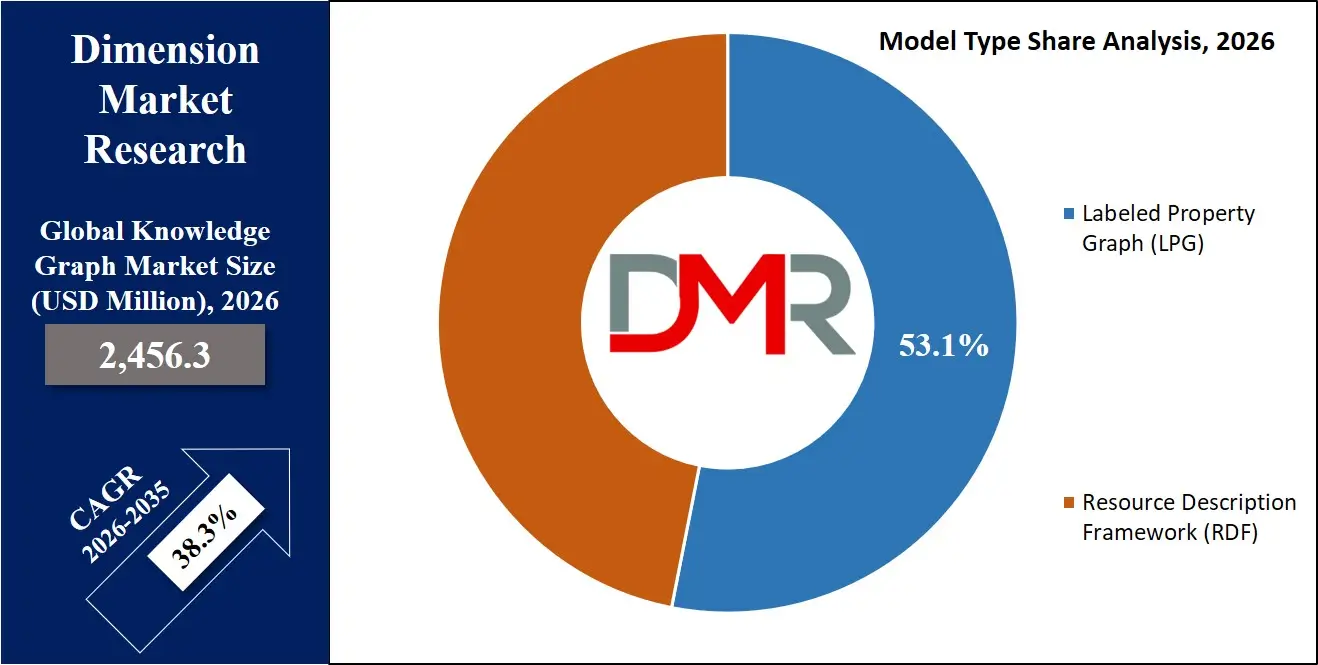
The Labeled Property Graph (LPG) is projected to hold the highest market share in the model type segment during the forecast period due to its natural fit with mainstream software development models, strong performance attributes on both transactional and analytical workloads, and wide support on platforms of major graph databases.
ℹ
To learn more about this report –
Download Your Free Sample Report Here
The LPG model models entities as nodes with key-value property sets and relationships as directed, labeled edges with optional properties that can have properties, forming a rich and expressive data model that can be easily mapped to the concepts of object-oriented programming software that business model developers are familiar with. The fact that LPG implementations in popular graph databases and cloud provider offerings are common provides significant ecosystem momentum that further pushes the further dominance of LPG in the market.
By Deployment Mode Analysis
Cloud-based deployment is expected to dominate the knowledge graph market through the forecast period, reflecting the broader enterprise migration toward cloud infrastructure and the compelling advantages of cloud-native knowledge graph and graph database services. Large cloud providers have made significant investments in creating fully operated graph database products that do not incur operational overhead, offer elastic scalability to support large graph and query volumes, and are provided with seamless integration with adjacent cloud services that ingest data, perform analytics, and AI/ML. The cloud deployment model fits organizational tastes of operational spending over capital investment, supports quick experimentation and prototyping, and minimizes the operational specialized knowledge to operate graph database infrastructure.
By Data Type Analysis
Structured Data is projected to lead the data type segment in knowledge graph market, as most organizations have initially focused on bringing existing relational database data, enterprise application data and other structured data into a single knowledge model. Structured data sources offer well-defined schemas and data representations, making the knowledge graph construction process easier and allowing organizations to realize early wins and show value prior to addressing more intricate data integration problems. Although the conversion of relational data to graph structures is conceptually simple, a great deal of care must be taken in the face of entity resolution between tables, relationship inferences based on foreign key constraints, and data integrity as information is transferred between relational and graph systems.
By Application Analysis
Governance Data Governance and Master Data Management is projected to be the one of the largest and most established application areas of knowledge graph technologies that solves fundamental enterprise issues of data consistency, quality, and discoverability. Companies that apply knowledge graphs to data governance build cohesive, semantically-enriched models of important business entities such as customers, products, suppliers, locations and organizational structures, resolve the competing definitions and incomplete presentations that build up across applications and data silos. The explicit relationship modelling of knowledge graphs provides a rich data provenance, impact analysis of suggested data alterations, and self-service data exploration to enable business users to locate and comprehend accessible information resources.
By End User Analysis
Banking, Financial Services and Insurance (BFSI) poised to represents the largest end-user segment by in terms of market value due to the conglomeration of large technology budgets, intricate data integration issues, strict regulatory demands, and high-valued applications that knowledge graph technologies can serve. Financial institutions are information intensive industries with complex relationships amongst customers, accounts, transactions, counterparties, and risk factors being core business activities. Applications of knowledge graphs in BFSI include fraud detection and anti-money laundering, credit risk and portfolio management, customer 360 applications that allow customer data to be consolidated across product silos, and regulatory compliance applications such as beneficial ownership reporting and sanctions screening. The high financial risks that these applications are linked to are the reasons why this type of investment should be made in terms of knowledge graph technologies and specialized implementation skills.
The Global Knowledge Graph Market Report is segmented on the basis of the following:
By Offering
- Solutions
- Enterprise knowledge graph platforms
- Graph database engines
- Data integration & ETL tools
- Ontology and taxonomy management
- Knowledge management toolsets
- Services
- Consulting
- Implementation & integration
- Training & education
- Managed services
By Model Type
- Labeled Property Graph (LPG)
- Resource Description Framework (RDF)
By Deployment Mode
- Cloud-based
- On-premises
- Hybrid
By Data Type
- Structured Data
- Semi-structured Data
- Unstructured Data
By Application
- Data Governance & Master Data Management
- Data Analytics & Business Intelligence
- Semantic Search
- Recommendation Engines
- Fraud Detection
- Virtual Assistants & Conversational AI
- Product & Configuration Management
- Infrastructure & Asset Management
- Risk Management, Compliance & Regulatory
- Process Optimization & Resource Management
- Knowledge & Content Management
- Self-service Data & Digital Experiences
- Other Application
By End User
- Banking, Financial Services & Insurance (BFSI)
- Healthcare & Life Sciences
- Retail & E-commerce
- IT & Telecommunications
- Government & Defense
- Manufacturing
- Transportation & Logistics
- Education
- Media & Entertainment
- Other End User
Regional Analysis
Leading Region by Market Share
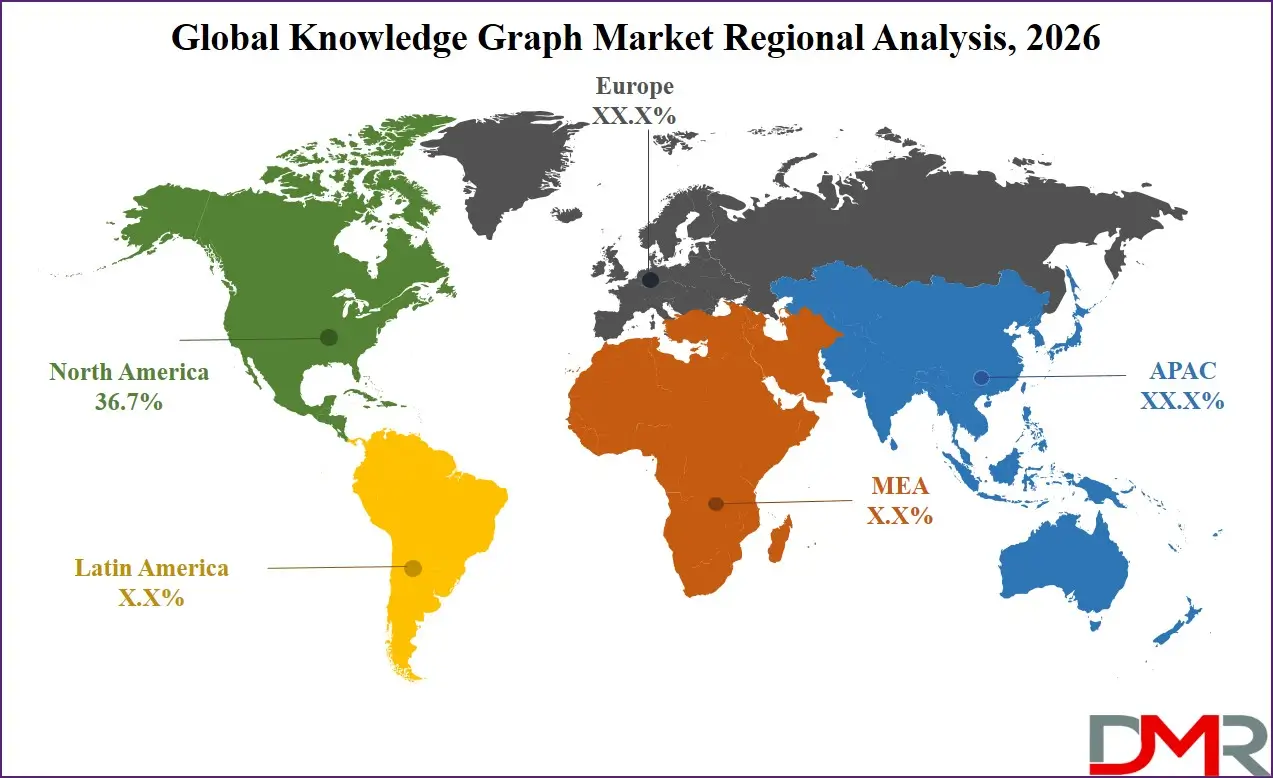
North America is poised to dominate the global knowledge graph market with 36.7% of the market share in 2026, due to the concentration of the technology innovators, the size of venture capital in graph start-ups and the aggressive enterprise AI adoption agendas that put knowledge graphs at the heart of infrastructure.
ℹ
To learn more about this report –
Download Your Free Sample Report Here
The United States, which captures the extremely large portion of the value of North American markets, has an established ecosystem of vendors of knowledge graphs platforms, graph database vendors, specialized consultancies, and academic research organizations working together to create innovation and market development. The availability of large cloud providers based in the region all investing heavily in native knowledge graph and graph database services provide further market momentum and speed up enterprise adoption.
Fastest-Growing Regional Market
Asia-Pacific will be the fastest growing knowledge graph market globally, as the region experiences a wave of digital transformation programs in China, India, Japan, South Korea, and the Southeast Asian economies that are driving significant need in high-order data management and AI infrastructure. The quick-paced economic development, a growing middle class, and the active digital economy in the region are already forcing existing conglomerates and new technology firms to invest in advanced data infrastructure that would make innovation more AI-driven and provide competitive advantage. Government-initiated projects such as the China AI development plan, Digital India program in India, and Society 5.0 vision in Japan specifically focus on building high-order data infrastructure and AI applications, establishing conducive policy frameworks to adopt knowledge graphs.
By Region
North America
Europe
- Germany
- The U.K.
- France
- Italy
- Russia
- Spain
- Benelux
- Nordic
- Rest of Europe
Asia-Pacific
- China
- Japan
- South Korea
- India
- ANZ
- ASEAN
- Rest of Asia-Pacific
Latin America
- Brazil
- Mexico
- Argentina
- Colombia
- Rest of Latin America
Middle East & Africa
- Saudi Arabia
- UAE
- South Africa
- Israel
- Egypt
- Rest of MEA
Competitive Landscape
The global knowledge graph market competitive landscape has now become extremely dynamic and multi-dimensional with competition amongst various types of players such as various specialized vendors of knowledge graphs platforms, graph database service providers, large vendors of major cloud platforms, global system integrators, and new AI-native start-ups. There is great fragmentation in the market both in terms of technology layer and use case domains, and there is no single vendor that dominates all of the segments of the knowledge graph value chain. Large cloud platform providers such as Amazon Web Services, Microsoft, and Google Cloud have become an increasingly formidable competitor with the creation of native knowledge graph and graph database services as part of their more extensive cloud data and AI portfolios.
These vendors leverage high engineering capacities, existing enterprise partnerships and the capacity to combine knowledge graph potentials with accompanying cloud offerings. Their full managed graph database services reduce the barriers to adoption with no complexity to operations and can scale elastically, in tandem with cloud consumption patterns. The strategic focus by the cloud vendors on knowledge graphs as the base of generative AI and RAG apps makes them poised to remain influential players in the competitive arena.
Some of the prominent players in the Global Knowledge Graph Market are:
- Neo4j
- Amazon Web Services
- TigerGraph
- Graphwise
- RelationalAI
- IBM
- Microsoft
- SAP
- Stardog
- Franz Inc.
- Altair
- Progress Software
- Esri
- OpenLink Software
- Bitnine
- Oracle
- Ontotext
- ArangoDB
- Diffbot
- Cambridge Semantics
- Other Key Players
Recent Developments
- December 2025: Neo4j released the general availability of its native integration with the major LLM platforms, which enabled enterprises to implement retrieval-augmented generation architectures that integrate Neo4j knowledge graphs with generative AI models. The integration consists of specialized graph retrieval algorithms that are optimized to help LLMs with contextual knowledge while safeguarding governance and explainability.
- November 2025: AWS announced significant additions to Amazon Neptune, such as new graph analytics and more integration with Amazon Bedrock to use knowledge graphs to build generative AI applications. The improvements allow organizations to apply complex graph algorithms to Neptune data and flawlessly integrate graph-based context in LLCM processes.
- October 2025: Microsoft unveiled new major features to Microsoft Graph that significantly broadened its use as an enterprise knowledge fabric that links together Microsoft 365 and third-party data sources. The releases feature additional semantic search functionality, enabled by the knowledge graph, and connectors to external sources of enterprise data.
Report Details
| Report Characteristics |
| Market Size (2026) |
USD 2,456.3 Mn |
| Forecast Value (2035) |
USD 45,423.8 Mn |
| CAGR (2026–2035) |
38.3% |
| The US Market Size (2026) |
USD 791.2 Mn |
| Historical Data |
2021 – 2025 |
| Forecast Data |
2027 – 2035 |
| Base Year |
2025 |
| Estimate Year |
2026 |
| Segments Covered |
By Offering (Solutions, and Services), By Model Type (Labeled Property Graph (LPG), and Resource Description Framework (RDF)), By Deployment Mode (Cloud-based, On-premises, and Hybrid), By Data Type (Structured Data, Semi-structured Data, and Unstructured Data), By Application (Data Governance & Master Data Management, Data Analytics & Business Intelligence, Semantic Search, Recommendation Engines, Fraud Detection, Virtual Assistants & Conversational AI, Product & Configuration Management, Infrastructure & Asset Management, Risk Management, Compliance & Regulatory, Process Optimization & Resource Management, Knowledge & Content Management, Self-service Data & Digital Experiences, and Other Application), By End User (Banking, Financial Services & Insurance (BFSI), Healthcare & Life Sciences, Retail & E-commerce, IT & Telecommunications, Government & Defense, Manufacturing, Transportation & Logistics, Education, Media & Entertainment, and Other End User) |
| Regional Coverage |
North America – The US and Canada; Europe – Germany, The UK, France, Russia, Spain, Italy, Benelux, Nordic, & Rest of Europe; Asia-Pacific – China, Japan, South Korea, India, ANZ, ASEAN, Rest of APAC; Latin America – Brazil, Mexico, Argentina, Colombia, Rest of Latin America; Middle East & Africa – Saudi Arabia, UAE, South Africa, Turkey, Egypt, Israel, & Rest of MEA |
Frequently Asked Questions
How big is the Global Knowledge Graph Market?
▾ The Global Knowledge Graph market is poised to be valued at USD 2,456.3 million in 2026 and is projected to reach USD 45,423.8 million by 2035, driven by the universal need for semantic data infrastructure.
What is the CAGR of the Global Knowledge Graph Market from 2026 to 2035?
▾ The market is expected to grow at a CAGR of 38.3% from 2026 to 2035, reflecting the accelerating integration of knowledge graphs with generative AI systems, and the proliferation of data fabric architectures requiring semantic connectivity layers.
What factors are driving the growth of the Global Knowledge Graph Market?
▾ Key drivers include the imperative to ground generative AI systems in factual, governed knowledge representations to reduce hallucination and enable explainability, the adoption of data fabric and data mesh architectures that require semantic unification across distributed data domains.
Which region held the largest share of the Knowledge Graph Market in 2026?
▾ North America, is poised to dominate this market with 36.7% of market share in 2026, driven by its concentration of technology innovators, substantial venture capital investment in knowledge graph startups.
Which region is expected to grow the fastest in the Knowledge Graph Market?
▾ The Asia-Pacific region is expected to grow the fastest, fueled by sweeping digital transformation initiatives across China, India, Japan, and Southeast Asian economies, government-led AI development strategies, and the rapid modernization of enterprise data infrastructure to support AI-driven innovation and competitive differentiation.
What are the major trends in the Global Knowledge Graph Market?
▾ Major trends include the convergence of knowledge graphs with vector databases to enable hybrid AI architectures combining symbolic reasoning with neural approaches, AI-powered automated ontology generation and knowledge graph construction using large language models across industrial sectors.
Who are the key players in the Global Knowledge Graph Market?
▾ Key players include major cloud providers (Microsoft, AWS, Google Cloud) offering integrated knowledge graph services, specialized graph database vendors (Neo4j, TigerGraph, Stardog), enterprise technology companies (Oracle, IBM, SAP), and global system integrators (Accenture, Deloitte) providing implementation expertise and industry-specific solutions.
How is the Global Knowledge Graph Market segmented?
▾ The market is segmented By Offering, By Model Type, By Deployment Mode, By Data Type, By Application, and By End Use.