KSA Livestock Genetics Market Snapshot
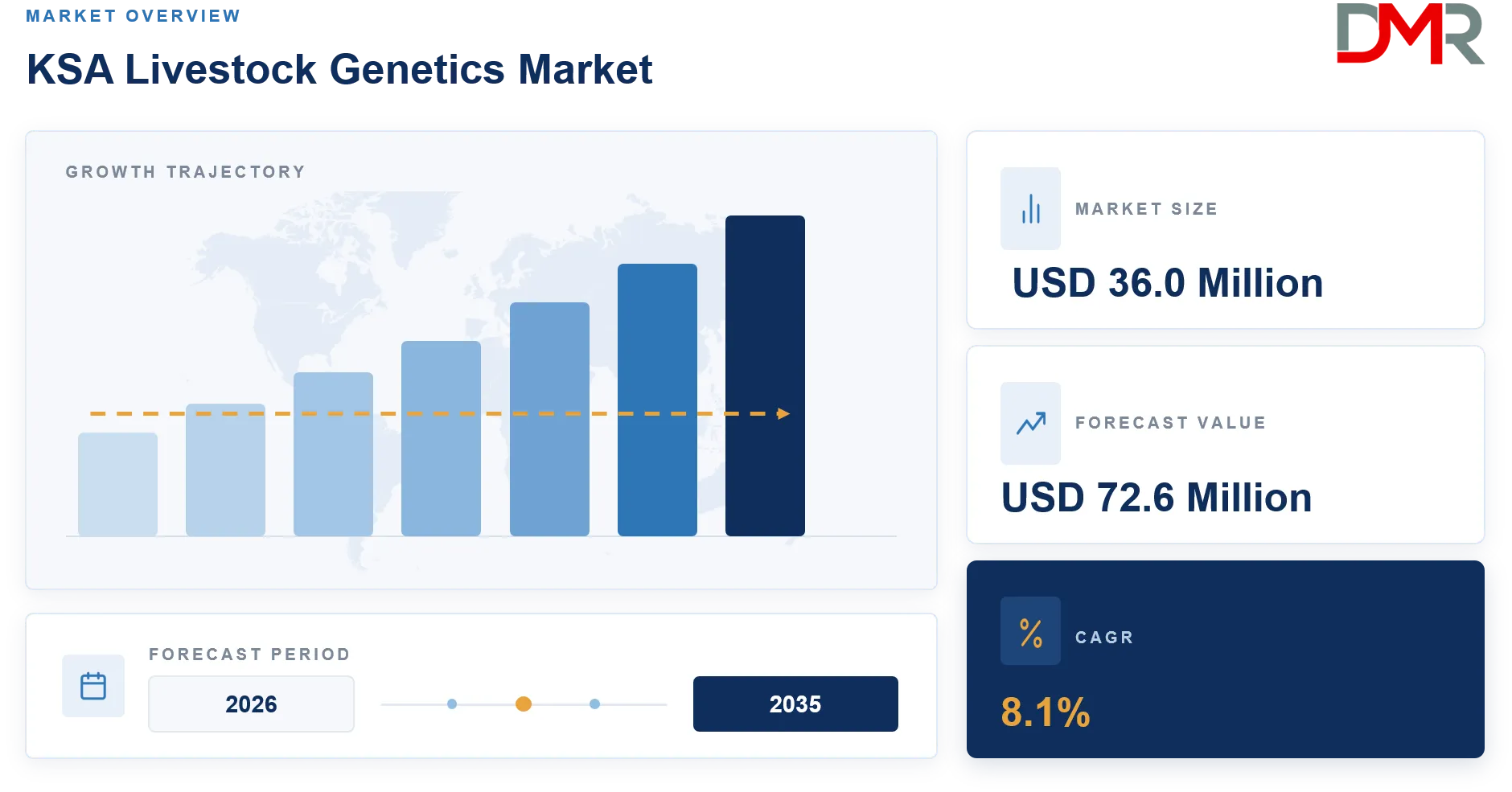
- Market Value: KSA livestock genetics market is valued at USD 36.0 million in 2026 and is projected to reach USD 72.6 million by 2035.
- CAGR: KSA livestock genetics market is expected to grow at a CAGR of 8.1% from 2026 to 2035.
- By Product and Service Segment Analysis: Genetic materials led the product and service segment with a 48.6% share in 2026.
- By Animal Type Segment Analysis: Cattle held a 49.8% share in 2026.
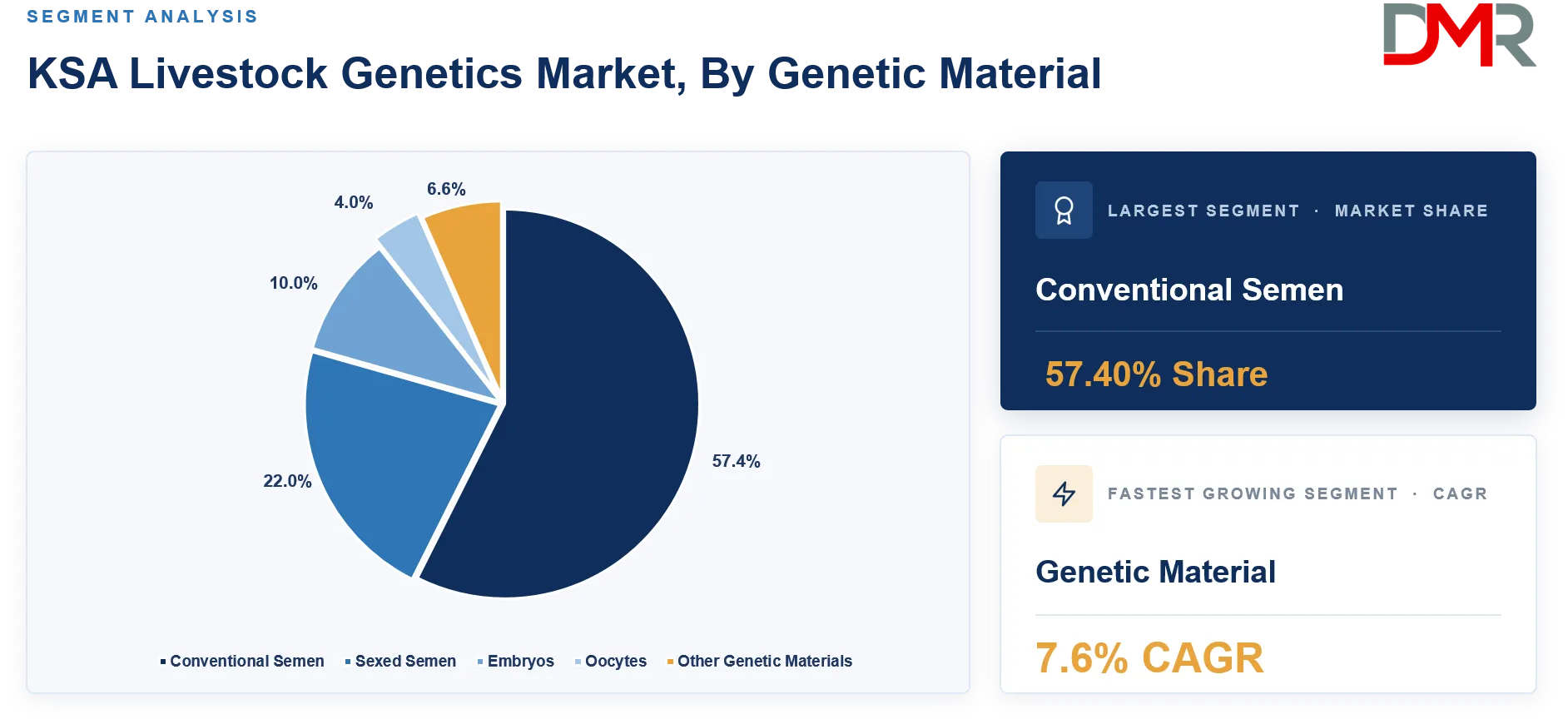
- By Genetic Material Segment Analysis: Conventional semen accounted for a 57.4% share in 2026.
- By Breeding Technology Segment Analysis: Artificial insemination led the breeding technology segment with a 53.7% share in 2026.
- By Trait Segment Analysis: Milk production accounted for a 34.6% share in 2026.
- By Application Segment Analysis: Dairy production held a 37.8% share in 2026.
- By End User Segment Analysis: Commercial livestock farms led the end-user segment with a 41.5% share in 2026.
- Regional Analysis: Central Region accounted for a 32.7% share in 2026.
- Major Players: Hendrix Genetics BV, Genus plc, STgenetics, Neogen Corporation, and CRV.
What is the KSA Livestock Genetics Market and its Market Size?
The KSA Livestock Genetics Market size is projected to be valued at USD 36.0 million in 2026 and is projected to reach USD 72.6 million by 2035, expanding at a steady CAGR of 8.1% during the forecast period. Livestock genetics covers breeding animals, semen, embryos, oocytes, genomic testing, reproductive technologies, and related services designed to improve economically important traits.
ℹ
To learn more about this report –
Download Your Free Sample Report Here
Market growth is linked to Saudi Arabia's focus on food security, herd productivity, reproductive efficiency, animal health, and climate resilience. Demand is particularly strong across commercial dairy, meat, poultry, sheep, goat, and camel production systems. Official Saudi reporting in August 2026 placed dairy self-sufficiency at 131%, poultry meat at 72%, and red meat at 62%, highlighting the scale and strategic value of domestic animal production.
Use Cases
- Dairy Herd Improvement: Livestock genetics helps Saudi dairy farms select animals with stronger milk yield, fertility, productive life, udder health, and feed conversion traits. Genomic selection, proven semen, and structured mating programs can increase genetic progress while helping large farms maintain consistent herd performance under intensive production conditions.
- Heat and Climate Tolerance: Genetic screening can identify livestock with stronger adaptation to high temperatures and arid conditions. Breeding programs that combine productivity with heat tolerance, disease resilience, and reproductive performance are increasingly relevant in KSA, where thermal stress can affect fertility, feed intake, milk output, and lifetime productivity.
- Reproductive Efficiency: Artificial insemination, sexed semen, embryo transfer, and reproductive monitoring allow producers to spread desirable genetics faster than natural mating alone. These tools can shorten generation intervals, improve replacement planning, reduce dependence on breeding males, and give commercial farms greater control over herd expansion and genetic quality.
- Meat and Growth Optimization: Sheep, goat, cattle, and camel breeders can use genetics to improve growth rate, carcass quality, fertility, survival, and feed efficiency. Better selection supports higher output from available feed and land resources, helping producers address growing demand for locally produced animal protein while managing production costs.
- Disease and Trait Management: DNA testing, genotyping, parentage verification, and trait testing help breeders identify inherited conditions and select animals with desirable characteristics. Wider testing can improve mating decisions, protect valuable bloodlines, support breed conservation, and create more reliable records for commercial breeding and livestock development programs.
How AI/Gen AI is Transforming the KSA Livestock Genetics Market?
Advanced analytics are changing livestock breeding by connecting genomic records with milk yield, fertility, feed intake, health events, pedigree data, environmental exposure, and reproductive history. Algorithms can rank breeding candidates, estimate genetic merit, identify unusual health patterns, and improve mating decisions across large herds. In Saudi Arabia, these capabilities are especially valuable because breeding programs need to balance high production with heat tolerance, reproductive resilience, and disease resistance. MEWA has also presented an AI-powered Livestock Health platform as part of its digital livestock initiatives, showing wider government interest in data-led animal management.
Generative tools can further support veterinarians, geneticists, breeding centers, and farm managers by converting complex genomic and herd records into practical recommendations. When integrated with sensor data and breeding databases, these systems can help summarize pedigree risks, flag low-performing genetic lines, compare mating combinations, and accelerate reporting. Human validation remains essential because genetic decisions affect several generations. As Saudi farms expand digital infrastructure, the combination of genomic selection, reproductive technology, precision monitoring, and decision-support software is expected to increase demand for integrated livestock genetics services.
Key Drivers in the KSA Livestock Genetics Market
Food Security and Domestic Livestock Productivity
Saudi Arabia's food-security strategy is encouraging producers to obtain more milk, meat, and breeding value from each animal. This raises demand for semen, embryos, genomic testing, and structured selection programs that improve productivity without depending only on herd expansion. MEWA and FAO have also studied a service-delivery model aimed at raising productivity in small ruminants, reflecting institutional interest in better farm performance and sustainable livestock development.
Expansion of Modern Reproductive Technologies
Artificial insemination is gaining importance because it allows superior genetics to be distributed efficiently across commercial herds. The availability of a formal Saudi licensing service for artificial insemination centers supports a regulated infrastructure for reproductive services. Wider use of semen, embryo transfer, genomic selection, and fertility management can accelerate genetic gain and improve replacement quality, supporting long-term KSA livestock genetics market growth.
Restraints in the KSA Livestock Genetics Market
High Cost of Advanced Genetic Programs
Genomic testing, imported semen, embryos, laboratory equipment, reproductive specialists, and sophisticated herd management systems can require substantial investment. Large commercial operations can spread these costs across thousands of animals, while smaller sheep, goat, and mixed-livestock farms may find adoption harder. Limited scale can reduce the immediate economic return from testing and advanced reproductive procedures, slowing penetration outside organized farming systems.
Climate and Reproductive Performance Challenges
Saudi Arabia's hot climate creates a complex breeding environment because genetics selected mainly for high output may not always provide the strongest adaptation to local heat stress. Fertility, conception rates, feed intake, and milk performance can weaken during extreme conditions. Producers therefore need balanced breeding indexes that account for production, health, fertility, and heat tolerance, increasing the technical complexity of genetic selection and herd management.
Growth Opportunities in the KSA Livestock Genetics Market
Genetics for Heat Tolerance and Local Adaptation
A major opportunity lies in breeding animals that combine commercial productivity with traits suited to Saudi conditions. Research on livestock genomics continues to identify genetic variation associated with heat adaptation and environmental resilience. Local breed characterization, genomic databases, crossbreeding programs, and climate-focused selection could create differentiated genetic products for cattle, sheep, goats, and camels while supporting sustainable livestock production in arid environments.
Expansion of Genomic Testing Services
Falling genotyping costs and greater use of digital herd records create room for DNA testing, parentage verification, disease screening, and genomic selection services. Saudi breeding centers and commercial farms can use these tools to identify superior animals earlier in life, reduce uncertainty in replacement decisions, and prevent undesirable inherited traits. Local laboratories and international genetics companies can also build partnerships around customized panels for regional breeds.
Trends in the KSA Livestock Genetics Market
Shift Toward Data-Based Breeding Decisions
Breeding choices are moving beyond visual assessment and basic pedigree records toward measurable genomic and performance data. Producers increasingly value breeding indexes that combine milk yield, growth, fertility, feed efficiency, health, and longevity. This trend supports demand for genotyping, digital herd records, reproductive monitoring, and genetic consulting, particularly among commercial farms seeking predictable genetic progress and better lifetime animal economics.
Growing Focus on Precision Reproduction
The market is moving toward breeding programs that combine artificial insemination with sexed semen, embryo technologies, fertility monitoring, and carefully planned mating. Precision reproduction allows producers to generate replacements from their highest-value females while directing lower-ranked animals toward meat or terminal breeding strategies. This approach improves herd planning and increases the commercial value derived from each breeding cycle.
Research Scope and Analysis
The KSA Livestock Genetics Market is segmented based on product and service, animal type, genetic material, breeding technology, trait, application, end user, and region. The study provides an in-depth analysis of key segments and sub-segments, covering their applications, industry adoption, demand patterns, and contribution to overall market growth.
By Product and Service
Genetic materials led the product and service category with a 48.6% share in 2026. Semen, embryos, and oocytes provide a practical route for introducing superior genetics without transporting entire breeding populations. Demand is reinforced by commercial dairy and livestock farms that require repeat access to proven genetic lines. Conventional and sexed semen remain important for routine breeding, while embryos and oocytes provide opportunities for faster multiplication of elite females and specialized breeding programs.
By Animal Type
Cattle accounted for 49.8% of the market in 2026, supported by Saudi Arabia's highly organized dairy production base and continued attention to milk productivity, fertility, and herd replacement. Commercial cattle farms can generate clear economic value from superior genetics because even modest gains in milk yield, productive life, conception performance, and feed efficiency can affect output across large herds. Sheep, goats, camels, and poultry also present growing opportunities for localized breeding and genomic services.
ℹ
To learn more about this report –
Download Your Free Sample Report Here
By Genetic Material
Conventional semen held a 57.4% share in 2026 because it offers established handling protocols, wide sire availability, and relatively economical access to genetic improvement. It remains suitable for routine artificial insemination programs across commercial dairy and cattle operations. Sexed semen is gaining interest for targeted female replacement production, while embryos and oocytes serve higher-value multiplication programs where producers seek faster genetic progress from elite animals.
By Breeding Technology
Artificial insemination led with a 53.7% share in 2026. The technology supports controlled mating, access to genetically superior sires, improved herd records, and reduced need to maintain numerous breeding males. Its commercial position is also strengthened by established semen distribution and veterinary practices. Future growth will increasingly combine artificial insemination with estrus monitoring, genomic selection, sexed semen, embryo transfer, and precision reproductive management.
By Trait
Milk production accounted for 34.6% of the market in 2026. High-output dairy systems place strong economic value on genetics that improve milk volume, solids, fertility, udder health, longevity, and feed conversion. Selection is gradually becoming more balanced as farms consider heat tolerance and animal health alongside yield. This creates demand for broader breeding indexes rather than selection based on production traits alone.
By Application
Dairy production held a 37.8% share in 2026. Saudi Arabia's established dairy value chain encourages continuous investment in replacement quality, reproductive efficiency, and herd productivity. Genetics can influence milk output across several generations, making breeding programs a strategic rather than short-term input. Meat production, herd improvement, breed conservation, and disease-resistance applications are also expected to expand as genomic tools become more accessible.
By End User
Commercial livestock farms led with a 41.5% share in 2026. These farms have the herd scale, data systems, veterinary access, and financial capacity needed to adopt structured breeding programs. Large operators can measure genetic performance across multiple generations and justify investment in testing and reproductive technologies. Breeding centers, laboratories, research institutions, and government livestock organizations provide an additional demand base for specialized genetic services.
The KSA Livestock Genetics Market Report is segmented on the basis of the following:
By Product and Service
- Live Animals
- Genetic Materials
- Genetic Testing and Genomic Services
- DNA Testing
- Genotyping
- Genomic Selection
- Parentage Testing
- Disease and Trait Testing
- Breeding and Consulting Services
By Animal Type
- Cattle
- Sheep
- Goats
- Camels
- Poultry
- Broilers
- Layers
- Breeding Stock
- Other Livestock
By Genetic Material
- Conventional Semen
- Sexed Semen
- Embryos
- Oocytes
- Other Genetic Materials
By Breeding Technology
- Artificial Insemination
- Embryo Transfer
- In Vitro Fertilization
- Genomic Selection
- Marker Assisted Selection
- Conventional Selective Breeding
- Other Breeding Technologies
By Trait
- Milk Production
- Meat Production and Growth
- Fertility and Reproductive Performance
- Disease Resistance
- Heat and Climate Tolerance
- Feed Efficiency
- Product Quality
- Other Traits
By Application
- Dairy Production
- Meat Production
- Poultry and Egg Production
- Herd Improvement
- Breed Conservation
- Reproductive Efficiency
- Disease Resistance Improvement
- Other Applications
By End User
- Commercial Livestock Farms
- Dairy Farms
- Poultry Farms
- Sheep and Goat Farms
- Camel Farms
- Breeding Centers
- Artificial Insemination Centers
- Veterinary and Genetic Laboratories
- Research and Academic Institutions
- Government and Livestock Development Organizations
Competitive Landscape
The KSA livestock genetics market includes international breeding companies, genomic-testing specialists, reproductive-technology providers, distributors, veterinary service firms, and local livestock organizations. Competition increasingly centers on proven genetic merit, conception performance, genomic accuracy, technical support, disease screening, supply reliability, and suitability for Saudi production conditions. Global companies can leverage large breeding populations and established genomic databases, while local partnerships are important for distribution, regulatory compliance, technical support, and adaptation to farm requirements. Suppliers are also broadening their offers from standalone semen or breeding stock toward integrated services combining genomic testing, mating plans, reproductive management, herd analytics, and genetic consulting. As commercial farms seek productivity gains without proportional increases in feed, water, and herd size, vendors able to demonstrate measurable improvements in fertility, milk yield, growth, feed efficiency, health, and heat resilience are expected to strengthen their competitive position.
Some of the prominent players in the KSA Livestock Genetics Industry are:
- Hendrix Genetics BV
- Genus plc
- STgenetics
- Neogen Corporation
- CRV
- Zoetis
- Semex Alliance
- URUS Group LP
- Genetics Australia
- Animal Genetics Inc.
- Swine Genetics International
- Generatio GmbH
- Others
Regulatory Landscape
The KSA livestock genetics market operates within an increasingly structured regulatory environment covering livestock health, reproductive services, imports, veterinary oversight, and biological materials. The Ministry of Environment, Water and Agriculture plays a central role in livestock-sector development and maintains licensing pathways for activities such as artificial insemination centers, helping formalize reproductive services and technical standards. Importers and service providers must also consider animal-health controls, documentation, disease-prevention measures, and relevant requirements for biological and veterinary products entering the Kingdom. Saudi regulatory policy places growing emphasis on food security, biosecurity, animal welfare, traceability, and sustainable agricultural production. For genetics suppliers, compliance capabilities are therefore becoming an important competitive factor alongside genetic merit. Companies with controlled semen and embryo handling, reliable cold-chain systems, verified pedigree information, diagnostic support, and local veterinary partnerships are better positioned to build institutional and commercial trust as advanced breeding adoption expands.
Investment and White Space Analysis
The KSA livestock genetics market offers attractive white-space opportunities in localized genomic testing, climate-resilient breeding, reproductive laboratories, embryo services, and integrated herd improvement platforms. Saudi Arabia continues to position agriculture and food processing as priority investment areas under its economic diversification and food-security agenda, creating room for specialized suppliers that can improve output per animal rather than relying only on larger herd numbers. A notable gap exists in locally calibrated genomic databases for dairy cattle, sheep, goats, and camels, particularly for heat tolerance, fertility, feed efficiency, disease resistance, and productive longevity. Investment opportunities also exist in semen storage and distribution, mobile reproductive services, embryo transfer and IVF facilities, genetic laboratories, breeder training, and farm-level data integration. Strategic partnerships between global genetics companies, Saudi farms, universities, veterinary laboratories, and livestock development organizations could reduce dependence on imported expertise while creating genetics programs aligned with local climate and production economics.
Recent Developments
- August 2026: Hendrix Genetics BV highlighted shrimp-seed quality and farm economics, reinforcing its sustainable aquatic-genetics portfolio and broader application of performance-focused breeding solutions.
- May 2026: URUS Group LP agreed to acquire AgriWebb, adding livestock-management software and producer data to its bovine genetics, reproduction, and precision-herd-management portfolio.
- May 2026: STgenetics introduced the Genetic Visions-ST genomic test for fertility, expanding its precision-breeding tools to help dairy producers improve reproductive performance and selection accuracy.
- March 2026: Neogen Corporation agreed to sell its global GeneSeek genomics business to Zoetis for US$160 million, supporting debt reduction while refocusing on food and animal safety operations.
- February 2026: Semex Alliance Boviteq selected Diamond Genetics as its Netherlands IVF partner, expanding access to advanced reproductive technologies and strengthening its international dairy-genetics service network.
Report Details
| Report Characteristics |
| Market Size (2026) |
USD 36.0 Million |
| Forecast Value (2035) |
USD 72.6 Million |
| CAGR (2026–2035) |
8.1% |
| Historical Data |
2021 – 2025 |
| Forecast Data |
2027 – 2035 |
| Base Year |
2025 |
| Estimate Year |
2026 |
| Segments Covered |
By Product and Service (Live Animals, Genetic Materials {Semen, Embryos, and Oocytes}, Genetic Testing and Genomic Services {DNA Testing, Genotyping, Genomic Selection, Parentage Testing, and Disease and Trait Testing}, and Breeding and Consulting Services), By Animal Type (Cattle {Dairy Cattle and Beef Cattle}, Sheep, Goats, Camels, Poultry {Broilers, Layers, and Breeding Stock}, and Other Livestock), By Genetic Material (Conventional Semen, Sexed Semen, Embryos, Oocytes, and Other Genetic Materials), By Breeding Technology (Artificial Insemination, Embryo Transfer, In Vitro Fertilization, Genomic Selection, Marker Assisted Selection, Conventional Selective Breeding, and Other Breeding Technologies), By Trait (Milk Production, Meat Production and Growth, Fertility and Reproductive Performance, Disease Resistance, Heat and Climate Tolerance, Feed Efficiency, Product Quality, and Other Traits), By Application (Dairy Production, Meat Production, Poultry and Egg Production, Herd Improvement, Breed Conservation, Reproductive Efficiency, Disease Resistance Improvement, and Other Applications), By End User (Commercial Livestock Farms, Dairy Farms, Poultry Farms, Sheep and Goat Farms, Camel Farms, Breeding Centers, Artificial Insemination Centers, Veterinary and Genetic Laboratories, Research and Academic Institutions, and Government and Livestock Development Organizations) |
| Regional Coverage |
Kingdom of Saudi Arabia (KSA) |
Frequently Asked Questions
What is the current size of the KSA Livestock Genetics Market?
▾ The KSA Livestock Genetics Market is valued at USD 36.0 million in 2026 and may reach USD 72.6 million by 2035.
What is the growth rate of the KSA Livestock Genetics Market during the forecast period?
▾ The KSA Livestock Genetics Market is expected to grow at a CAGR of 8.1% during the forecast period from 2026 to 2035.
What factors are driving the growth of the KSA Livestock Genetics Market?
▾ Food security, dairy growth, genomic testing, and reproductive technologies drive KSA Livestock Genetics Market demand.
What are the major challenges restraining the KSA Livestock Genetics Market?
▾ High testing costs, specialist needs, and heat-linked fertility risks restrain KSA Livestock Genetics Market adoption.
Which segment holds the largest share of the KSA Livestock Genetics Market?
▾ Genetic materials lead the KSA Livestock Genetics Market product and service segment with a 48.6% share in 2026.
Who are the leading companies in the KSA Livestock Genetics Market?
▾ Hendrix Genetics BV, Genus plc, STgenetics, Neogen Corporation, CRV, Zoetis, Semex Alliance, URUS Group LP, Genetics Australia, Animal Genetics Inc., Swine Genetics International, and Generatio GmbH are prominent companies in the KSA Livestock Genetics Market.
How is AI influencing the KSA Livestock Genetics Market?
▾ Analytics improve genetic selection, herd monitoring, and mating decisions across the KSA Livestock Genetics Market.
What are the future opportunities and trends in the KSA Livestock Genetics Market?
▾ Heat-tolerant genetics, genomic testing, IVF, and precision breeding create KSA Livestock Genetics Market opportunities.