Market Overview
The Global Laser Marking Machine Market size is estimated at USD 11.42 Billion in 2026, and is projected to reach USD 45.13 Billion by 2035, exhibiting a CAGR of 16.5% during the forecast period.
Permanent, contact-free identification has replaced ink-based and mechanical coding across metal, plastic, and glass substrates in regulated industries. Pharmaceutical serialization mandates, automotive traceability requirements, and electronics miniaturization collectively pulled forward capital procurement cycles that analysts had originally mapped to the late 2020s. Gravotech's September 2025 MOPA laser-marker launch introduced 30W and 60W output configurations, signaling that vendors are widening product lines to serve both entry-level and high-throughput industrial buyers simultaneously.
The market covers laser systems used for permanent marking, engraving, etching, and coding on industrial and commercial substrates. Adjacent categories such as laser cutting, laser welding, and laser cleaning fall outside the scope. Laser Technology underpins every product configuration in this market, from low-power benchtop units to high-power automated inline systems deployed in semiconductor fabs.
Connection to the broader Machine Tools sector is direct. Laser marking increasingly integrates with CNC machining cells, robotic assembly lines, and automated quality inspection stations as manufacturers pursue zero-defect production standards.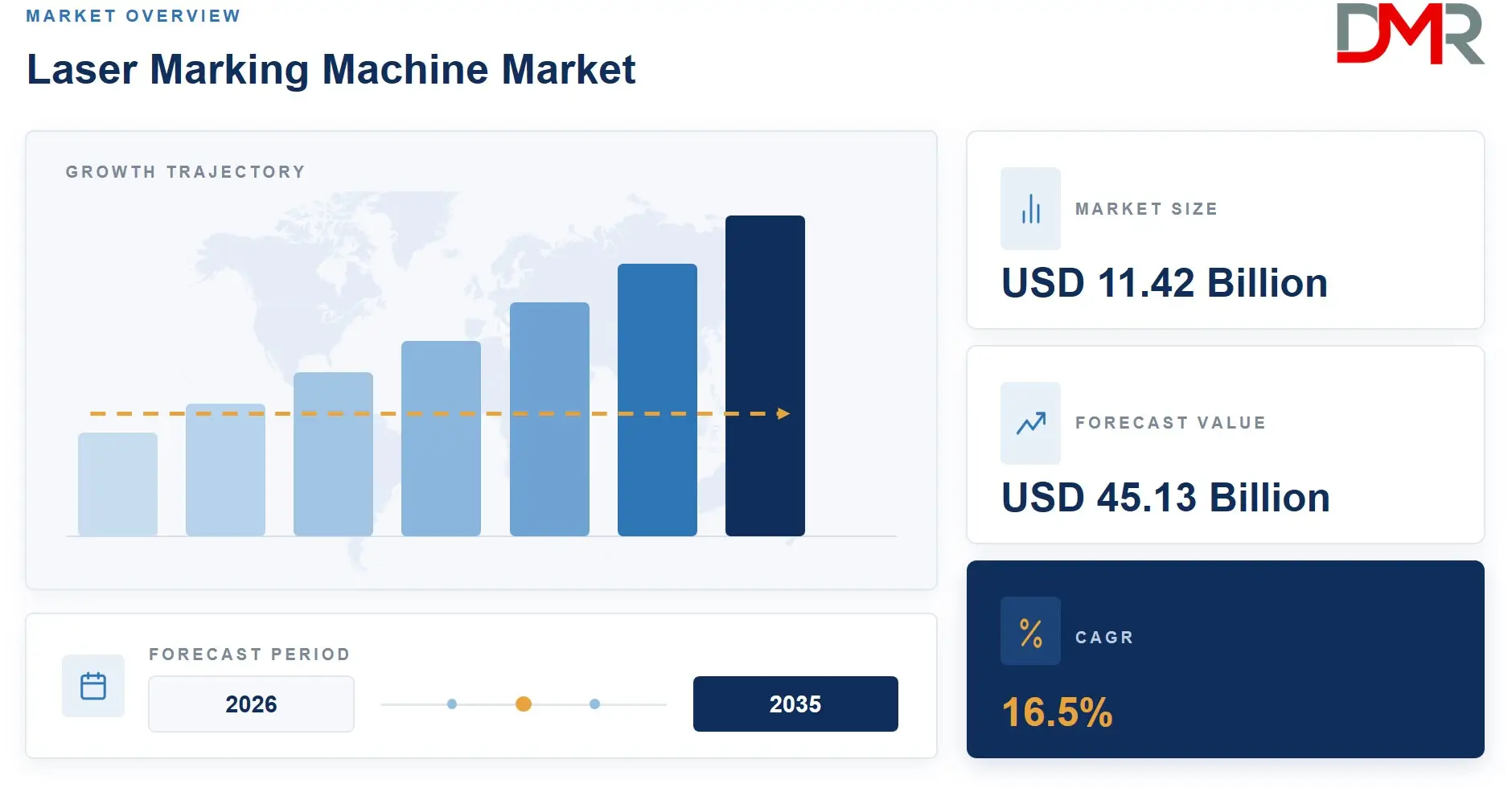
ℹ
To learn more about this report –
Download Your Free Sample Report Here
Key Takeaways
- The market size is USD 11.42 Billion in 2026, and is projected to hit USD 45.13 Billion by 2035 at a CAGR of 16.5%.
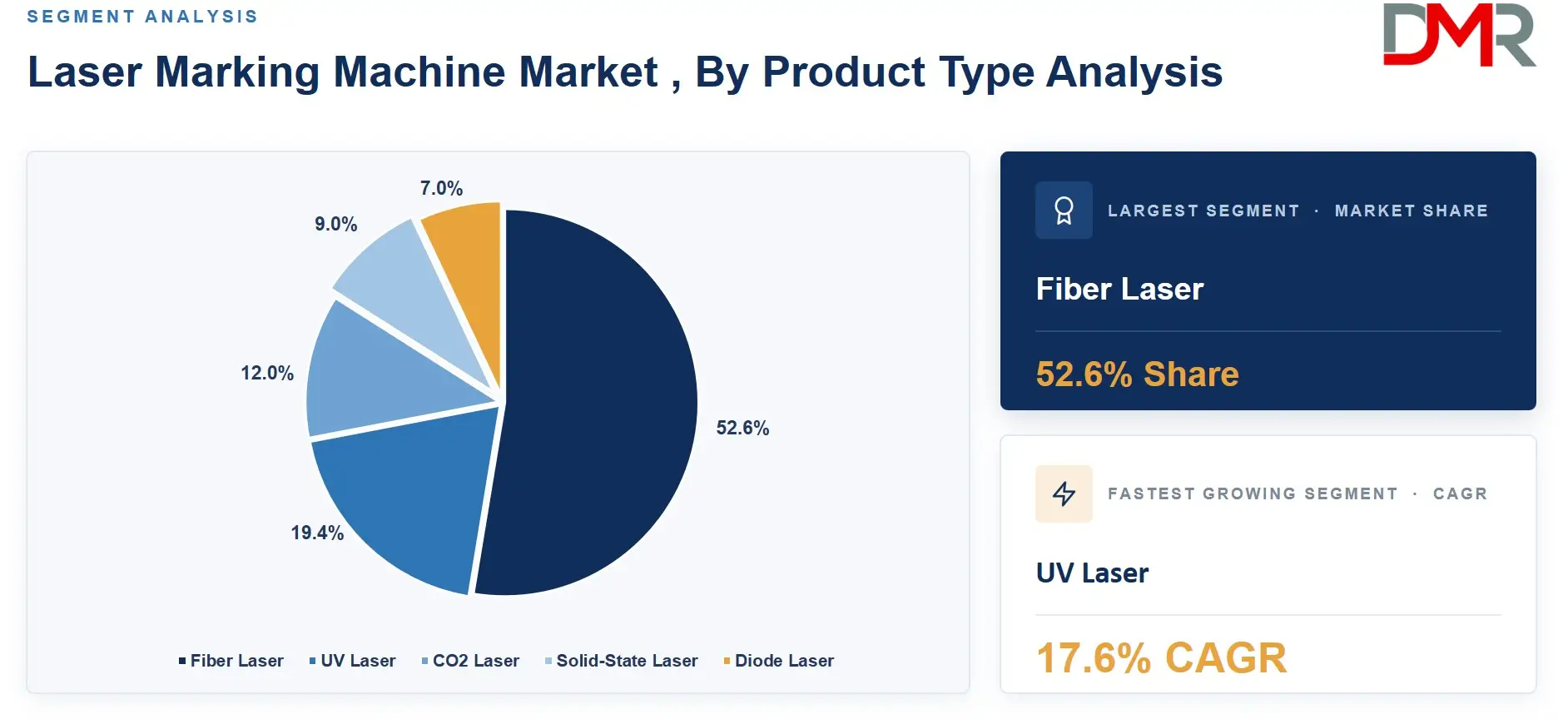
- By Product Type: Fiber Laser led with a 52.6% share in 2026.
- By Mobility Type: Fixed Laser Marking Machines led with a 70.8% share in 2026.
- By Material Type: Metal led with a 66.9% share in 2026.
- By Marking Process: Engraving led with a 40.5% share in 2026.
- By End Use: General Industries led with a 36.8% share in 2026.
- By Region: Asia Pacific led with a 67.6% share, valued at USD 6.5 Billion, in 2026.
- Top 5 key players: Coherent Corp., IPG Photonics Corporation, KEYENCE Corporation, Han's Laser Technology Industry Group Co., Ltd., and TRUMPF SE + Co. KG.
Product Type Analysis
Fiber Laser accounted for 52.6% of Product Type demand in 2026, the highest of any category.
Fiber lasers dominate because solid-state architecture eliminates consumable costs that burden CO₂ and UV alternatives. Videojet's 2025 selection guide confirms typical industrial power requirements of 20–50W for surface marking metals and above 50W for deeper or very-high-speed fiber applications, with CO₂ systems requiring 10–60W and UV systems operating at 2–10W. Buyers running high-volume metal marking lines favor fiber precisely because power density, running costs, and mark permanence align better than any competing wavelength for ferrous and non-ferrous substrates.
UV Laser is the fastest-growing sub-segment, driven by substrate expansion into clear polymers, glass, and heat-sensitive electronic components where fiber wavelengths cause thermal damage. Trotec's October 2025 SpeedMarker achieves galvo marking speeds of up to 12 m/s on principal fiber-laser configurations, while CO₂ versions of the SpeedMarker 50 reach maximum marking speeds of 13.4 m/s at 45W and 38.5 m/s at 60W or 120W. Speed advantages of CO₂ on non-metallic substrates keep that category relevant even as UV adoption expands. Diode and Solid-State lasers occupy niche positions in cost-sensitive or low-throughput applications, while CNC Machines integration is pushing Solid-State configurations into precision micro-marking on ceramic and semiconductor substrates.
ℹ
To learn more about this report –
Download Your Free Sample Report Here
Mobility Type Analysis
With a 70.8% share in 2026, Fixed Laser Marking Machines outpaced all other Mobility Type categories.
Fixed systems dominate because inline integration with automated production conveyors, robotic cells, and vision inspection stations delivers throughput levels that portable units cannot match. High-volume automotive, semiconductor, and pharmaceutical lines specify fixed configurations as standard OEM equipment, locking in recurring replacement and upgrade revenue for vendors.
Portable Laser Marking Machines serve field maintenance, large-part marking, and geographically distributed manufacturing applications. A 2025 copper marking study recorded RMS error of only 0.60%–1.35% when determining marking contrast, demonstrating that portable configurations can now meet precision thresholds that previously required fixed benchtop setups. Growth in the portable segment is fastest among aerospace MRO operators and shipbuilders who cannot bring components to a fixed station.
Material Type Analysis
Metal captured 66.9% of the Material Type segment in 2026, ahead of all rivals.
Metal's dominance reflects the concentration of laser marking demand in automotive traceability, aerospace part identification, and industrial tooling. VIN marking, part serialization, and date coding on steel, aluminum, and titanium components are regulatory requirements in most major markets, making metal the anchor substrate category for every major laser marking vendor.
Plastics rank second, driven by pharmaceutical packaging and consumer electronics enclosures. Glass, Ceramics, and Wood collectively address specialty applications in laboratory equipment, architectural components, and premium consumer goods. Energy and battery manufacturing is pulling ceramics and specialized polymer substrates into faster procurement cycles as EV cell production scales globally. Industrial Robotics integration is accelerating multi-material inline marking workflows where a single robotic cell handles metal, plastic, and ceramic components sequentially.
Marking Process Analysis
Engraving led the Marking Process segment with a 40.5% share in 2026.
Engraving produces recessed, tamper-resistant marks that survive surface treatments, chemical exposure, and high-cycle abrasion. Automotive and aerospace buyers specify engraving for part identification precisely because paint, anodizing, and plating applied after marking cannot obliterate the code. Depth of mark is the technical attribute driving OEM specification preference over annealing or etching alternatives.
Annealing is gaining share in stainless steel medical device marking because the process produces permanent marks without material removal, preserving corrosion resistance required by ISO 13485 compliance programs. Ablation addresses coating removal on painted or powder-coated surfaces. Etching serves high-contrast decorative and industrial identification needs. Carbonisation and Colour Change captures the wood, leather, and premium consumer goods personalization segment, where aesthetic quality of the mark matters as much as permanence.
End Use Analysis
General Industries led the End Use segment with a 36.8% share in 2026.
General Industries captures the broadest base of demand across metal fabrication, industrial tooling, fluid handling, and general manufacturing. Buyers in this category prioritize versatility, uptime, and total cost of ownership over application-specific precision. Vendors serving General Industries compete primarily on machine reliability, service network density, and software integration with existing ERP and MES platforms.
Energy and Battery Manufacturing is the fastest-growing end-use category. EV cell traceability mandates and battery pack serialization requirements are driving first-wave capital equipment procurement across China, Germany, and North America. Electronics and Semiconductors demand sub-millimeter precision that contact-based alternatives cannot deliver. Automotive and Aerospace require permanent, machine-readable codes across regulated supply chains. Healthcare's UDI compliance programs are creating multi-year procurement cycles in emerging markets. Packaging, Jewellery, and Personalised Products round out demand across FMCG, luxury, and DTC personalization channels.
Key Market Segments
By Product Type
- Fiber Laser
- UV Laser
- Diode Laser
- Solid-State Laser
- CO2 Laser
By Mobility Type
- Fixed Laser Marking Machines
- Portable Laser Marking Machines
By Material Type
- Metal
- Plastics
- Glass
- Ceramics
- Wood
- Other Materials
By Marking Process
- Engraving
- Annealing
- Ablation
- Etching
- Carbonisation and Colour Change
By End Use
- General Industries
- Energy and Battery Manufacturing
- Automotive
- Electronics and Semiconductors
- Aerospace
- Packaging
- Healthcare
- Jewellery and Personalised Products
Regional Analysis
Asia Pacific led the Laser Marking Machine Market with a 67.6% share, valued at USD 6.5 Billion, in 2026.
Asia Pacific
China anchors Asia Pacific's dominance through the world's largest concentration of electronics, EV battery, and automotive component manufacturers. Government-mandated traceability programs in pharmaceutical and food processing sectors added a regulatory layer that accelerated capital equipment replacement cycles from 2023 onward. Japan and South Korea contribute precision semiconductor and display panel marking demand that consistently specifies the highest-accuracy fiber and UV laser configurations available.
TRUMPF inaugurated its first specialized manufacturing facility in Pune, India, in August 2025, localizing assembly and supply of industrial laser marking and material processing systems. India's expanding electronics manufacturing base and pharmaceutical export obligations are converting the country from a minor importer to an active capital equipment buyer within the region.
North America
North America is the fastest-growing regional market. Reshoring of semiconductor fabrication, EV battery gigafactories, and pharmaceutical manufacturing is driving a capital equipment supercycle that specifically benefits laser marking vendors with established North American service networks. FDA serialization enforcement and Department of Defense part-marking specifications create baseline demand floors that protect against cyclical slowdowns in any single end-use vertical.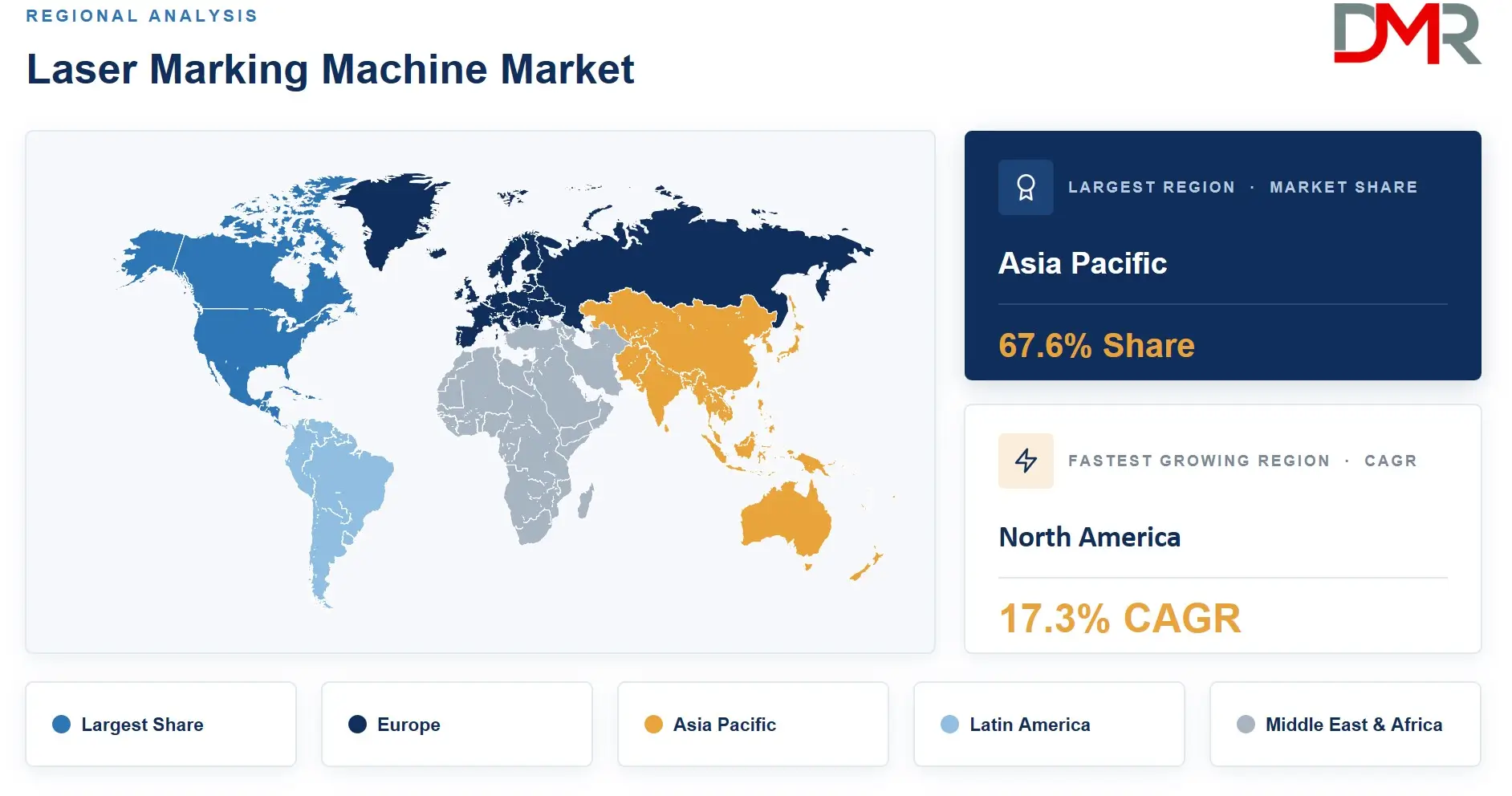
ℹ
To learn more about this report –
Download Your Free Sample Report Here
Europe
Europe's demand base centers on automotive OEM traceability requirements in Germany, precision medical device manufacturing in Switzerland and Germany, and pharmaceutical serialization compliance across the EU's Falsified Medicines Directive. TRUMPF's German engineering heritage gives it structural advantage in European OEM specifications. Patent litigation between IPG Photonics and TRUMPF, resolved in May 2026, removes a source of commercial uncertainty that had slowed some European buyers from committing to multi-site laser integration contracts.
Latin America
Brazil and Mexico lead Latin American demand, driven by automotive assembly exports and pharmaceutical manufacturing. Local content regulations in Brazil's automotive sector push Tier-1 suppliers to adopt OEM-specified traceability systems, including laser marking. Adoption remains price-sensitive, favoring entry-level fiber and CO₂ systems over high-power configurations.
Middle East and Africa
GCC countries are investing in manufacturing diversification as part of national industrial strategy programs. Petrochemical equipment marking and aerospace MRO represent the primary demand verticals. Adoption timelines remain longer than in Asia Pacific or North America, constrained by smaller domestic manufacturing bases and limited local service infrastructure for advanced laser systems.
Key Regions and Countries
North America
Europe
- Germany
- France
- The UK
- Spain
- Italy
- Rest of Europe
Asia Pacific
- China
- Japan
- South Korea
- India
- Australia
- Rest of APAC
Latin America
- Brazil
- Mexico
- Rest of Latin America
Middle East & Africa
- GCC
- South Africa
- Rest of MEA
Macroeconomic Impact
Industrial capital equipment procurement tracks closely with manufacturing PMI trends across Asia Pacific, North America, and Europe. Monetary tightening cycles from 2022 through 2024 extended payback period calculations for cost-constrained buyers, but easing inflation across the US and EU in 2025 and 2026 restored capital budget confidence among mid-tier manufacturers who had deferred laser system upgrades. Videojet's 2025 technical guide estimates that a 50W fiber laser draws approximately 500W while active, consuming roughly 4 kWh per day at 8-hour operation. Energy cost sensitivity is highest in Europe, where industrial electricity prices remain elevated relative to Asia Pacific and North America, giving fiber laser's energy efficiency a direct procurement justification in German and Italian manufacturing environments.
Market Dynamics
Driver: Regulatory Traceability Mandates Accelerating Permanent Mark Adoption
Pharmaceutical serialization requirements across the EU, US FDA, and emerging-market health ministries mandate machine-readable, permanent codes on primary and secondary drug packaging. Laser marking is the only technology that meets permanence, speed, and substrate compatibility requirements simultaneously across high-speed blister, bottle, and carton lines. Automotive OEMs extend the same logic to VIN, part, and date code marking across Tier-1 supply chains, where OEM-specified laser integration is a contract condition rather than an optional upgrade.
Operational efficiency gains compound the regulatory driver. Domino's Dx-Series CO₂ laser-marking platform increases coding speed by up to 30% compared with the preceding D-Series benchmark. Videojet reported in June 2025 that its laser-controller tools reduce production changeover time by up to 50% in some applications. Trotec's 2025 SpeedMarker supports working areas up to 1,300 × 450 mm, software-controlled focus shifting of ±50 mm, and distortion-corrected marking on tilted surfaces up to 60°, enabling a single system to handle part geometries that previously required multiple machine configurations. Han's Laser introduced next-generation intelligent fiber laser marking systems in February 2026, embedding AI-based quality inspection directly into the marking nodes for electronics sector buyers.
Restraint: Capital Cost and Safety Certification Barriers Slowing SME Adoption
High-power laser systems carry capital costs that push ROI payback periods beyond the planning horizons of small manufacturers. Class 4 laser safety classification requirements mandate enclosures, interlocks, and operator certification programs that inflate total project deployment costs well beyond the machine price. A mid-tier fabricator evaluating its first laser system faces a total deployment cost that can be two to three times the equipment invoice before the first production mark is made.
Laser safety compliance varies by jurisdiction, adding compliance design costs for vendors supplying across North America, the EU, and Asia Pacific simultaneously. Buyers in cost-sensitive segments, including small-batch general manufacturing and contract electronics assembly, frequently extend evaluation timelines by 12 to 18 months precisely because safety infrastructure investment is a one-time sunk cost with no direct revenue return.
Opportunity: Emerging-Market UDI Compliance and Additive Manufacturing Integration
Medical device UDI compliance programs in Southeast Asia, Latin America, and the Middle East are creating first-wave capital procurement cycles among hospital equipment manufacturers and surgical instrument producers who have never previously purchased laser marking systems. MKS's April 2025 Talon Mark UV15 and UV20 lasers deliver average powers above 15W and 20W respectively, with pulse energy up to 400 µJ, engineered for 24/7 operation at the precision levels UDI programs require. The 2025 NEXGEN MOPA laser marker specifies a pulse-repetition rate of up to 4,000 kHz and scan speeds of up to 6,000 mm/s, targeting the high-throughput traceability workflows that medical and electronics manufacturers demand in high-compliance environments.
Additive manufacturing post-processing creates a parallel opportunity. Metal 3D-printed parts require permanent identification before post-build heat treatment, creating a natural inline integration point for laser marking systems within AM workflow cells. Food and beverage direct-on-product laser coding eliminates label application costs and adhesive waste in FMCG lines, a procurement argument that resonates with sustainability-focused CPG buyers under EU packaging regulation pressure.
Porter's Five Forces
Competitive rivalry in the laser marking machine market is high among established vendors, with Coherent, IPG Photonics, KEYENCE, TRUMPF, and Han's Laser collectively holding the largest technology and distribution footprints while dozens of regional manufacturers in China and Europe compete aggressively on price in mid-range configurations. Barriers to entry are moderate: photonics engineering expertise, supply chain access to laser source components, and safety certification create meaningful hurdles, but Chinese OEM manufacturers have steadily reduced those barriers over the past decade by vertically integrating laser source production. Supplier bargaining power is concentrated among a small number of laser source component manufacturers, particularly for high-power diode pump modules and precision optical components, giving tier-one suppliers meaningful pricing leverage over system assemblers who source externally. Buyer bargaining power has increased as the installed base has matured and switching costs have declined for standard-power configurations. A February 2025 peer-reviewed study of laser marking on nonferrous-metal casting ingots reported average accuracy of 98.24% and an F1 value of 96.42, illustrating that competing systems now deliver near-identical marking quality at similar price points, which shifts buyer decisions toward software integration, service terms, and total lifecycle cost rather than raw marking performance. The threat of substitutes from inkjet, thermal transfer, and mechanical stamping remains real only in low-cost, low-regulation applications, as laser's permanence advantage eliminates substitution risk wherever regulatory compliance is a requirement.
AI and Gen AI Impact
Artificial intelligence is reshaping the laser marking machine market most visibly at the quality verification layer. Post-mark vision inspection, historically a separate capital line item, is integrating into mid-range laser marking workstations as a standard feature. A 2025 peer-reviewed study of silicon-wafer laser marking inspection reported 97.0% defect-detection accuracy and 91.6% accuracy in identifying the underlying error cause. The same study trained its machine-learning model using only 10 photographs per defect type and classified defects linked to 4 causes: unstable power, a dirty laser head, platform shaking, and voltage fluctuation. The implication for buyers is that AI inspection modules trained on small datasets can now achieve production-grade accuracy, reducing the cost barrier to deploying automated quality assurance alongside marking.
Cloud-connected laser marking systems enable centralized code management, audit trails, and remote diagnostics across multi-site networks. Early adopters in pharmaceutical and automotive manufacturing have reduced unplanned downtime by connecting marking system telemetry to predictive maintenance platforms. Vendors that lag in AI integration risk losing specification preference to rivals who offer post-mark quality data as a built-in feature rather than a separately priced option. Automated Test Equipment architectures used in electronics manufacturing are increasingly serving as the integration backbone for AI-enhanced laser marking cells.
Market Trends
Speed, Connectivity, and Substrate Versatility Redefining Platform Value
EZCAD's 2025 flying laser marking systems support scanning speeds of up to 15,000 mm/s and conveyor production speeds from 0 to 189 m/min, setting a new throughput benchmark that pressures all mid-range platform vendors to upgrade galvo and controller architecture. Green and UV laser wavelength adoption is expanding substrate compatibility into clear polymers, glass, and sensitive electronic components that fiber wavelengths cannot mark without thermal damage. Cloud connectivity and Textile Machinery-style centralized production management frameworks are converging in laser marking, as multi-site manufacturers demand unified code version control and remote audit trail access across geographically dispersed production lines.
Market Competition Overview
The laser marking machine market is moderately consolidated at the top and fragmented in mid-range and entry-level tiers. Five vendors, Coherent Corp., IPG Photonics, KEYENCE, TRUMPF, and Han's Laser, hold the strongest global positions through a combination of proprietary laser source technology, broad product portfolios, and established service networks in Asia Pacific, Europe, and North America. Lotus Laser's 2026 Meta-C system specifies an MTBF of 100,000 hours and a service life exceeding 15 years, reflecting an industry-wide shift toward reliability differentiation as a competitive tool when raw marking performance converges across brands. Coherent Corp. secured a $2 billion strategic investment through a multiyear partnership with NVIDIA in March 2026, signaling that photonics and AI compute integration will become a primary competitive battleground in the next product generation cycle.
Chinese vendors, led by Han's Laser and Huagong Tech, are capturing share in Asia Pacific and emerging markets by combining competitive pricing with vertically integrated laser source production. Mid-tier European and North American vendors are responding by differentiating on software capability, compliance documentation, and post-sale service depth rather than competing on price.
Pricing Analysis
Laser marking system pricing spans from entry-level benchtop fiber units at a few thousand USD to high-power automated inline systems exceeding USD 100,000 for fully integrated configurations with vision, robotics, and software. Videojet's 2025 guide confirms that a small CO₂ laser costs approximately 3–4 times as much initially as a high-end continuous-inkjet system, but manufacturers recover the premium in under 2–3 years after accounting for consumable, maintenance, downtime, and productivity savings. Fiber laser's pricing advantage over CO₂ in metal marking applications reflects both lower component costs and longer service life: Videojet's June 2025 data places fiber-laser source MTBF at approximately 100,000 operating hours compared with around 50,000 hours for CO₂ RF tubes before recharge or refill is required.
UV laser system pricing commands a premium over fiber across all power classes because of the complexity of frequency-tripling optics and the shorter operational life of UV optical components. Regional pricing differences are most pronounced in Asia Pacific, where Chinese domestic manufacturers offer fiber marking systems at 30 to 50 percent below European and North American vendor prices for equivalent power ratings, compressing margins across the mid-range segment globally.
Company Profiles
Coherent Corp. operates across laser source manufacturing, system integration, and photonics materials, giving it a vertical integration advantage that pure system assemblers cannot replicate. The company's March 2026 $2 billion NVIDIA partnership positions it to embed AI compute directly into laser system architectures, targeting semiconductor, display, and advanced manufacturing customers who require post-mark quality verification as a native platform feature rather than a third-party add-on. Lotus Laser's 2026 Meta-C 3D system, representative of the high-precision tier Coherent competes against, specifies 1 µm marking accuracy, ±0.02 mm Z-axis accuracy, and positioning speed of 10,000 mm/s, setting the benchmark that Coherent's own product lines must meet or exceed to retain specification preference among advanced manufacturing buyers.
IPG Photonics Corporation built its market position on proprietary high-power fiber laser source technology that it supplies to both its own marking systems and third-party OEM integrators. The May 2026 global patent settlement with TRUMPF resolves multi-jurisdiction litigation over high-power laser source architectures, removing a legal overhang that had introduced procurement uncertainty for buyers specifying IPG-based systems in automated assembly configurations. The Meta-C rotary option's angular indexing accuracy of better than 1/120 of a degree illustrates the precision benchmark IPG's fiber sources must support as cylindrical and multi-face marking applications grow in medical device and aerospace part identification.
Key Players
- Coherent Corp.
- IPG Photonics Corporation
- KEYENCE Corporation
- Han's Laser Technology Industry Group Co., Ltd.
- TRUMPF SE + Co. KG
- Huagong Tech Company Limited
- Videojet Technologies Inc.
- Novanta Inc.
- Gravotech Marking SAS
- Trotec Laser GmbH
- FOBA Laser Marking + Engraving
- Epilog Laser
- Telesis Technologies, Inc.
- MECCO
- Laserax Inc.
- LaserStar Technologies Corporation
- Hitachi Industrial Equipment Systems Co., Ltd.
- Cajo Technologies Oy
- Macsa ID, S.A.
- TYKMA Electrox, Inc.
Supply Chain and Value Chain Analysis
The laser marking machine value chain opens at the photonics component tier, where laser source manufacturers produce diode pump modules, gain fibers, and optical resonator assemblies that system integrators and OEM machine builders buy as subsystems. Lens arrays, galvanometer scanners, and beam delivery optics represent the highest-value intermediate layer, with a small number of German and Japanese optical manufacturers supplying the majority of precision components used by system builders globally. Final machine assembly, software integration, and safety enclosure fabrication occur at the OEM level, where branded system vendors add the greatest margin. Rotary Die Cutting Machine manufacturers and other industrial equipment makers increasingly co-locate with laser marking system vendors inside integrated production cell partnerships, shortening the channel between machine builder and end-user installation. After-sales service, consumable optics, and software licensing represent recurring revenue streams that generate higher lifetime margins than the initial capital equipment sale for established vendors with large installed bases.
Regulatory Landscape
Laser safety classification under IEC 60825-1 and its regional equivalents governs product design requirements for every laser marking system sold globally. Class 1 enclosed systems, which confine all laser radiation internally, face the lowest buyer compliance burden and command a procurement preference in open-floor manufacturing environments. EU Machinery Directive and CE marking requirements apply to all laser systems sold in European markets, while FDA CDRH 21 CFR 1040 regulates laser product performance standards in the United States. Pharmaceutical serialization mandates under the EU Falsified Medicines Directive, US DSCSA, and equivalent frameworks in India, Brazil, and China create a regulatory floor for permanent, machine-readable coding that directly specifies laser marking as the preferred technology. Medical device UDI programs under FDA 21 CFR Part 830 and EU MDR Article 27 are expanding the compliance buyer base into surgical instruments, implantable devices, and diagnostic equipment manufacturers who did not previously require traceability marking systems.
Investment and White Space Analysis
Investment flow is concentrated in three areas: AI-integrated quality inspection software, high-power UV laser platforms for electronics and semiconductor substrates, and compact benchtop systems targeting the jewellery, luxury goods, and DTC personalization segment. Energy and Battery Manufacturing represents the largest underserved white space. EV cell production is scaling at gigafactory pace across China, Europe, and North America, but laser marking vendor capacity to supply fully integrated, high-throughput battery cell identification systems with inline vision verification is still building. First movers with proven battery marking references will capture multi-year exclusive supply agreements before the segment consolidates. Emerging markets in Southeast Asia, India, and the Middle East offer high-growth entry points where UDI compliance programs and pharmaceutical serialization mandates are creating first-wave procurement cycles with limited competition from established global vendors who have not yet built local service infrastructure.
Recent Developments
- March 2025: Matthews Marking Systems launched a new line of Fiber, Fiber Film, and UV laser marking systems optimized for high-speed precision tracing in automotive and electronics packaging industries.
- June 2025: Laser Photonics Corporation announced a definitive agreement to acquire the operational assets of Beamer Laser Marking Systems, a producer of industrial fiber and CO2 equipment.
- September 2025: Laser Photonics Corporation closed the acquisition of Beamer Laser Marking Systems, integrating Beamer's manufacturing machinery, software intellectual property, and active customer contracts into its Florida facility.
- May 2026: IPG Photonics entered a binding global settlement agreement with TRUMPF, resolving multi-jurisdiction patent litigation regarding high-power laser sources and hardware architectures deployed in automated assembly configurations.
- September 2026: Laser Photonics Corporation unveiled the Beamer B-Series FB23 laser marking system, deploying a 20-watt fiber laser with machine vision and autofocus for high-volume manufacturing environments.
Report Scope
| Report Characteristics |
| Market Value (2026) |
USD 11.42 Billion |
| Forecast Revenue (2035) |
USD 45.13 Billion |
| CAGR (2026 to 2035) |
16.5% |
| Base Year for Estimation |
2025 |
| Historic Period |
2020 to 2024 |
| Forecast Period |
2026 to 2035 |
| Report Coverage |
Revenue Forecast, Market Dynamics, Competitive Landscape, Recent Developments |
| Segments Covered |
By Product Type (Fiber Laser, UV Laser, Diode Laser, Solid-State Laser, CO2 Laser), By Mobility Type (Fixed Laser Marking Machines, Portable Laser Marking Machines), By Material Type (Metal, Plastics, Glass, Ceramics, Wood, Other Materials), By Marking Process (Engraving, Annealing, Ablation, Etching, Carbonisation and Colour Change), By End Use (General Industries, Energy and Battery Manufacturing, Automotive, Electronics and Semiconductors, Aerospace, Packaging, Healthcare, Jewellery and Personalised Products) |
| Regional Analysis |
North America (US and Canada), Europe (Germany, France, The UK, Spain, Italy, and Rest of Europe), Asia Pacific (China, Japan, South Korea, India, Australia, and Rest of APAC), Latin America (Brazil, Mexico, and Rest of Latin America), Middle East & Africa (GCC, South Africa, and Rest of MEA) |
| Competitive Landscape |
Coherent Corp., IPG Photonics Corporation, KEYENCE Corporation, Han's Laser Technology Industry Group Co., Ltd., TRUMPF SE + Co. KG, Huagong Tech Company Limited, Videojet Technologies Inc., Novanta Inc., Gravotech Marking SAS, Trotec Laser GmbH, FOBA Laser Marking + Engraving, Epilog Laser, Telesis Technologies Inc., MECCO, Laserax Inc., LaserStar Technologies Corporation, Hitachi Industrial Equipment Systems Co. Ltd., Cajo Technologies Oy, Macsa ID S.A., TYKMA Electrox Inc. |
| Customization Scope |
Customization for segments and region or country level will be provided. Additional customization can be done based on requirements. |
| Purchase Options |
Three license options: Single User License, Multi-User License (Up to 5 Users), Corporate Use License (Unlimited Users and Printable PDF) |
Frequently Asked Questions
What is the biggest investment opportunity in the Laser Marking Machine market?
▾ Energy and Battery Manufacturing represents the clearest near-term investment opportunity. EV cell traceability requirements are generating first-wave capital procurement cycles across China, Europe, and North America, and vendors with proven battery marking references will capture multi-year supply agreements before the segment consolidates.
Who are the top companies in the Laser Marking Machine market?
▾ The top five companies are Coherent Corp., IPG Photonics Corporation, KEYENCE Corporation, Han's Laser Technology Industry Group Co., Ltd., and TRUMPF SE + Co. KG. Each holds a global position built on proprietary laser source technology, broad product portfolios, and service networks across Asia Pacific, Europe, and North America.
Which segment is growing fastest in the Laser Marking Machine marketand why?
▾ UV Laser is the fastest-growing product type because it expands substrate compatibility into clear polymers, glass, and heat-sensitive electronic components that fiber wavelengths cannot mark without thermal damage. Energy and Battery Manufacturing is the fastest-growing end-use category, driven by EV cell serialization mandates across the three largest manufacturing economies.
Which region is growing fastestin the Laser Marking Machine market and why?
▾ North America is the fastest-growing region, driven by reshoring of semiconductor fabrication, EV battery gigafactories, and pharmaceutical manufacturing. FDA serialization enforcement and Department of Defense part-marking specifications create baseline demand floors that protect against cyclical slowdowns in any single vertical.
What is the biggest challenge holding in the Laser Marking Machine market back?
▾ High capital expenditure combined with laser safety certification requirements is the primary restraint. Small manufacturers face total deployment costs two to three times the equipment invoice when safety enclosures, interlocks, and operator certification programs are included, extending ROI payback periods beyond standard capital planning horizons.