Latin America Mobile Payment Market Snapshot
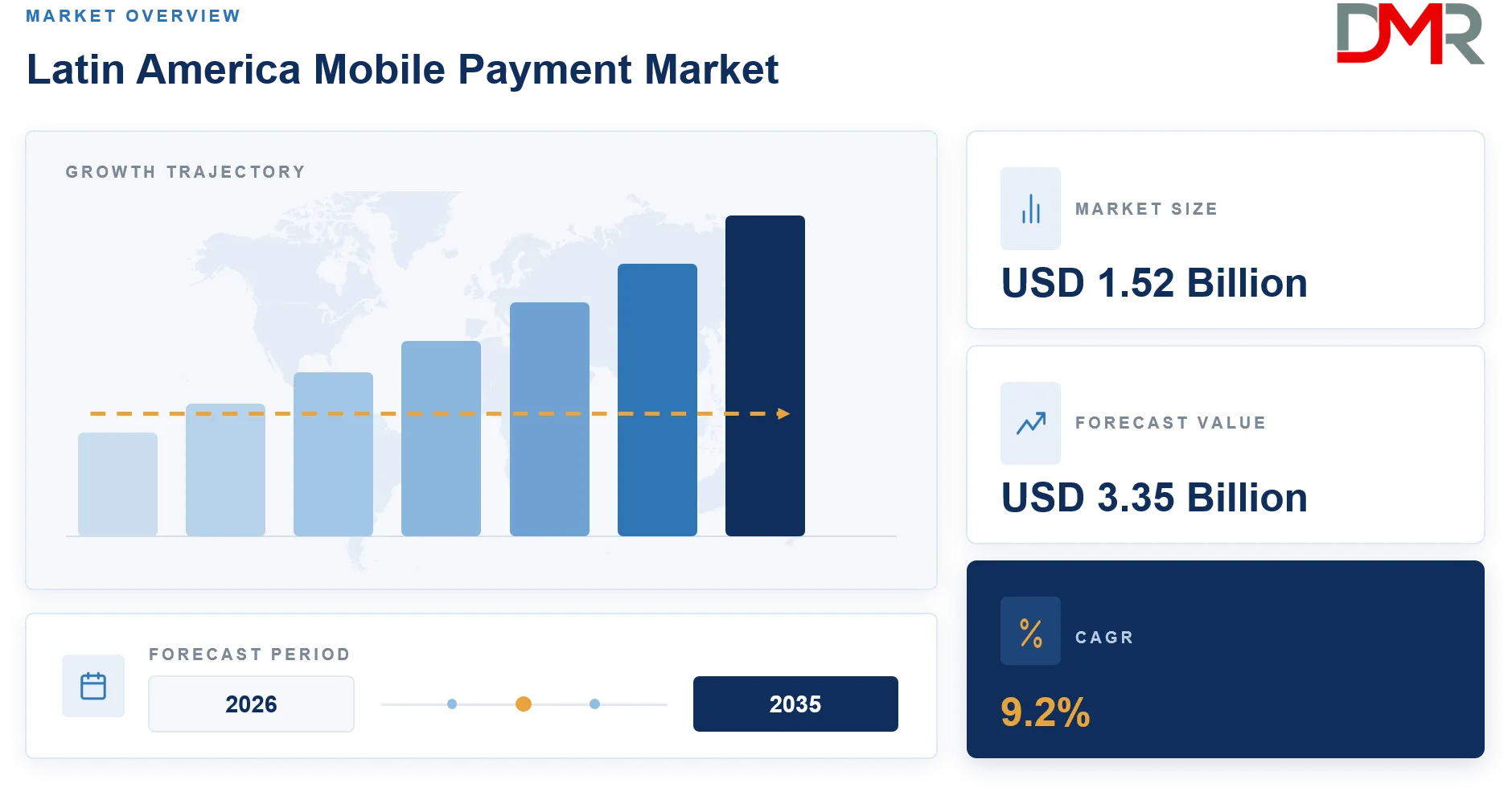
- Market Value: Latin America mobile payment market is estimated at USD 76.8 billion in 2026 and is projected to reach USD 218.6 billion by 2035.
- CAGR: Latin America mobile payment market is expected to expand at a CAGR of 12.34% during 2027 to 2035.
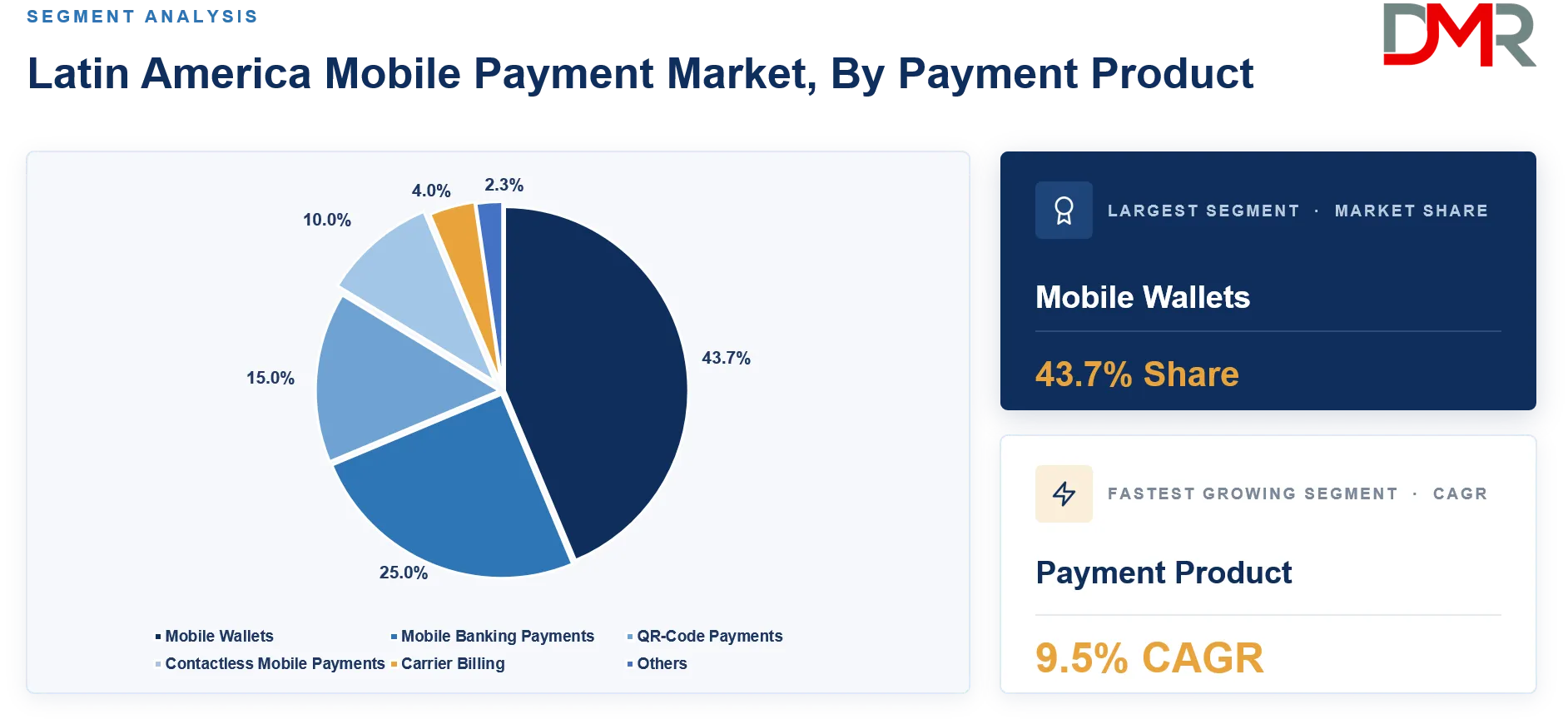
- By Payment Product Segment Analysis: Mobile wallets dominated the Latin America mobile payment market with a 43.7% share in 2026.
- By Transaction Type Segment Analysis: Person-to-person payments led transaction types with a 27.9% share in 2026.
- By User Type Segment Analysis: Consumers held the largest share among user types, accounting for 63.8% in 2026.
- Regional Analysis: Brazil led the Latin America mobile payment market with a 38.6% revenue share in 2026.
- Major Players: Mercado Pago, Nu Holdings, PagBank, PicPay, and PayPal.
What is the Latin America Mobile Payment Market and its Market Size?
The Latin America Mobile Payment Market size is estimated at USD 76.8 billion in 2026 and is projected to reach USD 218.6 billion by 2035, expanding at a CAGR of 12.34% during 2027 to 2035. Mobile payments include transactions initiated or completed through smartphones, banking applications, mobile wallets, QR codes, NFC-enabled devices, carrier billing, and other mobile interfaces. These solutions support person-to-person transfers, retail purchases, online commerce, utility and government payments, mobility services, and business transactions.
ℹ
To learn more about this report –
Download Your Free Sample Report Here
The Latin America mobile payment market is moving from isolated digital-wallet ecosystems toward connected real-time payment infrastructure. Brazil's Pix has made instant account-to-account payments part of daily commerce, while Mexico's SPEI and CoDi support rapid transfers and QR or NFC-based transactions. Colombia's Bre-B started full operations in October 2025 and passed 34 million registered users and more than 670 million transactions during its first six months. Across Latin America and the Caribbean, more than 15 jurisdictions have adopted fast-payment systems, expanding the addressable market for banks, fintech companies, merchants, and payment technology providers.
Use Cases
- Person-to-Person Transfers: Mobile applications let users send money instantly through account aliases, phone numbers, QR codes, or registered payment keys. Services built around Pix, SPEI, and Bre-B are reducing dependence on cash transfers while supporting household payments, family transfers, bill splitting, and payments to independent service providers.
- Retail and Merchant Payments: Merchants can accept smartphone-based payments through QR codes, NFC, digital wallets, or bank applications. These channels are increasingly relevant for supermarkets, restaurants, pharmacies, convenience stores, informal merchants, and small businesses seeking faster settlement and lower reliance on traditional point-of-sale equipment.
- Online Commerce: Mobile wallets and account-to-account payment options reduce checkout friction in e-commerce by allowing buyers to approve purchases directly in a familiar application. Pix has become an important online payment option in Brazil, while Mercado Pago links digital checkout, wallet services, merchant acquiring, and marketplace transactions across several Latin American markets.
- Bill and Recurring Payments: Mobile payment infrastructure supports utilities, education, subscriptions, telecommunications, taxes, and recurring services. Brazil's Pix Automático extends instant-payment infrastructure into scheduled recurring payments, creating an alternative to traditional bank debit arrangements and enabling businesses to collect repeated payments through digital channels.
- Transport and Mobility: Mobile payments are increasingly applied to ride-hailing, parking, tolls, public transport, delivery services, and mobility platforms. Wallet integration and QR-based transactions allow customers to pay without cash while giving mobility operators access to faster settlement, transaction records, loyalty programs, and integrated digital services.
How AI/Gen AI is Transforming the Latin America Mobile Payment Market?
Artificial intelligence is reshaping mobile payment operations through fraud detection, identity verification, transaction monitoring, credit assessment, customer authentication, and merchant risk management. Banks and fintech companies can analyze device information, transaction history, behavioral patterns, location signals, and account activity to identify unusual transfers before losses occur. This capability has become more important as instant payments shorten the period available for manual fraud review. Intelligent risk models can also reduce unnecessary payment declines by distinguishing legitimate customer behavior from suspicious patterns, improving both security and transaction completion rates.
Generative AI is expanding into customer service, merchant onboarding, payment troubleshooting, compliance operations, and financial education. Digital banks and wallet providers can use conversational interfaces to explain transaction failures, guide users through account recovery, summarize payment activity, and assist merchants with service configuration. Financial institutions are also applying automated tools to review alerts, classify support requests, and improve internal productivity. Market adoption will depend on strong controls around personal data, model governance, cybersecurity, consent, and regulatory compliance because payment applications manage sensitive identity and financial information.
Key Drivers in the Latin America Mobile Payment Market
Rapid Expansion of Instant Payment Infrastructure
Central-bank-backed instant payment systems are a major factor supporting Latin America mobile payment market growth. Brazil's Pix allows funds to move between accounts within seconds at any time, while Mexico's SPEI supports near-instant electronic transfers through banks and mobile banking. Colombia's Bre-B introduced interoperable transfers across participating financial institutions in 2025. Wider interoperability reduces transfer friction and gives banks, fintech companies, merchants, and consumers a common digital payment foundation, increasing transaction frequency and mobile payment demand.
Growing Shift from Cash to Mobile-First Transactions
Consumers are increasingly using smartphones for routine payments rather than treating them only as banking-access devices. Brazil shows the scale of this change: Pix reached nearly 170 million users by late 2025, while transaction activity rose to tens of billions of payments annually. QR acceptance and mobile banking are also extending digital payments to merchants that may not require conventional card terminals. The combination of smartphone access, digital accounts, fintech competition, and real-time transfers is creating a larger base of frequent mobile payment users across the region.
Restraints in the Latin America Mobile Payment Market
Fraud, Cybersecurity, and Account Takeover Risks
Instant settlement can increase exposure to social engineering, stolen credentials, fraudulent QR codes, account takeover, device compromise, and unauthorized transfers. Once funds move in real time, recovery can be more difficult than with payment methods that allow longer review periods. Providers therefore need stronger authentication, behavioral monitoring, transaction limits, device intelligence, customer education, and dispute procedures. These controls raise operating costs and can create friction if security measures are not designed carefully around the user experience.
Regulatory and Infrastructure Fragmentation
Latin America remains a collection of distinct payment markets rather than one unified regulatory environment. Licensing rules, wallet regulation, open-finance frameworks, data protection requirements, merchant acquiring structures, settlement systems, and customer identification standards vary between Brazil, Mexico, Colombia, Argentina, Chile, and other countries. Companies expanding across borders must integrate separate payment rails and compliance processes. This fragmentation can slow product launches, increase technical costs, and limit the immediate scalability of a single regional mobile payment model.
Growth Opportunities in the Latin America Mobile Payment Market
Expansion into Small-Business and Merchant Services
Small and medium-sized businesses offer a significant growth opportunity as mobile payments evolve beyond basic consumer transfers. QR acceptance, payment links, wallet checkout, instant settlement, and mobile point-of-sale services can help smaller merchants digitize collections without complex infrastructure. Payment companies can then add working-capital credit, invoicing, inventory tools, loyalty services, analytics, and digital banking products. This creates recurring revenue opportunities and strengthens provider relationships with merchants beyond the initial payment transaction.
Cross-Border and Regional Payment Interoperability
Cross-border mobile payments represent an emerging opportunity for tourism, e-commerce, remittances, marketplaces, and regional business transactions. Mercado Pago has already enabled Brazilian travelers to use Pix at participating merchants in Argentina, demonstrating how domestic instant-payment systems can connect with foreign merchant acceptance. Future interoperability between regional payment platforms could lower transaction costs, simplify currency conversion, reduce dependence on cash, and create new services for businesses operating across multiple Latin American economies.
Trends in the Latin America Mobile Payment Market
Account-to-Account Payments are Expanding into Retail Commerce
Instant payments are moving beyond person-to-person transfers and becoming direct competitors to cards for merchant transactions. In Brazil, Pix represented nearly half of non-cash payment transactions by the final quarter of 2024, while consumer-to-business activity has continued to expand. Features such as recurring Pix payments strengthen its use for utilities, subscriptions, education, and digital services. This shift encourages merchants and payment companies to integrate account-to-account options alongside cards and wallets rather than treating them as separate transfer products.
QR and Contactless Payment Experiences are Converging
QR codes remain important because merchants can display or generate them with limited hardware investment, while NFC is becoming more relevant for consumers who expect tap-based checkout. Mexico's CoDi supports both QR and NFC technologies, and Brazilian financial institutions have introduced new ways to initiate Pix through mobile devices. As acceptance technology improves, the distinction between mobile wallet, bank application, instant payment, QR payment, and contactless payment is becoming less visible to users. Providers are increasingly competing on speed, simplicity, acceptance coverage, rewards, and security.
Research Scope and Analysis
The Latin America Mobile Payment Market is segmented based on Payment Product, Transaction Type, User Type, and country-level markets. The study provides an in-depth analysis of key segments and sub-segments, covering their applications, industry adoption, demand patterns, payment behavior, technology development, and contribution to overall market growth.
By Payment Product
Mobile wallets dominated the Payment Product segment with a 43.7% share in 2026. Their leading position reflects the ability to combine payment authorization, stored credentials, QR functionality, transfers, transaction history, loyalty services, and financial products within a single mobile interface. Platforms such as Mercado Pago and PicPay have helped make app-based payments familiar to consumers and merchants, while digital banks increasingly incorporate wallet-like functionality directly into banking applications. The segment is also benefiting from greater interoperability with instant-payment rails. Future competition is expected to focus on merchant acceptance, checkout integration, security, rewards, credit, and cross-border usability rather than basic transfer functionality alone.
ℹ
To learn more about this report –
Download Your Free Sample Report Here
By Transaction Type
Person-to-person payments led the Transaction Type segment with a 27.9% share in 2026. P2P transfers are a high-frequency entry point for digital payment adoption because consumers regularly use them to send money to relatives, divide expenses, pay service providers, and transfer funds between individuals. Instant-payment networks such as Pix, SPEI, and Bre-B strengthen this segment by removing banking-hour limitations and shortening settlement times. As users become comfortable with real-time transfers, providers can extend the same payment credentials into retail purchases, online commerce, bill payments, subscriptions, and merchant transactions, expanding the lifetime value of digitally active customers.
By User Type
Consumers accounted for 63.8% of the Latin America mobile payment market in 2026, making them the largest user group. Consumer demand is supported by the convenience of instant transfers, mobile banking, digital wallets, QR payments, bill settlement, and online checkout from a single device. Frequent consumer use also encourages merchants to support additional mobile payment methods, creating a network effect between user adoption and acceptance. Over the forecast period, consumer growth will increasingly be influenced by interoperable instant payments, recurring-payment functionality, contactless experiences, stronger fraud controls, and the integration of mobile payments with credit, savings, shopping, and mobility applications.
The Latin America Mobile Payment Market Report is segmented on the basis of the following:
By Payment Product
- Mobile Wallets
- Mobile Banking Payments
- QR-Code Payments
- Contactless Mobile Payments
- Carrier Billing
- Other Mobile Payments
By Transaction Type
- Person-to-Person Payments
- Retail Payments
- Bill Payments and Government Payments
- Transport and Mobility Payments
- Online Commerce Payments
- Other Transactions
By User Type
- Consumers
- Small and Medium-Sized Businesses
- Large Enterprises
- Government and Public-Sector Users
Countries Analysis
Brazil is the Leading Country in the Latin America Mobile Payment Market
Brazil led the Latin America mobile payment market with a 38.6% revenue share in 2026. Its position is strongly supported by Pix, which has become core national payment infrastructure since its 2020 launch. Pix reached nearly 170 million users by late 2025, while 2025 transaction volume approached 80 billion transactions. Banks, fintech companies, digital wallets, merchants, and e-commerce platforms have integrated the system widely. Recurring payments and other Pix services are extending usage from P2P transfers into subscriptions, retail commerce, business collections, and broader financial services.
Colombia is an Emerging High-Growth Market in the Latin America Mobile Payment Industry
Colombia is entering a new phase of mobile payment growth following the full-scale launch of Bre-B in October 2025. The interoperable instant-payment system surpassed 34 million registered users and recorded more than 670 million transactions within its first six months. Bre-B connects participating financial institutions through common aliases and standards, allowing users to make real-time transfers through existing banking and financial applications. The infrastructure provides a stronger foundation for merchant payments, digital wallets, financial inclusion, fintech competition, and mobile-first payment services.
Mexico Latin America Mobile Payment Market
Mexico's mobile payment market is supported by Banco de México's SPEI infrastructure, which enables electronic transfers within seconds through banks, internet banking, and mobile applications. CoDi extends SPEI into merchant payments through QR codes and NFC, giving businesses and consumers an alternative way to complete cashless transactions. Mexico's large consumer economy, expanding fintech sector, e-commerce activity, and digital banking adoption create significant long-term potential. Growth depends on increasing merchant usage, improving consumer awareness, expanding account access, and making mobile payment experiences as simple as cash or card transactions.
By Country
- Brazil
- Mexico
- Argentina
- Colombia
- Chile
- Peru
- Rest of Latin America
Competitive Landscape
The Latin America mobile payment market is highly competitive because digital wallets, banks, fintech companies, merchant acquirers, card networks, and instant-payment infrastructure increasingly overlap. Mercado Pago benefits from its connection with Mercado Libre and combines digital wallet services, online checkout, QR payments, merchant acquiring, lending, and other financial products across multiple Latin American countries.
Some of the prominent players in the Latin America mobile payment industry are:
- Mercado Pago
- Nu Holdings Ltd.
- PagBank
- PicPay
- PayPal Holdings, Inc.
- Visa Inc.
- Mastercard Incorporated
- StoneCo Ltd.
- EBANX
- dLocal
- Clip
- Ualá
- Nequi
- Daviplata
- Others
Regulatory Landscape
The Latin America mobile payment market operates under country-specific rules that increasingly support instant payments, interoperability, competition, consumer protection, and financial inclusion. In Brazil, the Central Bank regulates payment institutions and oversees Pix, while Open Finance rules enable authorized sharing of financial data and payment initiation. Mexico regulates fintech activities under its Fintech Law, while Banco de México operates SPEI and supports CoDi for QR and NFC-based payments. Colombia strengthened its payment infrastructure with Bre-B, an interoperable instant-payment system operated by Banco de la República, which entered full operation in October 2025. Data privacy is another major compliance area, led by Brazil's LGPD and comparable personal-data frameworks across the region. Mobile payment providers must therefore manage licensing, KYC, anti-money laundering controls, cybersecurity, fraud prevention, data processing, and transaction monitoring. Regulatory modernization is improving market access, but differences between national frameworks continue to raise compliance costs for companies pursuing regional expansion.
Investment and White Space Analysis
Investment opportunities in the Latin America mobile payment market are shifting from basic wallet adoption toward infrastructure and services built around high-frequency digital transactions. With the market projected to rise from USD 76.8 billion in 2026 to USD 218.6 billion by 2035, opportunities are emerging in SME merchant acceptance, account-to-account payments, fraud prevention, payment orchestration, recurring payments, embedded finance, cross-border transactions, and digital identity. Brazil provides a mature base for services built on Pix, while Mexico and Colombia offer white space as interoperable payment infrastructure expands and more merchants move from cash to digital acceptance. Underserved small businesses represent a particularly attractive segment for QR payments, payment links, mobile point-of-sale tools, instant settlement, working-capital products, and integrated business software. Cross-border interoperability is another underdeveloped area, creating room for platforms that can connect local payment rails, simplify currency conversion, reduce transaction friction, and serve regional e-commerce, tourism, marketplaces, exporters, and remittance users.
Recent Developments
- August 2026: Danone S.A. completed its Argentine joint venture with Arcor, combining Danone Argentina, Mastellone Hermanos and their logistics arm to expand dairy innovation, operational scale and commercial reach.
- January 2026: Waitrose & Partners announced its first South West distribution centre in Avonmouth, Bristol. The DHL-operated, 360,000-square-foot facility is expected to create more than 550 jobs and support future store growth.
- December 2025: Alnatura Produktions- nd Handels GmbH reported 6.6% fiscal-year sales growth to €1.274 billion and announced a 30,000-square-metre logistics centre plus eight planned new stores.
Report Details
| Report Characteristics |
| Market Size (2026) |
USD 76.8 Bn |
| Forecast Value (2035) |
USD 218.6 Bn |
| CAGR (2026–2035) |
12.34% |
| Historical Data |
2021 – 2025 |
| Forecast Data |
2027 – 2035 |
| Base Year |
2025 |
| Estimate Year |
2026 |
| Segments Covered |
By Payment Product (Mobile Wallets, Mobile Banking Payments, QR-Code Payments, Contactless Mobile Payments, Carrier Billing, and Other Mobile Payments), By Transaction Type (Person-to-Person Payments, Retail Payments, Bill Payments and Government Payments, Transport and Mobility Payments, Online Commerce Payments, and Other Transactions), and By User Type (Consumers, Small and Medium-Sized Businesses, Large Enterprises, and Government and Public-Sector Users) |
| Regional Coverage |
Latin America |
Frequently Asked Questions
What is the current size of the Latin America Mobile Payment Market?
▾ The Latin America Mobile Payment Market is valued at USD 76.8 billion in 2026 and forecast to reach USD 218.6 billion by 2035.
What is the growth rate of the Latin America Mobile Payment Market during?
▾ The Latin America Mobile Payment Market is expected to grow at a CAGR of 12.34% during the forecast period 2027-2035.
Which Country dominates the Latin America Mobile Payment Market?
▾ Brazil leads the Latin America Mobile Payment Market with a 38.6% revenue share in 2026, supported by widespread Pix adoption.
What factors are driving the growth of the Latin America Mobile Payment Market?
▾ Instant payment networks, mobile wallets, QR payments, smartphone adoption, and digital banking drive Latin America Mobile Payment Market growth.
What are the major challenges restraining the Latin America Mobile Payment Market?
▾ Payment fraud, cybersecurity risks, regulatory fragmentation, and uneven digital infrastructure restrain Latin America Mobile Payment Market growth.
Which segment holds the largest share of the Latin America Mobile Payment Market?
▾ Mobile wallets hold the largest Latin America Mobile Payment Market share at 43.7% in 2026, supported by convenient app-based transactions.
Who are the leading companies in the Latin America Mobile Payment Market?
▾ Mercado Pago, Nu Holdings, PagBank, PicPay, PayPal, Visa, Mastercard, StoneCo, EBANX, dLocal, Clip, Ualá, Nequi, and Daviplata are prominent companies in the Latin America Mobile Payment Market.
How is AI influencing the Latin America Mobile Payment Market?
▾ AI supports the Latin America Mobile Payment Market through real-time fraud detection, identity verification, risk scoring, and automated customer service.
What are the future opportunities and trends in the Latin America Mobile Payment Market?
▾ Cross-border payments, QR acceptance, instant transfers, embedded finance, and SME digitization create Latin America Mobile Payment Market opportunities.