Market Snapshot
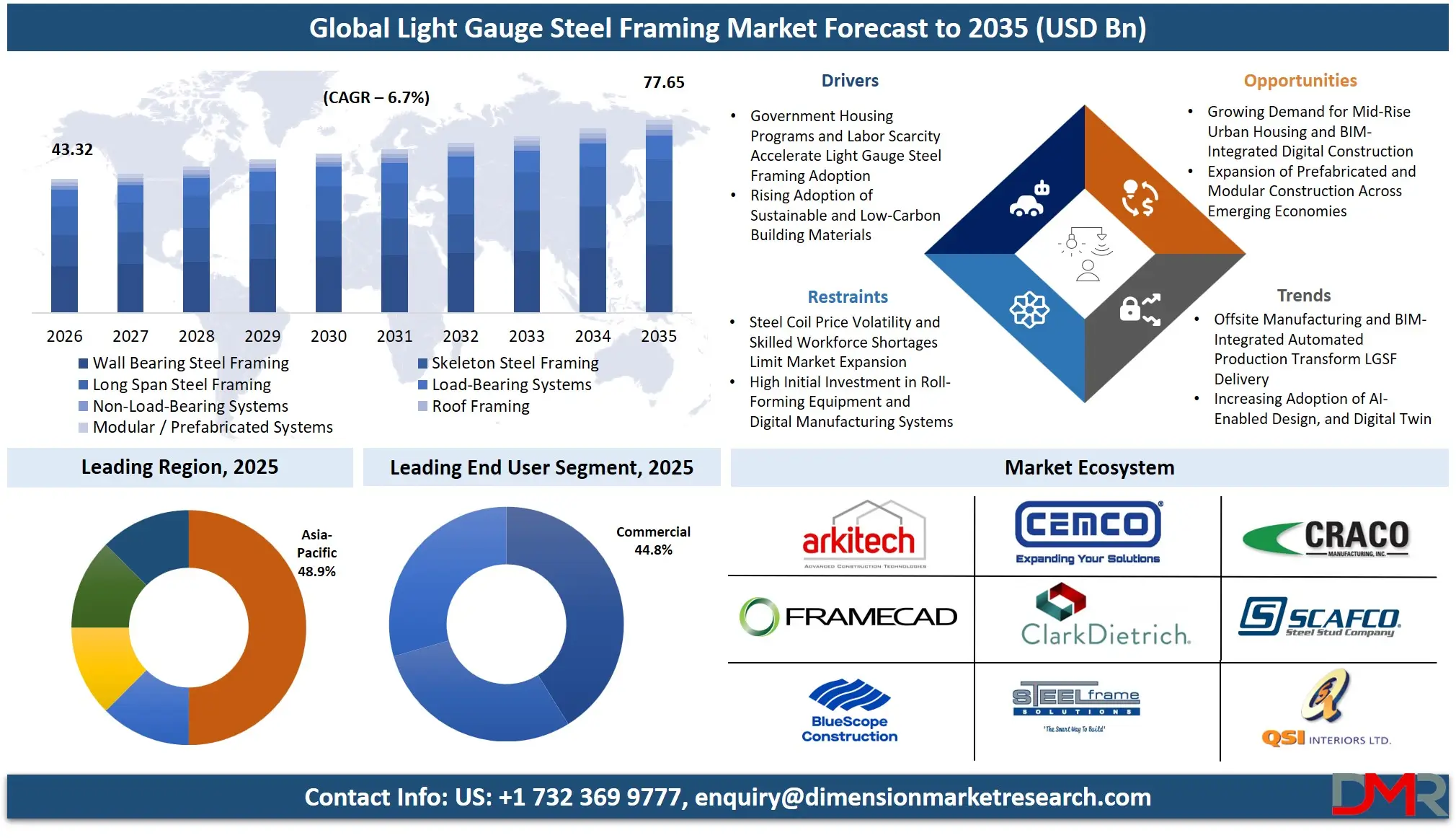
- The market size is USD 40.6 Billion in 2025, reached USD 43.32 Billion in 2026, and is projected to hit USD 77.65 Billion by 2035 at a CAGR of 6.7%.
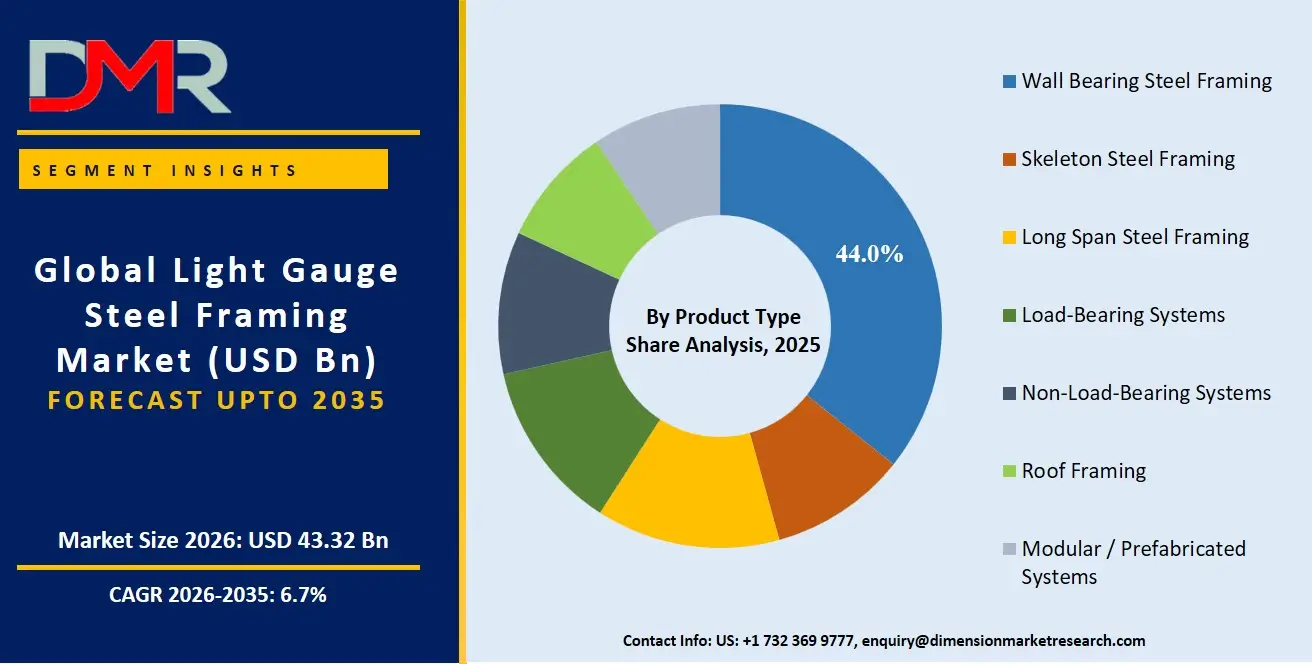
- By Product Type: Wall Bearing Steel Framing led with a 44.0% share in 2025.
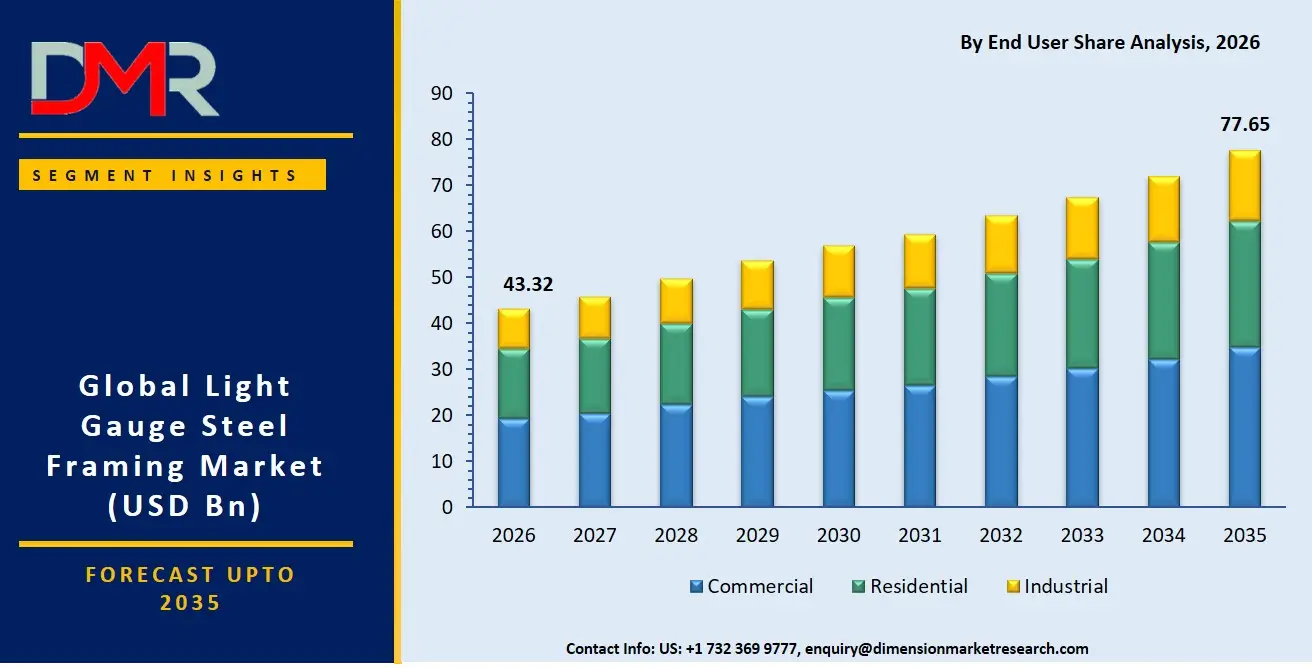
- By End User: Commercial led with a 44.8% share in 2025.
- By Application: Housing (Apartments, Villas) led with a 42.0% share in 2025.
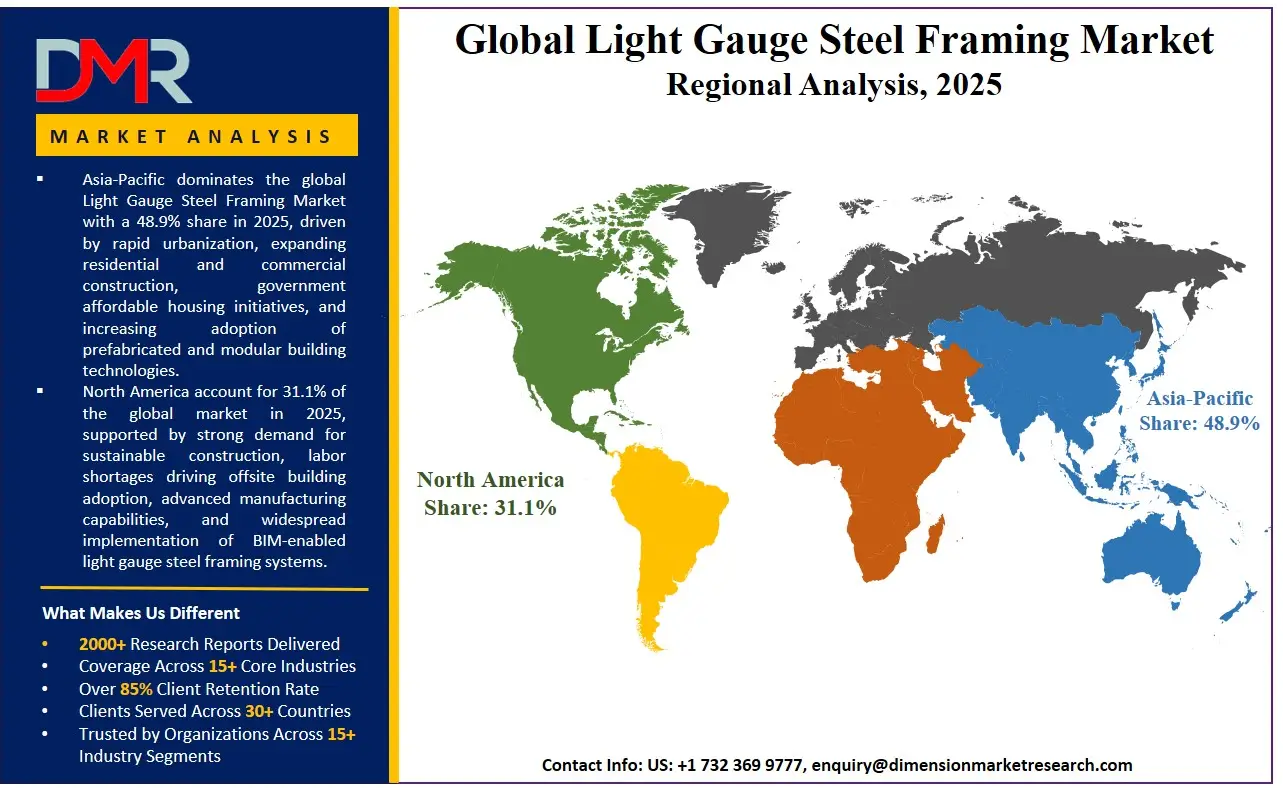
- By Region: Asia Pacific led with a 48.9% share in 2025.
- Key players include Arkitech Advanced Construction Technologies, Bluescope Steel Limited, FRAMECAD Ltd., Clarkwestern Dietrich Building Systems LLC, and six additional competitors.
Market Overview
The Light Gauge Steel Framing market covers the design, manufacture, and installation of cold-formed steel structural and non-structural components used in residential, commercial, institutional, and industrial buildings. Wall stud systems, roof trusses, floor joists, load-bearing partitions, and prefabricated panel assemblies all fall within scope. Concrete, timber, and masonry framing sit outside this market, though LGSF often competes directly against these materials at the specification stage.
ℹ
To learn more about this report –
Download Your Free Sample Report Here
The broader construction materials sector has long been dominated by timber and concrete, but tightening fire codes, green-building certification requirements, and labor shortages are shifting contractor preference toward cold-formed steel. LGSF connects directly to the modular and offsite construction industry, which provides a high-growth demand channel as developers seek faster project timelines and more predictable costs. The steel value chain upstream, covering galvanized coil producers and roll-forming equipment manufacturers, is a direct cost-transmission point that shapes contractor margins and end-market pricing.
In April 2025, Marino\WARE published third-party verified Environmental Product Declarations for its low embodied carbon cold-formed steel framing products. That move signals a broader industry shift toward verified sustainability credentials, as green building rating systems increasingly require documented embodied carbon data at the product level. Buyers evaluating LGSF against timber or concrete now have quantified environmental comparisons available, which accelerates specification decisions in sustainability-mandated projects.
Market Size and Forecast
The Global Light Gauge Steel Framing Market size is estimated at USD 43.32 Billion in 2026 from USD 40.6 Billion in 2025, and is projected to reach USD 77.65 Billion by 2035, exhibiting a CAGR of 6.7% during the forecast period.
Growth through the forecast base reflects a sustained conversion cycle from traditional framing materials to cold-formed steel in both established and emerging construction markets. Government-backed affordable housing programs in South and Southeast Asia added large volumes of residential units requiring fast, code-compliant framing solutions. Urbanization rates in China and India pulled forward demand that earlier forecasts had spread across a longer timeline.
A 2025 Modular Building Institute report on a semi-automated digital LGSF workflow found a payback period of 10 months and 26 days, confirming that the economics of factory-integrated LGSF production are now within reach for mid-size fabricators. That short payback window is accelerating capital investment in automated framing production, which expands supply capacity and makes LGSF price-competitive against timber at larger project scales. The downside scenario centers on galvanized steel coil price spikes, which can compress fabricator margins and delay project starts even when end-market demand stays firm.
Product Type Analysis
Wall Bearing Steel Framing accounted for 44.0% of product type demand in 2025, the highest of any category.
Wall Bearing Steel Framing dominates because it addresses the broadest set of building applications, from low-rise residential to multi-storey commercial construction. Structural walls that carry vertical loads cannot easily substitute alternative framing systems at equivalent cost without compromising code compliance, which locks in specification rates across a wide project base. Commercial developers and general contractors standardize on Wall Bearing systems because supplier familiarity and installer availability are highest in this sub-segment.
ℹ
To learn more about this report –
Download Your Free Sample Report Here
Skeleton Steel Framing serves high-rise and long-span applications where architectural flexibility matters more than unit cost. Long Span Steel Framing captures industrial and warehouse projects, where clear-span requirements make it the only viable cold-formed steel option. Load-Bearing Systems and Non-Load-Bearing Systems each serve distinct specification roles inside the same building, meaning contractors often buy from both sub-segments on a single project. Modular and Prefabricated Systems represent the fastest-growing product category as offsite construction adoption widens and as fabricators invest in panelization capability to reduce on-site labor exposure. Roof Framing rounds out the portfolio, with growth tied directly to residential housing program volumes in Asia Pacific and Latin America.
End User Analysis
With a 44.8% share in 2025, Commercial outpaced all other end user categories.
Commercial construction activity drives the largest single share because office, retail, and hospitality projects combine high floor-to-floor heights, demanding acoustic and fire performance, and tight project schedules. All three requirements favor cold-formed steel over timber. Developers in urban markets prioritize schedule certainty, and LGSF's off-site fabrication compatibility reduces weather-related delays that erode timber-frame project timelines.
ℹ
To learn more about this report –
Download Your Free Sample Report Here
Residential end users form the second-largest segment and will narrow the gap with Commercial over the forecast period as affordable housing programs in Asia Pacific and the Middle East scale up. Industrial buyers specify LGSF primarily for mezzanine systems, interior partition upgrades, and modular site facilities rather than primary structural framing, keeping their share relatively contained. The shift worth watching is the conversion of Institutional projects, including healthcare and education facilities, which were historically concrete-dominant but are now drawing LGSF specifications as renovation cycles accelerate and fire-code compliance requirements tighten.
Application Analysis
Housing (Apartments, Villas) captured 42.0% of the Application segment in 2025, ahead of all rivals.
Residential housing commands the dominant application share because apartment and villa construction volumes are inherently large and recurring. In high-density urban markets across Asia Pacific and the Middle East, apartment towers account for the majority of LGSF consumption. Affordable housing mandates in India, Indonesia, and Saudi Arabia are funneling substantial public and private capital into residential builds that specifically require fast-erecting, cost-controlled framing solutions.
Commercial Buildings form the second-largest application, with specification driven by the same fire and acoustic performance requirements that lift the Commercial end user segment. Healthcare and Hospitality applications are gaining traction because both building types require low-disruption interior fit-outs during phased renovations, a condition where non-load-bearing LGSF partitioning outperforms alternatives. Retail and Malls applications are growing modestly as new retail formats favor flexible interior layouts that cold-formed steel partition systems enable. Industrial Facilities and the Others category, covering modular cabins, temporary structures, and storage units, provide counter-cyclical volume when core construction markets soften.
Key Market Segments
By Product Type
- Wall Bearing Steel Framing
- Skeleton Steel Framing
- Long Span Steel Framing
- Load-Bearing Systems
- Non-Load-Bearing Systems
- Roof Framing
- Modular / Prefabricated Systems
By End User
- Commercial
- Residential
- Industrial
By Application
- Housing (Apartments, Villas)
- Commercial Buildings
- Institutional
- Healthcare
- Retail & Malls
- Hospitality
- Industrial Facilities
- Others (Modular cabins, Temporary structures, Storage units)
Regional Analysis
Asia Pacific led the regional segment with a 48.9% share in 2025, valued at USD 19.85 Billion.
ℹ
To learn more about this report –
Download Your Free Sample Report Here
Asia Pacific's position at nearly half the global market reflects a construction volume base that no other region matches. China's urban expansion programs and India's Pradhan Mantri Awas Yojana housing scheme both generate sustained demand for fast-erecting residential framing systems. Government procurement in both countries explicitly favors factory-manufactured building components, which positions LGSF fabricators with panelization capability to win large public sector contracts ahead of traditional masonry suppliers.
North America holds the second-largest share, supported by decades of established cold-formed steel framing practice in commercial interior construction and a growing retrofit market driven by seismic and fire code upgrades. Europe follows with a strong focus on sustainable construction, where LGSF's recyclability and low waste profile align with mandatory embodied carbon reporting frameworks now active in France, the Netherlands, and the UK. Latin America and the Middle East and Africa represent the fastest-growing regions, where disaster-resilient housing programs and hospitality infrastructure investment create new demand that domestic LGSF supply chains are not yet fully equipped to serve, opening entry points for international fabricators and technology licensors.
Key Regions and Countries
North America
Europe
- Germany
- France
- The UK
- Spain
- Italy
- Rest of Europe
Asia Pacific
- China
- Japan
- South Korea
- India
- Australia
- Rest of APAC
Latin America
- Brazil
- Mexico
- Rest of Latin America
Middle East & Africa
- GCC
- South Africa
- Rest of MEA
Market Dynamics
Driver: Government Housing Programs and Labor Scarcity Compress Timelines
Affordable housing programs in India, Southeast Asia, and the Middle East are generating construction volumes that site-built masonry or timber framing cannot fulfill within government-mandated timelines. A 2025 FRAMECAD case study reports that projects previously taking 6–7 months with concrete and brick were completed with LGSF in 60 days. Speed alone is a procurement criterion, not merely a cost consideration, when housing ministries face electoral deadlines tied to unit delivery targets.
Construction labor shortages in North America, Australia, and the UK are amplifying the scheduling advantage. A 2026 Tesh Group project example found that an identical building phase reached top-out in 85 working days using light-gauge steel, compared with 156 days using wood, approximately a 45% reduction in framing duration. Contractors facing skilled-labor scarcity cannot add crew capacity to close timeline gaps with traditional methods, making factory-engineered LGSF systems a structural necessity rather than a preference. In March 2024, ClarkDietrich launched its Low Embodied Carbon cold-formed steel framing portfolio manufactured using electric arc furnace steel, directly linking LGSF procurement to green-building compliance requirements that code bodies in Europe and North America are tightening.
Restraint: Steel Coil Volatility and Skill Gaps Erode Contractor Confidence
Galvanized steel coil prices fluctuate with iron ore, energy, and zinc markets simultaneously. Fabricators operating fixed-price contracts absorb margin compression when coil costs spike mid-project, a risk that timber and concrete framing subcontractors do not face to the same degree. That asymmetric cost exposure discourages some commercial contractors from committing to LGSF on large, long-duration projects without steel price hedging instruments that most smaller fabricators cannot access.
A 2025 Modular Building Institute analysis of a semi-automated LGSF workflow found a 38% reduction in labor hours for faster tasks, but also confirmed that achieving those gains requires digitally literate fabrication teams. As reported by the Modular Building Institute, the skill gap between what automated roll-forming equipment demands and what the current installer base can deliver slows adoption even where the economics are favorable. Designers, fabricators, and erectors with cold-formed steel engineering credentials remain scarce in Latin America and South Asia, limiting the rate at which new regional markets can absorb LGSF technology.
Opportunity: Mid-Rise Urban Housing and Integrated Digital Workflows
Land-constrained urban markets in Southeast Asia and the Middle East need mid-rise multifamily structures that combine lightweight load-bearing frames with fast floor cycle times. Panelized cold-formed steel framing requires up to 40–60% fewer on-site framing labor hours than stick framing, per a 2026 AAC Steel budgeting case study. That labor efficiency translates directly into lower construction finance costs on projects where every week of schedule compression reduces interest carry on developer balance sheets.
Disaster-resilient reconstruction programs in Southeast Asia and Sub-Saharan Africa are specifying termite-resistant, moisture-stable, and fire-resistant framing as a baseline requirement, which excludes timber from consideration in most program-compliant builds. Integrated design-to-manufacture platforms that link BIM models directly to automated roll-forming equipment are creating a new competitive tier of LGSF suppliers who can deliver fully coordinated panelized assemblies from digital order to fabricated component without manual re-entry errors. Vendors who own both the software and the manufacturing workflow will capture margin at two points in the value chain rather than one.
Market Trends
Offsite Manufacturing and BIM Integration Redefine LGSF Delivery
Offsite panelized and volumetric modular construction is shifting LGSF production from uncontrolled job sites into climate-controlled factories. FRAMECAD reported in 2025 that digitally manufactured light-gauge-steel modules can be framed in hours rather than days, reducing time spent on the factory floor. In July 2024, FRAMECAD launched the F325iT roll-forming system, featuring integrated software and automated material handling, which allows fabricators to move from digital design file to finished panel without manual machine setup between runs. BIM-enabled cold-formed steel detailing is removing clash detection errors before steel is cut, while automated roll-forming equipment is expanding made-to-order production capacity for studs, tracks, joists, and trusses that previously required long lead times.
Market Competition Overview
The Light Gauge Steel Framing market is moderately fragmented, with a mix of global roll-forming technology providers, regional steel product manufacturers, and specialist framing system suppliers competing across overlapping segments. No single player commands a dominant global share, but technology-integrated suppliers who combine design software, manufacturing equipment, and framing system delivery are pulling ahead of pure product distributors. Competitive advantage in this market increasingly ties to digital integration capability rather than steel procurement scale alone.
Based on data from the Steel Framing Industry Association, U.S. cold-formed steel framing manufacturing volume grew 1.7% year over year in Q1 2025, a figure that understates competitive intensity because volume growth is concentrated among automated fabricators while manual fabricators are losing share. Suppliers with proprietary BIM-to-fabrication platforms are converting that technology advantage into longer customer relationships and recurring software revenue, creating a moat that commodity steel distributors cannot easily replicate. Consolidation activity, including acquisitions of regional fabricators, signals that larger players are using M&A to acquire geographic coverage rather than building new capacity organically.
Company Profiles
Clarkwestern Dietrich Building Systems LLC has built its competitive position through a combination of product breadth, geographic manufacturing density, and sustainability-linked product innovation. Operating across a wide network of U.S. manufacturing facilities, the company serves both structural and non-structural framing markets simultaneously, allowing it to supply entire building envelopes from a single vendor relationship. In October 2024, ClarkDietrich acquired Studs Unlimited, an Oklahoma-based cold-formed steel framing manufacturer, extending its Midwest fabrication footprint and reducing freight costs for contractors in the region. That acquisition pattern, adding regional production capacity through M&A rather than greenfield investment, allows the company to grow market coverage without the lead times of new facility builds.
FRAMECAD Ltd. competes on a fundamentally different model, positioning itself as a technology licensor and integrated system provider rather than a steel product manufacturer. The company's software, roll-forming equipment, and production management platforms allow customers to manufacture cold-formed steel framing in-country rather than importing finished product, which gives FRAMECAD access to markets where import tariffs or logistics costs would otherwise make LGSF uncompetitive. That licensing model generates recurring software and support revenue independent of steel price cycles, providing margin stability that pure fabricators lack.
Key Players
- Arkitech Advanced Construction Technologies
- Bluescope Steel Limited
- Cemco
- Clarkwestern Dietrich Building Systems LLC
- CRACO Manufacturing Inc.
- FRAMECAD Ltd.
- Genesis Manazil Steel Framing
- QSI Interiors Ltd.
- SCAFCO Steel Stud Company
- Steel Frame Solutions
Supply Chain and Value Chain Analysis
The LGSF value chain opens with hot-rolled steel coil production, where integrated mills reduce coil to specified gauges before galvanizing lines apply zinc coating for corrosion resistance. Galvanized coil then moves to roll-forming fabricators who produce studs, tracks, joists, and trusses either in standard lengths for distribution or as custom-cut panelized assemblies for direct project delivery. Value concentration sits at the roll-forming and panelization stage, where digital fabrication capability commands the highest margin and where errors are most costly to correct downstream.
Erectors and framing contractors form the final link before the end-use structure, and their skill level directly affects whether factory-engineered tolerances are maintained on site. The highest supply chain risk sits at the galvanized coil level, where price volatility and supply disruptions from major producing countries propagate directly into fabricator input costs. Fabricators with long-term coil supply agreements or steel mill partnerships carry a structural cost advantage over those buying on spot markets.
Regulatory Landscape
North American cold-formed steel framing is governed primarily by the American Iron and Steel Institute's S100 standard for cold-formed steel structural members, which defines minimum material, design, and connection requirements. The International Building Code references AISI S100 directly, meaning compliance is a baseline market entry requirement for structural LGSF products sold in the U.S. and Canada. Fire-resistance ratings tested under ASTM E119 are a separate mandatory credential for load-bearing assemblies used in commercial and multi-family construction, where building codes mandate specific hourly ratings.
European markets operate under EN 1993 Eurocode 3 for cold-formed steel design, with individual member states applying national annexes that modify specific parameters. The UK's Building Regulations Part B fire safety requirements and France's RE2020 embodied carbon framework both create product-level compliance obligations that favor suppliers with certified, documented framing systems over those offering uncertified components. Environmental Product Declarations are moving from voluntary credentials to specified requirements in public procurement across multiple European markets, rewarding suppliers who have invested in third-party verification.
Investment and White Space Analysis
Investment in the LGSF market is concentrating at two points: automated roll-forming and panelization equipment, and BIM-to-fabrication software platforms. Fabricators who have not yet integrated digital design workflows face a growing productivity gap relative to automated competitors, making capital equipment upgrades a near-term competitive necessity rather than a discretionary spend. The white space with the highest near-term return sits in mid-rise multifamily residential projects in India, Indonesia, Vietnam, and the GCC, where demand is proven but domestic LGSF supply capacity remains undersized relative to housing program targets.
Healthcare and education retrofit markets in North America and Europe are underserved because most LGSF suppliers focus on new construction rather than occupied-building partition and ceiling framing upgrades. Suppliers who develop low-disruption retrofit framing systems and the installation methodologies to match will access a recurring revenue stream that does not depend on new construction starts. Technology licensors with established platforms in Asia Pacific are best positioned to expand into Sub-Saharan Africa and Latin America, where local manufacturing capability needs to be built from the ground up rather than imported.
Recent Developments
- October 2024, FRAMECAD launched FRAMECAD Nexa, an end-to-end production management platform digitally connecting design, manufacturing, and factory operations for cold-formed steel framing producers.
- January 2025, Nucor Corporation announced a $200 million highly automated utility structures production facility in Brigham City, Utah, expanding its downstream Towers and Structures footprint to serve growing Western infrastructure demand. Groundbreaking followed in May 2025.
- March 2025, ClarkDietrich introduced the ProSTUD Motion Frame Connector at BUILD25, designed to reduce noise caused by structural movement in steel-framed high-rise buildings.
Report Details
| Report Characteristics |
| Market Value (2025) |
USD 40.6 Billion |
| Market Value (2026) |
USD 43.32 Billion |
| Forecast Revenue (2035) |
USD 77.65 Billion |
| CAGR (2026–2035) |
6.7% |
| Base Year for Estimation |
2025 |
| Historic Period |
2020 to 2024 |
| Forecast Period |
2026 to 2035 |
| Report Coverage |
Revenue Forecast, Market Dynamics, Competitive Landscape, Recent Developments |
| Segments Covered |
By Product Type (Wall Bearing Steel Framing, Skeleton Steel Framing, Long Span Steel Framing, Load-Bearing Systems, Non-Load-Bearing Systems, Roof Framing, Modular/Prefabricated Systems), By End User (Commercial, Residential, Industrial), By Application (Housing, Commercial Buildings, Institutional, Healthcare, Retail & Malls, Hospitality, Industrial Facilities, Others) |
| Regional Analysis |
North America – US and Canada; Europe – Germany, France, The UK, Spain, Italy, and Rest of Europe; Asia Pacific – China, Japan, South Korea, India, Australia, and Rest of APAC; Latin America – Brazil, Mexico, and Rest of Latin America; Middle East & Africa – GCC, South Africa, and Rest of MEA |
| Competitive Landscape |
Arkitech Advanced Construction Technologies, Bluescope Steel Limited, Cemco, Clarkwestern Dietrich Building Systems LLC, CRACO Manufacturing Inc., FRAMECAD Ltd., Genesis Manazil Steel Framing, QSI Interiors Ltd., SCAFCO Steel Stud Company, Steel Frame Solutions |
| Customization Scope |
Customization for segments and region or country level will be provided. Additional customization can be done based on requirements. |
| Purchase Options |
Three license options: Single User License, Multi-User License (Up to 5 Users), Corporate Use License (Unlimited Users and Printable PDF). |
Frequently Asked Questions
What is the biggest investment opportunity in Light Gauge Steel Framing Market ?
▾ Mid-rise multifamily residential construction in India, Indonesia, and the GCC presents the highest near-term return. Domestic LGSF supply capacity in those markets falls well short of government housing program targets. Fabricators with panelization capability and BIM-integrated workflows are best positioned to capture the resulting volume.
Who are the top companies in Light Gauge Steel Framing Market ?
▾ Clarkwestern Dietrich Building Systems LLC and FRAMECAD Ltd. are the two most strategically distinct competitors. ClarkDietrich leads on manufacturing coverage and product breadth across the U.S. market. FRAMECAD competes as a global technology licensor whose software and roll-forming equipment reach markets where finished steel product imports are uneconomical.
Which segment is growing fastest in Light Gauge Steel Framing Market and why?
▾ Modular and Prefabricated Systems are the fastest-growing product type as offsite construction adoption widens. Fabricators investing in panel line automation are converting labor shortages from a constraint into a competitive advantage. Contractors who previously could not staff adequate framing crews are specifying panelized LGSF assemblies to close the gap.
Which region is growing fastest in Light Gauge Steel Framing Market and why?
▾ Latin America and the Middle East and Africa are the fastest-growing regions, starting from a lower base but attracting accelerating investment in disaster-resilient and affordable housing programs. Underdeveloped domestic supply chains mean that international technology licensors and equipment suppliers face limited local competition. That supply gap makes early market entry disproportionately valuable.
What is the biggest challenge holding Light Gauge Steel Framing Market ?
▾ Galvanized steel coil price volatility is the most immediate structural restraint. Fixed-price construction contracts expose LGSF fabricators to input cost risk that traditional framing contractors using timber or masonry do not face at the same magnitude. A secondary constraint is the shortage of designers, fabricators, and installers with cold-formed steel credentials, which limits how fast new regional markets can absorb LGSF demand.