Global Location Targeted Mobile Advertising Market Snapshot
- Market Size in 2026: USD 112.5 Billion
- Market Size in 2035: USD 295.8 Billion
- Global CAGR (2026-2035): 11.3%
- Leading Location Targeting Technology Segment in 2026: Geofencing, 34.5% share
- Leading Advertising Format Segment in 2026: Display Ads, 31.8% share
- Leading Industry Vertical Segment in 2026: Retail & E-commerce, 28.6% share
- Fastest-Growing Segment: Beacon-Based Targeting, 14.8% CAGR
- Leading Region in 2026: North America, 36.2% share
What is Location Targeted Mobile Advertising and its Market Size?
The Global Location Targeted Mobile Advertising Market refers to digital advertising solutions that use geographic data, mobile device signals, and location intelligence technologies to deliver personalized advertisements to consumers based on their physical location, movement patterns, and contextual surroundings. The market includes technologies such as geofencing, GPS-based targeting, beacon-based targeting, IP-based targeting, and geotargeting integrated into mobile advertising platforms. These solutions enable advertisers, retailers, brands, and enterprises to deliver highly relevant advertisements through mobile applications, websites, push notifications, display ads, video ads, and native advertising formats.
Location targeted mobile advertising operates by collecting anonymized location signals from smartphones through GPS, Wi-Fi, Bluetooth beacons, and mobile networks. Advertisers analyze this data using artificial intelligence (AI), machine learning algorithms, and customer analytics platforms to identify audience segments and deliver advertisements at optimal moments. The primary value proposition is improved advertising relevance, higher customer engagement, increased conversion rates, and optimized marketing spending compared with traditional mass advertising approaches.
ℹ
To learn more about this report –
Download Your Free Sample Report Here
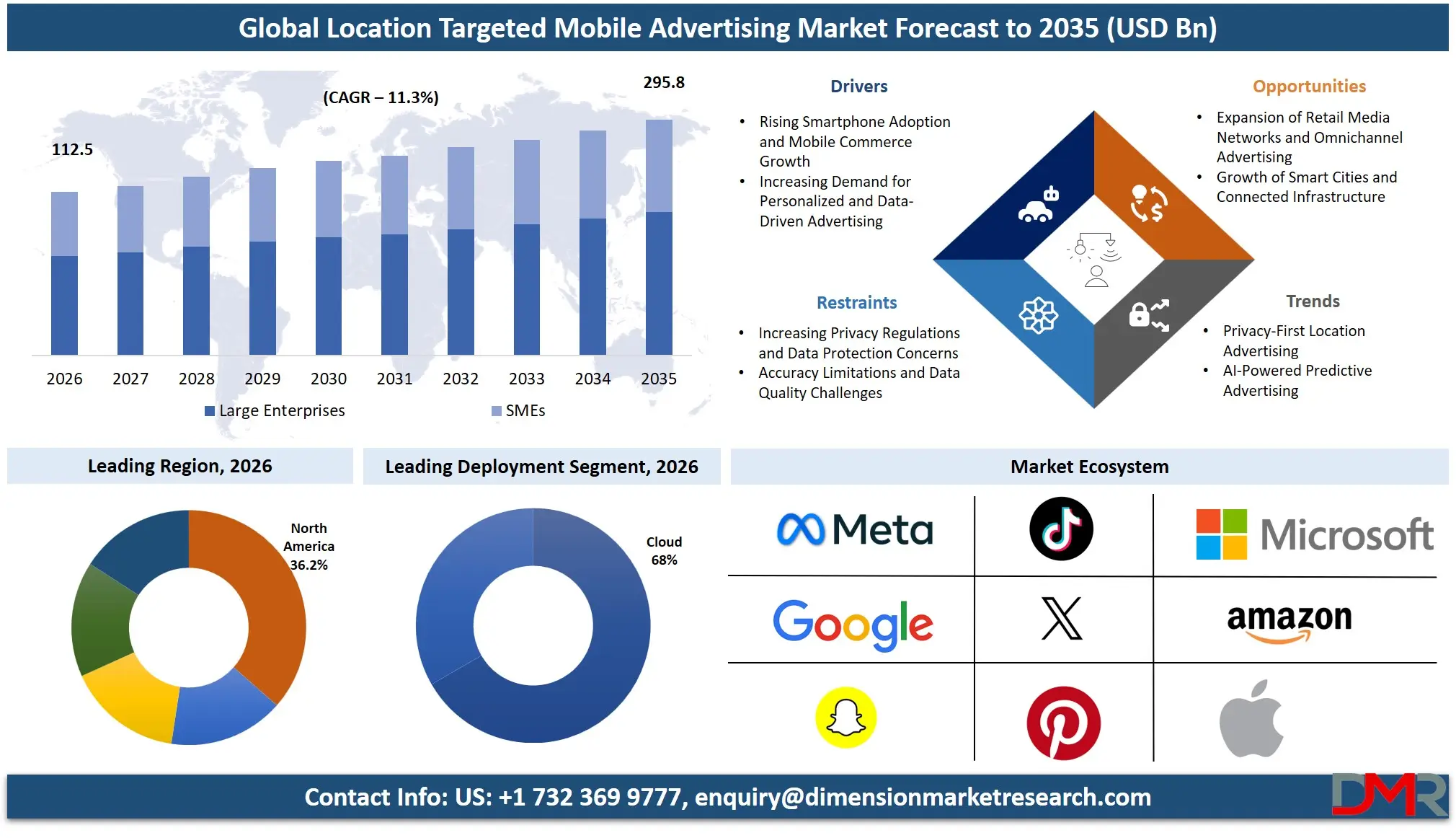
The Global Location Targeted Mobile Advertising Market is estimated to reach approximately USD 112.5 billion in 2026 and is projected to grow to USD 295.8 billion by 2035, registering a CAGR of around 11.3% between 2026 and 2035. Growth is driven by increasing smartphone adoption, rising mobile commerce activities, expanding digital advertising budgets, and growing demand for personalized consumer engagement strategies.
The rapid transition from traditional advertising toward data-driven digital marketing is accelerating market expansion. Businesses are increasingly adopting location intelligence platforms to understand consumer behavior, optimize advertising campaigns, and improve customer acquisition efficiency. The integration of artificial intelligence, predictive analytics, 5G connectivity, and privacy-compliant data management solutions is further strengthening market growth. Additionally, the expansion of retail media networks and omnichannel marketing strategies is creating new opportunities for location-based advertising providers.
Use Cases
- Retail Store Promotions: Enables retailers to send personalized offers and discounts to nearby customers based on real-time location.
- Restaurant and Food Delivery Advertising: Helps restaurants attract nearby consumers through targeted promotions and location-based campaigns.
- Travel and Hospitality Marketing: Allows hotels and travel companies to advertise services based on traveler locations and preferences.
- Event and Venue Marketing: Supports audience engagement by targeting users near concerts, exhibitions, and sports venues.
- Automotive Customer Engagement: Enables dealerships and automotive brands to target potential buyers within specific geographic areas.
- Financial Services Marketing: Helps banks and fintech companies promote nearby branches, services, and personalized financial products.
Key Takeaways
- The Global Location Targeted Mobile Advertising Market is expected to expand from USD 112.5 billion in 2026 to USD 295.8 billion by 2035, supported by increasing digital advertising adoption.
- Artificial intelligence, machine learning, and location intelligence platforms are becoming major growth enablers by improving targeting accuracy and campaign effectiveness.
- Geofencing technology dominates the location targeting segment due to its widespread adoption among retailers, advertisers, and enterprise marketers.
- Beacon-based targeting represents the fastest-growing segment due to increasing adoption in retail stores, shopping malls, airports, and smart venues.
- Retail & E-commerce remains the largest application segment as businesses increasingly focus on personalized shopping experiences.
- North America leads the global market due to advanced digital advertising infrastructure, high smartphone penetration, and strong adoption of location analytics technologies.
How AI/Gen AI is Transforming the Location Targeted Mobile Advertising Market?
Artificial intelligence is significantly transforming the Location Targeted Mobile Advertising Market by enabling advanced audience segmentation, predictive analytics, automated bidding, and real-time personalization. AI algorithms analyze large volumes of location data, consumer behavior patterns, purchase history, and contextual information to identify high-value customer segments. Machine learning models help advertisers predict consumer intent and deliver relevant advertisements at the right location and time.
AI-driven advertising platforms improve campaign efficiency by reducing wasted impressions, optimizing advertising budgets, and increasing conversion rates. Automated optimization tools continuously adjust targeting parameters based on campaign performance, enabling advertisers to achieve better return on investment. AI also supports privacy-focused advertising through techniques such as federated learning, anonymized data processing, and contextual targeting.
The integration of AI is reshaping competition by shifting the market from basic location tracking toward intelligent location-based engagement platforms. Companies offering advanced analytics, automation capabilities, and privacy-compliant AI solutions are gaining competitive advantages. AI-powered location advertising is also enabling new applications such as predictive retail marketing, smart city advertising, and personalized customer experiences.
Key Drivers in the Global Location Targeted Mobile Advertising Market
Rising Smartphone Adoption and Mobile Commerce Growth
The increasing global penetration of smartphones is one of the primary factors driving the expansion of location targeted mobile advertising. Smartphones have become essential consumer devices equipped with GPS capabilities, mobile applications, and internet connectivity, allowing advertisers to engage consumers based on real-world behavior and location.
The growth of mobile commerce has further accelerated demand for location-based advertising solutions. Retailers and brands are increasingly using location intelligence to influence purchase decisions, drive store visits, and connect online and offline shopping experiences.
Increasing Demand for Personalized and Data-Driven Advertising
Advertisers are shifting from broad audience campaigns toward personalized marketing strategies that deliver relevant messages to specific consumer groups. Location targeted mobile advertising enables brands to understand consumer movement patterns and provide customized advertisements based on geographic context.
Businesses across industries such as retail, automotive, hospitality, and financial services are adopting these solutions to improve customer engagement and marketing effectiveness.
Restraints in the Global Location Targeted Mobile Advertising Market
Increasing Privacy Regulations and Data Protection Concerns
Privacy concerns represent a major challenge for the growth of location targeted mobile advertising. Consumers are increasingly concerned about the collection and usage of personal location information, leading governments worldwide to introduce stricter data protection regulations.
Regulations such as consent requirements, data minimization rules, and restrictions on third-party tracking are influencing how companies collect and utilize location data. Advertisers must invest in privacy-compliant technologies and transparent data practices to maintain consumer trust.
Accuracy Limitations and Data Quality Challenges
The effectiveness of location targeted mobile advertising depends heavily on accurate location data. Inaccurate GPS signals, limited user permissions, incomplete consumer profiles, and inconsistent data sources can reduce campaign effectiveness.
Advertisers must integrate multiple data sources and advanced analytics solutions to improve targeting precision. However, these requirements increase operational complexity and technology costs.
Growth Opportunities in the Global Location Targeted Mobile Advertising Market
Expansion of Retail Media Networks and Omnichannel Advertising
The rapid growth of retail media networks represents a significant opportunity for location targeted mobile advertising providers. Retailers are increasingly monetizing their first-party customer data by offering advertising platforms that allow brands to reach consumers based on shopping behavior, store visits, and purchase intent.
Location intelligence enables retailers to connect digital advertising with physical shopping environments by identifying nearby customers and delivering personalized promotions. The integration of mobile applications, loyalty programs, and in-store technologies creates new opportunities for advertisers to influence customers throughout the purchase journey.
Growth of Smart Cities and Connected Infrastructure
The development of smart cities and connected urban infrastructure is creating new opportunities for location targeted mobile advertising. Governments and private organizations are deploying IoT-enabled infrastructure, connected transportation systems, and digital signage networks that generate valuable location intelligence.
Advertisers can leverage these ecosystems to provide context-aware advertisements based on traffic conditions, public events, consumer movement patterns, and urban environments.
Trends in the Global Location Targeted Mobile Advertising Market
Privacy-First Location Advertising
The location targeted advertising industry is moving toward privacy-focused solutions as consumers and regulators demand greater transparency in data collection. Companies are adopting consent-based tracking models, anonymized data processing, and contextual targeting approaches to maintain advertising effectiveness while protecting user privacy.
AI-Powered Predictive Advertising
Predictive analytics and machine learning are becoming essential components of modern location targeted advertising platforms. Instead of simply targeting users based on current locations, advertisers are increasingly predicting future consumer behavior, purchase likelihood, and movement patterns.
Research Scope and Analysis
The Global Location Targeted Mobile Advertising Market is segmented by Location Targeting Technology, Advertising Format, Deployment Model, Enterprise Size, and Industry Vertical. Each segment reflects differences in technology adoption, advertising objectives, business requirements, and customer engagement strategies.
ℹ
To learn more about this report –
Download Your Free Sample Report Here
By Location Targeting Technology Analysis
The location targeting technology segment includes Geofencing, Geotargeting, Beacon-Based Targeting, GPS-Based Targeting, and IP-Based Targeting. Among these, Geofencing dominated the market in 2026, accounting for approximately 34.5% share, driven by its widespread adoption among retailers, restaurants, and service providers. Geofencing enables businesses to create virtual boundaries around specific locations and trigger advertisements when consumers enter or leave defined areas. Its effectiveness in driving store visits and immediate customer actions has made it a preferred solution for location-based campaigns.
GPS-Based Targeting represents the second-largest segment, supported by smartphone integration and continuous improvements in mobile location accuracy. Meanwhile, Beacon-Based Targeting is expected to be the fastest-growing segment, expanding at approximately 14.8% CAGR through 2035. Growth is supported by increasing adoption in indoor environments such as shopping malls, airports, museums, and retail stores where traditional GPS technology has limitations.
By Advertising Format Analysis
The advertising format segment includes Display Ads, Video Ads, Native Ads, In-App Ads, and Push Notifications. Display Ads represented the largest segment in 2026, capturing around 31.8% market share, due to their cost-effectiveness, broad availability across mobile applications, and compatibility with programmatic advertising platforms.
Video advertising is emerging as a rapidly expanding segment as consumers increasingly engage with short-form mobile video content. Brands are investing heavily in video-based location campaigns because they provide stronger engagement and storytelling capabilities compared with traditional display advertisements.
Native advertising is also gaining momentum as advertisers seek less intrusive formats that blend naturally with mobile application content. Push notifications continue to play an important role among retailers and service providers for real-time promotions and location-triggered customer engagement.
By Deployment Analysis
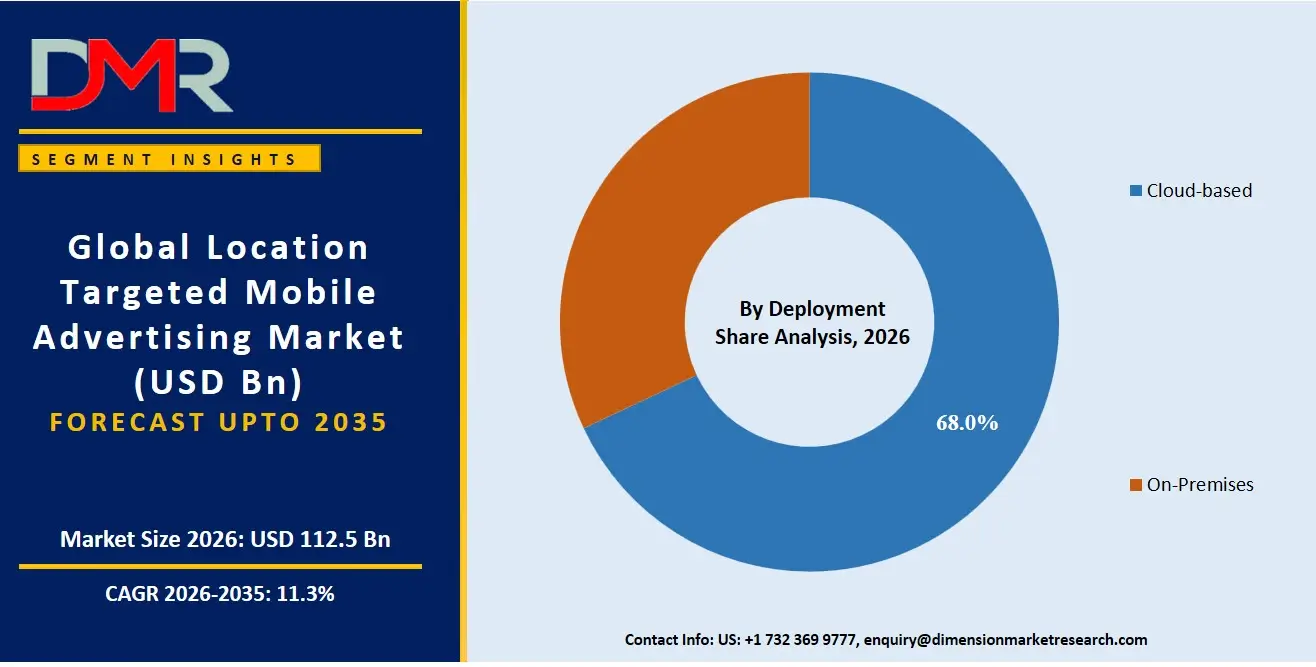
The deployment segment is divided into Cloud-Based and On-Premises solutions. The Cloud-Based deployment model dominated the market in 2026 with a majority share, as businesses increasingly prefer scalable advertising platforms that reduce infrastructure requirements and enable rapid implementation.
Cloud-based solutions provide advertisers with flexible access to analytics platforms, real-time campaign management tools, and AI-powered optimization capabilities. Small and medium-sized enterprises particularly benefit from cloud deployment because it eliminates the need for significant upfront technology investments.
On-premises deployment continues to be adopted by organizations with strict data control requirements, particularly financial institutions, government organizations, and large enterprises operating under regulatory constraints.
By Enterprise Size Analysis
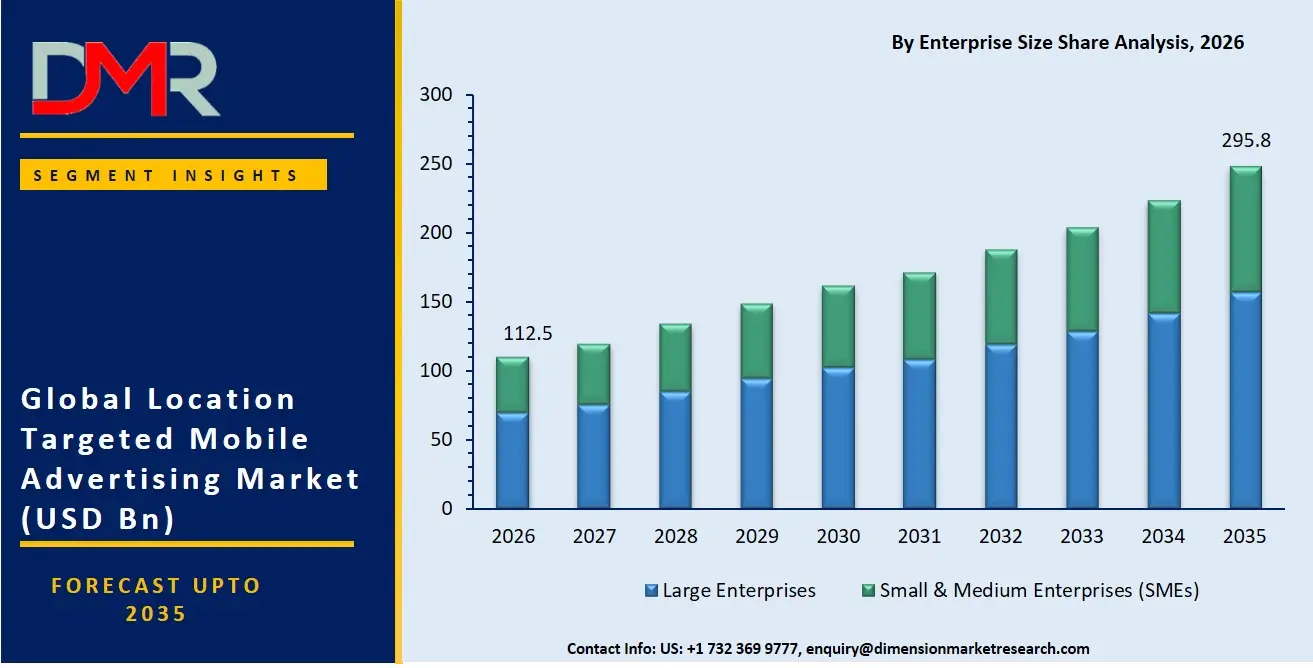
The enterprise size segment includes Large Enterprises and Small & Medium Enterprises (SMEs). Large enterprises held the dominant position in 2026 due to their larger advertising budgets, extensive customer databases, and ability to invest in advanced location intelligence technologies.
ℹ
To learn more about this report –
Download Your Free Sample Report Here
Retail chains, multinational consumer brands, and telecommunications companies are among the largest users of location targeted mobile advertising solutions.
However, SMEs are expected to register faster growth during the forecast period as affordable cloud-based advertising platforms become more accessible. Smaller businesses are increasingly using location targeting to compete with larger brands by reaching nearby customers efficiently.
By Industry Vertical Analysis
Retail & E-commerce dominated the market in 2026 with approximately 28.6% share, driven by the need for personalized customer experiences, store traffic generation, and omnichannel marketing strategies. Retailers use location targeting to promote discounts, recommend products, and improve customer retention.
Travel & Hospitality is one of the fastest-growing verticals due to increased adoption of mobile travel applications and personalized destination marketing. Automotive companies are also increasing investments in location-based campaigns to identify potential buyers near dealerships and service centers.
The Global Location Targeted Mobile Advertising Market Report is segmented on the basis of the following:
By Location Targeting Technology
- Geofencing
- Geotargeting
- Beacon-Based Targeting
- GPS-Based Targeting
- IP-Based Targeting
By Advertising Format
- Display Ads
- Video Ads
- Native Ads
- In-App Ads
- Push Notifications
By Deployment
By Enterprise Size
- Large Enterprises
- Small & Medium Enterprises (SMEs)
By Industry Vertical
- Retail & E-commerce
- BFSI
- Healthcare
- Travel & Hospitality
- Media & Entertainment
- Automotive
- Telecommunications
- Consumer Goods
- Others
Regional Analysis
North America is the Leading Region in the Global Location Targeted Mobile Advertising Market
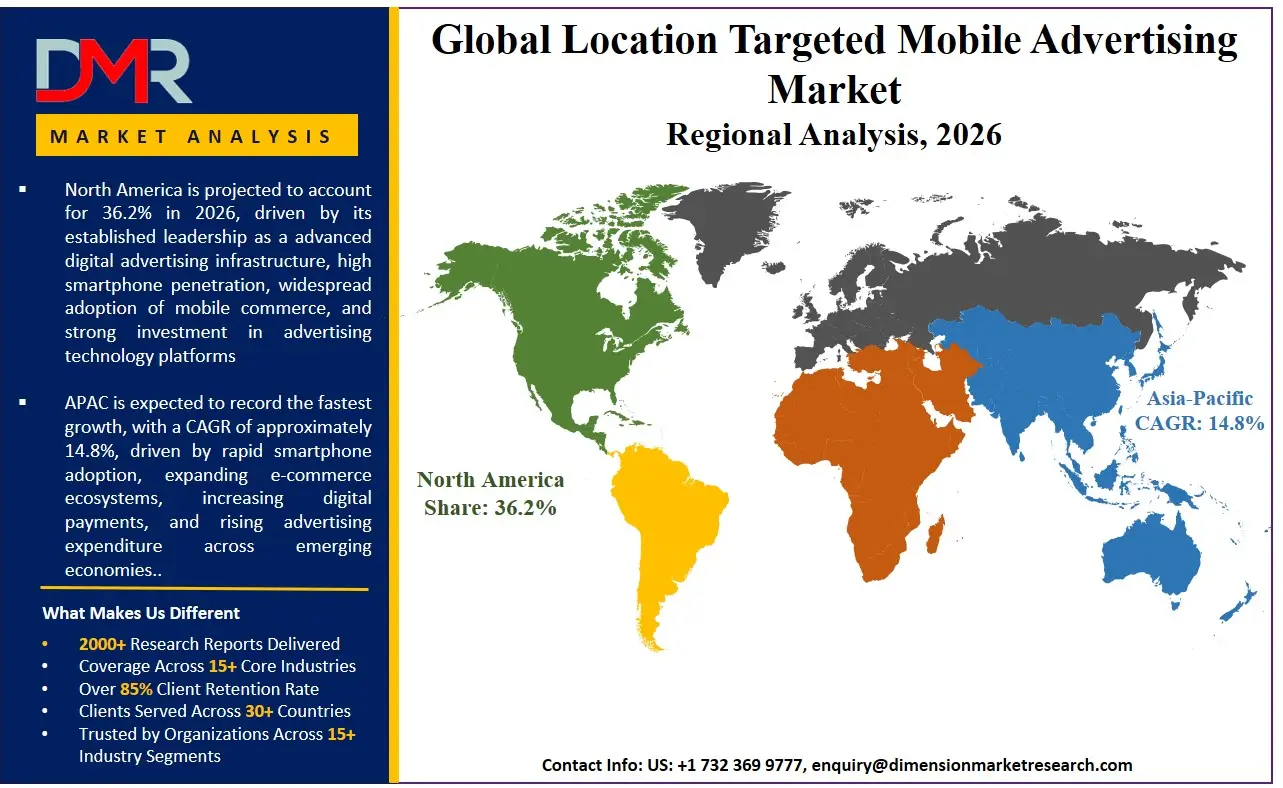
North America is expected to maintain its leading position in the Global Location Targeted Mobile Advertising Market, accounting for approximately 36.2% market share in 2026. The region benefits from advanced digital advertising infrastructure, high smartphone penetration, widespread adoption of mobile commerce, and strong investment in advertising technology platforms.
ℹ
To learn more about this report –
Download Your Free Sample Report Here
The United States represents the largest contributor due to the presence of major technology companies, advertising platforms, and retail brands using location intelligence solutions. Strong adoption of artificial intelligence, programmatic advertising, and retail media networks is further strengthening regional growth.
Additionally, increasing investments in privacy-compliant advertising technologies are encouraging companies to develop advanced location targeting solutions that balance personalization with consumer data protection.
Asia Pacific is the Fastest-Growing Region in the Global Location Targeted Mobile Advertising Market
Asia-Pacific is projected to become the fastest-growing regional market, expanding at approximately 14.8% CAGR between 2026 and 2035. Growth is supported by rapid smartphone adoption, expanding e-commerce ecosystems, increasing digital payments, and rising advertising expenditure across emerging economies.
Countries such as China, India, Japan, and South Korea are witnessing strong demand for personalized mobile marketing solutions. The expansion of smart cities, 5G networks, and mobile-first consumer behavior is creating favorable conditions for location targeted advertising adoption.
Europe Location Targeted Mobile Advertising Market
The Europe Location Targeted Mobile Advertising Market is estimated to reach approximately USD 27.8 billion in 2026 and is projected to grow to around USD 63.5 billion by 2035, registering a CAGR of approximately 11.7% during the forecast period. The region is witnessing strong adoption of location-based advertising solutions due to increasing digital advertising spending, rising smartphone usage, and growing demand for personalized customer engagement.
European retailers, automotive companies, travel businesses, and financial institutions are increasingly adopting location intelligence platforms to improve customer acquisition and retention. The implementation of privacy-focused advertising frameworks has encouraged companies to develop transparent consent-based solutions. AI-powered analytics, first-party customer data strategies, and retail media networks are becoming important growth drivers across major European economies, including Germany, the United Kingdom, France, and the Nordic countries.
Latin America Location Targeted Mobile Advertising Market
The Latin America Location Targeted Mobile Advertising Market is expected to reach approximately USD 9.6 billion in 2026 and is forecast to grow to nearly USD 23.4 billion by 2035, expanding at a CAGR of around 13.0%. Growth is driven by increasing smartphone penetration, rising mobile internet adoption, and expanding digital commerce activities across Brazil, Mexico, Argentina, and Colombia.
Businesses in the region are increasingly adopting mobile advertising solutions to reach digitally connected consumers and improve marketing efficiency. Retailers, financial technology companies, telecommunications providers, and consumer brands are leveraging location targeting technologies to engage customers in highly competitive markets. The expansion of mobile payment ecosystems and social commerce platforms is expected to further accelerate demand for location-based advertising solutions.
Middle East & Africa Location Targeted Mobile Advertising Market
The Middle East & Africa Location Targeted Mobile Advertising Market is estimated at approximately USD 7.4 billion in 2026 and is projected to reach nearly USD 18.2 billion by 2035, growing at a CAGR of approximately 13.2%. Increasing digital transformation initiatives, smartphone adoption, and investments in smart city infrastructure are driving market expansion.
Countries across the Gulf region are investing heavily in digital ecosystems, connected infrastructure, and advanced analytics technologies. Retail, tourism, banking, and entertainment industries are adopting location-based mobile advertising to improve consumer engagement. In Africa, increasing mobile connectivity and expanding digital services are creating new opportunities for advertisers seeking cost-effective customer acquisition methods.
Major Countries Analysis
United States Location Targeted Mobile Advertising Market
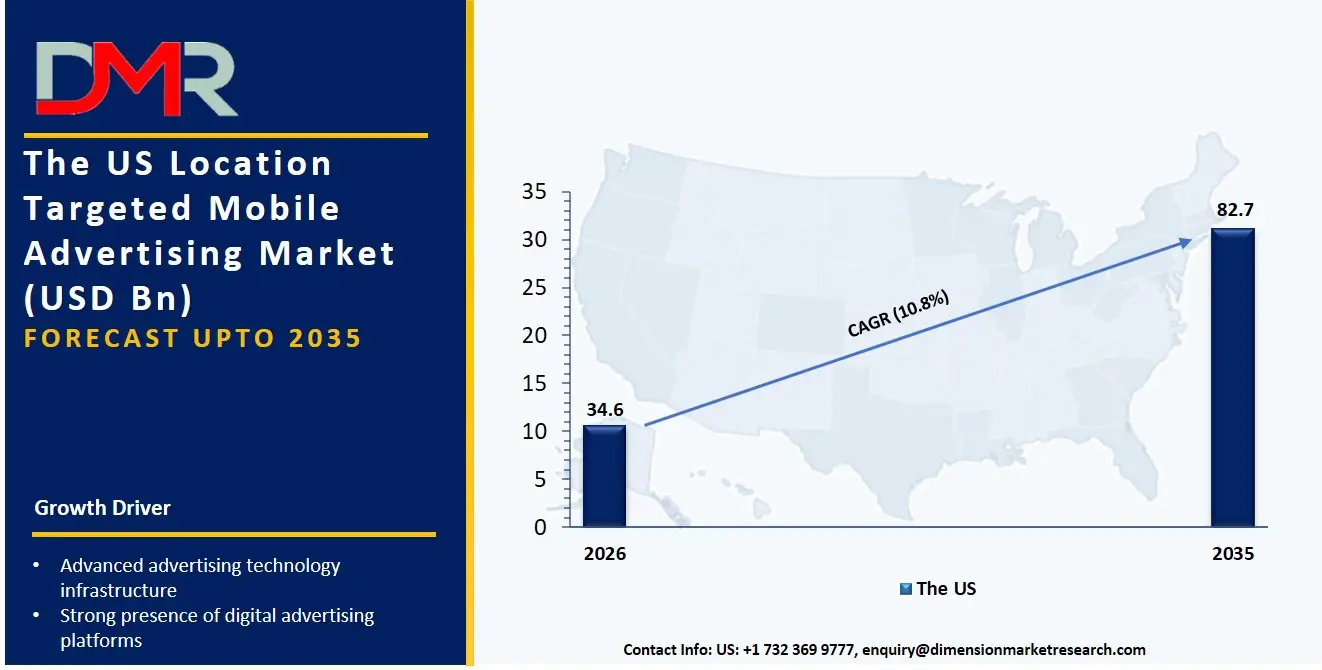
The United States Location Targeted Mobile Advertising Market is estimated to reach approximately USD 34.6 billion in 2026 and is projected to grow to nearly USD 82.7 billion by 2035, registering a CAGR of around 10.8%.
ℹ
To learn more about this report –
Download Your Free Sample Report Here
The country dominates due to advanced advertising technology infrastructure, strong presence of digital advertising platforms, and high enterprise adoption of location intelligence solutions. Retailers, restaurants, automotive companies, and financial institutions are major users of location-targeted advertising. The rapid expansion of retail media networks, AI-driven marketing platforms, and programmatic advertising ecosystems continues to strengthen market growth.
Japan Location Targeted Mobile Advertising Market
Japan's Location Targeted Mobile Advertising Market is expected to reach approximately USD 8.9 billion in 2026 and grow to around USD 18.9 billion by 2035, registering a CAGR of approximately 13.4%. Growth is supported by high smartphone adoption, advanced digital infrastructure, and increasing use of AI-powered customer engagement solutions. Japanese retailers and consumer brands are integrating location targeting with mobile applications, loyalty programs, and smart retail technologies. The country's focus on automation, connected infrastructure, and digital transformation is supporting continued adoption of location intelligence platforms.
Saudi Arabia Location Targeted Mobile Advertising Market
Saudi Arabia's Location Targeted Mobile Advertising Market is projected to reach approximately USD 2.1 billion in 2026 and expand to nearly USD 5.7 billion by 2035, growing at a CAGR of around 15.1%. Market growth is driven by Vision 2030 initiatives, digital transformation programs, smart city developments, and increasing investment in retail and tourism infrastructure. The country is witnessing rising adoption of location-based marketing solutions across shopping malls, entertainment venues, hospitality businesses, and financial services. The expansion of digital payment systems and connected consumer experiences is expected to further increase demand.
Regulatory Landscape
The regulatory environment for the Location Targeted Mobile Advertising Market is increasingly focused on consumer privacy, transparency, and responsible data usage. Regulations such as the European Union's General Data Protection Regulation (GDPR), California Consumer Privacy Act (CCPA), and other emerging privacy frameworks influence how companies collect, process, store, and utilize location information.
Advertising companies are required to implement consent management systems, anonymization techniques, and secure data governance practices. Mobile operating system providers have also introduced stricter permission controls for location tracking, requiring advertisers to adopt privacy-first strategies. These regulatory developments are encouraging innovation in contextual advertising, first-party data solutions, and privacy-enhancing technologies.
Investment and White Space Analysis
Investment opportunities in the Location Targeted Mobile Advertising Market are expanding across AI-powered analytics, privacy-compliant data platforms, retail media networks, and indoor location technologies. Companies developing advanced customer intelligence platforms that combine location data with behavioral analytics represent attractive investment opportunities.
Emerging markets in Asia-Pacific, Latin America, and the Middle East offer significant growth potential due to increasing smartphone adoption and digital commerce expansion. Additional white-space opportunities exist in sectors such as healthcare marketing, connected vehicles, smart cities, and personalized travel experiences. Startups focusing on privacy-preserving advertising technologies and AI-driven campaign optimization are expected to attract increased investment.
By Region
North America
Europe
- Germany
- The U.K.
- France
- Italy
- Spain
- Rest of Europe
Asia-Pacific
- China
- Japan
- South Korea
- India
- Australia
- Rest of APAC
Latin America
- Brazil
- Mexico
- Rest of LATAM
Middle East & Africa
- Saudi Arabia
- The UAE
- South Africa
- Rest of MEA
Competitive Landscape
The Global Location Targeted Mobile Advertising Market is moderately consolidated, with major digital advertising platforms competing alongside specialized location intelligence providers. Leading companies differentiate themselves through advanced AI capabilities, extensive advertising networks, analytics capabilities, privacy compliance, and integration with enterprise marketing platforms.
Market participants are focusing on strategic partnerships, acquisitions, platform enhancements, and geographic expansion to strengthen their market position. Companies are increasingly investing in artificial intelligence, machine learning, real-time analytics, and privacy-focused solutions to improve advertising effectiveness.
Some of the prominent players in the Global Location Targeted Mobile Advertising Market are
- Google
- Meta Platforms
- Amazon
- Apple
- Microsoft
- The Trade Desk
- InMobi
- Yahoo
- Baidu
- Tencent
- X
- Snap
- Pinterest
- TikTok
- Foursquare
- Near
- Blis
- GroundTruth
- Digital Turbine
- Verve Group
- Liftoff
- Moloco
- Adform
- Criteo
- PubMatic
- Magnite
- MediaMath
- Nexxen
- YOC
- AdColony
- Smaato
- Unity Ads
- ironSource
- Chartboost
- Jampp
- Kargo
- Outbrain
- Taboola
- Basis Technologies
- Viant Technology
- Other Key Players
Recent Developments
- In November 2025, Near Intelligence announced expanded partnerships focused on location analytics solutions for retail, consumer brands, and smart city applications.
- In September 2025, Foursquare expanded its location intelligence platform capabilities by integrating additional business location data and analytics features to support enterprise advertisers.
- In June 2025, Apple strengthened privacy-focused advertising technologies by enhancing user transparency controls and improving consent-based data management capabilities across its ecosystem.
- In April 2025, Meta Platforms introduced additional AI-based advertising tools aimed at improving campaign performance through automated creative generation, audience prediction, and advanced advertiser analytics.
- In February 2025, Google expanded its AI-powered advertising capabilities by introducing enhanced automated campaign optimization features designed to improve audience targeting and personalized ad delivery across digital channels.
Report Details
| Report Characteristics |
| Market Size (2026) |
USD 112.5 Bn |
| Forecast Value (2035) |
USD 295.8 Bn |
| CAGR (2026–2035) |
11.3% |
| Historical Period |
2021 – 2025 |
| Forecast Period |
2027 – 2035 |
| Base Year |
2025 |
| Estimate Year |
2026 |
| Segments Covered |
By Location Targeting Technology, By Advertising Format, By Deployment, By Enterprise Size, By Industry Vertical |
| Regional Coverage |
North America – The US and Canada; Europe – Germany, The UK, France, Spain, Italy, & Rest of Europe; Asia-Pacific – China, Japan, South Korea, India, Australia, Rest of APAC; Latin America – Brazil, Mexico, Rest of Latin America; Middle East & Africa – Saudi Arabia, The UAE, South Africa, & Rest of MEA |
Frequently Asked Questions
What is the projected size of the Location Targeted Mobile Advertising Market?
▾ The market is expected to reach approximately USD 112.5 billion in 2026 and grow to USD 295.8 billion by 2035.
What is the CAGR of the Location Targeted Mobile Advertising Market?
▾ The global market is projected to expand at a CAGR of approximately 11.3% from 2026 to 2035.
What are the major factors driving Location Targeted Mobile Advertising Market growth?
▾ Key drivers include smartphone adoption, mobile commerce growth, AI-powered personalization, and increasing digital advertising investments.
Which location targeting technology dominates the Location Targeted Mobile Advertising Market ?
▾ Geofencing is the leading technology segment due to widespread adoption among retailers and service providers.
Which region has the largest market share in Location Targeted Mobile Advertising Market ?
▾ North America leads the global market due to advanced digital advertising infrastructure and strong technology adoption.
Which region is growing fastest in Location Targeted Mobile Advertising Market ?
▾ Asia-Pacific is expected to record the fastest growth due to digital transformation, smartphone expansion, and e-commerce growth.
Who are the key players in Location Targeted Mobile Advertising Market ?
▾ Major players include Google, Meta Platforms, Apple, Microsoft, IBM, Foursquare, Near Intelligence, Verve Group, and GroundTruth.
What are the major market segments in Location Targeted Mobile Advertising Market ?
▾ The market is segmented by location targeting technology, advertising format, deployment model, enterprise size, and industry vertical.