Global Logistics Market snapshot
- Global Logistics Market size in 2026 is: USD 4.5 Trillion
- Global Logistics Market size in 2035 is: USD 10.2 Trillion
- Global CAGR from 2027 to 2035 is: 9.1%
- Transportation is the leading service type segment: 32.8%
- Roadways is the leading transportation mode segment: 44.6%
- 3PL is the leading logistics model segment: 38.6%
- Domestic is the leading coverage segment: 65.1%
- Retail and E-Commerce is the leading end-use industry segment: 25.9%
- Warehousing and Storage is the fastest-growing service type segment: 9.8%
- Airways is the fastest-growing transportation mode segment: 10.1%
- 5PL is the fastest-growing logistics model segment: 10.3%
- International is the fastest-growing coverage segment: 10.5%
- Retail and E-Commerce is the fastest-growing end-use industry segment: 9.9%
- Asia Pacific is the leading region in 2026: 41.2%
- Asia Pacific is the expected fastest-growing region: 10.7% CAGR
What is the Global Logistics Market? Global Logistics Market Size.
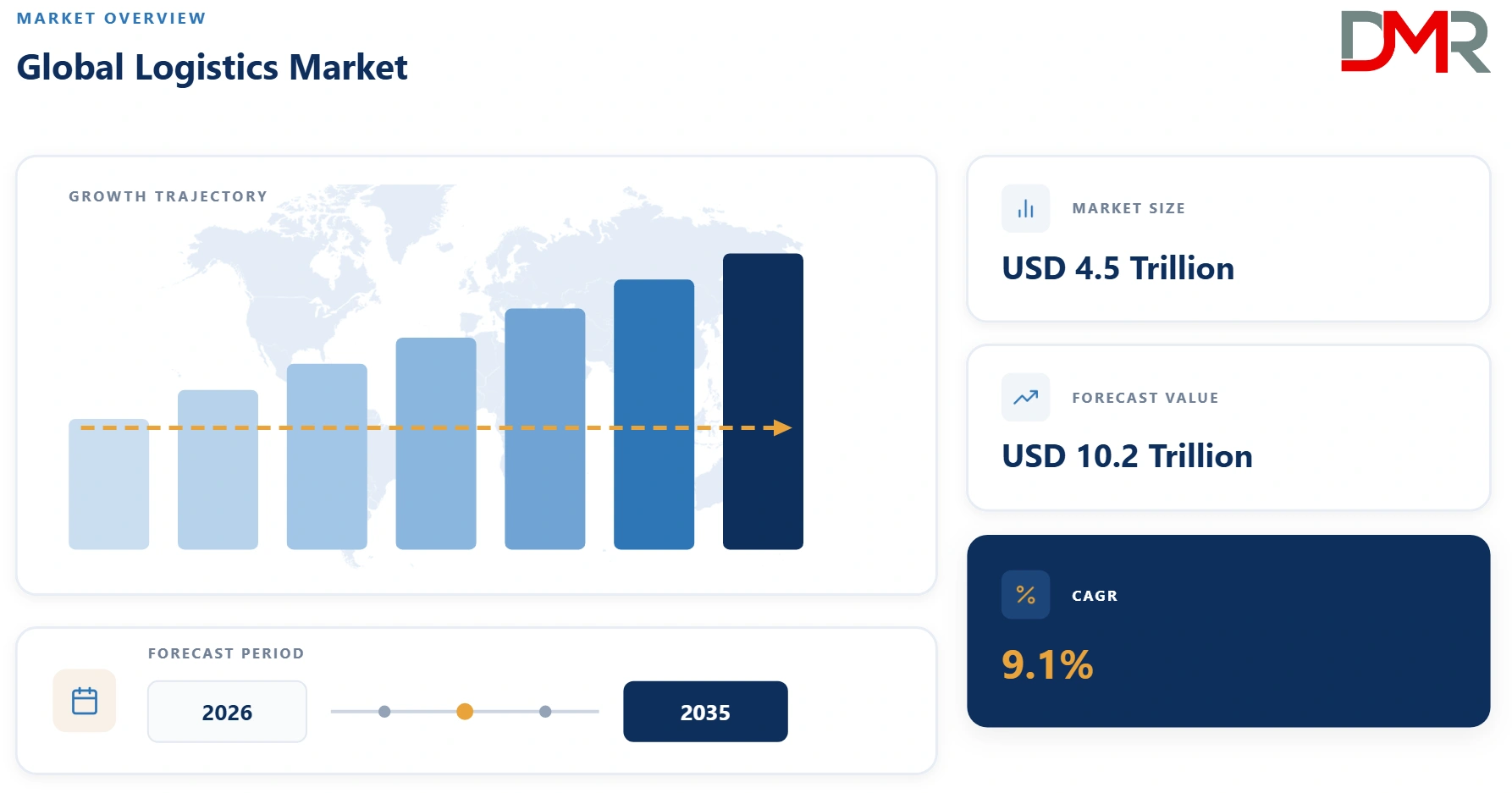
The Global Logistics Market size is valued at USD 4.5 trillion in 2026, and it is further anticipated to reach a market value of USD 10.2 trillion by 2035 at a CAGR of 9.1%.
ℹ
To learn more about this report –
Download Your Free Sample Report Here
The Global Logistics Market is associated with the transportation, storage, and distribution of goods domestically as well as internationally. This market links producers, vendors, distributors, retailers, and customers via a series of supply chain operations. Growth in this market is fueled by growing international business transactions, e-commerce business activities, production output, and the need for effective delivery services. Moreover, technological developments, automation of warehouses, real-time shipment tracking, and digitization of supply chains are making logistics more efficient and cost-effective.
Use Cases
- E-Commerce and Online Retail Distribution: The importance of logistics is significant in e-commerce because it takes care of warehousing, processing orders, packaging, transport, and delivery of goods. Organizations like Amazon and Flipkart rely on logistics networks to deliver products from their warehouses to consumers in different locations. Logistics makes the process of deliveries quick and increases the efficiency of handling higher amounts of orders. Increased shopping through online sites increases the need for better logistics facilities.
- Automotive Supply Chain Management: In the automotive sector, logistics are required for the movement of raw materials, automobile components, replacement parts, and automobiles from suppliers to manufacturing facilities and dealerships. In the manufacturing of automobiles, logistics managers facilitate the transportation of materials by road, rail, and sea. In addition, logistics managers also take care of storage of inventory, transportation of the automobiles, and international shipments of the automobiles. Automotive logistics management avoids production disruptions, lowers inventory costs, and facilitates effective coordination in the supply chain.
- Healthcare and Pharmaceutical Distribution: The health care and pharmaceutical industry utilizes specific logistical services for the transport of pharmaceutical products such as medications, vaccines, medical devices, and health care equipment. Temperature control, refrigerated storage, monitoring, and proper handling of products ensure that the quality of products is maintained through the distribution process. For instance, pharmaceutical companies use cold chain logistics in order to transport temperature-sensitive vaccines from the manufacturing plants to hospitals and health care centers.
- Transportation of Food and Beverages: In the food and beverage sector, logistics service providers are responsible for the transportation of various agricultural produce, dairy products, frozen products, beverages, and other perishable products. Refrigerated vehicles and efficient distribution channels play an important role in preserving the freshness of these goods. For instance, firms like Amul make use of cold chain logistics services for transporting milk, butter, cheese, and other dairy products. Increasing demand for fresh food products has led to an increased need for logistics infrastructure.
Key Takeaways
- Market Growth: The Global Logistics Market is anticipated to reach USD 10.2 trillion by 2035, starting from USD 4.5 trillion in 2026, at a CAGR of 9.1%. Various factors responsible for the market growth include rising international trade, increasing activities in e-commerce, increasing production and demand for better transportation and warehousing services, and supply chain management services.
- Transportation Leads the Service Type Segment: Transportation dominates the service type segment by acquiring a market share of 32.8% in 2026. Increasing movement of goods through domestic and international markets, along with increasing manufacturing activities, will boost this segment. However, Warehousing and Storage is projected to witness the highest growth rate of CAGR 9.8%.
- Roadways Dominates Transportation Mode Segment: Roadways covers 44.6% of the market share in 2026 owing to its flexibility, wide connectivity, and ability to offer door-to-door service delivery. High demand for regional distribution, last-mile delivery, and the transportation of consumer goods and industrial goods will support the growth of the segment. However, Airways is anticipated to have the highest growth rate at a CAGR of 10.1%, driven by growing demands for quick international shipment, premium cargo shipment, and time-sensitive deliveries.
- 3PL Dominates the Logistics Model Segment: Third-Party Logistics (3PL) accounts for 38.6% of the market share in 2026 owing to the increased outsourcing of transportation, warehousing, inventory, and distribution processes. Companies are becoming increasingly dependent on third-party logistics companies to cut costs and make their supply chain more efficient. However, 5PL services emerge as the fastest-growing segment with a CAGR of 10.3%.
- Domestic Leads the Coverage Segment: Domestic logistics holds 65.1% of the market share in 2026 on account of increased movement of cargo within the boundaries of the country, retail distribution networks, manufacturing processes, and rising consumer demand. However, International logistics is anticipated to have the fastest growth, at a CAGR of 10.5%.
- Retail and E-Commerce Is Leading the End-Use Industry Segment: Retail and E-Commerce holds 25.9% of the market in 2026 due to increased online purchases, increased parcel shipments, and growing demand for efficient warehousing and last-mile delivery services. Increased digitization of markets and omnichannel retailing is contributing to increased logistics needs. Moreover, the Retail and E-commerce segment is anticipated to have the fastest growth, at a CAGR of 9.9%.
- Asia Pacific to dominate the Market: The market share of Asia Pacific is 41.2% in 2026 owing to factors like increasing manufacturing activities, international business, e-commerce expansion, and consistent investments in transport and warehousing networks.
- Growth Opportunities in Asia Pacific: Asia Pacific is estimated to witness the highest CAGR of 10.7% during the forecast period. Rapid urbanization, increasing cross-border trade, rise in online commerce activities, developments in infrastructure, and the increasing use of automation in warehouses and logistics will lead to many growth opportunities for logistics services firms.
How AI/Gen AI Is Transforming the Global Logistics Market?
Artificial Intelligence (AI) and Generative AI play a critical role in the transformation of the Global Logistics Market in terms of efficiency, accuracy, and responsiveness in operations. By leveraging the power of AI, logistics firms have been able to make use of data analysis, route optimization, demand prediction, and inventory management, which enables them to lower the cost of transportation, avoid delivery delays, and optimize resource allocation. With generative AI, the logistics processes can be facilitated in an even better manner, as it enables logistics firms to automate the process of creating documentation, prepare shipment reports, answer customers' questions, and plan logistics operations. Also, through AI-powered warehousing, sorting, and predictive maintenance, logistics firms can increase productivity while reducing the need for manual intervention.
Key Drivers in the Global Logistics Market
Rise of E-Commerce and Online Retailing
The rise of E-Commerce and Online Retailing activities is another important catalyst behind the growth of the Global Logistics Market. The increasing inclination of consumers towards online shopping has resulted in more parcels being shipped, thereby increasing the need for effective and efficient warehouse management, order fulfillment, and last-mile deliveries. There has been an increased dependence of retailers on logistics service providers due to a higher number of orders, return policies, and fast deliveries.
International Trade and Manufacturing Growth
The growth in international trade and manufacturing has led to the need for logistics systems. The manufacturers rely on logistics systems in order to move the raw materials, spare parts, and finished products to different locations within and outside the country. There has been increased business activities between different countries, which have led to the increased demand for freight forwarders, cargo handling, and transportation services. The need for logistics services becomes necessary for a company that requires to grow in the market.
Restraints in the Global Logistics Market
High Operating and Infrastructure Costs
High operating and infrastructure costs continue to pose significant challenges to logistics service providers. The cost of setting up and maintaining the warehousing facilities, transportation fleet, distribution facilities, and handling equipment is very high. Moreover, the cost of fuel, maintenance of vehicles, labor, insurance, and facility management is also added to the cost of operations. The smaller logistics service providers find it difficult to manage such costs while ensuring competitiveness in pricing of their services.
Complex Regulatory and Customs Requirements
Logistics firms that conduct operations in more than one country are required to adhere to varied rules regarding transportation, documentation, customs clearance, and other aspects. The variations in the levels of tariffs, cargo restrictions, safety requirements, and clearance of goods at borders might complicate the process of international shipping. Delays in documentation and regulatory compliance lead to higher costs and increased time for the shipment of the goods.
Growth Opportunities in the Global Logistics Market
Development of Cold Chain and Specialized Logistics
The increasing demands on temperature-controlled transportation and storage have opened up possibilities for logistics firms to venture into specialized logistics operations. Distribution of vaccines, medicines, perishable foods, dairy products, and other temperature-sensitive goods calls for refrigeration facilities, temperature-controlled vehicles, and constant monitoring of temperatures has increased demand for temperature-controlled transportation. Firms that put up cold chain facilities can serve industries that require special handling and enhance their logistics capabilities.
Growth of Logistics Infrastructure in Emerging Markets
Logistics firms have many opportunities for growth in developing nations as the level of industrialization and urbanization increases in these countries along with better transportation systems. Development of highway, railroad, port, airport, and industrial corridor infrastructure helps connect the places of production and consumers more efficiently. This can help in setting up new logistics facilities. Logisticians expanding their operations in developing countries will be able to take advantage of higher local demand and trade.
Trends in the Global Logistics Market
Adoption of AI and Generative AI in Logistics Operations
Companies in the field of logistics are now making use of both artificial intelligence and Generative AI in order to make improvements to their logistics operations. While artificial intelligence-based technology can help with analyzing the information related to shipments, finding out delivery patterns, and even route planning, Generative AI technology can help with documenting processes, customer communications, and creating reports. The adoption of these technologies is also enabling them to recognize any possible problem areas in their logistics operations.
Increasing Use of Sustainable Transportation Solutions
Sustainability is emerging as a significant aspect in the operation of logistics firms as they look for ways of lowering emissions and increasing fuel efficiency. Logistics firms are adopting electric delivery trucks, the use of alternative fuels, eco-friendly warehouses, and better cargo loading practices to minimize their environmental footprint. Intermodal transportation involving both road, rail, and waterway transport in some cases is being employed by certain firms as well to increase efficiencies in the transportation process.
Research Scope and Analysis
The Global Logistics Market is segmented based on Service Type into Transportation, Warehousing and Storage, Freight Forwarding, Value-Added Logistics Services, and Others; Transportation Mode into Roadways, Railways, Airways, and Waterways; Logistics Model into 1PL, 2PL, 3PL, 4PL, and 5PL; Coverage into Domestic and International; End-Use Industry into Retail and E-Commerce, Manufacturing and Industrial, Automotive, Food and Beverages, Healthcare and Pharmaceuticals, Chemicals, Agriculture, and Others. Geographically, the market includes North America, Europe, Asia Pacific, Latin America, and the Middle East and Africa.
ℹ
To learn more about this report –
Download Your Free Sample Report Here
By Service Type Analysis
The Transportation service type segment holds the largest market share by value, accounting for 32.8% of the global market in 2026. Its dominance is attributed to the growing movement of goods across domestic and international markets. The Warehousing and Storage segment is forecasted to experience the highest CAGR of 9.8% during 2027–2035.
By Transportation Mode Analysis
The Roadways transportation mode segment holds the largest market share by value, accounting for 44.6% of the global market in 2026. Its dominance is attributed to its extensive connectivity, flexibility, and door-to-door delivery capabilities. The Airways transportation mode segment is forecasted to experience the highest CAGR of 10.1% during 2027–2035.
By Logistics Model Analysis
The 3PL logistics model segment holds the largest market share by value, accounting for 38.6% of the global market in 2026. Its dominance is attributed to the increasing preference for outsourcing transportation, warehousing, and distribution activities. The 5PL segment is forecasted to experience the highest CAGR of 10.3% during 2027–2035.
By Coverage Analysis
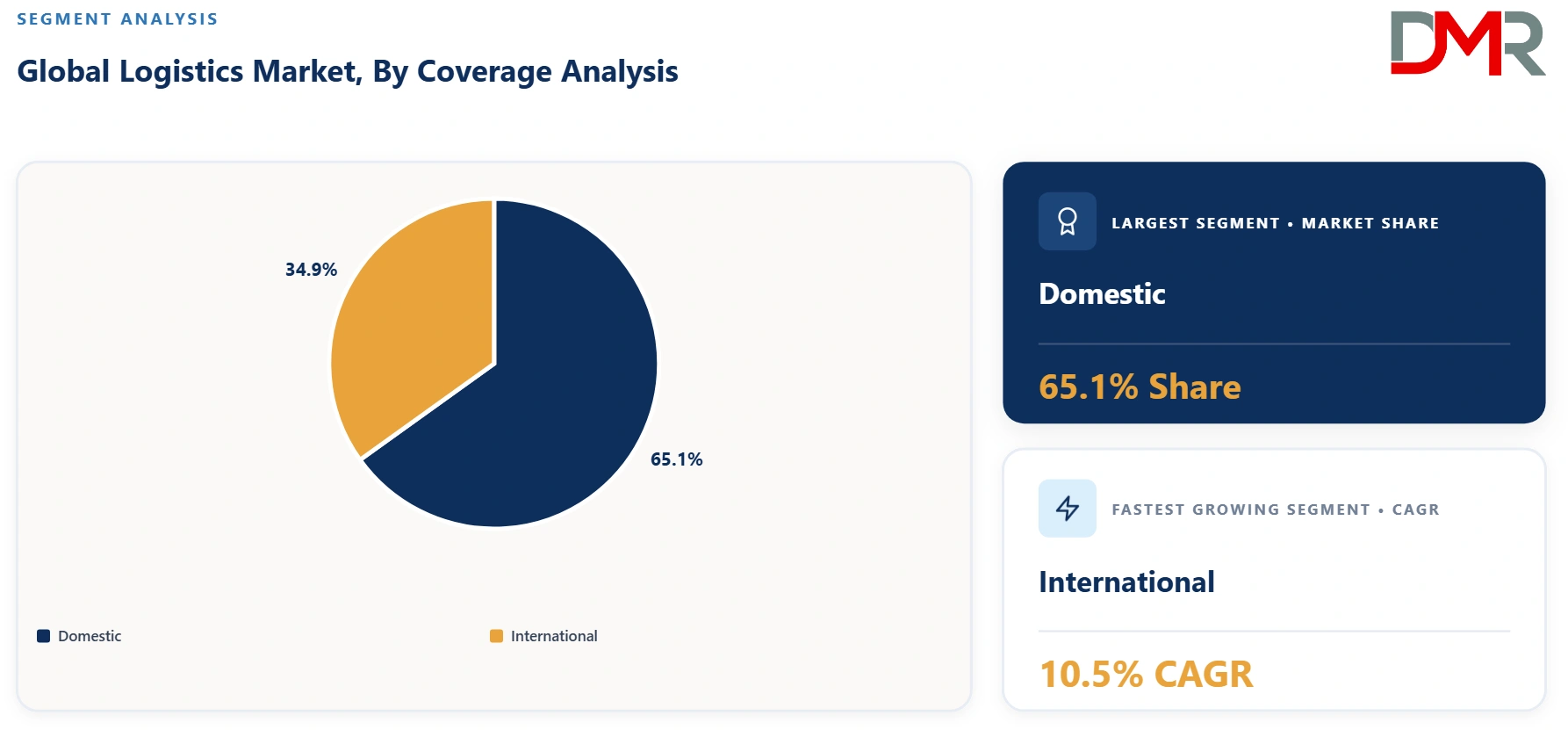
The Domestic coverage segment holds the largest market share by value, accounting for 65.1% of the global market in 2026. Its dominance is attributed to the continuous movement of goods within national boundaries to serve businesses and consumers. The International coverage segment is forecasted to experience the highest CAGR of 10.5% during 2027–2035.
By End-Use Industry Analysis
The Retail and E-Commerce end-use industry segment holds the largest market share by value, accounting for 25.9% of the global market in 2026. Its dominance is attributed to increasing online shopping activities and rising demand for order fulfilment and delivery services. The Retail and E-Commerce segment is forecasted to experience the highest CAGR of 9.9% during 2027–2035.
The Global Logistics Market Report is segmented based on the following:
By Service Type
- Transportation
- Warehousing and Storage
- Freight Forwarding
- Value-Added Logistics Services
- Others
By Transportation Mode
- Roadways
- Railways
- Airways
- Waterways
By Logistics Model
By Coverage
By End-Use Industry
- Retail and E-Commerce
- Manufacturing and Industrial
- Automotive
- Food and Beverages
- Healthcare and Pharmaceuticals
- Chemicals
- Agriculture
- Others
-
Regional Analysis
Asia Pacific is the Leading Region in the Global Logistics Market
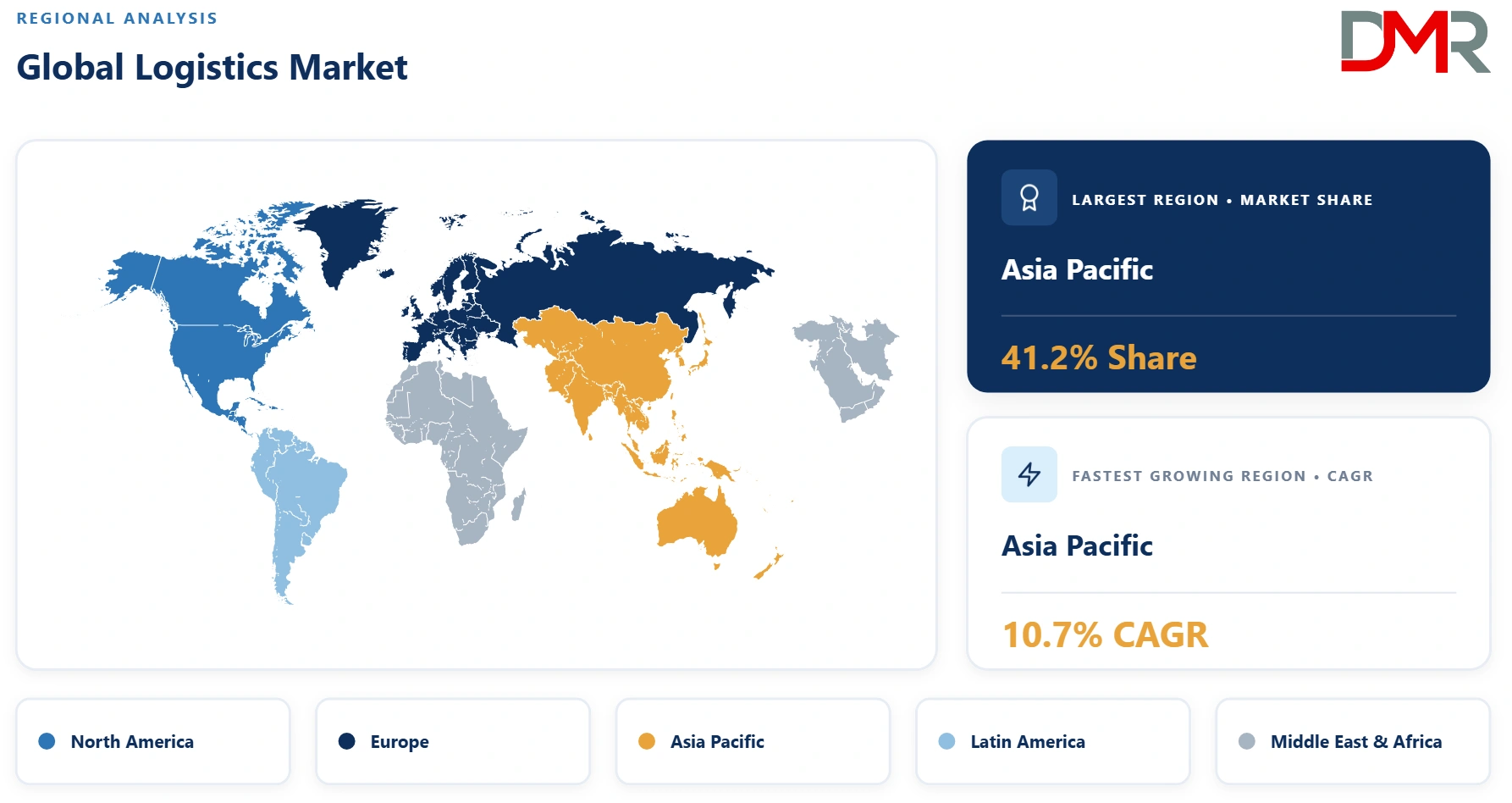
Asia Pacific occupies a dominant market share in the Global Logistics Market in 2026 with a market share of 41.2%. The domination of the region in the market can be attributed to the strong presence of manufacturers, increase in international business, increase in activities related to e-commerce, and development of transportation and warehousing infrastructures. The presence of manufacturing centers and export centers in the region as well as increased demand for movement of goods in the region are driving logistics activities in the region.
ℹ
To learn more about this report –
Download Your Free Sample Report Here
Asia Pacific is the Fastest-Growing Region in the Global Logistics Market
The Asia Pacific region is expected to grow at the highest compound annual growth rate of 10.7% during the forecast period between 2027 and 2035. The primary drivers behind this are increased manufacturing operations, increasing cross-border trade, and increased demand for e-commerce shipping services. Urbanization and rising consumer demands are also boosting the demand for efficient transport, warehousing, and distribution systems. Besides, continuous investments in highways, rail network, and ports are facilitating connectivity across the regions and aiding the transportation of goods in the region.
The Europe Logistics Market
Europe is an important market for logistics services owing to the availability of efficient transport network in the region, presence of manufacturing sector and cross border trade network in Europe. Europe is supported with efficient roads and rail linkages and efficient sea ports. The rise in the use of online shopping is creating greater demand for warehouse and last mile delivery services. The importance being placed on sustainable transport and efficient freight operations in Europe is driving the growth of the European logistics industry.
The Latin America Logistics Market
There is an increase in the demand for logistics in Latin America due to increased trade, production, and infrastructure investments for the transportation of goods within the region. The increasing number of online commerce operations has resulted in a need for better services such as warehouses, distribution, and last-mile deliveries. Investments in road transport, ports, and logistics facilities will help increase connectivity between important economic and industrial centers in the region. There is a need for more efficient movement of agricultural, industrial, and consumer goods in Latin America.
The Middle East and Africa Logistics Market
The Middle East and Africa region is witnessing rising logistics needs due to increased trade activities, infrastructure projects, and industrial investments in the region. Improved infrastructure projects such as port development, airport developments, road connections, and logistics parks are enhancing connectivity and contributing towards easy movement of goods. Growth in e-commerce and retailing activities has added to the rising need for logistics operations. Industrial parks, free trade zones, and logistics corridors are being developed to support the rising investments.
Major Country Analysis
United States Logistics Market
The U.S. Logistics Market is valued at USD 0.8 trillion in 2026 and is expected to reach approximately USD 1.8 trillion by 2035, registering a CAGR of 9.2%. The key drivers for the growth of the market include expansion of the e-commerce sector, increasing trade activities, and increased demand for logistics activities. Logistics includes transportation, warehousing, freight forwarding, and distribution. Additionally, there are various investments being made in the development of warehouse automation technology, fleet management, digital tracking of shipments, and transportation infrastructure in order to enhance logistics activities in the country.
Japan Logistics Market
The logistics market in Japan is driven by the existing transport network, the advanced manufacturing industry in the country, and high levels of trade both domestic and international. With a vast network of roads and railways, seaports and efficient distribution networks, there are high levels of movement of goods in the industrial and commercial centers. There is also a growing trend of e-commerce that is increasing the need for more warehouses and efficient order and last mile delivery processes.
Saudi Arabia Logistics Market
The logistics industry in Saudi Arabia is growing due to investments in transport networks, an increase in trade operations, and the development of industries. The strategically situated location of Saudi Arabia linking Asia, Europe, and Africa makes it an ideal region for logistics and distribution. Development of ports, airports, highways, and logistics parks is enhancing freight movement within the country and to other parts. Furthermore, the growth of activities such as e-commerce, manufacturing, and retail is contributing to an increase in logistics needs within the country.
Regulatory Landscape
There are many national and international laws that affect the operations of the Global Logistics Market in relation to transport, customs clearing, cargo handling, environmental laws, and other laws relating to trade. As more people turn their attention to carbon emissions reduction, it is becoming evident that logistics firms need to ensure that they use clean means of transportation and energy-efficient operations in their warehouses. It should be assured that cross-border logistics operators are faced with several different import and export procedures and requirements. These regulations present opportunities for companies to engage in legal and sustainable logistics operations.
Investment and White Space Analysis
In the Global Logistics Market, there is scope for investments in warehouses, cold storage, multimodal transport and technology-enabled distribution centers. The increased activities in e-commerce and international trade are generating a need for strategically positioned fulfillment centers and sophisticated storage centers. Investment in emerging markets provides logistics companies a chance to venture into underdeveloped areas with lack of transportation and warehousing facilities. Automation, digitization of shipments and fleet management are other ways in which efficiency could be increased. But on the downside, lack of capital, infrastructure and uncertain demand from emerging areas could pose challenges in terms of investment risks.
By Region
North America
Europe
- Germany
- France
- The U.K.
- Italy
- Spain
- Rest of Europe
Asia Pacific
- China
- Japan
- India
- Australia
- South Korea
- Rest of APAC
Latin America
- Mexico
- Brazil
- Rest of LATAM
Middle East and Africa
- Saudi Arabia
- The UAE
- South Africa
- Rest of MEA
Competitive Landscape
The Global Logistics Market is highly competitive due to the availability of established global logistics companies and regional service providers providing transport, warehousing, freight forwarding, and integrated logistics solutions. Leading players have been concentrating on developing their global networks, enhancing cross-border transport capabilities, and boosting efficiency levels to sustain their positions in the market. Major players are now spending on automation of warehousing facilities, shipment tracking systems, artificial intelligence systems, and fleet management systems to improve efficiency levels. Apart from these, strategic alliances, mergers & acquisitions, network expansion, and diversifying offerings are some other key competitive strategies. Moreover, increasing e-commerce activities and demand for faster delivery are prompting logistics companies to develop better last mile delivery networks.
Some of the prominent players in the Global Logistics Market are:
- DHL Group
- United Parcel Service, Inc.
- FedEx Corporation
- A.P. Moller – Maersk
- Kuehne+Nagel International AG
- DSV A/S
- C.H. Robinson Worldwide, Inc.
- Expeditors International of Washington, Inc.
- Nippon Express Holdings, Inc.
- Sinotrans Limited
- GEODIS
- GXO Logistics, Inc.
- Ryder System, Inc.
- J.B. Hunt Transport Services, Inc.
- XPO, Inc.
- Schneider National, Inc.
- Knight-Swift Transportation Holdings Inc.
- Werner Enterprises, Inc.
- Landstar System, Inc.
- Hub Group, Inc.
- Lineage, Inc.
- Americold Realty Trust
- DACHSER SE
- Rhenus Group
- Hellmann Worldwide Logistics SE & Co. KG
- Kintetsu World Express, Inc.
- Yusen Logistics Co., Ltd.
- Yamato Holdings Co., Ltd.
- SF Holding Co., Ltd.
- JD Logistics, Inc.
- CJ Logistics Corporation
- LX Pantos Co., Ltd.
- Toll Group
- Aramex PJSC
- DP World Limited
- COSCO SHIPPING Logistics Co., Ltd.
- Allcargo Logistics Limited
- Transport Corporation of India Limited
- Mainfreight Limited
- Savino Del Bene S.p.A.
- Others
Recent Developments
- In October 2026, DHL Group announced plans to invest more than EUR 400 million across Central and Eastern Europe through 2030. The investment will support the expansion of warehousing facilities, transportation networks, international express services, and technology-enabled supply chain solutions. The initiative targets key markets, including Poland, Czechia, Hungary, and Romania, to strengthen regional logistics infrastructure and distribution capabilities.
- In September 2026, DHL Group and Alibaba.com signed a Memorandum of Understanding to explore AI-powered logistics capabilities for small and medium-sized businesses involved in international trade. The proposed collaboration includes exploring the integration of DHL Global Forwarding's quotation and booking services into Alibaba.com's Accio AI platform, helping businesses access freight quotations and shipping options through AI-enabled tools.
Report Details
| Report Characteristics |
| Market Size (2026) |
USD 4.5 Tn |
| Forecast Value (2035) |
USD 10.2 Tn |
| CAGR (2027–2035) |
9.1% |
| The US Market Size (2026) |
USD 0.8 Tn |
| Historical Data |
2021 – 2025 |
| Forecast Data |
2027 – 2035 |
| Base Year |
2026 |
| Segments Covered |
By Service Type, By Transportation Mode, By Logistics Model, By Coverage, By End-Use Industry |
| Regional Coverage |
North America – The US and Canada; Europe – Germany, France, The UK, Italy, Spain, Rest of Europe; Asia-Pacific – China, Japan, India, Australia, South Korea, Rest of APAC; Latin America – Mexico, Brazil, Colombia, Argentina, Rest of LATAM; Middle East & Africa – Saudi Arabia, The UAE, South Africa, Rest of MEA |
Frequently Asked Questions
How big is the Global Logistics Market?
▾ The Global Logistics Market is valued at USD 4.5 trillion in 2026 and is projected to reach approximately USD 10.2 trillion by 2035.
What is the CAGR of the Global Logistics Market from 2027 to 2035?
▾ The Global Logistics Market is anticipated to grow at a compound annual growth rate (CAGR) of 9.1% during the forecast period from 2027 to 2035.
What factors are driving the growth of the Global Logistics Market?
▾ The growth of the Global Logistics Market is driven by expanding e-commerce activities, increasing international trade, rising manufacturing output, and growing demand for efficient transportation and warehousing services. Additionally, infrastructure development, cold chain expansion, and increasing adoption of digital logistics solutions are supporting market growth.
What are the major trends in the Global Logistics Market?
▾ The major trends in the Global Logistics Market include the increasing adoption of AI and Generative AI for route optimization, shipment tracking, and operational planning, along with the growing use of sustainable transportation solutions such as electric vehicles, alternative fuels, and energy-efficient warehouses to reduce emissions and improve logistics efficiency.
Which region held the largest share of the Global Logistics Market in 2026?
▾ Asia Pacific holds the largest share of the Global Logistics Market in 2026, accounting for approximately 41.2% of the total market.
Which region is expected to grow the fastest in the Global Logistics Market?
▾ Asia Pacific is expected to be the fastest-growing regional market during the forecast period, registering a CAGR of 10.7%. Asia Pacific’s rapid industrial expansion, growing manufacturing output, rising consumer demand, and increasing investments in regional supply chain networks are expected to accelerate logistics market growth.
Who are the key players in the Global Logistics Market?
▾ Key players include DHL Group, UPS, FedEx, Maersk, Kuehne+Nagel, DSV, C.H. Robinson, Nippon Express, Sinotrans, GEODIS, GXO Logistics, Ryder System, J.B. Hunt, XPO, DP World, and SF Holding, among others.
How is the Global Logistics Market segmented?
▾ The Global Logistics Market is segmented based on Service Type into Transportation, Warehousing and Storage, Freight Forwarding, Value-Added Logistics Services, and Others, Transportation Mode into Roadways, Railways, Airways, and Waterways, Logistics Model into 1PL, 2PL, 3PL, 4PL, and 5PL, Coverage into Domestic and International, End-Use Industry into Retail and E-Commerce, Manufacturing and Industrial, Automotive, Food and Beverages, Healthcare and Pharmaceuticals, Chemicals, Agriculture, and Others. Geographically, the market includes North America, Europe, Asia Pacific, Latin America, and the Middle East and Africa.