What is the M2M Satellite Communication Market Size?
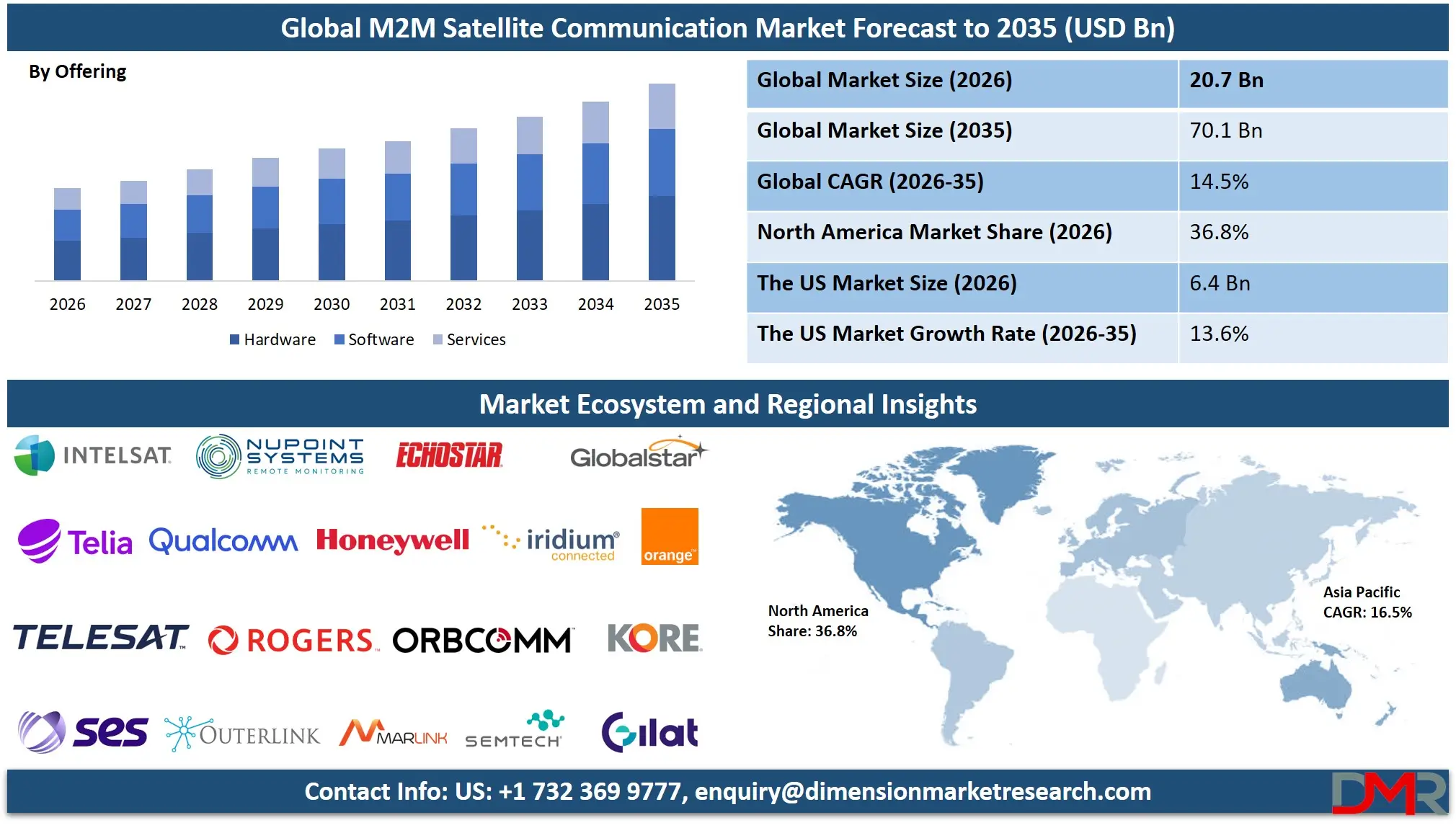
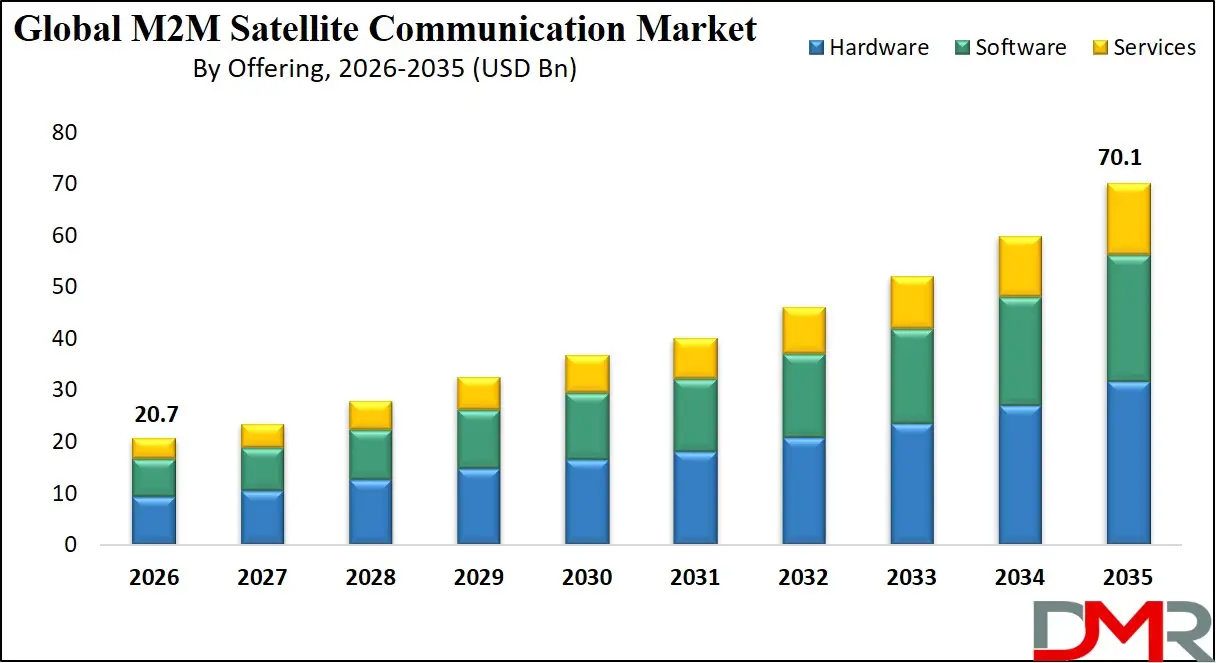
The Global M2M Satellite Communication Market is expected to reach a value of USD 20.7 billion in 2026, and it is further anticipated to reach USD 70.1 billion by 2035, growing at a CAGR of 14.5% during the forecast period.
ℹ
To learn more about this report –
Download Your Free Sample Report Here
The M2M satellite communication market has been enjoying a steady growth as businesses in remote and underserved areas are increasingly going to satellite-based connectivity to facilitate machine-to-machine communications where the terrestrial networks are non-existent or unreliable. The hardware components, software platform, and managed and professional services comprise the market that helps to establish a seamless communication of the data between the devices, sensors, and central management systems through satellite links.
The increasing integration of IoT ecosystems into asset-intensive sectors, the development of Low Earth Orbit (LEO) satellite constellations, and the increased requirement of real-time remote monitoring and control systems are pushing demand towards specific M2M satellite communication applications. The main adopters are industries in geographically dispersed environment, including mining, maritime, energy and utilities, and agriculture, where resilience, low-latency, and globally available connectivity are required to support the most critical operational processes and guarantee business continuity.
ℹ
To learn more about this report –
Download Your Free Sample Report Here
The US M2M Satellite Communication Market
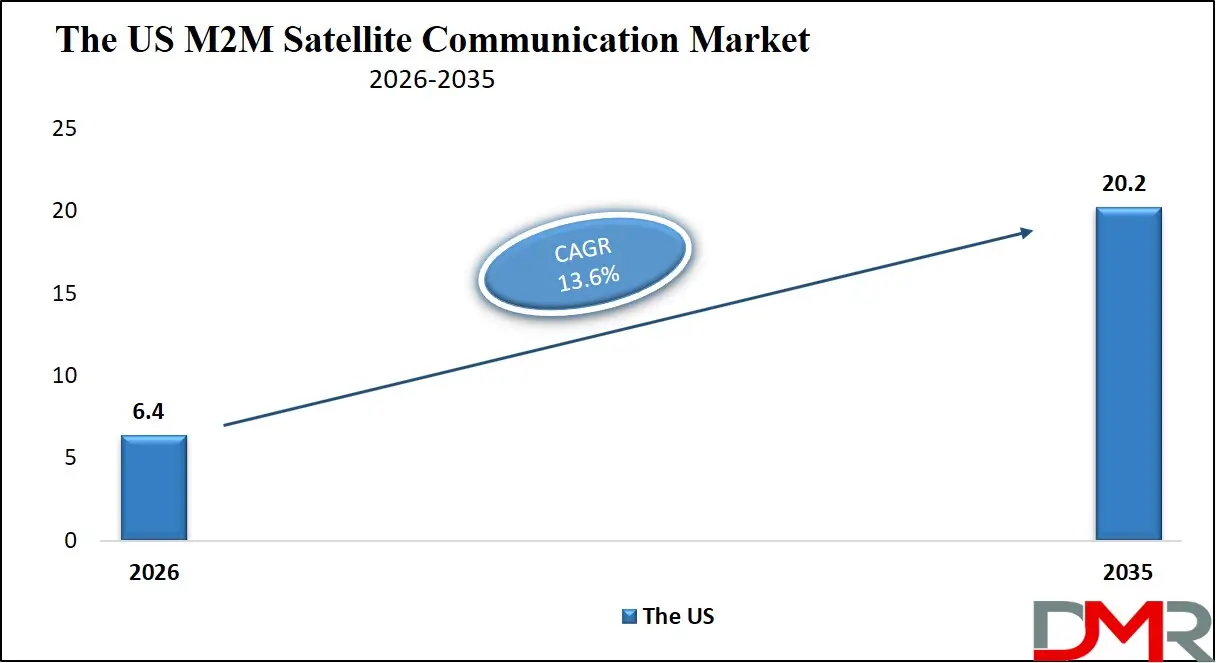
The US M2M Satellite Communication Market is projected to reach USD 6.4 billion in 2026 at a compound annual growth rate of 13.6% over its forecast period, which is further poised to reach a market value of USD 20.2 billion by 2035.
ℹ
To learn more about this report –
Download Your Free Sample Report Here
The United States maintains its position as the largest and most technologically advanced market for M2M satellite communication, driven by substantial investments in next-generation satellite constellations from domestic aerospace leaders and the extensive deployment of remote monitoring solutions across the energy sector. The market is defined by increased demand of LEO-based connectivity solutions as firms strive to use the low-latency and high-throughput of the new satellite networks to address pipeline monitoring to precision agriculture applications. Also, the combination of edge computing functionality with satellite-enabling M2M systems is establishing new demand on managed services capable of coordinating complex and hybrid connectivity frameworks and data protection and regulatory compliance over wide geographic areas.
The Europe M2M Satellite Communication Market
The Europe M2M Satellite Communication Market is estimated to be valued at USD 5.8 billion in 2026 and is further anticipated to reach USD 18.9 billion by 2035 at a CAGR of 14.0%.
The European market is strongly impacted by the ambitious environmental monitoring programs in the region, the needs of the maritime domain awareness, and the strategic investments in sovereign satellite communication systems made by the European Space Agency. Energy and utility Regulatory schemes such as the Green Deal in the EU and strict regulations requiring ongoing monitoring of emissions are driving the need to adopt remote monitoring and control applications in the energy and utilities industry, especially in offshore wind farms and pipeline infrastructure across national borders. There is also a growing move towards faster adoption of hybrid satellite-terrestrial M2M architectures in the region, with agricultural cooperatives and transportation logistics providers looking to ensure the continued visibility of assets traversing areas with patchy cellular coverage.
The Japan M2M Satellite Communication Market
The Japan M2M Satellite Communication Market is projected to be valued at USD 1.8 billion in 2026. It is further expected to witness robust growth, holding USD 5.6 billion in 2035 at a CAGR of 13.4%. The vulnerability of the Japanese to natural disasters and the sophisticated attitude to disaster preparedness and infrastructure resilience creates a unique environment of the Japanese market. The redundancy of emergency and disaster management communication requirements by the government has set the pace of the implementation of satellite-based M2M systems as seismic monitoring, tsunami early warning network, and critical infrastructure telemetry. Moreover, the dominance of autonomous maritime vessels and intelligent fisheries creating a niche market in Japan is creating specific demand in AIS (Automatic Identification System) and satellite telemetry devices capable of supporting real-time tracking of vessels and oceanographic data coverage of the large exclusive economic zone in the country.
Key Takeaways
- Market Size & Forecast: The Global M2M Satellite Communication market is projected to reach USD 20.7 billion in 2026, expanding substantially to USD 70.1 billion by 2035, driven by the two catalysts of LEO constellation deployments and the need to provide ubiquitous connectivity to remote industrial processes through IoT.
- Growth Rate & Outlook: The global market is projected to grow at a CAGR of 14.5% as the number of connected assets in the mining, agricultural and maritime markets continue to rise exponentially and the cost of satellite hardware and airtime continues to fall, making M2M solutions economical to a wider scope of applications.
- Primary Growth Drivers: The expansion of industrial IoT into new geographic locations beyond the coverage of terrestrial networks, the necessity of remote monitoring and control of critical infrastructure, the maturity of LEO satellite constellations with lower latency and higher bandwidth, and the augmenting regulatory demands on asset tracking.
- Key Market Trends: Major market trends are the convergence of satellite and terrestrial connectivity with hybrid network management solutions, the emergence of small form-factor, low-power antennas and modems to be used in battery-operated remote sensors, and the increased use of managed services as enterprises look to delegate the complexity of satellite network operations.
- By Offering Analysis: Hardware is poised to dominate this segment because of its fundamental capability of providing satellite connectivity by provision of antennas, modems, and gateways. The increasing use of IoT in remote settings and the need to deploy rugged, high-performance devices further cement its leadership as software and services are expanding.
- By Technology Analysis: LEO satellite constellations projected to dominate technology segment due to low latencies, global coverage, and the capability to communicate in real-time. Their adaptability to dynamic applications, such as tracking and logistics, and speedy deployment by key players reinforces their dominant role over traditional systems.
- By Type Analysis: VSAT systems are expected to lead type segment dominate because of the dependable two-way communication in remote locations where there are no terrestrial networks. They are extensively deployed in energy, maritime, and government sectors, with scalability, and generalizability assuring sustained leadership in this segment.
- Regional Leadership: North America is poised to dominate this market with 36.8% of the market share in 2026 because of its advanced ecosystem in the space industry, early uptake of LEO services, and vast remote asset base in the oil and gas and mining industries.
What is the M2M Satellite Communication?
M2M (Machine-to-Machine) satellite communication is the automatic transfer of information between devices by satellite networks rather than by the land-based infrastructure. It helps sensors, equipment and remote assets to send and receive information over long distances, particularly where there is no cellular or internet connections. This technology is based on satellite constellations, ground stations and communication modules integrated into devices to facilitate real-time or regular data transfer.
Some of the most common applications of M2M satellite communication include asset tracking services, environmental monitoring, fleet management, and industrial telemetry. It is of vital importance in industries such as maritime, energy, agriculture, and military where connectivity is vital. Its ability to provide global coverage, high reliability and secure data transmission facilitates the development of IoT ecosystems in remote and mission-critical settings.
Use Cases
- Remote Pipeline Monitoring in Energy & Utilities: These systems make use of VSAT terminals to relay the working information to the central control rooms in order to detect the leak, preemptive maintenance planning, and regulatory compliance accountability without the staff having to travel through remote terrain.
- Precision Agriculture and Livestock Management: LEO satellite connected soil moisture sensors and weather stations are able to supply real-time agronomic data used to make irrigation decisions and harvesting times in regions with zero cellular coverage.
- Maritime Vessel Monitoring and Fisheries Compliance: Commercial fishing fleets and cargo vessels are required to have Automatic Identification System (AIS) transceivers transmitting position, course and identification information via satellite to the maritime authorities. It allows sovereign states to track the movement of vessels in the exclusive economic zones, fight illegal fishing, and improve search and rescue efforts in ocean basins.
- Mining Operations and Heavy Equipment Telemetry: Remote monitoring and control solutions are used by mining companies in mountainous or desert areas to monitor the condition and use of haul trucks, excavators, and drilling rigs. Modems and gateways that are connected with satellites relay engine diagnostics, fuel consumption and operator productivity measurements to the centralized fleet management systems and optimize the maintenance intervals and minimize the downtimes of equipment.
How AI is Transforming the M2M Satellite Communication Market
The key way AI is improving M2M satellite communication is through predictive intelligence and autonomous optimization of traditionally fixed data transmission architectures. When used in network management solutions, AI-based algorithms utilize historical traffic data and atmospheric conditions to dynamically assign satellite bandwidth, prioritize critical telemetry data when there is a congestion event, and proactively change modulation schemes to ensure link reliability in bad weather. This optimization minimizes operational expenses and makes sure that the data that comes as a result of the remote monitoring applications is mission-critical and delivered with quality of service guaranteed.
In the software sector, machine learning models within connectivity management software are transforming the way businesses operate fleets of assets connected to satellites. The anomaly detection based on AI is constantly checking the well-being of remote modems and transceivers and detecting minor deviations in the power consumption, signal levels, or data transmission patterns that could signify an imminent hardware failure or intrusion.
Market Dynamics
Key Drivers in the Global M2M Satellite Communication Market
Proliferation of LEO Satellite Constellations
The continuous introduction of large Low Earth Orbit constellations of satellites by commercial space organizations is fundamentally transforming the accessibility and performance properties of M2M satellite communications. Contrary to the conventional Geostationary (GEO) satellites found 36,000 kilometers above the earth, the LEO satellites are found below 2,000 kilometers, which radically lowers the signal latency, which is approximately 600 milliseconds, to less than 50 milliseconds. This lowering of latency enables satellite-based access to be useful in applications that previously required access to a terrestrial network, like real-time remote control of mining equipment or autonomous agricultural machinery.
Expansion of Industrial IoT into Unconnected Geographies
Companies in asset-heavy industries are taking their digital transformation efforts beyond the context of terrestrial network coverage. The industrial IoT revolution that started its development with connected factories and urban infrastructure has recently extended to remote oil fields, offshore wind farms, open-pit mines, and transoceanic shipping routes. This growth generates an insatiable need of satellite telemetry and remote monitoring and control solutions that can provide the same degree of asset awareness and operational intelligence in cellular dead zones like businesses have grown to anticipate within the range of 4G and 5G coverage. The failure of cellular networks to support these key areas of operation makes M2M satellite communication a key facilitator of holistic digital transformation plans.
Restraints in the Global M2M Satellite Communication Market
High Total Cost of Ownership for Hardware and Airtime
Even as satellite service pricing trends have decreased, the overall cost of ownership of M2M satellite communications solutions has been noted to be a major obstacle to adoption, especially among price-sensitive applications and small scale implementations. Premium prices are charged on specialized hardware components, such as ruggedized antennas, modems, transceivers, and others, which are designed to perform well in harsh environmental conditions. Also, a recurrent satellite airtime subscriptions, although reducing, continue to manifest a significant operational cost when aggregated with thousands of remote assets.
Technical Complexity of Integration and Operations
Upon incorporation of M2M satellite communication solutions into the already established enterprise IT and operational technology systems, there are significant technical challenges. In contrast to plug-and-play cellular connectivity, the deployment of satellites demands specialized knowledge in radio frequency engineering, antenna pointing and centering, link budget analysis, and satellite network protocols. The relative lack of in-house resources, such as personnel, possessing this specialized knowledge, drives organizations to turn to external professional services and managed services providers, further burdening costs and coordination complexity.
Growth Opportunities in the Global M2M Satellite Communication Market
Hybrid Connectivity and Intelligent Network Orchestration
Another area of growth is in the creation and implementation of connectivity management systems that smartly coordinate communications between satellite and terrestrial networks. With businesses utilizing M2M-based solutions in geographically varying footprints, the optimal connectivity solution tends to be location and application-specific. Software vendors and managed services providers offering seamless failover, intelligent traffic steering, and single-point billing across heterogeneous networks are in a position to win the high-end market share as businesses strive to make the complexities of hybrid connectivity architecture simplified.
Industry-Specific Vertical Solutions for Agriculture and Mining
The agricultural and mining industries are particularly promising growth vectors of specialized M2M satellite communication products. In farming, the intersection of precision farming practices and the development of farming activities in historically marginalized land is driving a need to integrate turnkey solutions to incorporate soil sensors, weather stations, and equipment telematics with satellite connectivity and domain-specific analytics dashboard. Likewise, the unstopping drive by the mining industry in search of operational efficiency and safety gains in remote areas promotes the need to seek combined solutions to monitor many assets, safety of operators, and supervision of autonomous equipment. Vendors who create vertical depth and solution packages in these verticals will create defensible market positioning.
Trends in the Global M2M Satellite Communication Market
Miniaturization and Power Efficiency of Satellite Hardware
The M2M satellite communication hardware market is also changing radically due to developments in semiconductor technology and antenna design. Modems and transceivers are becoming smaller in size but at the same time minimizing the power requirements to the extent that they can be used in battery-operated or solar-powered remote sensor systems. Electronically steered antennas, which do not use the mechanical pointing mechanisms that traditionally have been a product failure point, are leaving the aerospace grade market as commercially viable products in industrial M2M applications. The new form of hardware opens up a whole new category of deployment, like integrating satellite connectivity into a single agricultural sensor or wildlife tracker collar, and the market of deployment can now be expanded beyond the traditional fixed installation.
Convergence of Satellite IoT with Cloud Analytics Platforms
The convergence of M2M satellite communication data feeds with cloud-based analytics and visualization services is a market trend. Businesses no longer want to accept raw telemetry information of remote assets, they want to easily ingest satellite-delivered information into enterprise resource planning systems, maintenance management solutions and executive dashboards. It is this convergence that is driving the need to demand software solutions that offer standardized APIs, data normalization services and ready-to-use connectors to major cloud services. Providers of managed services are reacting by providing end-to-end solutions to remove the complexities of satellite network operations and provide end-user applications with actionable business intelligence.
Research Scope and Analysis
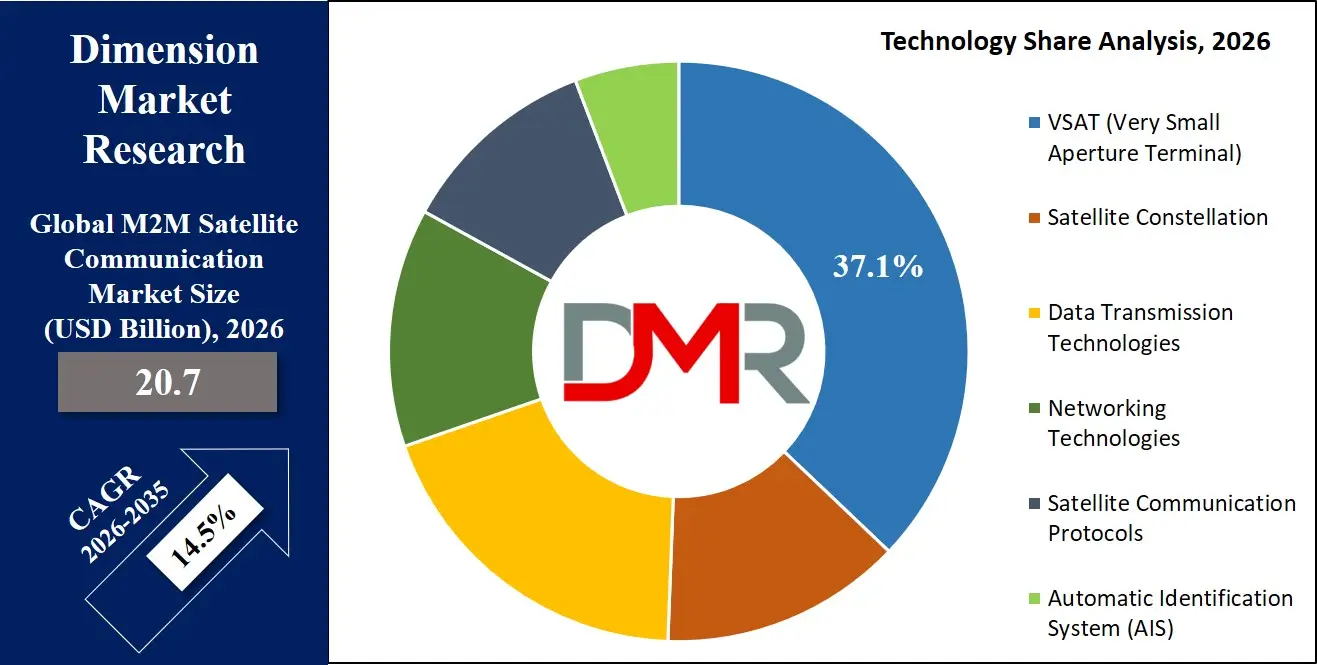
Hardware, LEO satellite constellations, and VSAT systems dominate the M2M satellite communication market, driven by asset tracking demand and strong adoption across energy and utilities for reliable remote connectivity.
ℹ
To learn more about this report –
Download Your Free Sample Report Here
By Offering Analysis
The hardware is poised to dominate the offering segment in the M2M satellite communication market because it provides the foundation on which connectivity is achieved. Antennas, modems, transceivers, and gateways are vital to the process of transmitting and receiving satellite signals and therefore will be imperative in all deployments. The increasing use of IoT devices in remote and harsh conditions, including offshore oil drilling platforms, mining and maritime, maintains the need to demand ruggedized and high-performance hardware. Also, the continuous innovations of small and energy efficient satellite terminals also enhance the leadership of this segment. Although software and services are expanding at a pace with the expansion of platform-based management and managed services, they are still reliant on physical infrastructure, and this strengthens the established market position of hardware.
By Technology Analysis
Satellite constellation technology, particularly Low Earth Orbit (LEO) systems, are poised to dominate this segment due to its superior latency, global coverage, and scalability. LEO satellites are placed in closer orbit to the earth and hence can transmit data faster and provide better real-time communication which is vital to M2M applications such as asset tracking and remote monitoring. LEO constellations offer greater connectivity in mobility-intensive and dynamic applications like aviation, maritime, and logistics in comparison to traditional GEO systems. Adoption further increases with the quick growth of large scale constellations by both privates and government actors. VSAT and AIS may still find their niche applications, but the scalability and performance benefits of LEO systems make satellite constellations the technology front-runners.
By Type Analysis
VSAT (Very Small Aperture Terminal) systems are expected to dominate the type segment as they are commonly used in enterprise and industrial applications. The systems offer dependable two-way satellite communication, which has made them best in supporting continuous data exchange in remote areas where the terrestrial networks are unreliable or inaccessible. VSAT is extensively used in industries like energy, maritime and government as a way of undertaking mission critical communication as well as efficiency in operations. Also, VSAT technology enjoys a good presence in the market due to its maturity and reliability. Although satellite telemetry and AIS systems have limited scope of application, VSAT systems have wider range of application and scalability, which will continue to dominate the classification of systems in the system level category.
By Application Analysis
Asset tracking and management is expected to be the dominant application segment, which has been spurred by the growing demands to have real-time access to assets within the global supply chains. M2M satellite communication allows real-time monitoring of vehicles, containers, equipment, and people in remote or transboundary locations where cellular connections are not available. This capability can play a significant role in industries like logistics, maritime, and oil and gas to make their operations efficient, minimize losses, and enhance safety. The use of IoT sensors in conjunction with satellite networks enhances this segment, as it can also be used to predict maintenance and make decisions based on data. Although the usage of other applications such as remote monitoring and emergency management is increasing, asset tracking is the biggest contributor.
By End-User Industry Analysis
The energy and utilities sector are projected to dominates the end-user segment as it requires widespread communication in remote and infrastructure-restricted environments. Continuous data transmission is the most effective and safe way of oil and gas exploration, pipeline monitoring, power grid management, and renewable energy installations. M2M satellite communication offers continuous connectivity in offshore, desert and rural areas where the terrestrial networks tend to be non-existent. Also, more investments in smart grids, and remote asset monitoring further promote the adoption in this sector. Although other sectors such as maritime, defense and transport are also important contributors, the nature and scale of energy operations make it the market leader.
The Global M2M Satellite Communication Market Report is segmented on the basis of the following:
By Offering
- Hardware
- Antennas
- Modems
- Transceivers
- Gateways
- Software
- Connectivity management platforms
- Network management solutions
- Services
- Managed services
- Professional services
By Technology
- VSAT (Very Small Aperture Terminal)
- Satellite Constellation
- LEO (Low Earth Orbit)
- MEO (Medium Earth Orbit)
- GEO (Geostationary Orbit)
- Data Transmission Technologies
- Networking Technologies
- Satellite Communication Protocols
- Automatic Identification System (AIS)
By Application
- Asset Tracking & Management
- Remote Monitoring & Control
- Telemetry & Sensor Networks
- Security & Surveillance
- Emergency & Disaster Management
- Others
By End-User Industry
- Mining
- Agriculture
- Energy & Utilities
- Government & Public Sector
- Automotive & Transportation
- Maritime
- Retail
- Military & Defense
- Healthcare
- Manufacturing
- Others
Regional Analysis
Leading Region by Market Share
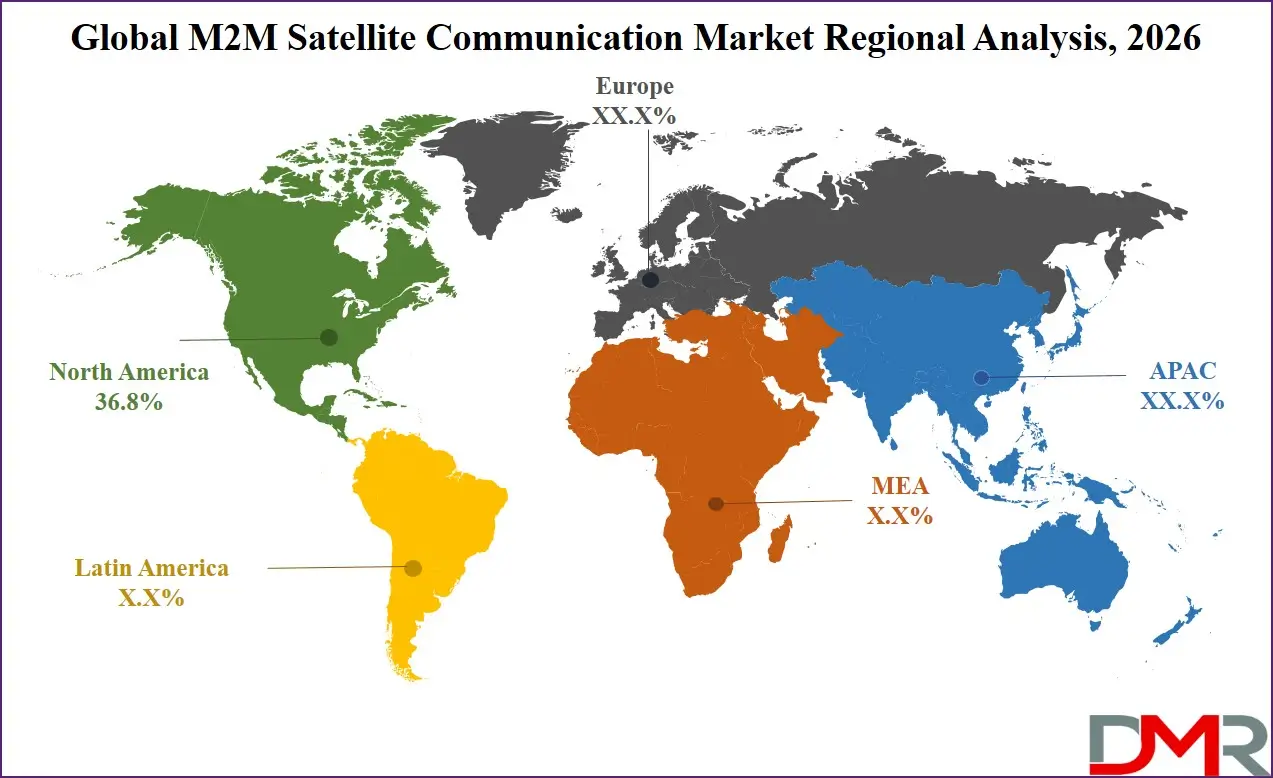
North America is poised to dominate the global M2M satellite communication market, holding 36.8% of the market share by the end of 2026. This dominance due to its leadership position by a presence of unmatched space industry infrastructure, aggressive venture investment in LEO constellation deployment, and massive remote asset bases in the energy, mining and agricultural industries. The industry enjoys the advantage of an established ecosystem with satellite operators, hardware vendors, systems integrators and managed service providers who can all provide end-to-end M2M solutions. The quick commercialisation of LEO satellite services by US-based constellation operators is increasing use in both asset tracking and management and remote monitoring and control applications, and defence and intelligence community services offer a consistent base of demand to secure satellite M2M services.
ℹ
To learn more about this report –
Download Your Free Sample Report Here
Fastest-Growing Regional Market
Asia-Pacific is expected to be the most rapidly expanding regional market for M2M satellite communication, driven by the confluence of ambitious national space programs, expansive maritime economic zones, and accelerating industrialization of remote regions. The strategic investment in GEO and LEO satellite constellations by China, along with its Belt and Road Initiative infrastructure presence in Asia and Africa, present a significant demand on satellite M2M solutions in energy and utilities, mining, and transportation logistics. The modernization efforts in agriculture in India and its expansive coastline that needs awareness of the maritime space also help in enhancing the region. The Southeast Asian archipelagos have their own connectivity issues which satellite M2M can uniquely overcome, specifically in maritime vessel logs, offshore energy platforms, and disaster early warning systems. The relatively undeveloped land telecommunications infrastructure in rural and remote locations of the region makes satellite M2M a primary and not a backup, connectivity solution.
By Region
North America
Europe
- Germany
- The U.K.
- France
- Italy
- Russia
- Spain
- Benelux
- Nordic
- Rest of Europe
Asia-Pacific
- China
- Japan
- South Korea
- India
- ANZ
- ASEAN
- Rest of Asia-Pacific
Latin America
- Brazil
- Mexico
- Argentina
- Colombia
- Rest of Latin America
Middle East & Africa
- Saudi Arabia
- UAE
- South Africa
- Israel
- Egypt
- Rest of MEA
Competitive Landscape
The competitive environment of the global M2M satellite communication market is characterized by a diverse mix of established satellite network operators, specialized hardware manufacturers, and emerging LEO constellation providers. GEO satellite operators can use their large global coverage footprints, well-developed infrastructure to deliver their services, and long-standing customer relationships in the energy and utility and maritime industries. These players are also entering into strategic alliances with LEO constellation operators to provide hybrid multi-orbit solutions that combine the reliability of GEO and the performance benefits of LEO.
Hardware suppliers compete based on product durability in extreme environmental environments, power efficiency when used in battery-based deployments, and form factor optimization to certain applications. Antenna vendors are pumping up their investments in electronically steered array technologies that remove mechanical failure modes and allow mobile uses on vehicles and vessels. Modem and transceiver experts are adding software-defined radio features that enable field hardware to flex to changing satellite network protocols and frequency assignments without having to be replaced physically.
Some of the prominent players in the Global M2M Satellite Communication Market are:
- EchoStar
- Gilat
- Globalstar
- Honeywell
- Intelsat
- Iridium Communications
- Kore Wireless
- Marlink
- Nupoint Systems
- Orange
- ORBCOMM
- Outerlink Global Solutions
- Qualcomm
- Rogers Communications
- Semtech
- SES
- Telesat
- Telia
- Thales
- Other Key Players
Recent Developments
- October 2025: Iridium Communications launched its next-generation connectivity management system, which leverages artificial intelligence-powered predictive analytics to proactively monitor the health of satellite terminals and automatically optimize bandwidth allocation within its LEO constellation, with particular focus on its managed services for energy, utilities, and mining companies.
- August 2025: ORBCOMM Inc. finalized its acquisition of a European satellite IoT solution vendor that offers specialized services in telemetry and sensor networks, particularly useful for environmental monitoring and emergency and disaster response, further strengthening its presence in the government and public sectors while complementing its software suite for network orchestration across multiple constellations.
- June 2025: Globalstar signed a joint venture agreement with a prominent agricultural technology firm to provide an advanced precision agriculture package that integrates a ground-based soil sensor network with satellite communications through Globalstar's LEO constellation, allowing for precise irrigation control and crop condition monitoring in farming operations in hard-to-reach areas of Latin America and Asia Pacific.
Report Details
| Report Characteristics |
| Market Size (2026) |
USD 20.7 Bn |
| Forecast Value (2035) |
USD 70.1 Bn |
| CAGR (2026–2035) |
14.5% |
| The US Market Size (2026) |
USD 6.4 Bn |
| Historical Data |
2021 – 2025 |
| Forecast Data |
2027 – 2035 |
| Base Year |
2025 |
| Estimate Year |
2026 |
| Segments Covered |
By Offering (Hardware, Software, Services), By Technology (VSAT (Very Small Aperture Terminal), Satellite Constellation, Data Transmission Technologies, Networking Technologies, Satellite Communication Protocols, Automatic Identification System (AIS)), By Application (Asset Tracking & Management, Remote Monitoring & Control, Telemetry & Sensor Networks, Security & Surveillance, Emergency & Disaster Management, Others), By End-User Industry (Mining, Agriculture, Energy & Utilities, Government & Public Sector, Automotive & Transportation, Maritime, Retail, Military & Defense, Healthcare, Manufacturing, Others) |
| Regional Coverage |
North America – The US and Canada; Europe – Germany, The UK, France, Russia, Spain, Italy, Benelux, Nordic, & Rest of Europe; Asia-Pacific – China, Japan, South Korea, India, ANZ, ASEAN, Rest of APAC; Latin America – Brazil, Mexico, Argentina, Colombia, Rest of Latin America; Middle East & Africa – Saudi Arabia, UAE, South Africa, Turkey, Egypt, Israel, & Rest of MEA |
Frequently Asked Questions
How big is the Global M2M Satellite Communication Market?
▾ The Global M2M Satellite Communication market is poised to be valued at USD 20.7 billion in 2026 and is projected to reach USD 70.1 billion by 2035, driven by the expansion of industrial IoT into areas beyond terrestrial network coverage and the commercial deployment of LEO satellite constellations.
What is the CAGR of the Global M2M Satellite Communication Market from 2026 to 2035?
▾ The market is expected to grow at a CAGR of 14.5% from 2026 to 2035, reflecting the accelerating adoption of satellite-enabled remote monitoring, asset tracking, and telemetry applications across energy, agriculture, maritime, and mining sectors.
What factors are driving the growth of the Global M2M Satellite Communication Market?
▾ Key drivers include the proliferation of LEO satellite constellations offering lower latency and reduced service costs, the expansion of industrial IoT into geographically remote operating environments, and the increasing regulatory requirements for environmental compliance and asset visibility in industries such as maritime and energy.
Which region held the largest share of the M2M Satellite Communication Market in 2026?
▾ North America is projected to dominate this market with 36.8% of the market share in 2026, driven by a mature space industry ecosystem, early availability of LEO satellite services, and extensive remote asset bases across the energy, mining, and agricultural sectors.
Which region is expected to grow the fastest in the M2M Satellite Communication Market?
▾ The Asia-Pacific region is expected to grow the fastest, fueled by national space program investments, expansive maritime economic zones, accelerating industrialization of remote areas, and relatively underdeveloped terrestrial telecommunications infrastructure in rural regions.
What are the major trends in the Global M2M Satellite Communication Market?
▾ Major trends include the miniaturization and power efficiency improvements of satellite hardware, the convergence of satellite M2M data with cloud analytics platforms, the adoption of hybrid multi-orbit connectivity strategies, and the integration of AI capabilities into network management solutions.
Who are the key players in the Global M2M Satellite Communication Market?
▾ Key players include established satellite network operators like Iridium, Inmarsat, Globalstar, and ORBCOMM, LEO constellation providers including SpaceX (Starlink) and OneWeb, and hardware and managed service specialists such as KVH Industries, Gilat Satellite Networks, and ST Engineering iDirect.
How is the Global M2M Satellite Communication Market segmented?
▾ The market is segmented by By Offering, By Technology, By Application, and By End-User Industry.