Market Snapshot
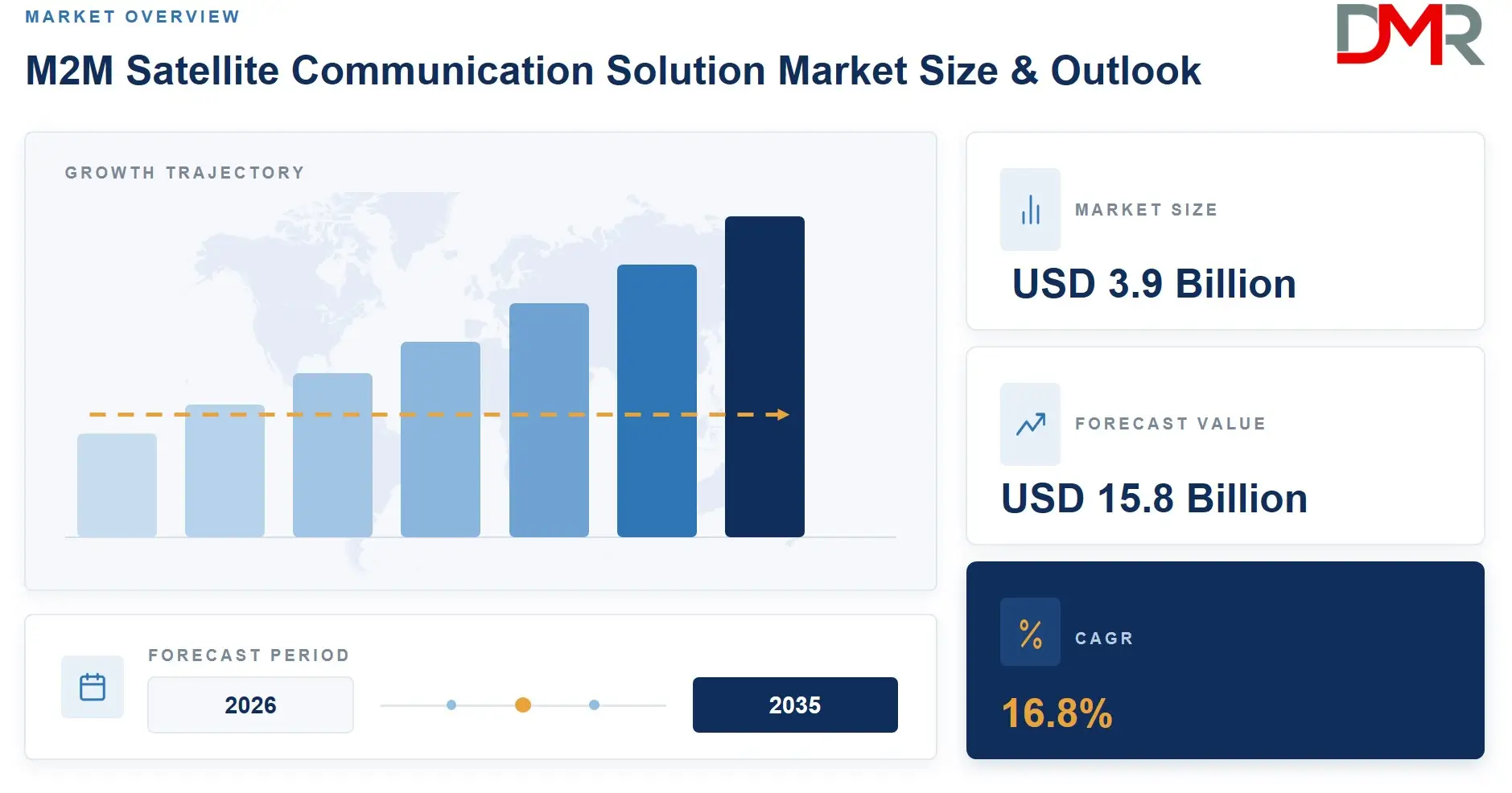
- Market Size (2026): USD 3.9 Bn
- Forecast Value (2035): USD 15.8 Bn
- CAGR (2026-2035): 16.8%
- Largest Region (2026): North America, approximately 34%
- Fastest-Growing Region: Asia-Pacific
- Leading Offering (2026): Hardware Terminals & Modules, around 44%
- Leading Application (2026): Asset Tracking & Fleet Management, close to 29%
- Key Players: Iridium Communications, Viasat and EchoStar, among others
What is M2M Satellite Communication Solution Market and its Market Size?
Global M2M Satellite Communication Solution Market size is estimated to reach USD 3.9 Bn in 2026 and is further anticipated to reach USD 15.8 Bn by 2035, at a CAGR of 16.8%.
ℹ
To learn more about this report –
Download Your Free Sample Report Here
The market covers the terminals, modules, connectivity services and software platforms that let machines, vehicles, vessels and fixed remote assets exchange telemetry, tracking and control data over satellite links in locations where terrestrial cellular coverage is absent, unreliable or economically unviable. It sits apart from consumer satellite broadband and direct-to-home television distribution; the addressable spend here is machine-originated traffic carried over L-band, Ku-band, Ka-band and S-band spectrum, priced by connection count and data volume rather than by household subscription.
Buyers cluster around asset-heavy operators with exposure to coverage gaps. Transportation and logistics firms track containers, trailers and rail cars across ocean crossings and low-density corridors where no cellular tower reaches. Oil and gas producers monitor pipeline pressure, wellhead status and compressor health from sites built before grid or fibre access existed. Maritime fleets report position, fuel burn and cargo condition to satisfy International Maritime Organisation reporting obligations, and government and defence agencies use satellite M2M links as a resilient fallback when terrestrial networks are degraded, congested or contested.
The structural shift underway is the movement of low earth orbit constellations into commercial service, paired with the extension of 3GPP non-terrestrial network standards into mainstream cellular chipsets. Direct-to-device partnerships between satellite operators and mobile carriers are pulling M2M connectivity out of a specialist procurement category and into ordinary IoT deployment planning, which is compressing hardware prices and widening the buyer base beyond the traditional oil, gas and maritime core.
Use Cases
- Cross-Border Trailer Tracking: Logistics operators fit refrigerated trailers with satellite trackers so dispatchers keep continuous visibility once a shipment leaves cellular range on long-haul freight corridors, cutting the blind spots that previously forced manual check calls at each border crossing.
- Unmanned Pipeline Monitoring: Upstream operators install satellite-linked pressure and flow sensors along remote pipeline segments, which is expected to shave close to 18% off routine inspection costs by replacing scheduled helicopter flyovers with continuous telemetry.
- Vessel Position and Cargo Reporting: Shipping lines equip bulk carriers and tankers with satellite terminals that stream position, fuel consumption and cargo hold conditions to shore-based operations centres, supporting compliance with maritime safety and emissions reporting rules.
- Precision Irrigation Scheduling: Large-scale farm operators in regions without rural broadband deploy soil-moisture and weather sensors linked by satellite, letting agronomists schedule irrigation and fertigation remotely rather than relying on periodic manual field visits.
Key Takeaways
- Market Size & Share: The market is estimated at USD 3.9 Bn in 2026, rising to USD 15.8 Bn by 2035.
- Offering Analysis: Hardware Terminals & Modules lead with approximately 44% of 2026 revenue.
- Regional Analysis: North America holds close to 34% of global share in 2026, with Asia-Pacific growing fastest.
- Orbit Shift: Low earth orbit platforms are projected to hold around 34% share by satellite type in 2026, narrowing the gap with geostationary incumbents.
- Application Concentration: Asset Tracking & Fleet Management accounts for nearly 29% of 2026 application demand.
- End Use Breadth: Transportation & Logistics remains the leading end use industry at approximately 27% of 2026 revenue, with Agriculture the fastest-growing.
How AI/Gen AI is Transforming the M2M Satellite Communication Solution Market?
Artificial intelligence is reshaping this market less through generative content and more through operational inference at the network edge. Onboard compute on satellite terminals now screens sensor readings before transmission, sending only anomalous or state-change events over expensive, bandwidth-limited links rather than continuous raw streams. This shift has a direct commercial effect: it lowers the airtime cost that has historically capped how many sensors a single asset can economically carry.
Ground-side platforms apply the same discipline in reverse, using predictive models to forecast link outages caused by satellite handover or weather fade and to pre-stage data buffering accordingly. Fleet and asset operators increasingly buy the analytics layer alongside the connectivity itself, which is pulling software further into the revenue mix and away from a pure hardware-and-airtime model.
- Edge Anomaly Detection: Onboard models flag pressure, vibration or temperature deviations and trigger event-based transmission instead of constant polling.
- Predictive Link Scheduling: Machine learning forecasts satellite visibility windows and outage risk to time transmissions for the lowest-cost path.
- Computer Vision for Maritime Inspection: Camera-equipped vessel terminals compress and prioritise imagery of deck or cargo anomalies for satellite backhaul.
- Automated Regulatory Reporting: Natural language generation compiles satellite-sourced telemetry into IMO and pipeline safety filings without manual data entry.
Key Drivers in the Global M2M Satellite Communication Solution Market
Two forces are pulling demand in different but reinforcing ways.
- Expansion of Low Earth Orbit Capacity: The commissioning of new low earth orbit constellations has cut the round-trip latency and per-byte cost of satellite links compared with legacy geostationary service, making satellite M2M viable for applications that previously could not justify the airtime bill. Fleet telematics and utility metering programmes that once budgeted for sparse, low-frequency position pings can now afford near-continuous reporting, which widens the addressable sensor count per asset. Terminal vendors have responded with smaller, lower-power modules sized for this new cost structure, and several national telecom regulators have fast-tracked spectrum coordination to accommodate the added satellite traffic, reinforcing the shift.
- Regulatory Reporting Mandates in Maritime and Energy: International Maritime Organisation tracking rules and national pipeline safety codes increasingly require continuous, auditable position and condition data from assets that operate beyond cellular coverage, and satellite M2M is the only practical way to meet that obligation on open ocean routes or in remote onshore fields. Operators facing penalties for reporting gaps are converting from periodic manual logging to always-on satellite telemetry, and insurers are beginning to price maritime and pipeline risk more favourably for fleets that carry verified satellite tracking, which turns a compliance cost into a commercial argument for adoption.
Restraints in the Global M2M Satellite Communication Solution Market
Two structural brakes temper the pace of adoption.
- High Terminal and Airtime Cost Relative to Cellular: Even with low earth orbit cost reductions, a satellite-connected sensor still costs several multiples more to deploy and operate than an equivalent cellular or LPWAN device, which keeps satellite M2M a coverage-gap solution rather than a default choice. Fleet operators mixing cellular and satellite connectivity face integration overhead in managing two billing models, two data formats and two provisioning systems, and smaller operators without dedicated IT resources often defer satellite deployment until asset losses or compliance penalties force the decision.
- Spectrum Coordination and Cross-Border Licensing Friction: Satellite M2M terminals that cross national boundaries, whether on a truck, a vessel or a migratory sensor network, must clear licensing requirements in every jurisdiction they transit, and coordination between national regulators and the International Telecommunication Union remains slow relative to the pace of constellation deployment. Operators serving multi-country corridors sometimes carry redundant hardware to satisfy conflicting national rules, which adds cost and complicates fleet-wide standardisation, and disputes over orbital slot and frequency interference between geostationary incumbents and new low earth orbit entrants have occasionally delayed service launches in specific markets.
Growth Opportunities in the Global M2M Satellite Communication Solution Market
Two areas of white space stand out for vendors willing to move beyond the legacy oil, gas and maritime core.
- Direct-to-Device Partnerships with Mobile Carriers: Satellite operators partnering directly with terrestrial mobile carriers to extend standard smartphone and IoT chipsets onto satellite links, rather than requiring dedicated terminals, open a materially larger addressable base than the specialist hardware model supported to date. Carriers gain a coverage story for rural and maritime customers without laying new infrastructure, and chipset vendors are already integrating non-terrestrial network support into mainstream silicon, which lowers the unit cost of entry for IoT device makers who previously avoided satellite connectivity altogether.
- Precision Agriculture in Underserved Farming Regions: Large-scale agricultural operations across regions with limited rural broadband represent a underexploited segment for soil, weather and irrigation sensor networks carried over satellite, since farm parcels are typically large enough to justify the hardware cost per sensor cluster rather than per individual device. Equipment makers bundling satellite connectivity into tractors, irrigation controllers and grain storage monitors give operators a single procurement decision instead of a separate connectivity purchase, which shortens the sales cycle for vendors that package hardware and airtime together.
Trends in the Global M2M Satellite Communication Solution Market
Two shifts are changing how the market is bought and sold, distinct from the drivers above.
- Bundled Hardware-Plus-Software Pricing: Vendors are moving away from separate terminal sales and airtime billing toward a single subscription that bundles the module, connectivity and an analytics dashboard, mirroring the shift already seen in terrestrial IoT connectivity management. This consolidation raises the software share of total revenue and gives operators a single point of accountability for uptime, which is reshaping how vendors structure sales teams and support contracts around account management rather than one-off hardware transactions.
- Constellation Consolidation Through Merger Activity: Ownership of satellite capacity is concentrating as operators combine geostationary and low earth orbit fleets under single corporate umbrellas, reducing the number of independent capacity providers that M2M solution vendors must negotiate with. This consolidation is changing procurement leverage for large fleet customers, who increasingly negotiate multi-year capacity commitments directly with combined operators rather than through smaller regional resellers, and it is prompting mid-tier vendors to differentiate on software and vertical expertise rather than on satellite access alone.
Research Scope and Analysis
Segment performance is assessed across five axes: offering, satellite orbit type, application, end use industry and frequency band. Each axis identifies the sub-segment carrying the largest share of 2026 revenue and the one expanding fastest through 2035, with the commercial reason behind each position.
ℹ
To learn more about this report –
Download Your Free Sample Report Here
By Offering
Hardware Terminals & Modules is projected to hold the largest share by offering in 2026, accounting for close to 44% of revenue, since every deployment requires a physical device regardless of how the connectivity or software layer is priced, and replacement cycles driven by battery life and orbital handover compatibility keep unit demand recurring. Growth, however, is concentrated in Software & Analytics Platforms, expanding at a CAGR of 23.5% between 2026 and 2035 as operators bundle predictive maintenance, anomaly detection and reporting tools into the connectivity contract rather than buying dashboards separately, shifting spend toward recurring software revenue.
By Satellite Orbit Type
Geostationary orbit terminals are expected to remain the largest category by orbit type in 2026, holding approximately 41% of revenue, reflecting the installed base of long-lived geostationary service contracts across maritime and government users that predate the newer constellations. The steeper trajectory sits with low earth orbit platforms, forecast at a CAGR of 24.1% through 2035, as new constellations reach global coverage and undercut geostationary latency and cost for applications that do not require the continuous single-satellite link geostationary service provides.
By Application
Asset Tracking & Fleet Management is set to lead application demand in 2026 at around 29% of revenue, driven by the sheer scale of transportation and logistics fleets that need continuous position visibility once assets leave cellular coverage. Growth, however, is concentrated in Environmental & Agricultural Monitoring, projected at a CAGR of 22.7% between 2026 and 2035, as large-scale farm operators in underserved broadband regions adopt soil and weather sensor networks that were previously uneconomical to connect.
By End Use Industry
Transportation & Logistics is expected to account for the largest end use share in 2026, at approximately 27% of revenue, reflecting the density of tracked assets per operator and the compliance pressure around cross-border cargo visibility. The steeper trajectory sits with Agriculture, forecast at a CAGR of 21.3% through 2035, as equipment makers bundle satellite connectivity directly into farm machinery rather than leaving it as a separate purchase decision for operators.
By Frequency Band
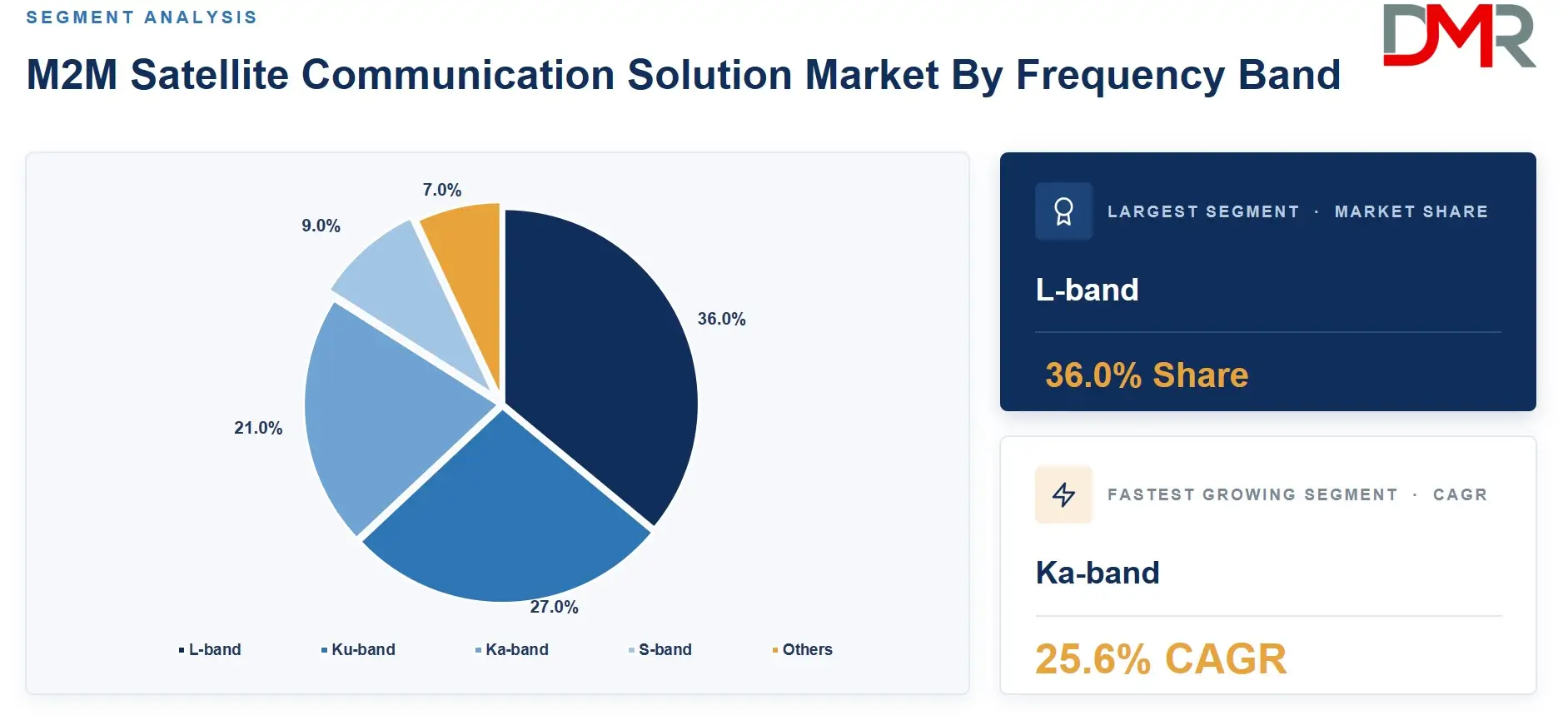
L-band is projected to remain the largest frequency category in 2026, holding close to 36% of revenue, since its narrowband, low-power characteristics remain the most cost-efficient fit for the intermittent telemetry that dominates legacy M2M deployments. Growth, however, is concentrated in Ka-band, expanding at a CAGR of 25.6% between 2026 and 2035, as new constellations built on Ka-band spectrum deliver the higher throughput that camera-equipped and sensor-dense applications increasingly require.
The Global M2M Satellite Communication Solution Market Report is Segmented Based on the Following
By Offering
- Hardware Terminals & Modules
- Connectivity Services
- Software & Analytics Platforms
- Professional & Managed Services
- Others
By Satellite Orbit Type
- Geostationary Orbit (GEO)
- Low Earth Orbit (LEO)
- Medium Earth Orbit (MEO)
- Hybrid / Multi-Orbit
- Others
By Application
- Asset Tracking & Fleet Management
- Remote Monitoring & SCADA
- Maritime Communication
- Environmental & Agricultural Monitoring
- Emergency & Disaster Response Communication
- Others
By End Use Industry
- Transportation & Logistics
- Oil & Gas
- Maritime
- Agriculture
- Government & Defence
- Utilities & Energy
- Others
By Frequency Band
- L-band
- Ku-band
- Ka-band
- S-band
- Others
Regional Analysis
Region with the Largest Revenue Share
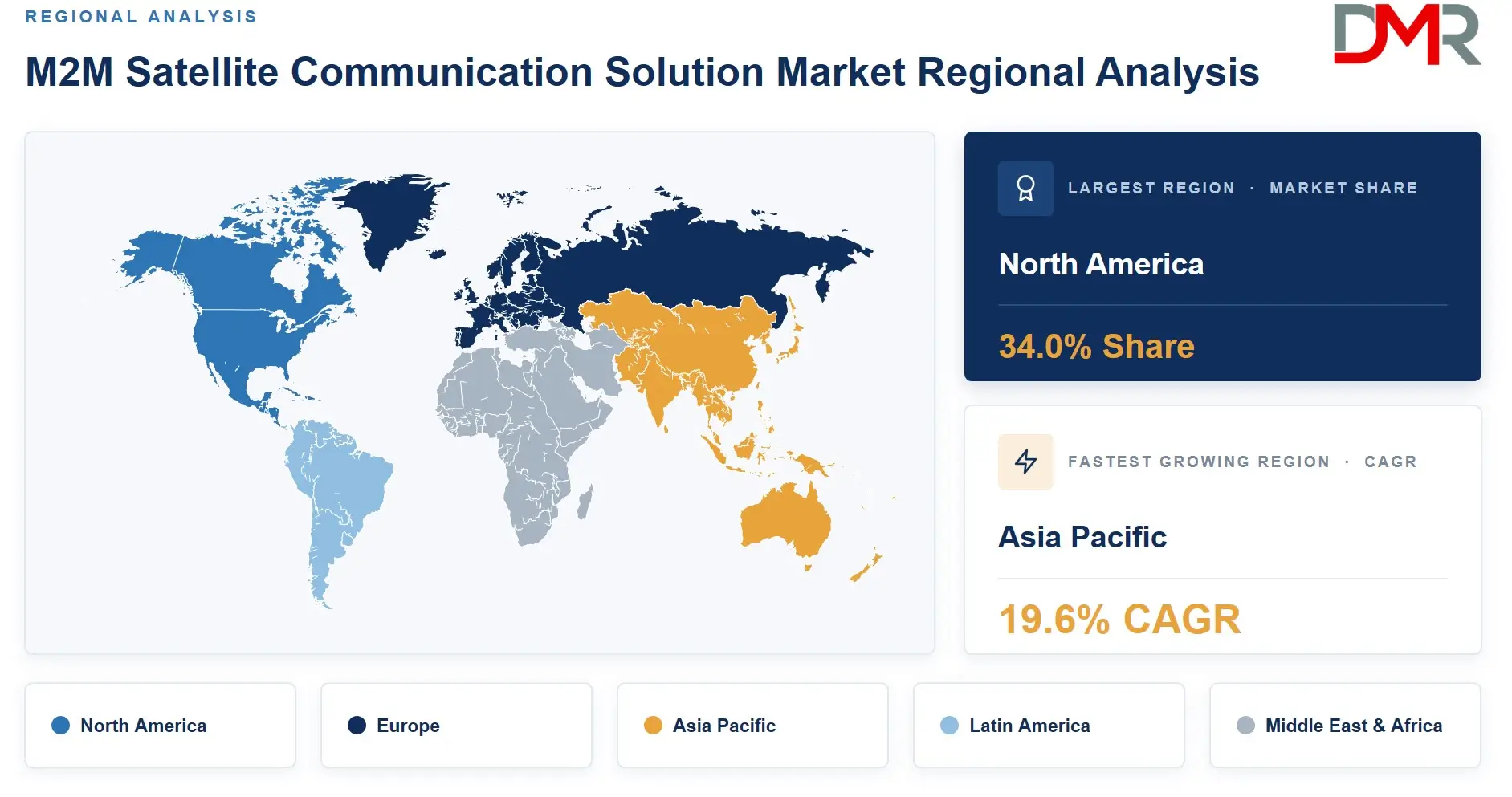
North America is expected to hold the largest regional share in 2026, accounting for approximately 34% of global revenue. The region's oil and gas producers operate extensive remote pipeline and wellhead networks across areas with no cellular backhaul, and its trucking and rail networks span long low-density corridors that make satellite tracking a standard fleet fitment rather than an exception. Government and defence procurement, which favours domestically licensed satellite capacity for resilience reasons, adds a further layer of stable demand that is less price-sensitive than commercial fleet spending.
ℹ
To learn more about this report –
Download Your Free Sample Report Here
Region with the Highest CAGR
Asia-Pacific is forecast to grow fastest through 2035, at a CAGR of 19.6%, as the region's shipping lanes carry a growing share of global maritime trade and its agricultural operators adopt sensor networks in areas where rural broadband build-out has lagged urban connectivity investment. New regional low earth orbit ground infrastructure is also lowering the cost of entry for operators that previously depended on higher-cost geostationary capacity leased from outside the region.
By Region
North America
Europe
- Germany
- France
- The UK
- Italy
- Spain
- Rest of Europe
Asia-Pacific
- China
- Japan
- India
- Australia
- South Korea
- Rest of APAC
Latin America
- Mexico
- Brazil
- Colombia
- Argentina
- Rest of LATAM
Middle East & Africa
- Saudi Arabia
- The UAE
- South Africa
- Rest of MEA
Technology Analysis
Satellite M2M technology is mid-transition from a small number of long-lived geostationary networks toward a layered environment of geostationary, low earth orbit and hybrid constellations, with terminals increasingly designed to hand off between orbits automatically. The immediate shift is in silicon: chipset vendors are embedding 3GPP non-terrestrial network support into mainstream modules, which is collapsing the historical cost gap between a dedicated satellite terminal and a standard IoT device. The commercial opening sits with device makers who can ship a single module that works across cellular and satellite links without a separate satellite-only product line, since that removes the inventory and support burden that has kept many IoT vendors out of the satellite category entirely. The principal risk is interoperability fragmentation, since competing constellations use different waveforms and ground infrastructure, and a device optimised for one network may not roam cleanly onto another, which could slow the standardisation that is currently lowering unit costs and widening the addressable device base.
Geopolitical Analysis
Orbital slot allocation and spectrum rights remain contested between established geostationary operators and newer low earth orbit entrants, with national regulators and the International Telecommunication Union mediating disputes that can delay service launches in specific countries. Export controls on satellite hardware and encryption-capable terminals are tightening in several jurisdictions, which is shifting where vendors locate manufacturing and how they structure cross-border sales to government and defence customers. The commercial opening lies with operators that hold licensed spectrum and ground infrastructure across multiple friendly jurisdictions, since they can offer multinational fleet customers a single contract instead of a patchwork of national resellers. The risk is that data sovereignty rules requiring satellite traffic to route through domestic ground stations could fragment what has so far been a largely borderless service model, raising costs for operators serving customers that cross politically sensitive corridors and potentially slowing adoption in regions where licensing remains unresolved.
Competitive Landscape
The market remains moderately concentrated at the network layer, where a small number of operators control the geostationary and low earth orbit capacity that everyone else resells or builds on top of, while the terminal, module and software layer is comparatively fragmented and open to new entrants. Competition centres on three levers: breadth of orbital coverage, terminal price and power efficiency, and the depth of the software and analytics layer bundled with connectivity. Consolidation between capacity owners is reshaping the competitive map faster than product innovation, as combined geostationary and low earth orbit portfolios let larger operators offer a single contract spanning coverage types that used to require separate vendors. Smaller specialists are responding by narrowing focus to a single vertical, such as maritime or agriculture, where deep application knowledge offsets their lack of proprietary satellite capacity.
Some of the Prominent Players in the Global M2M Satellite Communication Solution Market Are
- Iridium Communications Inc.
- Viasat Inc.
- EchoStar Corporation
- SES S.A.
- Eutelsat Group
- Intelsat S.A.
- Telesat Corporation
- Thales Group
- Honeywell International Inc.
- Garmin Ltd.
- Globalstar Inc.
- ORBCOMM Inc.
- KVH Industries Inc.
- Skylo Technologies Inc.
- Astrocast SA
- Kepler Communications Inc.
- Swarm Technologies Inc.
- Myriota Pty Ltd
- Lacuna Space Ltd
- Kineis SA
- Wyld Networks AB
- Fleet Space Technologies Pty Ltd
- Ligado Networks LLC
- Anuvu Corporation
- Speedcast International Ltd
- Semtech Corporation
- Telit Cinterion
- u-blox Holding AG
- Quectel Wireless Solutions Co., Ltd.
- NAL Research Corporation
- China Satellite Communications Co., Ltd.
- Thuraya Telecommunications Company
- Hanwha Systems Co., Ltd.
- SKY Perfect JSAT Corporation
- Al Yah Satellite Communications Company (Yahsat)
- Antrix Corporation Limited
- Rock Seven Mobile Data Services Ltd (RockBLOCK)
- Blue Sky Network LLC
- Beam Communications Pty Ltd
- Addvalue Technologies Ltd
- Other Key Players
Recent Developments
- In February 2026, Skylo Technologies expanded its direct-to-device satellite messaging service to additional smartphone chipset partners, extending non-terrestrial network coverage to a broader base of consumer and IoT devices without a dedicated satellite terminal.
- In April 2026, Eutelsat Group completed further integration of its geostationary and low earth orbit ground infrastructure, giving enterprise M2M customers a single provisioning system across both orbit types.
- In June 2025, Iridium Communications certified a new generation of low-power satellite modules aimed at battery-constrained agricultural and environmental sensor deployments, cutting device power draw for infrequent telemetry reporting.
- In September 2025, ORBCOMM extended its asset tracking platform with satellite-cellular dual-mode devices designed for cross-border trailer fleets, reducing coverage gaps at national boundaries.
- In November 2025, Kepler Communications began commercial data relay service using its low earth orbit constellation for remote industrial monitoring customers in previously underserved northern latitude regions.
- In October 2024, Viasat completed integration work following its acquisition of Inmarsat, consolidating maritime and government M2M service contracts onto a combined network footprint.
Report Details
| Report Characteristics |
| Market Size (2026) |
USD 3.9 Bn |
| Forecast Value (2035) |
USD 15.8 Bn |
| CAGR (2026-2035) |
16.8% |
| The US Market Size (2026) |
USD 1.0 Bn |
| Historical Data |
2021 - 2025 |
| Forecast Data |
2026 - 2035 |
| Base Year |
2025 |
| Segments Covered |
By Offering, By Satellite Orbit Type, By Application, By End Use Industry, By Frequency Band |
| Regional Coverage |
North America - The US and Canada; Europe - Germany, France, The UK, Italy, Spain, Rest of Europe; Asia-Pacific - China, Japan, India, Australia, South Korea, Rest of APAC; Latin America - Mexico, Brazil, Colombia, Argentina, Rest of LATAM; Middle East & Africa - Saudi Arabia, The UAE, South Africa, Rest of MEA |
Frequently Asked Questions
How big is the Global M2M Satellite Communication Solution Market?
▾ The market is estimated at USD 3.9 Bn in 2026 and is projected to reach USD 15.8 Bn by 2035, reflecting rising demand for asset visibility beyond terrestrial cellular coverage across logistics, energy and maritime operations.
What is the growth rate of the Global M2M Satellite Communication Solution Market?
▾ The market is forecast to expand at a CAGR of 16.8% between 2026 and 2035, driven by falling low earth orbit connectivity costs and tightening regulatory reporting mandates in maritime and pipeline operations.
Which region holds the largest share in the Global M2M Satellite Communication Solution Market?
▾ North America holds the largest share, accounting for approximately 34% of global revenue in 2026, supported by extensive remote oil and gas infrastructure, long-haul freight corridors and defence procurement of satellite capacity.
Who are the key players in the Global M2M Satellite Communication Solution Market?
▾ Leading companies include Iridium Communications, Viasat, EchoStar, SES, Eutelsat Group, Globalstar and ORBCOMM, alongside specialist low earth orbit entrants such as Kepler Communications and Skylo Technologies.
Which offering leads the Global M2M Satellite Communication Solution Market?
▾ Hardware Terminals & Modules lead the offering segment, accounting for close to 44% of 2026 revenue, while Software & Analytics Platforms is the fastest-growing offering as bundled analytics gains share within connectivity contracts.