Malaysia Food Packaging Market Snapshot
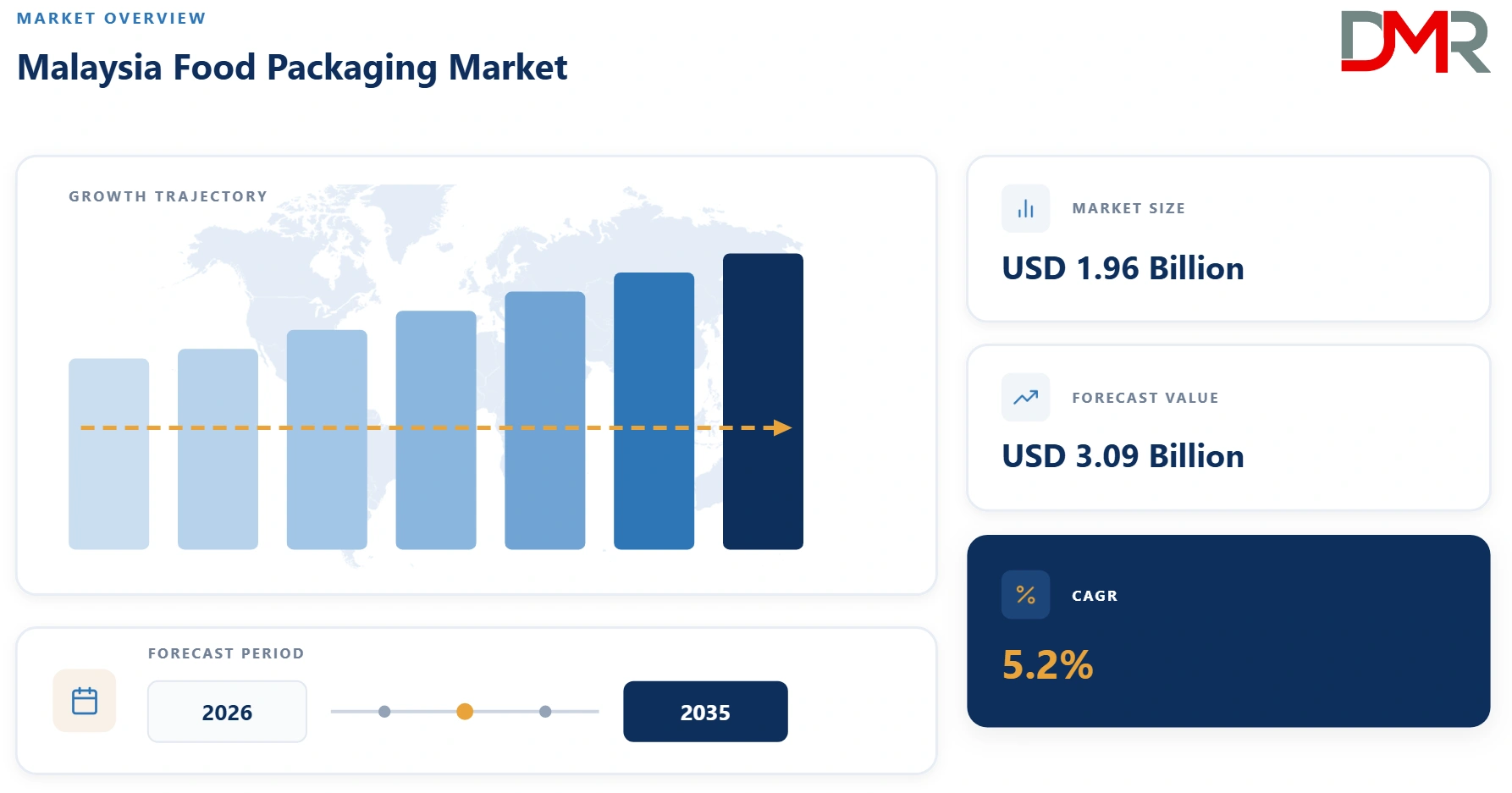
- Market Size in 2026: USD 1.96 billion
- Market Size in 2035: USD 3.09 billion
- CAGR, 2026-2035: 5.2%
- Leading Material Segment: Plastics, 54% share
- Leading Packaging Type: Flexible Packaging, 61% share
- Leading Application Segment: Meat, Poultry & Seafood, 18.6% share
- Fastest-Growing Segment: Bioplastics/Compostable Materials, 8.5% CAGR
What is the Malaysia Food Packaging and its Market Size?
The Malaysia food packaging market is estimated at USD 1.96 billion in 2026 and is projected to reach approximately USD 3.09 billion by 2035, representing a 5.2% CAGR.
ℹ
To learn more about this report –
Download Your Free Sample Report Here
The Malaysia food packaging market comprises materials, containers, films, pouches, cartons, trays, bottles, cans, closures and packaging technologies used to protect, preserve, transport, display and dispense food products. It covers flexible and rigid formats manufactured from plastics, paper and paperboard, glass, metal and emerging bio-based or compostable materials. Technologies include conventional packaging as well as modified-atmosphere, vacuum, aseptic, active and intelligent packaging. The market serves food processors, beverage manufacturers, foodservice operators, retailers and grocery chains. Its core value proposition is to extend shelf life, protect food safety and quality, reduce product loss, improve logistics and provide convenience while increasingly lowering material and environmental impacts.
Use Cases
- Fresh meat and seafood: Vacuum and modified-atmosphere packaging extends shelf life while protecting appearance, hygiene and product integrity.
- Bakery and confectionery: Flexible films and pouches protect products against moisture, oxygen and physical damage.
- Dairy products: Cups, tubs, cartons and aseptic formats preserve freshness and facilitate convenient distribution.
- Ready-to-eat foods: Trays, pouches and microwaveable containers support convenience, portion control and longer refrigerated or ambient shelf life.
- Beverages: PET bottles, cans and aseptic cartons provide portability, protection and efficient distribution.
- Fruits and vegetables: Flexible films, trays and modified-atmosphere systems reduce deterioration and food waste.
Key Takeaways
- Market size: Malaysia's food packaging market is estimated at USD 1.96 billion in 2026, reaching approximately USD 3.09 billion by 2035.
- Growth: The market is expected to expand at approximately 5.2% CAGR during 2026-2035.
- Primary drivers: Food-processing growth, convenience foods, urban consumption, food delivery, modern retail and demand for shelf-life extension.
- Segment dominance: Plastics remain the largest material category, while flexible packaging is the largest packaging format because of its cost, weight and material-efficiency advantages.
- Fastest growth: Bio-based, recyclable and compostable packaging is expected to grow substantially faster than conventional formats as sustainability requirements intensify.
- Strategic direction: Competition is shifting from simple packaging-volume economics toward recyclable structures, lightweighting, barrier performance, automation and circularity.
How AI/Gen AI is Transforming the Malaysia Food Packaging Market?
AI, IoT and digital manufacturing are increasingly being incorporated into packaging production through automated inspection, predictive maintenance, machine-vision systems, digital printing and connected production lines. Packaging manufacturers can monitor film thickness, sealing quality, registration accuracy, contamination and production efficiency in real time. Tetra Pak, for example, reports AI-assisted quality control at its regional Binh Duong facility serving markets including Malaysia.
The principal benefits are lower scrap rates, higher line utilization, more consistent quality, reduced downtime and improved traceability. Digital printing also enables shorter production runs and more customized packaging without requiring extensive plate changes. IoT-based monitoring allows manufacturers to identify equipment degradation before failures occur, reducing unplanned stoppages and maintenance costs.
Key Drivers in the Malaysia Food Packaging Market
Expansion of Food Processing and Packaged-Food Consumption
Malaysia's expanding food-processing ecosystem is generating structural demand for packaging across meat, seafood, bakery, dairy, snacks, convenience foods and beverages. Consumers are also increasingly balancing convenience with affordability, encouraging manufacturers to offer smaller portions, resealable formats and longer shelf-life products.
Convenience, Food Delivery and Modern Retail
The proliferation of convenience foods, ready meals, takeaway and food-delivery services is increasing the need for packaging that can withstand handling, transportation and temperature variation. Malaysia's food and beverage and accommodation-related service activities continued to expand strongly during 2025, supporting downstream foodservice demand.
Restraints in the Malaysia Food Packaging Market
Volatility in Resin, Energy and Other Input Costs
Plastic packaging remains highly exposed to movements in polymer resin, petrochemical feedstocks, energy and transportation costs. Because Malaysia has significant domestic plastics manufacturing capacity, fluctuations in global commodity markets can rapidly affect manufacturers' margins. Industry analysis in 2026 indicated that resin prices and competitive intensity remain important determinants of packaging-sector profitability.
Recycling Infrastructure and Sustainability Trade-offs
The transition away from difficult-to-recycle multilayer structures is technically challenging because food packaging often requires combinations of oxygen, moisture, aroma and grease barriers. Paper-based or mono-material alternatives may require additional coatings or process modifications and can sometimes involve higher costs.
Growth Opportunities in the Malaysia Food Packaging Market
Recyclable Mono-Material and Fiber-Based Packaging
A major white-space opportunity lies in replacing difficult-to-recycle multilayer structures with PE- or PP-based mono-material films, recyclable paper formats and molded-fiber packaging. Food manufacturers increasingly want solutions that retain high barrier performance while improving end-of-life outcomes.
Premium Convenience and Shelf-Life Technologies
Modified-atmosphere packaging, vacuum packaging, aseptic systems, intelligent labels and active packaging provide opportunities to capture higher-value applications. They can reduce food waste, increase distribution distances and enable ambient or extended-shelf-life products.
Trends in the Malaysia Food Packaging Market
Sustainability Moving from Branding to Packaging Design
Sustainability is evolving from a marketing feature into a design and procurement requirement. Lightweighting, recyclable structures, recycled content, renewable fibers and reduced material complexity are becoming increasingly important purchasing criteria. Industry reporting highlights growing demand for recyclable and eco-friendly materials alongside continued dominance of cost-efficient flexible plastics.
Packaging is Becoming More Functional and Data-Enabled
Food packaging is increasingly expected to deliver functionality beyond containment. QR codes, digital traceability, freshness indicators, tamper evidence, resealability and improved barrier performance are creating differentiated packaging propositions.
Research Scope and Analysis
The Malaysia food packaging market is segmented by Material Type, Packaging Type, Technology and Application, with additional analysis of end users. The assessment considers revenue generated from food-packaging products and systems, excluding general industrial packaging that has no direct food application.
ℹ
To learn more about this report –
Download Your Free Sample Report Here
By Material Type Analysis
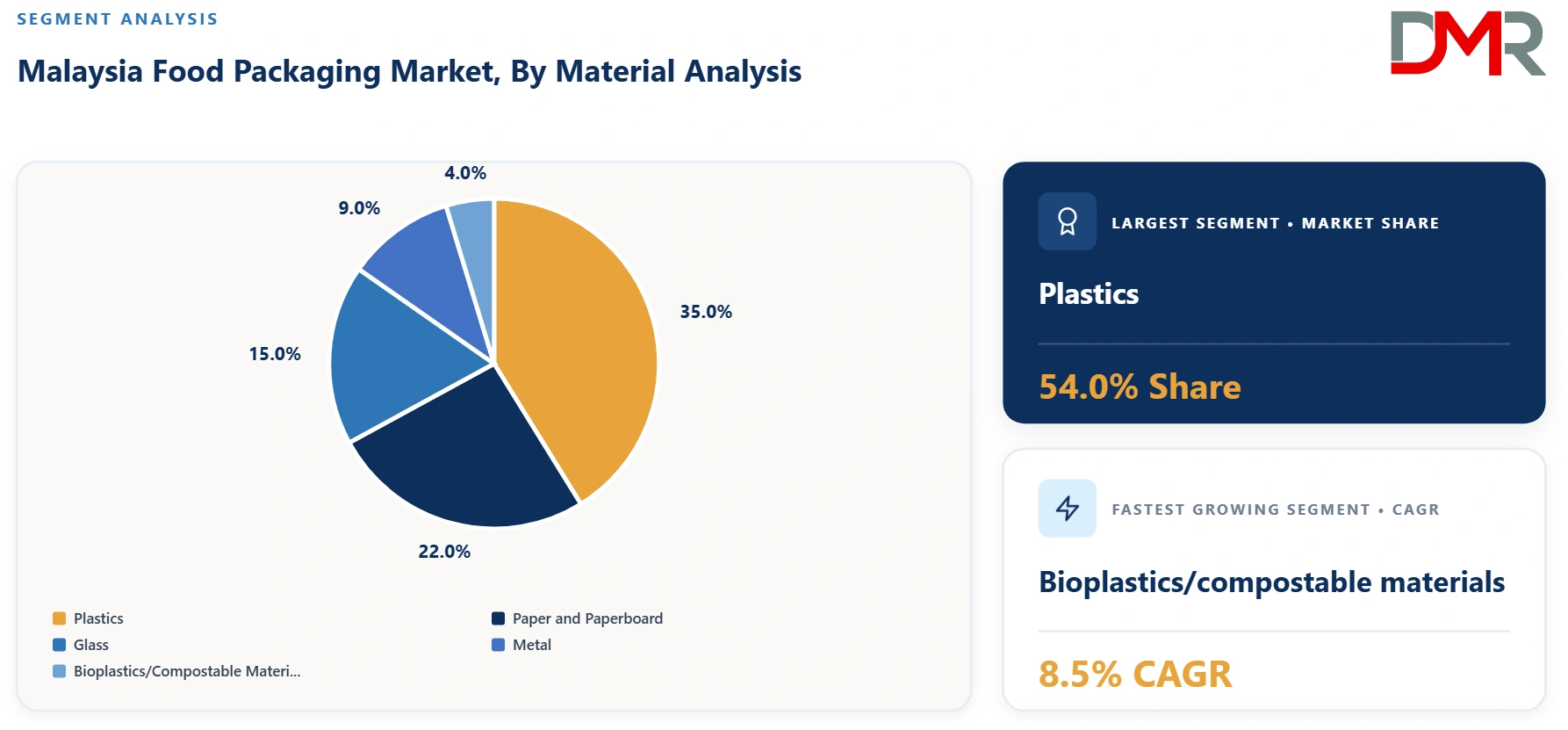
Plastics are estimated to remain the dominant material segment in 2026, accounting for approximately 54% of market revenue. Their leadership reflects low unit cost, light weight, excellent processability, strong barrier performance and compatibility with high-speed filling and form-fill-seal equipment. Flexible PE, PP and multilayer structures are particularly important in snacks, bakery, frozen foods, meat and sauces. Paper and paperboard, with approximately 21% share, represent the second-largest material category, supported by cartons, trays and foodservice applications and by sustainability-driven substitution. Glass represents approximately 10%, retaining strength in premium foods, sauces and beverages because of inertness and consumer perception. Metal accounts for around 9%, driven by cans and shelf-stable foods. Bioplastics/compostable materials, at roughly 6%, are the fastest-growing category, with an estimated 8.5% CAGR, supported by sustainability commitments, EPR development and demand for renewable materials. The principal constraint for bioplastics remains cost, supply availability and the need for appropriate end-of-life infrastructure.
By Packaging Type Analysis
Flexible packaging is estimated to command approximately 61% of the 2026 market, making it the largest packaging-type segment. Pouches, bags, films, wraps and sachets provide high packaging-to-product ratios, low transportation weight and strong printing capabilities, while resealable formats improve convenience. Malaysia also has a substantial flexible-plastics manufacturing base, with packaging identified as the largest segment of the country's plastics industry. Rigid packaging, at approximately 39%, remains essential for trays, bottles, jars, tubs, cans and cartons where structural protection and stackability are priorities. Flexible packaging is expected to retain its leadership, but rigid recyclable formats are likely to gain share in premium foods and foodservice. Within flexible packaging, recyclable mono-material pouches are expected to be the fastest-growing niche, at approximately 7.0% CAGR, as brand owners seek sustainability improvements without sacrificing barrier performance.
By Technology Analysis
Conventional packaging is estimated to represent approximately 42% of the 2026 market and remains dominant because of its low cost, established manufacturing infrastructure and broad application across everyday packaged foods. Modified Atmosphere Packaging (MAP) represents roughly 21%, particularly benefiting fresh meat, seafood, bakery and prepared foods by controlling oxygen and carbon dioxide concentrations. Aseptic packaging, at approximately 17%, is the second-largest advanced technology category and is widely suited to shelf-stable dairy and beverage products. Vacuum packaging represents about 12%, with strong penetration in meat, seafood and selected ready foods. Active and intelligent packaging remains smaller at approximately 8% but is forecast to grow fastest, at around 9.0% CAGR, as freshness indicators, oxygen scavengers, antimicrobial systems, sensors and connected packaging move toward broader commercial adoption. The overall technology trend is toward higher functionality while maintaining compatibility with automated high-speed production.
By Application Analysis
Meat, Poultry and Seafood is estimated to be the largest application in 2026, with approximately 18.6% share, supported by strong requirements for vacuum packaging, MAP, trays and high-barrier films. Published market data similarly places meat, poultry and seafood among Malaysia's largest food-packaging applications. Bakery and Confectionery represents roughly 17%, supported by high-volume flexible films, pouches and cartons. Beverages account for approximately 15%, while Ready-to-Eat and Frozen Foods represent around 13%; the latter is expected to be the fastest-growing application at approximately 6.2% CAGR, reflecting convenience-food demand. Fruits and Vegetables account for about 11%, Dairy Products approximately 9%, and Others approximately 16%. Growth in ready meals is being driven by convenience, smaller households, urban lifestyles and food delivery, making microwaveable trays, lidding films, retort pouches and high-barrier flexible structures attractive growth areas.
By End User Analysis
Food and Beverage Manufacturers remain the largest end-user group, estimated at approximately 72% of demand, because they purchase primary packaging at industrial scale. Foodservice Operators account for approximately 16%, driven by takeaway and delivery packaging, while Retailers and Grocery Chains account for roughly 12%, including private-label packaging and selected secondary packaging procurement.
The Malaysia Food Packaging Market Report is segmented on the basis of the following:
By Material Type
- Plastics
- Paper and Paperboard
- Glass
- Metal
- Bioplastics/Compostable Materials
By Packaging Type
- Flexible Packaging
- Rigid Packaging
By Technology
- Modified Atmosphere Packaging
- Vacuum Packaging
- Aseptic Packaging
- Active and Intelligent Packaging
- Conventional Packaging
By Application
- Bakery and Confectionery
- Dairy Products
- Beverages
- Meat, Poultry and Seafood
- Fruits and Vegetables
- Ready-to-Eat and Frozen Foods
- Others
By End User
- Food and Beverage Manufacturers
- Foodservice Operators
- Retailers and Grocery Chains
Regulatory Landscape
Malaysia's regulatory environment is becoming a more important determinant of food-packaging design. The Food Act 1983 and Food Regulations 1985 establish food-safety and packaging requirements, while Malaysia's food-safety program also governs packaging, storage and transportation conditions. Requirements prohibit packaging that can release harmful substances into food, with specific controls applying to materials such as PVC. Environmental policy is moving toward greater producer responsibility and circularity. Malaysia's plastics roadmap identifies EPR and sustainable-design milestones, while industry participants in 2026 were preparing for mandatory EPR under the broader circular-economy framework. This creates risks for non-recyclable multilayer formats but opportunities for mono-material, fiber-based, recycled-content and lightweight packaging.
Investment and White Space Analysis
Investment opportunities are strongest where packaging suppliers combine material innovation, food safety, automation and circularity. The most attractive white spaces include recyclable mono-material flexible packaging, molded fiber trays, high-barrier paper packaging, recycled PET, aseptic cartons, intelligent labels and packaging optimized for ready meals and chilled foods. Malaysia's established plastics ecosystem and export orientation provide a manufacturing base for regional expansion. Scientex, for example, operates an integrated packaging platform with exports to more than 60 countries and has continued investing in consumer and rigid packaging capabilities. Investment risks include commodity-price volatility, uncertain recycled-material economics, customer qualification cycles and regulatory changes. Suppliers that can prove equivalent shelf life and line performance while reducing material intensity should have the strongest pricing power.
Competitive Landscape
The Malaysian food packaging market is moderately fragmented, combining large multinational packaging companies, established Malaysian manufacturers, specialist converters and smaller regional producers. Competition is based on price, material efficiency, barrier performance, printing quality, production reliability, sustainability credentials and proximity to food manufacturers. Major players increasingly pursue vertical integration, strategic acquisitions, technology partnerships and product innovation. Scientex has developed an integrated packaging platform spanning industrial and consumer packaging, while multinational companies such as Tetra Pak, Amcor and Huhtamaki compete through advanced materials, food-safety expertise and global customer relationships.
Some of the prominent players in the Malaysia Food Packaging Market are:
- Scientex
- Daibochi Berhad
- Tomypak Holdings Berhad
- SCGM Bhd
- Kian Joo Can Factory Berhad
- Can-One Berhad
- Toyo Seikan Group
- Tetra Pak
- Sonoco Products Company
- Amcor
- Mondi
- Sealed Air
- Huhtamaki
- Constantia Flexibles
- UFlex
- Avery Dennison
- Rengo
- Toyo Ink
- DNP
- TOPPAN
- Respack Manufacturing
- Combi-Pack Industries
- Mega Printing & Packaging
- Dynapack Asia
- Yew Lee Pacific Group
- Box-Pak (Malaysia)
- Scientex Packaging
- BP Plastics Holding
- Thong Guan Industries
- Plastics Packaging Industries
- Kumpulan Peransang Selangor
- Muda Holdings
- Fibon Berhad
- Lam Soon Edible Oils
- Hovid
- Kawan Food
- EPB Group
- Easy Pack Machinery
- Clarity Excel
- REVE Machinery
- Other Key Players
Recent Developments
- In July 2025, Tetra Pak expanded its Binh Duong aseptic-carton facility with a €97 million investment, more than doubling production capacity and adding formats intended to serve Malaysia and other Asia-Pacific markets.
- In May 2025, Amcor and Metsä Group announced a collaboration to develop molded-fiber food packaging combining renewable fiber structures with high-barrier liners and lidding for perishable food applications.
- In May 2025, Tetra Pak opened its Customer Innovation Centre in Bangkok, creating an APAC collaboration hub serving food and beverage businesses including Malaysia and accelerating product-development and packaging innovation.
- In February 2025, Huhtamaki launched ProDairy, a recyclable single-coated paper cup designed for yogurt and dairy products, reducing plastic content to below 10% while maintaining food-safety and performance requirements.
Report Details
| Report Characteristics |
| Market Size (2026) |
USD 1.96 Bn |
| Forecast Value (2035) |
USD 3.09 Bn |
| CAGR (2026–2035) |
5.2% |
| Historical Data |
2021 – 2025 |
| Forecast Data |
2026 – 2035 |
| Base Year |
2025 |
| Segments Covered |
By Material Type, By Packaging Type, By Technology, By Application, By End User |
| Country Coverage |
Malaysia |
Frequently Asked Questions
What is the size of the Malaysia Food Packaging Market in 2026?
▾ The Malaysia Food Packaging Market is estimated at approximately USD 1.96 billion in 2026, supported by expanding food processing, convenience foods and modern retail.
What will the Malaysia Food Packaging Market be worth in 2035?
▾ The Malaysia Food Packaging Market is projected to reach approximately USD 3.09 billion by 2035, reflecting sustained demand across food, beverage and foodservice applications.
What is the CAGR of the Malaysia Food Packaging Market?
▾ The Malaysia Food Packaging Market is expected to grow at approximately 5.2% CAGR from 2026 to 2035, driven by packaged-food consumption and packaging innovation.
What are the key drivers of the Malaysia Food Packaging Market?
▾ The Malaysia Food Packaging Market is primarily driven by food-processing growth, convenience foods, food delivery, modern retail, longer shelf-life requirements and increasing sustainability initiatives.
Which material dominates the Malaysia Food Packaging Market?
▾ Plastics dominate the Malaysia Food Packaging Market, accounting for an estimated 54% share in 2026, owing to their versatility, lightweight properties, affordability and barrier performance.
Which segment is growing fastest in the Malaysia Food Packaging Market?
▾ Bioplastics and compostable materials are among the fastest-growing segments in the Malaysia Food Packaging Market, supported by sustainability requirements and the transition toward circular packaging.
Who are the major players in the Malaysia Food Packaging Market?
▾ Major participants in the Malaysia Food Packaging Market include Scientex, Tetra Pak, Amcor and Huhtamaki, alongside numerous domestic packaging converters and specialized manufacturers.
What are the major trends shaping the Malaysia Food Packaging Market?
▾ Key trends in the Malaysia Food Packaging Market include recyclable mono-material packaging, lightweighting, fiber-based alternatives, advanced barrier technologies, intelligent packaging and extended-shelf-life solutions.