Malaysia Food Processing Equipment Market Snapshot
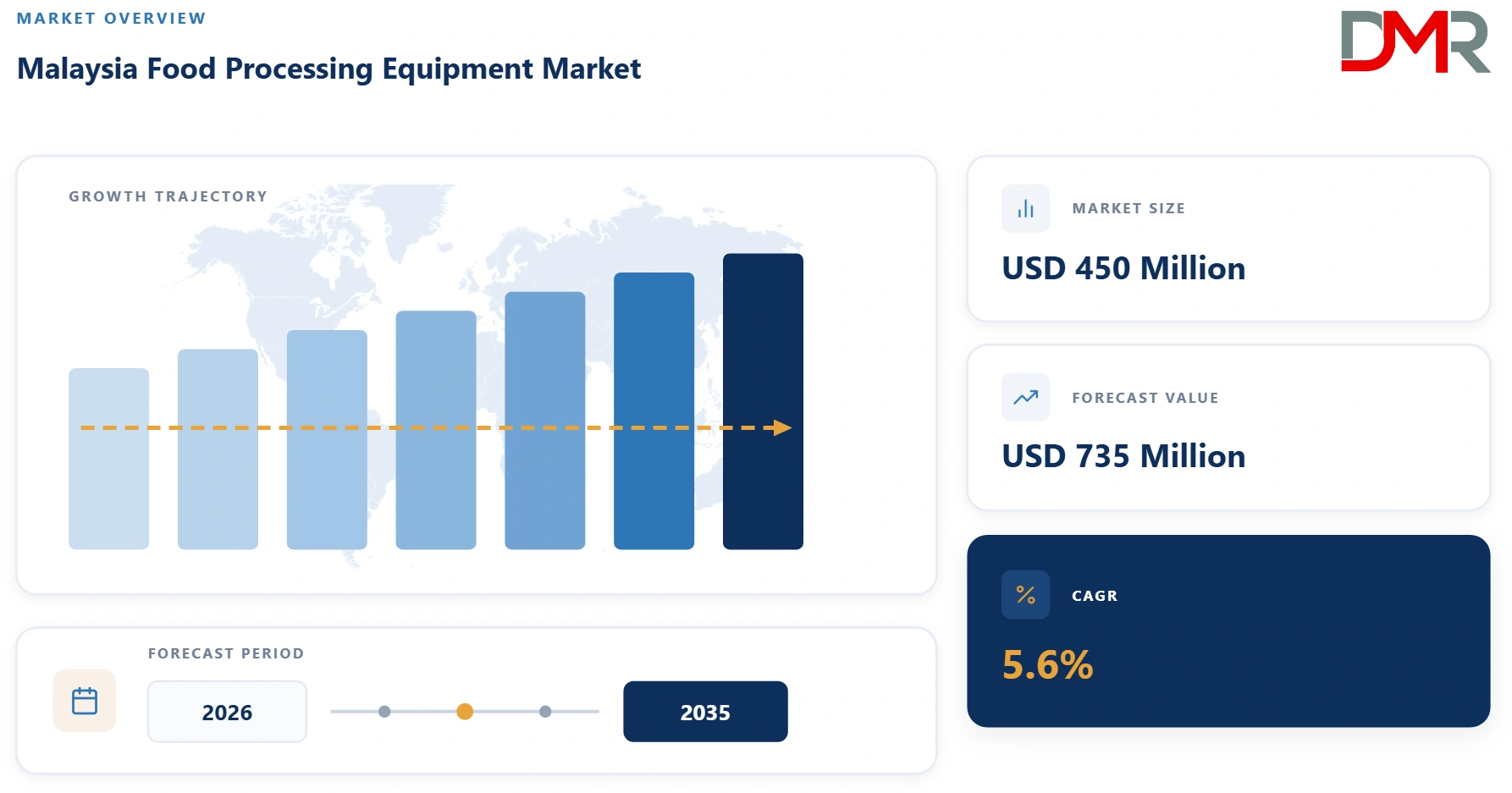
- Market Size, 2026: USD 450 million
- Market Size, 2035: USD 735 million
- CAGR, 2026–2035: 5.6%
- Leading Equipment Segment: Processing Equipment, 32%
- Leading Mode of Operation: Automatic, 42%
- Leading Food Category: Beverages, 23%
- Fastest-Growing Segment: Automatic Equipment, 7.8% CAGR
What is the Malaysia Food Processing Equipment and its Market Size?
The Malaysia food processing equipment market is estimated at USD 450 million in 2026 and is projected to reach approximately USD 735 million by 2035, representing a 5.6% CAGR.
ℹ
To learn more about this report –
Download Your Free Sample Report Here
Malaysia's food processing equipment market comprises machinery, systems and integrated production lines used to transform agricultural and food inputs into processed, packaged and commercially saleable products. It includes processing machinery, packaging systems, material-handling equipment, cooking and cooling systems, cleaning and sanitation equipment, automation and associated controls. Equipment is purchased by large food manufacturers, SMEs and specialty producers across meat, seafood, dairy, bakery, beverages, fruits and vegetables and other food categories. The value proposition is improved throughput, consistency, food safety, labor productivity, shelf life and compliance while reducing waste, energy consumption and total production cost.
Use Cases
- Protein processing: Automated slaughtering, deboning, portioning, weighing, inspection, cooking and packaging for meat, poultry and seafood.
- Beverage production: Mixing, pasteurization, UHT treatment, homogenization, filling, capping and secondary packaging for beverage manufacturers.
- Bakery manufacturing: Dough preparation, proofing, depositing, baking, cooling, slicing and high-speed packaging for industrial bakeries.
- Dairy processing: Separation, pasteurization, homogenization, fermentation, filling and cold-chain preparation for milk and dairy products.
- Fruit and vegetable processing: Washing, sorting, cutting, blanching, freezing, drying, pulping and packaging of fresh and processed produce.
- Halal-compliant production: Hygienic processing, cleaning, segregation and traceability systems supporting Malaysia's domestic and export-oriented halal manufacturers.
Key Takeaways
- Market size: Estimated at USD 450 million in 2026, reaching approximately USD 735 million by 2035.
- Growth rate: The market is forecast to expand at approximately 5.6% CAGR during 2026–2035.
- Primary drivers: Food-manufacturing expansion, automation, labor productivity, export growth, food-safety requirements and factory modernization.
- Segment dominance: Processing equipment remains the largest equipment category, while automatic systems are the largest operating mode.
- Geographic concentration: Selangor and the broader central region remain important because of manufacturing clusters, logistics infrastructure and technical-service availability.
- Fastest growth: Automatic equipment is expected to grow at approximately 7.8% CAGR, substantially outperforming manual equipment.
How AI/Gen AI is Transforming the Malaysia Food Processing Equipment Market?
AI, IoT, machine vision, industrial connectivity and cloud-based analytics are increasingly being incorporated into Malaysian food-processing lines. Connected sensors monitor temperature, pressure, vibration, flow, energy consumption and production output, while machine-vision systems support inspection, sorting and quality control. Equipment suppliers are increasingly combining machinery, automation and digital services rather than selling standalone hardware. Tetra Pak's Factory OS, for example, is designed to connect equipment and systems and provide real-time production intelligence.
The main benefits are higher overall equipment effectiveness, reduced downtime, more consistent product quality, predictive maintenance, lower waste and better resource utilization. Tetra Pak reports comparative results showing highly automated beverage factories achieving higher OEE and lower waste and packaging-line stoppages than less automated facilities.
Key Drivers in the Malaysia Food Processing Equipment Market
Rising demand for processed and convenience foods
Increasing consumption of packaged, ready-to-eat, frozen and value-added food products is encouraging Malaysian manufacturers to expand production capacity. This is driving investment in modern processing, packaging, cooking, cooling and material-handling equipment that can support higher throughput while maintaining consistent product quality.
Automation and factory modernization
Food manufacturers are increasingly adopting automated and connected processing systems to improve productivity, reduce dependence on manual labor and enhance operational consistency. Modern equipment also enables better process control, monitoring and integration across different stages of food production.
Restraints in the Malaysia Food Processing Equipment Market
High upfront investment requirements
Advanced processing equipment, automated production lines and digital technologies require substantial initial investment. This can create adoption challenges for smaller manufacturers, particularly when equipment upgrades also require facility modifications, employee training and system integration.
Complex food safety and compliance requirements
Manufacturers must meet strict hygiene, food safety, halal, quality and traceability requirements throughout production. Compliance can increase equipment specifications and operating complexity, while older facilities may require additional upgrades to accommodate modern hygienic processing systems.
Growth Opportunities in the Malaysia Food Processing Equipment Market
Expansion of smart processing and automation
Increasing adoption of Industry 4.0 technologies, robotics, IoT-enabled equipment, machine vision and predictive maintenance is creating opportunities for suppliers of intelligent processing solutions. Equipment providers can also benefit from demand for automation retrofits that allow existing production lines to become more efficient without complete replacement.
Growth of halal and export-oriented food production
Malaysia's strong halal manufacturing ecosystem and expanding food-export activities are creating demand for equipment capable of supporting hygienic production, product consistency and traceability. Manufacturers serving export markets are also expected to invest in modern systems that help meet international quality and processing requirements.
Trends in the Malaysia Food Processing Equipment Market
Shift toward connected and intelligent production
Food manufacturers are increasingly moving from standalone machinery toward integrated production systems that connect processing equipment, sensors and factory data. This supports real-time monitoring, automated quality control, predictive maintenance and improved production planning.
Growing focus on energy efficiency and sustainability
Equipment buyers are placing greater emphasis on machinery that can reduce energy and water consumption, minimize product waste and improve overall resource utilization. This trend is encouraging equipment manufacturers to develop more efficient processing technologies while helping food producers reduce operating costs and strengthen their sustainability performance.
Research Scope and Analysis
The Malaysia food processing equipment market is segmented by Equipment Type, Mode of Operation, Food Category and End User. The analysis considers new equipment, replacement demand, factory expansion, automation upgrades and integrated processing-line investments.
ℹ
To learn more about this report –
Download Your Free Sample Report Here
By Equipment Type Analysis
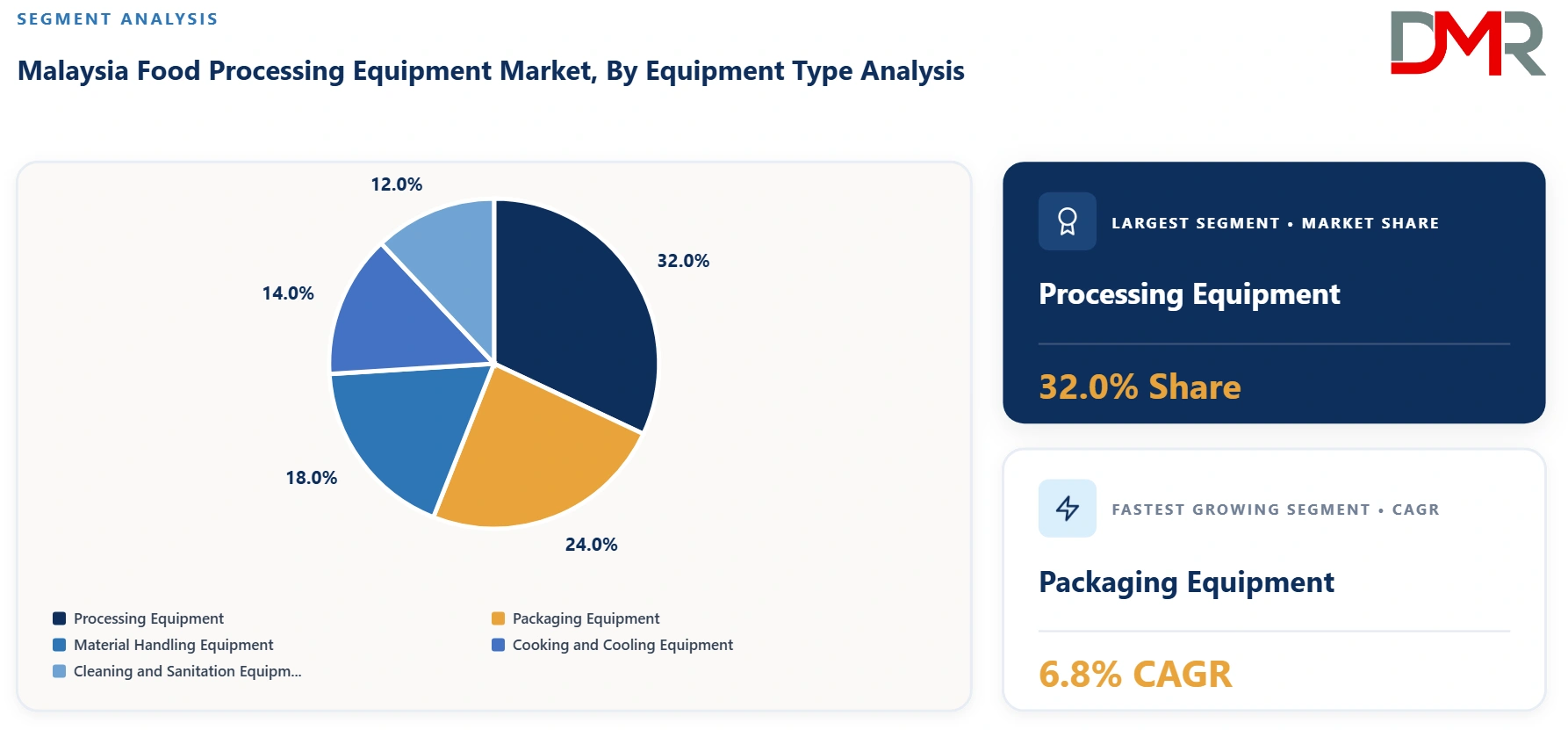
Processing Equipment is estimated to dominate the Malaysian market in 2026 with approximately 32% share, supported by demand for thermal processing, mixing, separation, extrusion, milling and other core transformation processes. Processing machinery commands the largest share because virtually every industrial food producer requires equipment to convert raw materials into finished or intermediate products. Packaging Equipment is the second-largest category at approximately 24%, supported by demand for higher-speed filling, sealing, labeling, coding and secondary packaging. Packaging Equipment is expected to be the fastest-growing equipment category at approximately 6.8% CAGR, reflecting convenience-food growth, export requirements, shelf-life extension and automation. Material Handling Equipment represents approximately 18%, including conveyors, elevators, palletizing and internal logistics. Cooking and Cooling Equipment accounts for around 14%, while Cleaning and Sanitation Equipment contributes approximately 12%. Demand for sanitation equipment is expected to grow steadily because food safety and audit requirements increasingly influence equipment specifications. Integrated lines that combine processing, automation and downstream packaging are expected to capture an increasing share of new capital expenditure. Tetra Pak's Malaysian portfolio illustrates this broader shift toward processing equipment and integrated solutions across dairy, beverages, prepared foods and other applications.
By Mode of Operation Analysis
Automatic equipment is estimated to hold the leading share in 2026 at approximately 42%, reflecting rising demand for labor productivity, consistent throughput and digital production control. Automatic lines are particularly prevalent among large processors and beverage, dairy, protein and packaged-food manufacturers where high volumes justify capital expenditure. Semi-Automatic equipment accounts for approximately 38%, retaining a substantial position among SMEs because it offers a balance between capital expenditure and labor requirements. Manual equipment represents around 20%, concentrated in artisanal operations, smaller processors and applications where product variability makes full automation less economical. Automatic equipment is also forecast to be the fastest-growing mode, at approximately 7.8% CAGR, as robotics, machine vision, automated weighing and palletizing become more affordable. The increasing availability of modular automation should gradually reduce adoption barriers for mid-sized manufacturers. Malaysian processors are already deploying automation in protein processing, while global suppliers are developing increasingly integrated robotics and intelligent control systems.
By Food Category Analysis
Beverages are estimated to represent the largest food-category application in 2026, with approximately 23% share, supported by high production volumes, established beverage manufacturing clusters and significant requirements for filling, pasteurization, UHT, homogenization, blending and packaging. Meat, poultry and seafood represent approximately 22%, making protein processing another major equipment-consuming category because automation can improve yield, labor productivity, hygiene and traceability. Bakery and confectionery account for around 19%, while dairy products contribute approximately 15%. Fruits and vegetables represent about 12%, with the remaining 9% comprising other categories such as sauces, ready meals, snacks, ingredients and specialty foods. Fruits and vegetables are estimated to be the fastest-growing category at approximately 6.7% CAGR, driven by demand for convenience foods, frozen products, minimally processed produce, juices and longer shelf life. Growth in plant-based products, ready-to-eat foods and specialty ingredients should also support equipment demand across multiple categories.
By End User Analysis
Large-Scale Food Processors are estimated to account for approximately 55% of the 2026 market, making them the dominant end-user group. Their leadership reflects greater production volumes, larger capital budgets, stronger export orientation and higher requirements for automated and integrated systems. Small and Medium-Sized Processors account for approximately 35%, representing the largest medium-term opportunity as modular automation and more affordable equipment increase accessibility. Artisanal and Specialty Food Producers account for approximately 10%, although their equipment purchases tend to be more fragmented and customization-oriented. SMEs are expected to be the fastest-growing end-user segment at approximately 6.4% CAGR, supported by digitalization, food-safety requirements and gradual formalization of smaller food businesses. Suppliers that provide scalable equipment allowing processors to begin semi-automatically and add robotics, vision, digital controls and additional capacity later are likely to outperform vendors focused exclusively on large greenfield projects. This is particularly relevant because Malaysia's manufacturing investment pipeline is broadening technological capability and creating demand for higher-value machinery.
The Malaysia Food Processing Equipment Market Report is segmented on the basis of the following:
By Equipment Type
- Processing Equipment
- Packaging Equipment
- Material Handling Equipment
- Cooking and Cooling Equipment
- Cleaning and Sanitation Equipment
By Mode of Operation
- Automatic
- Semi-Automatic
- Manual
By Food Category
- Meat, Poultry and Seafood
- Dairy Products
- Bakery and Confectionery
- Beverages
- Fruits and Vegetables
- Others
By End User
- Large-Scale Food Processors
- Small and Medium-Sized Processors
- Artisanal and Specialty Food Producers
Regulatory Landscape
Malaysia's food-processing equipment market is strongly influenced by food-safety, hygiene, halal, labeling, occupational-safety and environmental requirements. Equipment increasingly needs hygienic construction, cleanability, contamination control and traceability, particularly for exporters. Halal production creates additional requirements around segregation, sanitation and process integrity. Regulatory compliance therefore favors stainless-steel hygienic equipment, automated cleaning systems, controlled material flows and digital batch records. The opportunity for suppliers is to embed compliance into machine design rather than treat it as a downstream certification exercise. Risks include changing standards, additional validation requirements and higher compliance costs for SMEs. Vendors offering documentation, validation support, training and local technical assistance can command a premium.
Investment and White Space Analysis
Malaysia offers attractive white space in SME automation, energy-efficient retrofits, cold-chain processing, halal-compliant equipment, food inspection, digital monitoring and integrated packaging. Manufacturing investment reached RM131.3 billion in 2025, with 1,354 approved manufacturing projects, indicating a substantial pipeline for industrial equipment suppliers.
The strongest opportunity is not necessarily another standalone machine but modular solutions that allow processors to upgrade incrementally. Local service centers, spare-parts inventories, financing and performance-based contracts can further differentiate suppliers. White space is also emerging around plant-based proteins, fermentation-derived ingredients and specialty foods, where processors require flexible pilot-to-commercial production capabilities. Tetra Pak's expansion into new-food processing and pilot-scale development illustrates this emerging equipment opportunity.
Competitive Landscape
The Malaysia food processing equipment market is moderately fragmented, with multinational technology companies competing alongside regional engineering firms, distributors and domestic fabricators. Major international suppliers differentiate through process technology, integrated automation, global standards, engineering expertise and lifecycle service, while local and regional companies compete through customization, price, shorter lead times and after-sales responsiveness. Leading participants include GEA, Tetra Pak, Bühler, Alfa Laval, JBT Marel and Krones, alongside specialized Malaysian engineering and equipment companies.
Some of the prominent players in the Malaysia Food Processing Equipment Market are:
- GEA Group
- Tetra Pak
- Bühler Group
- Alfa Laval
- JBT Marel
- Krones
- SPX FLOW
- Heat and Control
- Ishida
- MULTIVAC
- Syntegon Technology
- IMA Group
- KHS
- Sidel
- Shibuya Corporation
- Shikoku Kakoki
- Fuji Machinery
- Yamato Scale
- Marel
- FLSmidth
- Hosokawa Micron
- ANDRITZ
- Baker Perkins
- Clextral
- Pavan Group
- Bühler Aeroglide
- NAGEMA
- JBT Corporation
- Bucher Unipektin
- Flottweg
- Alfa Laval Malaysia
- Tetra Pak Malaysia
- GEA Malaysia
- Krones Malaysia
- KHS Malaysia
- Technofood
- Hup Seng Machinery
- EPB Group
- Easy Pack Machinery
- Clarity Excel
- Other Key Players
Recent Developments
- May 2026: Bühler introduced major innovations and upgrades across its Grains & Food portfolio, including new automation systems, hygienic-design improvements and energy-efficiency enhancements for extrusion, chocolate, bakery and confectionery applications.
- November 2025: Tetra Pak launched Factory OS, a modular automation and digitalization portfolio designed to integrate factory equipment and data and prepare food and beverage plants for AI-enabled operations.
- June 2025: Tetra Pak opened its New Food Technology Development Centre, supporting pilot trials and commercialization of fermentation-derived foods and ingredients, potentially expanding demand for specialized processing systems.
- April 2025: JBT Marel highlighted its Malaysian customer CCK's automation progress, including automated poultry-processing systems and upgrades intended to improve reliability, productivity and sustainability.
- January 2025: Tetra Pak expanded its homogenizer portfolio with new models designed around a two-in-one homogenization concept, targeting simplified installation, lower maintenance requirements and energy consumption reductions of up to 25%.
Report Details
| Report Characteristics |
| Market Size (2026) |
USD 450.0 Mn |
| Forecast Value (2035) |
USD 735.0 Mn |
| CAGR (2026–2035) |
5.6% |
| Historical Data |
2021 – 2025 |
| Forecast Data |
2026 – 2035 |
| Base Year |
2025 |
| Segments Covered |
By Equipment Type, By Mode of Operation, By Food Category, By End User |
| Country Coverage |
Malaysia |
Frequently Asked Questions
What is the Malaysia food processing equipment market size in 2026?
▾ The Malaysia food processing equipment market is estimated at approximately USD 450 million in 2026, including processing, packaging, handling, cooking/cooling and sanitation equipment.
How large will the Malaysia food processing equipment market become by 2035?
▾ The Malaysia food processing equipment market is projected to reach approximately USD 735 million by 2035, reflecting sustained equipment modernization and food-manufacturing expansion.
What is the expected CAGR of the Malaysia food processing equipment market?
▾ The Malaysia food processing equipment market is forecast to expand at approximately 5.6% CAGR between 2026 and 2035, with automation growing faster than the overall market.
What are the major growth drivers of the Malaysia food processing equipment market?
▾ The Malaysia food processing equipment market is primarily driven by food-manufacturing investment, automation, labor productivity, export production, food-safety requirements, halal manufacturing and factory modernization.
Which equipment segment leads the Malaysia food processing equipment market?
▾ Processing equipment is estimated to lead the Malaysia food processing equipment market with approximately 32% share, followed by packaging and material-handling equipment.
Which operating mode is growing fastest in the Malaysia food processing equipment market?
▾ Automatic equipment is expected to be the fastest-growing operating mode in the Malaysia food processing equipment market, at approximately 7.8% CAGR, as robotics and connected automation become more accessible.
Who are the key participants in the Malaysia food processing equipment market?
▾ Major international participants in the Malaysia food processing equipment market include GEA, Tetra Pak, Bühler, Alfa Laval, JBT Marel and Krones, alongside local and regional equipment integrators.
Which end-user segment offers the greatest opportunity in the Malaysia food processing equipment market?
▾ SMEs offer significant growth potential in the Malaysia food processing equipment market because modular automation, retrofits and increasingly affordable digital technologies can address their productivity and compliance requirements.