Malaysia Halal Food Ingredients Market Snapshot
- Market Size 2026: USD 5.4 billion
- Market Size 2035: USD 9.3 billion
- CAGR, 2026–2035: 6.2%
- Leading Ingredient Type: Proteins & Amino Acids, 24% share
- Leading Source: Plant-Based, 48% share
- Leading Application: Meat & Poultry, 23% share
- Leading Function: Texture & Stability, 26% share
- Leading Distribution Channel: Direct Sales, 62% share
- Fastest-Growing Segment: Microbial & Fermentation-Derived Ingredients, 8.7% CAGR
What is the Malaysia Halal Food Ingredients and its Market Size?
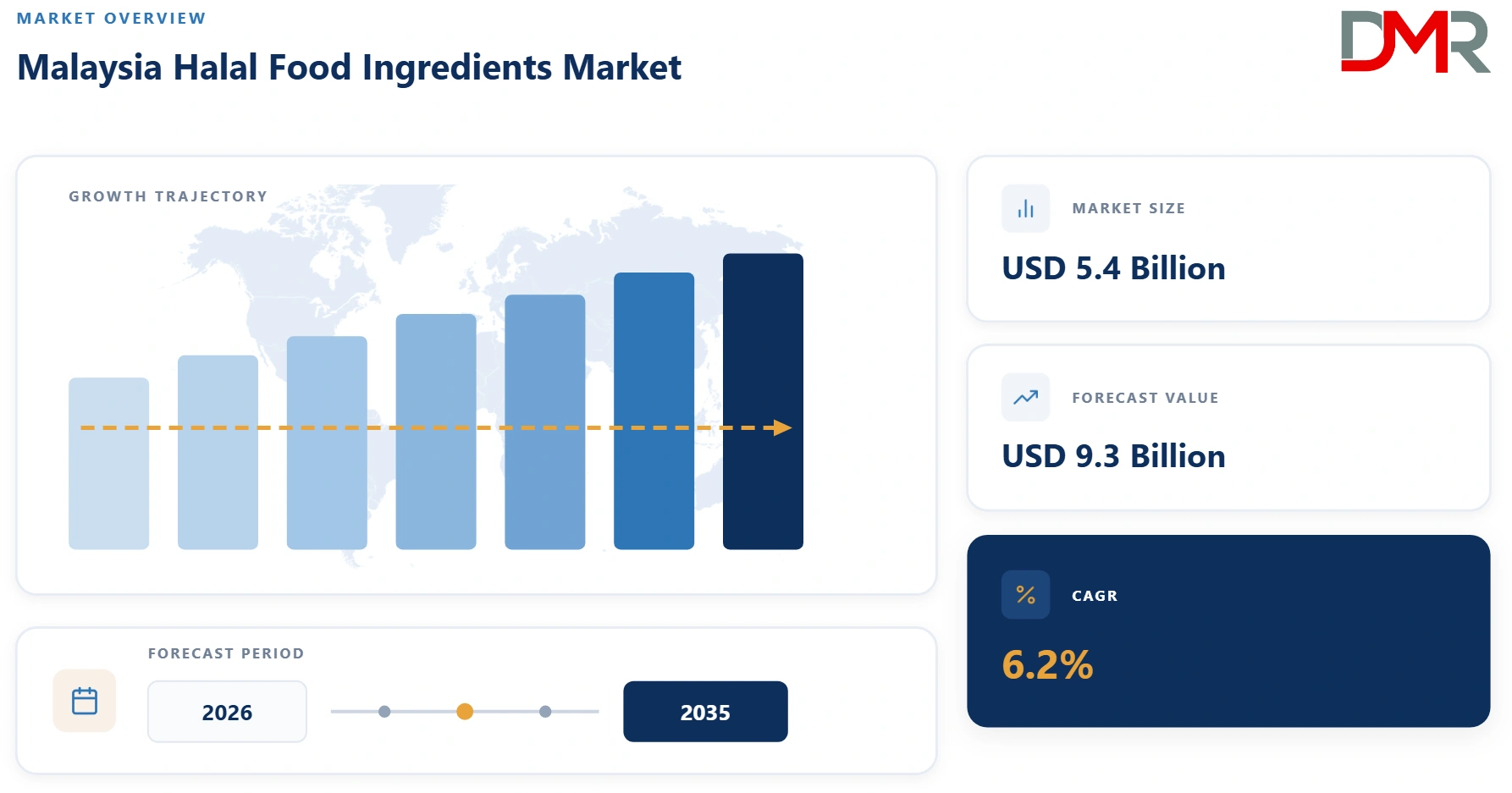
The Malaysia halal food ingredients market is estimated at USD 5.4 billion in 2026, with the value projected to reach approximately USD 9.3 billion by 2035, representing a 6.2% CAGR.
ℹ
To learn more about this report –
Download Your Free Sample Report Here
The Malaysia halal food ingredients market comprises ingredients manufactured, processed, imported, distributed, or supplied for use in food and beverage products that meet applicable halal requirements. It includes proteins, amino acids, flavors, colors, emulsifiers, stabilizers, enzymes, processing aids, vitamins, minerals, starches, sweeteners and other functional ingredients. The market serves food manufacturers, beverage producers, bakeries, meat processors, dairy companies, convenience-food manufacturers and foodservice suppliers. Malaysia's distinctive advantage is its mature halal-certification infrastructure, extensive food-processing ecosystem, strategic Asian location and strong export connectivity.
Use Cases
- Meat and poultry processing: Halal proteins, binders, emulsifiers, seasonings and stabilizers improve texture, yield, flavor and shelf life.
- Bakery and confectionery: Enzymes, emulsifiers, starches, colors and flavors improve volume, softness, stability and sensory performance.
- Beverage formulation: Flavors, sweeteners, stabilizers, vitamins and functional ingredients support differentiated beverage products.
- Dairy and frozen desserts: Hydrocolloids, emulsifiers, cultures and stabilizers deliver desirable texture and freeze-thaw stability.
- Convenience foods: Functional ingredients extend shelf life while improving taste, texture, nutritional content and manufacturing efficiency.
- Alternative proteins: Plant proteins, fermentation ingredients and functional systems enable halal meat alternatives and high-protein foods.
Key Takeaways
- The market is estimated at USD 5.4 billion in 2026 and projected to reach USD 9.3 billion by 2035, at a 6.2% CAGR.
- Growth is being supported by Malaysia's expanding halal exports, food-processing industry, certification infrastructure and regional manufacturing role.
- Proteins and amino acids are estimated to be the largest ingredient category, while plant-based ingredients dominate by source.
- Meat and poultry represents the largest application because of Malaysia's established halal protein-processing ecosystem.
- Microbial and fermentation-derived ingredients are expected to be the fastest-growing source segment, driven by clean-label, biotechnology and alternative-protein applications.
- Digital ingredient traceability and JAKIM's MyHALALINGREDIENTS system are increasing the importance of documented ingredient provenance.
How AI/Gen AI is Transforming the Malaysia Halal Food Ingredients Market?
Technology is increasingly influencing halal ingredient production through automated processing, digital traceability, laboratory testing, fermentation, enzyme engineering and AI-supported formulation. JAKIM's MyHALALINGREDIENTS, implemented from 15 August 2025, creates a centralized data mechanism for recording and assessing raw materials and integrates with MYeHALAL to reduce repeated physical documentation during certification.
Automation improves production consistency, hygiene, throughput and cost efficiency. Fermentation and biotechnology enable manufacturers to develop proteins, flavors, enzymes and functional ingredients with improved performance and potentially lower dependence on animal-derived materials. MIDA identifies automation and advanced food-production technologies as important to improving efficiency, precision, hygiene and cost-effectiveness.
Key Drivers in the Malaysia Halal Food Ingredients Market
Growth in Processed, Convenience and Functional Foods
Demand for convenient, shelf-stable and nutritionally enhanced foods is increasing the number and complexity of ingredients required by Malaysian food manufacturers. Food additives and specialty ingredients such as emulsifiers, preservatives, hydrocolloids, flavors and functional ingredients are increasingly important for maintaining product quality while meeting consumer expectations. Independent market research identifies convenience foods, health and wellness and clean-label innovation as important growth factors for Malaysia's food-additive and specialty-ingredient markets.
Expansion of Malaysia's Halal Export Economy
Malaysia's halal export ecosystem is a primary growth engine for ingredient suppliers, demonstrating that ingredients are not merely supporting products within the halal economy but a major export category in their own right. The country's strategic location, established food-processing infrastructure and internationally recognized certification ecosystem allow manufacturers to use Malaysia as a regional production and distribution base.
Restraints in the Malaysia Halal Food Ingredients Market
Certification Complexity and Ingredient Traceability
Halal certification requires control over raw materials, manufacturing processes, storage, handling and supply chains. For ingredient manufacturers, certification can therefore involve more than demonstrating the halal status of a final product. Raw materials and processing aids may require extensive documentation and verification. JAKIM explicitly advises companies to deal directly with JAKIM or relevant JAIN authorities for certification and warns against unauthorized third-party certification consultants.
Commodity Price Volatility and Import Dependence
Many Malaysian ingredient manufacturers remain exposed to fluctuations in palm oil, agricultural commodities, energy, logistics and imported specialty chemicals. Supply-chain disruptions can raise production costs and make pricing less predictable. This is particularly important for SMEs that have less bargaining power than multinational ingredient producers.
Growth Opportunities in the Malaysia Halal Food Ingredients Market
Plant-Based and Fermentation-Derived Ingredients
Plant proteins, fermentation-derived flavors, enzymes, functional cultures and alternative-protein ingredients represent one of the strongest long-term opportunities. Malaysia already has a significant palm-oil and agricultural-resource base and is developing capabilities around alternative proteins. A plant-protein facility announced by Agro Snow was expected to produce approximately 6,000 metric tonnes of pulse-protein isolates annually, highlighting the direction of investment.
Premium, Clean-Label and Functional Ingredients
Consumers increasingly expect products that combine halal compliance with health, transparency, sustainability and recognizable ingredients. This opens opportunities for natural colors, natural flavors, low-sugar systems, plant-derived emulsifiers, functional starches, fibers, vitamins and minerals.
Trends in the Malaysia Halal Food Ingredients Market
Convergence of Halal, Clean Label and Sustainability
Halal positioning increasingly overlaps with broader consumer expectations around ethical sourcing, natural ingredients, transparency and responsible manufacturing. This is pushing ingredient developers toward plant-based, fermentation-derived and minimally processed solutions.
Research Scope and Analysis
The market is analyzed across five principal dimensions: Ingredient Type, Source, Application, Function and Distribution Channel. Shares below are analyst estimates for the 2026 Malaysian halal food ingredients ecosystem and are intended to provide a consistent market model rather than represent official government segmentation.
ℹ
To learn more about this report –
Download Your Free Sample Report Here
By Ingredient Type Analysis
Proteins and Amino Acids are estimated to dominate in 2026 with approximately 24% market share, supported by meat and poultry processing, dairy alternatives, sports nutrition, nutritional fortification and the development of alternative proteins. The category benefits from strong demand for protein-rich convenience products and halal-certified protein systems. Flavors and Colors, estimated at approximately 19%, represent the second-largest category because Malaysian food and beverage manufacturers compete heavily on sensory differentiation, particularly in beverages, confectionery, sauces and snacks. Microbial and fermentation-derived functional ingredients within the broader ingredient landscape are projected to record the fastest growth, with demand increasing at approximately 8.7% CAGR, driven by clean-label formulation, biotechnology and alternative proteins. Emulsifiers and stabilizers remain essential for bakery, dairy, sauces and processed meat applications, while vitamins and minerals benefit from fortification trends. Starches, sweeteners and processing aids remain high-volume categories but face greater commodity-price competition.
By Source Analysis
Plant-Based ingredients are estimated to hold the leading position with approximately 48% share in 2026, reflecting Malaysia's agricultural-resource base, palm-derived ingredients, starches, proteins, fibers and natural extracts. Plant-based ingredients are also benefiting from the intersection of halal, clean-label, sustainability and alternative-protein trends. Animal-Derived ingredients represent approximately 23%, supported by established halal meat, dairy and gelatin-related applications, although their growth is constrained by traceability requirements and consumer interest in plant-based alternatives. Microbial and Fermentation-Derived ingredients are expected to be the fastest-growing source at around 8.7% CAGR, benefiting from enzymes, cultures, fermentation-derived proteins and natural flavor systems. Synthetic and mineral ingredients continue to serve cost-sensitive applications where performance, consistency and regulatory approval remain important.
By Application Analysis
Meat and Poultry is estimated to be the largest application at approximately 23% share, reflecting Malaysia's mature halal meat-processing industry and high consumption of processed poultry, sausages, nuggets, marinated products and ready-to-cook foods. Bakery and Confectionery follows at approximately 19%, supported by demand for emulsifiers, enzymes, colors, flavors, starches and functional systems. Convenience Foods are projected to be the fastest-growing application at approximately 8.1% CAGR, driven by urbanization, time-constrained consumers and growth in ready-to-eat and ready-to-cook products. Beverages represent another important growth area due to flavor systems, sweeteners, stabilizers and fortification ingredients. Dairy, sauces and condiments continue to generate stable demand, particularly as Malaysian manufacturers expand regional exports.
By Function Analysis
Texture and Stability is estimated to lead with approximately 26% share in 2026, as emulsifiers, stabilizers, hydrocolloids and starches are essential across meat, bakery, dairy, beverage and sauce applications. Flavor and Taste Enhancement, at roughly 23%, remains the second-largest function because taste differentiation is critical in processed foods and beverages. Nutritional Enhancement is forecast to be the fastest-growing functional segment at approximately 8.4% CAGR, reflecting rising demand for protein fortification, vitamins, minerals, fibers and functional ingredients. Preservation remains important for extending shelf life in convenience foods, while processing-efficiency ingredients such as enzymes can reduce production time and improve yield. Color enhancement represents a smaller but valuable segment, particularly in beverages, confectionery and premium natural-product formulations.
By Distribution Channel Analysis
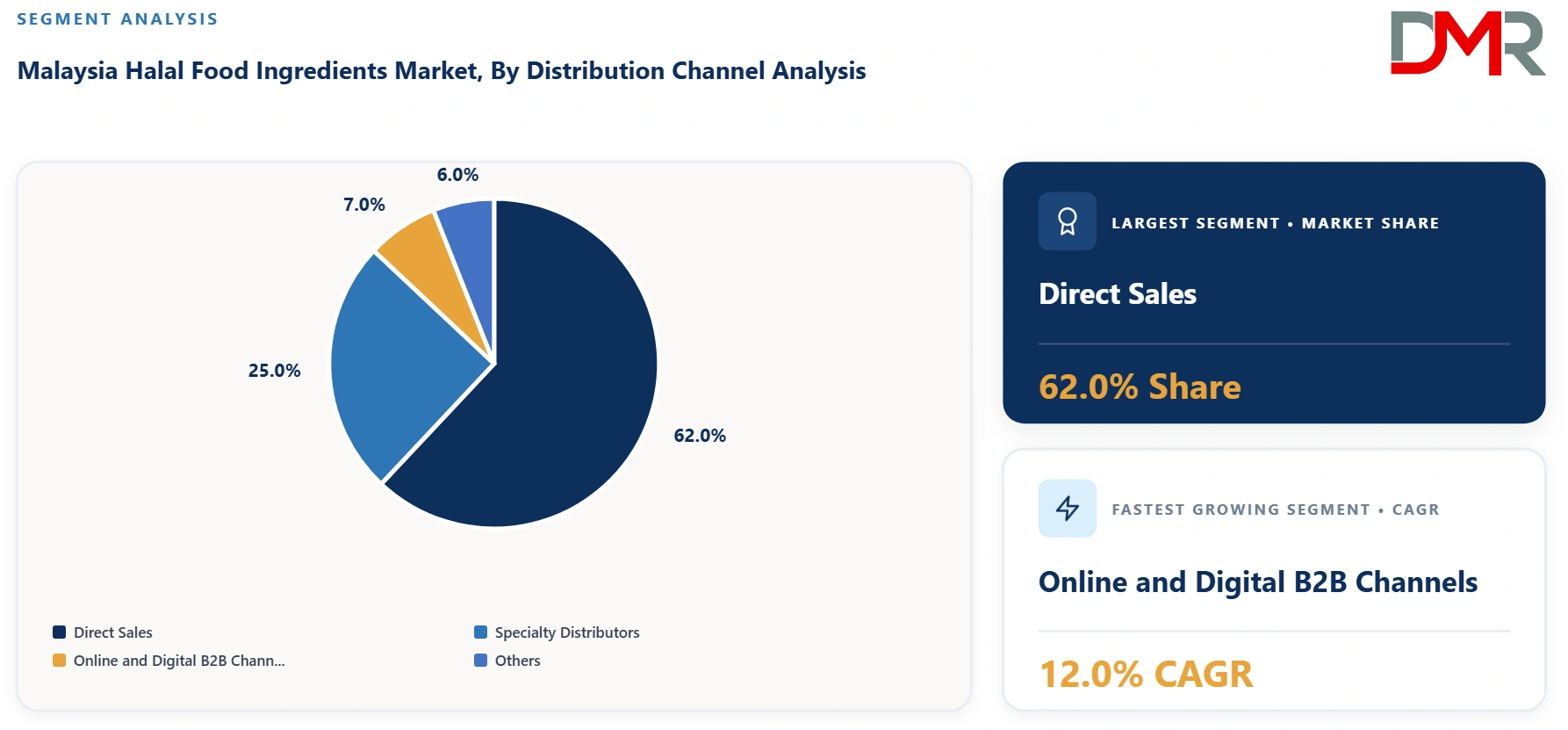
Direct Sales account for an estimated 62% share, reflecting the B2B nature of ingredient procurement and the importance of technical support, formulation assistance, quality documentation and long-term supply contracts. Specialty Distributors represent approximately 25%, particularly for SMEs that require smaller order quantities or access to multiple specialty ingredient brands. Online and Digital B2B Channels are projected to be the fastest-growing channel, with an estimated 12% CAGR, although they start from a comparatively small base. Digital procurement enables faster product discovery, documentation exchange and supplier comparison. The growth of online B2B channels is likely to be strongest among SMEs and smaller food manufacturers, while multinational manufacturers will continue to rely heavily on approved supplier networks and direct procurement.
The Malaysia Halal Food Ingredients Market Report is segmented on the basis of the following:
By Ingredient Type
- Proteins and Amino Acids
- Flavors and Colors
- Emulsifiers and Stabilizers
- Enzymes and Processing Aids
- Vitamins and Minerals
- Starches and Sweeteners
- Others
By Source
- Plant-Based
- Animal-Derived
- Microbial and Fermentation-Derived
- Synthetic and Mineral
- Others
By Application
- Meat and Poultry
- Bakery and Confectionery
- Dairy and Frozen Desserts
- Beverages
- Convenience Foods
- Sauces and Condiments
- Others
By Function
- Flavor and Taste Enhancement
- Texture and Stability
- Nutritional Enhancement
- Preservation
- Processing Efficiency
- Color Enhancement
- Others
By Distribution Channel
- Direct Sales
- Specialty Distributors
- Online and Digital B2B Channels
- Others
Regulatory Landscape
Regulation is a central competitive factor in Malaysia's halal food ingredients market because halal compliance extends across raw materials, manufacturing, storage, handling and certification documentation. JAKIM's MYeHALAL framework and the Malaysian Halal Management System provide the certification infrastructure, while MyHALALINGREDIENTS, implemented in August 2025, is designed to centralize raw-material information and reduce repeated documentation.
mported food and ingredients marketed as halal must meet Malaysian requirements or be certified by a foreign halal-certification body recognized by JAKIM. This raises compliance costs but also creates a barrier to entry that benefits established suppliers with strong traceability. Regulatory changes and withdrawal of recognition for foreign certification bodies demonstrate that suppliers must actively monitor certification status.
Investment and White Space Analysis
Investment prospects are strongest in high-value functional ingredients, alternative proteins, natural flavors and colors, fermentation-derived ingredients, halal-certified premixes and digitally traceable ingredient systems. MIDA reports more than 50 food-ingredient manufacturing companies and over RM2.3 billion of implemented investment as of December 2023, while HALMAS-certified halal industrial parks had accumulated RM16.75 billion of investment during 2012–2024.
White spaces include plant-protein isolates, clean-label emulsifiers, halal-certified enzymes, functional fibers, natural preservation systems and application-specific ingredient blends. The strongest investment thesis is not commodity ingredients alone, but localized production combined with R&D, halal assurance, formulation expertise and export access. Government incentives for promoted food-ingredient products and high-value processing can further improve investment economics.
Competitive Landscape
The Malaysia halal food ingredients market is moderately fragmented, combining multinational ingredient companies, regional suppliers, local manufacturers and specialty distributors. Large global suppliers compete through broad portfolios, technical laboratories, application development, international supply chains and multinational customer relationships. Local companies compete through halal specialization, price competitiveness, regional knowledge and faster customization.
Some of the prominent players in the Malaysia Halal Food Ingredients Market are:
- Kerry Ingredients Malaysia
- BASF Malaysia
- DSM-Firmenich
- Cargill Malaysia
- ADM Malaysia
- Ingredion Malaysia
- Tate & Lyle
- Palsgaard Malaysia
- IFF
- Givaudan Malaysia
- Symrise
- Corbion
- Novonesis
- Ajinomoto Malaysia
- Kewpie Malaysia
- Fonterra Brands Malaysia
- Puratos Malaysia
- Barry Callebaut Malaysia
- Brenntag Malaysia
- DKSH Malaysia
- Brenntag Ingredients
- AAK Malaysia
- Sime Darby Oils Nutrition
- IOI Oleochemical
- KLK OLEO
- Golden Agri-Resources
- Felda Global Ventures
- Apical Malaysia
- Mewah Group
- Bunge Loders Croklaan
- DuPont Nutrition & Biosciences
- Palsgaard
- Markaids
- Bapas Food Products
- Tropicor Foods
- Honeyberry International
- FC Materials
- Custom Food Ingredients
- Ableitner Foods
- Ace Ingredients
- Other Key Players
Recent Developments
- May 2026: Mahsuri opened a new state-of-the-art halal production facility in Negeri Sembilan, introducing rotary koji technology for more precise fermentation and automated soy-sauce production while targeting domestic and regional expansion.
- December 2025: Otafuku opened its new RM50 million halal-certified factory in Negeri Sembilan, with approximately eight times the capacity of its previous facility and an emphasis on export-oriented halal seasonings.
- October 2025: OTS opened a RM40 million halal-certified manufacturing facility in Johor equipped with advanced machinery and automation, increasing monthly production capacity to 200 tonnes from 60 tonnes in Singapore.
- August 2025: Malaysia implemented MyHALALINGREDIENTS, a digital ingredient-data system integrated with MYeHALAL to streamline halal certification and reduce repetitive physical documentation.
Report Details
| Report Characteristics |
| Market Size (2026) |
USD 5.4 Bn |
| Forecast Value (2035) |
USD 9.3 Bn |
| CAGR (2026–2035) |
6.2% |
| Historical Data |
2021 – 2025 |
| Forecast Data |
2026 – 2035 |
| Base Year |
2025 |
| Segments Covered |
By Ingredient Type, By Source, By Application, By Function, By Distribution Channel |
| Country Coverage |
Malaysia |
Frequently Asked Questions
What is the size of the Malaysia Halal Food Ingredients Market in 2026?
▾ The Malaysia Halal Food Ingredients Market is estimated at approximately USD 5.4 billion in 2026, based on a triangulated market model.
What will the Malaysia Halal Food Ingredients Market be worth by 2035?
▾ The Malaysia Halal Food Ingredients Market is projected to reach approximately USD 9.3 billion by 2035, supported by export growth and ingredient innovation.
What is the CAGR of the Malaysia Halal Food Ingredients Market from 2026 to 2035?
▾ The Malaysia Halal Food Ingredients Market is projected to expand at approximately 6.2% CAGR during the 2026–2035 forecast period.
What are the major growth drivers of the Malaysia Halal Food Ingredients Market?
▾ Major drivers include halal export expansion, processed-food demand, functional nutrition, clean-label products, plant proteins, advanced processing and digital halal traceability.
Which ingredient category leads the Malaysia Halal Food Ingredients Market?
▾ Proteins and Amino Acids lead the Malaysia Halal Food Ingredients Market, accounting for an estimated 24% share in 2026.
Which is the fastest-growing segment in the Malaysia Halal Food Ingredients Market?
▾ Microbial and Fermentation-Derived Ingredients are projected to be the fastest-growing segment of the Malaysia Halal Food Ingredients Market, at approximately 8.7% CAGR.
Who are the key players in the Malaysia Halal Food Ingredients Market?
▾ Key participants include Kerry, Givaudan, IFF, Ingredion, ADM, Cargill, DSM-Firmenich, Tate & Lyle, Corbion and Malaysian specialty ingredient manufacturers.
What are the major trends shaping the Malaysia Halal Food Ingredients Market?
▾ Major trends include plant-based ingredients, fermentation technology, clean-label formulation, functional nutrition, digital halal certification, traceability and sustainable ingredient production.