Malaysia Medical Tourism Market Snapshot
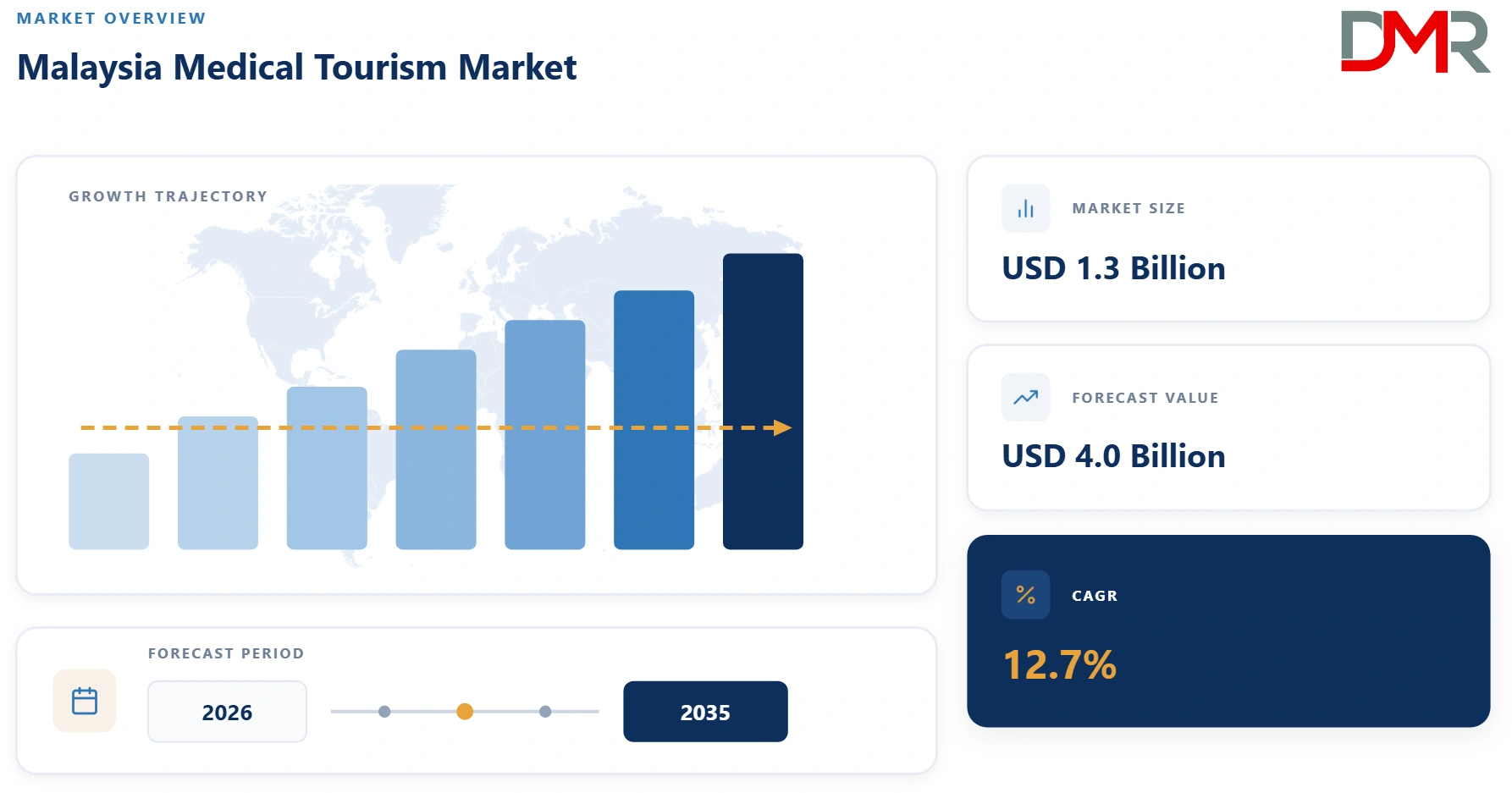
- Malaysia Medical Tourism Market Size in 2026: USD 1.3 Billion
- Malaysia Medical Tourism Market Size in 2035: USD 4.0 Billion
- Malaysia CAGR from 2026 to 2035: 12.7%
- Cosmetic and Aesthetic Treatments is the leading treatment type segment in 2026: 20.3%
- International Patients is the leading patient origin segment in 2026: 78.5%
- Medical and Surgical Treatment is the leading service nature segment in 2026: 68.4%
- Private Hospitals and Clinics is the leading service provider segment in 2026: 87.6%
- Selangor is the leading state hub for medical tourism activity in 2026: 36.2%
What is the Malaysia Medical Tourism Market and its Market Size?
The Malaysia Medical Tourism Market covers medical, surgical, wellness, and preventive care delivered to both international and domestic patients across Malaysia's private and public healthcare providers. The market is sized at USD 1.3 Billion in 2026 and is projected to reach USD 4.0 Billion by 2035, expanding at a CAGR of 12.7% during the forecast period.
ℹ
To learn more about this report –
Download Your Free Sample Report Here
Growth is being propelled by Malaysia's positioning as a cost-competitive, internationally accredited healthcare destination, with treatment prices for many procedures 30-40% lower than in the United States, United Kingdom, and other Western markets while maintaining comparable clinical outcomes. Structured government promotion through the Malaysia Healthcare Travel Council, a growing base of Joint Commission International and MSQH-accredited private hospitals, multilingual patient coordination teams, and Malaysia's proximity and air connectivity to Indonesia, Singapore, and other regional source markets are reshaping the market from a dental- and cosmetic-led destination into a broader full-specialty medical tourism hub spanning cardiology, oncology, fertility, and orthopedics. Investment is accelerating as private hospital groups expand dedicated international patient centers and foreign-patient ward capacity to capture growing demand from both traditional Southeast Asian source markets and an expanding Middle Eastern and South Asian patient base.
Use Cases
- Cost-Competitive Cardiac and Orthopedic Surgery for Regional Patients: International patients from Indonesia, Bangladesh, and the Middle East travel to Malaysian private hospitals for cardiovascular and orthopedic procedures, drawn by internationally accredited care at a fraction of home-country or Western pricing.
- Fertility and Reproductive Treatment Packages for Cross-Border Patients: Couples from across Southeast Asia and the Middle East engage Malaysian fertility clinics for IVF, ICSI, and related reproductive treatments, supported by transparent treatment packages and rising success rates.
- Cosmetic and Dental Tourism Combined with Recovery Travel: International patients combine cosmetic surgery or dental treatment with recovery stays at partner hotels, supported by telehealth check-in services and Malaysia's broader tourism infrastructure.
- Executive Health Screening and Wellness Packages for Domestic and Regional Patients: Both domestic and international patients increasingly use Malaysian private hospitals for executive health screening, cancer screening, and wellness packages, reflecting growing demand for preventive rather than purely curative care.
Key Takeaways
- Market Size: The Malaysia Medical Tourism Market is projected to valued at USD 1.3 Billion in 2026 and is forecast to reach USD 4.0 Billion by 2035, expanding at a CAGR of 12.7%.
- Growth Outlook: Market expansion is sustained by continued cost-competitiveness relative to Western and some regional markets, growing international hospital accreditation, and rising government-backed promotion of Malaysia as a medical tourism destination.
- Primary Growth Drivers: Affordable, internationally accredited private healthcare, structured public-private promotion through the Malaysia Healthcare Travel Council, strong air connectivity to key source markets, and expanding foreign-patient hospital infrastructure.
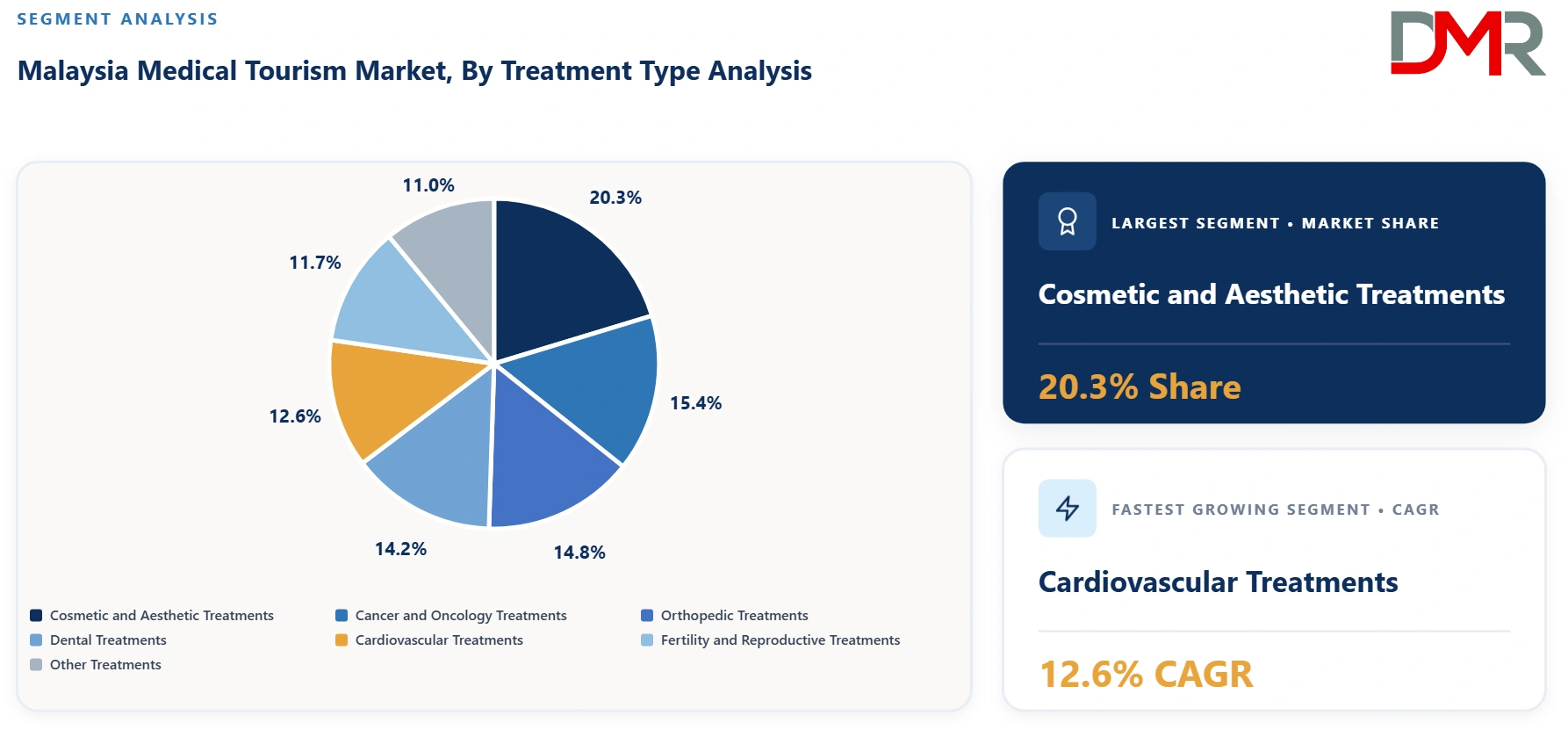
- By Treatment Type Analysis: Cosmetic and Aesthetic Treatments is projected to lead with a 20.3% market share in 2026 and is projected to record the highest CAGR during 2026–2035.
- By Service Nature Analysis: Medical and Surgical Treatment is poised to lead with a 68.4% market share in 2026 and is projected to record the highest CAGR during 2026–2035.
- By Patient Origin Analysis: International Patients ia anticipated to dominate with a 78.5% market share in 2026 and are projected to record the highest CAGR during 2026–2035.
- By Service Provider Analysis: Private Hospitals and Clinics dominate with an 87.6% market share in 2026 and are projected to record the highest CAGR during 2026–2035.
- By State Analysis: Selangor leads with a 36.2% market share in 2026 and is projected to record the highest CAGR during 2026–2035.
Key Drivers in the Malaysia Medical Tourism Market
Sustained Cost Advantage Across High-Demand Specialties
Malaysia's medical tourism market benefits significantly from its competitive treatment costs across major specialties, including cardiology, orthopedics, fertility, oncology, dental care, and cosmetic surgery. Treatment expenses in Malaysia are generally lower than those in the United States, United Kingdom, and several other developed healthcare markets, while leading hospitals maintain internationally recognized clinical and quality standards. This combination of affordability and healthcare quality makes Malaysia attractive to international patients seeking elective and semi-elective procedures. The cost advantage is particularly relevant for patients from neighboring Asian countries and emerging markets, where private healthcare costs may be relatively high compared with local incomes. Consequently, Malaysia continues strengthening its position as a value-oriented regional medical tourism destination.
Structured Government Promotion and Accreditation Infrastructure
Government-backed promotion and healthcare accreditation are important factors supporting the growth of Malaysia's medical tourism industry. The Malaysia Healthcare Travel Council (MHTC) works with healthcare providers and tourism stakeholders to promote Malaysia as a trusted international healthcare destination. Its initiatives help improve visibility among patients, insurers, medical facilitators, and overseas referral networks. At the same time, internationally recognized accreditation and Malaysian Society for Quality in Health (MSQH) standards strengthen confidence in participating hospitals and clinical facilities. Private hospitals increasingly offer dedicated international patient centers, multilingual assistance, transparent treatment packages, and coordinated appointment services. These developments simplify the patient journey from initial consultation through treatment and recovery, strengthening Malaysia's reputation for organized, reliable, and patient-focused medical tourism services.
Restraints in the Malaysia Medical Tourism Market
Regional Competition from Established Medical Tourism Hubs
Intensifying competition from established medical tourism destinations represents a major restraint for Malaysia's market expansion. Thailand, Singapore, India, and other regional destinations offer comparable combinations of advanced medical infrastructure, specialist expertise, competitive pricing, and international patient services. Thailand remains particularly competitive in cosmetic surgery, wellness, dental care, and elective procedures, while Singapore has a strong reputation for complex and high-acuity medical treatments. India competes strongly through significantly lower treatment costs and its large pool of specialized physicians. Patients therefore have multiple destination choices when selecting providers for major procedures. Malaysia must continuously strengthen hospital accreditation, treatment quality, international marketing, patient experience, and pricing competitiveness to retain existing patients and attract new international demand.
Growth Opportunities in the Malaysia Medical Tourism Market
Expansion of Dedicated Foreign-Patient Hospital Infrastructure
The increasing flow of international patients creates substantial opportunities for Malaysian private healthcare providers to expand infrastructure specifically designed for medical tourists. Hospitals can develop dedicated international patient centers, specialized foreign-patient wards, multilingual concierge services, and integrated treatment coordination facilities. Major healthcare clusters in Selangor, Kuala Lumpur, Penang, and Johor are particularly well positioned to capture this demand because of their established private hospital networks and strong connectivity. Providers can also develop comprehensive packages covering consultation, diagnostics, treatment, accommodation coordination, transportation, and post-treatment follow-up. Expanding such infrastructure can improve patient convenience while increasing hospital capacity for high-value procedures. Greater specialization in international patient services can therefore support longer patient stays, higher treatment spending, and stronger referral relationships.
Growth in Wellness and Preventive Care Packages
The expansion of wellness and preventive healthcare represents an important opportunity for Malaysia's medical tourism industry to diversify beyond traditional treatment-focused services. International and domestic consumers are increasingly interested in comprehensive health screenings, executive check-ups, preventive diagnostics, nutrition programs, rehabilitation, and wellness packages. Malaysian private hospitals can combine advanced diagnostic capabilities with hospitality and tourism services to create integrated health and wellness experiences. Executive health screening packages are particularly attractive to corporate professionals and regional patients seeking convenient access to multiple diagnostic services within a short visit. Providers can also introduce personalized preventive health programs supported by digital monitoring and telehealth follow-ups. This shift toward prevention can create recurring revenue opportunities while strengthening Malaysia's broader positioning as a healthcare and wellness destination.
Trends in the Malaysia Medical Tourism Market
Rising Demand for Fertility and Reproductive Treatments
Fertility and reproductive healthcare is becoming an increasingly important component of Malaysia's medical tourism industry. Growing awareness of assisted reproductive technologies, delayed family formation, and improving access to specialized fertility services are supporting demand for IVF, ICSI, fertility assessments, and related treatments. Malaysian fertility centers are attracting patients from neighboring Southeast Asian markets and other international regions by offering competitive treatment costs, specialist expertise, modern laboratory facilities, and structured treatment packages. The ability to combine medical services with Malaysia's established hospitality infrastructure further enhances the destination's appeal for couples requiring multiple visits or extended stays. Continued investment in fertility technology, specialist capabilities, patient coordination, and international referral networks is expected to support the segment's expansion over the forecast period.
Tightening Facility Standards for Foreign-Patient Wards
Increasing emphasis on healthcare quality, patient safety, and regulatory compliance is influencing the development of Malaysia's medical tourism infrastructure. Healthcare facilities serving international patients are facing greater expectations regarding licensing, accreditation, clinical quality, infection control, patient documentation, and dedicated foreign-patient services. The Ministry of Health and Malaysian Society for Quality in Health (MSQH) play important roles in establishing and maintaining healthcare quality standards. Higher facility requirements can improve international patient confidence by ensuring that participating hospitals meet consistent operational and clinical benchmarks. However, stricter standards can also increase compliance costs and make market entry more difficult for smaller providers. As a result, medical tourism activity is likely to remain concentrated among established, well-equipped private hospital groups with strong accreditation and international patient capabilities.
Research Scope and Analysis
The Malaysia Medical Tourism Market is segmented by treatment type, service nature, patient origin, and service provider, covering cosmetic and aesthetic, oncology, orthopedic, dental, cardiovascular, and fertility and reproductive treatments delivered across private and public healthcare providers to both international and domestic patients.
ℹ
To learn more about this report –
Download Your Free Sample Report Here
By Treatment Type Analysis
Cosmetic and Aesthetic Treatments is poised to lead the treatment type segment with a 20.3% share in 2026, reflecting Malaysia's established reputation in facelifts, liposuction, breast procedures, and related aesthetic surgery. Dental and Orthopedic Treatments together account for a further 29.0% share, reflecting Malaysia's competitive pricing in implants, veneers, and joint reconstruction. Fertility and Reproductive Treatments and Cancer and Oncology Treatments are expected to register comparatively faster growth off their 2026 base, supported by rising cross-border demand for IVF and cancer care respectively, while Cardiovascular Treatments continue to account for a meaningful 12.6% share of high-value inbound procedures.
By Service Nature Analysis
Medical and Surgical Treatment is expected to dominate the service nature segment with a 68.4% share in 2026, reflecting the concentration of high-value inbound procedures in surgical and interventional specialties such as cardiology, orthopedics, and cosmetic surgery. Wellness and Preventive Treatments holds a 21.3% share, supported by rising demand for executive health screening and preventive packages among both international and domestic patients, while Alternative Treatments and Therapies accounts for a 10.3% share tied to traditional and complementary wellness offerings.
By Patient Origin Analysis
International Patients is projected to dominate the patient origin segment with a 78.5% share in 2026, underscoring the structurally inbound-driven nature of Malaysia's medical tourism sector, with demand concentrated among patients from Indonesia, Bangladesh, the Middle East, and other regional source markets. Domestic Patients account for a 21.5% share, largely tied to private specialty and wellness services outside the core inbound medical tourism definition.
By Service Provider Analysis
Private Hospitals and Clinics is poised to dominate the service provider segment with an 87.6% in 2026, reflecting Ministry of Health licensing requirements that concentrate foreign-patient ward capacity among accredited private facilities such as those operated by IHH Healthcare, KPJ Healthcare, and Sunway Medical Centre. Public Healthcare Institutions account for a 12.4% share reflecting their comparatively limited role in inbound medical tourism given their primary mandate toward domestic patient care.
The Malaysia Medical Tourism Market Report is segmented based on the following:
By Treatment Type
- Cosmetic and Aesthetic Treatments
- Cancer and Oncology Treatments
- Orthopedic Treatments
- Dental Treatments
- Cardiovascular Treatments
- Fertility and Reproductive Treatments
- Other Treatments
By Service Nature
- Medical and Surgical Treatment
- Wellness and Preventive Treatments
- Alternative Treatments and Therapies
By Patient Origin
- International Patients
- Domestic Patients
By Service Provider
- Private Hospitals and Clinics
- Public Healthcare Institutions
Technology Analysis
Technology adoption in the Malaysia medical tourism market is increasingly centered on digital patient records and multilingual coordination platforms supporting cross-border care management, telehealth-based pre-treatment consultation and post-treatment follow-up, and robotic surgical and advanced imaging platforms deployed by leading private hospital groups to support high-acuity cardiology and orthopedic procedures. Growing adoption of international insurance network integration is reducing out-of-pocket costs for covered international patients. Opportunities are expanding for providers investing in integrated digital platforms spanning pre-arrival consultation, treatment, and post-treatment telehealth follow-up, though maintaining consistent data quality and interoperability across multiple international insurance and referral networks remains an ongoing operational challenge.
Investment and White Space Analysis
Investment opportunities in the Malaysia Medical Tourism Market are expanding alongside sustained inbound demand growth, rising accreditation standards, and structured government promotion. Significant white space exists in dedicated foreign-patient hospital infrastructure expansion, wellness and preventive care packaging, and fertility and oncology treatment capacity capable of capturing rising cross-border demand. Providers with strong international accreditation, established referral relationships in key source markets, and comprehensive treatment packaging spanning pre-arrival through post-treatment care are positioned to capture premium, longer-duration patient engagements. However, intensifying regional competition from Thailand, Singapore, and India, along with tightening Ministry of Health facility licensing requirements, can constrain the pace of new entrant capacity expansion.
Competitive Landscape
The Malaysia Medical Tourism Market exhibits a moderately high concentration, with a small number of large private hospital groups accounting for a significant share of international patient inflows. Competition centers on international accreditation, treatment specialty breadth, established referral relationships in key source markets, multilingual patient coordination capability, and dedicated foreign-patient ward infrastructure. Leading private hospital groups benefit from integrated campus models, robotic surgical platforms, and established brand recognition across Southeast Asian and Middle Eastern source markets, while smaller specialty clinics compete through deep expertise in specific treatment categories such as fertility or cosmetic surgery.
Some of the prominent players in the Malaysia Medical Tourism Market are:
- IHH Healthcare Berhad
- KPJ Healthcare Berhad
- Sunway Healthcare Group
- Asia OneHealthcare (A1Health)
- Thomson Medical Group
- Prince Court Medical Centre
- Mahkota Medical Centre
- Island Hospital
- Pantai Holdings Berhad
- Gleneagles Hospitals
- Columbia Asia Malaysia / A1Health
- Avisena Healthcare
- Ramsay Sime Darby Health Care
- LohGuanLye Specialists Centre
- Penang Adventist Hospital
- TMC Fertility & Women’s Specialist Centre
- Alpha International Fertility Centre
- Sunfert International Fertility Centre
- Beverly Wilshire Medical Centre
- SJMC – Subang Jaya Medical Centre
- KPJ Damansara Specialist Hospital
- KPJ Johor Specialist Hospital
- KPJ Penang Specialist Hospital
- KPJ Ampang Puteri Specialist Hospital
- Pantai Hospital Kuala Lumpur
- Pantai Hospital Penang
- Pantai Hospital Johor
- Gleneagles Hospital Kuala Lumpur
- Gleneagles Hospital Penang
- Gleneagles Hospital Johor
- Gleneagles Hospital Kota Kinabalu
- Sunway Medical Centre
- Sunway Medical Centre Velocity
- Sunway Medical Centre Damansara
- KPJ Sabah Specialist Hospital
- Timberland Medical Centre
- Normah Medical Specialist Centre
- KPJ Kuching Specialist Hospital
- Regency Specialist Hospit
- Other Key Players
Recent Developments
- September 2026: KKR acquired a minority stake in Avisena Healthcare to support the expansion of multi-specialty services at its Shah Alam hospitals and the development of new greenfield hospitals in the Klang Valley, strengthening Malaysia's private healthcare and medical tourism capacity.
- February 2026: Sunway Healthcare launched an IPO targeting RM2.86 billion (US$736 million), with proceeds supporting hospital expansion. The listing valued the company at approximately RM16.7 billion, reinforcing investment momentum in Malaysia's private healthcare sector.
- February 2026: The Malaysia Healthcare Travel Council launched Malaysia Healthcare Week Phnom Penh 2026 in partnership with OneHealth Cambodia, strengthening referral networks and promoting Malaysian hospitals to Cambodian patients as part of Malaysia Year of Medical Tourism 2026.
Report Details
| Report Characteristics |
| Market Size (2026) |
USD 1.3 Bn |
| Forecast Value (2035) |
USD 4.0 Bn |
| CAGR (2026–2035) |
12.7% |
| Historical Data |
2021 – 2025 |
| Forecast Data |
2026 – 2035 |
| Base Year |
2025 |
| Segments Covered |
By Treatment Type, By Service Nature, By Patient Origin, By Service Provider |
| Country Coverage |
Malaysia |
Frequently Asked Questions
How big is the Malaysia Medical Tourism Market?
▾ The Malaysia Medical Tourism Market is poised to be valued at USD 1.3 Billion in 2026 and is projected to reach USD 4.0 Billion by 2035.
What is the CAGR of the Malaysia Medical Tourism Market from 2026 to 2035?
▾ The market is projected to expand at a compound annual growth rate (CAGR) of 12.7% between 2026 and 2035.
What factors are driving the growth of the Malaysia Medical Tourism Market?
▾ Growth is driven by sustained cost competitiveness relative to Western healthcare markets, structured government promotion through the Malaysia Healthcare Travel Council, expanding internationally accredited private hospital infrastructure, and rising cross-border demand for fertility, cosmetic, and cardiovascular treatments.
What are the major trends in the Malaysia Medical Tourism Market?
▾ Major trends include rising demand for fertility and reproductive treatments, tightening facility licensing standards for foreign-patient wards, and growing adoption of telehealth and digital patient coordination platforms.
Who are the key players in the Malaysia Medical Tourism Market?
▾ Key market participants include IHH Healthcare Berhad, KPJ Healthcare Berhad, Sunway Medical Centre, Pantai Holdings Berhad, and Mahkota Medical Centre, among other private hospital groups and specialty clinics.
How is the Malaysia Medical Tourism Market segmented?
▾ The market is segmented by treatment type, service nature, patient origin, and service provider, with demand concentrated in Selangor, W.P. Kuala Lumpur, Penang, and Johor.