Malaysia Palm Oil Derivatives Market Snapshot
- Market Size in 2026: USD 9.2 billion
- Market Size in 2035: USD 14.4 billion
- CAGR, 2026–2035: 5.1%
- Leading Product Segment in 2026: RBD Palm Oil, 27.5% share
- Leading Form Segment in 2026: Liquid, 42.0% share
- Leading Application Segment in 2026: Food Processing, 31.5% share
- Fastest-Growing Segment: Specialty Palm Fractions, 7.2% CAGR
What is the Malaysia Palm Oil Derivatives and its Market Size?
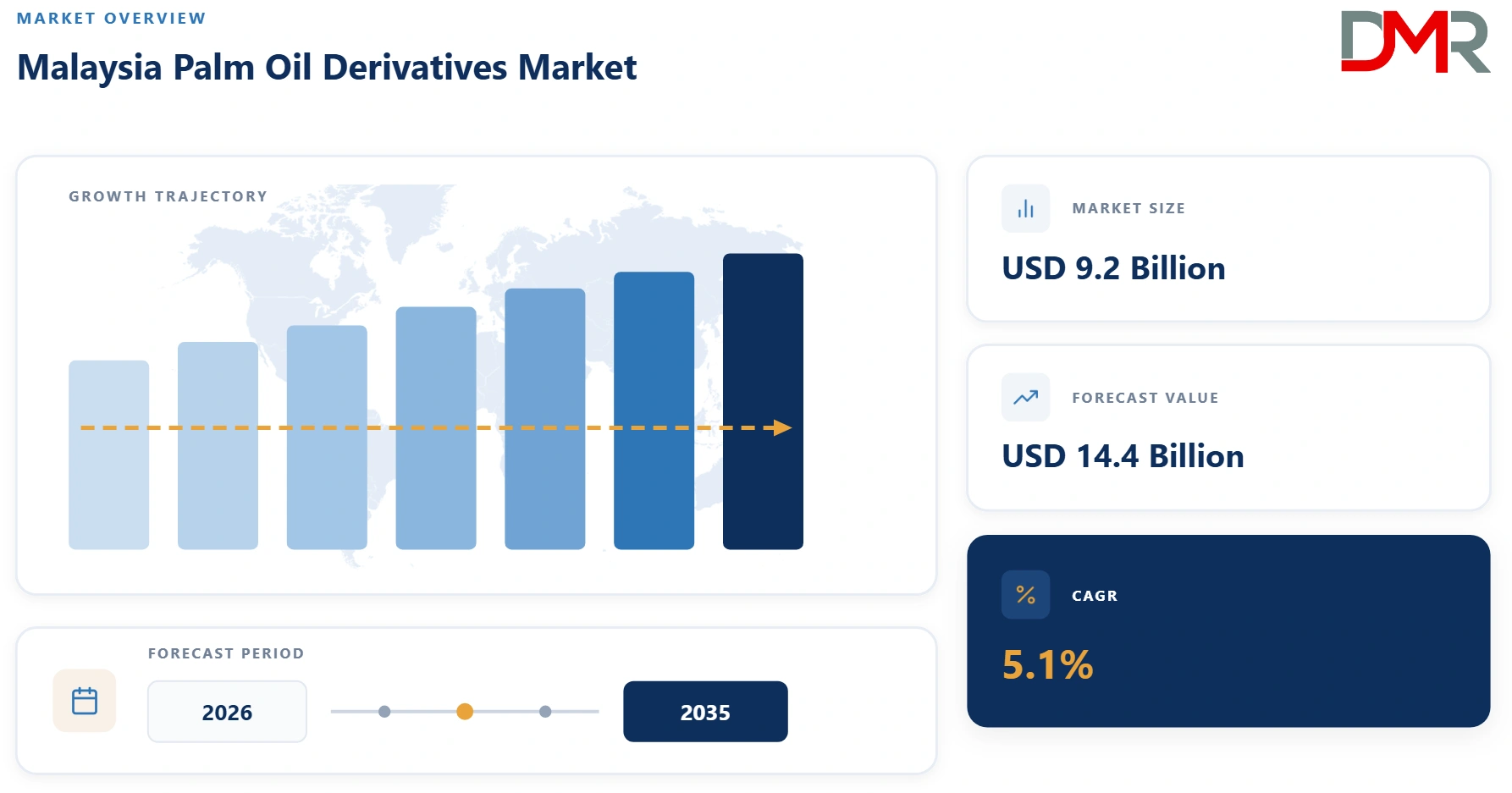
The Malaysia palm oil derivatives market is estimated at USD 9.2 billion in 2026, increasing to approximately USD 14.4 billion by 2035, representing a 5.1% CAGR.
ℹ
To learn more about this report –
Download Your Free Sample Report Here
Malaysia palm oil derivatives are refined, fractionated, modified and downstream products manufactured from crude palm oil, palm olein, palm stearin and palm kernel oil. The market encompasses refined palm oils, specialty fractions, fatty acids, glycerine, esters, surfactants, soap noodles and other oleochemical derivatives used across food, personal care, cosmetics, pharmaceuticals, animal nutrition and industrial applications. Malaysia's vertically integrated palm industry connects plantations, mills, refineries, fractionation facilities and oleochemical plants, enabling manufacturers to convert palm feedstock into higher-value ingredients and functional materials. Malaysian producers serve both domestic customers and major international markets across Asia, Europe and North America.
Use Cases
- Food Processing: Palm fractions provide stable, cost-efficient oils and fats for frying, margarine, fillings and processed foods.
- Bakery and Confectionery: Specialty palm fats deliver controlled melting profiles, texture, aeration and shelf stability.
- Personal Care and Cosmetics: Fatty acids, esters and glycerine support creams, lotions, surfactants, soaps and emollient formulations.
- Oleochemicals: Palm-derived feedstocks are converted into fatty acids, glycerine, esters and specialty chemicals.
- Animal Feed: Palm kernel derivatives provide energy, protein and functional ingredients for livestock and aquaculture.
- Industrial Applications: Palm-based derivatives are incorporated into lubricants, polymers, coatings, detergents and other materials.
Key Takeaways
- The market is estimated to reach USD 9.2 billion in 2026 and USD 14.4 billion by 2035, growing at 5.1% CAGR.
- Demand is being supported by Malaysia's large feedstock base, established refining infrastructure and strong export orientation.
- RBD Palm Oil is expected to remain the leading product category, supported by broad food-processing and foodservice applications.
- Liquid derivatives represent the largest form category because of their extensive use in food manufacturing, frying and industrial processing.
- Food Processing remains the largest application, while specialty fractions are expected to achieve the fastest growth.
- Sustainability certification, traceability, product innovation and higher-value oleochemical derivatives are becoming increasingly important competitive factors.
How AI/Gen AI is Transforming the Malaysia Palm Oil Derivatives Market?
AI, IoT and industrial automation are increasingly being applied throughout Malaysia's palm-oil value chain, including mills, refineries, fractionation plants and oleochemical facilities. Technologies such as machine vision, automated quality inspection, predictive maintenance, process sensors and digital production monitoring improve control over feedstock quality, extraction efficiency and refining parameters. Malaysian industry R&D is already incorporating AIoT-based fruit sorting, targeted spraying, mechanised harvesting and Industry 4.0 technologies.
The principal benefits include improved yield, lower energy consumption, reduced production downtime and more consistent product specifications. Digital traceability also supports sustainability certification and customer requirements. Automation is gradually shifting competition from commodity-scale production toward operational efficiency, quality consistency, traceability and the ability to manufacture specialized derivatives at commercial scale.
Key Drivers in the Malaysia Palm Oil Derivatives Market
Expanding Demand for Value-Added Palm Products
A major growth driver is the increasing conversion of Malaysian palm feedstock into higher-value refined, fractionated and oleochemical products. Food manufacturers continue to use palm-derived ingredients because of their functionality, oxidative stability and broad formulation flexibility. Meanwhile, personal-care, pharmaceutical and industrial customers increasingly require specialized fatty acids, esters, glycerine and surfactants. Malaysian producers benefit from proximity to large palm feedstock supplies and established downstream infrastructure. IOI, for example, operates refining and oleochemical facilities producing fatty acids, glycerine, soap noodles, fatty esters and specialty derivatives for international customers.
Expanding Demand for Value-Added Palm Products
A major growth driver is the increasing conversion of Malaysian palm feedstock into higher-value refined, fractionated and oleochemical products. Food manufacturers continue to use palm-derived ingredients because of their functionality, oxidative stability and broad formulation flexibility. Meanwhile, personal-care, pharmaceutical and industrial customers increasingly require specialized fatty acids, esters, glycerine and surfactants. Malaysian producers benefit from proximity to large palm feedstock supplies and established downstream infrastructure. IOI, for example, operates refining and oleochemical facilities producing fatty acids, glycerine, soap noodles, fatty esters and specialty derivatives for international customers.
Restraints in the Malaysia Palm Oil Derivatives Market
Feedstock Price Volatility
Palm oil derivatives remain exposed to fluctuations in CPO and palm kernel oil prices. Changes in crude palm oil prices can quickly affect refining economics, inventory values and downstream margins. Weather conditions, production cycles, currency movements, biodiesel policies and competing vegetable oils can all influence feedstock prices. In addition, downstream producers face pressure when selling prices cannot immediately adjust to higher raw-material costs.
Sustainability and Regulatory Compliance
Environmental and traceability requirements are becoming increasingly important in international palm-oil trade. European customers in particular require detailed evidence regarding sourcing and deforestation risk. Compliance requires investments in traceability systems, certification, supplier monitoring and documentation. Smaller suppliers may find these requirements more difficult to absorb than large integrated producers.
Growth Opportunities in the Malaysia Palm Oil Derivatives Market
Specialty and High-Performance Derivatives
Specialty palm fractions, fatty esters, surfactants, bio-based polyols and other higher-value derivatives represent a significant opportunity. These products typically offer greater margins than bulk refined oils and can serve specialized food, cosmetic, pharmaceutical and industrial applications. Malaysian research institutions are actively developing palm-based polyols, polymers, composites, specialty chemicals and glycerol derivatives.
Expansion into Bio-Based Industrial Materials
Palm-derived chemicals can increasingly substitute petroleum-derived materials in selected applications. Bio-based polyols, lubricants, surfactants, polymers, coatings and specialty chemicals offer opportunities as manufacturers seek renewable raw materials and lower-carbon alternatives.
Trends in the Malaysia Palm Oil Derivatives Market
Premiumization of Palm Derivatives
The market is moving beyond basic refined oils toward specialty fats, customized fractions, functional ingredients and performance-oriented oleochemicals. Customers increasingly require products optimized for specific melting points, texture, stability, emulsification and formulation characteristics.
Sustainability-Linked Product Differentiation
Sustainability certification, traceability and carbon-footprint management are becoming commercial differentiators rather than purely compliance requirements. Major Malaysian producers are investing in certified supply chains, renewable energy, waste utilization and lower-emission manufacturing.
Research Scope and Analysis
The market is analyzed across Product, Form, Application, End Use Industry and Distribution Channel. The segmentation reflects the different stages through which palm-derived feedstocks are converted into refined oils, fractions, specialty ingredients and industrial derivatives.
ℹ
To learn more about this report –
Download Your Free Sample Report Here
By Product Analysis
RBD Palm Oil is estimated to be the dominant product segment in 2026, accounting for approximately 27.5% of market value, supported by extensive consumption in food manufacturing, foodservice, retail cooking and ingredient formulation. Crude Palm Oil remains the second-largest category at approximately 20.5%, reflecting its importance as the primary feedstock entering downstream processing. Specialty Palm Fractions are projected to be the fastest-growing product category at approximately 7.2% CAGR through 2035, driven by demand for customized melting profiles, confectionery fats, bakery ingredients and premium food formulations. Palm olein remains particularly important for frying and foodservice, while palm stearin serves as a functional hard-fat component. Palm kernel oil continues to support oleochemical production and applications requiring specific fatty-acid profiles. The overall product mix is gradually shifting toward higher-value fractions and derivatives as Malaysian manufacturers seek stronger margins and greater downstream value capture.
By Form Analysis
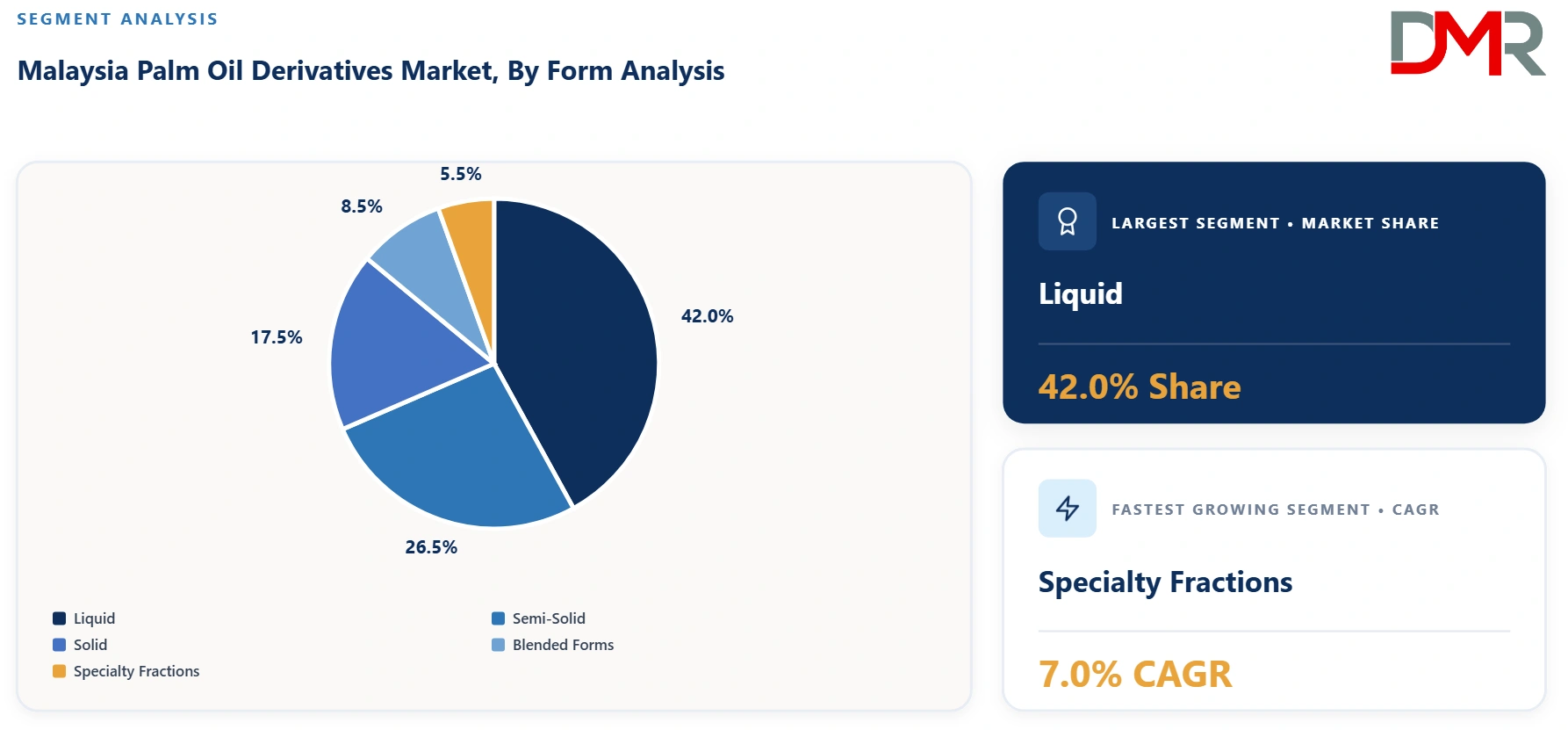
Liquid products are estimated to represent the largest form category in 2026 at approximately 42.0%, reflecting extensive use of palm olein, refined palm oil and liquid formulations across cooking, food processing and industrial applications. Semi-Solid products represent approximately 26.5%, particularly in specialty fats, spreads, bakery ingredients and confectionery formulations. Solid derivatives account for roughly 17.5%, supported by palm stearin and hard-fat applications. Blended Forms represent approximately 8.5%, benefiting from customized formulations combining palm fractions with other vegetable oils. Specialty Fractions account for about 5.5% but are expected to achieve the strongest growth, at approximately 7.0% CAGR, as food manufacturers increasingly seek tailored functionality rather than standardized commodity oils. Form innovation is therefore closely linked to premiumization and application-specific product development.
By Application Analysis
Food Processing is expected to remain the dominant application in 2026, representing approximately 31.5% of market value because palm-derived oils and fats provide stability, functionality and competitive economics across processed foods. Bakery & Confectionery is the second-largest application at approximately 22.0%, supported by demand for specialty fats, shortening, fillings and confectionery formulations. Personal Care & Cosmetics is projected to be among the fastest-growing applications at approximately 6.8% CAGR, driven by increasing utilization of fatty acids, esters, glycerine and palm-derived surfactants. Foodservice remains important because palm olein is widely used in commercial frying. Industrial applications, including detergents, lubricants, polymers and coatings, provide further diversification. Animal feed is supported by palm kernel products, while emerging bio-based chemical applications offer additional long-term growth opportunities.
By End Use Industry Analysis
Food & Beverages is estimated to account for approximately 36.0% of the market in 2026, making it the largest end-use industry due to extensive consumption of refined palm oils, oleins, stearins and specialty fats. Personal Care represents the second-largest segment at approximately 17.0%, supported by fatty acids, glycerine, esters and surfactants used in cosmetics and hygiene products. Oleochemicals are expected to register the fastest growth at approximately 7.0% CAGR, reflecting increasing demand for bio-based chemicals and downstream specialty products. Hospitality and restaurants remain significant consumers of frying oils, while retail cooking oils provide a large domestic and export channel. Industrial users represent a diverse demand base spanning detergents, lubricants, polymers and coatings. Malaysia's established downstream capabilities provide manufacturers with opportunities to integrate across several end-use markets.
By Distribution Channel Analysis
Direct B2B Supply is estimated to be the largest distribution channel in 2026, with approximately 38.0% share, reflecting the bulk nature of palm derivatives and long-term relationships between Malaysian producers and multinational manufacturers. Distributors & Wholesalers account for approximately 23.0%, supporting access to smaller industrial, foodservice and regional customers. Modern Retail represents around 14.0%, primarily for packaged refined oils and consumer products, while Traditional Retail contributes approximately 10.0%. Foodservice Suppliers represent roughly 9.0%, benefiting from demand from restaurants, hotels and commercial kitchens. E-commerce remains relatively small at approximately 4.0%, but is expected to grow fastest at approximately 8.0% CAGR as smaller packaged products, specialty ingredients and business-to-business ordering platforms become more digital. Other channels account for the remaining 2.0%.
The Malaysia Palm Oil Derivatives Market Report is segmented on the basis of the following:
By Product
- RBD Palm Oil
- Palm Olein
- Palm Stearin
- Crude Palm Oil
- Palm Kernel Oil
- Specialty Palm Fractions
- Others
By Form
- Liquid
- Semi-Solid
- Solid
- Blended Forms
- Specialty Fractions
By Application
- Food Processing
- Foodservice
- Bakery & Confectionery
- Personal Care & Cosmetics
- Industrial Uses
- Animal Feed
- Others
By End Use Industry
- Food & Beverages
- Hospitality & Restaurants
- Retail Cooking Oils
- Personal Care
- Oleochemicals
- Other Industrial Users
- Others
By Distribution Channel
- Direct B2B Supply
- Distributors & Wholesalers
- Modern Retail
- Traditional Retail
- Foodservice Suppliers
- E-commerce
- Others
Investment and White Space Analysis
Malaysia's palm derivatives industry presents attractive investment potential in specialty fractions, oleochemicals, bio-based chemicals and application-specific food ingredients. The strongest white spaces are products that move beyond commodity refining into technically differentiated formulations, including specialty fats, bio-based polyols, esters, surfactants and high-performance palm-derived materials. Existing Malaysian research is already targeting polymers, composites, specialty chemicals and circular-economy applications. Malaysia's palm derivatives industry presents attractive investment potential in specialty fractions, oleochemicals, bio-based chemicals and application-specific food ingredients. The strongest white spaces are products that move beyond commodity refining into technically differentiated formulations, including specialty fats, bio-based polyols, esters, surfactants and high-performance palm-derived materials. Existing Malaysian research is already targeting polymers, composites, specialty chemicals and circular-economy applications.
Technology Analysis
Technology investment is increasingly determining productivity and product differentiation across Malaysian palm derivatives. Automated refining controls, advanced process sensors, AI-assisted quality inspection, predictive maintenance and digital traceability can reduce operating costs while improving consistency. The downstream opportunity extends beyond automation into biotechnology and green chemistry, particularly for bio-based polyols, specialty esters, surfactants and polymer intermediates. Malaysian R&D institutions are actively developing these higher-value applications, while integrated companies are increasing mechanisation and manufacturing efficiency.
Competitive Landscape
The Malaysia palm oil derivatives market is moderately consolidated at the large-scale manufacturing level but fragmented across smaller processors and distributors. Major integrated companies compete through feedstock security, refinery and oleochemical capacity, international distribution, sustainability credentials and product innovation. Key participants include IOI Corporation, KLK, SD Guthrie, Wilmar International, Sime Darby-linked businesses, Musim Mas and other regional producers. Competitive strategies increasingly involve downstream integration, specialty-product development, operational efficiency, sustainability certification and partnerships with multinational customers. IOI, for example, operates oleochemical facilities producing fatty acids, glycerine, soap noodles, fatty esters and specialty derivatives and exports products to major global markets.
Some of the prominent players in the Malaysia Palm Oil Derivatives Market are:
- IOI Corporation
- Kuala Lumpur Kepong (KLK)
- SD Guthrie
- FGV Holdings
- Wilmar International
- Sime Darby Oils
- Musim Mas
- Oleon
- Emery Oleochemicals
- Evyap
- BASF
- Cargill
- ADM
- Croda International
- Kao Corporation
- Procter & Gamble
- KLK OLEO
- IOI Oleochemical Industries
- Southern Acids Industries
- Palm-Oleo
- IOI Acidchem
- FPG Oleochemicals
- Edenor Oleochemicals
- Natural Oleochemicals
- Pacific Oleochemicals
- Fatty Chemical (Malaysia)
- Evyap Sabun Malaysia
- IFFCO Malaysia
- Sime Darby Oils Nutrition
- KL-Kepong Oleomas
- Palm-Oleo (Klang)
- KLK Bioenergy
- Emery Oleochemicals Malaysia
- Oleon Malaysia
- Timur Oleochemicals Malaysia
- Vance Bioenergy
- Apical
- Golden Agri-Resources
- AAK
- Bunge Loders Croklaan
- Other Key Players
Recent Developments
- October 2025: KLK formed a strategic partnership with AAK to develop and operate Nura Speciality Oils and Fats in Johor, focusing on high-value fractionated palm-oil products for the global food industry.
- September 2025: IOI launched new personal-care products, including polyglycerol esters and SOFTISAN 650, supporting its expansion into higher-value specialty ingredients.
- July 2025: KLK strengthened its European oleochemical and pharmaceutical activities through organizational restructuring and established KLK OLEO Life Science to consolidate its pharmaceutical business.
- June 2025: IOI expanded its focus on downstream productivity, targeting improved fatty-acid plant utilization and greater operational efficiency across its oleochemical manufacturing operations.
- January 2025: IOI introduced its 2025–2029 strategic roadmap focused on product portfolio expansion, innovation, productivity, quality and sustainability, with an emphasis on higher-value sustainable palm products.
Report Details
| Report Characteristics |
| Market Size (2026) |
USD 9.2 Bn |
| Forecast Value (2035) |
USD 14.4 Bn |
| CAGR (2026–2035) |
5.1% |
| Historical Data |
2021 – 2025 |
| Forecast Data |
2026 – 2035 |
| Base Year |
2025 |
| Segments Covered |
By Product, By Form, By Application, By End Use Industry, By Distribution Channel |
| Country Coverage |
Malaysia |
Frequently Asked Questions
What is the Malaysia Palm Oil Derivatives Market size in 2026?
▾ The Malaysia Palm Oil Derivatives Market is estimated at approximately USD 9.2 billion in 2026 and is projected to reach USD 14.4 billion by 2035.
What is the expected CAGR of the Malaysia Palm Oil Derivatives Market?
▾ The Malaysia Palm Oil Derivatives Market is projected to grow at a 5.1% CAGR from 2026 to 2035, driven by downstream processing and specialty-product demand.
What are the key drivers of the Malaysia Palm Oil Derivatives Market?
▾ Key drivers include strong palm feedstock availability, expanding food applications, oleochemical demand, specialty fractions, and growing adoption of bio-based materials.
Which product segment leads the Malaysia Palm Oil Derivatives Market?
▾ RBD Palm Oil is expected to lead the Malaysia Palm Oil Derivatives Market in 2026, accounting for approximately 27.5% of market value.
Which segment is growing fastest in the Malaysia Palm Oil Derivatives Market?
▾ Specialty Palm Fractions are projected to be the fastest-growing product segment, with an estimated 7.2% CAGR through 2035.
What are the major trends in the Malaysia Palm Oil Derivatives Market?
▾ Key trends include specialty-product development, downstream integration, sustainability-focused sourcing, digital manufacturing, and increasing demand for bio-based oleochemicals.
Who are the key players in the Malaysia Palm Oil Derivatives Market?
▾ Major participants include IOI Corporation, KLK, SD Guthrie, Wilmar International, and other Malaysian and regional palm-oil and oleochemical producers.
How is the Malaysia Palm Oil Derivatives Market segmented?
▾ The Malaysia Palm Oil Derivatives Market is segmented by Product, Form, Application, End Use Industry, and Distribution Channel.