Global Manufacturing Operations Management Platforms Market Snapshot
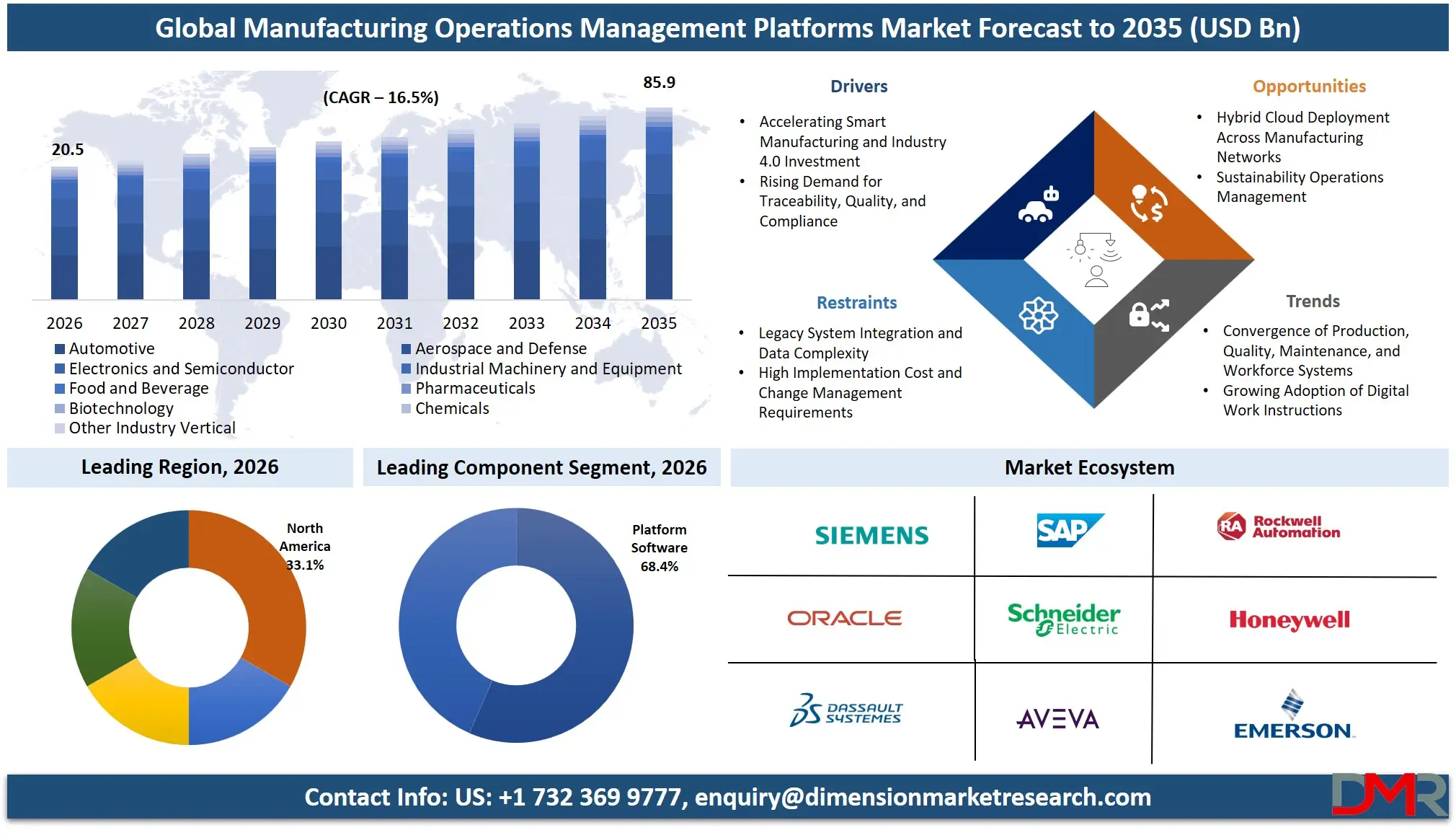
- Market Size in 2026: USD 20.5 Billion
- Market Size in 2035: USD 85.9 Billion
- CAGR from 2026 to 2035: 16.5%
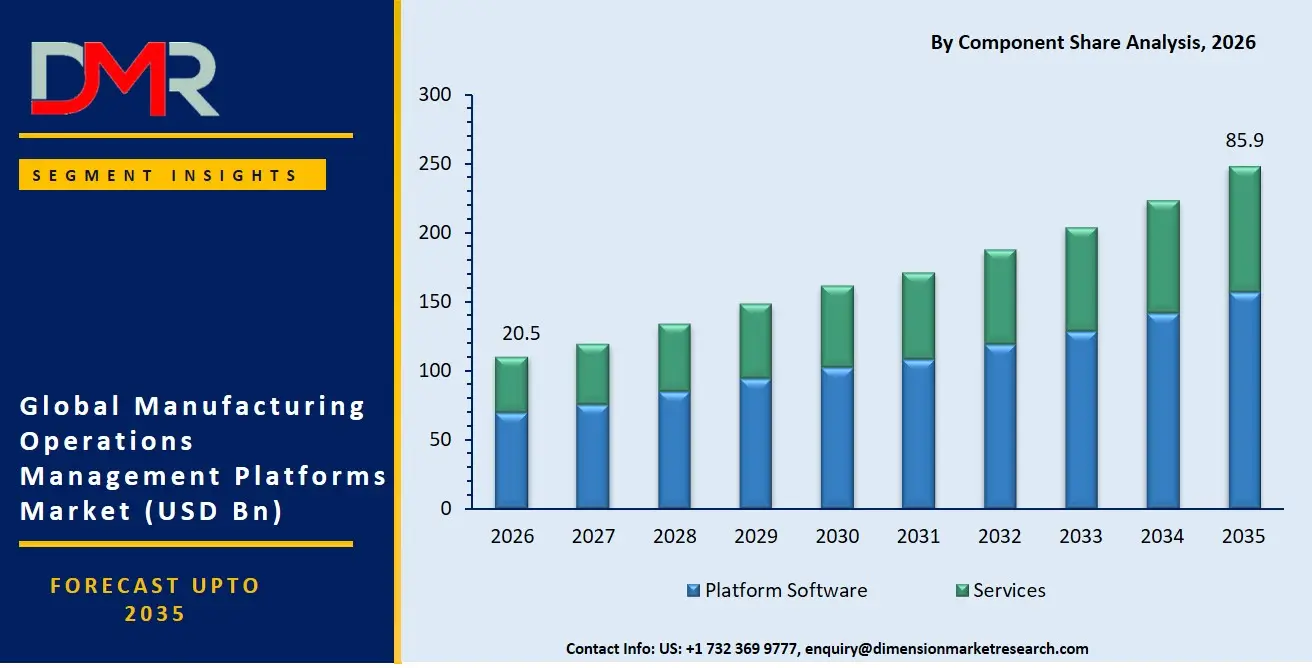
- Leading Component: Platform Software with 68.4% share
- Fastest Growing Component: Services with 17.7% CAGR
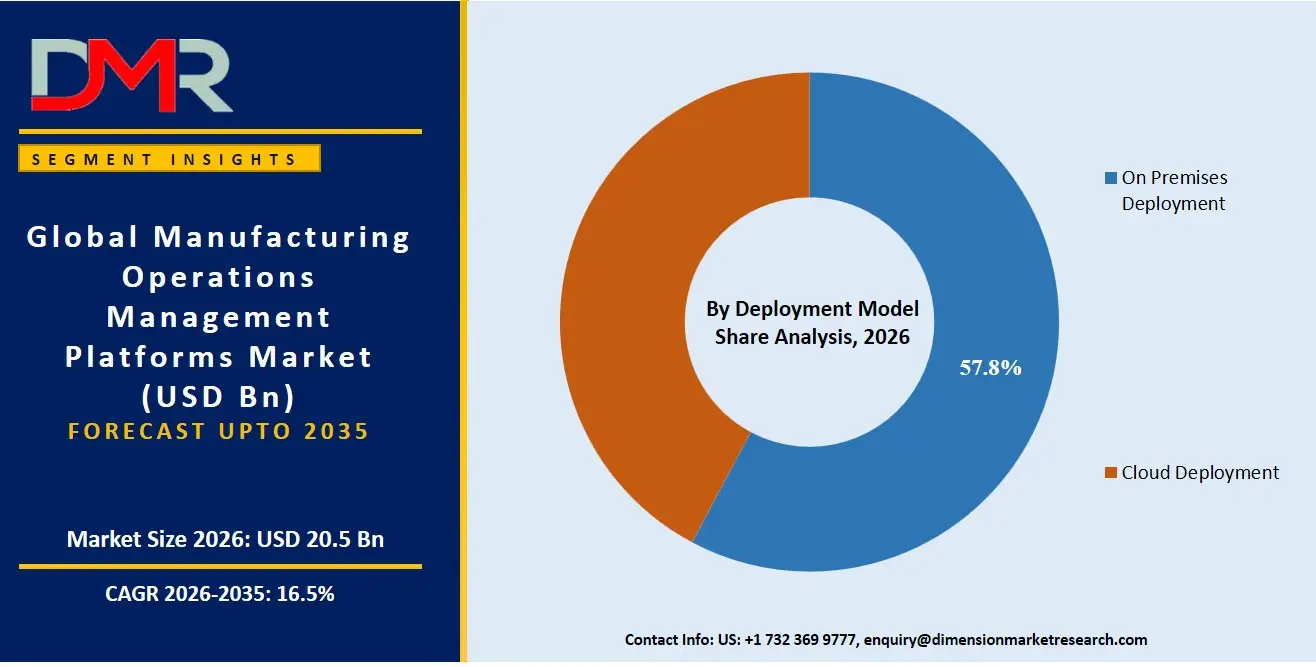
- Leading Deployment Model: On Premises Deployment with 57.8% share
- Leading Enterprise Size: Large Enterprises with 71.4% share
- Leading Manufacturing Type: Discrete Manufacturing with 44.2% share
- Leading Industry Vertical: Automotive with 22.6% share
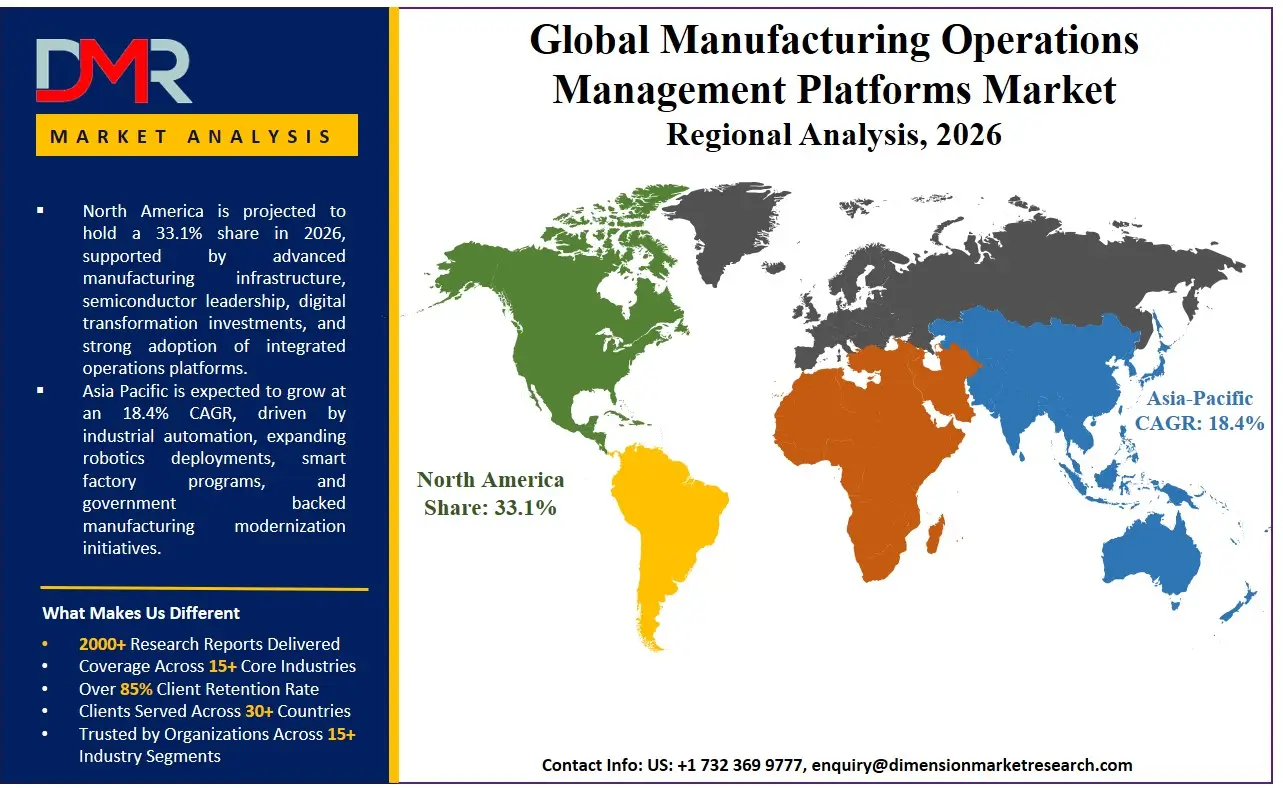
- Leading Region: North America with 33.1% share
- Fastest Growing Region: Asia Pacific with 18.4% CAGR
What is the Global Manufacturing Operations Management Platforms Market Size?
Manufacturing Operations Management platforms are integrated software environments that manage, monitor, coordinate, and optimize plant operations. They connect enterprise resource planning systems with shop floor systems, industrial control systems, equipment data, production workflows, materials, quality processes, workforce activities, and operational analytics. The technology enables manufacturers to achieve real time production visibility, improve process control, maintain material traceability, strengthen quality compliance, and optimize the use of labor and production assets.
The Global Manufacturing Operations Management Platforms Market is projected to grow from USD 20.5 billion in 2026 to USD 85.9 billion by 2035, registering a CAGR of 16.5%. Growth is being supported by smart factory investment, industrial Internet of Things adoption, rising automation, stronger product traceability requirements, and the need to reduce downtime and production losses. Manufacturers are moving away from disconnected applications, manual records, and isolated production systems toward unified operational platforms that improve coordination across multi site manufacturing networks.
ℹ
To learn more about this report –
Download Your Free Sample Report Here
Manufacturing Operations Management platforms are becoming the digital operating layer between enterprise planning and physical production. They consolidate work order execution, production scheduling, quality events, maintenance activities, material movement, operator guidance, energy monitoring, and manufacturing intelligence. Automotive, aerospace and defense, electronics and semiconductor, industrial machinery, food and beverage, pharmaceuticals, biotechnology, chemicals, and other industrial organizations are adopting these platforms to improve operational efficiency and resilience.
Use Cases
- Production Execution and Work Order Management: Manufacturers use Manufacturing Execution System capabilities to dispatch work, execute orders, track production progress, capture labor activity, and monitor work in progress across production lines.
- Digital Quality and Compliance Management: Quality Management System capabilities support inspections, statistical process control, nonconformance management, corrective and preventive action management, audit readiness, and supplier quality control.
- Predictive Maintenance and Asset Reliability: Asset Performance Management uses equipment condition data, production history, and maintenance records to identify failure risks, optimize maintenance schedules, and reduce unplanned downtime.
- Material Traceability and Product Genealogy: Materials Operations Management links raw materials, lots, work orders, equipment, inspections, and finished goods to support recall readiness, root cause analysis, and regulatory documentation.
- Connected Workforce and Digital Work Instructions: Digital Operator Guidance, skills management, and shift handover tools help manufacturers standardize work execution, reduce training time, and maintain operational knowledge.
Key Takeaways
- Component Segment Analysis: Platform Software leads the component segment with an estimated 68.4% share in 2026, while Services are projected to grow at the highest CAGR of 17.7% as manufacturers require consulting, integration, migration, training, and managed platform support.
- Platform Software Segment Analysis: Manufacturing Execution System is the largest Platform Software segment with an estimated 24.8% share, followed by Manufacturing Operations Management Suite at 18.6%, reflecting demand for production execution and multi site governance capabilities.
- Deployment Model Segment Analysis: On Premises Deployment leads with a 57.8% share because manufacturers prioritize local control, low latency response, data sovereignty, operational technology security, and established industrial control system integration.
- Fastest Growing Deployment Model: Hybrid Cloud Deployment is anticipated to record the highest CAGR of 19.6% as manufacturers combine localized production execution with cloud based analytics, multi site governance, and enterprise collaboration capabilities.
- Operational Function Segment Analysis: Production Operations Management leads the operational function segment with a 31.6% share, while Quality Operations Management is projected to grow at the highest CAGR of 18.2% due to stricter regulatory and customer quality requirements.
- Industry Vertical Segment Analysis: Automotive leads the industry vertical segment with 22.6% share, while Electronics and Semiconductor is expected to grow at the highest CAGR of 19.1% driven by precision manufacturing, yield optimization, and capacity expansion investments.
- Regional Market Analysis: North America leads the regional market with 33.1% share, while Asia Pacific is projected to record the highest regional CAGR of 18.4% due to rapid industrial automation and smart factory deployment.
How Artificial Intelligence Is Transforming the Global Manufacturing Operations Management Platforms Market?
Artificial intelligence is improving manufacturing operations by transforming machine, production, quality, material, energy, maintenance, and workforce data into real time operational intelligence. Machine learning can identify production anomalies, forecast equipment failure, detect quality deviations, improve resource allocation, and support dynamic scheduling. These capabilities help manufacturers reduce downtime, increase throughput, minimize waste, and improve overall equipment effectiveness.
Artificial Intelligence Driven Insights are also improving root cause analysis. Instead of reviewing disconnected reports, plant teams can assess production events alongside machine condition, maintenance history, quality records, material data, and operator activity. Generative artificial intelligence can summarize work instructions, maintenance records, inspection results, and quality events through natural language queries. However, manufacturers must maintain rigorous cybersecurity, data governance, access control, model validation, and human approval processes before using artificial intelligence for critical production decisions.
Key Drivers in the Global Manufacturing Operations Management Platforms Market
Accelerating Smart Manufacturing and Industry 4.0 Investment
Global manufacturers are channeling capital into connected factory technologies, industrial IoT sensors, and advanced automation to boost productivity, flexibility, and operational resilience. Manufacturing Operations Management platforms form the digital backbone of these Industry 4.0 initiatives by tightly integrating enterprise resource planning with shop floor execution, industrial control systems, and real-time equipment data. Demand is surging for comprehensive production visibility, digital workflow orchestration, and multi-site performance benchmarking. As organizations scale smart factory programs, they require unified platforms that transform raw machine data into actionable insights, enabling predictive decision-making and autonomous process optimization across globally distributed manufacturing networks.
Rising Demand for Traceability, Quality, and Compliance
Regulatory mandates and customer expectations are compelling manufacturers to maintain meticulous digital records of raw materials, production lots, work orders, inspections, and finished goods. Quality Operations Management and Materials Operations Management capabilities deliver robust product genealogy, forward-and-backward lot traceability, and comprehensive audit readiness. These digital traceability threads are indispensable in automotive, aerospace, pharmaceuticals, biotechnology, food and beverage, and electronics manufacturing, where a single quality escape can trigger massive recalls or regulatory penalties. By connecting material consumption, equipment status, and inspection results in a unified system, manufacturers can rapidly isolate root causes during investigations and demonstrate compliance with evolving global standards.
Restraints in the Global Manufacturing Operations Management Platforms Market
Legacy System Integration and Data Complexity
Industrial facilities frequently operate aging equipment with proprietary control interfaces, decades-old automation infrastructure, and fragmented point solutions that were never designed for interoperability. Integrating these heterogeneous environments with a unified Manufacturing Operations Management platform demands extensive process mapping, industrial protocol translation, data cleansing, and interface engineering. Brownfield deployments must navigate custom machine protocols, legacy databases, and disconnected operator workstations without disrupting active production.
High Implementation Cost and Change Management Requirements
Enterprise-wide Manufacturing Operations Management adoption demands significant financial commitment across platform licensing, industrial connectivity hardware, systems integration, workforce training, and cybersecurity hardening. Beyond technology expenditure, organizations must orchestrate complex change management spanning production operators, quality engineers, maintenance technicians, materials planners, IT teams, and senior leadership. Aligning these diverse stakeholders around standardized processes, data definitions, and new workflows frequently encounters cultural resistance. Small and medium-sized manufacturers face disproportionate barriers due to constrained capital budgets and limited specialized personnel.
Growth Opportunities in the Global Manufacturing Operations Management Platforms Market
Hybrid Cloud Deployment Across Manufacturing Networks
Hybrid cloud architectures allow manufacturers to maintain deterministic, low-latency plant floor execution while simultaneously leveraging centralized cloud capabilities for enterprise analytics, multi-site governance, and supply chain collaboration. This model supports standardized KPI benchmarking across facilities, centralized master data management, and enterprise-wide continuous improvement programs without compromising local plant autonomy. Manufacturing organizations gain the ability to aggregate production intelligence from distributed sites while preserving operational technology security boundaries and data sovereignty requirements.
Sustainability Operations Management
Environmental performance monitoring is emerging as a critical growth vector within Manufacturing Operations Management platforms. Energy Consumption Monitoring, Emissions Monitoring, Waste Reduction Management, and Resource Efficiency Analytics capabilities enable manufacturers to track carbon footprints at the production line level, optimize energy-intensive processes, and validate sustainability claims with auditable operational data. Regulatory frameworks around carbon pricing, digital product passports, and extended producer responsibility are transforming environmental reporting from voluntary disclosure into compliance obligation.
Trends in the Global Manufacturing Operations Management Platforms Market
Convergence of Production, Quality, Maintenance, and Workforce Systems
Manufacturers are dismantling traditional silos between production execution, quality control, maintenance management, and workforce scheduling by adopting connected platforms built on unified data models. This convergence enables cross-functional operational coordination where production deviations automatically trigger quality holds, equipment anomalies generate maintenance work orders, and workforce certifications gate operator assignments. Root cause analysis accelerates dramatically when engineers can correlate production performance trends with machine condition alerts, incoming material quality, and operator activity within a single analytical environment.
Growing Adoption of Digital Work Instructions
Digital Work Instructions are rapidly gaining traction as manufacturers confront skilled labor shortages, accelerating workforce turnover, and the loss of tribal knowledge through retirements. Standard Operating Procedures delivered through interactive digital interfaces, Operator Guidance enriched with visual aids and augmented reality overlays, Skills-Based Task Assignment matching certified personnel to specific operations, and structured Shift Handover Management tools collectively improve operational consistency and reduce process variation. By digitizing and standardizing work execution knowledge, manufacturers can accelerate new operator onboarding, enforce best practices across shifts and facilities, maintain quality during workforce transitions, and preserve critical institutional knowledge that previously existed only in experienced employees' expertise.
Research Scope and Analysis
The Global Manufacturing Operations Management Platforms Market is segmented by component, deployment model, operational function, enterprise size, manufacturing type, and industry vertical. Platform software includes execution, planning, quality, asset management, analytics, work instructions, and data integration capabilities. The market serves automotive, aerospace, electronics, food and beverage, pharmaceuticals, biotechnology, chemicals, industrial machinery, and other manufacturing industries.
ℹ
To learn more about this report –
Download Your Free Sample Report Here
By Component Analysis
Platform Software is expected to hold the highest market share of 68.4% in 2026. Demand is driven by integrated Manufacturing Execution System, Manufacturing Operations Management Suite, Advanced Planning and Scheduling, Quality Management System, Asset Performance Management, Manufacturing Intelligence and Analytics, Digital Work Instructions, and Manufacturing Data Integration Platform capabilities.
ℹ
To learn more about this report –
Download Your Free Sample Report Here
Buyers increasingly prefer interoperable platforms that connect operational data across production, quality, maintenance, workforce, and material workflows rather than isolated point applications. Services are projected to record the highest CAGR of 17.7%. Manufacturers require consulting and process assessment, platform design and configuration, implementation and integration, data migration and validation, training and change management, application support and maintenance, and managed platform services.
By Deployment Model Analysis
On Premises Deployment is projected to lead with a 57.8% share in 2026. It remains important for organizations requiring local control, low-latency response, operational technology security, data sovereignty, deterministic connectivity, and direct integration with plant equipment. It is particularly relevant where production continuity depends on operating even when wide-area connectivity is impaired, or where established industrial architecture and regulatory policy favor local systems.
Cloud Deployment is expected to record the highest CAGR of 19.6%. It supports localized production control alongside scalable cloud analytics, centralized governance, cross-site benchmarking, and enterprise collaboration. The approach lets organizations preserve validated plant processes while progressively moving reporting, analytics, configuration, and collaboration workloads to cloud environments. It is therefore well suited to complex manufacturers pursuing modernization without a disruptive all-at-once migration.
By Operational Function Analysis
Production Operations Management is estimated to lead with a 31.6% share in 2026. Production Tracking, Resource Allocation, Downtime Management, Overall Equipment Effectiveness Management, and Production Performance Management directly influence throughput, schedule adherence, equipment utilization, and operational performance. These functions are foundational to MOM value because production teams need immediate visibility into what is occurring, what is delayed, and what action is required.
Quality Operations Management is anticipated to record the highest CAGR of 18.2%. Inspection Management, Quality Event Management, Audit Management, Supplier Quality Management, and Regulatory Compliance Management are becoming essential as manufacturers seek to prevent defects earlier and prove conformance throughout the production lifecycle. Data-driven quality systems also reduce the time required to investigate deviations and implement corrective actions across multiple sites.
By Enterprise Size Analysis
Large Enterprises lead with a 71.4% share in 2026 because they manage complex manufacturing networks, multiple plants, extensive supply chains, varied product portfolios, and enterprise-wide compliance requirements. They have a strong need to harmonize key processes while still supporting local operating conditions. Large organizations also possess the scale to deploy connected platforms across production, quality, maintenance, materials, and workforce functions and to benefit from comparative analytics between plants. Small and Medium Sized Enterprises are expected to grow at the highest CAGR of 18.5%. Their adoption is supported by modular platform designs, managed services, standardized connectors, and lower initial infrastructure requirements. SMEs are using MOM technologies to replace manual records, respond to customer audits, improve delivery reliability, strengthen product traceability, and build the operational discipline required to participate in more demanding industrial supply chains.
By Manufacturing Type Analysis
Discrete Manufacturing leads with an estimated 44.2% share in 2026. Assembly manufacturing, repetitive manufacturing, configure-to-order manufacturing, and engineer-to-order manufacturing require synchronized production sequencing, work-order control, material traceability, quality verification, and workforce guidance. Automotive, industrial machinery, aerospace and defense, and electronics producers are prominent adopters because they manage complex assemblies, demanding customer specifications, and high expectations for production visibility. Process Manufacturing holds the second highest share of 35.7%. Batch manufacturing, continuous manufacturing, formula-based manufacturing, and blending and mixing operations require consistent parameters, material lineage, electronic batch records, quality controls, and compliance documentation. Adoption is reinforced by food and beverage, pharmaceuticals, biotechnology, chemicals, and related process industries where variation control, traceability, and safe operating procedures are central to operational performance.
By Industry Vertical Analysis
Automotive leads with a 22.6% share in 2026. Manufacturers require production sequencing, supplier coordination, material genealogy, quality control, electric vehicle manufacturing support, and real-time operational visibility. MOM platforms help manage line performance, trace vehicle and component history, coordinate changeovers, and improve the consistency of production processes across global sites. Aerospace and Defense follows with 16.8% share. The sector requires controlled work instructions, detailed traceability, configuration discipline, inspection documentation, maintenance records, and secure production processes. MOM platforms support the link between quality evidence, manufacturing execution, material records, and operational approvals, helping organizations manage complex programs and long product lifecycles.
The Global Manufacturing Operations Management Platforms Market Report is segmented on the basis of the following:
By Component
- Platform Software
- Manufacturing Execution System
- Production Dispatching
- Work Order Execution
- Material Genealogy
- Electronic Batch Records
- Manufacturing Operations Management Suite
- Plant Operations Coordination
- Multi Site Operations Governance
- Operational Workflow Management
- Advanced Planning and Scheduling
- Finite Capacity Planning
- Production Sequencing
- Constraint Based Scheduling
- Quality Management System
- In Process Quality Control
- Statistical Process Control
- Nonconformance Management
- Corrective and Preventive Action Management
- Asset Performance Management
- Condition Monitoring
- Predictive Maintenance
- Asset Reliability Management
- Maintenance Work Order Management
- Manufacturing Intelligence and Analytics
- Operational Dashboarding
- Performance Analytics
- Root Cause Analysis
- Artificial Intelligence Driven Insights
- Digital Work Instructions
- Standard Operating Procedures
- Operator Guidance
- Skills Based Task Assignment
- Manufacturing Data Integration Platform
- Enterprise Resource Planning Integration
- Industrial Control System Integration
- Industrial Internet of Things Connectivity
- Manufacturing Data Management
- Services
- Consulting and Process Assessment
- Platform Design and Configuration
- Implementation and Integration
- Data Migration and Validation
- Managed Platform Services
By Deployment Model
- On Premises Deployment
- Cloud Deployment
By Operational Function
- Production Operations Management
- Production Tracking
- Resource Allocation
- Downtime Management
- Overall Equipment Effectiveness Management
- Production Performance Management
- Quality Operations Management
- Inspection Management
- Quality Event Management
- Audit Management
- Supplier Quality Management
- Regulatory Compliance Management
- Materials Operations Management
- Material Availability Management
- Inventory Visibility
- Lot Traceability
- Warehouse Operations Integration
- Product Genealogy Management
- Workforce Operations Management
- Labor Scheduling
- Skills and Certification Management
- Time and Attendance Tracking
- Shift Handover Management
- Digital Operator Guidance
- Sustainability Operations Management
- Energy Consumption Monitoring
- Emissions Monitoring
- Waste Reduction Management
- Resource Efficiency Analytics
By Enterprise Size
- Large Enterprises
- Small and Medium Sized Enterprises
By Manufacturing Type
- Discrete Manufacturing
- Assembly Manufacturing
- Repetitive Manufacturing
- Configure To Order Manufacturing
- Engineer To Order Manufacturing
- Process Manufacturing
- Batch Manufacturing
- Continuous Manufacturing
- Formula Based Manufacturing
- Blending and Mixing Operations
- Hybrid Manufacturing
- Batch and Assembly Operations
- Process and Packaging Operations
- Complex Production Operations
By Industry Vertical
- Automotive
- Aerospace and Defense
- Electronics and Semiconductor
- Industrial Machinery and Equipment
- Food and Beverage
- Pharmaceuticals
- Biotechnology
- Chemicals
- Other Industry Vertical
Regional Analysis
North America is the Leading Region in the Global Manufacturing Operations Management Platforms Market
ℹ
To learn more about this report –
Download Your Free Sample Report Here
North America is projected to account for 33.1% of the Global Manufacturing Operations Management Platforms Market in 2026. The region's leadership is supported by established automotive, aerospace and defense, pharmaceuticals, industrial machinery, electronics, food processing, and chemicals manufacturing sectors. Strong investment in smart manufacturing, industrial automation, reshoring, connected factory infrastructure, and cyber resilient production systems is accelerating platform adoption. Manufacturers are deploying integrated manufacturing execution, quality, maintenance, analytics, and operational intelligence capabilities to improve plant visibility, traceability, compliance, and multi site production coordination. A mature ecosystem of software providers, industrial automation specialists, system integrators, and implementation partners further strengthens regional demand.
Asia Pacific is the Fastest Growing Region in the Global Manufacturing Operations Management Platforms Market
Asia Pacific is expected to register the highest CAGR of 18.4% from 2026 to 2035. China, Japan, South Korea, India, Australia, and Southeast Asian countries are expanding semiconductor fabrication, electronics production, automotive manufacturing, industrial automation, and smart factory programs. The region's extensive manufacturing base creates strong demand for real time production tracking, digital work instructions, material traceability, quality operations management, and artificial intelligence driven manufacturing analytics. Export focused manufacturers are increasingly modernizing plant operations to enhance product quality, improve equipment productivity, reduce operational downtime, and respond quickly to changing supply chain requirements.
Europe Manufacturing Operations Management Platforms Market
Europe is anticipated to hold the second highest market share of 27.6% in 2026 driven by the demand is supported by automotive, aerospace, industrial machinery, chemicals, pharmaceuticals, food manufacturing, and process industries. European manufacturers are investing in manufacturing execution systems, advanced planning and scheduling, quality management, energy monitoring, and digitalized plant operations to improve productivity and regulatory readiness. The growing emphasis on carbon reduction, resource efficiency, sustainable production, product genealogy, and multi site manufacturing governance is further increasing the adoption of integrated manufacturing operations management platforms.
Latin America Manufacturing Operations Management Platforms Market
Latin America is gaining momentum as automotive, food and beverage, chemicals, mining equipment, consumer goods, and industrial manufacturers modernize production environments. Brazil and Mexico remain important adoption centers due to their large industrial bases, automotive production clusters, and integration with global supply chains. Manufacturing operations management platforms enable companies to strengthen inventory visibility, improve operational performance, standardize production workflows, and enhance traceability across facilities. Cloud enabled services, modular implementation approaches, and managed platform offerings are improving accessibility for regional manufacturers, although legacy infrastructure, capital limitations, and shortages of specialized digital skills may affect implementation speed.
Middle East and Africa Manufacturing Operations Management Platforms Market
The Middle East and Africa market is developing as governments and enterprises advance industrial diversification, localized manufacturing, industrial digitalization, and workforce development programs. Demand is emerging across food processing, chemicals, pharmaceuticals, electrical equipment, energy related manufacturing, industrial machinery, and consumer products. Saudi Arabia, the United Arab Emirates, and South Africa are strengthening investment in connected manufacturing infrastructure and smart industrial operations. Manufacturing operations management platform providers offering secure deployment, localized technical support, integration expertise, workforce training, and flexible service models are well positioned to support the region's evolving production, quality, maintenance, and sustainability requirements.
Major Countries Analysis
United States Manufacturing Operations Management Platforms Market
ℹ
To learn more about this report –
Download Your Free Sample Report Here
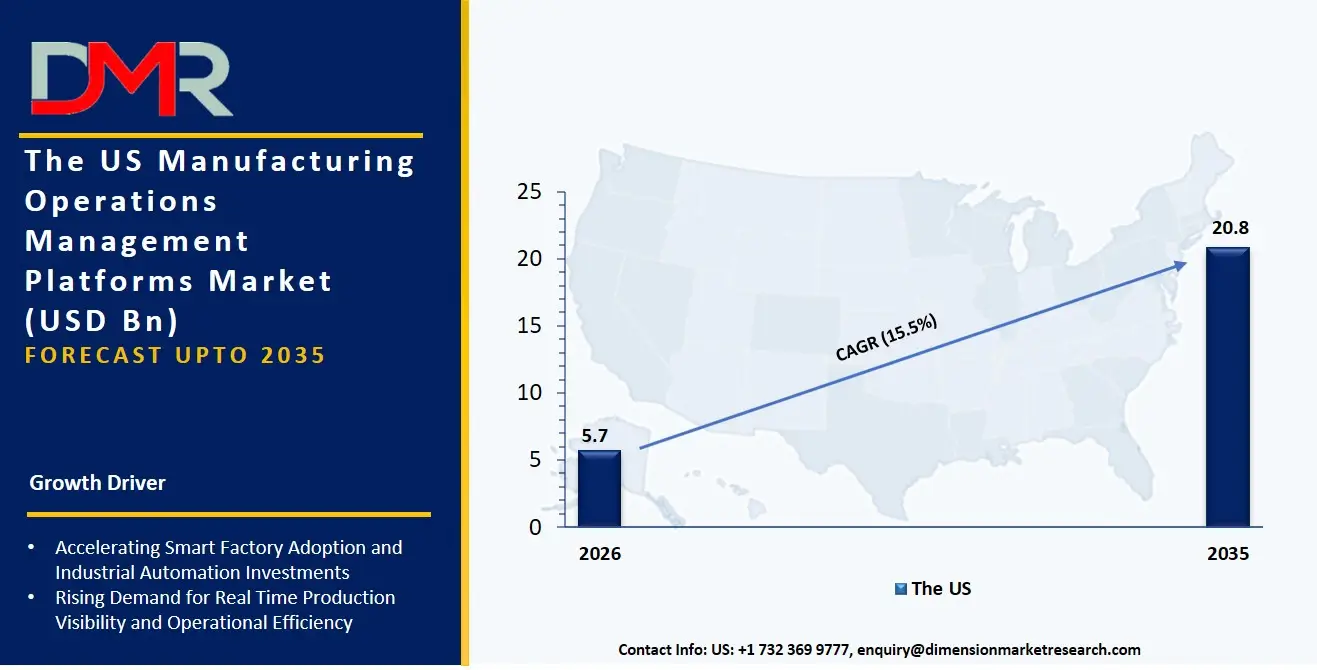
The United States Manufacturing Operations Management Platforms Market is estimated at USD 5.7 billion in 2026 and is projected to reach USD 20.8 billion by 2035, growing at a CAGR of 15.5%. Growth is supported by extensive automotive, aerospace and defense, pharmaceuticals, medical technology, electronics, food processing, industrial machinery, and chemicals production. Manufacturers are investing in smart factory systems, industrial data integration, automation, cyber resilient operations, quality modernization, and supply chain responsiveness. Manufacturing operations management platforms enable enterprises to connect plant floor data with enterprise systems, improve production performance, optimize asset utilization, strengthen quality control, and standardize workflows across geographically distributed manufacturing facilities.
Japan Manufacturing Operations Management Platforms Market
Japan remains a significant market due to its advanced automotive, electronics, robotics, industrial machinery, precision instruments, chemicals, and food manufacturing industries. Manufacturers are increasingly adopting manufacturing operations management platforms to maintain quality consistency, preserve operational knowledge, address workforce constraints, and improve coordination across domestic and international production sites. Strong emphasis on connected equipment, asset reliability, process control, continuous improvement, and production efficiency supports adoption of integrated manufacturing execution, quality management, predictive maintenance, workforce operations, and manufacturing intelligence capabilities. Japan’s focus on high value production and industrial automation continues to create opportunities for advanced operational technology platforms.
Saudi Arabia Manufacturing Operations Management Platforms Market
The Saudi Arabia Manufacturing Operations Management Platforms Market is estimated at USD 563.3 million in 2026 at a CAGR of 13.9%. Growth is supported by national industrial diversification initiatives that are strengthening local aerospace, defense, automotive, electrical equipment, industrial machinery, food processing, chemicals, and technology manufacturing. New manufacturing facilities require connected production operations, quality management, materials traceability, asset performance monitoring, workforce enablement, and enterprise resource planning integration. Opportunities are strong for platform providers offering secure deployment, localized implementation, operator training, cloud enabled services, industrial connectivity, and integration with enterprise and plant floor systems.
Regulatory Landscape
The regulatory environment increases the importance of traceability, controlled changes, product safety, cybersecurity, environmental compliance, and auditable operational records. Aerospace and defense producers require detailed manufacturing evidence and configuration control. Pharmaceutical and biotechnology companies need documented batch, quality, and deviation processes. Automotive and electronics producers manage safety, reliability, material, and supplier obligations, while food and beverage manufacturers require robust lot tracking and recall readiness.
MOM platforms support compliance by linking work instructions, material records, inspections, quality events, maintenance activity, approvals, and operational changes in controlled workflows. They can improve the completeness and accessibility of records, but compliance results depend on validated processes, accurate master data, well-defined user roles, and disciplined execution. Vendors must help customers align platform configurations with relevant industry and jurisdictional requirements.
Investment and White Space Analysis
The strongest investment opportunities include interoperable Manufacturing Execution System platforms, cloud-enabled analytics, industrial data integration, artificial intelligence grounded in plant context, digital quality workflows, predictive maintenance, and sustainability operations management. White space remains in connecting legacy equipment and applications without excessive custom integration. There is also a need for standardized industry templates that reduce implementation duration for mid-market companies while preserving configuration flexibility for large enterprises.
Vendors can differentiate by offering secure architectures, open integration tools, reusable connectors, no-code or low-code workflow configuration, effective migration methods, and measurable operational outcomes. Service providers have opportunity in process assessment, data readiness, implementation, operator training, managed support, and post-deployment optimization. Specialized capabilities for semiconductor, life sciences, food, chemicals, aerospace, and complex discrete production can address needs not fully met by broad horizontal platforms.
By Region
North America
Europe
- Germany
- The U.K.
- France
- Italy
- Russia
- Spain
- Benelux
- Nordic
- Rest of Europe
Asia-Pacific
- China
- Japan
- South Korea
- India
- ANZ
- ASEAN
- Rest of Asia-Pacific
Latin America
- Brazil
- Mexico
- Argentina
- Colombia
- Rest of Latin America
Middle East & Africa
- Saudi Arabia
- UAE
- South Africa
- Israel
- Egypt
- Rest of MEA
Competitive Landscape
The Global Manufacturing Operations Management Platforms Market is moderately fragmented, with industrial automation providers, enterprise software vendors, manufacturing execution specialists, quality management vendors, industrial analytics companies, and system integrators competing for transformation budgets. Key differentiation factors include industrial connectivity, production execution capability, quality integration, asset performance management, artificial intelligence, cybersecurity, deployment flexibility, implementation expertise, and the ability to demonstrate measurable plant-level value.
Leading vendors are expanding cloud-enabled offerings, reusable connectors, embedded analytics, and partner ecosystems for implementation and managed services. Competition increasingly centers on whether a platform can connect enterprise systems, operational technology, and workforce processes without creating another silo. Buyers also evaluate vendor longevity, industry expertise, support coverage, interoperability, and the capacity to scale from a single plant use case to a global manufacturing operating model.
Some of the prominent players in the Global Manufacturing Operations Management Platforms Market are:
- Siemens AG
- Rockwell Automation Inc.
- Dassault Systèmes SE
- SAP SE
- Oracle Corporation
- AVEVA Group plc
- Schneider Electric SE
- Honeywell International Inc.
- Emerson Electric Co.
- ABB Ltd.
- GE Vernova Inc.
- Aspen Technology Inc.
- PTC Inc.
- IBM Corporation
- Mitsubishi Electric Corporation
- Yokogawa Electric Corporation
- Hitachi Ltd.
- Fujitsu Limited
- Toshiba Corporation
- Bosch Rexroth AG
- Infor Inc.
- IFS AB
- Epicor Software Corporation
- Plex Systems Inc.
- Tulip Interfaces Inc.
- Critical Manufacturing SA
- iBASEt Inc.
- Aegis Software Corporation
- Sepasoft LLC
- Parsec Automation Corp.
- Körber AG
- MasterControl Inc.
- QAD Inc.
- SYSPRO Pty Ltd.
- L2L Inc.
- DELMIA Corporation
- Werum PAS X GmbH
- FactoryTalk Software
- Atos SE
- Wipro Limited
- Other Key Players
Recent Developments
- In July 2025, Rockwell Automation expanded Plex availability in Australia through a reseller and implementation partnership with Nukon, strengthening regional access to cloud based smart manufacturing capabilities.
- In June 2026, Siemens expanded the web based operator experience within Opcenter Execution with artificial intelligence enabled work instruction design, stronger platform performance, and modular weighing capabilities for production operations.
- In June 2026, Gerdau selected the Plex Smart Manufacturing Platform to modernize special steel operations, unify reporting, inventory management, analytics, and automated process workflows.
- In January 2026, THG Nutrition selected Plex MES to standardize manufacturing processes, improve real time production visibility, optimize scheduling, and support scalable food and beverage manufacturing operations.
Report Details
| Report Characteristics |
| Market Size (2026) |
USD 20.5 Bn |
| Forecast Value (2035) |
USD 85.9 Bn |
| CAGR (2026–2035) |
16.5% |
| The US Market Size (2026) |
USD 5.7 Bn |
| Historical Data |
2021 – 2025 |
| Forecast Data |
2027 – 2035 |
| Base Year |
2025 |
| Estimate Year |
2026 |
| Segments Covered |
By Component, By Deployment Model, By Operational Function, By Enterprise Size, By Manufacturing Type, and By Industry Vertical |
| Regional Coverage |
North America – The US and Canada; Europe – Germany, The UK, France, Russia, Spain, Italy, Benelux, Nordic, & Rest of Europe; Asia-Pacific – China, Japan, South Korea, India, ANZ, ASEAN, Rest of APAC; Latin America – Brazil, Mexico, Argentina, Colombia, Rest of Latin America; Middle East & Africa – Saudi Arabia, UAE, South Africa, Turkey, Egypt, Israel, & Rest of MEA |
Frequently Asked Questions
How big is the Global Manufacturing Operations Management Platforms Market?
▾ The Global Manufacturing Operations Management Platforms Market is valued at USD 20.5 billion in 2026 and is projected to reach USD 85.9 billion by 2035, reflecting growing demand for connected production, quality, maintenance, materials, workforce, and analytics capabilities.
What is the CAGR of the Global Manufacturing Operations Management Platforms Market from 2026 to 2035?
▾ The market is projected to expand at a compound annual growth rate of 16.5% between 2026 and 2035, supported by smart manufacturing investment, industrial automation, traceability needs, quality modernization, predictive maintenance, and multi-site operational transformation.
What factors are driving Manufacturing Operations Management Platforms Market growth?
▾ Growth is driven by connected factory programs, digital quality management, industrial automation, production traceability mandates, predictive maintenance deployment, workforce digitalization, sustainability operations requirements, and the need to improve productivity, resilience, asset utilization, and operational visibility.
Which component leads Manufacturing Operations Management Platforms Market ?
▾ Platform Software leads the component segment with a 68.4% share in 2026. Its leadership reflects demand for integrated production execution, quality management, planning, asset performance, analytics, work instructions, and manufacturing data integration capabilities.
Which component is growing the fastest in Manufacturing Operations Management Platforms Market?
▾ Services are projected to grow at the highest CAGR of 17.7%. Manufacturers need consulting, process assessment, configuration, implementation, integration, data migration, validation, training, support, maintenance, and managed platform services to deploy and optimize MOM environments.
Which deployment model leads the Manufacturing Operations Management Platforms Market ?
▾ On Premises Deployment leads with a 57.8% share in 2026 because many manufacturers prioritize local control, low-latency response, operational technology security, data sovereignty, direct equipment integration, and continuity of critical plant operations.
Which deployment model is expected to grow the fastest in Manufacturing Operations Management Platforms Market ?
▾ Hybrid Cloud Deployment is projected to record the highest CAGR of 19.6%. It enables manufacturers to retain localized execution while using cloud resources for enterprise analytics, centralized governance, cross-site benchmarking, reporting, and collaborative operational improvement.
Which operational function leads the Manufacturing Operations Management Platforms Market ?
▾ Production Operations Management leads with a 31.6% share in 2026, supported by demand for production tracking, resource allocation, downtime management, overall equipment effectiveness management, and production performance management across diverse manufacturing environments.
Which manufacturing type leads the Manufacturing Operations Management Platforms Market ?
▾ Discrete Manufacturing leads with a 44.2% share in 2026. Automotive, aerospace and defense, electronics, industrial machinery, and equipment producers require strong execution control, material traceability, production sequencing, quality verification, and workforce coordination.
Which region holds the largest share in Manufacturing Operations Management Platforms Market ?
▾ North America is poised to lead with a 33.1% share in 2026, supported by advanced manufacturing industries, smart factory investment, industrial automation, reshoring initiatives, quality requirements, mature technology infrastructure, and a strong ecosystem of vendors and implementation partners.
Which region is expected to grow the fastest in Manufacturing Operations Management Platforms Market ?
▾ Asia Pacific is expected to record the highest CAGR of 18.4% through 2035. Growth is supported by smart factory initiatives, semiconductor and automotive investment, expanding industrial automation, connected manufacturing infrastructure, and a substantial regional production base.