Market Snapshot
- Global Materials for Bone Implants Market valued at USD 6.71 Billion in 2025, projected to reach USD 14.87 Billion by 2035 at a CAGR of 8.28%.
- Titanium and Titanium Alloys led the material type segment with a 37.8% revenue share in 2025.
- Orthopedic Plates and Screws held the largest implant type share at 32.9% in 2025.
- Hospitals accounted for 56.8% of end-user demand in 2025.
- North America commanded the leading regional share at 40.2%, with the US market valued at USD 2.12 Billion in 2025.
Market Overview
The materials for bone implants market covers metallic, polymeric, and ceramic biomaterials used in orthopedic, spinal, and dental implant devices. Excluded from this scope are soft-tissue implants, drug-eluting device coatings, and implant-adjacent consumables such as bone fixation cements used independently of structural implants. The market connects directly to the broader orthopedic device and dental device industries, where biomaterial selection determines both clinical outcomes and regulatory pathway complexity.
As reported by PubMed, hydroxyapatite coatings increased bone ingrowth by 8% compared with titanium-coated implants, a difference large enough to shift procurement preferences among hospital purchasing committees. Implant material performance now shapes OEM supplier selection as directly as device-level engineering. Buyers at hospital networks in Europe and the US have begun requiring osseointegration data at the material level, not just the device level.
Additive manufacturing reshaped the competitive logic of Materials for Bone Implants Market . Tier-1 orthopedic OEMs no longer source standard material formats and machine them into implants. Manufacturers now design lattice architectures natively within titanium or PEEK feedstocks, making the biomaterial itself a platform rather than a commodity input. Suppliers unable to provide implant-grade material compatible with direct metal laser sintering face progressive delisting from major OEM-approved supplier lists.
Market Size and Forecast
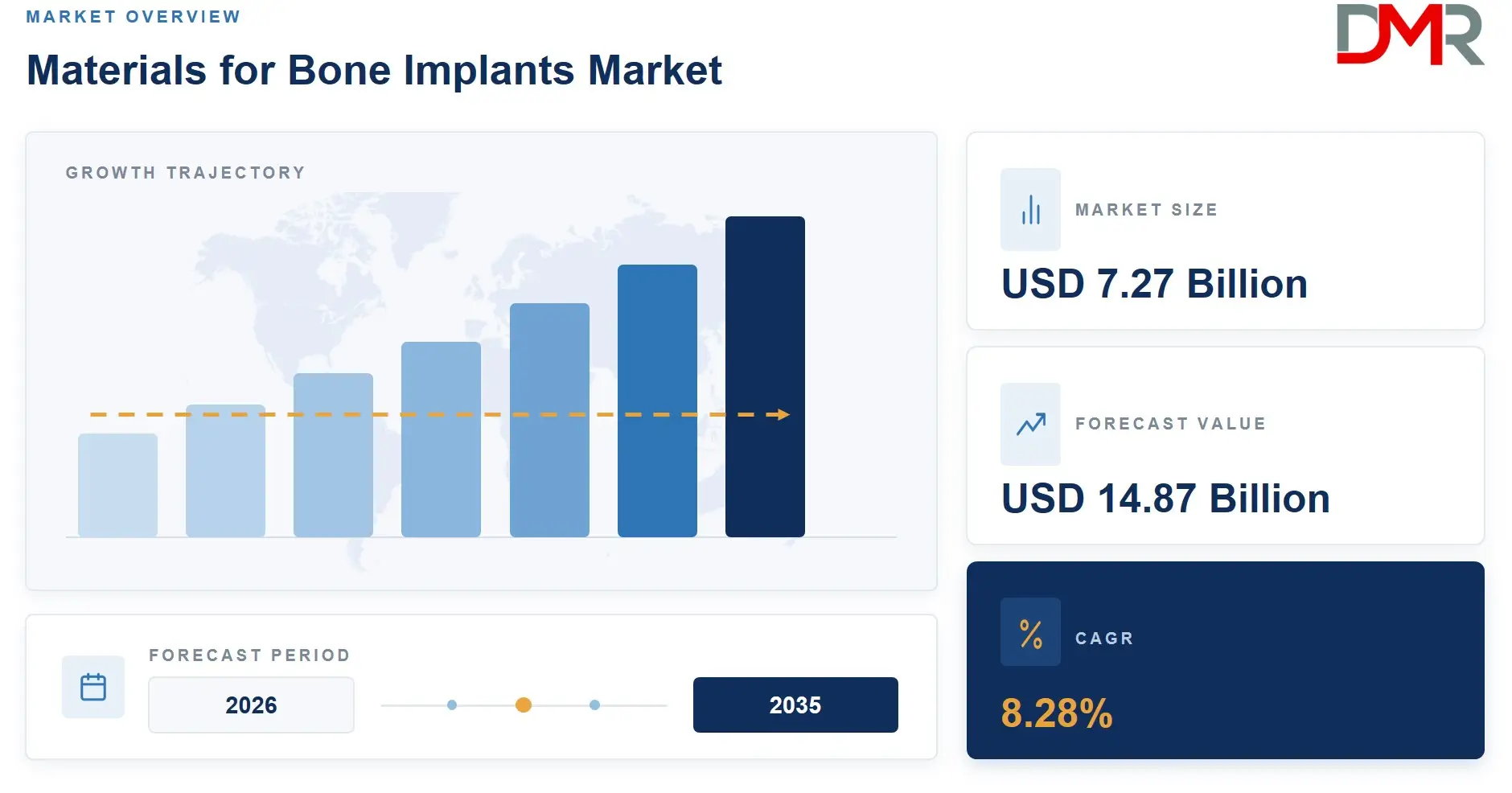
The Global Materials for Bone Implants Market size is estimated at USD 7.27 Billion in 2026 from USD 6.71 Billion in 2025, and is projected to reach USD 14.87 Billion by 2035, exhibiting a CAGR of 8.28% during the forecast period.
Research published by BMC Oral Health confirmed that 3D-printed titanium implants show enhanced osseointegration strength due to increased surface roughness and microscale bone interlocking mechanisms. OEMs incorporating these findings into production have accelerated qualification cycles, compressing the gap between material innovation and commercial launch. The bioresorbable polymer segment remains sub-scale at USD 1.2 Billion today, but its trajectory diverges from the broader market once secondary revision surgery elimination becomes standard clinical expectation.
ℹ
To learn more about this report –
Download Your Free Sample Report Here
Stryker's September 2025 launch of the Incompass Total Ankle System, featuring 3D-printed porous metal tibial and talar components, illustrates how next-generation material formats are already generating first commercial revenues rather than remaining in pipeline. Forecast assumptions embed continued FDA 510(k) clearance velocity for titanium alloy and PEEK variants, stable reimbursement environments in the US and Germany, and incremental volume growth from aging demographics in Japan and South Korea.
Material Type Analysis
Titanium and Titanium Alloys led the material type segment with a 37.8% share in 2026.
Titanium's dominance reflects both clinical trust built over four decades of orthopedic use and its compatibility with modern additive manufacturing. Hospitals in North America and Germany specify titanium alloys as the default material for primary hip, knee, and spinal implants. OEM qualification data consistently favors titanium when load-bearing performance and long-term osseointegration are the primary selection criteria.
PEEK holds the fastest-growth position within the material type segment. Spinal surgeons across the US and Europe have shifted toward PEEK for interbody fusion cages because its radiolucency allows post-operative MRI monitoring without artifact interference. Findings from arXiv confirm hydroxyapatite coverage on up to 35.0 ± 14.0% of PEEK implant surfaces after bioactive coating, preserving compressive strength. Stainless steel retains volume in trauma and low-cost hospital environments, while Cobalt-Chromium holds share in revision arthroplasty. Ceramic materials and biodegradable polymers represent structurally smaller but strategically significant categories for the next phase of market development.
Implant Type Analysis
With a 32.9% share in 2026, Orthopedic Plates and Screws outpaced all other implant type categories.
Orthopedic plates and screws generate volume through both trauma surgery and elective orthopedic procedures, creating a demand base that is partially insulated from elective-surgery fluctuations. Fracture fixation remains the highest-frequency orthopedic intervention globally, and titanium alloy remains the preferred material for locking plates in long-bone trauma. Stainless steel variants persist in price-sensitive markets across Southeast Asia and Latin America.
Spinal implants represent the segment most directly disrupted by PEEK adoption, with joint prostheses following behind. Dental implants occupy a distinct commercial channel, where zirconia is displacing titanium at the premium end of the market. Bone cements and fillers operate largely as a hospital consumable category, differentiated from structural implants by purchasing pathway and reimbursement logic. Intramedullary nails retain procedural volume in geriatric hip fracture repair across aging markets in Europe and Japan.
End User Analysis
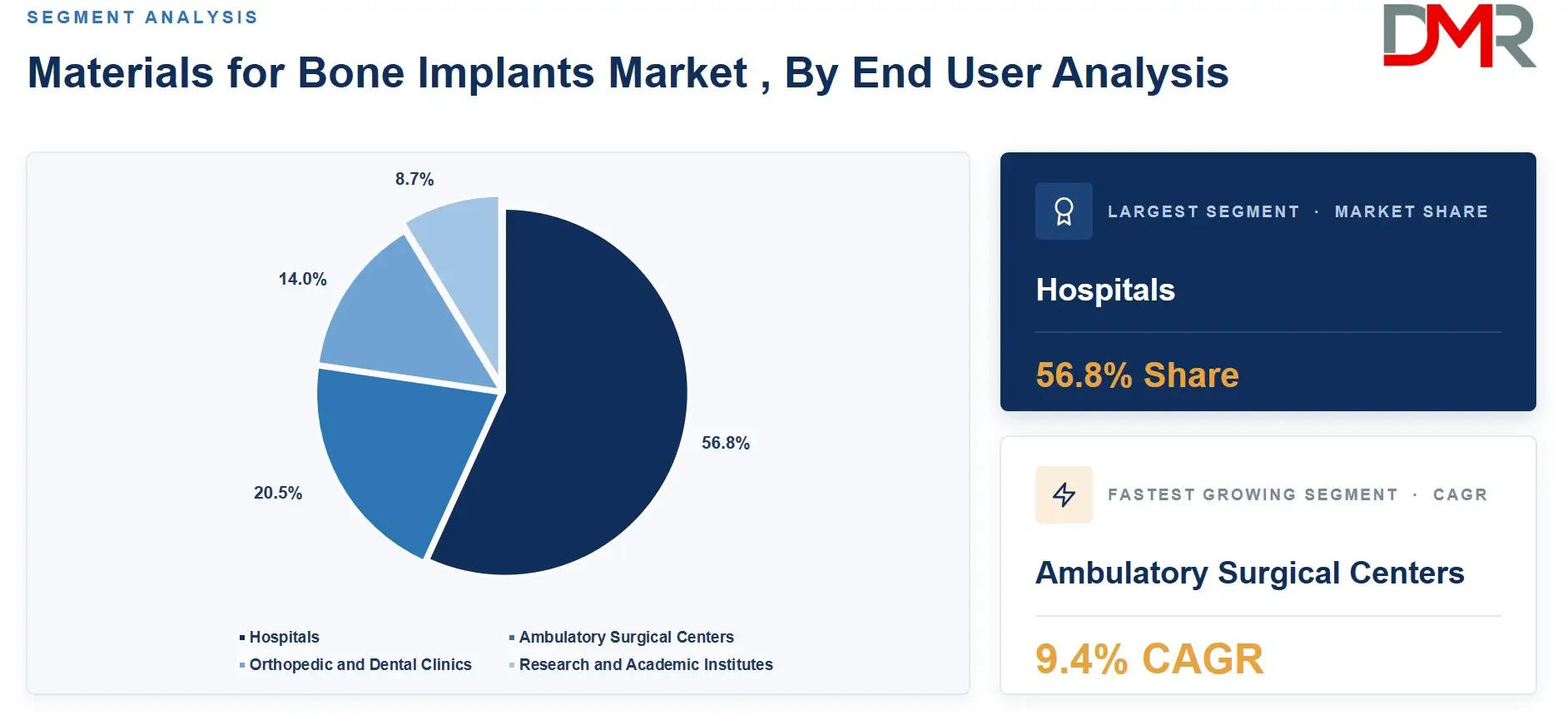
Hospitals accounted for 56.8% of end-user demand in 2026, the highest of any category.
Hospitals concentrate the largest and most complex orthopedic procedures, giving implant material OEMs their highest-revenue channel. Inpatient procedure volume in US academic medical centers and large European hospital networks drives bulk procurement agreements. These institutions also influence standardization, as their preferred biomaterial specs cascade into procurement frameworks used by smaller affiliated facilities.
ℹ
To learn more about this report –
Download Your Free Sample Report Here
Ambulatory surgical centers are the fastest-growing end-user channel. Procedure migration from inpatient hospitals to ASCs in the US accelerated after CMS expanded the covered procedures list in 2023 and 2024. Orthopedic and dental clinics remain important channels for dental implant materials and simple fracture fixation. Research and academic institutes represent a small revenue share but an outsized role in qualifying next-generation biomaterials for OEM adoption.
Key Market Segments
By Material Type
- Titanium and Titanium Alloys
- Stainless Steel
- Cobalt-Chromium Alloys
- Polyetheretherketone (PEEK)
- Ceramic-based Material
- Biodegradable Polymer
By Implant Type
- Orthopedic Plates and Screws
- Intramedullary Nail
- Joint Prostheses
- Spinal Implants
- Bone Cements and Fillers
- Dental Implants
By End User
- Hospitals
- Ambulatory Surgical Centers
- Orthopedic and Dental Clinics
- Research and Academic Institutes
Regional Analysis
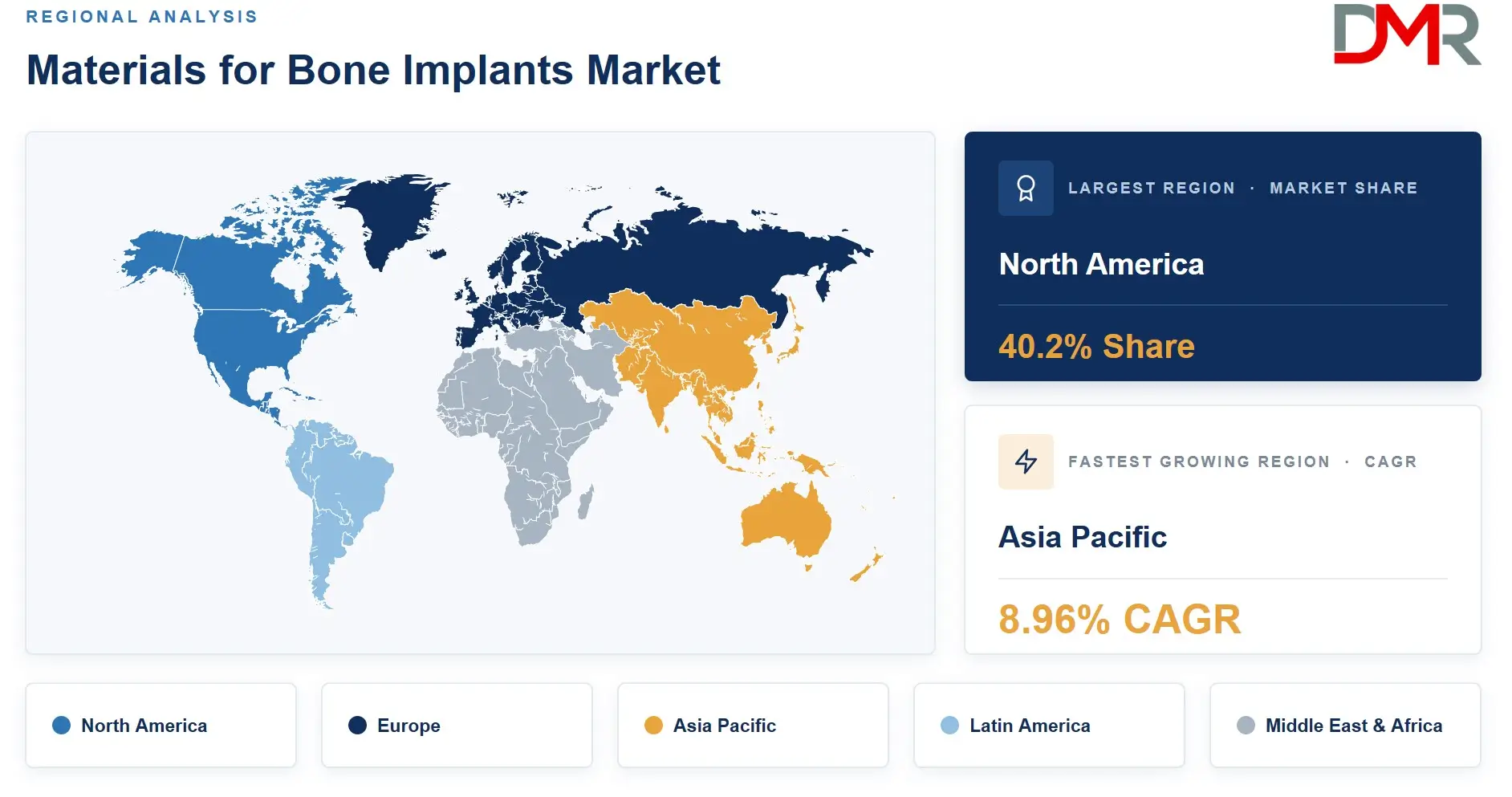
North America led all regions with a 40.2% revenue share in 2026, equivalent to USD 2.69 Billion.
North America's position reflects a combination of high procedure volumes, favorable reimbursement structures, and the presence of the world's largest orthopedic OEMs. US hospital systems operate on procurement frameworks that embed biomaterial-level specifications into device contracts, creating durable revenue relationships for approved titanium and PEEK suppliers. The FDA's 510(k) clearance process, while demanding, moves faster than EU MDR timelines for incremental innovations.
ℹ
To learn more about this report –
Download Your Free Sample Report Here
Asia-Pacific is the region with the highest structural growth potential. Public hospital infrastructure across China, India, and Southeast Asia remains significantly underpenetrated relative to procedure-eligible population size. A 2025 study published in the Journal of Materials Science and Technology demonstrated that femtosecond laser surface processing on titanium implants significantly improved cell adhesion and osteogenic differentiation, a finding with direct implications for the premium-tier implant segment growing in China's private hospital network. Europe holds the second-largest share, with Germany and France generating the highest per-capita orthopedic implant volumes on the continent. Latin America and the Middle East and Africa remain early-stage markets where cost-competitive titanium and stainless steel formats will outperform premium biomaterials through the forecast period.
Key Regions and Countries
North America
Europe
- Germany
- France
- The UK
- Spain
- Italy
- Rest of Europe
Asia Pacific
- China
- Japan
- South Korea
- India
- Australia
- Rest of APAC
Latin America
- Brazil
- Mexico
- Rest of Latin America
Middle East and Africa
- GCC
- South Africa
- Rest of MEA
Market Dynamics
Aging Demographics and Sports Injuries Structurally Expand Procedure Volumes
Adults over 65 fracture bone at a rate that compounds as a cohort grows, and every major OECD country is now past the inflection point where that cohort expands faster than healthcare systems add orthopedic capacity. A British Dental Journal meta-analysis covering 30 studies and 1,719 participants reported implant success rates consistently between 90.9% and 100%, confirming that clinical confidence in current biomaterials is high enough to support rising procedure authorization rates. Surgeons and payers no longer debate whether implants work. Debate has shifted to which biomaterial performs best in which patient profile.
Adults under 50 with sports-related musculoskeletal injuries represent a structurally new demand cohort. NCBI data confirms that 3D-printed implants achieved 72% porosity versus 60% in conventionally manufactured implants, a difference that matters for younger patients who require long-term biological fixation rather than short-term mechanical stability. Zimmer Biomet's March 2025 FDA 510(k) clearance for the Persona Revision SoluTion Femur, a metal-sensitivity revision implant, illustrates how OEMs are already segmenting their portfolios to serve patient profiles that did not previously represent addressable volume.
A 45-trial PubMed meta-analysis found hydroxyapatite-coated implant survival rates between 93.2% and 98.5% after four to eight years of follow-up. Survival performance at that level enables surgeons to confidently implant in younger patients where multi-decade device longevity is required. Biomaterial suppliers who can certify HA coating consistency at scale have a defensible commercial position that generic metal suppliers cannot replicate.
Regulatory Timelines and Material Costs Limit Market Accessibility
ISO 10993 biocompatibility validation and EU MDR 2017/745 sterility requirements impose multi-year pre-market timelines on novel biomaterial entrants. A company developing a new bioresorbable polymer or ceramic composite faces clinical testing, documentation, and audit cycles that commonly span four to six years before commercial sale in Europe. Smaller biomaterial startups with differentiated chemistry often cannot sustain operations across that window without strategic partnership or acquisition.
Medical-grade PEEK, zirconia, and bioresorbable polymers carry per-unit costs that exclude them from price-sensitive emerging market hospital systems. Titanium hypersensitivity has been reported in less than 1% of the population, confirming that the shift away from titanium toward premium alternatives is driven by performance advantage rather than safety necessity. That distinction matters because it limits the urgency of premium biomaterial adoption in markets where purchasing is cost-driven rather than outcomes-driven.
Asia-Pacific Localization and Bioresorbable Materials Define the Next Growth Phase
Asia-Pacific public hospital infrastructure offers a large, underpenetrated channel for cost-optimized ceramic and titanium implant localization strategies. Manufacturers who establish in-country production in China or India can navigate local procurement preferences, reduce import duties, and compete in tenders that would otherwise be inaccessible. China's volume-based procurement system, which compresses device pricing, paradoxically favors manufacturers with localized cost structures over imported premium devices.
Elute's March 2025 FDA clearance for BonVie+, a synthetic resorbable bone void filler designed to be replaced by new bone tissue, signals that bioresorbable materials are clearing the regulatory threshold needed for commercial scale. A 2025 arXiv in-vivo study found that bioactive-glass-coated titanium implants accelerated bone ingrowth during early healing versus standard 3D-printed titanium, demonstrating the performance premium that next-generation surface chemistry can deliver. Combined, these developments indicate that the bioresorbable and bioactive-coating segments are transitioning from clinical validation into commercial buildout simultaneously.
Hydroxyapatite surface modification raised stem-cell adhesion from 121 cells per square millimeter to 234 cells per square millimeter in a 2024 arXiv study of porous PEKK implants. That doubling of cellular attachment directly translates into faster patient recovery and reduced revision risk. OEMs that co-own surface coating IP with biomaterial suppliers capture recurring revenue from coating materials rather than competing purely on implant price.
Market Trends
Surface Engineering and Additive Manufacturing Converge on Biologically Active Implants
PEEK is displacing titanium in spinal and cranial applications as surgeons prioritize radiolucency for post-operative MRI protocols. Modified PEKK implants achieved surface calcium content of 17.4 ± 4.1 wt.% and phosphorus content of 8.0 ± 1.7 wt.% after bioactive treatment per arXiv data, confirming that polymer-based implants can now achieve mineral profiles previously associated only with ceramic materials. Copper-strontium doped calcium silicate coatings on 3D-printed porous titanium reported enhanced osseointegration alongside antimicrobial functionality per SAGE Journals, opening a commercial pathway for infection-resistant implants in high-risk surgical environments. Kelyniam Global's September 2025 FDA clearance for the Fusion BCP-PEEK cranial implant confirms that hybrid material platforms combining ceramics with PEEK are reaching commercial readiness.
Market Competition Overview
The materials for bone implants market operates in a consolidated upper tier where five to seven global OEMs control the majority of revenue and set the biomaterial standards that cascade through the supply chain. Tier-1 players compete through portfolio breadth, regulatory track records, and proprietary surface coating technologies rather than on unit price alone. Fragmentation exists in the mid-market, where regional manufacturers serve domestic hospital procurement in Asia and Latin America using commodity titanium and stainless steel formats.
Competitive momentum is shifting toward manufacturers who can demonstrate performance differentiation at the material level. A 2025 arXiv study evaluated osseointegration using bone-to-implant contact and bone density measurements at both four-week and twelve-week healing periods, reflecting the kind of comparative data that now separates premium biomaterial platforms from commodity supply. Companies that build proprietary clinical evidence for their material formulations create switching costs that protect margin even as OEMs consolidate their approved supplier lists.
Company Profiles
Stryker Corporation holds a leading position in the orthopedic implant materials market through vertical integration across device design, biomaterial sourcing, and surgical instrumentation. Stryker's September 2025 launch of the Incompass Total Ankle System with 3D-printed porous metal components demonstrates its ability to bring next-generation biomaterial architectures to commercial scale ahead of competitors. Stryker's manufacturing scale across the US and Europe gives it a cost and supply security advantage that smaller biomaterial specialists cannot replicate.
Zimmer Biomet Holdings, Inc. is executing a deliberate platform expansion strategy through acquisition. Zimmer Biomet completed its acquisition of Monogram Technologies in October 2025, adding AI-driven semi-autonomous and fully autonomous orthopedic robotic technologies to its ecosystem. A 2025 PubMed study on titanium-tantalum scaffolds confirmed improved osseointegration through advanced porous alloy engineering, a material class that Zimmer Biomet's expanded R&D base is positioned to commercialize faster than peers. The combination of robotics and advanced biomaterials creates an integrated surgical workflow that raises the barrier for OEM switching at the hospital level.
Key Players
- Stryker Corporation
- Zimmer Biomet Holdings, Inc.
- Medtronic plc
- Smith and Nephew plc
- DePuy Synthes (Johnson and Johnson)
- Globus Medical, Inc.
- NuVasive, Inc.
- B. Braun Melsungen AG
- Arthrex, Inc.
- LivaNova PLC
- Conmed Corporation
- Invibio Ltd.
- Orthofix Medical Inc.
- Amedica Corporation
- Cook Medical
Investment and White Space Analysis
Point-of-care 3D printing of patient-specific bone implants using bioresorbable materials represents the clearest white space at the intersection of additive manufacturing, precision surgery, and materials science. No single player has established a dominant position in this category, and hospital adoption is constrained by material qualification rather than device design. Investors entering early can capture IP positions in material feedstock formulations before OEM consolidation sets preferred supplier standards.
Venture capital and strategic M&A activity have concentrated in bioresorbable and smart biomaterial startups, with exit multiples in adjacent MedTech verticals signaling category maturation. Co-development agreements between biomaterial suppliers and orthopedic OEMs to co-own next-generation surface coating intellectual property represent a lower-risk entry model. Asia-Pacific public hospital channels offer high volume potential with low current competition from premium biomaterial platforms, making cost-optimized ceramic and titanium localization strategies the most accessible near-term entry point for new regional players.
Recent Developments
- January 2025 — Zimmer Biomet announced the acquisition of Paragon 28 for approximately USD 1.1 Billion, expanding its orthopedic implant portfolio to include foot and ankle implants, trauma solutions, and reconstructive technologies.
- July 2025 — Zimmer Biomet announced an agreement to acquire Monogram Technologies for approximately USD 177 Million to strengthen its orthopedic robotics and next-generation surgical technology platform.
- September 2025 — Kelyniam Global received FDA clearance for its Fusion BCP-PEEK cranial implant, combining Biphasic Calcium Phosphate with PEEK material for cranial and craniofacial reconstruction.
- November 2025 — Zavation Medical Products launched NanoPrime, a hybrid PEEK-titanium spinal implant platform combining both materials through titanium ion bond technology.
Report Details
| Report Characteristics |
| Market Value (2025) |
USD 6.71 Billion |
| Market Value (2026) |
USD 7.27 Billion |
| Forecast Revenue (2035) |
USD 14.87 Billion |
| CAGR (2026–2035) |
8.28% |
| Historical Data |
2020 – 2024 |
| Forecast Data |
2026 – 2035 |
| Base Year |
2025 |
| Estimate Year |
2026 |
| Report Coverage |
Revenue Forecast, Market Dynamics, Competitive Landscape, Recent Developments |
| Segments Covered |
By Material Type (Titanium and Titanium Alloys, Stainless Steel, Cobalt-Chromium Alloys, PEEK, Ceramic-based Material, Biodegradable Polymer); By Implant Type (Orthopedic Plates and Screws, Intramedullary Nail, Joint Prostheses, Spinal Implants, Bone Cements and Fillers, Dental Implants); By End User (Hospitals, Ambulatory Surgical Centers, Orthopedic and Dental Clinics, Research and Academic Institutes) |
| Regional Coverage |
North America – US, Canada; Europe – Germany, France, UK, Spain, Italy, Rest of Europe; Asia-Pacific – China, Japan, South Korea, India, Australia, Rest of APAC; Latin America – Brazil, Mexico, Rest of Latin America; Middle East & Africa – GCC, South Africa, Rest of MEA |
| Prominent Players |
Stryker Corporation, Zimmer Biomet Holdings Inc., Medtronic plc, Smith and Nephew plc, DePuy Synthes, Globus Medical Inc., NuVasive Inc., B. Braun Melsungen AG, Arthrex Inc., LivaNova PLC, Conmed Corporation, Invibio Ltd., Orthofix Medical Inc., Amedica Corporation, Cook Medical, and Other Key Players |
| Customization Scope |
Customization for segments and region or country level will be provided. Additional customization can be done based on requirements. |
| Purchase Options |
Three license options: Single User License, Multi-User License (Up to 5 Users), and Corporate Use License (Unlimited Users and Printable PDF) |
Frequently Asked Questions
What is the biggest investment opportunity in Materials for Bone Implants Market ?
▾ Point-of-care 3D printing of patient-specific bone implants using bioresorbable materials represents the clearest white space in the market today. No established player controls this segment, and material feedstock IP is still available to early movers. The bioresorbable polymer segment sits at USD 1.2 Billion currently, with structural growth ahead as clinical evidence eliminates secondary revision surgery requirements.
Who are the top companies in Materials for Bone Implants Market ?
▾ Stryker Corporation and Zimmer Biomet Holdings are the two leading companies by revenue and portfolio breadth. Both operate across titanium alloy, PEEK, and ceramic biomaterial categories and hold approved supplier status with the largest hospital networks globally. Medtronic plc, Smith and Nephew, and DePuy Synthes round out the top five by market presence.
Which segment is growing fastest in Materials for Bone Implants Market and why?
▾ PEEK within the material type segment and bioresorbable polymers within the broader biomaterial category are the fastest-growing sub-segments. PEEK's radiolucency advantage in spinal applications is driving systematic surgeon preference shifts in the US and Europe. Bioresorbable materials eliminate secondary surgery, a cost and risk reduction that payers and hospital procurement committees are actively incentivizing.
Which region is growing fastest in Materials for Bone Implants Market and why?
▾ Asia-Pacific is the fastest-growing region, driven by underpenetrated public hospital infrastructure across China, India, and Southeast Asia. Procedure-eligible populations in these countries are large and aging, but implant penetration rates remain a fraction of North American levels. Cost-optimized ceramic and titanium formats localized for domestic manufacturing are the most competitive entry vehicles in this channel.
What is the biggest challenge holding Materials for Bone Implants Market back?
▾ Multi-year regulatory approval timelines under ISO 10993 and EU MDR 2017/745 are the primary structural constraint on market acceleration. Novel biomaterial entrants face four to six years of pre-market validation before European commercial sale. High per-unit costs for advanced materials such as medical-grade PEEK and zirconia further limit adoption in price-sensitive emerging markets where the largest patient volume growth is occurring.