Market Snapshot
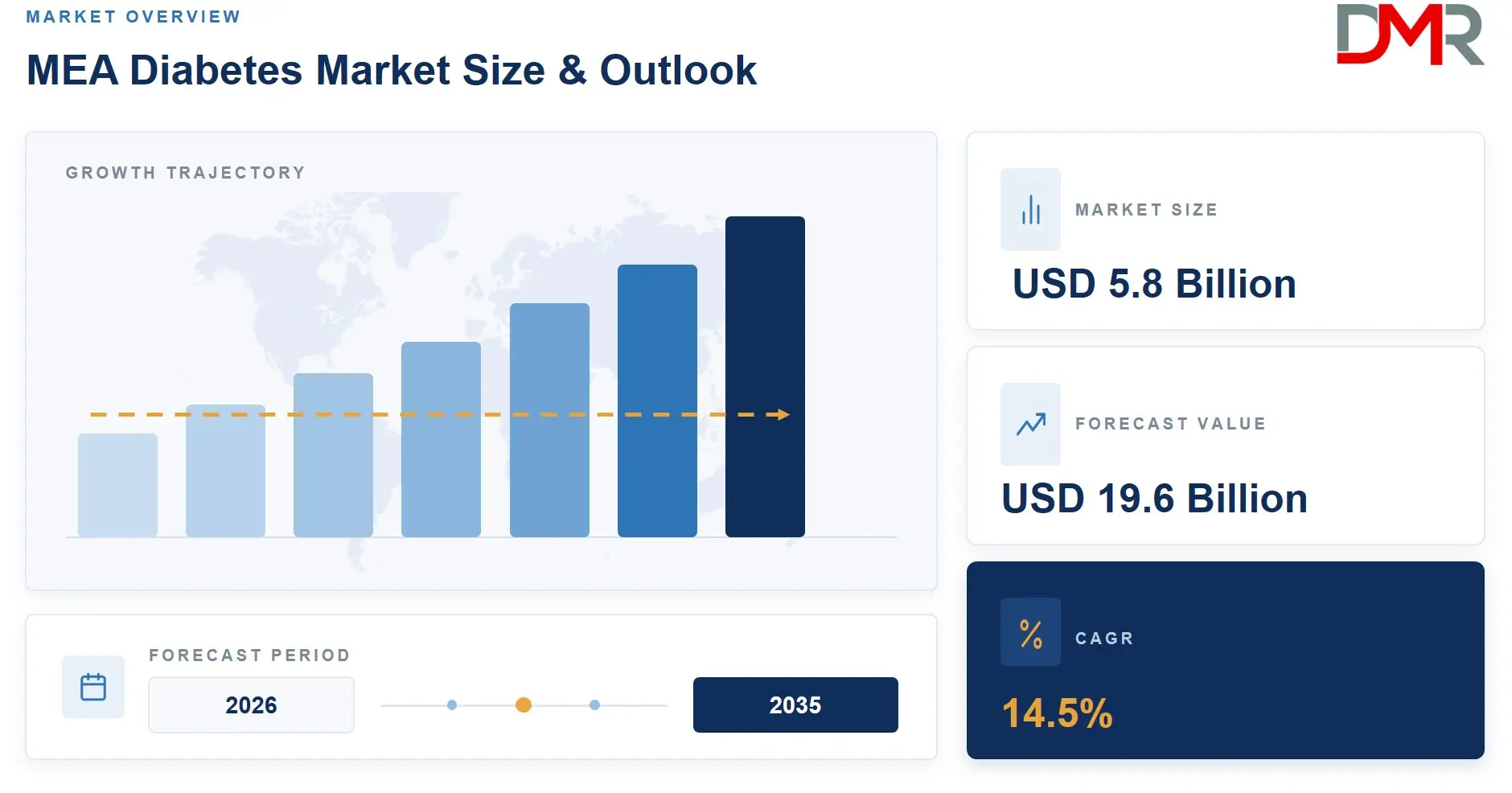
- Market Size (2026): USD 5.8 Bn
- Forecast Value (2035): USD 19.6 Bn
- CAGR (2026-2035): 14.5%
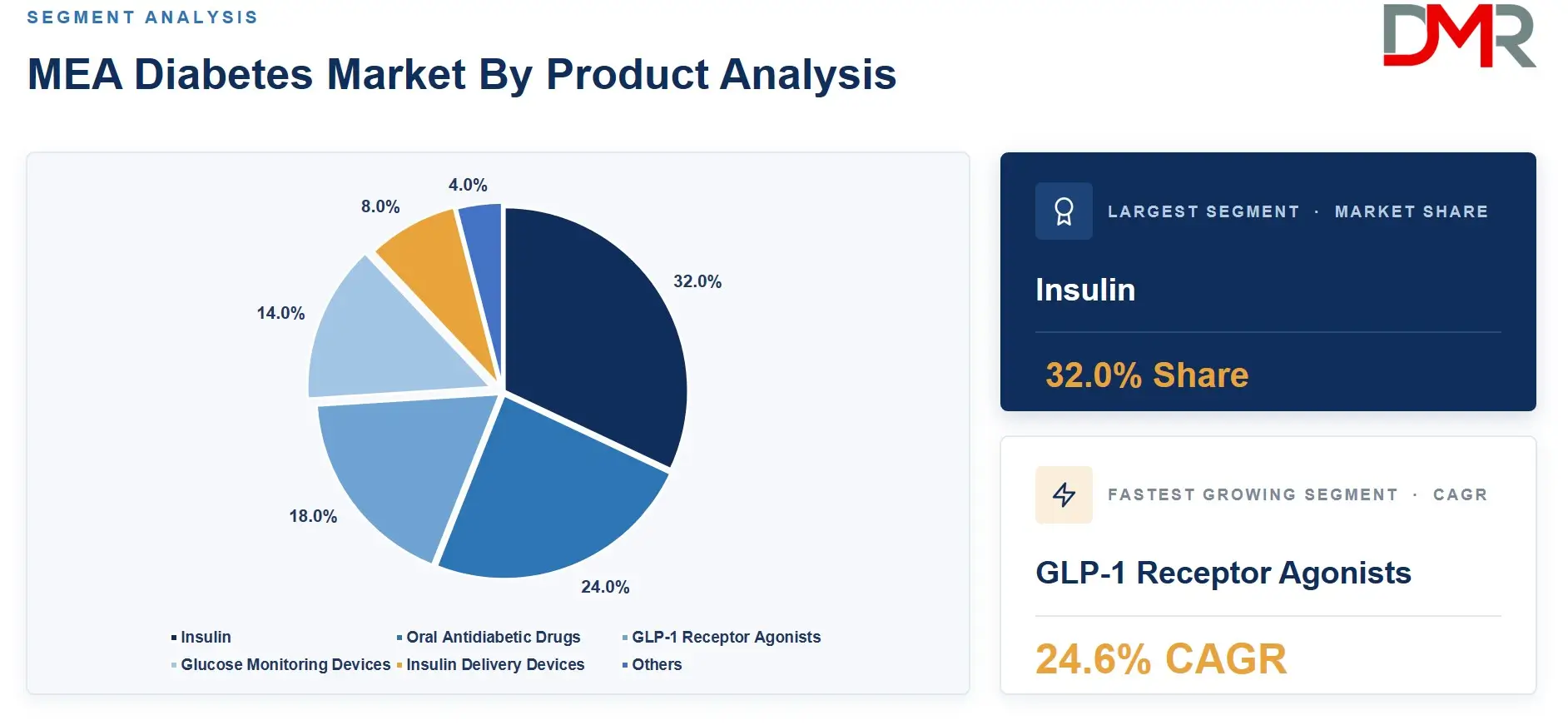
- Leading By Product (2026): Insulin, around 32%
- Leading By Diabetes Type (2026): Type 2 Diabetes, close to 66%
- Key Players: Novo Nordisk, Sanofi, Eli Lilly and others
What is the MEA Diabetes Market and its Market Size?
The MEA Diabetes Market size is estimated to reach USD 5.8 Bn in 2026 and is further anticipated to reach USD 19.6 Bn by 2035, at a CAGR of 14.5%. The market covers diagnosis, drug therapy and device based management of Type 1 diabetes, Type 2 diabetes, gestational diabetes and prediabetes across the Middle East and Africa, spanning national health systems in Saudi Arabia, the UAE, South Africa, Egypt and neighbouring markets.
ℹ
To learn more about this report –
Download Your Free Sample Report Here
The figures published here quantify demand generated inside the region, insulin and oral antidiabetic prescriptions filled at pharmacies, glucose monitoring devices sold through hospital and retail channels, and diagnostic testing performed at clinics, rather than the worldwide revenue booked by companies headquartered there.
Buyers span three distinct groups. Ministries of health and national insurers procure insulin, oral antidiabetic drugs and screening programmes at population scale, particularly in the Gulf states where diabetes prevalence sits among the highest in the world. Private hospital networks and endocrinology clinics purchase glucose monitoring systems, insulin pumps and continuous monitoring sensors for insured patients. Retail and online pharmacies fill the ongoing prescription and supply volume that keeps existing patients on therapy, a channel that is expanding fastest as digital health platforms extend refill and coaching services into homes.
What is structurally changing is the shift from reactive treatment toward funded prevention and early detection. National screening programmes in Saudi Arabia and the UAE are identifying prediabetic populations years before diagnosis, private medical schemes across South Africa now reimburse continuous glucose monitors and insulin pumps that were previously self funded, and GLP-1 receptor agonists are moving from a specialist prescription into broader primary care use as regional regulators approve additional indications. Local manufacturing incentives in Egypt and Saudi Arabia are also narrowing the cost gap between imported and domestically produced insulin and test strips.
Demand concentrates where diabetes prevalence, healthcare spending and insurance coverage intersect. Saudi Arabia and the UAE carry some of the highest adult diabetes prevalence rates globally and combine that burden with well funded public health systems, while South Africa carries the region's largest patient population and a fast expanding National Health Insurance rollout. Egypt and the wider Sub-Saharan African markets remain earlier stage, constrained by out of pocket spending, but are the base from which regional volume growth is expected to compound through 2035.
Use Cases
- National Screening Programmes: Ministries of health in Saudi Arabia and the UAE run population level screening drives that flag prediabetic and undiagnosed Type 2 patients through community health centres, shifting spend toward early intervention and away from costlier complication management later.
- Private Hospital Endocrinology Units: Tertiary hospital networks in the Gulf deploy continuous glucose monitoring and insulin pump programmes for insured patients with Type 1 diabetes, replacing periodic fingerstick testing with real time glucose data that guides dosing decisions between clinic visits.
- Homecare Management for Chronic Patients: Retail and online pharmacies across South Africa and Egypt supply ongoing insulin, test strips and oral antidiabetic refills directly to patient homes, reducing clinic visit frequency for stable, long term Type 2 diabetes cases.
- Maternal Health Screening in Public Hospitals: Public maternity units screen pregnant women for gestational diabetes as a standard antenatal step, a practice expanding fastest where national maternal health budgets have grown, catching an estimated close to 8% of pregnancies that develop the condition regionally.
Key Takeaways
- Market Size & Share: The market is estimated at USD 5.8 Bn in 2026, expanding to USD 19.6 Bn by 2035 at a 14.5% CAGR.
- Product Analysis: Insulin leads with a share of approximately 32% of 2026 revenue, while GLP-1 receptor agonists post the fastest sub-segment growth at a CAGR of 24.6%.
- Diabetes Type Analysis: Type 2 diabetes accounts for close to 66% of 2026 demand, reflecting the region's obesity and lifestyle disease burden.
- Demand Concentration: Saudi Arabia, South Africa and the UAE together generate the majority of regional revenue, underpinned by high prevalence and funded insurance coverage.
- Regulatory Momentum: National screening mandates and expanding reimbursement lists are pulling forward demand for continuous glucose monitoring and GLP-1 therapies faster than the headline market rate.
- Technology Adoption: Continuous glucose monitoring holds around 38% share of the technology axis in 2026, while smart insulin pens are the fastest growing device category through 2035.
How AI/Gen AI is Transforming the MEA Diabetes Market?
Artificial intelligence is entering the MEA diabetes care pathway primarily through predictive glucose analytics rather than novel drug discovery. Continuous glucose monitoring platforms deployed across Saudi and Emirati hospital networks increasingly pair sensor data with machine learning models that forecast hypoglycaemic episodes ahead of time, giving clinicians and patients a window to intervene before an emergency admission is needed. This operational use case, not a generative one, is where near term commercial value is concentrated.
Digital coaching platforms are also layering large language model based chat interfaces onto existing diabetes management apps, letting patients ask dosing and dietary questions in Arabic, English and regional dialects without waiting for a clinic appointment. National screening programmes are separately piloting computer vision tools that read retinal images captured on portable cameras to flag diabetic retinopathy in community settings that lack an on-site ophthalmologist.
- Predictive Hypoglycaemia Alerts: Sensor data models flag dangerous glucose drops before they occur, reducing emergency visits among continuous monitoring users.
- Conversational Patient Coaching: Chat based assistants answer dosing, diet and lifestyle questions between clinical visits in local languages.
- Retinal Screening via Computer Vision: Portable camera images are read automatically to flag diabetic retinopathy in primary care and rural settings.
- Population Risk Stratification: Health authorities apply predictive models to national screening data to prioritise outreach toward the highest risk prediabetic groups.
Key Drivers in the MEA Diabetes Market
Two forces are pulling demand ahead of the region's broader healthcare spending trend.
- Rising Prevalence Tied to Lifestyle Change: Diabetes prevalence in Gulf states sits among the highest recorded anywhere, driven by rapid urbanisation, sedentary lifestyles and dietary shifts toward processed food, and this base rate of new diagnoses is what sets the floor for insulin, oral antidiabetic and monitoring device demand regardless of any single policy programme. Health authorities in Saudi Arabia and the UAE now treat diabetes as a chronic disease priority on par with cardiovascular care, which has pulled national screening budgets and specialist staffing into the category faster than population growth alone would explain, and every additional diagnosis converts directly into recurring pharmacy and device spend across the forecast period.
- Insurance and National Programme Expansion: South Africa's National Health Insurance rollout and Gulf state mandatory private insurance schemes are extending reimbursement to continuous glucose monitors, insulin pumps and GLP-1 therapies that patients previously paid for out of pocket, converting latent demand into billed volume. As reimbursement lists widen, hospitals and pharmacy chains stock a broader device and drug mix to match what payers will now cover, which is why device and premium drug segments are growing faster than the insulin base that anchors the market.
Restraints in the MEA Diabetes Market
Two brakes temper the pace of adoption across lower income parts of the region.
- Out of Pocket Cost Exposure: Outside the Gulf states and South Africa's insured population, most patients in Egypt and Sub-Saharan African markets still pay for insulin, test strips and monitoring devices directly, which caps device penetration and pushes patients toward the cheapest available therapy rather than the clinically preferred one. This price sensitivity is why self monitoring blood glucose devices retain a larger installed base than continuous glucose monitors outside the highest income markets, even as clinical guidance favours the latter.
- Fragmented Regulatory and Distribution Systems: Registration pathways, import duties and pharmacy licensing rules differ across more than a dozen national regulators in the region, which slows new product launches and forces manufacturers to build country specific distribution relationships rather than a single regional go to market. Supply chains for cold chain sensitive insulin also face logistics gaps outside major Gulf and South African cities, which constrains reliable access in more remote markets.
Growth Opportunities in the MEA Diabetes Market
Two areas of white space stand out as the region's care model matures.
- Homecare and Retail Pharmacy Channel Build-out: Online and retail pharmacy platforms that combine prescription refill logistics with digital coaching are still under penetrated relative to hospital dominated dispensing, and operators that build reliable delivery networks into secondary cities stand to capture patients currently underserved by clinic based refill cycles.
- Local Insulin and Device Manufacturing: Government backed local production incentives in Saudi Arabia and Egypt are opening space for domestic insulin fill-finish and device assembly that reduces import dependence, a channel that also qualifies for preferential public procurement in several national tenders.
Trends in the MEA Diabetes Market
Two shifts are reshaping how care is delivered and paid for right now.
- Migration Toward GLP-1 and Combination Therapies: Prescribing is moving beyond standalone insulin and metformin toward GLP-1 receptor agonists and fixed dose combination drugs as regional regulators clear additional indications, a shift that is reshaping pharmacy stocking patterns and payer formularies faster than device adoption is changing.
- Bundled Digital and Physical Care Models: Providers are packaging glucose monitoring hardware with subscription-based coaching apps and remote clinician review rather than selling devices as a one time purchase, changing the commercial relationship between manufacturers, distributors and patients from a single transaction into a recurring one.
Research Scope and Analysis
Segment performance is assessed across five axes: product, diabetes type, distribution channel, end user and technology. Each axis identifies the sub-segment carrying the largest share of 2026 revenue and the one expanding fastest through 2035, with the commercial reason behind each position.
ℹ
To learn more about this report –
Download Your Free Sample Report Here
By Product
Insulin holds the largest share by product in 2026, accounting for approximately 32% of revenue, since it remains the default therapy for Type 1 patients and advanced Type 2 cases across every national health system in the region, and its status on essential medicine lists keeps volume stable regardless of payer type. Growth, however, is concentrated in GLP-1 receptor agonists, expanding at a CAGR of 24.6% between 2026 and 2035 as regional regulators approve broader indications and private insurers add the drug class to reimbursement formularies previously reserved for insulin and metformin.
By Diabetes Type
Type 2 diabetes carries the largest share by diabetes type in 2026, accounting for close to 66% of revenue, driven by the region's rising obesity rates and the sheer size of the adult population living with the lifestyle linked form of the disease. The steeper trajectory sits with prediabetes screening and management, growing at a CAGR of 21.4% as national screening programmes fund early identification and intervention before a formal Type 2 diagnosis is made.
By Distribution Channel
Hospital pharmacies hold the largest share by distribution channel in 2026, at around 44%, because specialist insulin titration, pump initiation and continuous monitor setup still require an in-hospital clinical touchpoint across most of the region. Growth, however, is concentrated in online pharmacies, expanding at a CAGR of 23.8% as digital platforms extend refill logistics and coaching support into secondary cities that hospital pharmacy networks do not reach directly.
By End User
Hospitals and clinics account for the largest share by end user in 2026, at approximately 52%, reflecting their role as the entry point for diagnosis, device fitting and complication management across national health systems. The steeper trajectory sits with homecare settings, growing at a CAGR of 19.6% as insurance reimbursement and digital monitoring tools make sustained at-home management viable for a larger share of stable patients.
By Technology
Continuous glucose monitoring leads by technology in 2026, holding close to 38% of revenue, as private insurers and Gulf state health systems increasingly reimburse sensor based monitoring over periodic fingerstick testing. Growth, however, is concentrated in smart insulin pens, expanding at a CAGR of 25.8% as connected pen platforms that log dosing data become the entry point device for patients moving off vial and syringe delivery.
The MEA Diabetes Market Report is Segmented Based on the Following
By Product
- Insulin
- Oral Antidiabetic Drugs
- GLP-1 Receptor Agonists
- Glucose Monitoring Devices
- Insulin Delivery Devices
- Others
By Diabetes Type
- Type 2 Diabetes
- Type 1 Diabetes
- Gestational Diabetes
- Prediabetes
- Others
By Distribution Channel
- Hospital Pharmacies
- Retail Pharmacies
- Online Pharmacies
- Others
By End User
- Hospitals & Clinics
- Homecare Settings
- Diagnostic Centers
- Others
By Technology
- Continuous Glucose Monitoring
- Self-Monitoring Blood Glucose
- Insulin Pumps
- Smart Insulin Pens
- Others
Regulatory Landscape
Diabetes drug and device approvals across the region run through separate national authorities, chiefly the Saudi Food and Drug Authority, the UAE Ministry of Health and Prevention, and the South African Health Products Regulatory Authority, each maintaining its own registration timeline and essential medicine list. What is shifting now is a gradual move toward mutual recognition within the Gulf Cooperation Council, letting a product cleared in one member state reach a second market with a lighter review, alongside expanding public reimbursement lists that now include GLP-1 therapies and continuous glucose monitors previously excluded. The commercial opening sits with manufacturers that secure a first Gulf approval and use it to accelerate entry elsewhere in the bloc. The risk is that South Africa and Sub-Saharan African regulators remain slower and more fragmented, which keeps timelines uneven and forces country by country registration investment that smaller device makers cannot always sustain, tempering how quickly regional demand converts into shipped volume.
Epidemiology
Diabetes prevalence among adults in parts of the Gulf ranks among the highest recorded globally, with Saudi Arabia and the UAE both carrying rates well above the world average, while South Africa's Type 2 burden continues to climb alongside rising obesity. What is shifting now is the share of undiagnosed cases, still estimated at more than half of the UAE's adult diabetic population, that national screening programmes are actively working to close through community testing drives. The commercial opening sits with every newly diagnosed patient converting into recurring drug and monitoring spend over a multi-decade treatment horizon. The brake is that diagnosis alone does not guarantee treatment adherence, since gaps in insurance coverage and health literacy across lower income parts of the region mean a portion of the newly identified population remains under-treated, which caps how quickly rising prevalence translates into billed market volume.
Competitive Landscape
The MEA diabetes market is moderately concentrated at the drug level, where a small group of multinational pharmaceutical majors supplies the bulk of insulin and GLP-1 volume through regional distribution agreements, and more fragmented at the device and channel level, where local distributors, hospital groups and pharmacy chains determine which products actually reach patients. Competition centres on securing public tender listings, building reimbursement relationships with Gulf insurers and South African medical schemes, and establishing cold chain distribution into secondary cities. Regional manufacturers compete chiefly on price and local production incentives rather than on originating new therapies.
Some of the Prominent Players in the MEA Diabetes Market Are
- Novo Nordisk
- Sanofi
- Eli Lilly
- Merck & Co.
- AstraZeneca
- Boehringer Ingelheim
- Novartis
- Roche
- Abbott
- Medtronic
- Bayer
- Viatris
- Dexcom
- Insulet
- Tandem Diabetes Care
- Ypsomed
- Ascensia Diabetes Care
- LifeScan
- Beta Bionics
- Senseonics
- ARKRAY
- i-SENS
- Terumo
- Owen Mumford
- B. Braun
- Trividia Health
- Julphar
- SPIMACO
- Tabuk Pharmaceuticals
- Jamjoom Pharma
- NeoPharma
- Aspen Pharmacare
- Adcock Ingram
- Pharco Pharmaceuticals
- EIPICO
- EVA Pharma
- Amoun Pharmaceutical
- Marcyrl Pharmaceutical Industries
- Hikma Pharmaceuticals
- Nahdi Medical Company
- Other Key Players
Recent Developments
- In July 2026, DiabMart launched a one-stop digital diabetes platform in the UAE, combining an online supply store with monitoring technology and coaching support aimed at closing gaps between clinical consultations.
- In June 2026, the Saudi Ministry of Health signed a Walk Safe memorandum with Boston Scientific to identify diabetic foot risk earlier and reduce diabetes related amputations nationwide.
- In April 2026, the Abu Dhabi Public Health Center partnered with Novo Nordisk to launch a precision weight management programme targeting obesity linked Type 2 diabetes risk.
- In February 2026, Saudi Arabia launched a national programme expanding prediabetes screening and nutritional counselling through community health centres across the Kingdom.
- In November 2025, Roche Diagnostics launched its Accu-Chek SmartGuide continuous glucose monitoring system in South Africa, widening sensor-based monitoring choice in the market.
Report Details
| Report Characteristics |
| Market Size (2026) |
USD 5.8 Bn |
| Forecast Value (2035) |
USD 19.6 Bn |
| CAGR (2026-2035) |
14.5% |
| Historical Data |
2021 - 2025 |
| Forecast Data |
2026 - 2035 |
| Base Year |
2025 |
| Segments Covered |
By Product, By Diabetes Type, By Distribution Channel, By End User, By Technology |
| Regional Coverage |
Middle East & Africa - Saudi Arabia, The UAE, South Africa, Rest of MEA |
Frequently Asked Questions
How big is the MEA Diabetes Market?
▾ The MEA Diabetes Market is estimated at USD 5.8 Bn in 2026 and is projected to reach USD 19.6 Bn by 2035, reflecting sustained demand growth for insulin, GLP-1 therapies and glucose monitoring devices across the region's national health systems.
What is the growth rate of the MEA Diabetes Market?
▾ The market is forecast to expand at a CAGR of 14.5% between 2026 and 2035, ahead of the region's broader pharmaceutical spending growth, driven by rising prevalence, expanding insurance coverage and GLP-1 adoption.
Which country holds the largest share in the MEA Diabetes Market?
▾ Saudi Arabia leads regional demand, supported by among the highest adult diabetes prevalence rates recorded globally and a well funded public health system, with South Africa and the UAE following as the next largest national markets.
Who are the key players in the MEA Diabetes Market?
▾ Leading companies include Novo Nordisk, Sanofi, Eli Lilly, Abbott, Medtronic and Julphar, alongside a broader base of regional distributors and domestic manufacturers serving national tenders and pharmacy channels.
What is driving demand for GLP-1 therapies in the MEA Diabetes Market?
▾ Expanding regulatory approvals for additional indications and growing inclusion on Gulf insurer reimbursement lists are pulling GLP-1 receptor agonists into broader primary care use, moving the drug class beyond its earlier specialist only prescribing pattern.
What role does technology play in the MEA Diabetes Market?
▾ Continuous glucose monitoring and connected insulin pens are replacing periodic fingerstick testing and unlogged injections as insurers extend reimbursement, giving clinicians and patients real time data that supports faster, better informed dosing decisions.
Which segment is expected to grow fastest in the MEA Diabetes Market?
▾ GLP-1 receptor agonists are projected to be the fastest growing product segment through 2035, expanding at a CAGR of approximately 24.6% as adoption widens beyond the Gulf states into other national health systems in the region.