Market Snapshot
- Market Size (2026): USD 1.6 Bn
- Forecast Value (2035): USD 5.3 Bn
- CAGR (2026-2035): 14.2%
- Leading Product (2026): Nicotine Replacement Therapy, around 44%
- Leading Treatment Type (2026): Pharmacological Treatment, close to 54%
- Key Players: Haleon, Pfizer, Badael and others
What is MEA Smoking Cessation Nicotine De Addiction Market and its Market Size?
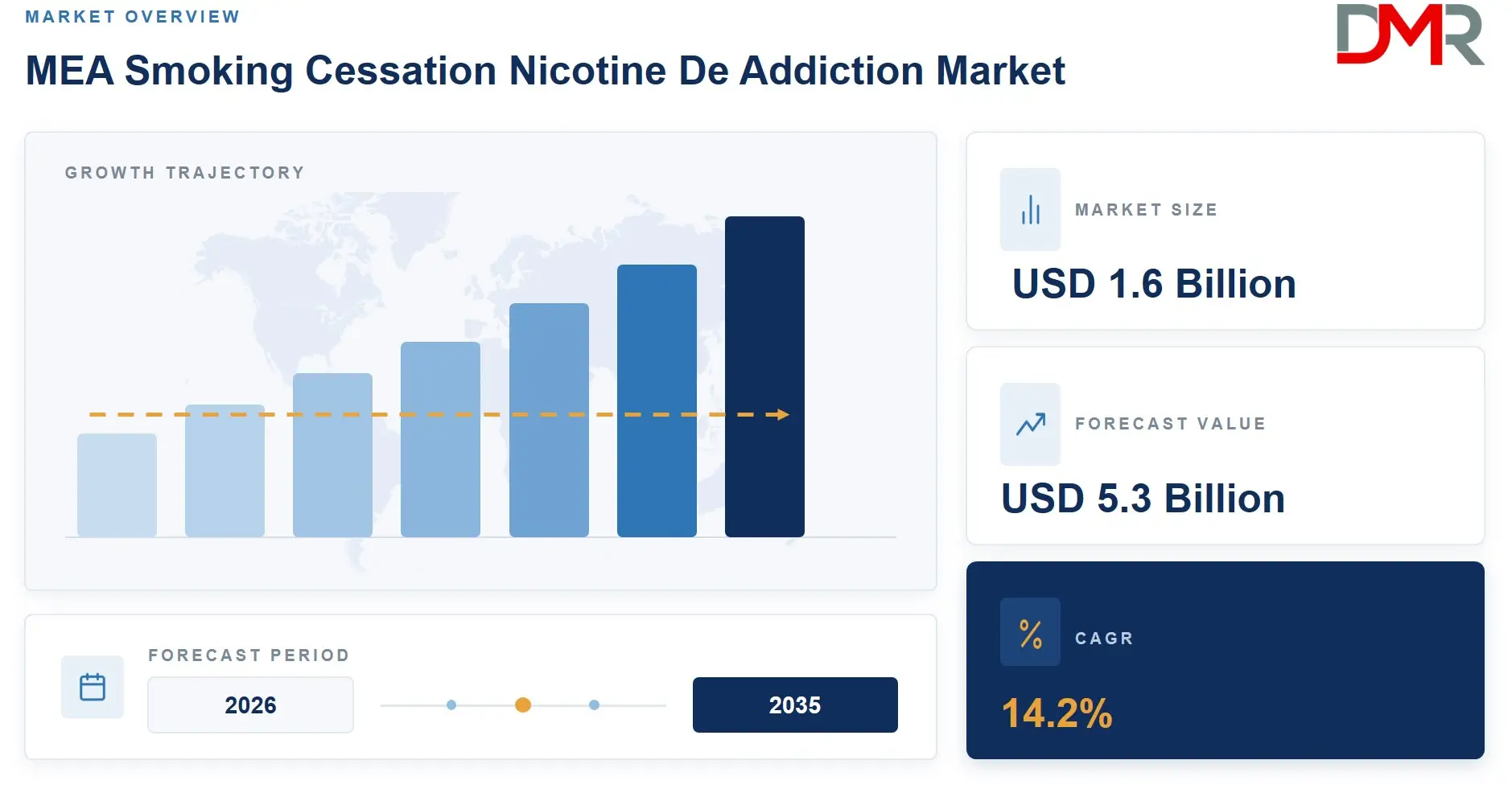
The MEA Smoking Cessation Nicotine De Addiction Market size is estimated to reach USD 1.6 Bn in 2026 and is further anticipated to reach USD 5.3 Bn by 2035, at a CAGR of 14.2%.
ℹ
To learn more about this report –
Download Your Free Sample Report Here
The market covers the pharmaceuticals, nicotine replacement products, behavioral support services and digital tools that adult smokers across the Middle East and Africa use to break dependence on tobacco. It spans gums and patches sold without a prescription, prescription drugs such as varenicline and bupropion, tobacco free nicotine pouches, and counseling delivered through pharmacies, hospitals and employer wellness schemes.
The figures in this report describe demand generated inside Saudi Arabia, the UAE, South Africa and the wider Middle East and Africa region, not the worldwide revenue of pharmaceutical companies headquartered there. A UAE distributor selling nicotine patches in Europe or a South African manufacturer exporting gum to Asia contributes nothing to this sizing; only sales consumed by smokers and cessation programs located within the region count toward the market.
Buyers range from individual smokers purchasing gum or patches at a retail pharmacy counter, to national health ministries procuring pharmacotherapy for subsidized cessation clinics, to corporations funding workplace wellness programs for employees. Demand concentrates where smoking prevalence remains high and disposable income supports branded pharmacotherapy, notably the Gulf states, alongside high volume markets such as South Africa and Egypt where price sensitive generics and community health programs carry most of the demand.
What is structurally changing is the product mix. Governments across the Gulf are financing national cessation campaigns and treating tobacco free nicotine pouches as a distinct regulatory category rather than banning them outright, while South Africa's tobacco reform debate has moved toward exempting smokeless products from the harshest restrictions applied to cigarettes. That regulatory differentiation, combined with rising retail and online pharmacy access, is pulling spend away from cold turkey attempts toward assisted cessation.
Use Cases
- Retail Pharmacy Counseling in Saudi Arabia: Community pharmacists trained under the Kingdom's tobacco treatment certification programs dispense nicotine replacement therapy alongside brief counseling sessions, helping working age adults quit ahead of national wellness targets, replacing informal quitting attempts with structured, monitored regimens.
- Hospital Based Cessation Clinics in South Africa: Public and private hospitals run dedicated tobacco dependence clinics that combine pharmacotherapy with behavioral counseling for patients presenting with respiratory or cardiovascular disease, integrating quitting support into chronic disease management rather than treating it as a separate activity.
- Corporate Wellness Programs in the UAE: Multinational employers in Dubai and Abu Dhabi embed nicotine replacement benefits and digital coaching apps into employee health insurance packages, reducing sick leave linked to smoking related illness while meeting occupational health requirements tied to insurance underwriting.
- Nicotine Pouch Adoption Among Young Adults: Smoke free nicotine pouches, now sold through licensed retailers in several MEA markets, are drawing young adult smokers who reject patches and gum in favor of discreet formats, with pouch focused brands reporting hundreds of thousands of confirmed switches.
Key Takeaways
- Market Size & Share: The MEA smoking cessation nicotine de addiction market is valued at USD 1.6 Bn in 2026, expanding to USD 5.3 Bn by 2035 at a 14.2% CAGR.
- Product Analysis: Nicotine Replacement Therapy is expected to account for approximately 44% of 2026 revenue, ahead of prescription pharmacotherapy.
- Demand Concentration: Saudi Arabia, South Africa and the UAE together generate the largest share of regional demand, anchored by national cessation programs and premium retail access.
- Treatment Type: Pharmacological treatment is projected to hold close to 54% share in 2026, while digital and mHealth assisted treatment is the fastest growing pathway at a 24.8% CAGR through 2035.
- Regulatory Momentum: Gulf regulators are formalizing tobacco free nicotine pouches as a distinct product category rather than banning them, a shift that is reshaping assisted quit rates.
- Distribution Shift: Online pharmacies and e-commerce channels are set to grow fastest among distribution formats, narrowing access gaps outside major Gulf and South African cities.
How AI/Gen AI is Transforming the MEA Smoking Cessation Nicotine De Addiction Market?
Artificial intelligence is entering the smoking cessation pathway mainly through personalization rather than through the manufacture of nicotine products themselves. Cessation apps distributed by pharmacy chains and insurers in the Gulf increasingly use machine learning models trained on relapse patterns to time reminders and flag users at high risk of relapse before a craving episode occurs, replacing generic printed quit plans with adaptive coaching that responds to a smoker's actual behavior.
On the clinical side, natural language processing is being layered onto teleconsultation platforms used by national cessation hotlines in Saudi Arabia and South Africa, allowing a limited pool of trained counselors to triage more callers, document sessions automatically and route complex cases to specialists. The near term impact is operational, expanding counselor capacity, rather than the invention of new pharmacological therapies.
- Relapse Risk Prediction: Machine learning models flag smokers likely to resume tobacco use within a critical window, triggering targeted outreach from pharmacy or clinic staff.
- Conversational Triage Bots: Natural language processing powered chat tools handle first line quit hotline inquiries, freeing human counselors for complex or high risk cases.
- Personalized Tapering Plans: Algorithms adjust nicotine replacement dosing schedules based on a user's logged cravings and adherence data rather than a fixed template.
- Automated Documentation: Speech to text tools transcribe and summarize counseling sessions for hospital based cessation clinics, cutting administrative time per patient.
Key Drivers in the MEA Smoking Cessation Nicotine De-Addiction Market
Two forces are pulling the largest share of new demand into the market: government led cessation financing and the regulatory normalization of smokeless nicotine formats.
- Government Backed National Cessation Campaigns: Saudi Arabia's Public Investment Fund has backed a dedicated cessation company whose flagship tobacco free pouch has been credited with helping roughly 700,000 adults move away from cigarette smoking by the end of 2025, a milestone the company aims to reach years ahead of its original schedule. Ministries of health across the Gulf are simultaneously training pharmacists and physicians under formal tobacco treatment certification programs, embedding pharmacotherapy and counseling into subsidized public health infrastructure, which is pulling first time treatment seekers into the market at a pace few other regions are matching.
- Regulatory Differentiation Between Combustible and Smokeless Nicotine: Regulators in the UAE and South Africa are increasingly treating non combustible nicotine products, including pouches and patches, as a distinct category from cigarettes rather than folding them into blanket tobacco restrictions. The UAE's technical regulations for tobacco free nicotine pouches set clear certification, labeling and strength limits, while South Africa's health department has proposed exempting smokeless products from several provisions of its pending tobacco control bill. That differentiation lowers the compliance uncertainty that previously discouraged branded cessation products from expanding into new MEA markets.
Restraints in the MEA Smoking Cessation Nicotine De-Addiction Market
Two brakes limit how quickly assisted cessation displaces informal quitting across the region.
- Out of Pocket Cost and Limited Insurance Coverage: Branded pharmacotherapy and prescription varenicline remain priced beyond reach for much of the population outside the Gulf states, and public insurance schemes in many African markets do not reimburse cessation products, leaving smokers to weigh a course of treatment against basic household spending. Generic substitution has narrowed the gap in some markets, but distribution of low cost generics remains uneven outside major urban pharmacy chains, which keeps assisted quit rates well below levels seen in higher income regions.
- Fragmented and Sometimes Contradictory Regulation: Tobacco and nicotine policy varies sharply across the region, from outright bans on certain nicotine formats in some Gulf states to South Africa's still unsettled legislative debate over whether vapes and pouches count as harm reduction tools or should be regulated the same way as cigarettes. That inconsistency raises compliance costs for manufacturers seeking a single regional launch strategy and slows product availability in markets awaiting clearer rules, and it discourages smaller manufacturers from prioritizing the region ahead of markets with a single, predictable rulebook.
Growth Opportunities in the MEA Smoking Cessation Nicotine De-Addiction Market
The clearest white space sits outside the largest cities, in channels that established cessation brands have not yet built out.
- Employer Funded Wellness Programs in Gulf Free Zones: Multinational employers operating inside free zones in the UAE and Saudi Arabia are expanding health benefit packages to include nicotine replacement therapy and digital coaching as part of occupational health compliance, creating a channel largely untapped by consumer facing cessation brands. Insurers underwriting these packages are beginning to price premiums against employee smoking status, giving manufacturers a route to bulk institutional contracts. Extending this model to domestic small and mid sized employers, who currently offer little structured cessation support, represents a mostly untapped channel.
- Online Pharmacy Expansion into Secondary Cities: E-commerce linked pharmacy platforms have concentrated cessation product availability in Riyadh, Jeddah, Dubai, Abu Dhabi, Cairo and Johannesburg, leaving smokers in secondary cities and rural areas reliant on informal or unregulated supply. Extending licensed online pharmacy delivery and last mile logistics into these underserved areas offers a direct path to volume growth without requiring new physical retail infrastructure, particularly for repeat purchasers who no longer need in person counseling with each refill.
Trends in the MEA Smoking Cessation Nicotine De-Addiction Market
Two shifts are changing how cessation products reach smokers, independent of the drivers behind overall demand.
- Rapid Uptake of Tobacco Free Nicotine Pouches: Pouches have moved from a niche Gulf product to a mainstream quit aid within a few years, helped by regulatory frameworks that treat them as a distinct nicotine category rather than a tobacco product, and by domestic manufacturers positioning them explicitly as a bridge away from cigarettes. Retail placement alongside gum and patches, rather than behind tobacco counters, is accelerating this shift. Distributors report that many pouch buyers had never previously tried a pharmacy dispensed cessation product, suggesting the format is expanding the addressable market rather than only cannibalizing existing sales.
- Consolidation of Cessation Support into Digital Platforms: Pharmacy chains and national quit lines are folding SMS reminders, mobile apps and teleconsultation into a single digital front end, replacing what used to be separate paper based programs, phone hotlines and in person counseling. This consolidation is most visible in Saudi Arabia and the UAE, where digital health infrastructure investment has outpaced much of the rest of the region, and is gradually spreading to South African private healthcare networks serving insured patients.
Research Scope and Analysis
Segment performance is assessed across five axes: product, treatment type, distribution channel, end user and age group. Each axis identifies the sub-segment carrying the largest share of 2026 revenue and the one expanding fastest through 2035, together with the commercial reason behind each position.
ℹ
To learn more about this report –
Download Your Free Sample Report Here
By Product
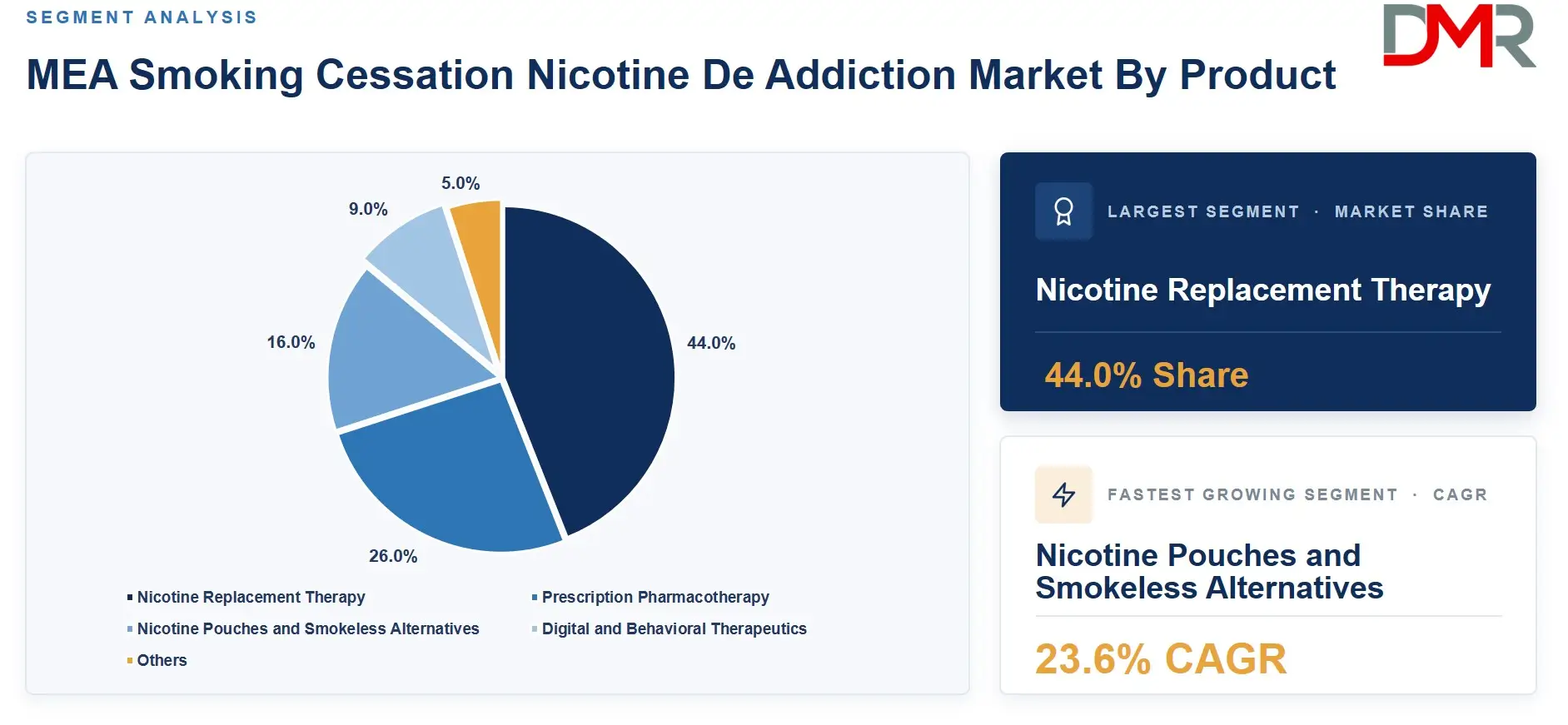
Nicotine Replacement Therapy holds the largest share by product in 2026, accounting for around 44% of revenue, because gums, patches and lozenges are sold without a prescription, carry decades of familiarity among prescribers, and remain the cheapest assisted option across South Africa and Egypt. Growth, however, is concentrated in nicotine pouches and other smokeless alternatives, expanding at a CAGR of 23.6% between 2026 and 2035 as Gulf regulators formalize certification pathways and domestic manufacturers, led by Saudi Arabia's Badael, position pouches as a cessation bridge, pulling first time quitters who previously avoided pharmacy dispensed formats.
By Treatment Type
Pharmacological treatment leads by treatment type, holding close to 54% of 2026 revenue, since national cessation programs across the Gulf default to subsidized nicotine replacement or prescription pharmacotherapy as the first line intervention offered through public clinics. The steeper trajectory sits with digital and mHealth assisted treatment, forecast to expand at a 24.8% CAGR through 2035, as insurers and employers bundle coaching apps with pharmacotherapy, and as teleconsultation platforms extend counselor reach into markets that have historically lacked dedicated tobacco treatment clinics. Behavioral counseling alone continues to lose share to combination approaches, since pharmacies increasingly bundle a short counseling session into every nicotine replacement sale rather than charging for it separately.
By Distribution Channel
Retail pharmacies account for the largest distribution share in 2026, at approximately 46%, reflecting their role as the default point of purchase for cessation products across the region's major population centers. Growth, however, is concentrated in online pharmacies and e-commerce, projected to expand at a 23.1% CAGR to 2035, as licensed digital pharmacy platforms extend delivery into secondary cities in Saudi Arabia, South Africa and Egypt where physical pharmacy density remains thin. Government and NGO cessation programs, distributing product free of charge through public clinics, remain a small but steady channel underpinning access in lower income markets.
By End User
Adult individual smokers pursuing self-directed quit attempts represent the largest end user segment in 2026, close to 55% of revenue, since most cessation purchases in the region still occur without formal enrollment in a structured program. The fastest growing end user group is corporate and workplace wellness programs, forecast at a 22.4% CAGR through 2035, as multinational employers in Gulf free zones embed nicotine replacement benefits into occupational health packages, shifting purchases from individual retail transactions to bulk institutional contracts. Hospital and clinic patients, typically referred after a respiratory or cardiovascular diagnosis, sit between these two groups and rely more heavily on prescription pharmacotherapy.
By Age Group
Adults between 25 and 54 years old account for the largest share by age group in 2026, at around 48%, consistent with peak smoking prevalence and disposable income for branded pharmacotherapy in this cohort. The fastest growing age group is young adults between 18 and 24 years, expanding at a 21.7% CAGR through 2035, as national proposals to raise the minimum tobacco purchase age in the Gulf, combined with pouch focused marketing that resonates with younger buyers, pull a demographic that historically avoided pharmacy dispensed therapy into the market. Older adults aged 55 and above still account for a meaningful share, reflecting decades long smoking histories and a higher incidence of the comorbidities that prompt referred treatment.
The MEA Smoking Cessation Nicotine De Addiction Market Report is Segmented Based on the Following
By Product
- Nicotine Replacement Therapy (Gums, Patches, Lozenges and Nasal Sprays)
- Prescription Pharmacotherapy
- Nicotine Pouches and Smokeless Alternatives
- Digital Therapeutics and Behavioral Support Tools
- Others
By Treatment Type
- Pharmacological Treatment
- Behavioral Counseling and Support Programs
- Combination Therapy
- Digital and mHealth Assisted Treatment
- Others
By Distribution Channel
- Retail Pharmacies
- Hospital Pharmacies
- Online Pharmacies and E-commerce
- Government and NGO Cessation Programs
- Others
By End User
- Adult Individual Smokers (Self Directed)
- Hospital and Clinic Cessation Patients
- Corporate and Workplace Wellness Programs
- Others
By Age Group
- Adults (25 to 54 Years)
- Older Adults (55 Years and Above)
- Young Adults (18 to 24 Years)
- Others
Regulatory Landscape
Tobacco and nicotine regulation across the Middle East and Africa remains split between established combustible tobacco control and newly emerging rules for smokeless nicotine formats. The UAE has moved furthest, certifying tobacco free nicotine pouches under a dedicated technical regulation with defined nicotine strength limits and labeling requirements, while South Africa's health department has proposed exempting pouches, snus and vapes from the harsher provisions of its pending tobacco control bill. Saudi Arabia continues expanding publicly funded cessation infrastructure rather than issuing new product rules. This gives manufacturers a defined, if uneven, regional launch path; the risk is that South Africa's bill could still tighten before enactment, delaying entry for products not yet formally exempted.
Epidemiology
Smoking prevalence varies widely across the region, higher among adult males in the Gulf and North Africa, lower across much of Sub-Saharan Africa, though urbanization is pushing prevalence upward in several African markets even as it declines in Saudi Arabia. Reported quitting activity has accelerated, with hundreds of thousands of Saudi adults documented as having moved away from cigarettes within roughly two years, evidence that assisted cessation is beginning to shift population level behavior. The clinical opening lies in earlier dependence screening alongside routine respiratory and cardiovascular checks; the risk is that many African health systems still lack the primary care infrastructure to refer patients into cessation pathways at scale, capping volumes outside better resourced Gulf and South African systems.
Competitive Landscape
Competition in the MEA smoking cessation nicotine de-addiction market is moderately fragmented, spanning multinational consumer health majors that supply branded nicotine replacement therapy, generics manufacturers that undercut them on price, and a growing cluster of Gulf based specialists building entirely new smokeless nicotine categories. Basis of competition splits along two lines: established brands compete on pharmacy shelf presence, physician familiarity and insurance formulary inclusion, while newer entrants compete on certification speed, flavor and format innovation, and direct to consumer digital marketing. Dominant strategies include partnering with national cessation programs to secure institutional volume, localizing manufacturing inside Saudi Arabia and the UAE, and expanding online pharmacy distribution.
Some of the Prominent Players in the MEA Smoking Cessation Nicotine De-Addiction Market Are
- Haleon plc
- Pfizer Inc.
- Johnson & Johnson
- Perrigo Company plc
- Sanofi
- Reckitt Benckiser Group plc
- Teva Pharmaceutical Industries Ltd.
- Viatris Inc.
- Novartis AG
- Cipla Limited
- Fertin Pharma A/S
- Achieve Life Sciences, Inc.
- 22nd Century Group, Inc.
- Niconovum AB
- Chrono Therapeutics, Inc.
- Kwit SAS
- Alkaloid AD Skopje
- Sun Pharmaceutical Industries Ltd.
- Dr. Reddy's Laboratories Ltd.
- Torrent Pharmaceuticals Ltd.
- Lupin Limited
- Zydus Lifesciences Ltd.
- Cadila Pharmaceuticals Ltd.
- Wockhardt Ltd.
- Alkem Laboratories Ltd.
- Glenmark Pharmaceuticals Ltd.
- Badael Company (DZRT)
- Julphar (Gulf Pharmaceutical Industries)
- SPIMACO Addwaeih
- Tabuk Pharmaceutical Manufacturing Company
- Jamjoom Pharma
- NeoPharma LLC
- Aspen Pharmacare Holdings Limited
- Adcock Ingram Healthcare Ltd.
- Pharco Pharmaceuticals
- EIPICO
- EVA Pharma
- Amoun Pharmaceutical Company
- Marcyrl Pharmaceutical Industries
- Hikma Pharmaceuticals PLC
- Other Key Players
Recent Developments
- In August 2026, the UAE Ministry of Finance introduced a minimum excise price of AED 1 per millilitre on vaping liquids effective from September 2026, a move regulators said was intended to standardize excise enforcement rather than raise the underlying tax rate.
- In June 2026, South Africa's Portfolio Committee on Health voted to advance the Tobacco Products and Electronic Delivery Systems Control Bill, with members conditioning support on clearer differentiation between combustible and non combustible nicotine products.
- In June 2026, Badael reported that its DZRT nicotine pouch had been associated with roughly 700,000 Saudi adults moving away from cigarette smoking by the end of 2025, with about 200,000 of them subsequently exiting nicotine use entirely.
- In March 2026, South Africa's health department proposed exempting nicotine pouches, snus and e-cigarettes from several provisions of the pending national tobacco control bill, citing their lower risk profile relative to combustible cigarettes.
- In November 2025, Badael said its DZRT pouch had enabled nearly 400,000 Saudi smokers to quit within under two years of launch, prompting the company to move its one million quitter target forward to 2026.
Report Details
| Report Characteristics |
| Market Size (2026) |
USD 1.6 Bn |
| Forecast Value (2035) |
USD 5.3 Bn |
| CAGR (2026-2035) |
14.2% |
| Historical Data |
2021 - 2025 |
| Forecast Data |
2026 - 2035 |
| Base Year |
2025 |
| Segments Covered |
By Product, By Treatment Type, By Distribution Channel, By End User, and By Age Group |
| Regional Coverage |
Middle East & Africa - Saudi Arabia, The UAE, South Africa, Rest of MEA |
Frequently Asked Questions
How big is the MEA Smoking Cessation Nicotine De Addiction Market?
▾ The market is valued at USD 1.6 Bn in 2026 and is projected to reach USD 5.3 Bn by 2035, expanding at a CAGR of 14.2% across the forecast period. Growth is led by Saudi Arabia, South Africa and the UAE, where government backed cessation programs and expanding pharmacy access are pulling more smokers toward assisted quit attempts each year.
What is the growth rate of the MEA Smoking Cessation Nicotine De Addiction Market?
▾ The market is expected to grow at a CAGR of 14.2% between 2026 and 2035. Growth is fastest in nicotine pouches and smokeless alternatives, digital and mHealth assisted treatment, and online pharmacy distribution, as regulatory clarity and rising institutional demand from employer wellness programs expand the pool of assisted quitters beyond traditional retail pharmacy customers.
Which country holds the largest share in the MEA Smoking Cessation Nicotine De Addiction Market?
▾ Saudi Arabia holds the largest share of regional demand, supported by publicly funded cessation clinics, a national tobacco treatment certification program for pharmacists and physicians, and a domestically manufactured nicotine pouch brand credited with helping hundreds of thousands of adults quit smoking. South Africa and the UAE follow, driven respectively by pharmacy scale and premium product adoption.
Who are the key players in the MEA Smoking Cessation Nicotine De Addiction Market?
▾ Key players include Haleon, Pfizer, Johnson and Johnson, Sanofi, Reckitt Benckiser, Badael, Julphar, Aspen Pharmacare and Hikma Pharmaceuticals, among others. Competition spans multinational consumer health majors supplying branded nicotine replacement therapy, regional generics manufacturers competing on price, and Gulf based specialists building new smokeless nicotine categories tailored to local regulation.
Which product segment is growing fastest in the MEA Smoking Cessation Nicotine De Addiction Market?
▾ Nicotine pouches and other smokeless alternatives are the fastest growing product segment, forecast to expand at a 23.6% CAGR between 2026 and 2035. Growth is driven by Gulf regulators formalizing certification pathways for tobacco free pouches and domestic manufacturers marketing them explicitly as a bridge away from cigarettes rather than a recreational product.
What is driving demand growth in the MEA Smoking Cessation Nicotine De Addiction Market?
▾ Demand is driven by government financed national cessation campaigns, particularly in Saudi Arabia, alongside regulatory differentiation that treats smokeless nicotine products separately from cigarettes in the UAE and South Africa. Expanding online pharmacy access and employer funded workplace wellness programs are pulling additional first time treatment seekers into the addressable market each year.
How is regulation shaping the MEA Smoking Cessation Nicotine De Addiction Market?
▾ Regulation is actively reshaping the MEA Smoking Cessation Nicotine De Addiction Market as the UAE certifies tobacco free nicotine pouches under defined technical standards and South Africa considers exempting smokeless products from its pending tobacco control bill. This differentiation between combustible and non combustible nicotine is lowering compliance uncertainty and accelerating product launches across the region.