Market Snapshot
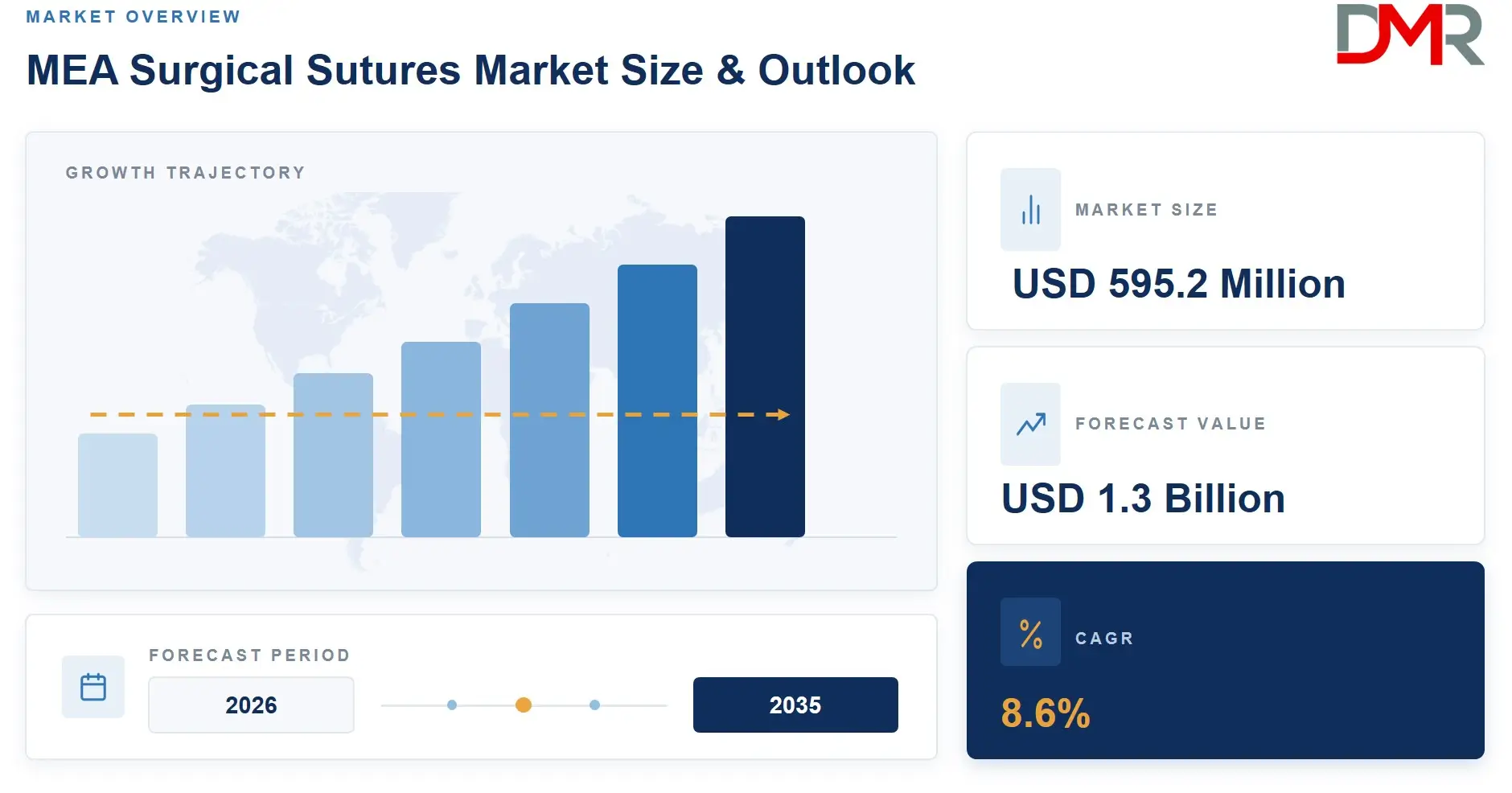
- Market Size (2026): USD 595.2 Mn
- Forecast Value (2035): USD 1,251.0 Mn
- CAGR (2026-2035): 8.6%
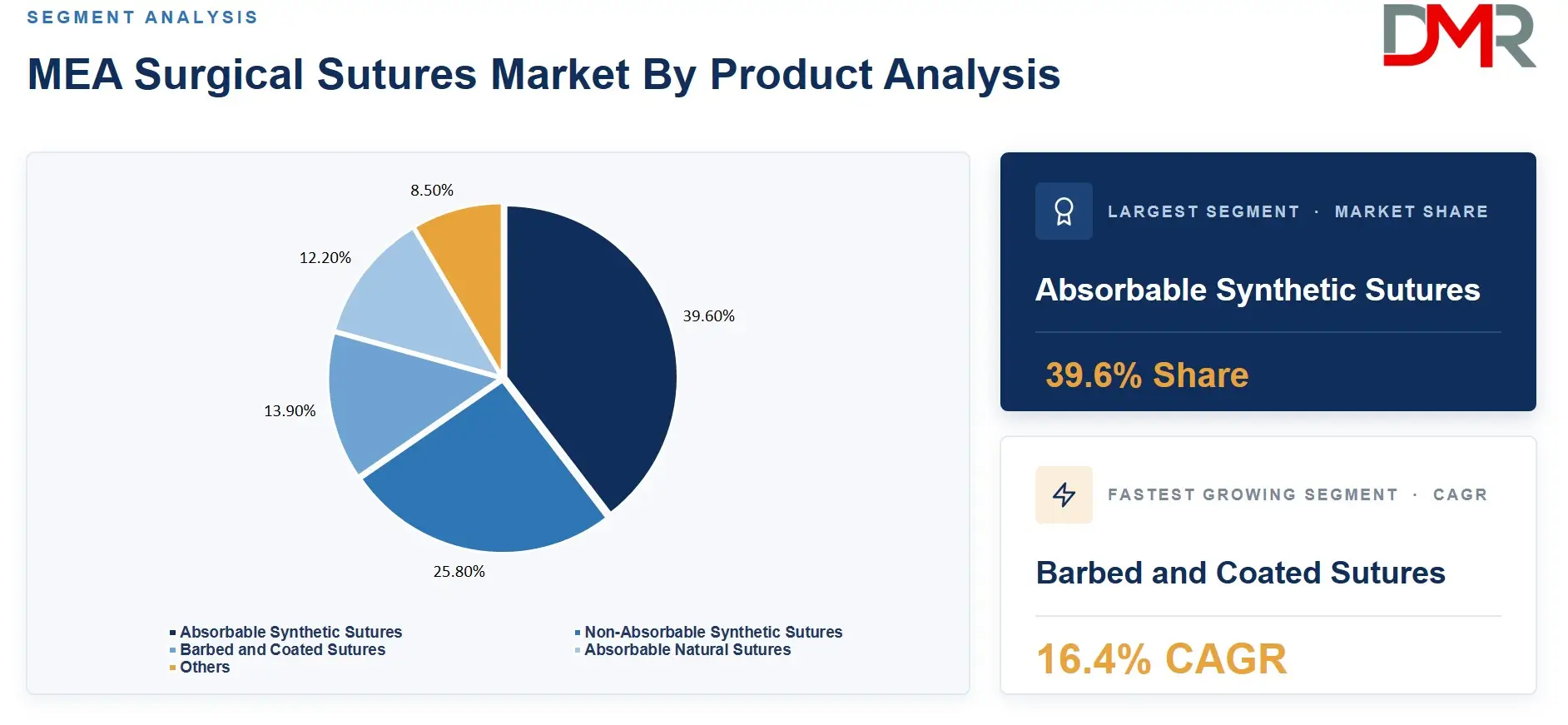
- Leading By Product (2026): Absorbable Synthetic Sutures, around 39.6%
- Leading By Material (2026): Synthetic Polymers, approximately 45.3%
- Key Players: Ethicon, Medtronic, B. Braun Melsungen, and others
What is the MEA Surgical Sutures Market and its Market Size?
The MEA Surgical Sutures Market size is estimated to reach USD 595.2 Mn in 2026 and is further anticipated to reach USD 1,251.0 Mn by 2035, at a CAGR of 8.6%. The figures cover suture consumption inside the Middle East and Africa region itself, meaning procedures performed and products purchased by hospitals, surgical centers and clinics located within the geography, not the worldwide revenue of companies headquartered there.
ℹ
To learn more about this report –
Download Your Free Sample Report Here
A surgical suture is a sterile medical thread, packaged with or without an attached needle, used to hold wound edges, tissue layers or blood vessels together while the body heals. The category splits along two broad lines: absorbable sutures, which the body breaks down over weeks and therefore need no removal, and non-absorbable sutures, which remain in place until a clinician removes them or which are left permanently in internal tissue that will not be re-exposed. Raw material choice, whether synthetic polymer, silk, catgut or polyester, and construction, whether monofilament or braided, together determine handling characteristics, tensile strength retention and infection risk, and surgeons select among them based on the tissue type, wound tension and anticipated healing timeline.
Demand across the region concentrates where formal surgical capacity has expanded fastest: the Gulf Cooperation Council states, where large hospital building programmes and medical tourism have lifted procedure volumes, and South Africa, where a mature private hospital network sits alongside a public system still building out theatre capacity. Buyers range from large tertiary hospitals running centralized procurement tenders to independent day surgery centers and mission hospitals sourcing through regional distributors, and purchasing decisions weigh price, tender compliance, cold chain and shelf life alongside clinical performance.
What is structurally changing is the mix rather than the base act of suturing. Barbed and antibacterial coated sutures are displacing conventional monofilament and braided products in higher acuity procedures, minimally invasive and day case surgery is shifting volume toward ambulatory settings, and local assembly and distribution partnerships are reducing the region's historical dependence on long import lead times from Europe and Asia.
Use Cases
- Tertiary Hospital General Surgery: Large public and private hospitals across Saudi Arabia and the UAE use absorbable synthetic sutures for routine abdominal, gynecological and general surgical closures, prioritising consistent tensile strength and predictable absorption to reduce reoperation and follow-up visits in high-volume theatre schedules.
- Cardiovascular Procedure Suites: Cardiac centers in Gulf referral hospitals rely on fine gauge monofilament sutures for vascular anastomosis and valve repair, where knot security and minimal tissue drag directly affect procedural outcomes in a segment expanding alongside rising cardiovascular disease burden.
- Private Ambulatory Surgical Centers: Day case clinics in South Africa and North Africa are adopting barbed sutures for laparoscopic and cosmetic procedures, cutting closure time and enabling same day discharge, a shift that suits the roughly 22.6% share ambulatory settings are expected to hold of end use demand in 2026.
- Rural and Mission Hospital Networks: Faith based and NGO run hospitals across Sub Saharan Africa depend on affordable braided non-absorbable and natural sutures sourced through regional distributors, where price sensitivity and long procurement lead times shape purchasing far more than product novelty.
Key Takeaways
- Market Size & Share: The market is set to expand from an estimated USD 595.2 Mn in 2026 to USD 1,251.0 Mn by 2035.
- By Product Analysis: Absorbable synthetic sutures are expected to lead with close to 39.6% of 2026 revenue.
- Demand Concentration: Saudi Arabia is projected to hold the largest share of regional demand in 2026, ahead of South Africa and the UAE.
- Growth Driver: Rising surgical volumes tied to expanding GCC hospital capacity are lifting consumption at a pace above the regional CAGR of 8.6%.
- Technology Shift: Barbed and coated sutures, though just around 13.9% of 2026 volume, are forecast to grow at 16.4% annually through 2035.
- Distribution Channel: Direct institutional tenders account for roughly 67.4% of 2026 purchasing, reflecting the region's hospital-led procurement structure.
How AI/Gen AI is Transforming the MEA Surgical Sutures Market?
Artificial intelligence has a narrower, more operational footprint in surgical sutures than in diagnostic or imaging categories, since the product itself is a passive consumable rather than a connected device. The clearest impact sits upstream and downstream of the stitch: computer vision assisted quality inspection on production lines, demand forecasting for regional distributors managing tender cycles and shelf life, and machine learning driven surgical site infection surveillance that indirectly shapes which suture types hospitals standardise on.
Regional distributors and larger hospital groups in the Gulf are the earliest adopters, using predictive analytics to align stock levels with elective surgery scheduling and to reduce the wastage that comes from sutures expiring before use. Suture and needle manufacturers, meanwhile, are applying automated visual inspection to catch coating defects and needle attachment faults that manual inspection can miss at high production speeds.
- Automated Visual Inspection: Computer vision systems on suture and needle assembly lines flag coating irregularities, needle swage defects and packaging seal failures before sterilisation.
- Tender and Inventory Forecasting: Predictive models help distributors match stock holding to hospital tender cycles across multiple MEA countries, reducing both stockouts and expiry write-offs.
- Surgical Site Infection Analytics: Hospital infection control teams use pattern recognition across procedure and outcome data to inform which suture materials and coatings get standardised into theatre protocols.
Key Drivers in the MEA Surgical Sutures Market
Two forces account for most of the region's incremental suture demand through 2035.
- Expanding Surgical Infrastructure Across the Gulf: Saudi Arabia and the UAE have both committed large public and private capital to new hospital beds and specialty surgical centers as part of broader healthcare privatisation and medical tourism strategies. Each new operating theatre adds a recurring consumable demand base rather than a one time purchase, and government backed insurance expansion is widening the pool of patients who can access elective surgery that previously went untreated or was referred abroad. As theatre utilisation rises toward levels seen in mature Western markets, suture volume per capita is following the same trajectory, with absorbable synthetic products capturing most of the incremental case load because they suit the general and gynecological procedures driving bed growth.
- Rising Chronic Disease and Trauma Burden: Cardiovascular disease, diabetes related complications and road traffic injuries are all climbing across the region's more populous markets, and each pushes patients toward procedures that require suturing, from vascular repair to orthopedic trauma fixation. Urbanisation and an ageing population in the GCC compound this effect, while high trauma incidence in parts of Sub Saharan Africa sustains steady demand for lower cost non-absorbable and natural sutures in emergency settings even where elective surgical capacity remains limited.
Restraints in the MEA Surgical Sutures Market
Two structural brakes temper the pace of adoption.
- Import Dependence and Currency Exposure: The large majority of sutures sold across the region are imported, since local manufacturing capacity remains limited to a handful of facilities in Egypt, Turkey and the Gulf. That leaves hospitals and distributors exposed to shipping delays, import duty changes and currency depreciation in markets such as Egypt and Nigeria, where a weaker local currency can push landed suture costs up faster than public procurement budgets adjust, squeezing distributor margins and occasionally forcing substitution toward lower specification products.
- Fragmented Regulatory Pathways: Registration requirements differ across Gulf Cooperation Council states, North Africa and Sub Saharan Africa, and a product cleared in Saudi Arabia does not automatically gain approval in Nigeria or Kenya. Smaller specialist manufacturers often lack the regulatory affairs resources to pursue registration in every jurisdiction, which narrows the field of suppliers, particularly for newer barbed and coated technologies, to companies large enough to run parallel submissions.
Growth Opportunities in the MEA Surgical Sutures Market
The clearest white space sits in day surgery and channel modernisation rather than in any single new geography.
- Ambulatory Surgical Center Build Out: As UAE and Saudi private healthcare groups add free standing day surgery centers to relieve pressure on hospital theatres, these facilities are standardising on barbed and pre-loaded suture systems that shorten closure time, giving suppliers that can bundle sutures with device kits and staff training a route to lock in multi year facility contracts ahead of broader hospital tenders.
- E-Procurement for Distributors: Online and e-distribution channels remain a small share of purchasing today but are opening a low cost route for regional distributors serving mid sized private clinics and pharmacy linked surgical suppliers, particularly in South Africa and Kenya, where digital procurement platforms are reducing the order lead times that have historically favoured only the largest hospital groups.
Trends in the MEA Surgical Sutures Market
Three shifts are reshaping how sutures reach the operating table across the region.
- Coating and Antibacterial Innovation: Antibacterial coated sutures are moving from a premium niche into mainstream hospital protocols as infection control committees in Gulf tertiary hospitals adopt them for high risk abdominal and orthopedic cases, pushing manufacturers to expand coated variants across a wider range of gauges and materials.
- Local Assembly Partnerships: Suture makers are increasingly partnering with or licensing regional manufacturers in Egypt, Turkey and Saudi Arabia to finish or pack products locally, shortening lead times and helping products qualify under local content requirements attached to some government tenders.
- Consolidation of Distribution Channels: Regional medical device distributors are consolidating through acquisition, giving surviving distributors broader country coverage and stronger negotiating positions with both manufacturers and hospital procurement committees.
Research Scope and Analysis
Segment performance across the MEA Surgical Sutures Market is assessed along five axes: product, material, application, end use and distribution channel. Each axis identifies the sub-segment carrying the largest share of 2026 revenue and the one expanding fastest through 2035, along with the commercial reason behind each position.
ℹ
To learn more about this report –
Download Your Free Sample Report Here
By Product
Absorbable synthetic sutures are projected to hold the largest share by product in 2026, accounting for close to 39.6% of revenue, since they suit the general, gynecological and abdominal procedures that make up the bulk of regional surgical volume and require no follow up removal visit, an important cost consideration for hospitals managing constrained outpatient capacity. Growth, however, is concentrated in barbed and coated sutures, expanding at a CAGR of 16.4% between 2026 and 2035 as private hospital groups in the Gulf standardise on these products for laparoscopic and cosmetic procedures, where faster closure times directly translate into higher theatre throughput. Non-absorbable synthetic sutures remain the second largest category, holding steady demand in cardiovascular and orthopedic procedures where permanent tensile support is clinically required.
By Material
Synthetic polymers lead the material axis with approximately 45.3% of 2026 revenue, reflecting their consistent absorption profile, lower infection risk and compatibility with coating technologies that natural materials cannot easily support. Growth, however, is concentrated in polyester, forecast to expand at a CAGR of 12.6% through 2035 as its high tensile strength and low cost make it an increasingly common substitute for silk in orthopedic and cardiovascular fixation across price sensitive public hospital tenders. Silk retains a meaningful share in lower income markets where its low unit cost and long shelf stability continue to outweigh the infection control advantages of synthetic alternatives.
By Application
General surgery is projected to remain the largest application in 2026, holding around 33.6% of revenue, since abdominal, hernia and gastrointestinal procedures make up the largest single block of surgical case volume across both public and private hospital systems in the region. The steeper trajectory sits with cardiovascular surgery, expanding at a CAGR of 13.8% between 2026 and 2035 as Gulf referral hospitals expand cardiac surgery capacity to reduce patient outflow to Europe and Asia for specialised procedures. Orthopedic surgery follows a similar pattern, supported by rising trauma case volume and an expanding base of joint replacement procedures.
By End Use
Hospitals dominate the end use axis, accounting for close to 60.8% of 2026 revenue, since the large majority of MEA surgical capacity, both public and private, still sits inside hospital theatre complexes rather than free standing facilities. Growth, however, is concentrated in ambulatory surgical centers, projected to expand at a CAGR of 12.9% through 2035 as private operators in the UAE and Saudi Arabia build out day surgery capacity to capture lower acuity procedures at a lower cost base than full service hospitals. Specialty clinics contribute a smaller but stable share, concentrated in ophthalmic and dermatological procedures.
By Distribution Channel
Direct institutional tenders remain the dominant distribution channel, representing roughly 67.4% of 2026 revenue, because large public hospital systems and Gulf ministries of health procure sutures through centralised tender processes that favour established suppliers with regional registration and logistics capability. Growth, however, is concentrated in online and e-distribution, forecast to expand at a CAGR of 16.1% through 2035 as digital procurement platforms extend reach into mid sized private clinics and independent surgical practices that tenders do not typically serve. Retail pharmacy channels continue to supply smaller volumes of non-sterile and outpatient wound closure products.
The MEA Surgical Sutures Market Report is Segmented Based on the Following
By Product
- Absorbable Synthetic Sutures
- Non-Absorbable Synthetic Sutures
- Barbed and Coated Sutures
- Absorbable Natural Sutures
- Others
By Material
- Synthetic Polymers
- Silk
- Polyester
- Catgut
- Others
By Application
- General Surgery
- Cardiovascular Surgery
- Orthopedic Surgery
- Gynecological Surgery
- Others
By End Use
- Hospitals
- Ambulatory Surgical Centers
- Specialty Clinics
- Others
By Distribution Channel
- Direct and Institutional Tenders
- Retail Pharmacies
- Online and E-distribution
- Others
Regulatory Landscape
Registration pathways across the region remain fragmented rather than unified. Saudi Arabia's Food and Drug Authority and the UAE's Ministry of Health and Prevention each run independent device registration processes, while many Sub Saharan African markets rely on a mix of national approval and reliance procedures that reference CE marking or FDA clearance rather than running full local review. This is shifting as the African Medicines Agency builds out continental coordination and as Gulf regulators move toward harmonised Gulf Cooperation Council registration to cut duplicate filings. The commercial opening favours manufacturers able to fund parallel submissions across several jurisdictions at once; the brake is that smaller specialist suppliers without dedicated regulatory affairs teams often default to a handful of larger markets, narrowing competition and slowing new suture technologies from reaching lower income countries in the region.
Patent Analysis
Innovation in this market concentrates on coating chemistry and barb geometry rather than base fiber technology, which has changed little in decades. Established players hold layered patent portfolios covering antibacterial coatings and self anchoring barb designs, creating a defensible position in the higher margin premium segment even as base absorbable and non-absorbable products commoditise. Regional manufacturers in Turkey and Egypt largely operate outside this patent activity, competing instead on price and local registration speed for conventional products. The opening for newer entrants sits in formulation work around biodegradable coatings that sidestep existing claims; the risk is that patent disputes between multinational suppliers occasionally disrupt distributor supply commitments in the region when injunctions affect specific coated product lines.
Competitive Landscape
The MEA surgical sutures market is moderately consolidated, with a small number of multinational manufacturers supplying the majority of hospital tender volume through regional distribution partners, while dozens of smaller regional and imported brands compete on price for lower specification products. Competition centers on tender compliance, registration breadth across multiple MEA jurisdictions, and the ability to guarantee supply continuity through long and sometimes disrupted shipping routes. Multinational players increasingly compete through local assembly or packaging partnerships that shorten lead times and support local content requirements, while regional manufacturers in Turkey, Egypt, Saudi Arabia and South Africa compete primarily on price, registration speed and proximity to distributors serving lower income markets across Sub Saharan Africa.
Some of the Prominent Players in the MEA Surgical Sutures Market Are
- Ethicon (Johnson & Johnson MedTech)
- Medtronic plc
- B. Braun Melsungen AG
- Smith+Nephew plc
- Teleflex Incorporated
- CONMED Corporation
- Integra LifeSciences Holdings Corporation
- Boston Scientific Corporation
- Zimmer Biomet Holdings, Inc.
- Advanced Medical Solutions Group plc
- Healthium Medtech Limited
- DemeTECH Corporation
- Sutures India Pvt Ltd
- Dolphin Sutures
- Centenial Surgical Suture Ltd
- TT Life Sciences Corp
- Surgical Specialties Corporation
- Peters Surgical
- SMI AG
- Mellon Medical B.V.
- Atramat
- Internacional Farmaceutica S.A. de C.V.
- Lotus Surgicals (TI Medical)
- Unisur Lifecare Private Limited
- W.L. Gore & Associates
- United Medical Industries Co. Ltd. (UNIMED)
- Synthecon Sutures
- M-Group Holding (ISMC)
- Dogsan Medical Devices
- Katsan Medical Devices
- Setpa Medical
- Ethan Medical
- Al Naghi Medical
- Medispot Medical Equipment
- United Surgicals Limited
- Suremed Medical Supplies
- Orion Surgical and Sutures Nigeria
- Cardinal Health Inc.
- Medline Industries Inc.
- WEGO Medical
- Other Key Players
Recent Developments
- In June 2026, Ethicon extended its PEEK suture anchor platform into additional Gulf markets, giving tendon and ligament repair surgeons in the region a lower profile fixation option than legacy metal anchors.
- In February 2026, DemeTECH Corporation secured CE Mark certification for a barbed suture anchor system, opening a registration path into Middle Eastern and North African procurement tenders that require CE-marked devices.
- In November 2025, B. Braun Melsungen AG introduced its OptiStitch skin closure device across several Sub-Saharan African distribution markets, giving outpatient clinics a faster alternative to hand-tied sutures for superficial wound closure.
- In July 2025, Dolphin Sutures expanded its Middle East footprint with new country registrations, pairing competitive pricing with an enlarged absorbable and barbed suture range for regional distributors.
- In April 2025, Sutures India Pvt Ltd added manufacturing capacity earmarked for African demand, prioritising lower-cost absorbable sutures for public sector and NGO run surgical programmes.
Report Details
| Report Characteristics |
| Market Size (2026) |
USD 595.2 Mn |
| Forecast Value (2035) |
USD 1,251.0 Mn |
| CAGR (2026-2035) |
8.6% |
| Historical Data |
2021 - 2025 |
| Forecast Data |
2026 - 2035 |
| Base Year |
2025 |
| Segments Covered |
By Product, By Material, By Application, By End Use, and By Distribution Channel |
| Regional Coverage |
Middle East & Africa - Saudi Arabia, The UAE, South Africa, Rest of MEA |
Frequently Asked Questions
How big is the MEA Surgical Sutures Market?
▾ The MEA Surgical Sutures Market is estimated at USD 595.2 Mn in 2026 and is projected to reach USD 1,251.0 Mn by 2035, expanding at a CAGR of 8.6% between 2026 and 2035. Growth is concentrated in the Gulf Cooperation Council states, where expanding hospital capacity and rising elective surgery volumes are lifting consumption of absorbable synthetic sutures across general and gynecological procedures.
What is the growth rate of the MEA Surgical Sutures Market?
▾ The market is forecast to grow at a CAGR of 8.6% from 2026 to 2035, moving from USD 595.2 Mn to USD 1,251.0 Mn. Barbed and coated sutures are growing fastest within the category, expanding at 16.4% annually as private hospitals adopt them for laparoscopic and cosmetic procedures across the Gulf.
Which country holds the largest share in the MEA Surgical Sutures Market?
▾ Saudi Arabia is projected to hold the largest share of regional demand in 2026, supported by large scale hospital expansion and rising elective surgery volumes under the country's healthcare privatisation programme. South Africa and the UAE follow, with the UAE recording faster underlying procedure growth on a smaller base.
Who are the key players in the MEA Surgical Sutures Market?
▾ Key players include Ethicon, Medtronic, B. Braun Melsungen, Healthium Medtech, DemeTECH Corporation, United Medical Industries (UNIMED) and Synthecon Sutures, among others. Competition centers on tender compliance, multi country regulatory registration and the ability to guarantee consistent supply through the region's import dependent distribution chains.
Which product segment leads the MEA Surgical Sutures Market?
▾ Absorbable synthetic sutures lead the market, accounting for close to 39.6% of 2026 revenue, since they suit the general and gynecological procedures that make up most regional surgical case volume and require no separate removal visit, an important consideration for hospitals managing constrained outpatient follow up capacity.