Market Snapshot
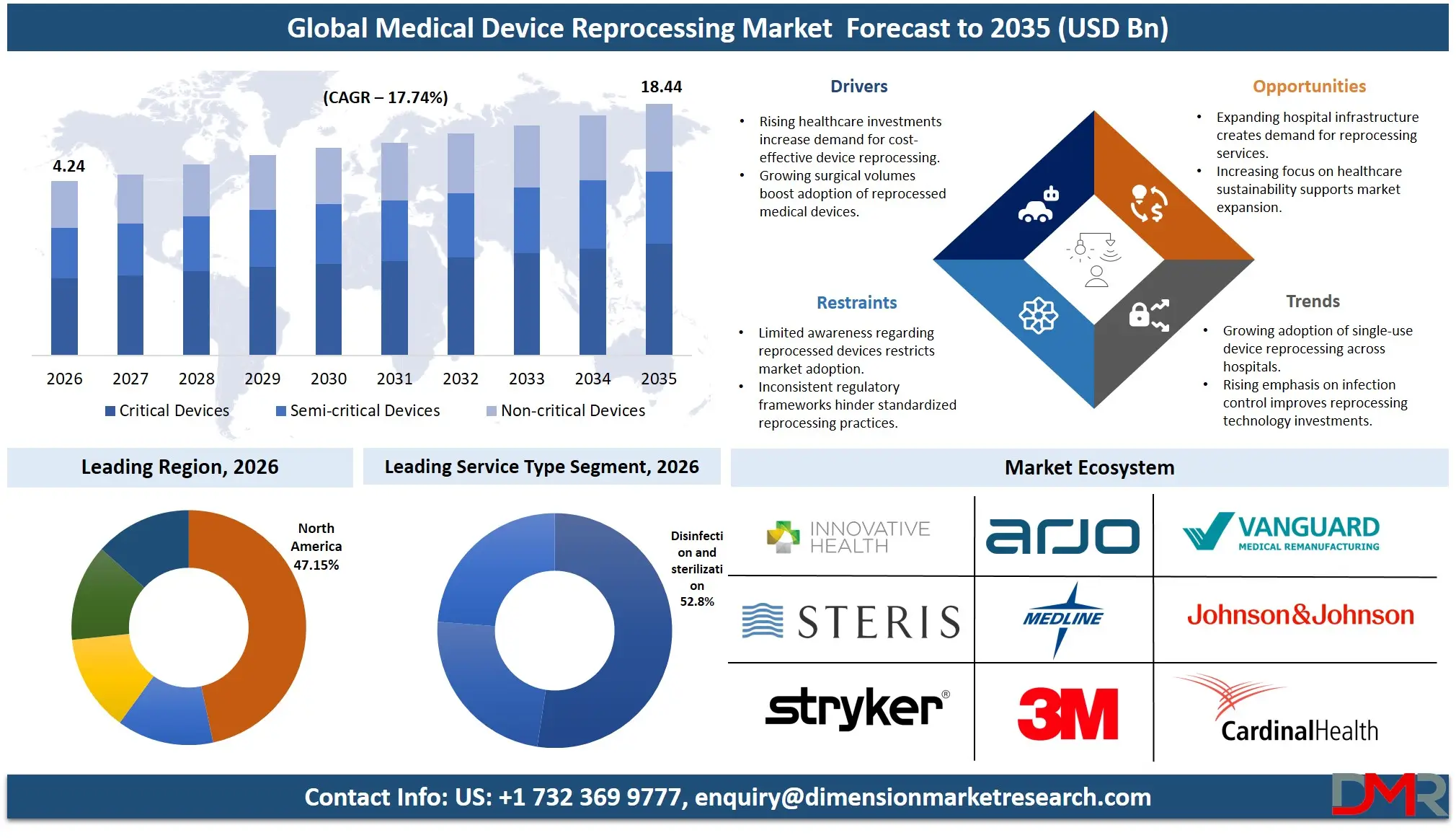
- The Global Medical Device Reprocessing Market size is estimated at USD 4.24 Billion in 2026.
- Reusable products led the Product segment with the largest revenue share in 2025.
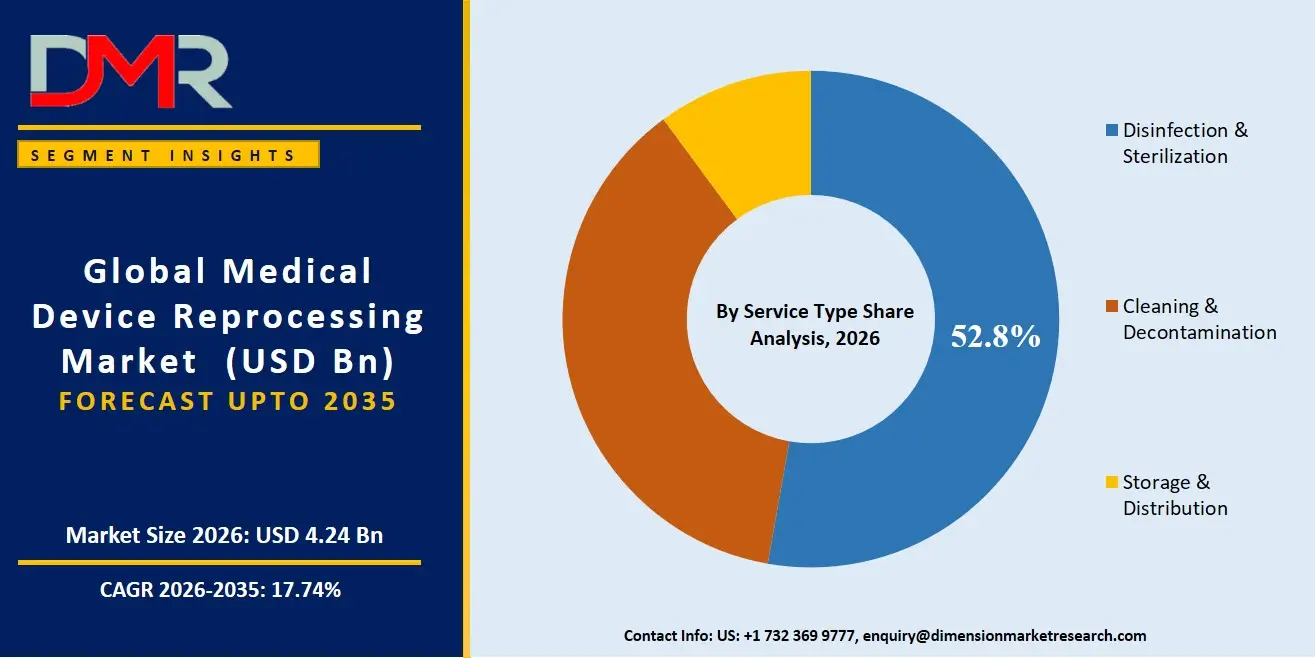
- Disinfection & Sterilization led the Service Type segment with a 52.78% revenue share.
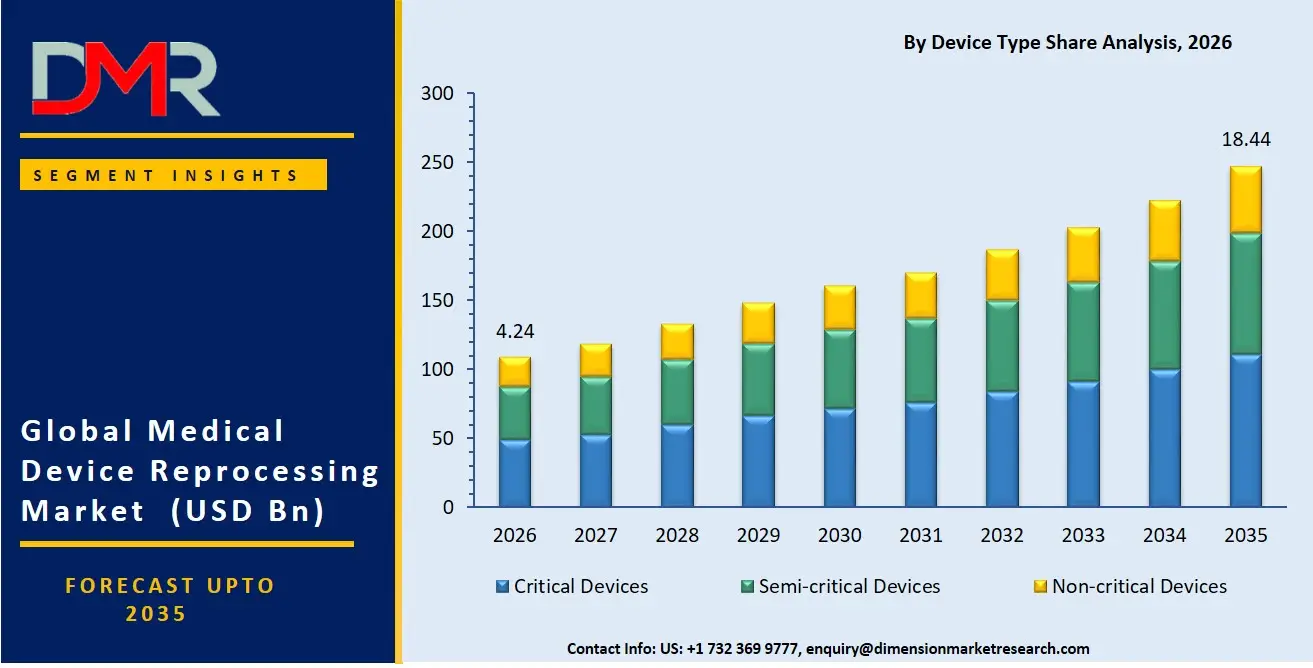
- Critical Devices led the Device Type segment with a 55.75% revenue share.
- Third-party/Commercial Reprocessors led the Service Provider segment with an 82.27% revenue share.
- Cardiovascular Catheters led the Product Type segment with a 38.10% revenue share.
- Cardiology led the Application segment with a 41.74% revenue share.
- Hospitals & ASCs led the End User segment with an 85.74% revenue share.
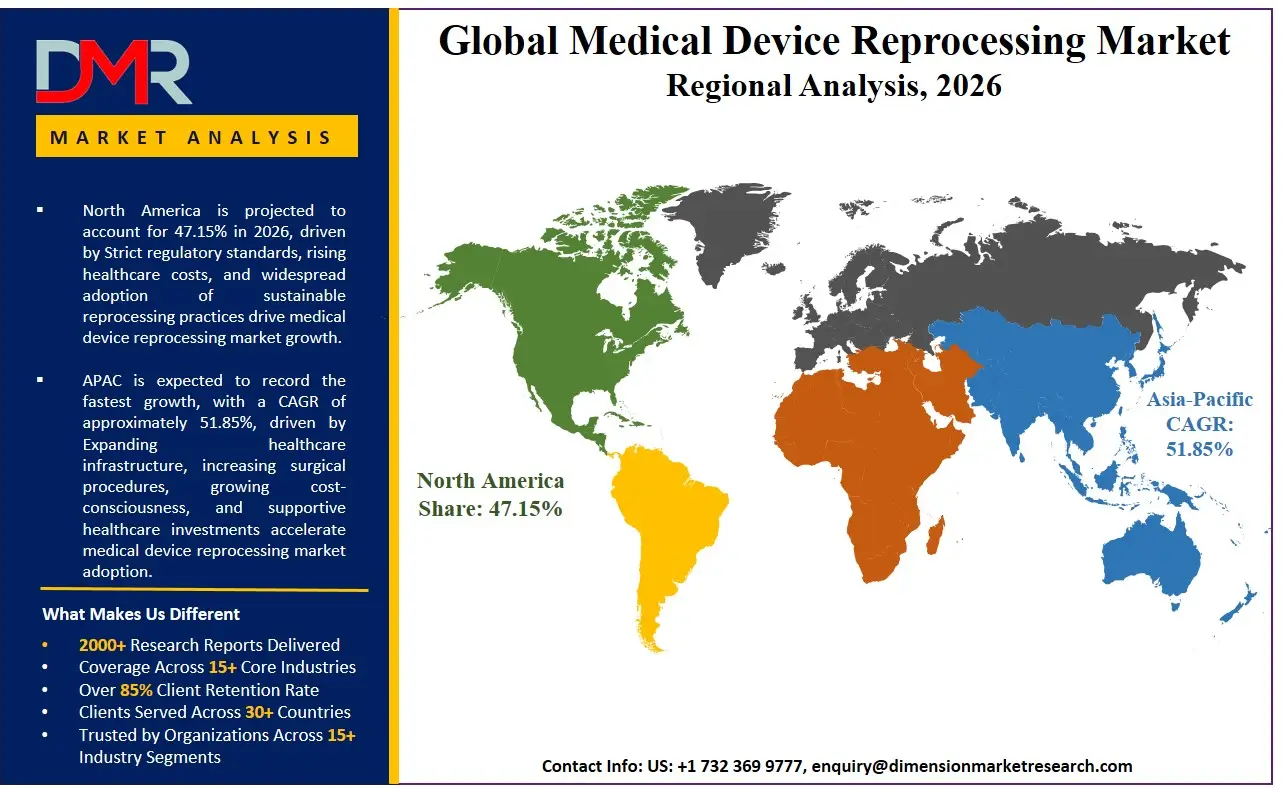
- North America led all regions with a 47.15% revenue share.
Market Overview
Medical device reprocessing covers the FDA-regulated collection, cleaning, disinfection, sterilization, and repackaging of devices originally labeled for single use, so hospitals can buy them back at a fraction of new-device cost. The market excludes original equipment manufacturing and excludes informal, unregulated reuse practices that fall outside FDA or equivalent oversight. Reprocessed single-use devices typically cost 30% to 50% less than virgin equivalents, As reported by AMDR, which is the central economic lever pulling hospital purchasing teams into the category.
ℹ
To learn more about this report –
Download Your Free Sample Report Here
Procurement teams do not buy reprocessing as a standalone category. They buy it as a line item inside broader supply chain and sustainability budgets, sitting next to virgin device purchasing and waste management contracts. Hospital sustainability officers increasingly treat reprocessing volume as a Scope 3 emissions lever rather than a pure cost play, which pulls reprocessing decisions into board-level ESG reporting cycles that previously ignored device procurement entirely. That shift changes who signs the contract. Sustainability committees now sit alongside supply chain directors in vendor selection, lengthening sales cycles but widening the pool of internal champions for reprocessing programs.
Market Size and Forecast
The Global Medical Device Reprocessing Market size is estimated at USD 4.24 Billion in 2026 from USD 3.60 Billion in 2025, and is projected to reach USD 18.44 Billion by 2035, exhibiting a CAGR of 17.74% during the forecast period.
Volume data backs the dollar trend. AMDR member reprocessors sold 39,387,336 reprocessed single-use devices back to hospitals in 2025, an 8.26% increase over 2024, As per AMDR's April 2026 program data. Hospitals and surgical centers saved USD 495.52 Million in 2025 through reduced purchasing costs and avoided waste disposal fees, Based on data from the same AMDR report. Unit growth outpacing dollar savings growth suggests buyers are reprocessing a wider basket of device types rather than simply buying more of the same catalog, which supports continued double-digit volume expansion even if per-unit pricing softens.
The forecast assumes continued FDA 510(k) clearance throughput for new device categories and no material reversal in hospital sustainability commitments. A meaningful caveat applies to the rate itself. The 17.74% figure available for Medical Device Reprocessing Market is labeled as a 2025 to 2030 CAGR rather than a full 2026 to 2035 rate, so the 2035 figure above should be treated as an extrapolation pending a confirmed long-range rate from the data provider.
Product Analysis
Reusable products led the Product segment with the largest revenue share in 2026.
Reusable devices anchor hospital capital budgets because they amortize cost across hundreds of procedures rather than one. Health systems treat reusable instrument sets as fixed assets, which puts purchasing decisions in the hands of capital committees rather than per-procedure supply buyers. That distinction matters for vendors. Selling into reusable categories means selling a multi-year asset, not a recurring consumable.
Single Use devices remain the feeder category for the entire reprocessing industry, since every reprocessed unit starts life as a virgin single-use product collected from an operating room. Vendors increasingly pitch hybrid programs that pair new single-use purchases with a reprocessing buyback agreement, turning what was once a one-way disposal cost into a partial revenue recovery for the hospital. This bundling approach is reshaping how OEMs and third-party reprocessors negotiate shared access to the same device pool.
Service Type Analysis
Disinfection & Sterilization captured 52.78% of the Service Type segment in 2025, ahead of all rivals.
Sterilization carries the heaviest regulatory burden of any reprocessing step, since it must demonstrate a Sterility Assurance Level before a device can legally return to a hospital shelf. That compliance weight concentrates revenue in providers who have already built validated, audited sterilization lines, raising the entry barrier for smaller players.
ℹ
To learn more about this report –
Download Your Free Sample Report Here
Cleaning & Decontamination and Storage & Distribution round out the service chain, with cleaning validation now facing tighter scrutiny under updated extraction-efficiency standards. Storage and distribution remain the least differentiated service layer, leaving most competitive pressure concentrated in the sterilization step rather than spread evenly across the chain.
Device Type Analysis
With a 55.75% share in 2026, Critical Devices outpaced all other Device Type categories.
Critical devices contact sterile tissue or the bloodstream, which means reprocessors serving this category absorb the highest validation cost per device cleared. Cardiovascular catheters sit at the center of this category, and their complexity is exactly why margins concentrate among a small number of specialized reprocessors rather than spreading across generalist players.
Semi-critical and Non-critical devices carry lighter validation requirements and faster regulatory throughput, making them attractive entry points for reprocessors expanding their catalog. Buyers in these lower-risk tiers often switch vendors more readily, since clinical risk tolerance is higher and switching costs are lower than in the critical tier.
ℹ
To learn more about this report –
Download Your Free Sample Report Here
Service Provider Analysis
Third-party/Commercial Reprocessors accounted for 82.27% of Service Provider demand in 2026, the highest of any category.
Commercial reprocessors built dedicated, FDA-registered facilities years before most hospitals considered in-house reprocessing, and that head start now shows up as scale advantage in unit cost. Hospitals lack the capital appetite to replicate that infrastructure internally for anything beyond the simplest device categories.
In-house/Hospital Reprocessing Units persist mainly at large academic medical centers with existing sterile processing departments. Taiwan's 2025 application data shows the operational gap this creates. Only 27% of 394 reprocessing applications across 33 device types passed all 12 checklist items, As reported by a Journal of Hospital Infection study published in November 2025, which signals that in-house programs without dedicated reprocessing infrastructure struggle to clear the same bar third-party specialists meet routinely.
Service Provider Analysis (corrected)
Third-party/Commercial Reprocessors accounted for 82.27% of Service Provider demand in 2026, the highest of any category.
Commercial reprocessors built dedicated, FDA-registered facilities years before most hospitals considered in-house reprocessing, and that head start now shows up as scale advantage in unit cost. Hospitals lack the capital appetite to replicate that infrastructure internally for anything beyond the simplest device categories.
In-house/Hospital Reprocessing Units persist mainly at large academic medical centers with existing sterile processing departments. Smaller hospitals without dedicated reprocessing infrastructure tend to outsource entirely rather than build partial in-house capability, which keeps the commercial tier's share structurally high regardless of hospital-level cost pressure.
Product Type Analysis
Cardiovascular Catheters captured 38.10% of the Product Type segment in 2026, ahead of all rivals.
Cardiovascular catheters command premium reprocessing margins because original units are expensive and procedure volume in electrophysiology labs keeps climbing. Reprocessors who clear FDA validation for catheter reuse capture outsized revenue per unit relative to lower-cost device types.
Electrophysiology Catheters, Laparoscopic Instruments, Gastroenterology Devices, Orthopedic External Fixation Devices, and General Surgery Instruments fill out the remainder of the category, with laparoscopic instruments showing the broadest hospital adoption since general surgery volume dwarfs specialty procedure counts. Vendors expanding their catalog tend to target laparoscopic and general surgery instruments first, since validation pathways are better established than for newer catheter subtypes.
Application Analysis
Cardiology accounted for 41.74% of Application demand in 2026, the highest of any category.
Cardiology's lead tracks directly with the dominance of cardiovascular catheters in the product mix, since the two categories largely describe the same clinical volume from different angles. High procedure frequency in cath labs creates a steady, predictable collection stream that reprocessors can plan capacity around.
Gastroenterology, Gynecology, General Surgery, Orthopedics, and Urology make up the remaining application mix, with general surgery offering the largest absolute procedure volume even without cardiology's premium device economics. Buyers in these categories tend to prioritize cost savings over the sustainability framing that increasingly drives cardiology and orthopedics purchasing conversations.
End User Analysis
A 85.74% share made Hospitals & ASCs the clear leader across End User categories in 2025.
Hospitals and ambulatory surgical centers generate the device volume reprocessors need to run efficient collection logistics, since scattered low-volume sites raise per-unit transport and tracking costs past the point of profitability. Specialty Clinics, Ambulatory Surgical Centers, and Academic & Research Institutes round out demand, with research institutes representing the smallest but most regulation-sensitive segment given device traceability requirements tied to clinical study protocols.
Key Market Segments
By Product
By Service Type
- Disinfection & Sterilization
- Cleaning & Decontamination
- Storage & Distribution
By Device Type
- Critical Devices
- Semi-critical Devices
- Non-critical Devices
By Service Provider
- Third-party/Commercial Reprocessors
- In-house/Hospital Reprocessing Units
By Product Type
- Cardiovascular Catheters
- Electrophysiology Catheters
- Laparoscopic Instruments
- Gastroenterology Devices
- Orthopedic External Fixation Devices
- General Surgery Instruments
By Application
- Cardiology
- Gastroenterology
- Gynecology
- General Surgery
- Orthopedics
- Urology
By End User
- Hospitals & ASCs
- Specialty Clinics
- Ambulatory Surgical Centers
- Academic & Research Institutes
Regional Analysis
North America led all regions with a 47.15% share in 2025, anchored by deep third-party reprocessor infrastructure.
North America's lead reflects two decades of FDA-cleared reprocessing precedent that simply does not exist at the same depth anywhere else. Hospitals here have had time to build procurement habits, GPO contracts, and clinical trust around reprocessed devices that newer markets are still establishing.
Europe trails North America but is closing distance fastest, driven by Germany's MDR Article 17 framework and Vanguard AG's February 2026 milestone as the first company to receive a TÜV NORD MDR certificate for CE reprocessing, a regulatory marker that signals the European pathway is now operational rather than theoretical. Asia Pacific, Latin America, and the Middle East & Africa remain earlier-stage markets where reprocessing adoption depends heavily on individual hospital systems rather than region-wide regulatory frameworks, leaving room for first-mover reprocessors willing to invest ahead of formal demand.
ℹ
To learn more about this report –
Download Your Free Sample Report Here
Key Regions and Countries
North America
Europe
- Germany
- France
- The UK
- Spain
- Italy
- Rest of Europe
Asia Pacific
- China
- Japan
- South Korea
- India
- Australia
- Rest of APAC
Latin America
- Brazil
- Mexico
- Rest of Latin America
Middle East & Africa
- GCC
- South Africa
- Rest of MEA
Market Dynamics
Hospital Adoption Scale Builds Recurring Reprocessing Demand
Hospital adoption has crossed a threshold where reprocessing is now routine infrastructure rather than a pilot program. 11,458 hospitals and surgical centers across 18 countries used regulated reprocessed devices in 2025, including 60 U.S. military institutions, As reported by AMDR's April 2026 program data. That scale matters because it converts reprocessing from a vendor pitch into an expected line item in new hospital procurement contracts, lowering the sales friction for reprocessors entering new accounts.
Regulatory clarity reinforces the adoption curve. Vanguard AG's receipt of the first TÜV NORD MDR certificate for CE reprocessing in February 2026 gives European hospitals a concrete, audited precedent to point to when justifying reprocessing contracts to internal compliance teams, Findings from Vanguard AG's official announcement confirm. Buyers no longer need to argue reprocessing is theoretically MDR-compliant. One company has now proven it in practice.
Federal Non-Adoption Signals an Unresolved Policy Gap
Not every institutional buyer has followed the adoption curve. The U.S. Veterans Health Administration's continued refusal to use FDA-regulated reprocessed devices is estimated to waste approximately $167 million in taxpayer dollars every year, Based on data from AMDR's 2025 member survey. That gap matters beyond its dollar value. It signals that even with two decades of FDA clearance precedent, institutional inertia can override documented cost savings inside large bureaucracies.
Validation inconsistency compounds the adoption gap at the facility level. A Taiwan-based study found only 27% of 394 reprocessing applications across 33 device types passed all 12 required checklist items, Data published by the Journal of Hospital Infection in November 2025 shows. Hospital class, location, and staffing levels were all linked to pass rates, meaning smaller or resource-constrained facilities face a structural disadvantage in clearing the same validation bar that well-staffed academic centers clear routinely.
Underused Hospital Capacity Represents the Largest Open Opportunity
The widest gap in Medical Device Reprocessing Market is not new technology. It is underused capacity at hospitals that already have reprocessing relationships in place. AMDR estimates that if all participating U.S. hospitals collected and reprocessed devices at the rate the top 10% of performing hospitals already achieve, the industry could unlock an additional USD 2.43 Billion in savings, Figures from AMDR's April 2026 report indicate. That is not a hypothetical greenfield market. It is existing customers leaving documented savings on the table.
Vendors who can solve the operational gap between top-decile and average hospital collection rates, through better staff training, collection bin placement, or workflow integration, stand to capture share without needing a single new hospital account. The opportunity sits inside accounts reprocessors already serve.
Market Trends
Sustainability Reporting Turns Reprocessing Into a Board-Level Metric
Reprocessing has moved from a quiet cost-saving tactic to a number hospital sustainability officers report upward. Hospitals using reprocessed devices in 2025 eliminated 125,018,466 pounds of greenhouse gas emissions, equal to more than 6.3 million gallons of gasoline, As per AMDR's April 2026 figures. Early movers that quantify this number internally now use it in board ESG reporting and public sustainability disclosures, giving reprocessing a visibility it never had when it was purely a purchasing-department decision.
Market Competition Overview
The reprocessing market sits closer to consolidated than fragmented at the top, with a small group of specialized commercial reprocessors controlling the bulk of third-party volume, which itself accounts for 82.27% of all service provider activity. Scale advantage compounds here. Each new device category a reprocessor validates adds to a regulatory moat that smaller entrants cannot easily replicate without years of FDA submission history.
Original equipment manufacturers entering reprocessing through their own divisions are reshaping competitive lines that used to be clean. When OEMs operate in-house reprocessing arms, they compete directly against the third-party specialists who built the category, blurring a distinction hospitals once relied on to compare vendors. Buyers now evaluate reprocessing vendors less by manufacturer origin and more by validated device catalog breadth and regulatory track record, which favors whoever has cleared the most device types rather than whoever built the original device.
Company Profiles
Cardinal Health runs its reprocessing business through its Sustainable Technologies division, which collected 21.6 million single-use devices and diverted 6.6 million pounds of waste from landfills in fiscal 2025, avoiding 1,900 metric tons of CO2e emissions, As reported by Cardinal Health's April 2026 newsroom update. The company is now extending that model geographically, opening a remanufacturing facility in Australia in 2026 to serve the Asia-Pacific region without shipping devices across oceans for processing. That local-footprint strategy reduces transport-related emissions that would otherwise undercut the sustainability case for reprocessing, giving Cardinal Health an edge in markets where environmental reporting requirements are tightening faster than cost pressure alone would justify expansion.
Vanguard AG positioned itself as Europe's regulatory first-mover by becoming the first company to receive a TÜV NORD MDR certificate for CE reprocessing of single-use devices in February 2026, Findings from Vanguard AG's official company announcement confirm. Under Article 17 of the EU Medical Device Regulation, CE reprocessing means Vanguard legally assumes manufacturer-level responsibility for the devices it reprocesses, including post-market surveillance and clinical evaluation. That regulatory weight is exactly what gives Vanguard a credibility advantage over competitors still operating under the lighter-touch CS reprocessing pathway, particularly as more EU member states decide whether to opt into national reprocessing frameworks.
Key Players
- Stryker
- Johnson & Johnson
- Medline Industries
- STERIS
- Cardinal Health
- Innovative Health
- Arjo
- Vanguard AG
- 3M
- Jabil Inc.
- Life Science Outsourcing, Inc.
- NEScientific, Inc.
- ReNu Medical
- Hygia Health Services
- Centurion Medical Products
- Medtronic
- Becton Dickinson
- Siemens Healthineers
- Philips
- Restore Medical Solutions
- Getinge
Regulatory Landscape
Cleaning validation for reprocessed devices now requires extraction methods to demonstrate at least 70% recovery efficiency before residual contamination results can be accepted, As per technical guidance referencing AAMI ST98 and ISO 15883-5 standards. That threshold directly shapes which reprocessors can clear validation for new device categories, since methods falling below the recovery floor cannot be used to support a submission regardless of how clean the device appears on visual inspection.
Europe's regulatory posture shifted concretely with Vanguard AG's February 2026 MDR certification, which gives hospitals and regulators a working example of full Article 17 compliance rather than a theoretical pathway. Member states still decide individually whether to permit reprocessing under national law, so the regulatory map across Europe remains uneven even as the compliance bar for companies that do operate becomes clearer.
Report Details
| Report Characteristics |
| Market Value (2025) |
USD 3.60 Billion |
| Market Value (2026) |
USD 4.24 Billion |
| Forecast Revenue (2035) |
USD 18.44 Billion |
| CAGR (2026–2035) |
17.74% |
| Historical Data |
2020 – 2024 |
| Forecast Data |
2026 – 2035 |
| Base Year |
2025 |
| Estimate Year |
2026 |
| Report Coverage |
Revenue Forecast, Market Dynamics, Competitive Landscape, Recent Developments |
| Segments Covered |
By Product (Reusable, Single Use); By Service Type (Disinfection & Sterilization, Cleaning & Decontamination, Storage & Distribution); By Device Type (Critical, Semi-critical, Non-critical); By Service Provider (Third-party/Commercial, In-house/Hospital); By Product Type (Cardiovascular Catheters, Electrophysiology Catheters, Laparoscopic Instruments, Gastroenterology Devices, Orthopedic External Fixation Devices, General Surgery Instruments); By Application (Cardiology, Gastroenterology, Gynecology, General Surgery, Orthopedics, Urology); By End User (Hospitals & ASCs, Specialty Clinics, Ambulatory Surgical Centers, Academic & Research Institutes) |
| Regional Coverage |
North America – US, Canada; Europe – Germany, France, UK, Spain, Italy, Rest of Europe; Asia-Pacific – China, Japan, South Korea, India, Australia, Rest of APAC; Latin America – Brazil, Mexico, Rest of Latin America; Middle East & Africa – GCC, South Africa, Rest of MEA |
| Prominent Players |
Stryker, Johnson & Johnson, Medline Industries, STERIS, Cardinal Health, Innovative Health, Arjo, Vanguard AG, 3M, Jabil Inc., Life Science Outsourcing Inc., NEScientific Inc., ReNu Medical, Hygia Health Services, Centurion Medical Products, Medtronic, Becton Dickinson, Siemens Healthineers, Philips, Restore Medical Solutions, Getinge, and Other Key Players |
| Purchase Options |
We have three licenses to opt for: Single User License (Limited to 1 User), Multi-User License (Up to 5 Users), and Corporate Use License (Unlimited Users & Printable PDF) along with customization based on project requirements. |
Frequently Asked Questions
What is the biggest investment opportunity in Medical Device Reprocessing Market ?
▾ The clearest opportunity is closing the gap between average and top-performing hospital collection rates. AMDR estimates that matching top-decile hospital reprocessing performance industry-wide could unlock an additional USD 2.43 Billion in savings without adding a single new hospital account.
Who are the top companies in Medical Device Reprocessing Market ?
▾ Cardinal Health and Vanguard AG lead through different strategies. Cardinal Health scales through its Sustainable Technologies division and geographic expansion into Australia, while Vanguard AG leads on European regulatory credibility as the first company to hold a TÜV NORD MDR certificate for CE reprocessing.
Which segment is growing fastest in Medical Device Reprocessing Market and why?
▾ Critical devices, led by cardiovascular catheters at a 38.10% product type share, show the strongest momentum because procedure volume in electrophysiology and cardiology keeps climbing and reprocessors keep clearing new catheter subtypes for reuse.
Which region is growing fastest and in Medical Device Reprocessing Market and why?
▾ Europe is closing the gap with North America fastest, driven by Vanguard AG's February 2026 MDR certification, which gives hospitals and regulators a working proof point for full Article 17 compliance rather than a theoretical pathway.
What is the biggest challenge holding Medical Device Reprocessing Market back?
▾ Validation inconsistency limits scale. A Taiwan-based study found only 27% of reprocessing applications passed all required checklist items, showing that facilities without dedicated reprocessing infrastructure struggle to meet the same technical bar specialist reprocessors clear routinely.