What is the Mep Software Market Size in 2026?
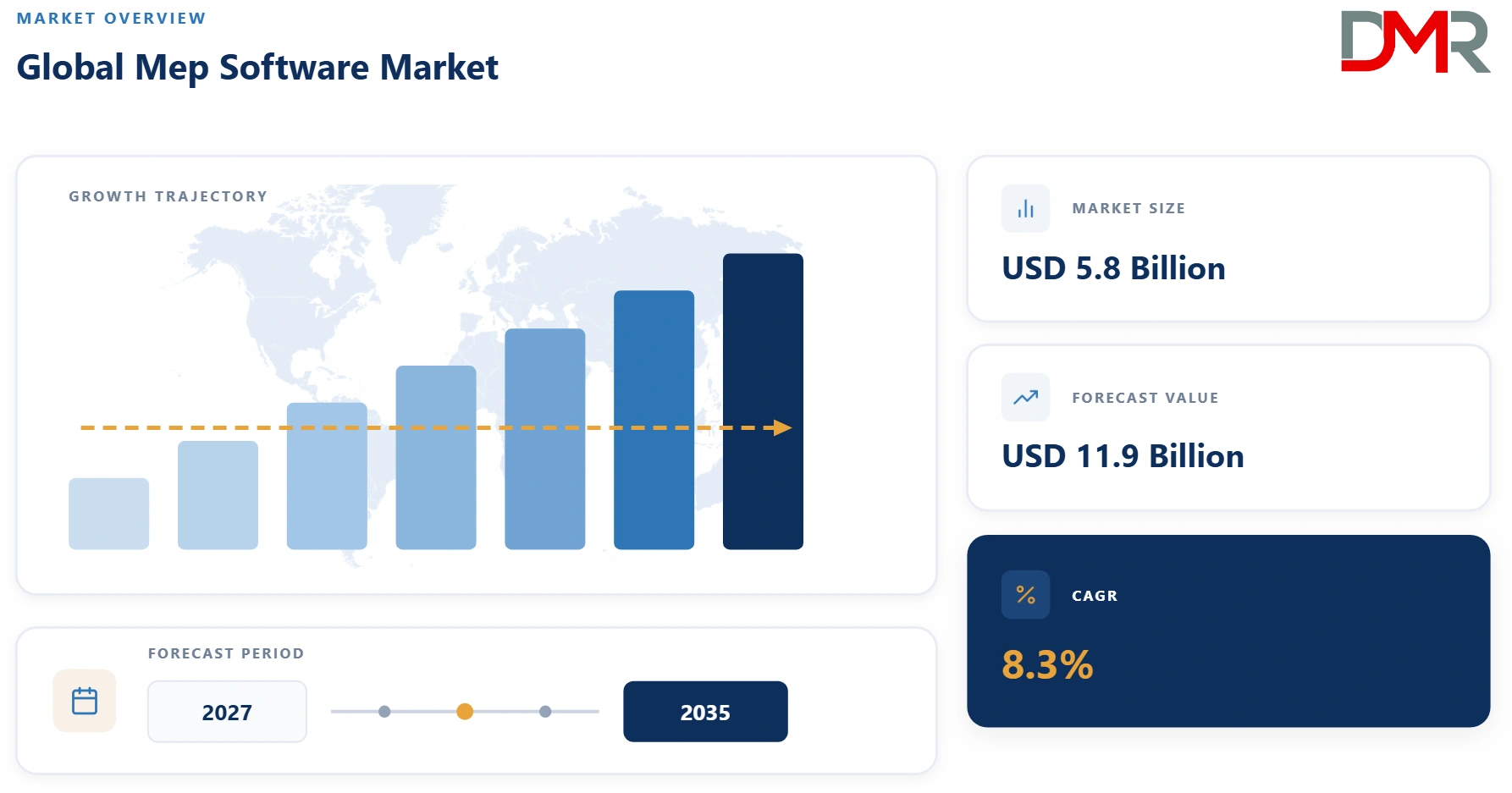
The global MEP software market is valued at USD 5.8 billion in 2026 and is projected to reach USD 11.9 billion by 2035, growing at a CAGR of 8.3% from 2027 to 2035. Growth is driven by accelerating BIM adoption, tightening building energy codes, and the urgent need to resolve labor shortages through design automation.
ℹ
To learn more about this report –
Download Your Free Sample Report Here
MEP software encompasses digital tools used to design, model, simulate, coordinate, and document mechanical, electrical, and plumbing systems within buildings and infrastructure. It spans discipline-specific calculation engines, BIM-integrated modeling environments, clash detection platforms, and emerging AI-driven automation layers that generate code-compliant routings, equipment schedules, and construction documentation. The market includes perpetual licenses, subscription software, and associated implementation and training services sold to engineering firms, contractors, and facility operators.
The report covers software and services deployed across architectural, engineering, and construction workflows for mechanical, electrical, and plumbing system design. Coverage extends to cloud, on-premises, and hybrid delivery models, and spans small, medium, and large enterprises. End-user segments include architecture and engineering firms, MEP contractors, construction companies, facility management providers, and government infrastructure agencies. Regional coverage addresses North America, Europe, Asia Pacific, Latin America, and the Middle East and Africa, with country-level granularity for major markets.
Mep Software Market Snapshot
Mep Software Market Snapshot, 2026-2035
| Metric |
Value |
| Market Size (2026) |
USD 5.8 billion |
| Forecast Value (2035) |
USD 11.9 Billion |
| CAGR (2027-2035) |
8.3% |
| Largest Region (2026) |
North America, 38% share |
| Fastest-Growing Region (2027-2035) |
Asia Pacific, 10.2% CAGR |
| Leading Component (2026) |
Software, 64% share |
| Leading Deployment Mode (2026) |
Cloud-Based, 56% share |
| Key Players |
Autodesk, Trimble, Nemetschek, Bentley Systems, MagiCAD, COINS Global, eVolve MEP, Endra |
Key Takeaways
- Market growth: The market expands from USD 5.8 billion in 2026 to USD 11.9 billion by 2035, registering an 8.3% CAGR.
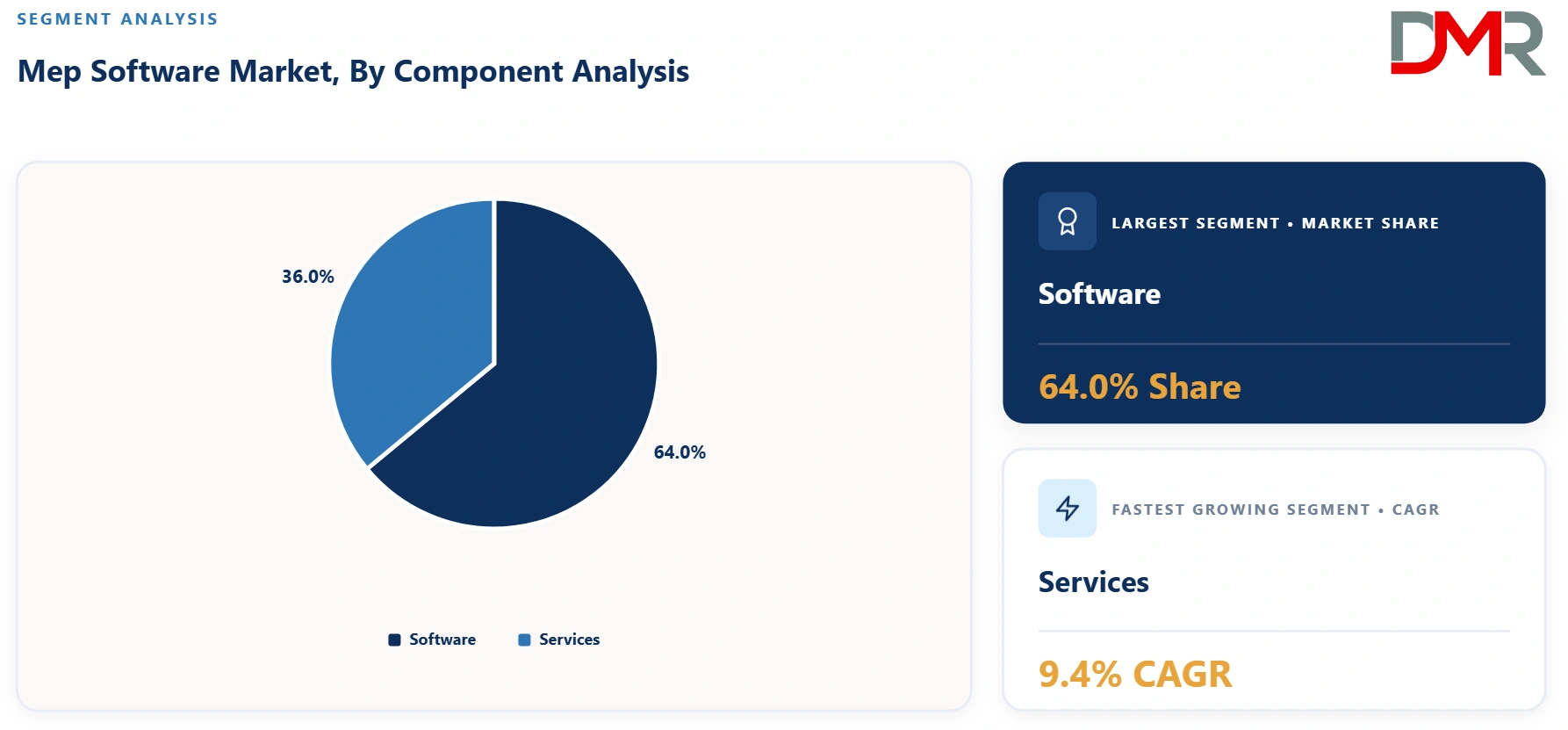
- Component leader: Software holds 64% share in 2026, led by BIM-integrated design suites and discipline-specific calculation tools.
- Fastest component: Services are set to grow at 9.4% CAGR through 2035, ahead of the overall market, as implementation complexity rises.
- Deployment leader: Cloud-based accounts for 56% of 2026 demand, as distributed teams require real-time model access and lower upfront costs.
- Fastest deployment mode: Hybrid deployments are projected to grow at 9.8% CAGR, supported by firms balancing data sovereignty with collaboration needs.
- Regional picture: North America leads with 38% share in 2026, while Asia Pacific is fastest-growing at 10.2% CAGR.
What are the Key Use Cases of Mep Software?
- Clash-free coordination: Detecting MEP-to-structure and inter-discipline conflicts before construction, reducing rework and change orders on complex commercial projects.
- Energy code compliance: Simulating HVAC loads and lighting power density against ASHRAE and local regulations to avoid permit delays and penalties.
- Prefabrication workflows: Generating fabrication-ready spool drawings and bill-of-materials outputs that feed directly into offsite manufacturing and installation sequencing.
- Facility handover: Delivering as-built digital twins with embedded equipment data to support commissioning, maintenance planning, and lifecycle asset management.
How are Foundation Models and Generative AI Transforming the Mep Software Market?
Foundation models and generative AI are beginning to reshape MEP software from productivity adjuncts into core engineering accelerators. Current adoption concentrates at the productivity layer, drafting specification sections, summarizing code documents, and generating preliminary reports, where time savings are measurable and risk is contained. The engineering layer, encompassing routing, sizing, and code validation, remains largely untouched by general-purpose LLMs due to accuracy constraints: standalone models exhibit variance exceeding 400% on deterministic engineering calculations, while solver-integrated approaches hold within approximately 1.5%.
The market impact is bifurcated. Incumbent vendors are embedding copilot features into established BIM platforms, while AI-native entrants pursue agentic workflows that delegate discrete design tasks to specialized models grounded in physics engines and validated solvers. Endra’s Power Studio, launched in 2026, claims electrical design for a 500,000-square-foot commercial building in under one day versus roughly two months traditionally. Adoption barriers remain high, with industry surveys indicating that up to 95% of generative AI initiatives in AEC fail to demonstrate measurable impact, but successful integrations are compressing design cycles and shifting software pricing toward outcome-based models.
Mep Software Market Dynamics at a Glance
Drivers, Restraints, Opportunities and Trends in the Mep Software Market
| Type |
Factor |
Impact |
| Driver |
Mandatory BIM requirements in public infrastructure projects |
High |
| Driver |
Construction labor shortages accelerating automation demand |
High |
| Restraint |
High switching costs and interoperability friction with legacy tools |
Medium |
| Restraint |
Accuracy limitations of generative AI in code-critical engineering tasks |
High |
| Opportunity |
AI-native platforms capturing greenfield design workflows |
Medium |
| Opportunity |
Emerging economies investing in smart city and infrastructure digitization |
High |
| Trend |
Shift from perpetual licenses to subscription and consumption pricing |
Medium |
| Trend |
Consolidation of point solutions into unified MEP platforms |
High |
What is Driving the Growth of the Mep Software Market?
Mandatory BIM Requirements in Public Infrastructure
Governments worldwide are mandating Building Information Modeling for publicly funded construction, creating a compliance-driven adoption floor for MEP software. The UK’s BIM Level 2 mandate, Singapore’s CORENET e-submission system, and expanding requirements across Nordic and Gulf states require coordinated MEP models as a condition of project approval. Public infrastructure spending packages in the United States and European Union have allocated hundreds of billions toward buildings and transit projects that specify digital delivery. For MEP software vendors, this regulatory floor converts what was once a discretionary productivity investment into a procurement prerequisite, expanding the addressable market beyond early-adopting engineering firms to the broader contractor and agency ecosystem.
Construction Labor Shortages Accelerating Automation Demand
Persistent shortages of skilled MEP engineers and tradespeople are forcing firms to substitute software-driven productivity for unavailable headcount. Industry estimates place the global construction labor deficit in the millions, with mechanical and electrical trades among the most constrained. Engineering firms report that junior staff require years of supervision before achieving independent code-compliant design competency, a timeline incompatible with current project backlogs. Software that automates routine sizing, routing, and documentation compresses that learning curve and multiplies the output of experienced engineers. Vendors positioning their products as force multipliers rather than replacement tools are gaining traction with firm principals facing simultaneous margin pressure and project volume growth.
What are the Key Restraints in the Mep Software Market?
High Switching Costs and Interoperability Friction
MEP software sits at the center of firm workflows, with project files, templates, and institutional standards deeply embedded in chosen platforms. Migrating from established tools like Revit or AutoCAD MEP requires retraining, template reconstruction, and costly downtime that small and mid-sized firms can ill afford. Interoperability failures compound the problem: IFC-based exchange between proprietary platforms frequently loses parametric intelligence, forcing manual rework. Vendors have limited incentive to reduce these barriers, as lock-in supports renewal revenue. The result is a market where incumbents retain accounts through inertia as much as satisfaction, and new entrants must overcome integration deficits that outweigh feature advantages in procurement decisions.
Accuracy Limitations of Generative AI in Code-Critical Tasks
The engineering layer of MEP design demands deterministic, auditable outputs that general-purpose generative models cannot reliably deliver. Tests of leading LLMs on MEP pump-station load calculations produced peak heating estimates ranging from 25 to 150 MBH for the same problem—a sixfold variance on a calculation with a single defensible answer. For routing and equipment sizing, errors propagate directly into construction documents and permit submissions, carrying liability implications that no engineer of record will accept without rigorous validation. Until AI systems are tightly coupled to validated solvers and physics engines, their addressable scope remains confined to low-risk documentation and drafting assistance, limiting the revenue potential of AI-differentiated offerings.
What are the Key Opportunities in the Mep Software Market?
AI-Native Platforms Capturing Greenfield Workflows
The emergence of AI-native MEP platforms creates an opportunity to bypass the migration problem entirely by targeting new firms and greenfield projects unencumbered by legacy templates. Endra’s approach—building agentic workflows from the ground up around physics engines and code-checking rather than retrofitting AI onto existing BIM tools illustrates this path. With over 600 companies on its waitlist across 90 countries before broad commercial launch, demand for purpose-built automation clearly exceeds what incumbent copilots satisfy. Vendors that establish credibility on well-scoped engineering tasks, such as electrical single-line diagrams or plumbing riser layouts, can expand scope incrementally while incumbents struggle to refactor architectures not designed for AI.
Emerging Economies Investing in Infrastructure Digitization
Asia Pacific and the Middle East present the highest growth opportunity as construction volumes shift eastward and governments prioritize digital delivery. India’s national infrastructure pipeline, Saudi Arabia’s giga-project program, and Southeast Asian smart city initiatives all embed BIM requirements and create demand for MEP design capacity that local engineering workforces cannot supply at required scale. Software that reduces reliance on scarce senior engineers has particular resonance in these markets. However, success requires localization: code compliance engines must accommodate national building standards, and pricing must align with local firm economics. Vendors treating these markets as pure export opportunities will lose to competitors investing in regional code libraries and channel partnerships.
What are the Latest Trends in the Mep Software Market?
Shift from Perpetual Licenses to Subscription and Consumption Pricing
The MEP software market is completing a transition from perpetual license sales to recurring subscription and usage-based models. Autodesk’s multi-year shift to named-user subscriptions established the template, and competitors across the BIM ecosystem have followed. The trend is now extending to consumption-based pricing for computation-intensive tasks: AI-driven simulation and code-checking lend themselves to per-project or per-calculation billing that aligns cost with value delivered rather than seat count. For vendors, this improves revenue predictability and lifetime customer value. For buyers, it lowers initial barriers but raises long-term lock-in concerns as design data and institutional workflows accumulate in vendor ecosystems. Pricing innovation is becoming a competitive battleground, particularly for AI-native entrants unburdened by legacy license structures.
Consolidation of Point Solutions into Unified MEP Platforms
The market is moving away from fragmented point-tool stacks toward integrated platforms spanning mechanical, electrical, and plumbing disciplines within a single data environment. Endra’s acquisition of Planlabs to extend from electrical into mechanical engineering, with a plumbing module planned for 2027, exemplifies the strategy. Incumbent consolidation, Autodesk’s absorption of MEP-focused capabilities into its AEC collection, and Trimble’s acquisition-driven expansion follows the same logic from the opposite direction. The driver is workflow economics: firms incur integration costs and data loss every time a model crosses a software boundary, and vendors capturing the full disciplinary span can eliminate those handoffs. Buyers benefit from reduced complexity, but face heightened vendor dependency as the number of viable platform alternatives narrows.
Research Scope and Analysis
The analysis segments the MEP software market by component, deployment mode, functionality, organization size, and end user, with regional and country-level revenue breakdowns. Market sizing reflects software licenses, subscriptions, and associated services. Growth forecasts incorporate adoption drivers, substitution dynamics, and regulatory requirements across covered segments.
ℹ
To learn more about this report –
Download Your Free Sample Report Here
By Component Analysis
Software holds the leading position with 64% revenue share in 2026, sustained by BIM-integrated design suites that serve as the primary authoring environment for MEP documentation and coordination. Services represent the fastest-growing component at 9.4% CAGR from 2027 to 2035, driven by implementation complexity associated with AI feature deployment, legacy data migration, and workflow customization that firms cannot resource internally.
By Deployment Mode Analysis
Cloud-based deployment leads with 56% share in 2026, reflecting the shift toward distributed project teams requiring real-time model access and the preference among small and mid-sized firms for operating expenditure over capital investment. Hybrid deployment is the fastest-growing mode at 9.8% CAGR, as large enterprises seek to retain on-premises data residency for sensitive projects while enabling cloud collaboration for distributed teams.
By Functionality Analysis
Mechanical systems design accounts for the largest functionality share at 34% in 2026, underpinned by HVAC load calculation and ductwork routing requirements present in virtually every commercial building project. Electrical systems design is the fastest-growing functionality at 9.1% CAGR, driven by renewable energy integration, electric vehicle charging infrastructure, and smart building controls that substantially increase electrical design complexity.
By Organization Size Analysis
Large enterprises hold the leading position with 55% share in 2026, reflecting their seat-count scale, multi-discipline platform adoption, and budgets for enterprise-wide BIM standardization across global project portfolios. Small enterprises are the fastest-growing size segment at 9.5% CAGR from 2027 to 2035, as cloud subscription models eliminate large capital outlays and AI-assisted design features compress the expertise barrier that previously favored larger firms. Medium enterprises grow at 8.8% CAGR, steadily migrating from point tools to integrated platforms as project complexity rises.
By End User Analysis
Architecture and engineering firms represent the leading end-user segment with 42% share in 2026, as the primary purchasers of design authoring and analysis tools. MEP contractors are the fastest-growing end-user segment at 9.6% CAGR, driven by prefabrication adoption and the need for constructability validation earlier in project timelines.
How is the Mep Software Market Segmented?
By Component
- Software
- Design and Modeling Software
- Building Information Modeling (BIM) Software
- Drafting and Documentation Software
- Simulation and Analysis Software
- Coordination and Clash Detection Software
- Services
By Deployment Mode
- Cloud-Based
- On-Premises
- Hybrid
By Functionality
- Mechanical Systems Design
- Electrical Systems Design
- Plumbing Systems Design
- Fire Protection Systems Design
- HVAC Systems Design
By Organization Size
- Small Enterprises
- Medium Enterprises
- Large Enterprises
By End User
- Architecture and Engineering Firms
- MEP Contractors
- Construction Companies
- Facility Management Companies
- Government and Public Infrastructure Agencies
Which Region Leads the Mep Software Market?
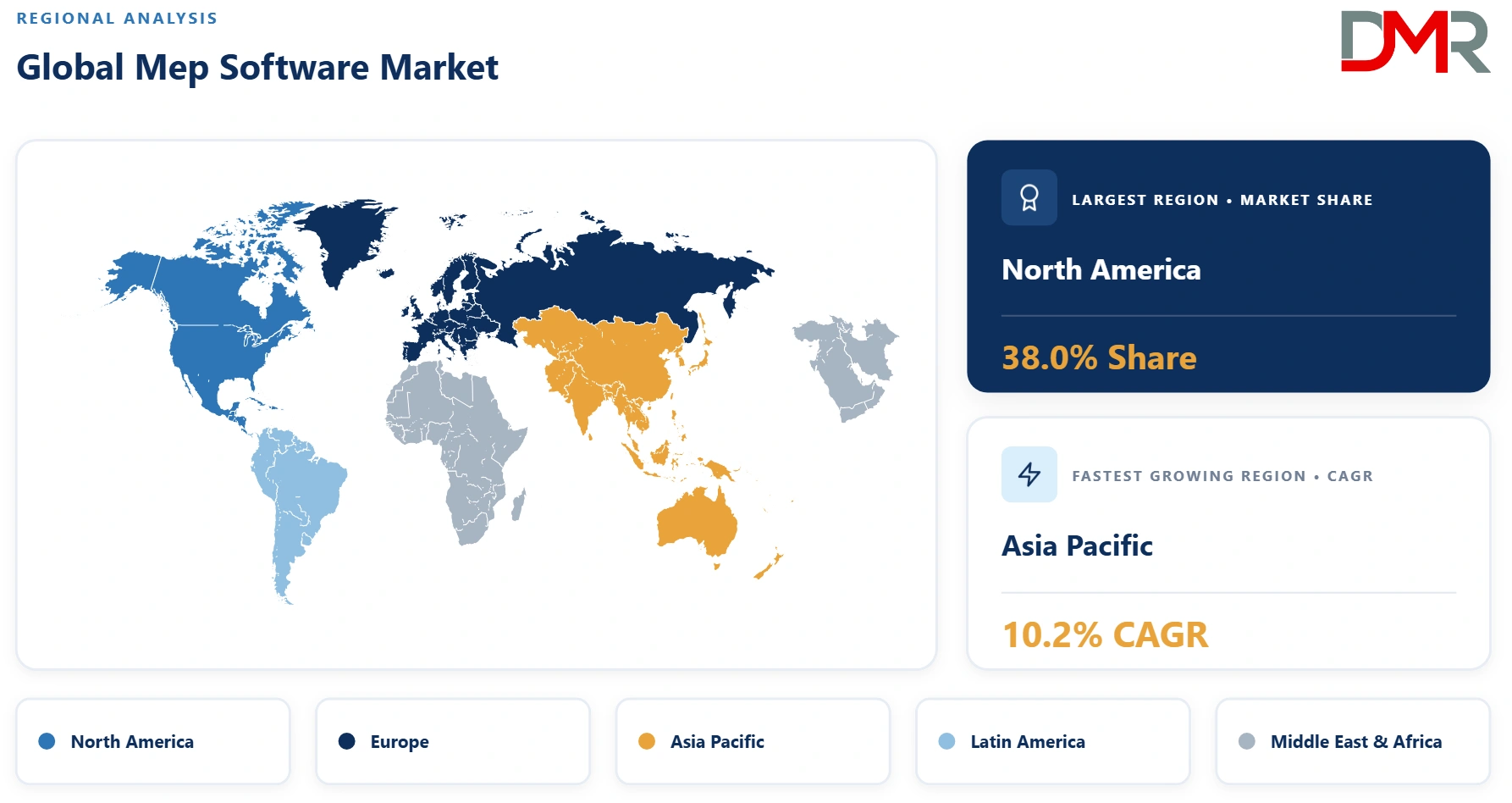
North America leads with a 38% share in 2026, while Asia Pacific is projected to grow at 10.2% CAGR from 2027 to 2035.
Region with the Largest Revenue Share
North America commands 38% of global MEP software revenue in 2026, with the United States accounting for the substantial majority. Demand is anchored by high BIM adoption rates, stringent energy codes such as ASHRAE 90.1, and a concentrated ecosystem of established vendors and trained practitioners. The region’s engineering firms operate at scale with complex project portfolios that justify software investment. Growth in Canada tracks U.S. trends with additional emphasis on cold-climate mechanical design. The outlook remains steady, with AI feature adoption and infrastructure spending providing incremental upside through the forecast period.
Region with the Highest CAGR
Asia Pacific is the fastest-growing region at 10.2% CAGR, expanding from a 27% revenue share base. China drives volume through massive urbanization and mandated BIM adoption in public projects, while India’s infrastructure pipeline and Japan’s building stock renewal contribute distinct demand streams. Southeast Asian markets are accelerating from lower bases as construction digitization spreads. The region benefits from demographic momentum and government digitization mandates, though localization requirements and price sensitivity demand investment that global vendors cannot treat as an afterthought.
Regional Analysis
Europe Mep Software Market
Europe is a major revenue region, with Germany, the U.K., and France as leading markets. The region's BIM mandates, particularly the U.K.'s Level 2 requirement, have institutionalized digital delivery across public projects. Energy performance directives drive simulation adoption. Growth is moderate but steady, with Nordic markets demonstrating advanced AI adoption and Eastern European countries contributing incremental volume as construction digitization spreads.
ℹ
To learn more about this report –
Download Your Free Sample Report Here
Latin America Mep Software Market
Latin America represents a smaller but expanding market, led by Brazil and Mexico. Infrastructure investment cycles and private commercial construction drive demand, with BIM adoption growing from a low base. Price sensitivity shapes vendor strategies, favoring subscription models and localized offerings. The region's growth trajectory is tied to broader economic stability and construction sector recovery.
Middle East & Africa Mep Software Market
The Middle East is a high-value, project-driven market anchored by Saudi Arabia's giga-projects and UAE construction activity. These projects frequently mandate advanced digital delivery and create demand for sophisticated MEP coordination tools. Africa remains nascent but is developing through infrastructure investment and urbanization, with South Africa and select North African markets showing early adoption.
By Region
North America
Europe
- Germany
- France
- The U.K.
- Italy
- Spain
- Rest of Europe
Asia-Pacific
- China
- Japan
- India
- Australia
- South Korea
- Rest of APAC
Latin America
- Mexico
- Brazil
- Rest of LATAM
Middle East & Africa
- Saudi Arabia
- The UAE
- South Africa
- Rest of MEA
Regulatory Landscape
The regulatory environment for MEP software is shaped by building codes, BIM mandates, and data governance frameworks that vary substantially across jurisdictions. Building energy codes, most prominently ASHRAE 90.1 in the United States and the Energy Performance of Buildings Directive in Europe, directly influence software requirements by mandating load calculations and compliance documentation that tools must generate. BIM mandates for public projects in the U.K., Singapore, and an expanding list of jurisdictions create compliance-driven demand floors. Data residency and cybersecurity regulations, particularly the EU’s GDPR and emerging AI governance frameworks, constrain cloud deployment architectures and AI training data practices. Vendors must maintain jurisdiction-specific code libraries and validation logic, a cost that favors scale players but also creates barriers against low-cost entrants.
Investment Analysis
Capital flows into MEP software have accelerated sharply, concentrated at the AI-native frontier. Endra’s USD 50 million Series A led by Andreessen Horowitz, following earlier seed funding, signals investor conviction that engineering workflow automation represents a venture-scale opportunity rather than a feature enhancement. Incumbent vendors continue acquiring point capabilities to fill portfolio gaps. White space exists in three areas: mechanical engineering AI, where validated solver integration remains technically challenging; code compliance automation across fragmented national standards; and the contractor segment, where constructability and prefabrication workflows are underserved by tools designed primarily for design firms. Risks include longer-than-anticipated sales cycles in a conservative industry and the possibility that incumbents’ copilot offerings prove “good enough” for the majority of buyers, compressing the addressable market for premium AI-native platforms.
Who are the Leading Companies in the Mep Software Market?
The MEP software market exhibits moderate concentration, with the top three vendors Autodesk, Trimble, and Nemetschek collectively holding approximately a major share of global revenue. Competition is intensifying as AI-native entrants target workflow segments incumbents have not automated, while established players embed generative capabilities into existing platforms. Differentiation increasingly rests on solver integration depth, code library breadth, and the ability to demonstrate measurable engineering time savings rather than feature counts. Partnership ecosystems and targeted acquisitions are the primary strategic levers.
- Autodesk (United States): Revit MEP and AutoCAD MEP anchor the industry’s most widely adopted BIM authoring environment; expanding AI copilot capabilities within the AEC collection.
- Trimble (United States): MEP design and estimating solutions integrated with construction management workflows; strong presence in contractor-facing tools.
- Nemetschek (Germany): Vectorworks and affiliated brands serving architectural and MEP design markets with strong European footprint.
- Bentley Systems (United States): OpenPlant and building services design tools with emphasis on infrastructure and plant environments.
- MagiCAD (Finland): Specialized BIM MEP design software with deep Nordic and European penetration, known for calculation integration.
- COINS Global (United Kingdom): Construction ERP and MEP estimating tools with contractor-focused workflow integration.
- eVolve MEP (United States): Revit-based MEP fabrication and productivity add-ins targeting electrical and mechanical contractors.
- Endra (Sweden): AI-native MEP design platform with agentic electrical engineering capabilities and expanding mechanical scope.
Some of the prominent players in the Global Mep Software Market are:
- Autodesk
- Trimble
- Nemetschek
- Bentley Systems
- MagiCAD
- COINS Global
- eVolve MEP
- Witas
- Exactal
- On Center Software
- Design Master Software
- Stack
- Causeway
- progeCAD
- Renga Software
- ePROMIS Solutions
- Revizto
- RIB Software
- ACCA Software
- CADSoft Technologies
- Dassault Systèmes
- Hexagon AB
- Procore Technologies
- Bluebeam
- Oracle Construction and Engineering
- ANSYS
- Fujitsu
- Hitachi Solutions
- Glodon
- Siemens
- Graphisoft
- Cype
- 4MCAD
- Aptus Engineering
- Benchmark Enterprise Software
- ALCADS
- Endra
- Planlabs
- h2x
- Elite Software
- Other Key Players
Recent Developments
- In September 2026, Endra launched Power Studio, an agentic electrical engineering platform, and acquired Swiss AI firm Planlabs to extend into mechanical engineering, with a plumbing module planned for 2027.
- In June 2026, Trimble advanced its connected construction data strategy, linking MEP design outputs more tightly to field execution and estimating workflows.
- In February 2026, Autodesk continued embedding generative AI features across its AEC collection, including automated documentation and design assistance within Revit.
- In December 2025, Endra raised $20 million in seed funding led by Notion Capital to accelerate AI-driven MEP design automation and international expansion.
- In March 2025, Nemetschek expanded its MEP-focused offerings through targeted acquisitions and product integration across its brand portfolio.
Report Scope and Research Methodology
Market definition: MEP software encompasses digital tools for designing, modeling, simulating, coordinating, and documenting mechanical, electrical, and plumbing systems across building and infrastructure projects, delivered as software licenses, subscriptions, and supporting services.
Methodology: Dimension Market Research built the estimate bottom-up from company revenues, subscription and license data, and AI value per unit for each product and end-user segment, then checked it top-down against construction technology spending totals. Primary interviews with engineering firm principals, software vendors, and contractor technology leaders validated adoption rates and pricing. Forecasts apply segment-level growth assumptions for 2027–2035 and are reviewed at each report update.
Report Details
| Report Characteristics |
Details |
| Market Size (2026) |
USD 5.8 Billion |
| Forecast Value (2035) |
USD 11.9 Billion |
| CAGR (2027-2035) |
8.3% |
| Historical Data |
2021–2026 |
| Forecast Data |
2027–2035 |
| Base Year |
2026 |
| Estimate Year |
2027 |
| Segments Covered |
By Component, By Deployment Mode, By Functionality, By Organization Size, By End User |
| Regional Coverage |
North America (The US, Canada); Europe (Germany, France, The UK, Italy, Spain, Rest of Europe); Asia Pacific (China, Japan, India, Australia, South Korea, Rest of APAC); Latin America (Mexico, Brazil, Rest of LATAM); Middle East & Africa (Saudi Arabia, The UAE, South Africa, Rest of MEA) |
Frequently Asked Questions
How big is the MEP Software Market in 2026?
▾ The global MEP Software Market is valued at USD 5.8 billion in 2026.
What is the growth rate of the MEP Software Market?
▾ The MEP Software Market is projected to grow at an 8.3% CAGR from 2027 to 2035.
Which region leads the MEP Software Market?
▾ North America leads the MEP Software Market with 38% revenue share in 2026.
Which product segment dominates the MEP Software Market?
▾ Software holds the largest component share of the MEP Software Market at 64% in 2026.
Which end user is growing fastest in the MEP Software Market?
▾ MEP contractors represent the fastest-growing end-user segment in the MEP Software Market at 9.6% CAGR.
Who are the key players in the MEP Software Market?
▾ Key players in the MEP Software Market include Autodesk, Trimble, Nemetschek, Bentley Systems, MagiCAD, COINS Global, eVolve MEP, and Endra.
What are the main challenges facing the MEP Software Market?
▾ Primary challenges facing the MEP Software Market include high switching costs, interoperability friction between proprietary platforms, and accuracy limitations of generative AI in code-critical engineering calculations.