Key Takeaways
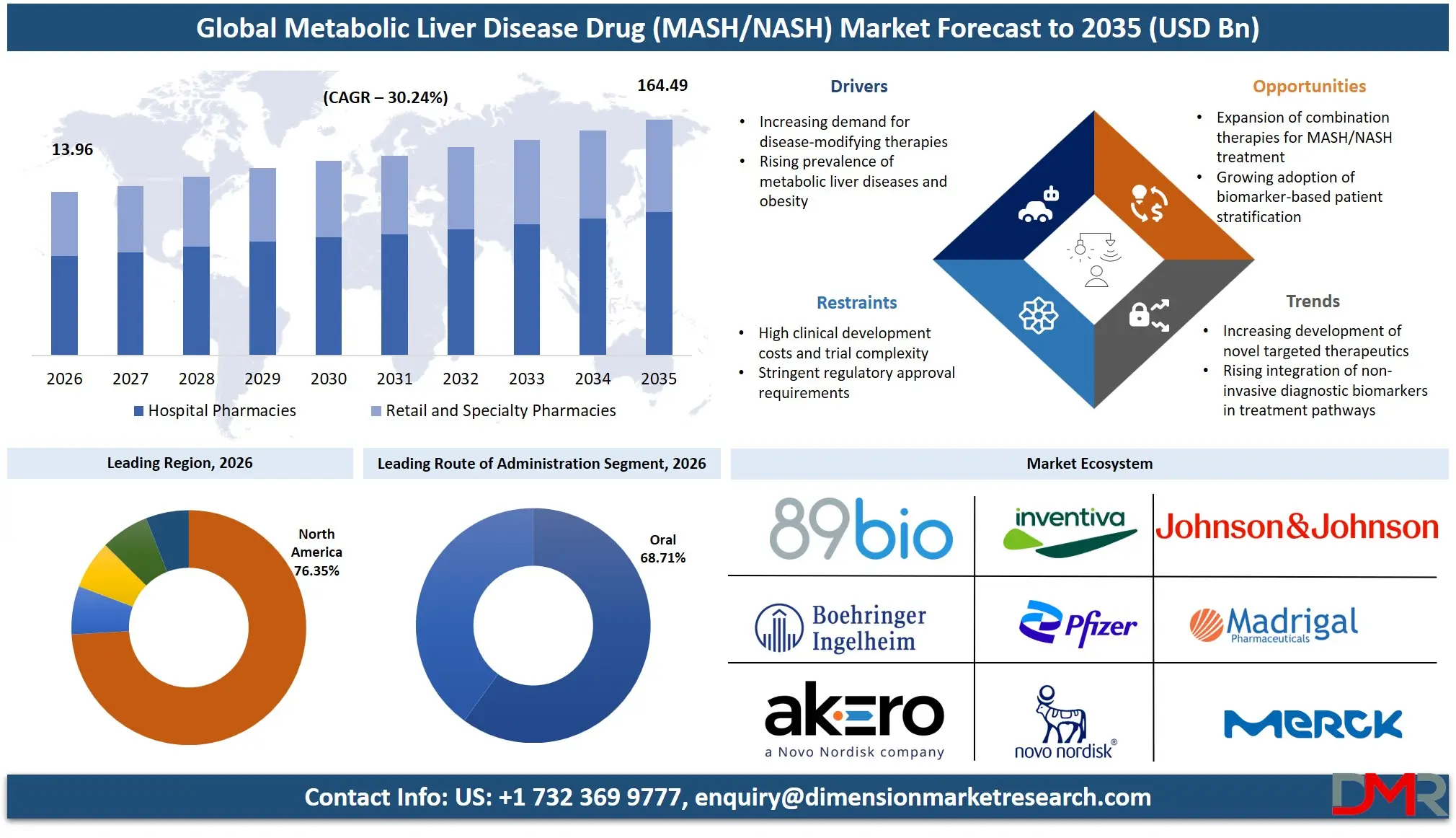
- The Global Metabolic Liver Disease Drug (MASH/NASH) Market is valued at USD 10.72 billion in 2025 and is projected to grow at a CAGR of 30.24% through 2035.
- Vitamin E and Pioglitazone led the drug segment with a 70.24% share in 2026.
- NASH Stage F1 accounted for 36.81% of the disease stage segment in 2026.
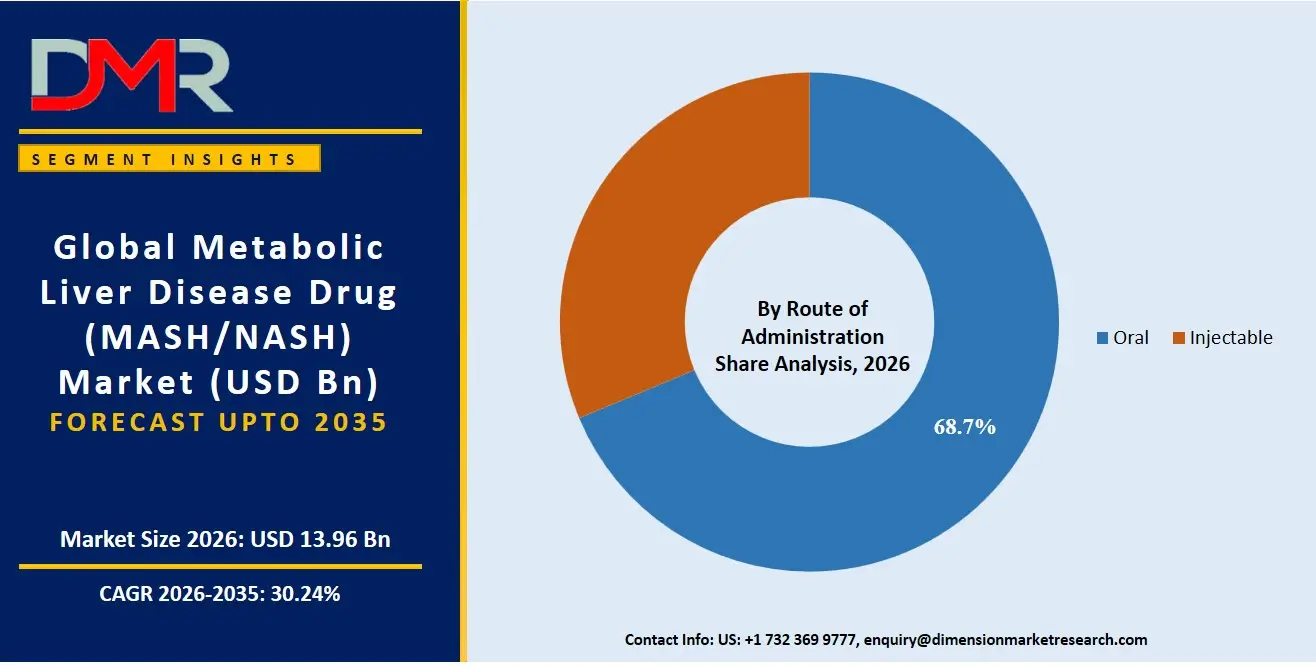
- Oral therapies captured 68.71% of the route of administration segment in 2026.
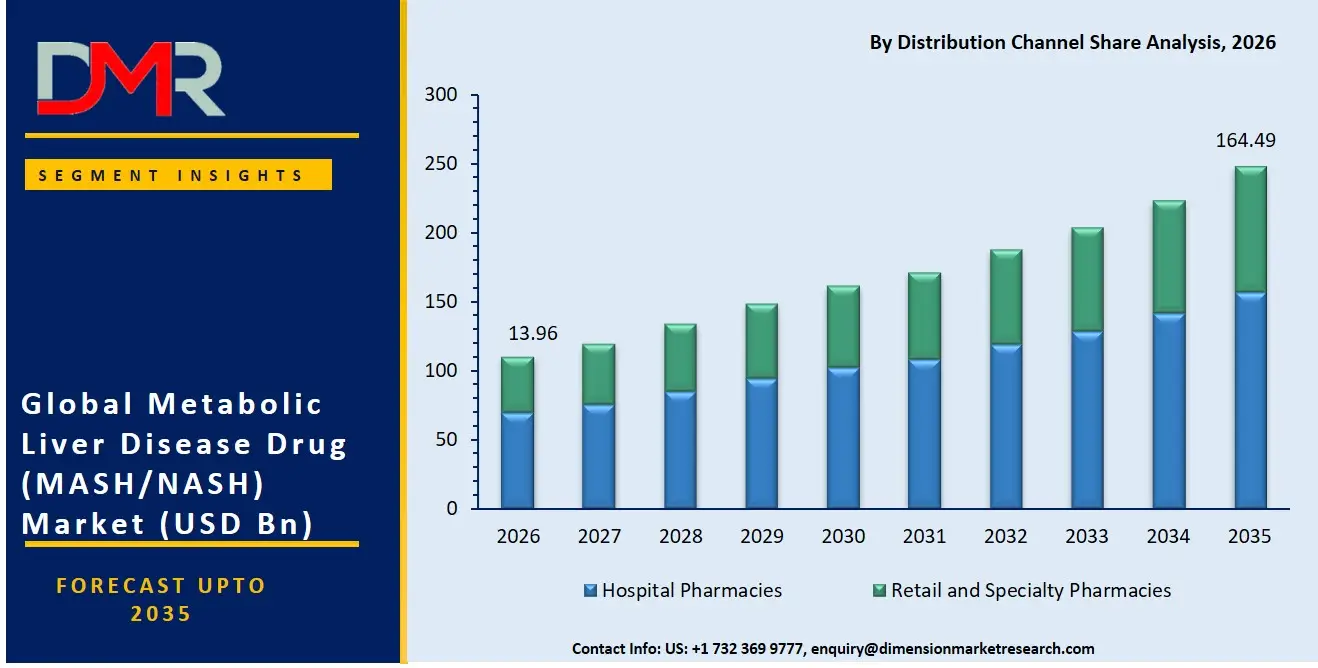
- Hospital pharmacies held 67.24% of the distribution channel segment in 2026.
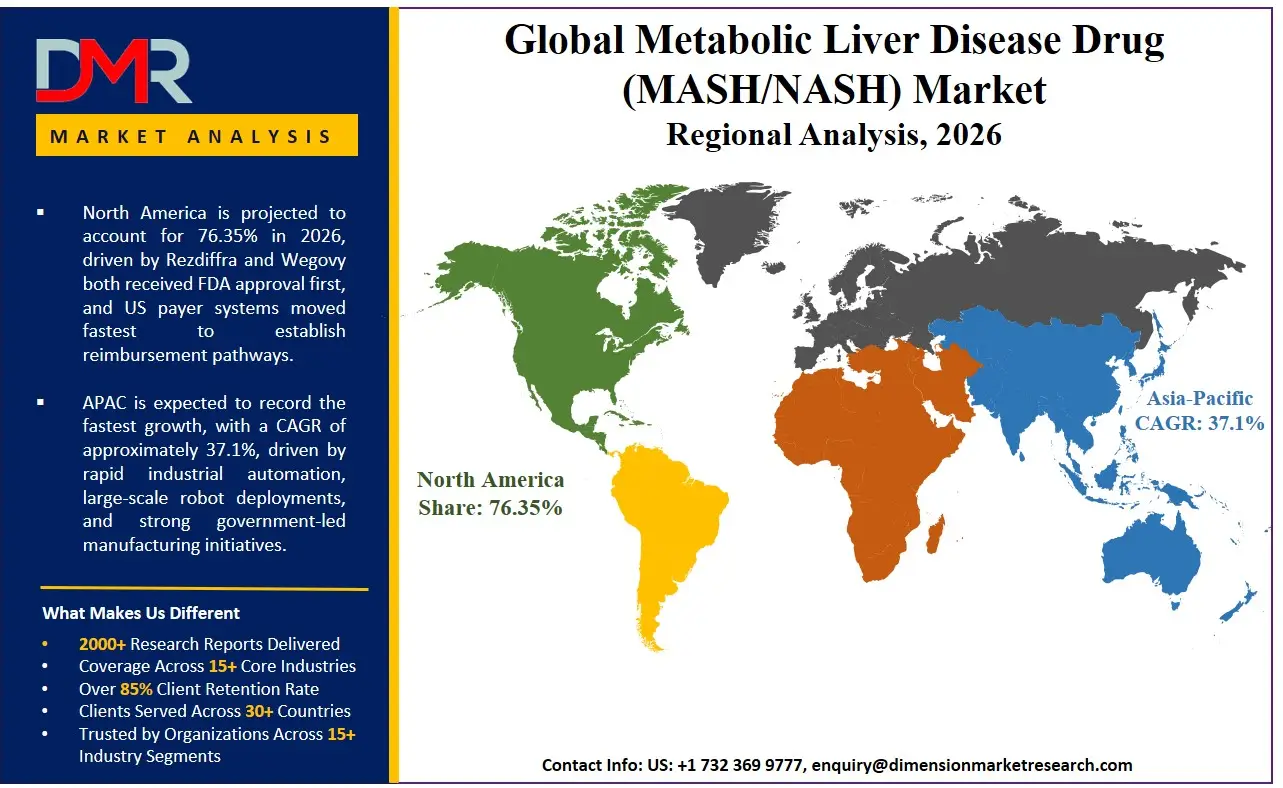
- North America dominated the regional landscape with a 76.35% share in 2026.
Market Overview
This report covers drugs treating metabolic dysfunction-associated steatohepatitis, spanning oral and injectable therapies across all fibrosis stages from F0 to F4. It excludes diagnostics, surgical interventions, and lifestyle management programs. Madrigal's Rezdiffra anchors the category as the first approved MASH therapy, with the broader market valued at USD 10.72 billion in 2025.
ℹ
To learn more about this report –
Download Your Free Sample Report Here
Pharmaceutical companies increasingly position MASH within the cardiometabolic disease continuum rather than treating it as an isolated liver indication. Novo Nordisk's FDA approval of Wegovy for F2 to F3 MASH in August 2025 illustrates this convergence, bringing an established GLP-1 commercial infrastructure into hepatology. Shared patient panels between obesity and liver disease specialists accelerate prescribing once a drug clears regulatory hurdles.
Artificial intelligence now influences how this category identifies patients and measures outcomes. Akero's November 2025 Phase 2b presentation included AI-powered histology analysis, a shift away from manual biopsy scoring. Companies that integrate AI diagnostics into trial design gain an edge in regulatory submissions and post-market evidence generation.
Market Size and Forecast
The Global Metabolic Liver Disease Drug (MASH/NASH) Market size is estimated at USD 13.96 billion in 2026 from USD 10.72 billion in 2025, and is projected to reach USD 164.49 billion by 2035, exhibiting a CAGR of 30.24% during the forecast period.
Commercial validation drives this trajectory more than pipeline announcements alone. Rezdiffra generated $311.3 million in net sales during Q1 2026, marking 127% year-over-year growth, as reported by Madrigal Pharmaceuticals. More than 29,500 patients were on Rezdiffra therapy in the US as of September 30, 2025, based on data from FirstWord Pharma, confirming real-world uptake beyond clinical trial populations.
Forecast assumptions hinge on payer reimbursement decisions and the diagnosed treatable pool expanding toward 460,000 US patients with F2 to F3 fibrosis. Downside risk centers on Rezdiffra's accelerated-approval status, which requires confirmatory outcomes data before full reimbursement security. Upside potential comes from combination regimens pairing resmetirom with GLP-1 backbones, which could broaden addressable patients beyond monotherapy candidates.
Drug Analysis
Vitamin E and Pioglitazone accounted for 70.24% of drug demand in 2026, the highest of any category.
Off-patent generics still dominate prescribing volume because they remain the only widely reimbursed options for early-stage patients without access to newer branded agents. Physicians default to this combination while awaiting broader payer coverage for resmetirom and semaglutide, particularly for F0 to F1 patients who don't yet qualify for newly approved therapies.
Resmetirom is changing this picture quickly. In ESSENCE, semaglutide achieved combined resolution of steatohepatitis and fibrosis reduction in 32.7% of patients versus 16.1% on placebo, as per data published in ScienceDirect. Lanifibranor reached a 55% fibrosis improvement rate in NATiV3, compared with resmetirom's 26% in MAESTRO-NASH, according to PatSnap research. Obeticholic acid, semaglutide, and aramchol compete for the expanding F2 to F3 population, while efruxifermin targets compensated cirrhosis patients with no approved alternative. Vendors developing combination protocols stand to capture share as monotherapy limitations become clearer.
Disease Stage Analysis
With a 36.81% share in 2026, NASH Stage F1 outpaced all other disease stage categories.
Stage F1 patients represent the largest diagnosed population because screening programs catch metabolic dysfunction before significant fibrosis develops. Most current approved therapies target F2 to F3, leaving F1 patients managed primarily through lifestyle intervention and generic options, creating a gap between diagnosis volume and treatment availability.
Stage F4, compensated cirrhosis, represents roughly 245,000 untreated US patients carrying 42 times the liver-mortality risk of earlier stages, with no approved therapy. This gap positions F4 as the segment most likely to see new drug approvals next, particularly from FGF21-class candidates like efruxifermin. Stages F2 and F3 sit at the center of current commercial activity, since Rezdiffra and Wegovy both target this window, intensifying competition for the same prescribing base.
Route of Administration Analysis
Oral therapies captured 68.71% of the route of administration segment in 2026, ahead of all rivals.
ℹ
To learn more about this report –
Download Your Free Sample Report Here
Oral dosing dominates because Rezdiffra, the only fully approved MASH therapy until mid-2025, comes in tablet form with weight-based dosing of 80 mg or 100 mg. Patients managing a chronic, often asymptomatic condition prefer daily pills over injections, supporting adherence in a population that may not feel immediate symptoms.
Injectable therapies are gaining ground as GLP-1 and FGF21 agonists enter the market. Wegovy's approval brings weekly injection into mainstream MASH treatment, while efruxifermin and pegozafermin follow similar dosing schedules. GSK's planned acquisition of efimosfermin, a once-monthly injectable, signals that injection frequency itself becomes a competitive differentiator as more agents reach approval.
Distribution Channel Analysis
Hospital pharmacies accounted for 67.24% of distribution channel demand in 2026, the highest of any category.
ℹ
To learn more about this report –
Download Your Free Sample Report Here
Hospital pharmacies lead distribution because newly approved MASH therapies require specialist initiation, fibrosis staging confirmation, and close monitoring during early treatment. Hepatologists and endocrinologists working within hospital systems control most prescribing decisions for Rezdiffra and Wegovy in this early commercial phase.
Retail and specialty pharmacies will likely gain share as prescribing protocols mature and primary care physicians become comfortable managing stable patients. Specialty pharmacy networks already handle complex biologics in other therapeutic areas, giving them infrastructure to absorb MASH prescriptions once payer prior-authorization processes standardize.
Key Market Segments
By Drug
- Vitamin E and Pioglitazone
- Obeticholic Acid (OCA)
- Lanifibranor
- Semaglutide
- Resmetirom
- Aramchol
- Cenicriviroc
- Selonsertib
By Disease Stage
- NASH Stage F1
- NASH Stage F0
- NASH Stage F2
- NASH Stage F3
- NASH Stage F4
By Route of Administration
By Distribution Channel
- Hospital Pharmacies
- Retail and Specialty Pharmacies
By Age Group
- Adults
- Pediatrics
- Geriatrics
By Gender
Regional Analysis
North America held a 76.35% share of the global market in 2026.
ℹ
To learn more about this report –
Download Your Free Sample Report Here
North America leads because Rezdiffra and Wegovy both received FDA approval first, and US payer systems moved fastest to establish reimbursement pathways. The expanding diagnosed treatable pool, now approaching 460,000 F2 to F3 patients, concentrates prescribing volume within US specialty centers ahead of any other region.
Europe follows as resmetirom gained a conditional approval recommendation from EU regulators in June 2025, extending Madrigal's commercial reach. Asia Pacific represents the fastest-growing white space, given its large untreated patient population and a current revenue base still concentrated in North America. Companies planning international expansion should prioritize markets where fibrosis staging infrastructure already exists, since diagnosis capacity gates treatment uptake everywhere.
Key Regions and Countries
North America
Europe
- Germany
- France
- The UK
- Spain
- Italy
- Rest of Europe
Asia Pacific
- China
- Japan
- South Korea
- India
- Australia
- Rest of APAC
Latin America
- Brazil
- Mexico
- Rest of Latin America
Middle East & Africa
- GCC
- South Africa
- Rest of MEA
Market Dynamics
Approved Therapies Validate Commercial Demand
Rezdiffra's accelerated approval in March 2024 as the first-in-class oral THR-beta agonist for F2 to F3 MASH opened the category to commercial revenue. Its Q1 2026 sales of $311.3 million represented 127% growth year over year, according to figures from Madrigal Pharmaceuticals, proof that physicians will prescribe once a labeled option exists.
Wegovy's August 2025 approval for the same fibrosis range brought Novo Nordisk's established prescribing relationships into hepatology. As reported by clinical trial data, semaglutide achieved steatohepatitis resolution without worsening fibrosis in 62.9% of ESSENCE patients versus 34.3% on placebo. This efficacy gap gives physicians confidence to switch patients from off-label GLP-1 use to the approved indication.
Reimbursement Uncertainty Limits Prescription Conversion
Rezdiffra's accelerated approval carries a contingency requiring confirmatory outcomes trials, leaving reimbursement exposed if clinical-benefit verification fails. A 2025 JAMA Network Open analysis found that at $19,011 per year, resmetirom was not cost-effective against standard of care, based on data published in JAMA.
Payers also require documented F2 to F3 fibrosis staging and exclude decompensated cirrhosis patients before authorizing prescriptions. This prior-authorization gate throttles conversion at the pharmacy counter, even when physicians write prescriptions. Practices without non-invasive staging capacity face longer approval timelines, slowing revenue realization for manufacturers.
Untreated F4 Cirrhosis Offers an Open Therapeutic Window
Roughly 245,000 US patients with compensated cirrhosis face 42 times the liver-mortality risk of earlier-stage patients, yet no approved therapy exists for this group. Akero's efruxifermin, the lead FGF21-analogue candidate, showed significantly greater fibrosis improvement than placebo after 96 weeks in compensated cirrhosis, as per Akero's August 2025 data.
Novo Nordisk's acquisition of Akero for approximately $4.7 billion in October 2025 signals that larger players view F4 as the next major prize. Combination regimens pairing resmetirom or FGF21 agonists with GLP-1 backbones could address steatohepatitis and fibrosis simultaneously, opening a second wave of approvals beyond current F2 to F3 indications.
Market Trends
Non-Invasive Staging Reshapes Patient Identification
Clinics increasingly replace liver biopsy with FibroScan, ELF, and FIB-4 testing to identify MASH patients earlier and more cheaply. Big pharma players including Pfizer, J&J, and Merck are entering the category, compressing Madrigal's first-mover advantage. Madrigal signaled at JPM26 a pivot toward strategic acquisitions to defend its position, while NASH-to-MASH nomenclature standardization aligns diagnostic coding and payer policy language, easing market entry for new entrants.
Market Competition Overview
Metabolic Liver Disease Drug (MASHNASH) Market remains moderately fragmented, with one commercial leader and a wide pipeline of late-stage challengers. Madrigal holds first-mover advantage through Rezdiffra, but large pharmaceutical companies are entering through acquisition rather than internal development. Roche's purchase of 89bio for roughly $2.4 billion upfront illustrates how established players buy their way into FGF21-class assets rather than building programs from scratch.
Novo Nordisk's GLP-1 franchise gives it a structural advantage, since its existing prescriber relationships transfer directly to MASH once Wegovy gained its hepatology indication. Smaller biotechs developing single-asset pipelines, such as Akero before its acquisition, become acquisition targets once Phase 3 data reads out positively. Expect consolidation to accelerate as more F2 to F3 and F4 therapies approach approval.
Company Profiles
Madrigal Pharmaceuticals holds the first-mover position with Rezdiffra, the only therapy to reach accelerated FDA approval before mid-2025. The European regulator's June 2025 recommendation for conditional approval extends Madrigal's commercial reach into the EU. With Q1 2026 sales already at $311.3 million, Madrigal faces pressure to defend its lead as Pfizer, J&J, and Merck enter the category, prompting its signaled pivot toward acquisitions at JPM26.
Novo Nordisk entered MASH through Wegovy's August 2025 approval, leveraging its existing GLP-1 obesity prescribing infrastructure and payer relationships. Its October 2025 acquisition of Akero Therapeutics for about $4.7 billion added the Phase 3 FGF21 analogue efruxifermin, giving Novo Nordisk exposure to the untreated F4 cirrhosis segment alongside its F2 to F3 GLP-1 franchise.
Key Players
- Madrigal Pharmaceuticals Inc.
- Novo Nordisk A/S
- Boehringer Ingelheim International GmbH
- 89bio, Inc.
- Akero Therapeutics, Inc.
- Inventiva
- Sagimet Biosciences
- Chia Tai Tianqing Pharmaceutical Group Co., Ltd
- Eli Lilly and Company
- Viking Therapeutics
- Intercept Pharmaceuticals, Inc.
- AbbVie Inc.
- Galmed Pharmaceuticals Ltd
- Galectin Therapeutics Inc.
- NGM Biopharmaceuticals, Inc.
- Bristol-Myers Squibb Company
- Gilead Sciences, Inc.
- Pfizer Inc.
- Johnson & Johnson
- Merck & Co.
Recent Developments
- March 2024, FDA granted Madrigal accelerated approval for Rezdiffra, the first oral MASH therapy for F2 to F3 fibrosis.
- April 2024, FDA granted D&D Pharmatech Fast Track designation after DD01 showed over 50% liver fat reduction.
- October 2024, Boehringer Ingelheim's survodutide received FDA Breakthrough Therapy designation for F2 to F3 MASH.
- May 2025, GSK agreed to pay up to $2 billion for Boston Pharmaceuticals' injectable MASH asset efimosfermin.
- December 2025, Health Canada issued a Notice of Compliance for Wegovy in F2 to F3 non-cirrhotic MASH.
- October 2025, Roche acquired 89bio and its FGF21 analogue pegozafermin for roughly $2.4 billion upfront.
Report Details
| Report Characteristics |
| Market Value (2025) |
USD 10.72 Billion |
| Market Value (2026) |
USD 13.96 Billion |
| Forecast Revenue (2035) |
USD 164.49 Billion |
| CAGR (2026–2035) |
30.24% |
| Base Year for Estimation |
2025 |
| Historic Period |
2020 – 2024 |
| Forecast Period |
2026 – 2035 |
| Report Coverage |
Revenue Forecast, Market Dynamics, Competitive Landscape, Recent Developments |
| Segments Covered |
By Drug (Vitamin E and Pioglitazone, Obeticholic Acid, Lanifibranor, Semaglutide, Resmetirom, Aramchol, Cenicriviroc, Selonsertib), By Disease Stage (NASH Stage F0, F1, F2, F3, F4), By Route of Administration (Oral, Injectable), By Distribution Channel (Hospital Pharmacies, Retail and Specialty Pharmacies), By Age Group (Adults, Pediatrics, Geriatrics), By Gender (Male, Female) |
| Regional Analysis |
North America – US and Canada; Europe – Germany, France, The UK, Spain, Italy, and Rest of Europe; Asia Pacific – China, Japan, South Korea, India, Australia, and Rest of APAC; Latin America – Brazil, Mexico, and Rest of Latin America; Middle East & Africa – GCC, South Africa, and Rest of MEA |
| Competitive Landscape |
Madrigal Pharmaceuticals, Novo Nordisk, Boehringer Ingelheim, 89bio, Akero Therapeutics, Inventiva, Sagimet Biosciences, Chia Tai Tianqing Pharmaceutical, Eli Lilly, Viking Therapeutics, Intercept Pharmaceuticals, AbbVie, Galmed Pharmaceuticals, Galectin Therapeutics, NGM Biopharmaceuticals, Bristol-Myers Squibb, Gilead Sciences, Pfizer, Johnson & Johnson, Merck & Co. |
| Customization Scope |
Customization for segments and region or country level will be provided. Additional customization can be done based on requirements. |
| Purchase Options |
Three license options: Single User License, Multi-User License (Up to 5 Users), Corporate Use License (Unlimited Users and Printable PDF). |
Frequently Asked Questions
What is the biggest investment opportunity in Metabolic Liver Disease Drug (MASHNASH) Market?
▾ The untreated compensated cirrhosis (F4) segment offers the largest opening, with roughly 245,000 US patients carrying 42 times higher liver-mortality risk and no approved therapy.
Which companies lead the MASH drug market?
▾ Madrigal Pharmaceuticals leads with Rezdiffra, the first approved MASH therapy, while Novo Nordisk follows closely through Wegovy and its acquisition of Akero Therapeutics.
Which region will grow fastest in Metabolic Liver Disease Drug (MASHNASH) Market and why?
▾ Asia Pacific represents the fastest-growing region, given its large untreated patient population and a revenue base still concentrated in North America at 76.35% share.
Which segment is growing fastest in Metabolic Liver Disease Drug (MASHNASH) Market and why?
▾ Injectable therapies are growing fastest as GLP-1 and FGF21 agonists like Wegovy, efruxifermin, and pegozafermin enter the market, shifting share away from oral-only options.
What is the biggest challenge holding back Metabolic Liver Disease Drug (MASHNASH) Market?
▾ Reimbursement uncertainty poses the largest challenge, since Rezdiffra's accelerated approval requires confirmatory trials and payers mandate strict F2 to F3 fibrosis staging documentation.