What is the Global Metamaterials Market Size?
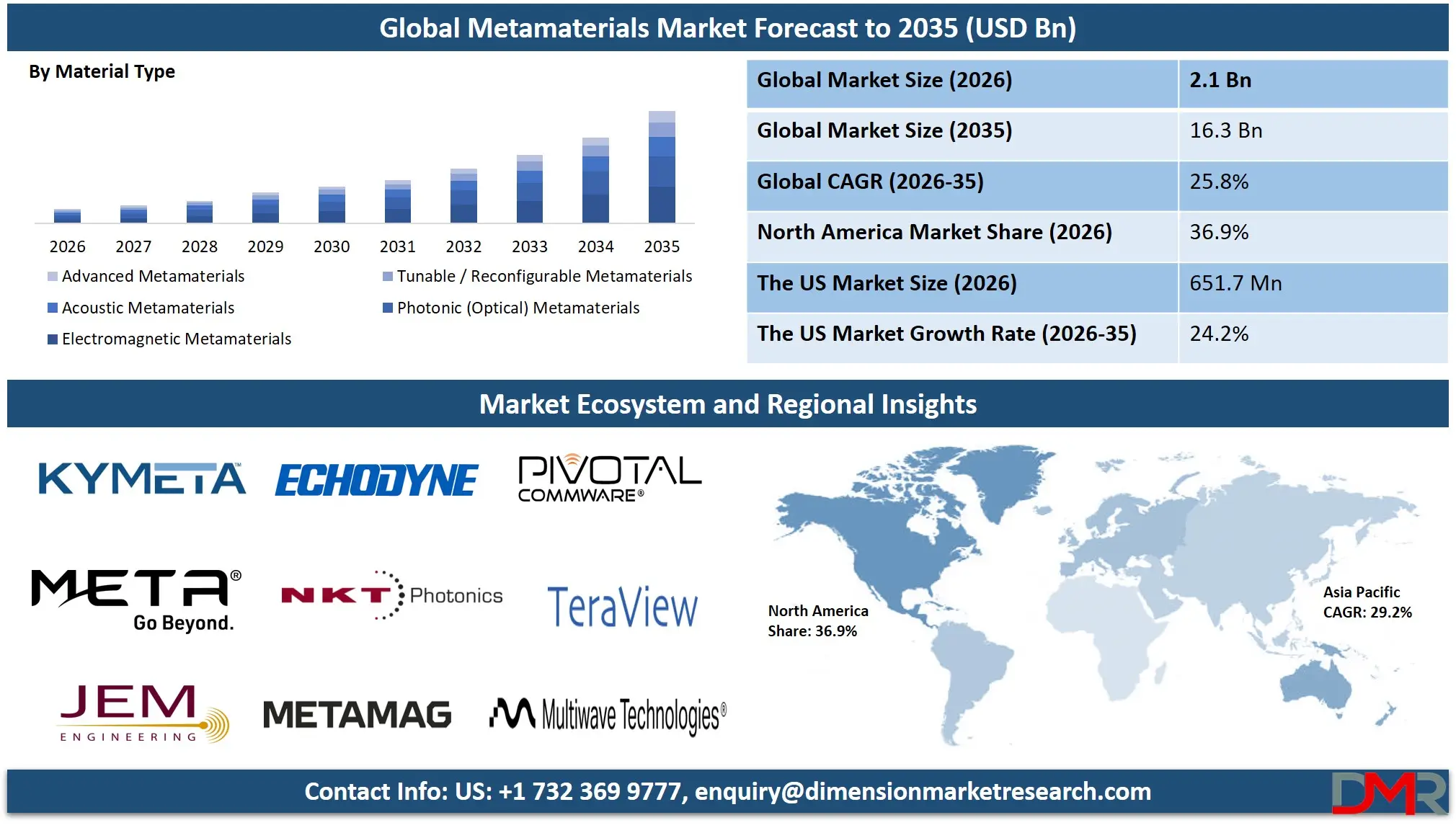
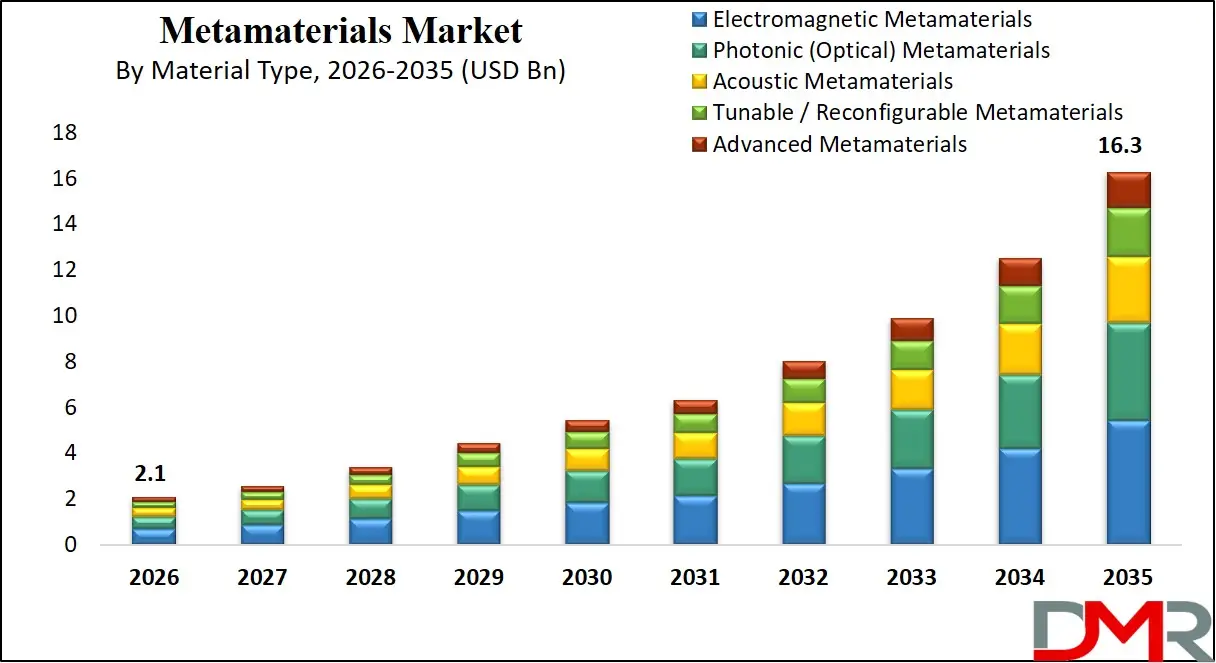
The Global Metamaterials Market size is estimated at USD 2.1 billion in 2026 and is expected to reach USD 16.3 billion by 2035, expanding at a CAGR of 25.8%, driven by AI-enabled engineered material design, advanced nanofabrication, and integrated design-simulate-fabricate-test workflows in electromagnetic and photonic applications.
ℹ
To learn more about this report –
Download Your Free Sample Report Here
The growth of the Metamaterials Market can be attributed to an increase in machine learning techniques for unit cell optimization and electromagnetic response prediction, government mandates that minimize the likelihood of signal degradation and shorten the timeline for the development of next-generation RF and optical systems, and higher investment in automated nanofabrication programs by private companies and governments.
Additional factors driving the growth include breakthroughs in real-time material characterization technologies, electromagnetic modeling and prediction, automated lithography, and high-throughput simulation, among other developments in interoperability systems that facilitate metamaterial integration in manufacturing operations. Digital modernization in telecom, aerospace, and defense companies has helped optimize unit cell geometry and improve system outcomes, including reduced time to prototyping. Automation of design workflows, predictive simulations, and artificial intelligence-enabled design-simulate-test systems has accelerated adoption, and national strategies for advanced materials have supported innovation in engineered metamaterials.
ℹ
To learn more about this report –
Download Your Free Sample Report Here
The US Metamaterials Market
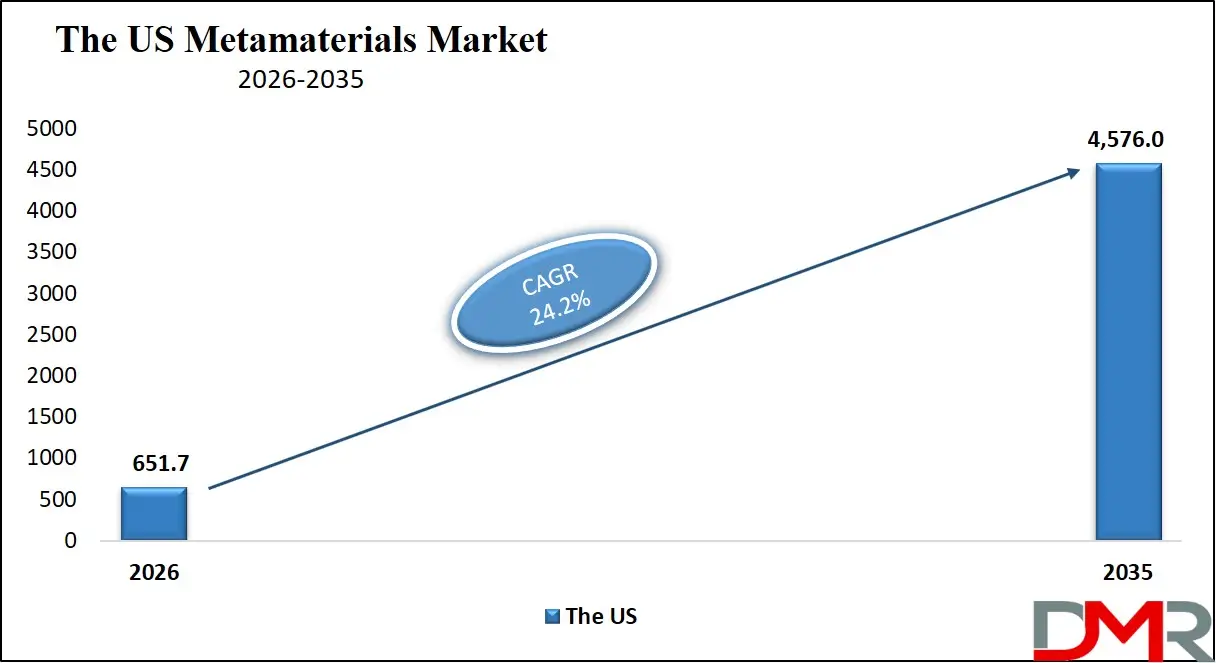
The US Metamaterials Market is estimated to grow to USD 651.7 million in 2026 with a compound annual growth rate of 24.2% during the forecast period.
ℹ
To learn more about this report –
Download Your Free Sample Report Here
The US market is defined by the existence of significant federal funding schemes like the DARPA Metamaterials Programs, the AIM Photonics manufacturing centers, the DoD-involved AI/ML-enabled RF component design and testing pathways for radar and communication systems, all of which will help the development of the necessity of AI-driven electromagnetic unit cell engineering, real-time material telemetry of automated nanofabrication systems and robotic assembly cells, and predictive metamaterial software. Automated metamaterial manufacturing hardware systems remain to be more rapidly adopted in the region, and the US needs highly developed interoperability frameworks, integration of real-world evidence using digital engineering notebooks (DENs), and verifiable metamaterial AI assurance. Also, service providers are being pressured by initiatives like the National Defense Authorization Act and national AI in manufacturing strategies to create dedicated integration and deployment services to guarantee data interoperability, security, and compliance across a variety of defense R&D departments and academic research centers.
Europe Metamaterials Market
The Europe Metamaterials Market is estimated to be valued at USD 420.0 million in 2026, witnessing growth at a CAGR of 23.5%, during the forecast period.
The metamaterials market is mature in Europe, and it has a strong effect on the regulatory specifications and the regional policies including the EU Advanced Materials 2030 Initiative, the European Photonics Pilot Lines, and national digital materials programs (e.g., the French METAMAT and the German MaterialDigital 2030 strategy). Another area that countries are working towards is smart metamaterial modularization in order to align research and production workload demands and interoperability of cross-border electromagnetic simulation data supply chains. It is driven by advanced technologies, such as real-time electromagnetic design engines and high-reliability effective medium parameter scoring systems with an inbuilt predictive algorithm on the development of engineered unit cells. Adoption is facilitated by the use of public-private partnerships and harmonization of metamaterial characterization standards. Technologies like real-time computational workload balancing and smart contract-based data sharing are commonly practiced as research-centric programs, and Europe is a frontrunner in terms of the digital transformation of safe and efficient metamaterial-enabled manufacturing.
Japan Metamaterials Market
The Japan Metamaterials Market is projected to be valued at USD 113.4 million in 2026, progressing at a CAGR of 24.8%, during the period spanning from 2026 to 2035.
Japan boasts a mature metamaterials market supported by high-performance automated nanolithography systems, diagnostic electromagnetic integration technology, and a wide network of robotic nanofabrication AI innovations. Automation, precision, and process integrity are the priorities in the country and are achieved by predictive effective medium parameter models and intelligent process management systems for industrial-scale metamaterial production. Growth is stimulated by government actions under the Society 5.0 initiative and constant investment in digital manufacturing infrastructure for advanced materials. The high volume of telecom R&D, defense radar development for antennas and cloaking, and metamaterial lab automation requires efficient AI for real-time evidence-based inference. The difficulties are high validation costs for new metamaterial fabrication architectures and integration with legacy RF system production, yet the prospects are in exporting developed metamaterial technologies to Asian and Pacific markets.
Key Takeaways
- Market Size & Forecast: The Global Metamaterials Market is estimated to be valued at USD 2.1 billion in 2026 and is expected to grow to USD 16.3 billion by 2035.
- Growth Rate & Outlook: The market is expected to witness growth at a compound annual growth rate of 25.8% in the forecast period.
- Primary Growth Drivers: Technological progress in machine learning-based engineering of unit cells for RF and optical systems; regulatory requirements for faster component development and reduced signal degradation; and defense/telecom deployment of intelligent metamaterial platforms are some of the key drivers of growth in the market.
- Key Market Trends: The use of predictive electromagnetic response monitoring, real-time material optimization, and transition to cloud-based metamaterial telemetry and fleet management systems are some of the primary market trends.
- By Material Type: The Electromagnetic Metamaterials segment is anticipated to get the majority share of the metamaterials market in 2026.
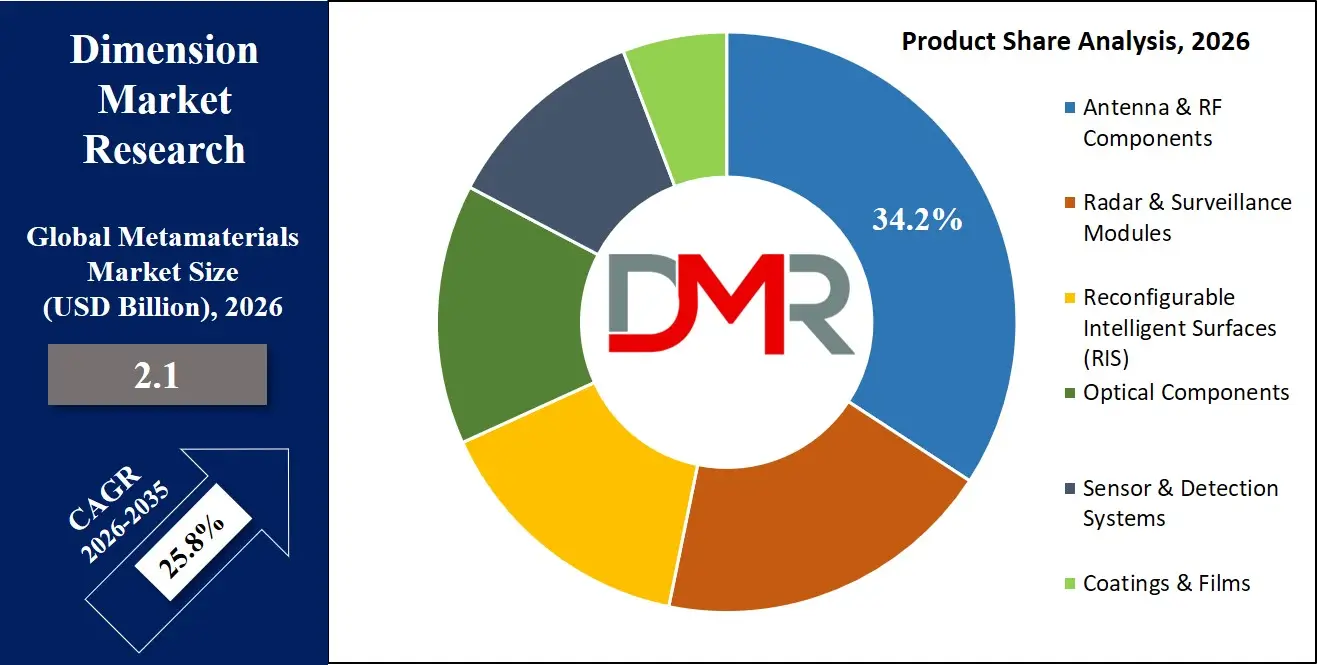
- By Product: The Antenna & RF Components segment is expected to occupy the largest revenue share in 2026 in the metamaterials market.
- By Application: The Communication & RF Systems segment (specifically 5G/6G) is expected to get the largest revenue share in 2026 in the metamaterials market.
- Regional Leadership: North America is predicted to dominate the market with an estimated 36.9% share in 2026, with high defense and telecom R&D spend and metamaterials technology investment.
What are Metamaterials?
Metamaterials refer to artificially engineered structures that derive their electromagnetic, photonic, or acoustic properties from carefully designed unit cell geometries rather than their chemical composition. These advanced materials use sub-wavelength periodic or aperiodic structures to achieve properties such as negative refractive index, superlensing, cloaking, and beam steering that are not found in nature. They are integrated with electromagnetic simulation tools, nanofabrication lithography, and high-throughput characterization techniques to enable rapid unit cell prototyping, improved design accuracy, and accelerated scaling of metamaterial-based components. Metamaterials are increasingly used in aerospace and defense, telecommunications, and consumer electronics to enhance antenna gain, support 6G reconfigurable intelligent surfaces, and enable high-performance optical and acoustic devices.
Use Cases
- Antenna & RF Component Engineering for 5G/6G: Metamaterials are capable of designing high-throughput unit cell configurations in real-time to discover optimal beam-steering antennas and RF components with latency on the order of weeks, saving orders of magnitude over time compared with manually simulating periodic structures.
- Reconfigurable Intelligent Surfaces (RIS): Long-term field and signal data, such as coverage maps and interference patterns, are modeled to give RIS tuning recommendations and keep safely managing wireless environments without interruption to ensure signal stability and network confidence.
- Radar & Cloaking System Monitoring: Defense deployments are employing machine learning and electromagnetic analytics to perform on-device real-time radar cross-section reduction, stealth anomaly detection, and automated cloaking adjustment with quantifiable and proven accuracy.
- Population Connectivity & Government Programs: More efficient metamaterials contribute to the success of telecom infrastructure innovation, 6G network development, and smart electromagnetic environment surveillance, facilitate national advanced materials adoption, contribute to deployment reliability, and help implement policies, such as the metamaterials governance policy and manufacturing standards.
How AI Is Transforming the Global Metamaterials Market?
Artificial intelligence is revolutionizing the field of metamaterials, allowing predictive modeling of the likelihood of electromagnetic pathway success, automatic detection of anomalies in material characterization data patterns, and optimization of unit cell design parameters in a frequency-specific scenario. Simulation-generated telemetry and scattering parameter data can be processed using AI algorithms to identify any degradation or performance drift and optimize production outcomes at scale. This saves time, is verifiable and cheaper than manual data analysis.
Moreover, AI enhances metamaterial assurance through offering adaptive computational event-based scheduling, anticipating workflow threats to design accuracy, and intelligent prioritization of metamaterial module health monitoring. It is also involved in reducing the cost of baseline testing and ongoing performance tracking, allowing advanced manufacturing IT operators to reduce the cost and physical footprint of on-prem test campaigns and improve the reliability of metamaterial workloads and their financial returns.
Market Dynamics
Key Drivers of the Global Metamaterials Market
Rapid developments in Machine Learning and Real-Time Electromagnetic Inference
The market is being pushed by a fast uptake of AI-driven unit cell and electromagnetic optimization, high-efficiency simulation data processing, API-based interoperability with digital engineering notebooks (DENs) and simulation data management systems, and real-time telemetry analytics from material characterization systems. These technologies enable monitoring of the performance of metamaterial systems in real-time, identify performance anomalies early, predict effective medium parameters, and simplify the process of experimental validation. Consequently, operational uptime and R&D efficiency are highly enhanced while minimizing the costs of manual data analysis. The growth of machine learning models for unit cell design, in particular, is also accelerating the need for intelligent metamaterial automation, as telecom and defense operators are increasingly adopting automation and workflow optimization based on electromagnetic simulation data.
Growing Focus on Electromagnetic Compliance and Advanced Manufacturing
The world is increasingly focused on signal integrity and device performance, with governments and regulatory bodies introducing advanced manufacturing efficiency frameworks, such as the EU Advanced Materials 2030 provisions and the US DoD's Advanced Manufacturing Technologies framework for RF and optical systems. These structures are driving demand for efficient metamaterial automation capable of supporting real-time electromagnetic monitoring and continuous learning. In parallel, global initiatives promoting metamaterial standardization and workforce development are encouraging the adoption of evidence-based metamaterial architectures. The increasing focus on transparency in antenna design and reduction in signal loss rates is also enhancing the necessity of reliable and scalable metamaterial automation in both public and private manufacturing systems.
Restraints in the Global Metamaterials Market
High Costs of Integration and Process Validation
Metamaterial platforms are expensive and time-intensive to implement, need to be heavily tested in production settings, and the process logic reliability needs to be tested. Long-term performance evaluation of new components is also needed. Also, regulatory limitations and data privacy regulations (e.g., ITAR for defense applications, trade secret protections) add to the complexity and cost of deployment. These aspects pose barriers to entry, lengthen deployment, and raise initial capital investments.
Limited Standardization Across Simulation Data and Workflows
The industry continues to rely on multiple metamaterial automation architectures, including electromagnetic simulation-based, AI-based for material optimization, and computer vision-based for defect detection. However, the lack of standardized simulation data interfaces beyond platforms like OpenSCAD and Simulia remains a key challenge. Metamaterials lack universal plug-and-play standards compared to traditional RF components, making integration complex and limiting interoperability of metamaterial models across different R&D and production systems.
Growth Opportunities in the Global Metamaterials Market
Expansion of Emerging 6G and Defense Programs
Developing defense and telecom markets such as Brazil, Indonesia, Saudi Arabia, UAE, and Vietnam are investing in digital advanced materials infrastructure and next-generation metamaterial capabilities. These regions present strong growth potential due to increasing demand for automated antenna development, electromagnetic monitoring, and remote RF consultation applications. With limited legacy RF infrastructure, they provide opportunities for the deployment of modern metamaterial automation optimized for R&D and manufacturing environments.
Rising Demand for Cloud-Based Metamaterial Deployment
The increased requirement for advanced metamaterial automation is being generated by the growth of remote R&D collaboration, distributed manufacturing, and real-time electromagnetic control applications. These technologies play a vital role in virtual metamaterial platforms, remote production facilities, and telecom innovation hubs. With the rising importance of sub-hour simulation latency as a major production concern, cloud-based metamaterial inference capabilities are likely to be fundamental to future advanced manufacturing and defense IT infrastructure.
Global Metamaterials Market Trends
Predictive Electromagnetic Response Monitoring and Computational Analytics
Metamaterial platforms are being monitored and performance anomalies are detected in real time, and performance degradation patterns are predicted using on-system learning. The use of digital twin models of electromagnetic response and machine learning algorithms is enhancing design workflow scheduling, system lifespan, and deployment reliability. This shift is transforming metamaterial management from manual data review to a fully automated, continuously optimized system monitoring.
Cloud-Based Telemetry and Fleet Management Systems
Cloud computing and digital twin technologies are taking centre stage in the operations of metamaterial production clusters. These platforms enable real-time storage and analysis of electromagnetic performance data, centralized fleet management of automated nanofabrication work cells, and remote monitoring of metamaterial module health. Cloud-based systems enhance transparency, lower on-prem infrastructure expenses, and provide quicker responses to workflow changes across R&D sites, as experienced by operators of large metamaterial production networks.
Research Scope and Analysis
By Material Type Analysis
The Electromagnetic Metamaterials segment is expected to remain the largest in 2026, accounting for about 36.2% of the global metamaterials market, driven by its dominant use in large-scale antenna and RF component design, seamless simulation data integration, and flexibility across diverse defense and telecom frameworks where real-time electromagnetic data access and simulation ecosystem maturity are essential. Meanwhile, the Tunable / Reconfigurable Metamaterials segment is witnessing strong growth, driven by rising demand for RIS, adaptive cloaking, and AI-controlled electromagnetic surfaces in R&D and production settings where real-time data capture and tunability are critical. Adoption is further supported by workflow optimization, real-time efficiency improvements, and modular configurations that integrate multiple design logic types for improved workflow flexibility and operator satisfaction.
By Product Analysis
The Antenna & RF Components segment is expected to dominate in 2026, accounting for 34.2% share, driven by its central role in 5G/6G communication infrastructure, satellite connectivity, and defense radar systems. The Radar & Surveillance Modules segment forms the second-largest category, as defense and security applications heavily rely on advanced detection and tracking systems.
ℹ
To learn more about this report –
Download Your Free Sample Report Here
The Reconfigurable Intelligent Surfaces (RIS) segment is witnessing the fastest growth, driven by the ability to enable programmable wireless environments in telecom and smart infrastructure environments.
By Frequency Band Analysis
The Radio Frequency (RF) segment is expected to dominate in 2026, accounting for approximately 58.0% share, driven by its extensive use in telecommunications, radar systems, and antenna-based metamaterial applications across defense and wireless communication networks. The Terahertz segment is witnessing strong growth, driven by emerging applications in imaging, high-speed wireless communication, and spectroscopy-based sensing systems. Meanwhile, the Optical/Infrared segment is also expanding steadily, supported by demand in photonic devices, cloaking technologies, and advanced sensing and light manipulation systems where nanoscale electromagnetic control is critical.
By Application Analysis
The Communication & RF Systems segment (specifically 5G/6G infrastructure) is expected to dominate with around 42.5% market share in 2026, driven by the critical need for high-gain, low-profile antennas, beam steering arrays, and RIS in telecom R&D. Metamaterials support communication scenarios due to their ability to rapidly prototype antenna unit cells, delivering rapid turnaround times while maintaining simulation data within R&D systems. The Cloaking & Stealth segment (specifically defense applications), while smaller, is witnessing strong growth, driven by defense contractors where lower radar observability and integration with existing military platforms are required. The Energy & Light Management segment (specifically solar and IR control) has the fastest development.
By End-Use Industry Analysis
The Aerospace & Defense segment represents the largest end-user in 2026, accounting for 44.2% share, driven by complex R&D environments requiring real-time unit cell design and electromagnetic optimization for radar, cloaking, and surveillance systems. The Telecommunications segment forms the second-largest, utilizing metamaterials for 5G/6G antenna arrays and RIS. The fastest-growing area is the Consumer Electronics segment, adopting metamaterials for wireless power transfer, sensors, and compact antenna modules. The Automotive & Transportation segment is emerging for metamaterial-assisted radar and LiDAR systems.
The Global Metamaterials Market Report is segmented based on the following:
By Material Type
- Electromagnetic Metamaterials
- Photonic (Optical) Metamaterials
- Acoustic Metamaterials
- Tunable / Reconfigurable Metamaterials
- Advanced Metamaterials
By Product
- Antenna & RF Components
- Radar & Surveillance Modules
- Reconfigurable Intelligent Surfaces (RIS)
- Optical Components
- Sensor & Detection Systems
- Coatings & Films
By Frequency Band
- Radio Frequency (RF)
- Terahertz
- Optical / Infrared
By Application
- Communication & RF Systems
- Imaging & Optical Systems
- Sensing & Monitoring
- Wireless Power Transfer
- Cloaking & Stealth
- Energy & Light Management
- Acoustic & Vibration Control
By End-Use Industry
- Aerospace & Defense
- Telecommunications
- Consumer Electronics
- Automotive & Transportation
- Healthcare & Medical
- Energy & Power
- Industrial & Other End-Use Industries
Regional Analysis
Leading Region in the Metamaterials Market
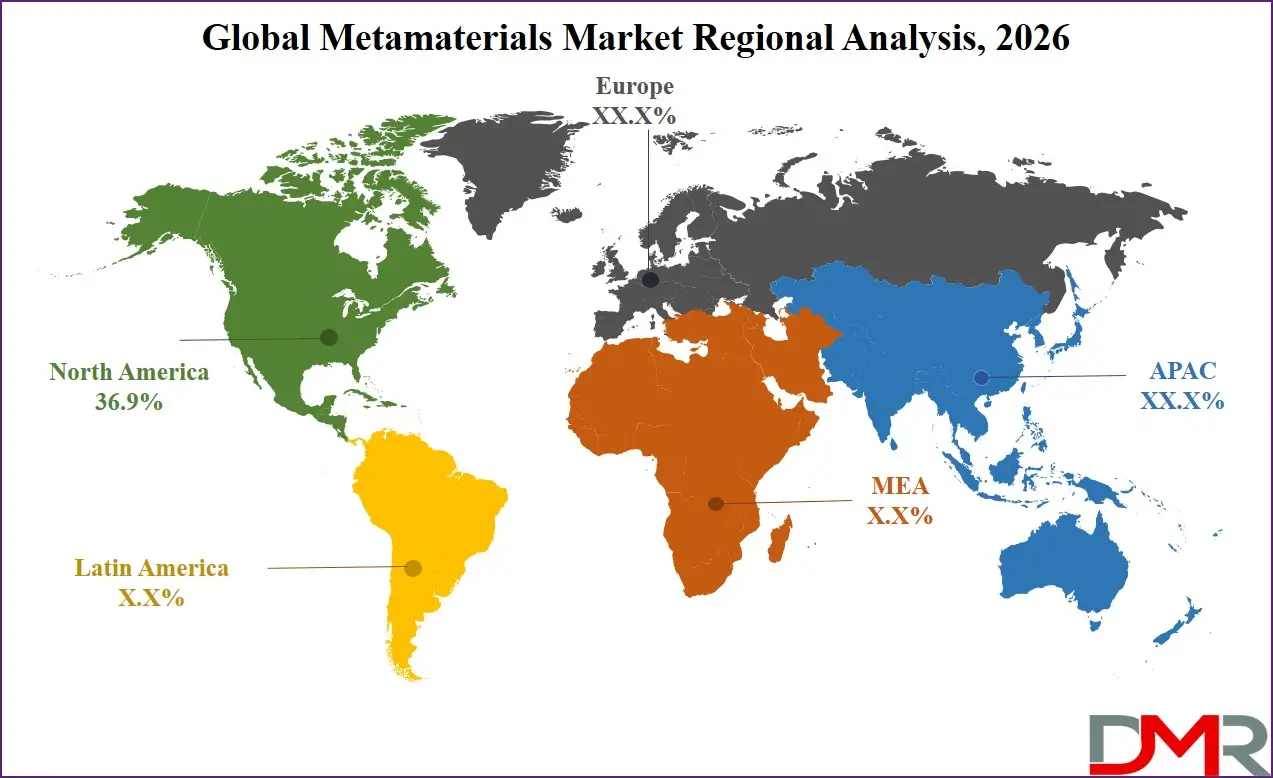
It is projected that North America will take the lead in the global metamaterials market (by value), covering a market share of about 36.9% in the year 2026. The region's dominance is driven by strong defense and telecom R&D workload cadence (US-based DARPA Metamaterials Programs and AIM Photonics initiatives), high software and nanofabrication prices relative to other regions, a mature simulation IT supply chain for advanced interoperability and high-speed data exchange, and the presence of key metamaterial vendors and advanced material labs. The widespread adoption of advanced machine learning and simulation-based metamaterial automation for defense, 6G, and sensing applications further strengthens North America's leading position in the market. Additionally, continuous investments in AI-enabled electromagnetic monitoring and interoperability capabilities are further reinforcing regional technological leadership.
ℹ
To learn more about this report –
Download Your Free Sample Report Here
Fastest-Growing Region in the Metamaterials Market
Asia-Pacific is the fastest-growing region, supported by strong digital manufacturing deployment targets (China, Japan, South Korea, India), increasing electromagnetic sovereignty initiatives, rising investments in domestic metamaterial capabilities, and growing adoption of automated unit cell design systems. The region benefits from well-established semiconductor and nanofabrication manufacturing capacity for automated workcells, increasing commercial participation, and alignment with national advanced material roadmaps. Countries across the region are actively deploying metamaterials to enhance R&D productivity-per-dollar and strengthen telecom and defense infrastructure. Growing emphasis on metamaterials R&D and structured design logic development further accelerates market expansion in the region. Moreover, increasing government support and commercial telecom commitments are expected to sustain high growth momentum.
By Region
North America
Europe
- Germany
- The U.K.
- France
- Italy
- Russia
- Spain
- Benelux
- Nordic
- Rest of Europe
Asia-Pacific
- China
- Japan
- South Korea
- India
- ANZ
- ASEAN
- Rest of Asia-Pacific
Latin America
- Brazil
- Mexico
- Argentina
- Colombia
- Rest of Latin America
Middle East & Africa
- Saudi Arabia
- UAE
- South Africa
- Israel
- Egypt
- Rest of MEA
Competitive Landscape
The metamaterials market is highly competitive, with innovation and strategic alliances shaping the competitive environment. In order to achieve a competitive advantage, companies and research labs are focused on the development of advanced design architectures (e.g., AI-based unit cell optimization, simulation for high-throughput screening, and machine learning for electromagnetic optimization), AI-powered material telemetry, and digital twin-enabled performance monitoring platforms. There are high barriers to entry due to capital-intensive process validation infrastructure, specialized electromagnetic simulation expertise, and the need for mature software ecosystems and defense/telecom regulatory and procurement compliance.
Strategic approaches in the market to increase market presence include partnerships with defense contractors and telecom operators, mergers between simulation solution providers and system integrators, and long-term support contracts with R&D labs and academic institutions. Moreover, research and development in interoperability frameworks and scalable software architectures are important factors in maintaining competitiveness and addressing the evolving needs of the advanced materials community.
Some of the prominent players in the Global Metamaterials Market are:
- Kymeta Corporation
- Echodyne Corp.
- Pivotal Commware, Inc.
- Meta Materials Inc.
- NKT Photonics A/S
- TeraView Limited
- Metamagnetics, Inc.
- Multiwave Technologies AG
- Fractal Antenna Systems, Inc.
- JEM Engineering LLC
- Metalenz, Inc.
- Lumotive, Inc.
- Greenerwave SAS
- Alcan Systems GmbH
- Plasmonics, Inc.
- Nanohmics, Inc.
- Sintec Optronics Pte Ltd.
- Phoebus Optoelectronics LLC
- KuangChi Science Limited
- Moxtek, Inc.
- Other Key Players
Recent Developments
- February 2026: Kymeta announced a strategic partnership with Japan Display Inc. (JDI) to develop a next-generation multi-band metasurface antenna supporting Ku and Ka-band satellite communications, targeting defense and commercial scalability.
- February 2026: Echodyne announced the opening of a new advanced radar manufacturing facility in Washington State, significantly expanding production capacity to over 30,000 radar units annually. The expansion supports growing demand for metamaterial-based radar systems used in defense, border security, and counter-UAS applications.
- July 2025: Metalenz and STMicroelectronics signed a new licensing agreement to accelerate the adoption of metasurface optics, enabling large-scale manufacturing of meta-optical components for consumer electronics, automotive sensing, and industrial imaging applications.
Report Details
| Report Characteristics |
| Market Size (2026) |
USD 2.1 Bn |
| Forecast Value (2035) |
USD 16.3 Bn |
| CAGR (2026–2035) |
25.8% |
| The US Market Size (2026) |
USD 651.7 Mn |
| Historical Period |
2021 – 2025 |
| Forecast Period |
2027 – 2035 |
| Base Year |
2025 |
| Estimated Year |
2026 |
| Segments Covered |
By Material Type (Electromagnetic Metamaterials, Photonic Metamaterials, Acoustic Metamaterials, Tunable/Reconfigurable Metamaterials, Advanced Metamaterials), By Product (Antenna & RF Components, Radar & Surveillance Modules, Reconfigurable Intelligent Surfaces, Optical Components, Sensor & Detection Systems, Coatings & Films), By Frequency Band (Radio Frequency, Terahertz, Optical/Infrared), By Application (Communication & RF Systems, Imaging & Optical Systems, Sensing & Monitoring, Wireless Power Transfer, Cloaking & Stealth, Energy & Light Management, Acoustic & Vibration Control), By End-Use Industry (Aerospace & Defense, Telecommunications, Consumer Electronics, Automotive & Transportation, Healthcare & Medical, Energy & Power, Industrial & Other End-Use Industries) |
| Regional Coverage |
North America – The US and Canada; Europe – Germany, The UK, France, Russia, Spain, Italy, Benelux, Nordic, & Rest of Europe; Asia-Pacific – China, Japan, South Korea, India, ANZ, ASEAN, Rest of APAC; Latin America – Brazil, Mexico, Argentina, Colombia, Rest of Latin America; Middle East & Africa – Saudi Arabia, UAE, South Africa, Turkey, Egypt, Israel, & Rest of MEA |
Frequently Asked Questions
How big is the Global Metamaterials Market?
▾ The Global Metamaterials Market size is estimated to have a value of USD 2.1 billion in 2026 and is expected to reach USD 16.3 billion by the end of 2035.
What is the CAGR of the Global Metamaterials Market from 2026 to 2035?
▾ The market is growing at a CAGR of 25.8% over the forecasted period.
What factors are driving the growth of the Global Metamaterials Market?
▾ The market is driven by advances in machine learning-based unit cell and electromagnetic response engineering and real-time simulation data generation, regulatory pressure to accelerate component development and reduce signal loss rates, and increasing government investment in national advanced materials infrastructure.
What are the major trends in the Global Metamaterials Market?
▾ The key market trends include the adoption of predictive electromagnetic response monitoring and real-time material optimization, as well as a growing shift toward cloud-based metamaterial platforms and telemetry-enabled workflow management systems.
Which region held the largest share of the Global Metamaterials Market in 2026?
▾ North America is expected to account for the largest market share in 2026, with a share of about 36.9%.
Which region is expected to grow the fastest in the Global Metamaterials Market?
▾ Asia Pacific is the fastest-growing region in the market during the forecast period.
Who are the key players in the Global Metamaterials Market?
▾ Some of the major key players in the Global Metamaterials Market are Kymeta Corporation, Metamaterial Technologies Inc., Echodyne Corp., Pivotal Commware, Inc., Lumotive, Inc., and many others.
How is the Global Metamaterials Market segmented?
▾ The market is segmented by material type, product, frequency band, application, and end-use industry.