Mexico Beverage Processing Equipment Market Snapshot
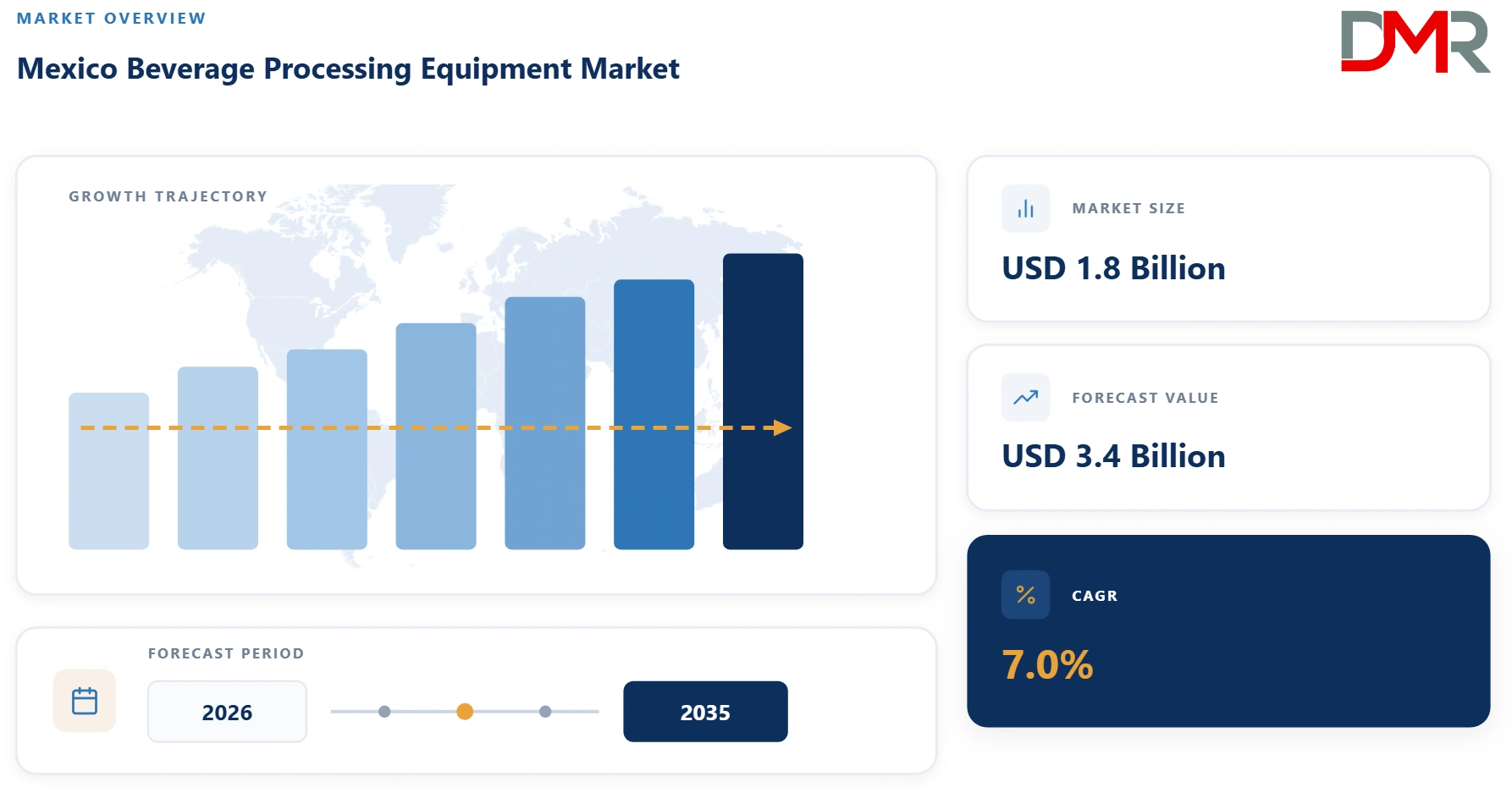
- Mexico Beverage Processing Equipment Market Size in 2026: USD 1.8 Billion
- Mexico Beverage Processing Equipment Market Size in 2035: USD 3.4 Billion
- Mexico CAGR from 2026 to 2035: 7.0%
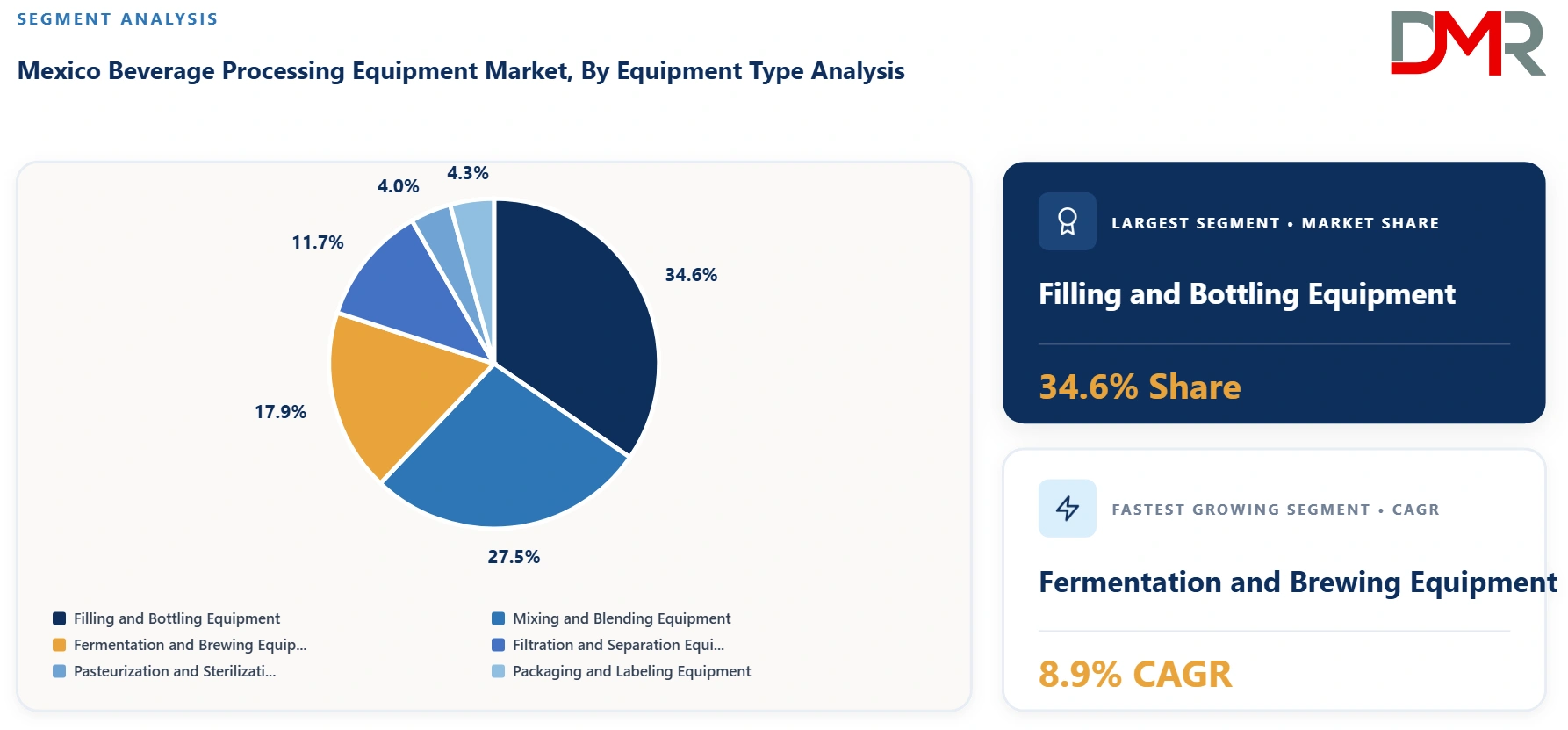
- Filling and Bottling Equipment is the leading equipment type segment in 2026: 34.6%
- Automatic is the leading mode of operation segment in 2026: 56.3%
- Beer is the leading beverage category segment in 2026: 31.8%
- Large-Scale Beverage Manufacturers is the leading end user segment in 2026: 61.4%
What is the Mexico Beverage Processing Equipment Market and its Market Size?
The Mexico Beverage Processing Equipment Market is projected to be valued at USD 1.8 Billion in 2026 and is projected to reach USD 3.4 Billion by 2035, expanding at a CAGR of 7.0% during the forecast period.
ℹ
To learn more about this report –
Download Your Free Sample Report Here
Growth is being propelled by Mexico's position as one of the world's largest beer exporters and a globally recognized tequila and spirits producing nation, sustained domestic consumption growth across soft drinks, bottled water, and other beverage categories, and continued capacity expansion investment by major Mexican and multinational beverage companies serving both robust domestic demand and substantial export markets, particularly the United States. The maturing of automated, high-speed filling and bottling technology suited to Mexico's large-scale beverage export production, growing craft brewery and artisanal spirits equipment demand as smaller producers enter Mexico's beverage market, and continued investment in fermentation, distillation, and quality control technology supporting the tequila and mezcal categories' premiumization and international growth are reshaping the market from conventional large-volume production equipment procurement into a more diversified capital investment category spanning both industrial-scale and craft-oriented producers. Investment is accelerating as Mexican beverage companies expand capacity to serve growing export demand while smaller producers invest in equipment supporting premium and craft beverage category growth.
Use Cases
- High-Speed Bottling and Canning Line Expansion for Beer Export Growth: Major Mexican brewing companies invest in high-speed automated bottling and canning equipment to expand production capacity supporting Mexico's position as one of the world's largest beer exporters, particularly to the United States market.
- Tequila and Mezcal Distillation and Aging Equipment for Premium Category Growth: Tequila and mezcal producers invest in modernized distillation, aging, and bottling equipment to support both traditional production methods and expanding premium product categories driving continued international export growth for these protected, geographically designated Mexican spirits.
- Automated Soft Drink and Bottled Water Filling for Domestic Consumption: Mexican beverage manufacturers invest in automated filling, carbonation, and packaging equipment to meet substantial domestic consumption demand for soft drinks and bottled water, categories with historically high per-capita consumption in Mexico.
- Craft Brewery and Small-Batch Distillery Equipment for Emerging Producers: Growing numbers of craft breweries and small-batch spirits producers across Mexican urban centers invest in smaller-scale fermentation, brewing, and distillation equipment suited to craft production volumes, reflecting rising consumer interest in artisanal and locally produced beverages.
Key Takeaways
- Market Size: The Mexico Beverage Processing Equipment Market is anticipated to be valued at USD 1.8 Billion in 2026 and is forecast to reach USD 3.4 Billion by 2035, expanding at a CAGR of 7.0%.
- Growth Outlook: Market expansion is sustained by Mexico's position as a leading global beer exporter and tequila producer, sustained domestic beverage consumption growth, and continued capacity investment by major beverage companies serving both domestic and export markets.
- Primary Growth Drivers: Mexico's global leadership in beer export and tequila production, sustained domestic soft drink and bottled water consumption, growing craft beverage production entering the market, and continued capacity expansion serving both domestic and U.S. export demand are accelerating equipment investment.
- By Equipment Type Analysis: Filling and Bottling Equipment is projected to lead the equipment type segment with a 34.6% share in 2026, reflecting its central role across Mexico's large-scale beer, soft drink, and bottled water production. Fermentation and Brewing Equipment is the fastest-growing equipment type segment at 8.9% CAGR, driven by growing craft brewery and premium spirits production investment.
- By Mode of Operation Analysis: Automatic equipment is expected to dominate with a 56.3% share in 2026, supported by substantial investment in high-volume industrial beverage production. Automatic is also the fastest-growing mode of operation segment at 8.4% CAGR, as continued capacity expansion incorporates advanced automation technology.
- By Beverage Category Analysis: Beer is expected to command a 31.8% share in 2026, underpinned by Mexico's globally significant brewing and export industry. Spirits and Tequila is the fastest-growing beverage category segment at 9.6% CAGR, driven by sustained international demand growth for Mexican tequila and mezcal products.
- By End User Analysis: Large-Scale Beverage Manufacturers are projected to dominate with a 61.4% share in 2026, reflecting the substantial scale of Mexico's major beer, soft drink, and spirits companies. Craft Breweries and Distilleries is the fastest-growing end user segment at 10.2% CAGR, driven by rising consumer interest in artisanal and locally produced beverages across Mexican urban centers.
Key Drivers in the Mexico Beverage Processing Equipment Market
Mexico's Global Leadership in Beer Export and Tequila Production
Mexico's position as one of the world's largest beer exporters, with several Mexican beer brands among the most internationally recognized and widely distributed globally, combined with the country's exclusive position as the geographically protected origin for tequila production, provides a substantial and durable foundation for the Mexican beverage processing equipment market. These established global beverage export leadership positions, built over decades of production expertise and sustained international brand building, create ongoing capacity expansion and modernization investment requirements as Mexican beverage companies work to meet continued growing international demand for these globally recognized product categories.
Sustained Domestic Beverage Consumption Growth
Mexico maintains historically high per-capita consumption of soft drinks and bottled water, reflecting both cultural consumption patterns and, in the case of bottled water, water quality and infrastructure considerations affecting tap water consumption in various regions. This sustained, substantial domestic consumption base provides beverage manufacturers with a stable revenue and volume foundation supporting continued equipment investment, independent of the additional growth opportunity presented by Mexico's substantial beverage export industry.
Restraints in the Mexico Beverage Processing Equipment Market
Sugar Tax and Health-Related Regulatory Pressure on Sugar-Sweetened Beverages
Mexico's sugar-sweetened beverage tax and related public health policy measures aimed at reducing sugar consumption represent a meaningful restraint on the Mexico Beverage Processing Equipment Market, particularly for equipment serving traditional sugar-sweetened soft drink production. These regulatory measures have encouraged some beverage manufacturers to reformulate products toward reduced-sugar or sugar-free alternatives, requiring corresponding equipment adaptation and potentially affecting the growth trajectory of equipment serving traditional full-sugar beverage production lines.
Growth Opportunities in the Mexico Beverage Processing Equipment Market
Premium and Reduced-Sugar Beverage Reformulation Equipment
Growing regulatory and consumer pressure toward reduced-sugar beverage formulations presents an opportunity for equipment vendors offering flexible filling and processing systems capable of efficiently handling reformulated, lower-sugar, or alternative sweetener beverage products. Vendors capable of supporting beverage manufacturers' reformulation efforts while maintaining production efficiency and taste quality can capture equipment modernization investment driven by Mexico's evolving sugar-related regulatory environment.
Craft and Artisanal Beverage Production Equipment for Emerging Producers
Mexico's growing craft brewery, small-batch distillery, and artisanal beverage production sector presents a substantial opportunity for equipment vendors offering smaller-scale, more accessible fermentation, brewing, and distillation equipment suited to emerging producers entering the market. Vendors developing equipment specifically designed for craft-scale production volumes, with lower minimum investment thresholds than industrial-scale equipment, can capture growing demand from Mexico's expanding population of smaller, quality-focused beverage producers.
Trends in the Mexico Beverage Processing Equipment Market
Continued Premiumization of Tequila and Mezcal Production Technology
Mexican spirits producers are increasingly investing in premium distillation, aging, and quality control equipment supporting the ongoing premiumization trend within the tequila and mezcal categories, as international consumers increasingly seek higher-end, artisanally positioned Mexican spirits products. This premiumization trend is encouraging investment in more sophisticated production and quality control technology beyond traditional volume-focused distillation equipment, supporting higher-margin product category development.
Growing Investment in Sustainable and Water-Efficient Beverage Processing Technology
Mexican beverage manufacturers are increasingly investing in water-efficient processing technology and sustainable packaging-compatible filling equipment, reflecting both operational cost management considerations given water resource constraints in various Mexican production regions and growing corporate sustainability commitments among major beverage companies. This trend is encouraging equipment vendors to emphasize water efficiency and sustainability credentials alongside traditional production throughput and reliability considerations.
Research Scope and Analysis
The Mexico Beverage Processing Equipment Market is segmented by equipment type, mode of operation, beverage category, and end user, covering filling, mixing, fermentation, filtration, pasteurization, and packaging equipment across beer, soft drink, spirits, juice, and dairy beverage categories.
ℹ
To learn more about this report –
Download Your Free Sample Report Here
By Equipment Type Analysis
Filling and Bottling Equipment is projected to dominate the Mexico Beverage Processing Equipment Market with 34.6% share in 2026, reflecting its central and essential role across Mexico's large-scale beer, soft drink, and bottled water production operations. Fermentation and Brewing Equipment is expected to register the highest CAGR of 8.9% during 2026-2035, driven by growing craft brewery investment and continued premium spirits production capacity expansion within the tequila and mezcal categories.
By Mode of Operation Analysis
Automatic equipment is anticipated to dominate the Mexico Beverage Processing Equipment Market by mode of operation, accounting for a 56.3% share in 2026, supported by substantial investment in high-volume industrial beverage production capacity serving both domestic consumption and significant export markets. Automatic equipment is also projected to register the highest CAGR of 8.4% between 2026 and 2035, as continued capacity expansion among major Mexican beverage companies consistently incorporates advanced automation technology.
By Beverage Category Analysis
Beer is expected to lead the Mexico Beverage Processing Equipment Market by beverage category, accounting for a 31.8% share in 2026, underpinned by Mexico's globally significant brewing industry and position as one of the world's largest beer exporters. Spirits and Tequila is projected to achieve the fastest CAGR of 9.6% during 2026-2035, driven by sustained international demand growth for Mexican tequila and mezcal products supporting continued production capacity and quality investment.
By End User Analysis
Large-Scale Beverage Manufacturers are projected to dominate the Mexico Beverage Processing Equipment Market with a 61.4% share in 2026, reflecting the substantial production scale of Mexico's major beer, soft drink, and spirits companies serving both domestic and international markets. Craft Breweries and Distilleries are expected to register the fastest CAGR of 10.2% through 2035, driven by rising consumer interest in artisanal and locally produced beverages across Mexico's growing urban craft beverage scene.
The Mexico Beverage Processing Equipment Market Report is segmented based on the following:
By Equipment Type
- Filling and Bottling Equipment
- Mixing and Blending Equipment
- Fermentation and Brewing Equipment
- Filtration and Separation Equipment
- Pasteurization and Sterilization Equipment
- Packaging and Labeling Equipment
By Mode of Operation
- Automatic
- Semi-Automatic
- Manual
By Beverage Category
- Beer
- Soft Drinks and Carbonated Beverages
- Bottled Water
- Spirits and Tequila
- Juices and Nectars
- Dairy-Based Beverages
- Others
By End User
- Large-Scale Beverage Manufacturers
- Small and Medium-Sized Beverage Producers
- Craft Breweries and Distilleries
Technology Analysis
Technology development is increasingly shaping competitiveness in the Mexico Beverage Processing Equipment Market as vendors invest in high-speed, flexible filling systems capable of handling reformulated and reduced-sugar beverage products, advanced fermentation monitoring technology supporting tequila and mezcal quality consistency, and water-efficient processing systems addressing regional water resource considerations. Growing use of digital production monitoring and predictive maintenance technology is helping major beverage manufacturers maintain the production reliability required to meet both domestic and export market demand consistently. Opportunities are expanding for vendors developing accessible, smaller-scale equipment suited to Mexico's growing craft brewery and distillery sector, as well as flexible filling technology supporting beverage reformulation in response to sugar tax and health policy considerations. However, achieving the production flexibility required to serve both large-scale industrial producers and Mexico's growing craft beverage sector requires distinct equipment design approaches, creating a bifurcated market landscape.
Investment and White Space Analysis
Investment opportunities in the Mexico Beverage Processing Equipment Market are expanding alongside Mexico's global leadership in beer export and tequila production, sustained domestic beverage consumption, and growing craft beverage sector development. Significant white space exists in premium spirits production and quality control equipment supporting continued tequila and mezcal premiumization, accessible craft-scale brewing and distillation equipment, and reformulation-supporting filling technology addressing evolving sugar tax and health policy considerations. Vendors with strong relationships with major Mexican beverage companies, craft beverage sector accessibility, and reformulation-flexible equipment design are positioned to capture premium, longer-duration contracts. However, sugar tax and health-related regulatory pressure on traditional sugar-sweetened beverage categories, along with water resource considerations affecting processing operations, can shape and in some cases constrain certain segments of equipment investment.
Competitive Landscape
The Mexico Beverage Processing Equipment Market is moderately consolidated and increasingly competitive, comprising large diversified global beverage processing equipment manufacturers, specialty distillation and fermentation equipment suppliers serving the tequila and spirits industry, and smaller equipment providers serving Mexico's growing craft beverage sector. Competition centers on high-speed filling and bottling technology, specialized distillation and fermentation equipment supporting Mexico's globally recognized spirits categories, water efficiency and sustainability credentials, and accessibility for craft-scale producers. Large diversified global equipment manufacturers benefit from broad product portfolios and established relationships with major Mexican beverage companies, while specialty suppliers compete on deep expertise in tequila and mezcal production technology and closer relationships with craft and artisanal producers. Companies increasingly differentiate through reformulation-flexible technology and craft-scale accessibility rather than production volume capability alone.
Some of the prominent players in the Mexico Beverage Processing Equipment Market are:
- GEA Group AG
- Tetra Pak International S.A.
- Krones AG
- KHS GmbH
- Alfa Laval AB
- SPX FLOW, Inc.
- JBT Marel Corporation
- Sidel Group
- Pentair plc
- Bucher Industries AG
- Bühler Group
- ProMach, Inc.
- CFT Group
- Praj Industries Ltd.
- Pall Corporation
- HRS Process Systems Ltd.
- Statco-DSI Process Systems
- Paul Mueller Company
- Feldmeier Equipment, Inc.
- A Due S.p.A.
- Goma Engineering Pvt. Ltd.
- Bajaj Processpack Limited
- VLS Technologies
- IC Filling Systems
- Central States Industrial
- SACMI Beverage
- Omnia Technologies
- ACMI S.p.A.
- Zambelli Enotech S.r.l.
- Della Toffola Group
- TMCI Padovan
- Framax S.r.l.
- Bertolaso S.p.A.
- GAI Macchine Imbottigliatrici S.p.A.
- Fenco Food Machinery S.r.l.
- Newamstar Packaging Machinery Co., Ltd.
- Zhangjiagang King Machine Co., Ltd.
- Zhangjiagang Comark Machinery Co., Ltd.
- Equipos de Proceso Industriales
- IMEPSA
- Other Key Players
Recent Developments
- May 2026: Tetra Pak Mexico promoted advanced processing solutions designed to reduce, reuse and optimize water consumption in beverage and food production, supporting Mexican manufacturers seeking greater resource efficiency and lower water intensity across processing operations.
- March 2026: Mexico’s beverage industry reported continued investment in processing technology and plant improvements, contributing to a 27% reduction in water use since 2008. The industry targets a Water Use Ratio of 1.47 liters per liter of beverage by 2030.
- February 2026: KHS introduced KHS SUPREME, incorporating Plasmax barrier technology for oxygen-sensitive beverages. The system supports production speeds of up to 60,000 PET bottles per hour, targeting beverages such as tea requiring enhanced product protection and shelf-life performance.
Report Details
| Report Characteristics |
| Market Size (2026) |
USD 1.8 Bn |
| Forecast Value (2035) |
USD 3.4 Bn |
| CAGR (2026–2035) |
7.0% |
| Historical Data |
2021 – 2025 |
| Forecast Data |
2026 – 2035 |
| Base Year |
2025 |
| Segments Covered |
By Equipment Type, By Mode of Operation, By Beverage Category, and By End User |
| Country Coverage |
Mexico |
Frequently Asked Questions
How big is the Mexico Beverage Processing Equipment Market?
▾ The Mexico Beverage Processing Equipment Market is poised to be valued at USD 1.8 Billion in 2026 and is projected to reach USD 3.4 Billion by 2035, reflecting Mexico's global leadership in beer export and tequila production alongside sustained domestic beverage consumption.
What is the CAGR of the Mexico Beverage Processing Equipment Market from 2026 to 2035?
▾ The market is projected to expand at a compound annual growth rate (CAGR) of 7.0% between 2026 and 2035, supported by sustained beer and spirits export growth, domestic consumption, and rising craft beverage production investment.
What factors are driving the growth of the Mexico Beverage Processing Equipment Market?
▾ Growth is driven by Mexico's global leadership in beer export and tequila production, sustained domestic soft drink and bottled water consumption, growing craft beverage production entering the market, and continued capacity expansion serving both domestic and U.S. export demand.
What are the major trends in the Mexico Beverage Processing Equipment Market?
▾ Major trends include continued premiumization of tequila and mezcal production technology, growing investment in sustainable and water-efficient beverage processing technology, and rising demand for accessible craft-scale brewing and distillation equipment.
Who are the key players in the Mexico Beverage Processing Equipment Market?
▾ Key market participants include Krones, KHS GmbH, GEA Group, Sidel, and Tetra Pak, among other global and specialty beverage processing equipment manufacturers serving Mexico's beer, spirits, and soft drink industries.
How is the Mexico Beverage Processing Equipment Market segmented?
▾ The market is segmented by equipment type, mode of operation, beverage category, and end user, with demand analysis concentrated across Jalisco, Nuevo León, Mexico City, and the Bajío region.