Mexico Cold Chain Logistics Market Snapshot
- Mexico Cold Chain Logistics Market Size in 2026: USD 7.8 Billion
- Mexico Cold Chain Logistics Market Size in 2035: USD 14.5 Billion
- Mexico CAGR from 2026 to 2035: 7.2%
- Refrigerated Transportation is the leading service type segment in 2026: 53.6%
- Frozen is the leading temperature type segment in 2026: 41.9%
- Roadways is the leading mode of transport segment in 2026: 79.8%
- Fruits and Vegetables is the leading application segment in 2026: 32.4%
- Food and Beverage Industry is the leading end user segment in 2026: 76.3%
What is the Mexico Cold Chain Logistics Market and its Market Size?
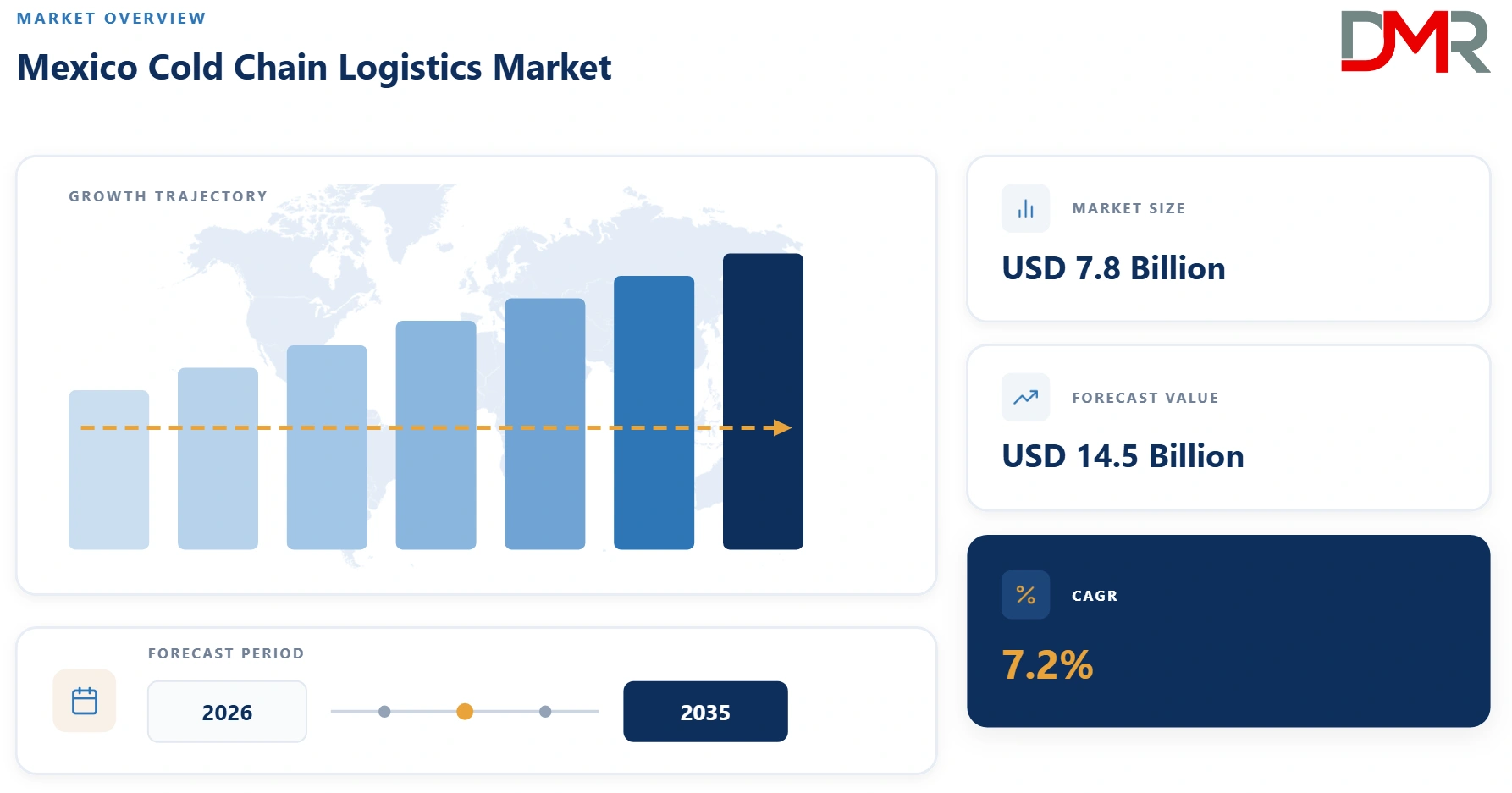
The Mexico Cold Chain Logistics Market is projected to be valued at USD 7.8 Billion in 2026 and is projected to reach USD 14.5 Billion by 2035, expanding at a CAGR of 7.2% during the forecast period.
ℹ
To learn more about this report –
Download Your Free Sample Report Here
Growth is being propelled by Mexico's position as one of the world's largest fresh produce exporters to the United States, requiring extensive cross-border refrigerated transportation and cold storage infrastructure, accelerating nearshoring-driven manufacturing investment that is expanding demand for integrated North American cold chain logistics networks, and sustained growth in Mexican grocery e-commerce and domestic pharmaceutical distribution. The maturing of cross-border refrigerated logistics infrastructure connecting Mexican production regions with U.S. distribution networks, growing investment in automated cold storage facilities near key border crossings and agricultural export regions, and continued integration of Mexican and U.S. cold chain logistics networks under deepening North American supply chain relationships are reshaping the market from a historically fragmented, domestically oriented logistics function into an increasingly sophisticated, cross-border integrated cold chain network. Investment is accelerating as Mexican and multinational logistics providers expand capacity to serve both growing fresh produce export volumes and nearshoring-driven North American supply chain integration.
Use Cases
- Cross-Border Refrigerated Transportation for Fresh Produce Export to the United States: Mexican fruit and vegetable exporters, among the largest suppliers to the U.S. market, rely on extensive cross-border refrigerated trucking networks connecting agricultural production regions in states such as Sinaloa and Michoacán with U.S. distribution centers.
- Cold Storage Infrastructure Supporting Nearshoring-Driven Food Manufacturing: Multinational and Mexican food companies expanding manufacturing capacity under nearshoring trends require integrated cold storage and refrigerated transportation infrastructure connecting production facilities with both domestic Mexican distribution and U.S. export logistics networks.
- Last-Mile Cold Chain for Growing Mexican Grocery E-Commerce: Online grocery platforms operating in Mexico City, Guadalajara, and other major Mexican urban centers rely on temperature-controlled last-mile delivery fleets to maintain product quality for chilled and frozen groceries delivered directly to consumers.
- Temperature-Controlled Pharmaceutical Distribution Across Mexico's Healthcare Network: Pharmaceutical distributors and healthcare logistics providers use validated cold chain transportation and storage to distribute vaccines, biologics, and temperature-sensitive medications across Mexico's dispersed healthcare facility network.
Key Takeaways
- Market Size: The Mexico Cold Chain Logistics Market is anticipated to be valued at USD 7.8 Billion in 2026 and is forecast to reach USD 14.5 Billion by 2035, expanding at a CAGR of 7.2%.
- Growth Outlook: Market expansion is sustained by Mexico's position as a leading fresh produce exporter to the United States, accelerating nearshoring-driven manufacturing investment requiring integrated cold chain infrastructure, and sustained growth in Mexican grocery e-commerce and pharmaceutical distribution.
- Primary Growth Drivers: Mexico's substantial fresh produce export trade to the United States, accelerating nearshoring investment requiring integrated cross-border cold chain networks, growing Mexican grocery e-commerce adoption, and expanding pharmaceutical and healthcare cold chain distribution requirements are accelerating market growth.
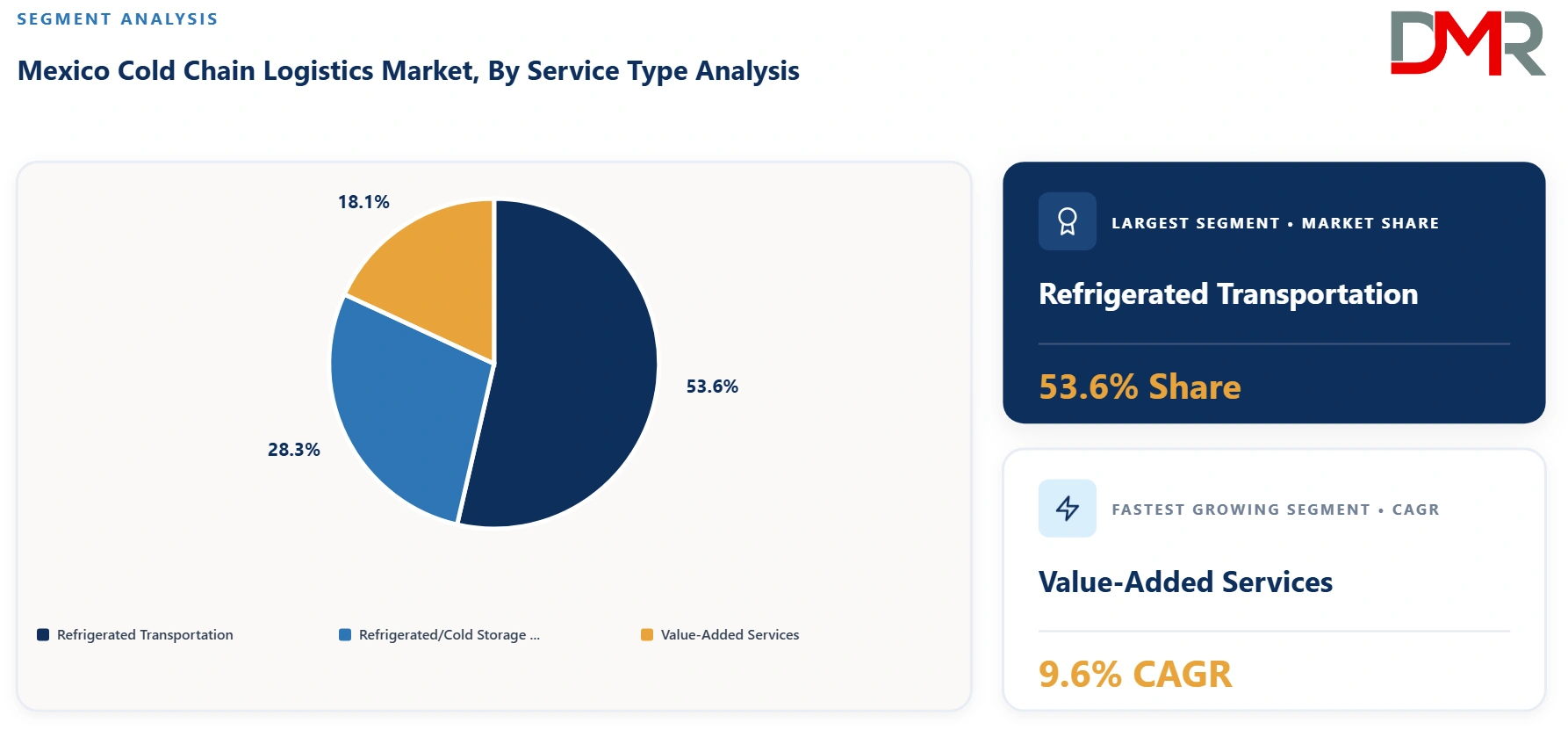
- By Service Type Analysis: Refrigerated Transportation is projected to lead the service type segment with a 53.6% share in 2026, reflecting Mexico's substantial reliance on cross-border and domestic trucking to connect agricultural production regions with both domestic and U.S. export destinations. Value-Added Services is the fastest-growing service type segment at 9.6% CAGR, driven by rising demand for cross-docking and inventory management services supporting nearshoring-driven supply chains.
- By Temperature Type Analysis: Frozen is expected to dominate with a 41.9% share in 2026, supported by extensive frozen food and protein distribution volumes. Deep-Frozen is the fastest-growing temperature type segment at 9.8% CAGR, driven by expanding pharmaceutical biologics distribution requiring ultra-low temperature handling.
- By Mode of Transport Analysis: Roadways is poised to lead with a 79.8% share in 2026, reflecting the dominant role of cross-border and domestic refrigerated trucking within Mexico's logistics network. Railways is the fastest-growing mode of transport segment at 8.9% CAGR, driven by growing investment in intermodal refrigerated rail capacity connecting Mexican production regions with U.S. distribution networks.
- By Application Analysis: Fruits and Vegetables is expected to command a 32.4% share in 2026, underpinned by Mexico's position as a leading global fresh produce exporter. Pharmaceuticals and Healthcare is the fastest-growing application segment at 10.1% CAGR, driven by expanding healthcare infrastructure and biologics distribution requirements.
- By End User Analysis: Food and Beverage Industry is projected to dominate with a 76.3% share in 2026, reflecting the sector's overwhelming share of overall cold chain volume tied to Mexico's substantial agricultural export and domestic food distribution trade. Pharmaceutical and Healthcare Industry is the fastest-growing end user segment at 9.7% CAGR, driven by sustained growth in temperature-sensitive drug distribution.
Key Drivers in the Mexico Cold Chain Logistics Market
Mexico's Position as a Leading Fresh Produce Exporter to the United States
Mexico ranks among the largest suppliers of fresh fruits and vegetables to the United States market, with substantial agricultural production regions in states such as Sinaloa, Michoacán, and Baja California supplying tomatoes, avocados, berries, and other produce categories to U.S. consumers year-round. This substantial and growing cross-border agricultural trade relationship requires extensive, reliable cold chain infrastructure connecting Mexican production and packing facilities with U.S. distribution networks, creating sustained demand for cross-border refrigerated transportation capacity and border-adjacent cold storage warehousing that represents a structurally durable driver of Mexican cold chain logistics market growth.
Accelerating Nearshoring Investment Requiring Integrated Cross-Border Cold Chain Networks
Mexico's growing role as a preferred nearshoring destination for multinational food and beverage manufacturers serving the North American market is driving substantial new investment in integrated logistics infrastructure connecting Mexican production facilities with both domestic Mexican distribution and U.S. export networks. As companies establish or expand Mexican manufacturing capacity specifically oriented toward North American market service, corresponding investment in reliable, cross-border-capable cold chain logistics infrastructure is increasingly viewed as an essential component of successful nearshoring strategy execution.
Restraints in the Mexico Cold Chain Logistics Market
Border Crossing Congestion and Cross-Border Logistics Complexity
Congestion at major U.S.-Mexico border crossings, combined with the customs, inspection, and documentation complexity inherent in cross-border refrigerated freight movement, represents a significant restraint on the Mexico Cold Chain Logistics Market. Delays at border crossings can compromise the temperature integrity of perishable cargo and complicate delivery scheduling reliability, requiring cold chain logistics providers to invest in redundant capacity, advance customs documentation systems, and buffer time in transportation planning to manage this cross-border logistics complexity, adding cost and operational complexity relative to purely domestic cold chain operations.
Growth Opportunities in the Mexico Cold Chain Logistics Market
Automated Cold Storage Facility Development Near Key Border Crossings
Growing cross-border trade volume presents a substantial opportunity for developers and logistics providers investing in automated, high-capacity cold storage facilities strategically located near major U.S.-Mexico border crossings such as Nogales, Laredo, and Otay Mesa. Facilities capable of efficiently processing and cross-docking substantial refrigerated freight volumes at these critical logistics chokepoints can capture premium positioning serving both Mexican export agriculture and nearshoring-driven manufacturing supply chains.
Integrated North American Cold Chain Network Services
Mexico's deepening integration with U.S. and Canadian supply chains under nearshoring trends presents an opportunity for logistics providers to develop integrated, seamless North American cold chain network services spanning all three USMCA countries. Providers capable of offering unified visibility, documentation, and service quality across Mexican, U.S., and Canadian cold chain operations can capture premium contracts from multinational food and beverage companies increasingly managing integrated North American supply chains rather than treating Mexico as a separate logistics market.
Trends in the Mexico Cold Chain Logistics Market
Growing Investment in Cross-Border Logistics Technology and Documentation Systems
Mexican and U.S. cold chain logistics providers are increasingly investing in digital customs documentation, advance cargo information systems, and real-time cross-border shipment tracking technology to reduce border crossing delays and improve cross-border refrigerated freight reliability. This trend reflects both companies' own operational efficiency interests and growing regulatory emphasis on supply chain security and documentation accuracy for cross-border agricultural and food trade.
Consolidation and Cross-Border Expansion Among Cold Chain Logistics Providers
The Mexico Cold Chain Logistics Market is experiencing continued consolidation as larger North American logistics companies acquire or expand Mexican cold chain operations to build more comprehensive, integrated cross-border logistics networks. This consolidation trend reflects the capital intensity required for competitive cross-border logistics capability and the scale and network advantages available to larger, more established providers capable of serving increasingly integrated North American supply chains.
Research Scope and Analysis
The Mexico Cold Chain Logistics Market is segmented by service type, temperature type, mode of transport, application, and end user, covering refrigerated transportation, cold storage warehousing, value-added services, chilled, frozen, deep-frozen temperature ranges, and food, pharmaceutical, and retail end users.
ℹ
To learn more about this report –
Download Your Free Sample Report Here
By Service Type Analysis
Refrigerated Transportation is projected to dominate the Mexico Cold Chain Logistics Market with 53.6% share in 2026, reflecting Mexico's substantial reliance on both domestic and cross-border trucking to connect agricultural production and manufacturing regions with distribution destinations across Mexico and the United States. Value-Added Services is expected to register the highest CAGR of 9.6% during 2026-2035, driven by rising demand for cross-docking, customs documentation support, and inventory management services supporting increasingly integrated nearshoring-driven supply chains.
By Temperature Type Analysis
Frozen is anticipated to dominate the Mexico Cold Chain Logistics Market by temperature type, accounting for 41.9% share in 2026, supported by extensive frozen food and protein product distribution volumes across both domestic Mexican consumption and cross-border trade. Deep-Frozen is projected to register the highest CAGR of 9.8% between 2026 and 2035, driven by expanding pharmaceutical biologics distribution requiring ultra-low temperature handling and storage.
By Mode of Transport Analysis
Roadways is projected to lead the Mexico Cold Chain Logistics Market with an estimated 79.8% share in 2026, reflecting the dominant and largely unavoidable role of cross-border and domestic refrigerated trucking within Mexico's logistics network connecting agricultural regions with both domestic and U.S. destinations. Railways is expected to register the fastest CAGR of 8.9% through 2035, driven by growing investment in intermodal refrigerated rail capacity as companies seek lower-cost, lower-emission alternatives for longer-distance freight movement between Mexican production regions and U.S. distribution centers.
By Application Analysis
Fruits and Vegetables is projected to lead the Mexico Cold Chain Logistics Market with an estimated 32.4% share in 2026, underpinned by Mexico's position as one of the world's leading fresh produce exporters requiring extensive protective cold chain infrastructure for cross-border trade. Pharmaceuticals and Healthcare is expected to register the fastest CAGR of 10.1% through 2035, driven by sustained growth in temperature-sensitive medication and biologics distribution supporting Mexico's expanding domestic healthcare infrastructure.
By End User Analysis
Food and Beverage Industry is projected to dominate the Mexico Cold Chain Logistics Market with 76.3% share in 2026, reflecting the sector's overwhelming share of total cold chain volume tied to Mexico's substantial agricultural export and domestic food distribution trade. Pharmaceutical and Healthcare Industry is expected to register the fastest CAGR of 9.7% through 2035, driven by sustained growth in temperature-sensitive drug, vaccine, and biologics distribution across Mexico's healthcare system.
The Mexico Cold Chain Logistics Market Report is segmented based on the following:
By Service Type
- Refrigerated Transportation
- Refrigerated/Cold Storage Warehousing
- Value-Added Services
By Temperature Type
- Chilled
- Frozen
- Deep-Frozen
By Mode of Transport
- Roadways
- Railways
- Airways
- Waterways
By Application
- Fruits and Vegetables
- Dairy Products
- Meat, Poultry and Seafood
- Bakery and Confectionery
- Pharmaceuticals and Healthcare
- Others
By End User
- Food and Beverage Industry
- Pharmaceutical and Healthcare Industry
- Retail and E-Commerce
- Others
Technology Analysis
Technology investment is increasingly shaping competitiveness in the Mexico Cold Chain Logistics Market as providers adopt advance cargo documentation systems, IoT-based real-time temperature and location monitoring, and border crossing optimization technology to reduce cross-border logistics complexity and delay risk. Growing use of predictive analytics for border wait time and customs processing is helping providers plan more reliable cross-border delivery schedules for perishable cargo. Opportunities are expanding for providers investing in automated cold storage and cross-docking facilities near key border crossings, digital customs documentation platforms reducing border delay risk, and integrated North American shipment visibility platforms serving increasingly unified USMCA supply chains. However, the technical and regulatory complexity of cross-border cold chain logistics, combined with the capital intensity of border-adjacent infrastructure development, remain significant considerations for providers and investors.
Investment and White Space Analysis
Investment opportunities in the Mexico Cold Chain Logistics Market are expanding alongside Mexico's substantial fresh produce export trade, accelerating nearshoring-driven manufacturing investment, and sustained growth in domestic grocery e-commerce and pharmaceutical distribution. Significant white space exists in automated cold storage facility development near key border crossings, integrated North American cold chain network services, and digital cross-border logistics technology reducing customs and documentation friction. Providers with strong cross-border logistics capability, established relationships with major agricultural exporters and nearshoring-focused manufacturers, and border-adjacent infrastructure access are positioned to capture premium, longer-duration contracts. However, border crossing congestion and cross-border logistics complexity, along with consolidation-driven competitive pressure, can constrain margins and operational reliability for smaller, less integrated logistics providers.
Competitive Landscape
The Mexico Cold Chain Logistics Market is moderately consolidated and increasingly competitive, comprising large North American cold chain and logistics companies with integrated cross-border capability, Mexican domestic refrigerated transportation and cold storage providers, and specialized agricultural export logistics companies serving Mexico's fresh produce trade. Competition centers on cross-border logistics reliability and documentation capability, cold storage capacity near key border crossings, integration with U.S. and broader North American distribution networks, and established relationships with major agricultural exporters and nearshoring-focused food manufacturers. Large North American providers benefit from integrated cross-border network capability and established U.S. customer relationships, while Mexican domestic providers compete on local market knowledge and closer relationships with Mexican agricultural and food manufacturing clients. Companies increasingly differentiate through cross-border technology investment and integrated North American network capability rather than domestic storage capacity alone.
Some of the prominent players in the Mexico Cold Chain Logistics Market are:
- Frialsa Frigoríficos
- Emergent Cold LatAm
- Americold Logistics
- Lineage Logistics
- DHL Supply Chain
- AIT Worldwide Logistics
- UPS Supply Chain Solutions
- Kuehne+Nagel
- DSV
- C.H. Robinson
- Penske Logistics
- Grupo Traxión
- Solistica
- Friopuerto
- CEVA Logistics
- Crane Worldwide Logistics
- TIBA Group
- Noatum Logistics
- Yusen Logistics
- Nippon Express
- GEODIS
- Hellmann Worldwide Logistics
- Werner Enterprises
- Grupo TMM
- Grupo Serbom
- Transportes Castores
- Qualianz
- FedEx Logistics
- Maersk
- Grupo Transportes Monterrey
- Transportes Refrigerados TSM
- Fresco
- NCC Logistics
- Arc Global Logistics
- Sheer Logistics
- Grupo Logístico Especializado
- Logyt
- ARCOSA
- Grupo Marítima Sureste
- Cold Box Logistics
- Other Key Players
Recent Developments
- August 2026: ALMER inaugurated its new temperature-controlled distribution center in Monterrey, Nuevo León, following an investment exceeding MXN 500 million. The 15,000-square-meter facility strengthens refrigerated storage capacity and cold-chain infrastructure serving northern Mexico.
- May 2026: Frialsa inaugurated its Puerta Querétaro Distribution Center, investing more than MXN 400 million. The cold-chain logistics complex incorporates automation, temperature-control and traceability technologies, with another MXN 400 million expansion planned for 2027.
- November 2025: Emergent Cold LatAm inaugurated a new cold-storage facility in Guadalajara, offering 12,000 pallet positions across 81,000 cubic meters and capacity for approximately 12,000 tons of food, with space available for future expansion.
- March 2025: Emergent Cold LatAm opened its first ground-up cold-storage facility in Mexico at Ciénega de Flores, Monterrey. The facility provides 23,000 pallet positions and approximately 150,000 cubic meters of temperature-controlled storage space.
Report Details
| Report Characteristics |
| Market Size (2026) |
USD 7.8 Bn |
| Forecast Value (2035) |
USD 14.5 Bn |
| CAGR (2026–2035) |
7.2% |
| Historical Data |
2021 – 2025 |
| Forecast Data |
2026 – 2035 |
| Base Year |
2025 |
| Segments Covered |
By Service Type, By Temperature Type, By Mode of Transport, By Application, and By End User |
| Country Coverage |
Mexico |
Frequently Asked Questions
How big is the Mexico Cold Chain Logistics Market?
▾ The Mexico Cold Chain Logistics Market is projected to valued at USD 7.8 Billion in 2026 and is projected to reach USD 14.5 Billion by 2035, reflecting Mexico's position as a leading fresh produce exporter and accelerating nearshoring-driven cold chain infrastructure investment.
What is the CAGR of the Mexico Cold Chain Logistics Market from 2026 to 2035?
▾ The market is projected to expand at a compound annual growth rate (CAGR) of 7.2% between 2026 and 2035, supported by sustained fresh produce export growth, nearshoring-driven manufacturing investment, and growing grocery e-commerce and pharmaceutical distribution.
What factors are driving the growth of the Mexico Cold Chain Logistics Market?
▾ Growth is driven by Mexico's substantial fresh produce export trade to the United States, accelerating nearshoring investment requiring integrated cross-border cold chain networks, growing Mexican grocery e-commerce adoption, and expanding pharmaceutical and healthcare cold chain distribution requirements.
What are the major trends in the Mexico Cold Chain Logistics Market?
▾ Major trends include growing investment in cross-border logistics technology and documentation systems, continued consolidation and cross-border expansion among cold chain logistics providers, and rising investment in intermodal refrigerated rail capacity.
Who are the key players in the Mexico Cold Chain Logistics Market?
▾ Key market participants include Americold Logistics Mexico Operations, Lineage Logistics Mexico Operations, Grupo Traxion, Grupo Solistica, and CEVA Logistics Mexico, among other North American and Mexican cold chain logistics providers.
How is the Mexico Cold Chain Logistics Market segmented?
▾ The market is segmented by service type, temperature type, mode of transport, application, and end user, with demand analysis concentrated across Sinaloa, Nuevo León, Baja California, and the U.S.-Mexico border region.