Mexico Food Packaging Market Snapshot
- Mexico Food Packaging Market Size in 2026: USD 6.5 Billion
- Mexico Food Packaging Market Size in 2035: USD 9.3 Billion
- Mexico CAGR from 2026 to 2035: 4.1%
- Plastics is the leading material type segment in 2026: 43.7%
- Flexible Packaging is the leading packaging type segment in 2026: 48.9%
- Modified Atmosphere Packaging is the leading technology segment in 2026: 21.6%
- Beverages is the leading application segment in 2026: 24.3%
- Food and Beverage Manufacturers is the leading end user segment in 2026: 69.8%
What is the Mexico Food Packaging Market and its Market Size?
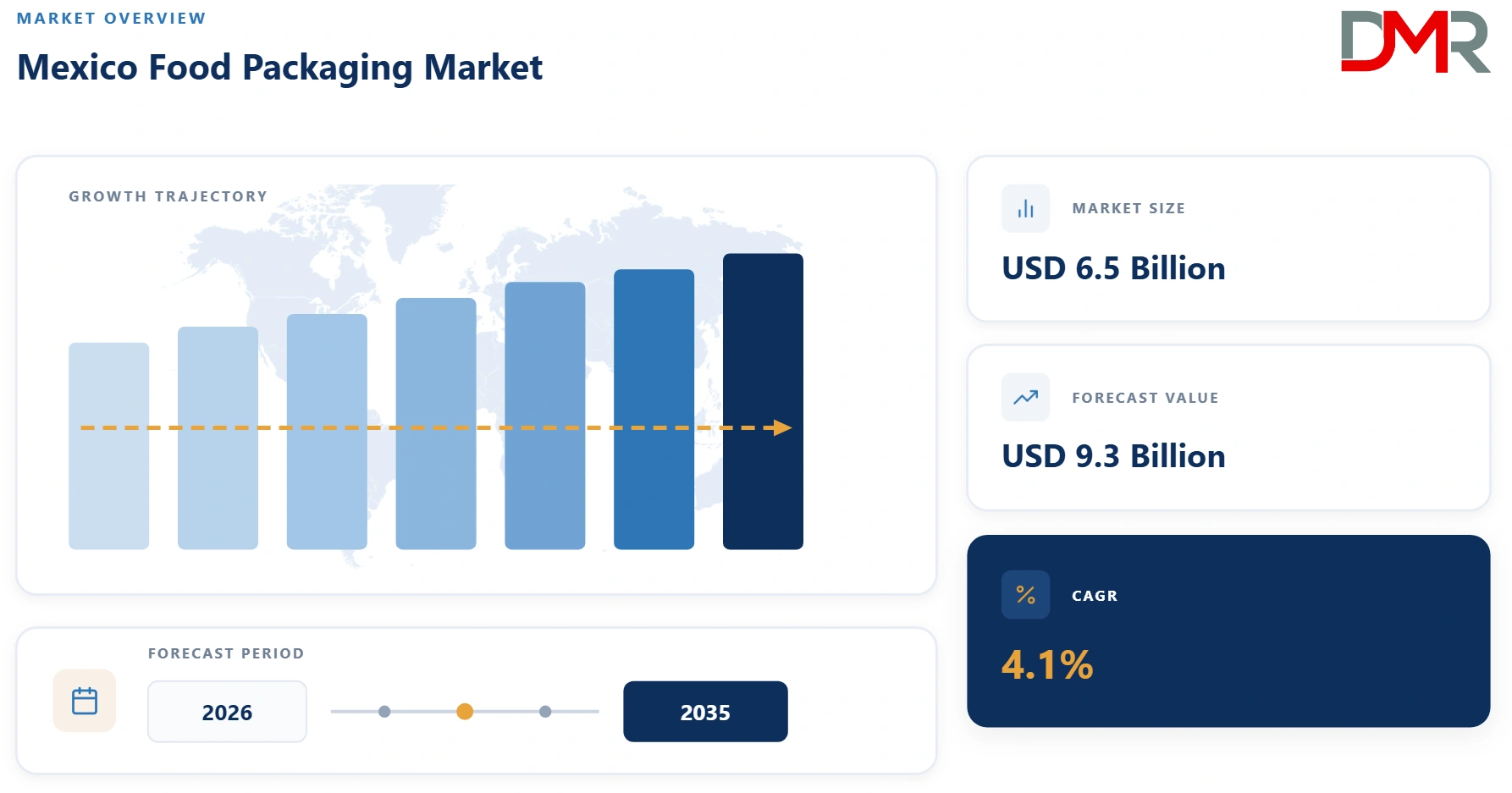
The Mexico Food Packaging Market is projected to be valued at USD 6.5 Billion in 2026 and is projected to reach USD 9.3 Billion by 2035, expanding at a CAGR of 4.1% during the forecast period.
ℹ
To learn more about this report –
Download Your Free Sample Report Here
Growth is being propelled by accelerating nearshoring-driven food and beverage manufacturing investment as multinational companies expand Mexican production capacity serving the North American market under USMCA trade preferences, sustained growth in Mexico's substantial food and beverage export industry, and continued expansion of domestic Mexican packaged food and beverage consumption amid rising urbanization and disposable incomes. The maturing of export-compliant packaging technologies meeting both Mexican and U.S. regulatory and labeling requirements, growing food manufacturer investment in sustainable packaging aligned with Mexico's evolving extended producer responsibility and single-use plastics regulation, and continued strength of Mexico's globally significant beverage packaging industry spanning beer, soft drinks, and tequila are reshaping the market from a historically domestically oriented packaging supply pattern into an increasingly export-integrated, North American-aligned packaging industry. Investment is accelerating as Mexican and multinational packaging manufacturers expand capacity to serve both nearshoring-driven export production and robust domestic consumption growth.
Use Cases
- Export-Compliant Packaging for Nearshoring-Driven Food Manufacturing: Multinational and Mexican food companies expanding production capacity to serve the U.S. and Canadian markets under USMCA trade preferences require packaging solutions meeting both Mexican and North American food safety, labeling, and quality certification standards.
- Beverage Packaging for Mexico's Globally Significant Beer, Soft Drink, and Tequila Industries: Mexican beverage manufacturers rely on substantial volumes of glass, metal, and PET packaging to support the country's globally significant beer, soft drink, and tequila production and export industries, among the largest in the world for several beverage categories.
- Flexible Packaging for Snack and Convenience Food Products: Mexican snack food manufacturers, serving both a large and growing domestic market and substantial export demand, rely on flexible pouch and film packaging formats to provide cost-effective barrier protection for chips, confectionery, and other convenience food products.
- Sustainable Packaging Redesign Aligned with Extended Producer Responsibility Regulation: Food and beverage manufacturers reformulate packaging into more recyclable formats to comply with Mexico's evolving extended producer responsibility and state-level single-use plastics regulations, particularly in states such as Mexico City and Jalisco with more advanced plastics reduction policies.
Key Takeaways
- Market Size: The Mexico Food Packaging Market is anticipated to be valued at USD 6.5 Billion in 2026 and is forecast to reach USD 9.3 Billion by 2035, expanding at a CAGR of 4.1%.
- Growth Outlook: Market expansion is sustained by accelerating nearshoring-driven food manufacturing investment, sustained growth in Mexico's substantial food and beverage export industry, and continued domestic packaged food and beverage consumption growth.
- Primary Growth Drivers: Accelerating nearshoring investment under USMCA trade preferences, sustained growth in Mexico's globally significant beverage export industry, rising domestic packaged food consumption, and evolving extended producer responsibility and plastics reduction regulation are accelerating packaging innovation and capacity investment.
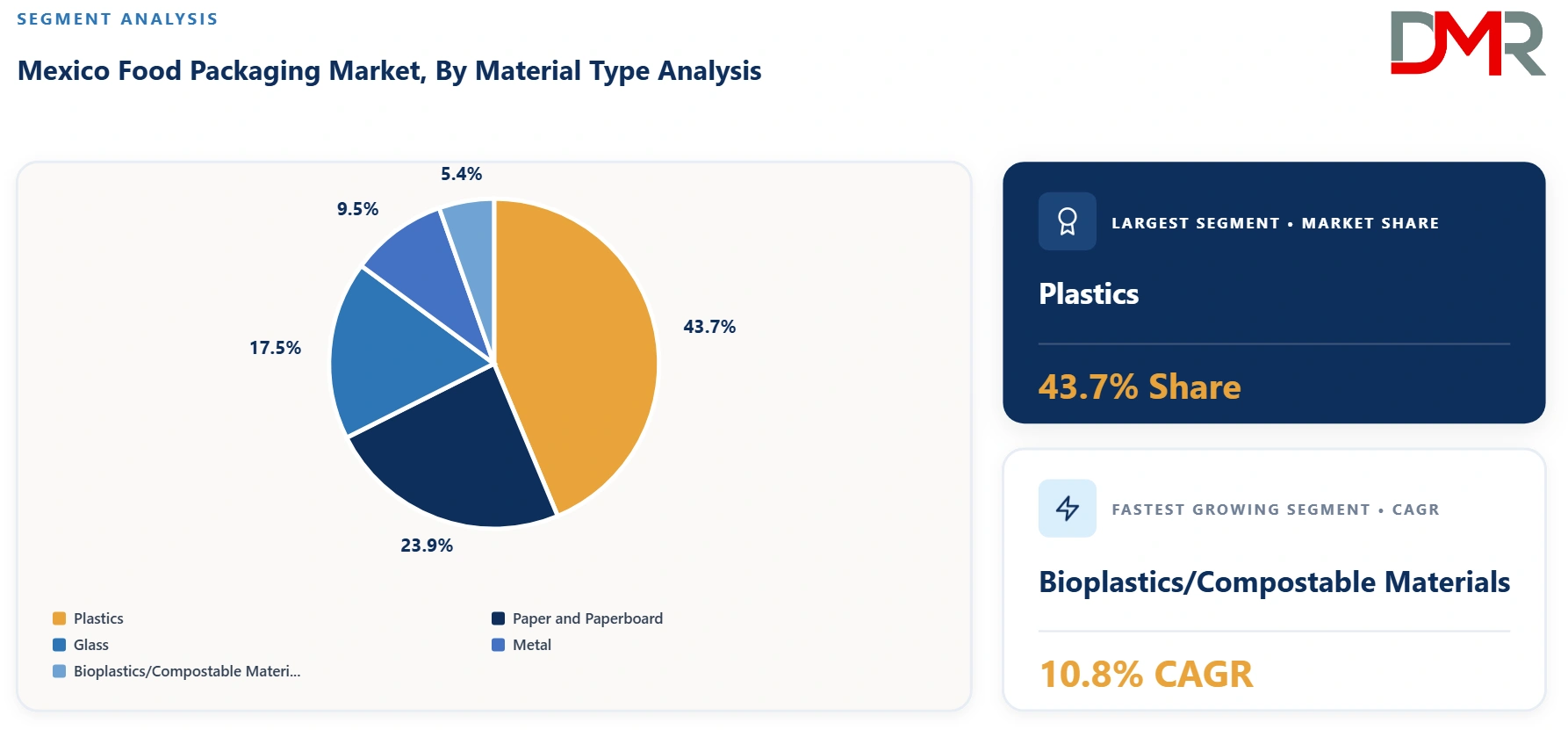
- By Material Type Analysis: Plastics is projected to lead the material type segment with a 43.7% share in 2026, reflecting continued cost-effectiveness and barrier performance across Mexico's diverse food and beverage packaging requirements. Bioplastics/Compostable Materials is the fastest-growing material type segment at 10.8% CAGR, driven by expanding compostable packaging adoption in response to evolving state-level plastics regulation.
- By Packaging Type Analysis: Flexible Packaging is expected to dominate with a 48.9% share in 2026, supported by widespread use across snack, bakery, and convenience food categories. Rigid Packaging remains substantial given Mexico's significant glass and metal beverage packaging requirements for beer, soft drink, and tequila production.
- By Technology Analysis: Modified Atmosphere Packaging is poised to lead with a 21.6% share in 2026, reflecting its central role extending shelf life for meat, poultry, and prepared foods. Active and Intelligent Packaging is the fastest-growing technology segment at 9.4% CAGR, driven by rising demand for freshness monitoring solutions supporting both domestic and export distribution.
- By Application Analysis: Beverages is expected to command a 24.3% share in 2026, underpinned by Mexico's globally significant beer, soft drink, and tequila production and export industries. Snacks and Convenience Foods is the fastest-growing application segment at 7.8% CAGR, fuelled by sustained domestic and export demand growth for Mexican snack food products.
- By End User Analysis: Food and Beverage Manufacturers are projected to dominate with a 69.8% share in 2026, reflecting their position as the primary purchasers of packaging materials. Retailers and Grocery Chains is the fastest-growing end user segment at 7.6% CAGR, driven by expanding private label packaging initiatives among Mexico's growing modern grocery retail sector.
Key Drivers in the Mexico Food Packaging Market
Accelerating Nearshoring-Driven Food Manufacturing Investment
Mexico's position as a preferred nearshoring destination for multinational food and beverage manufacturers seeking to serve the North American market has driven substantial new investment in Mexican food production capacity, generating corresponding packaging demand growth. As multinational companies establish or expand Mexican manufacturing facilities specifically oriented toward U.S. and Canadian export under USMCA trade preferences, packaging manufacturers must meet the food safety, labeling, and quality certification standards required for cross-border North American market access, driving both packaging volume growth and technical sophistication requirements.
Mexico's Globally Significant Beverage Export Industry
Mexico maintains globally significant beer, soft drink, and tequila production and export industries, with Mexican beer brands among the most exported globally and tequila representing a protected, geographically designated Mexican product category with substantial international demand. This established beverage export leadership generates sustained and substantial demand for glass, metal, and PET packaging materials, providing a durable foundation for Mexico's packaging industry that is distinct from and complementary to the broader nearshoring-driven food manufacturing investment trend.
Restraints in the Mexico Food Packaging Market
Regulatory Fragmentation Across Mexican States on Plastics and Packaging Waste Policy
Variation in single-use plastics restrictions and extended producer responsibility requirements across Mexican states, with certain states such as Mexico City and Jalisco implementing more advanced plastics reduction policies than others, represents a meaningful restraint on the Mexico Food Packaging Market. Food and beverage manufacturers operating nationally must navigate this regulatory fragmentation, often adopting more stringent state-level standards across their broader packaging strategy to simplify multi-state compliance, which can complicate packaging standardization and increase administrative complexity relative to a harmonized national framework.
Growth Opportunities in the Mexico Food Packaging Market
Domestic Manufacturing Capacity Supporting Nearshoring-Driven Export Packaging Demand
Growing nearshoring-driven food manufacturing investment presents a substantial opportunity for packaging manufacturers to expand Mexican production capacity specifically serving export-oriented food and beverage companies, capitalizing on proximity advantages and reduced supply chain complexity relative to importing packaging materials. Companies investing in Mexican manufacturing capacity aligned with nearshoring trends can capture premium positioning serving multinational food companies establishing or expanding Mexican operations.
Recyclable Packaging Innovation for Mexico's Beverage Export Industry
Growing international sustainability expectations for Mexico's globally exported beer, tequila, and other beverage products present an opportunity for packaging manufacturers to develop recyclable and lightweighted glass, metal, and PET packaging solutions that maintain the premium brand positioning associated with these internationally recognized Mexican beverage categories while meeting evolving sustainability expectations among international consumers and retail buyers.
Trends in the Mexico Food Packaging Market
Growing Alignment Between Mexican and U.S. Packaging Standards Supporting Cross-Border Trade
Mexican food and beverage packaging manufacturers are increasingly aligning packaging design, labeling, and material standards with U.S. regulatory requirements, reflecting the deepening integration of Mexican and U.S. food supply chains under nearshoring trends and USMCA trade preferences. This alignment trend is streamlining cross-border packaging compliance for companies operating integrated North American manufacturing and distribution networks, reducing the need for separate packaging formats serving domestic Mexican and U.S. export markets.
Rising Adoption of Recyclable and Lightweighted Packaging for Beverage Export Categories
Mexican beverage manufacturers, particularly within the beer and soft drink categories, are increasingly investing in lightweighted glass and aluminum packaging along with expanded recycled-content usage, responding to both domestic extended producer responsibility regulation and international sustainability expectations for exported Mexican beverage brands. This trend reflects the dual regulatory and commercial pressures facing Mexico's substantial beverage export industry as global packaging sustainability standards continue to evolve.
Research Scope and Analysis
The Mexico Food Packaging Market is segmented by material type, packaging type, technology, application, and end user, covering plastics, paper and paperboard, glass, metal, bioplastics, flexible and rigid packaging, modified atmosphere and active packaging technologies, and manufacturer, foodservice, and retail end users.
ℹ
To learn more about this report –
Download Your Free Sample Report Here
By Material Type Analysis
Plastics is projected to dominate the Mexico Food Packaging Market with 43.7% share in 2026, reflecting continued cost-effectiveness and barrier performance across Mexico's diverse food and beverage packaging requirements spanning both domestic and export-oriented production. Bioplastics/Compostable Materials is expected to register the highest CAGR of 10.8% during 2026-2035, driven by expanding compostable packaging adoption in response to evolving state-level plastics regulation, particularly in more environmentally progressive states such as Mexico City and Jalisco.
By Packaging Type Analysis
Flexible Packaging is anticipated to dominate the Mexico Food Packaging Market by packaging type, accounting for 48.9% share in 2026, supported by widespread use across snack, bakery, and convenience food categories requiring lightweight, cost-effective barrier protection. Rigid Packaging remains a substantial segment given Mexico's significant glass and metal beverage packaging requirements supporting the country's globally recognized beer, soft drink, and tequila industries.
By Technology Analysis
Modified Atmosphere Packaging is projected to lead the Mexico Food Packaging Market by technology, accounting for 21.6% share in 2026, reflecting its central role extending shelf life for meat, poultry, and prepared food products distributed across both domestic and export supply chains. Active and Intelligent Packaging is expected to register the fastest CAGR of 9.4% between 2026 and 2035, driven by rising manufacturer interest in freshness monitoring technologies supporting quality assurance across nearshoring-driven export distribution.
By Application Analysis
Beverages is projected to lead the Mexico Food Packaging Market with an estimated 24.3% share in 2026, underpinned by Mexico's globally significant beer, soft drink, and tequila production and export industries requiring substantial glass, metal, and PET packaging volumes. Snacks and Convenience Foods is expected to register the fastest CAGR of 7.8% through 2035, driven by sustained domestic consumption growth and expanding export demand for Mexican snack food brands.
By End User Analysis
Food and Beverage Manufacturers are projected to dominate the Mexico Food Packaging Market with 69.8% share in 2026, reflecting their position as the primary purchasers of packaging materials across both domestic and nearshoring-driven export-oriented production. Retailers and Grocery Chains are expected to register the fastest CAGR of 7.6% through 2035, driven by expanding private label packaging initiatives across Mexico's growing modern grocery retail sector.
The Mexico Food Packaging Market Report is segmented based on the following:
By Material Type
- Plastics
- Paper and Paperboard
- Glass
- Metal
- Bioplastics/Compostable Materials
By Packaging Type
- Flexible Packaging
- Rigid Packaging
By Technology
- Modified Atmosphere Packaging
- Vacuum Packaging
- Aseptic Packaging
- Active and Intelligent Packaging
- Conventional Packaging
By Application
- Bakery and Confectionery
- Beverages
- Dairy Products
- Meat, Poultry and Seafood
- Snacks and Convenience Foods
- Sauces, Dressings and Condiments
- Others
By End User
- Food and Beverage Manufacturers
- Foodservice Operators
- Retailers and Grocery Chains
Technology Analysis
Technology development is increasingly shaping competitiveness in the Mexico Food Packaging Market as manufacturers invest in lightweighted glass and aluminum packaging technology, recyclable mono-material flexible film structures, and export-compliant labeling and traceability systems supporting nearshoring-driven cross-border trade. Growing use of digital printing technology is supporting the dual-language labeling and varied regulatory compliance documentation required for packaging serving both domestic Mexican and U.S. export markets. Opportunities are expanding for manufacturers investing in domestic production capacity specifically serving nearshoring-driven export packaging demand, as well as recyclable packaging innovation for Mexico's globally exported beverage brands. However, navigating regulatory fragmentation across Mexican states on plastics and packaging waste policy, alongside the need to meet both Mexican and U.S. compliance standards, remains a persistent technical and administrative challenge across the industry.
Investment and White Space Analysis
Investment opportunities in the Mexico Food Packaging Market are expanding alongside accelerating nearshoring-driven food manufacturing investment, sustained growth in Mexico's globally significant beverage export industry, and continued domestic packaged food consumption growth. Significant white space exists in domestic manufacturing capacity supporting nearshoring-driven export packaging demand, recyclable and lightweighted packaging innovation for beverage export categories, and packaging solutions capable of meeting both Mexican and U.S. regulatory standards without extensive reformulation. Manufacturers with strong export-oriented technical capability, established relationships with nearshoring-focused multinational food and beverage companies, and proven recyclability and sustainability credentials are positioned to capture premium, longer-duration contracts. However, regulatory fragmentation across Mexican states, along with cost premiums associated with some sustainable material alternatives, can constrain adoption pace and pressure margins for smaller manufacturers.
Competitive Landscape
The Mexico Food Packaging Market is moderately consolidated and increasingly competitive, comprising large diversified global packaging companies with substantial Mexican operations, specialty Mexican packaging manufacturers serving domestic and export-oriented food and beverage producers, and glass and metal packaging producers with deep expertise supporting Mexico's beverage export industry. Competition centers on export compliance capability, domestic manufacturing capacity aligned with nearshoring trends, sustainability and recyclability innovation, and established relationships with major Mexican and multinational food and beverage manufacturers. Large diversified global packaging companies benefit from scale and integrated material science capabilities relevant to cross-border North American production, while specialty Mexican manufacturers compete on deep expertise in traditional Mexican food and beverage packaging categories. Companies increasingly differentiate through export compliance certification, sustainability credentials, and nearshoring-aligned domestic production capacity rather than material cost alone.
Some of the prominent players in the Mexico Food Packaging Market are:
- Grupo Gondi S.A. de C.V.
- Smurfit Westrock plc
- Envases Universales de México S.A.P.I. de C.V.
- Vitro S.A.B. de C.V.
- Amcor plc
- ALPLA Group
- Berry Global Group, Inc.
- Sealed Air Corporation
- Constantia Flexibles GmbH
- AptarGroup, Inc.
- Tetra Pak International S.A.
- O-I Glass, Inc.
- International Paper Company
- Sonoco Products Company
- Printpack, Inc.
- Ecolean AB
- Plastiglas de México S.A. de C.V.
- Cartones Ponderosa S.A. de C.V.
- Mondi plc
- Ball Corporation
- Crown Holdings, Inc.
- Huhtamaki Oyj
- UFlex Limited
- Winpak Ltd.
- COEXPAN S.A.
- Greif, Inc.
- Graphic Packaging International, LLC
- Bio Pappel S.A. de C.V.
- Copamex S.A. de C.V.
- Papeles y Conversiones de México
- CCL Industries Inc.
- Mauser Packaging Solutions
- Vidrio Formas S.A. de C.V.
- Fevisa
- Saverglass Group
- Flexitek de México S.A. de C.V.
- Transcontinental Inc.
- Glenroy, Inc.
- Altopro S.A. de C.V.
- Grupo Phoenix
- Other Key Players
Recent Developments
- August 2026: UFlex commissioned its first overseas woven polypropylene bag manufacturing facility in Altamira, Mexico, investing approximately USD 52 million. The 10-acre plant has annual capacity of 80 million bags, primarily targeting pet-food packaging markets across North and Latin America.
- April 2026: SIG announced a phased expansion of its Querétaro packaging plant, targeting completion by 2028. The project will add production lines and strategic processes, doubling annual packaging capacity from 1.5 billion to 3 billion packs and creating around 40 direct jobs.
- October 2025: Tetra Pak announced an investment exceeding MXN 1 billion to expand its Mexicali manufacturing facility. The project is designed to increase production capacity by approximately 60%, while incorporating sustainable technologies and greater digitalization into packaging manufacturing operations.
- January 2025: Envases Universales announced a USD 50 million expansion of its manufacturing plant in Guadalupe, Nuevo León. The investment is expected to generate 110 direct and 200 indirect jobs, strengthening the company's packaging manufacturing capacity in Mexico.
Report Details
| Report Characteristics |
| Market Size (2026) |
USD 6.5 Bn |
| Forecast Value (2035) |
USD 9.3 Bn |
| CAGR (2026–2035) |
4.1% |
| Historical Data |
2021 – 2025 |
| Forecast Data |
2026 – 2035 |
| Base Year |
2025 |
| Segments Covered |
By Material Type, By Packaging Type, By Technology, By Application, and By End User |
| Country Coverage |
Mexico |
Frequently Asked Questions
How big is the Mexico Food Packaging Market?
▾ The Mexico Food Packaging Market is poised to be valued at USD 6.5 Billion in 2026 and is projected to reach USD 9.3 Billion by 2035, reflecting accelerating nearshoring-driven food manufacturing investment and sustained growth in Mexico's globally significant beverage export industry.
What is the CAGR of the Mexico Food Packaging Market from 2026 to 2035?
▾ The market is projected to expand at a compound annual growth rate (CAGR) of 4.1% between 2026 and 2035, supported by nearshoring-driven manufacturing investment, sustained beverage export growth, and continued domestic packaged food consumption growth.
What factors are driving the growth of the Mexico Food Packaging Market?
▾ Growth is driven by accelerating nearshoring investment under USMCA trade preferences, sustained growth in Mexico's globally significant beverage export industry, rising domestic packaged food consumption, and evolving extended producer responsibility and plastics reduction regulation.
What are the major trends in the Mexico Food Packaging Market?
▾ Major trends include growing alignment between Mexican and U.S. packaging standards supporting cross-border trade, rising adoption of recyclable and lightweighted packaging for beverage export categories, and continued expansion of domestic manufacturing capacity serving nearshoring demand.
Who are the key players in the Mexico Food Packaging Market?
▾ Key market participants include Grupo Vitro, Envases Universales de Mexico, Owens-Illinois (O-I) Mexico, Ball Corporation Mexico, and Amcor Mexico, among other diversified and specialty Mexican and international packaging manufacturers.
How is the Mexico Food Packaging Market segmented?
▾ The market is segmented by material type, packaging type, technology, application, and end user, with demand analysis concentrated across Nuevo León, Jalisco, Mexico City, and the Bajío region.