Mexico Food Processing Equipment Market Snapshot
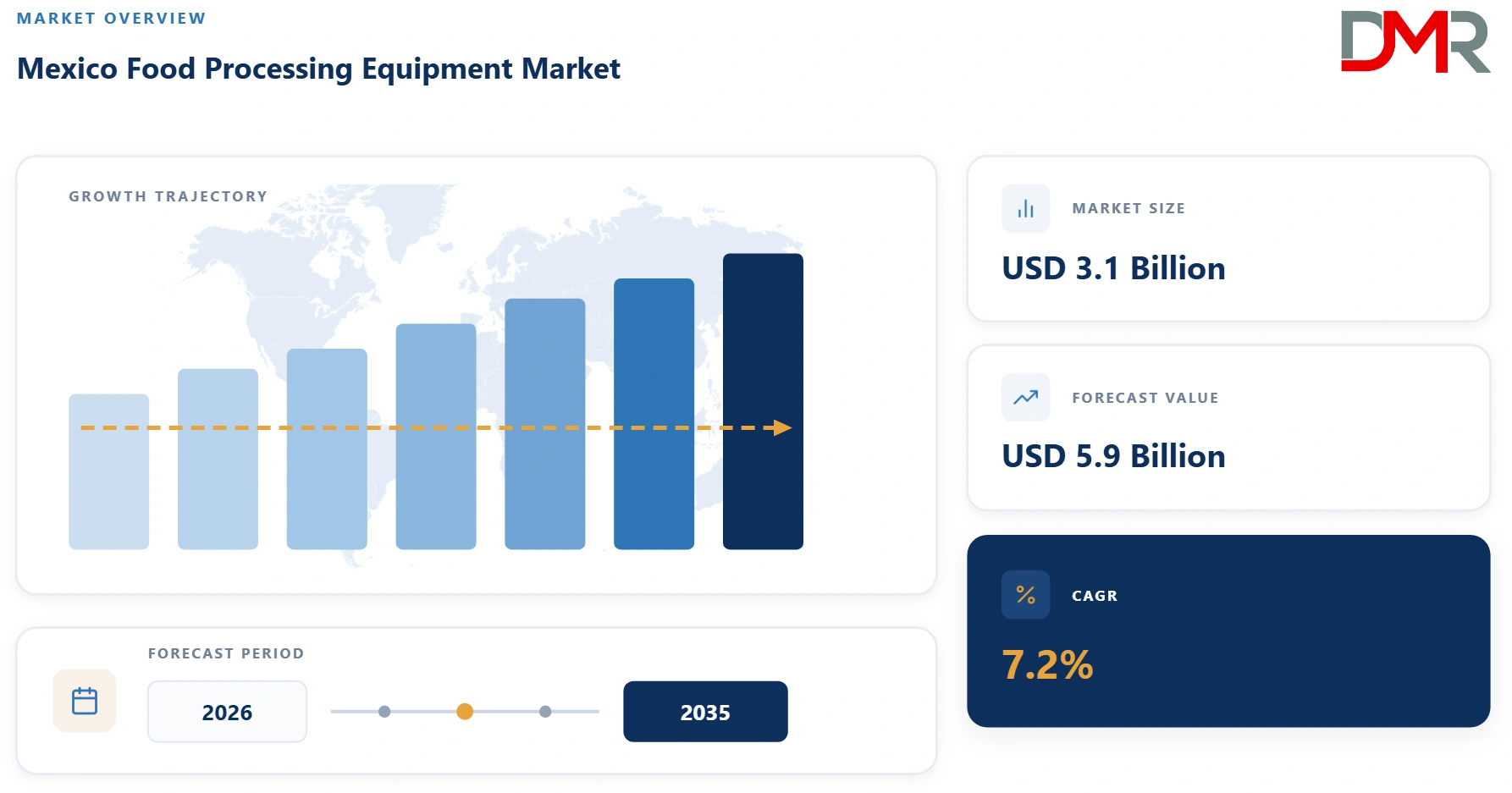
- Mexico Food Processing Equipment Market Size in 2026: USD 3.1 Billion
- Mexico Food Processing Equipment Market Size in 2035: USD 5.9 Billion
- Mexico CAGR from 2026 to 2035: 7.2%
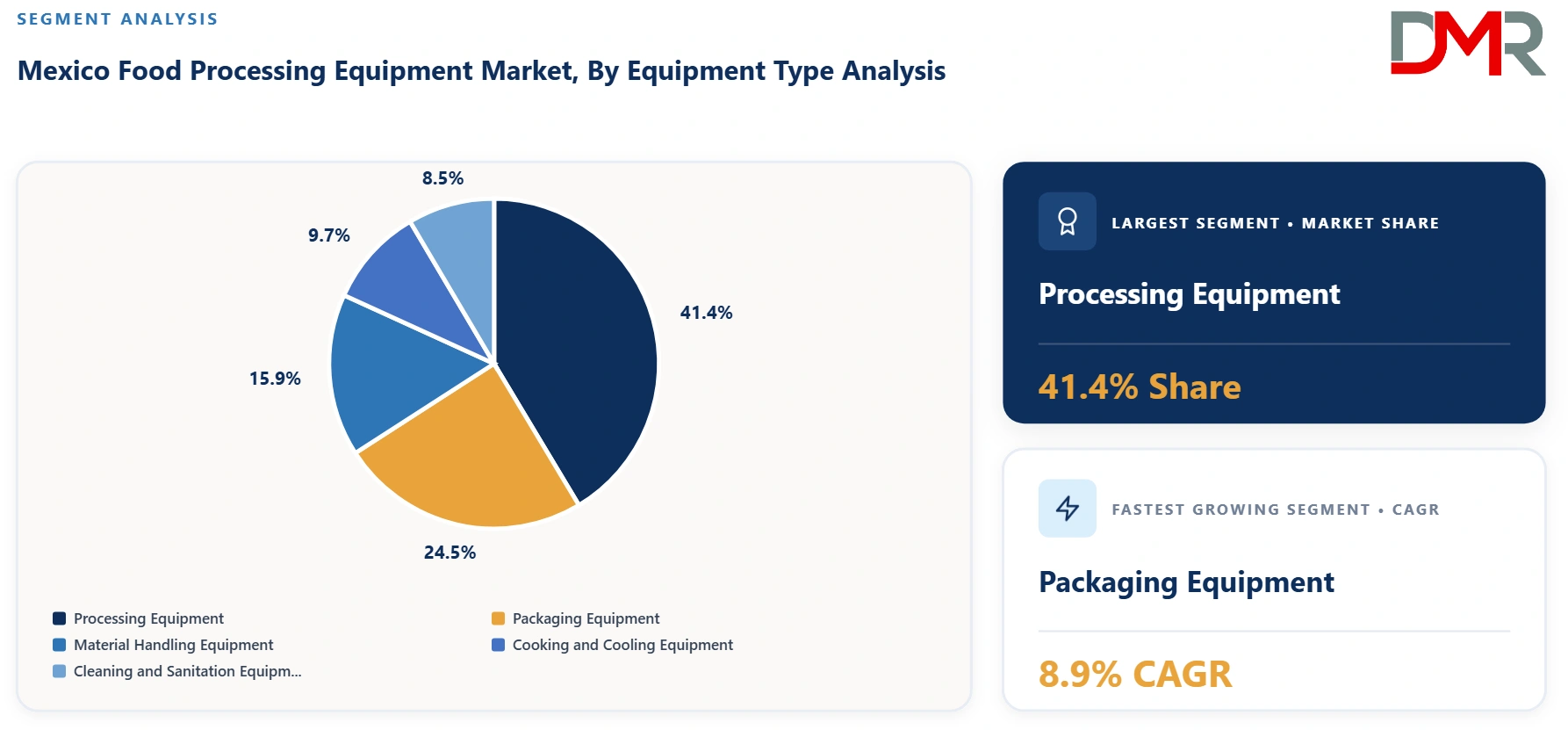
- Processing Equipment is the leading equipment type segment in 2026: 41.4%
- Automatic is the leading mode of operation segment in 2026: 48.7%
- Meat, Poultry and Seafood is the leading food category segment in 2026: 25.8%
- Large-Scale Food Processors is the leading end user segment in 2026: 56.9%
What is the Mexico Food Processing Equipment Market and its Market Size?
The Mexico Food Processing Equipment Market is projected to be valued at USD 3.1 Billion in 2026 and is projected to reach USD 5.9 Billion by 2035, expanding at a CAGR of 7.2% during the forecast period.
ℹ
To learn more about this report –
Download Your Free Sample Report Here
Growth is being propelled by accelerating nearshoring investment as multinational food companies expand Mexican manufacturing capacity to serve the North American market under USMCA trade preferences, sustained growth in Mexico's substantial food export industry spanning produce, beverages, and processed foods, and continued modernization of Mexico's traditional food processing sectors including tortilla, dairy, and meat processing. The maturing of automated, export-compliant processing equipment meeting both Mexican and U.S. food safety standards, growing food manufacturer investment in production capacity supporting nearshoring-driven export growth to the United States and Canada, and expanding domestic Mexican consumer demand for packaged and processed foods amid rising urbanization and disposable incomes are reshaping the market from a historically fragmented, small-scale processing equipment market into an increasingly automated, export-oriented industry. Investment is accelerating as Mexican food processors and multinational companies with Mexican operations expand capacity to capture both nearshoring-driven export opportunities and growing domestic consumption.
Use Cases
- Nearshoring-Driven Food Manufacturing Capacity Expansion for U.S. Export: Multinational and Mexican food companies invest in modern, automated processing equipment at Mexican facilities to expand production capacity serving U.S. and Canadian markets, capitalizing on USMCA trade preferences and lower relative labor and operating costs compared to domestic North American production.
- Automated Meat and Poultry Processing for Growing Export Demand: Mexican meat and poultry processors invest in automated cutting, portioning, and packaging equipment to expand production capacity meeting both strong domestic consumption and growing export demand to the United States and other international markets.
- Traditional Food Processing Modernization for Tortilla and Dairy Products: Mexican food manufacturers invest in modernized, automated equipment for tortilla, dairy, and other traditional Mexican food product categories, improving production efficiency and consistency while preserving the traditional taste and quality characteristics valued by Mexican consumers.
- Beverage Processing Capacity Expansion for Domestic and Export Markets: Mexican beverage manufacturers, including in the substantial beer, tequila, and soft drink categories, invest in modernized bottling, fermentation, and packaging equipment supporting both strong domestic consumption and Mexico's significant beverage export industry.
Key Takeaways
- Market Size: The Mexico Food Processing Equipment Market is anticipated to be valued at USD 3.1 Billion in 2026 and is forecast to reach USD 5.9 Billion by 2035, expanding at a CAGR of 7.2%.
- Growth Outlook: Market expansion is sustained by accelerating nearshoring investment in Mexican food manufacturing capacity, sustained growth in Mexico's substantial food export industry, and continued modernization of traditional Mexican food processing sectors.
- Primary Growth Drivers: Accelerating nearshoring investment under USMCA trade preferences, sustained growth in Mexico's food and beverage export industry, rising domestic consumer demand for packaged and processed foods, and continued modernization of traditional food processing categories are accelerating equipment investment.
- By Equipment Type Analysis: Processing Equipment is projected to lead the equipment type segment with a 41.4% share in 2026, reflecting its central role across Mexico's diverse meat, dairy, bakery, and beverage processing operations. Packaging Equipment is the fastest-growing equipment type segment at 8.9% CAGR, driven by rising demand for automated packaging lines supporting both domestic retail and export product formats.
- By Mode of Operation Analysis: Automatic equipment is expected to dominate with a 48.7% share in 2026, supported by nearshoring-driven investment in modern, export-oriented processing facilities. Automatic is also the fastest-growing mode of operation segment at 9.6% CAGR, as new facility development consistently incorporates advanced automation technology.
- By Food Category Analysis: Meat, Poultry and Seafood is expected to command a 25.8% share in 2026, underpinned by substantial domestic consumption and growing export demand. Beverages is the fastest-growing food category segment at 8.4% CAGR, driven by continued investment across Mexico's significant beer, tequila, and soft drink manufacturing sectors.
- By End User Analysis: Large-Scale Food Processors are projected to dominate with a 56.9% share in 2026, reflecting the scale of nearshoring-driven investment among multinational and large Mexican food companies. Small and Medium-Sized Processors is the fastest-growing end user segment at 9.2% CAGR, driven by falling automation equipment costs and growing domestic market opportunities.
Key Drivers in the Mexico Food Processing Equipment Market
Accelerating Nearshoring Investment Under USMCA Trade Preferences
Mexico's position as a preferred nearshoring destination for multinational manufacturers seeking to serve the North American market while reducing exposure to longer, more complex Asian supply chains has driven substantial new investment in Mexican food manufacturing capacity. USMCA trade preferences, combined with Mexico's proximity to the United States and relatively lower labor and operating costs, are encouraging both multinational food companies and Mexican domestic producers to expand modern, export-compliant processing capacity. This nearshoring trend represents a structurally significant and relatively durable driver of food processing equipment investment, as companies establish new facilities specifically designed around current automation and export compliance standards.
Sustained Growth in Mexico's Substantial Food and Beverage Export Industry
Mexico maintains a substantial and diverse food and beverage export industry spanning fresh produce, processed foods, beverages including beer and tequila, and other categories, with the United States representing the predominant export destination. Continued growth in this export industry, supported by strong bilateral trade relationships and Mexico's established agricultural and food processing expertise, drives sustained investment in processing capacity and equipment modernization to meet both growing export volume requirements and the food safety and quality certification standards required for international market access.
Restraints in the Mexico Food Processing Equipment Market
Security Concerns and Infrastructure Challenges in Certain Production Regions
Security concerns and infrastructure limitations in certain Mexican regions represent a meaningful restraint on the Food Processing Equipment Market, as these factors can affect investment decisions regarding new facility location, complicate logistics and supply chain reliability, and in some cases limit the geographic distribution of food processing capacity expansion to a narrower set of more secure and infrastructure-developed regions. These considerations require food companies and equipment vendors to carefully evaluate regional investment decisions, potentially concentrating growth in already well-developed industrial corridors rather than more broadly distributing capacity expansion across the country.
Growth Opportunities in the Mexico Food Processing Equipment Market
Export Compliance-Focused Equipment and Certification Support Services
Growing nearshoring-driven investment in Mexican food manufacturing capacity oriented toward U.S. and Canadian export presents a significant opportunity for equipment vendors offering processing and packaging systems specifically designed to meet U.S. Food and Drug Administration and other North American food safety compliance standards. Vendors capable of providing integrated compliance documentation and certification support alongside equipment sales can differentiate in a market where export market access requirements are an increasingly central purchasing consideration.
Flexible Financing Models for Small and Medium-Sized Mexican Processors
Growing interest among Mexico's substantial base of small and medium-sized food processors in accessing automation technology without significant upfront capital investment presents an opportunity for equipment vendors offering leasing, financing, and equipment-as-a-service commercial models. These flexible arrangements can lower adoption barriers for resource-constrained processors, expanding the addressable market for automation vendors beyond large nearshoring-focused multinational investment and capturing growth from Mexico's broader domestic food manufacturing sector.
Trends in the Mexico Food Processing Equipment Market
Growing Concentration of Food Processing Investment in Established Industrial Corridors
Mexico's food processing equipment investment is increasingly concentrating within established, well-developed industrial corridors, particularly in northern and central Mexican states with strong transportation infrastructure and proximity to U.S. border crossings, reflecting the logistics advantages these regions offer for nearshoring-driven export-oriented production. This geographic concentration trend is shaping equipment vendor market strategies and service network development, with growing investment in technical support and service infrastructure within these key industrial regions.
Increasing Integration of Automation to Address Rising Labor Costs and Availability Considerations
Mexican food processors are increasingly investing in automation to address rising labor costs and, in certain regions, labor availability considerations affecting food manufacturing operations. This trend reflects both Mexico's evolving labor market dynamics and the broader nearshoring-driven emphasis on production efficiency and consistency required to meet the quality and reliability standards expected by North American export customers.
Research Scope and Analysis
The Mexico Food Processing Equipment Market is segmented by equipment type, mode of operation, food category, and end user, covering processing, packaging, material handling, cooking and cooling, and cleaning and sanitation equipment across meat, bakery, dairy, beverage, and produce processing categories.
ℹ
To learn more about this report –
Download Your Free Sample Report Here
By Equipment Type Analysis
Processing Equipment is projected to dominate the Mexico Food Processing Equipment Market with a 41.4% share in 2026, reflecting its central role across Mexico's diverse meat, dairy, bakery, and beverage processing operations serving both domestic and export markets. Packaging Equipment is expected to register the highest CAGR of 8.9% during 2026-2035, driven by rising processor investment in automated packaging lines capable of supporting both domestic retail distribution and growing export product format requirements.
By Mode of Operation Analysis
Automatic equipment is anticipated to dominate the Mexico Food Processing Equipment Market by mode of operation, accounting for a 48.7% share in 2026, supported by substantial nearshoring-driven investment in modern, export-oriented processing facilities incorporating advanced automation from initial design. Automatic equipment is also projected to register the highest CAGR of 9.6% between 2026 and 2035, as continued nearshoring investment and rising labor cost considerations favor increasing automation levels across both new and modernized Mexican processing facilities.
By Food Category Analysis
Meat, Poultry and Seafood is expected to lead the Mexico Food Processing Equipment Market by food category, accounting for a 25.8% share in 2026, underpinned by substantial domestic consumption alongside growing export demand requiring automated cutting, portioning, and packaging equipment investment. Beverages is projected to achieve the fastest CAGR of 8.4% during 2026-2035, driven by continued modernization investment across Mexico's significant beer, tequila, and soft drink manufacturing sectors serving both domestic and international markets.
By End User Analysis
Large-Scale Food Processors are projected to dominate the Mexico Food Processing Equipment Market with a 56.9% share in 2026, reflecting the substantial scale of nearshoring-driven investment among multinational food companies and large domestic Mexican food processors. Small and Medium-Sized Processors are expected to register the fastest CAGR of 9.2% through 2035, driven by falling automation equipment costs and growing availability of flexible financing options suited to Mexico's substantial base of smaller domestic food manufacturers.
The Mexico Food Processing Equipment Market Report is segmented based on the following:
By Equipment Type
- Processing Equipment
- Packaging Equipment
- Material Handling Equipment
- Cooking and Cooling Equipment
- Cleaning and Sanitation Equipment
By Mode of Operation
- Automatic
- Semi-Automatic
- Manual
By Food Category
- Meat, Poultry and Seafood
- Bakery and Confectionery
- Dairy Products
- Beverages
- Fruits and Vegetables
- Grain Milling and Processing
- Others
By End User
- Large-Scale Food Processors
- Small and Medium-Sized Processors
- Artisanal and Specialty Food Producers
Technology Analysis
Technology development is increasingly shaping competitiveness in the Mexico Food Processing Equipment Market as vendors invest in export-compliant automation systems, digital traceability technology supporting U.S. FDA and USMCA documentation requirements, and energy-efficient processing equipment addressing Mexico's evolving industrial energy cost environment. Growing use of predictive maintenance analytics is helping nearshoring-focused processors maintain the production reliability and consistency required to meet North American export customer quality expectations. Opportunities are expanding for vendors developing equipment specifically designed to meet integrated U.S. and Mexican food safety compliance standards, as well as flexible, cost-effective automation solutions suited to Mexico's substantial base of small and medium-sized domestic food processors. However, security and infrastructure considerations in certain regions, along with the need to navigate both Mexican and U.S. regulatory compliance requirements for export-oriented production, remain important considerations for equipment vendors and processor customers alike.
Investment and White Space Analysis
Investment opportunities in the Mexico Food Processing Equipment Market are expanding alongside accelerating nearshoring-driven manufacturing investment, sustained growth in Mexico's food and beverage export industry, and continued domestic consumption growth supporting broader food processing sector development. Significant white space exists in export compliance-focused equipment and certification support services, flexible financing models for small and medium-sized domestic processors, and automation solutions supporting Mexico's evolving labor cost and availability environment. Vendors with strong export compliance expertise, established relationships with nearshoring-focused multinational and domestic food companies, and flexible commercial financing capability are positioned to capture premium, longer-duration contracts. However, security and infrastructure considerations in certain regions, along with the geographic concentration of nearshoring investment in established industrial corridors, can shape and in some cases limit the broader geographic distribution of equipment investment opportunity.
Competitive Landscape
The Mexico Food Processing Equipment Market is moderately consolidated and increasingly competitive, comprising large diversified global food processing equipment manufacturers, U.S. and North American equipment suppliers well positioned to serve nearshoring-driven cross-border investment, and specialty Mexican equipment suppliers serving traditional domestic food processing categories. Competition centers on export compliance certification capability, integration with North American food safety and quality standards, established relationships with nearshoring-focused multinational food companies, and comprehensive after-sales service and technical support across Mexico's geography. Large diversified global equipment manufacturers benefit from broad product portfolios and established food safety certification credibility relevant to export-oriented production, while specialty Mexican suppliers compete on deep expertise in traditional food processing categories and closer domestic market relationships. Companies increasingly differentiate through export compliance support and flexible financing models rather than equipment sales alone.
Some of the prominent players in the Mexico Food Processing Equipment Market are:
- JBT Marel Corporation
- GEA Group AG
- Bühler AG
- Tetra Pak International S.A.
- Krones AG
- Alfa Laval AB
- SPX FLOW, Inc.
- The Middleby Corporation
- Heat and Control, Inc.
- MULTIVAC Group
- Syntegon Technology GmbH
- tna solutions Pty Ltd
- BAADER
- Meyn Food Processing Technology B.V.
- Cabinplant A/S
- Hiperbaric S.A.
- Urschel Laboratories, Inc.
- KRONEN GmbH
- Provisur Technologies, Inc.
- Handtmann Maschinenfabrik GmbH & Co. KG
- VEMAG Maschinenbau GmbH
- Risco S.p.A.
- Baker Perkins Ltd.
- Coperion GmbH
- TOMRA Food
- Key Technology, Inc.
- Ishida Co., Ltd.
- Sesotec GmbH
- Elea Technology GmbH
- Lyco Manufacturing, Inc.
- Marlen International
- Reiser
- ProXES GmbH
- FAM STUMABO
- Grote Company
- KHS GmbH
- PROBAT SE
- SANOVO TECHNOLOGY GROUP
- Moba Group
- Bucher Industries AG
- Other Key Players
Recent Developments
- May 2026: Duravant companies Key Technology, PPM Technologies, Mespack and others announced the presentation of food-processing and packaging technologies at EXPO PACK México 2026, including optical sorting, seasoning, conveying and automation systems for processors.
- May 2025: Bühler broke ground on a new manufacturing facility in Torreón, Mexico, investing USD 24 million in the first phase. Scheduled for operation in Q2 2026, the facility will manufacture equipment supporting Bühler’s Grains & Food business.
- September 2025: IFC provided USD 30 million financing to Grupo Naturasol to support the acquisition and installation of new production lines for its potato and corn-processing operations in Mexico, expanding capacity and improving production efficiency.
- June 2025: MULTIVAC participated in EXPO PACK Guadalajara 2025, held June 10–12, showcasing its latest processing and packaging solutions focused on automation, operational efficiency, sustainability and digitalization for Mexico and the broader Latin American market.
Report Details
| Report Characteristics |
| Market Size (2026) |
USD 3.1 Bn |
| Forecast Value (2035) |
USD 5.9 Bn |
| CAGR (2026–2035) |
7.2% |
| Historical Data |
2021 – 2025 |
| Forecast Data |
2026 – 2035 |
| Base Year |
2025 |
| Segments Covered |
By Equipment Type, By Mode of Operation, By Food Category, and By End User |
| Country Coverage |
Mexico |
Frequently Asked Questions
How big is the Mexico Food Processing Equipment Market?
▾ The Mexico Food Processing Equipment Market is poised to be valued at USD 3.1 Billion in 2026 and is projected to reach USD 5.9 Billion by 2035, reflecting accelerating nearshoring investment and sustained growth in Mexico's food and beverage export industry.
What is the CAGR of the Mexico Food Processing Equipment Market from 2026 to 2035?
▾ The market is projected to expand at a compound annual growth rate (CAGR) of 7.2% between 2026 and 2035, supported by nearshoring-driven manufacturing investment, sustained export growth, and continued domestic consumption expansion.
What factors are driving the growth of the Mexico Food Processing Equipment Market?
▾ Growth is driven by accelerating nearshoring investment under USMCA trade preferences, sustained growth in Mexico's food and beverage export industry, rising domestic consumer demand for packaged and processed foods, and continued modernization of traditional food processing categories.
What are the major trends in the Mexico Food Processing Equipment Market?
▾ Major trends include growing concentration of food processing investment in established industrial corridors, increasing integration of automation to address rising labor costs, and continued export compliance-focused equipment and certification investment.
Who are the key players in the Mexico Food Processing Equipment Market?
▾ Key market participants include GEA Group, Tetra Pak, Bühler Group, JBT Corporation, and Marel, among other global and specialty equipment manufacturers serving Mexico's nearshoring-driven food processing sector.
How is the Mexico Food Processing Equipment Market segmented?
▾ The market is segmented by equipment type, mode of operation, food category, and end user, with demand analysis concentrated across Nuevo León, Jalisco, the Bajío region, and Mexico City.