Mexico Rainwater Harvesting Market Snapshot
- Mexico Rainwater Harvesting Market Size in 2026: USD 22.1 Billion
- Mexico Rainwater Harvesting Market Size in 2035: USD 34.9 Billion
- Mexico CAGR from 2026 to 2035: 5.2%
- Rooftop Rainwater Harvesting is the leading type segment in 2026: 45.2%
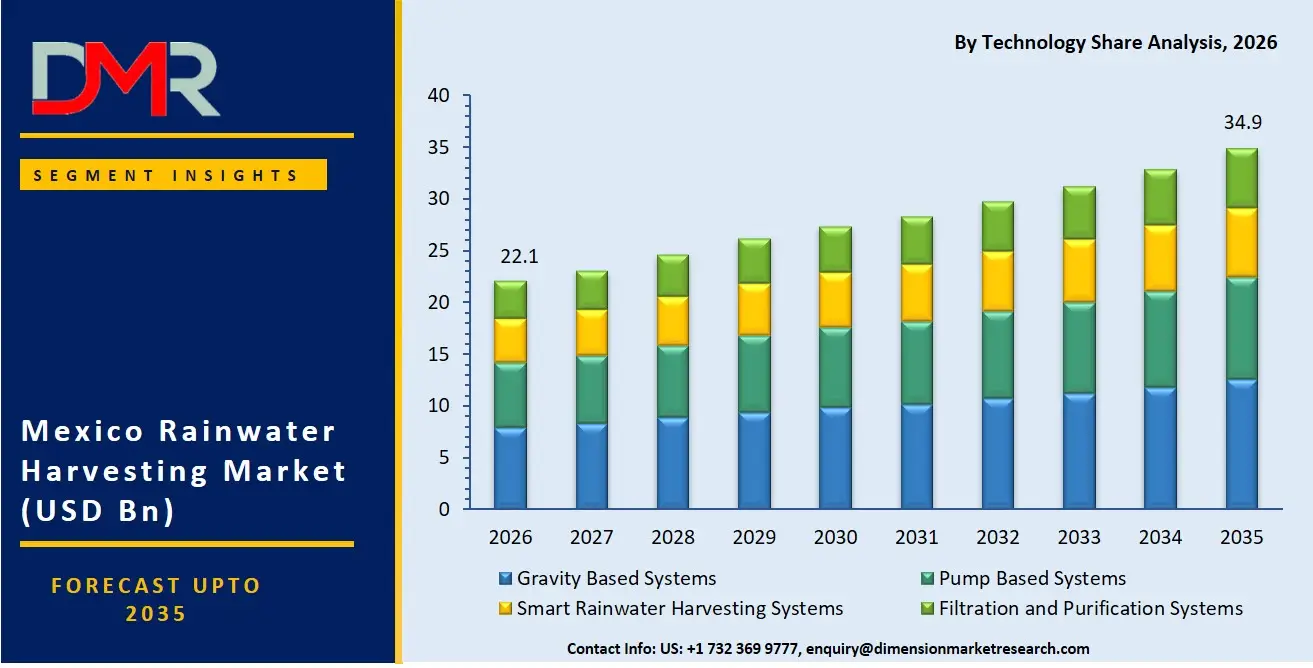
- Gravity Based Systems is the leading technology segment in 2026: 41.8%
- Residential Buildings is the leading catchment area segment in 2026: 38.5%
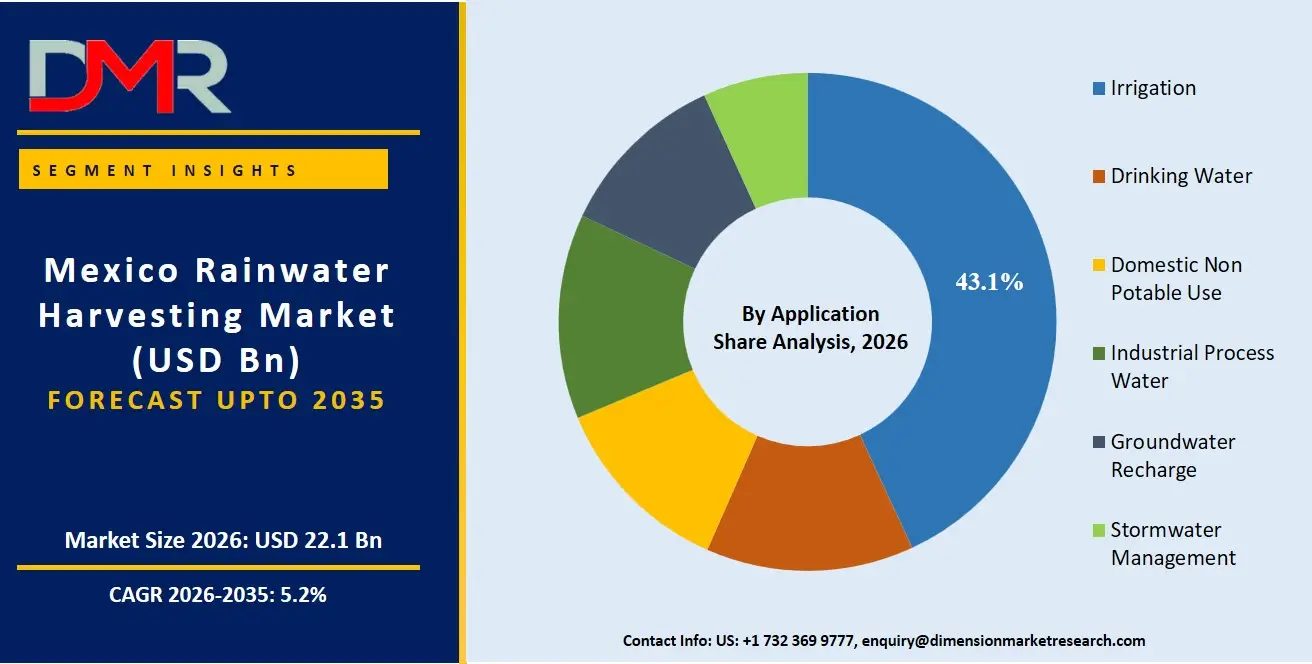
- Irrigation is the leading application segment in 2026: 43.1%
- Agricultural is the leading end-user segment in 2026: 29.1%
What is the Mexico Rainwater Harvesting Market and its Market Size?
Rainwater harvesting in Mexico is a critical water management discipline encompassing the capture, diversion, and storage of precipitation for beneficial use, mitigating the nation's acute water stress and aquifer depletion. It integrates a comprehensive ecosystem of catchment surfaces, conveyance systems, first-flush diverters, filtration and purification technologies, and storage infrastructure from modular underground cisterns to large-scale surface reservoirs to validate critical parameters such as potability, sediment removal efficiency, and sustainable groundwater yield across residential, agricultural, and industrial sectors. Federal, state, and municipal entities, alongside commercial enterprises and rural communities lacking reliable centralized water supply, depend on rainwater harvesting systems to ensure water security, buffer against prolonged drought cycles, and meet stringent environmental discharge and aquifer conservation mandates.
ℹ
To learn more about this report –
Download Your Free Sample Report Here
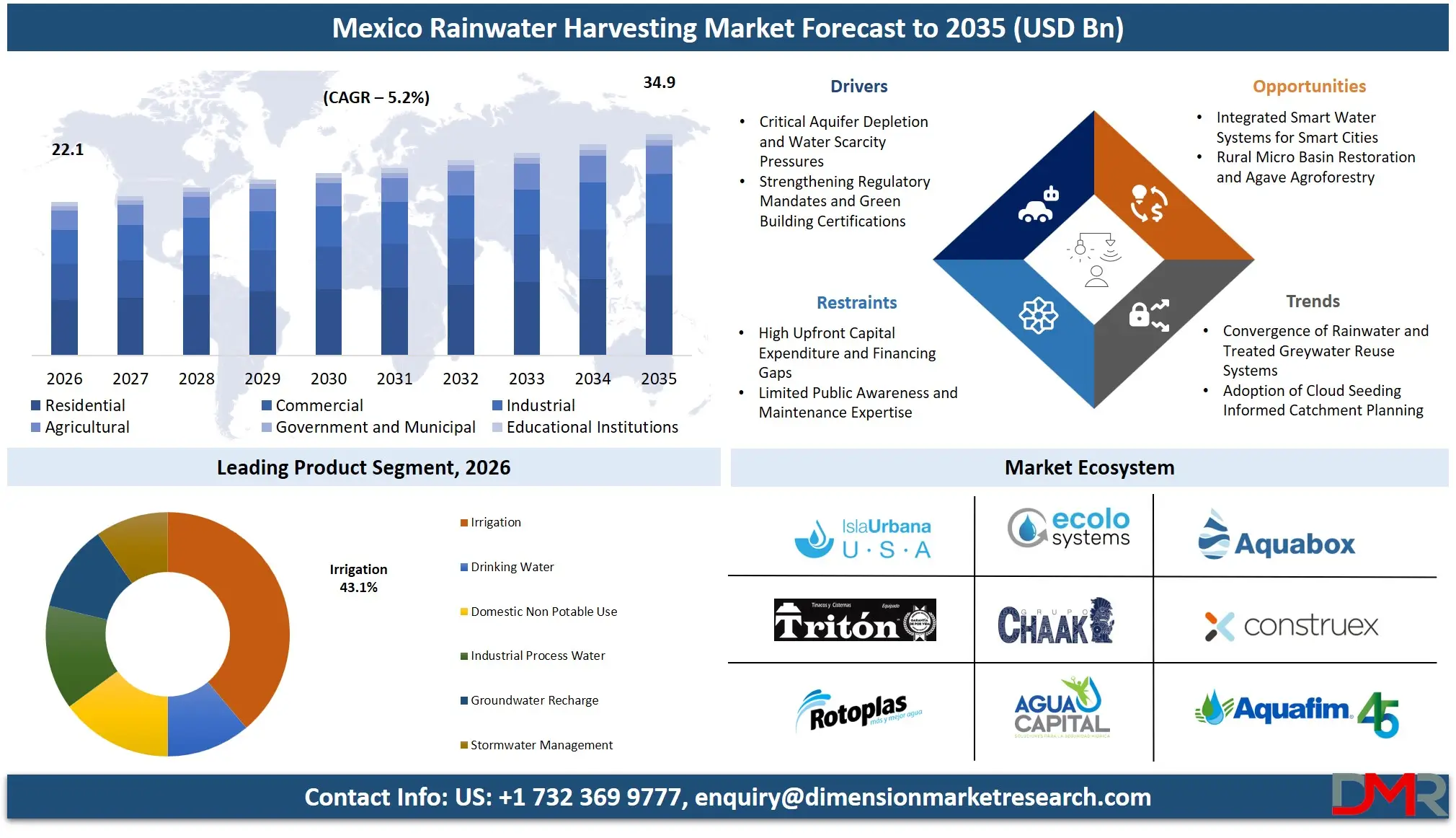
The Mexico Rainwater Harvesting Market is projected to be valued at USD 22.1 billion in 2026 and is projected to reach USD 34.9 billion by 2035, expanding at a CAGR of 5.2% during the forecast period. Growth is being driven by escalating water insecurity due to climate change-induced erratic rainfall, critically overdrafted aquifers in the Bajío and northern regions, a national push for decentralized water infrastructure, and government programs like the "Cosecha de Lluvia" (Rain Harvest) initiative. Investment is accelerating as the market moves beyond simple rain barrels toward integrated, smart water management systems that combine capture, advanced multi-stage purification, and IoT-enabled cistern monitoring to validate water quality and optimize consumption before reliance on the stressed national grid.
Use Cases
- Decentralized Potable Water Supply for Peri-Urban and Rural Settlements: Communities on the fringes of Mexico City, Monterrey, and Guadalajara, where piped water is intermittent, deploy rooftop rainwater harvesting systems coupled with sediment filters, activated carbon, and UV disinfection trains to generate a decentralized, potable drinking water supply, validating compliance with NOM-127-SSA1 water quality standards.
- Agricultural Resilience and Fertigation in Arid Regions: Agribusinesses in Sonora and Baja California utilize large-scale surface runoff harvesting and lined farm ponds to capture seasonal monsoon flows.
- Industrial Process Water and Corporate Water Stewardship: Manufacturing and beverage facilities in the industrial corridors of Nuevo León and Querétaro deploy rooftop and parking lot catchment systems, channeling harvested stormwater into above-ground modular tanks.
- Managed Aquifer Recharge and Subsidence Control: Municipal governments and water utilities in cities like León and Querétaro deploy check dams and injection wells at scale to capture intense stormwater runoff, directing it into infiltration basins for managed aquifer recharge.
Key Takeaways
- Market Size: The Mexico Rainwater Harvesting Market is valued at USD 22.1 billion in 2026 and is forecast to reach USD 34.9 billion by 2035, expanding at a CAGR of 5.2%.
- Growth Outlook: Market expansion is supported by critical national water stress, the cessation of groundwater extraction permits in overdrafted zones, growing corporate ESG mandates for water circularity, and the proliferation of micro-catchment projects for food sovereignty in rainfed agricultural areas.
- Primary Growth Drivers: A dire water crisis marked by "Day Zero" scenarios in major metropolitan areas, rising municipal water tariffs and discharge fees, the high energy costs of pumping deep groundwater, and a robust policy framework mandating rainwater capture in new developments across Mexico City and other states are accelerating investment.
- By Type Analysis: Rooftop Rainwater Harvesting is projected to lead the segment with a dominant 45.2% share in 2026, driven by its mandatory inclusion in new building codes and its direct applicability for capturing clean rainwater from impervious roofs before it becomes contaminated surface runoff.
- By Technology Analysis: Gravity Based Systems is expected to dominate with a 41.8% share in 2026, underpinned by low operational costs, zero energy consumption, and suitability for the gravity-flow architecture of residential and small-scale community water distribution networks.
- By Catchment Area Analysis: Residential Buildings is anticipated to lead with a 38.5% share in 2026, fueled by large-scale government-subsidized rooftop system installations and a growing culture of household water self-sufficiency in water-scarce municipalities.
- By End User Analysis: The Agricultural sector is projected to hold a significant 29.1% share in 2026, driven by an urgent need to sustain crop yields, capture seasonal runoff for dry-season irrigation, and reduce the pressure on over-concessioned agricultural aquifers.
How AI and IoT are Transforming the Mexico Rainwater Harvesting Market?
The Internet of Things (IoT) is fundamentally transforming rainwater harvesting by enabling intelligent, real-time water asset management across the hydrological cycle. Smart sensor networks on cisterns, tanks, and check dams dynamically monitor water levels, track inflow and outflow rates, and classify water quality parameters like turbidity and pH in real time. Predictive analytics platforms correlate local weather forecast data with current storage levels, automatically instructing automated actuators to divert pre-storm first-flush runoff or optimize the release of stored water for subsurface irrigation, significantly reducing spillage and enhancing net catchment efficiency. This capability is critical for validating a system's yield and water quality without manual intervention.
The next frontier of adoption involves agentic AI workflows that orchestrate closed-loop, autonomous water management at the district or smart city scale. In this paradigm, an AI engine detects a forecast for a high-intensity precipitation event, instantly instructs networked smart valves across a housing complex to isolate cisterns that have already reached storage capacity and redirect excess flow to shared infiltration basins for managed aquifer recharge. Simultaneously, the system correlates soil moisture sensor baselines with evapotranspiration models to schedule precise drip irrigation cycles. This capability compresses the decision-to-action cycle for stormwater management from hours to seconds. However, for these autonomous systems to be trusted for potable water distribution decisions, they require strict governance on sensor calibration, data integrity, and fail-safe manual overrides to prevent cross-contamination or structural damage to storage systems.
Key Drivers in the Mexico Rainwater Harvesting Market
Critical Aquifer Depletion and Water Scarcity Pressures
The severe over-extraction of groundwater from Mexico's aquifers is a primary driver for the rainwater harvesting market. With over 100 aquifers officially declared as overdrafted, the government is increasingly restricting agricultural and industrial water concessions. This hydrological crisis directly fuels demand for alternative water supply systems that capture precipitation at the point of use. The growing unreliability of municipal piped water, manifested in "tandeo" (water rationing) schedules, makes decentralized rainwater harvesting for domestic potable and non-potable use an essential resilience strategy for households and businesses that can no longer depend on the grid.
Strengthening Regulatory Mandates and Green Building Certifications
A tightening web of state and municipal building codes is mandating rainwater harvesting infrastructure. Mexico City's landmark regulation requiring rainwater capture systems in all new residential and commercial developments is being replicated in other water-stressed states. Furthermore, green building certifications like LEED and the national NMX-AA-164-SCFI standard reward water efficiency and on-site stormwater management with valuable scoring criteria. These legal and market-driven pressures transform rainwater harvesting from a voluntary sustainability practice into a non-negotiable element of construction permitting and property valuation, driving institutional-scale investment.
Restraints in the Mexico Rainwater Harvesting Market
High Upfront Capital Expenditure and Financing Gaps
The initial capital outlay for a comprehensive rainwater harvesting system including first-flush diversion, multi-barrier filtration, UV purification, and adequate storage capacity remains a significant barrier, particularly for low-income households and small-scale farmers. While the long-term savings on water bills and irrigation costs are demonstrable, the lack of accessible, low-interest green financing or government subsidy clawback mechanisms can block adoption. The absence of a mature, pay-as-you-save financing model specific to water infrastructure prevents the market from fully scaling across all socioeconomic segments, constraining growth to grant-dependent projects.
Growth Opportunities in the Mexico Rainwater Harvesting Market
Integrated Smart Water Systems for Smart Cities
A significant growth opportunity lies in developing IoT-enabled, utility-managed decentralized water networks that aggregate thousands of residential and commercial cisterns into a single, controllable virtual reservoir. This approach allows water utilities in cities like Monterrey and Guadalajara to remotely manage stored rainwater, using predictive algorithms to orchestrate releases for drought buffering or to create storage headspace before a forecasted storm to prevent urban flooding. This model transforms passive harvesting into an active stormwater management and drought resilience tool, creating a recurring revenue stream through "Water-as-a-Service" contracts and grid optimization fees.
Rural Micro-Basin Restoration and Agave Agroforestry
The intersection of rainwater harvesting and regenerative agriculture in rural zones creates a massive opportunity for check dams, contour swales, and keyline water harvesting systems. Government and NGO programs focused on recharging aquifers in the severely degraded Lerma-Chapala basin are promoting the integration of water harvesting earthworks with high-value, drought-tolerant crops like agave for mezcal production. This approach captures surface runoff to arrest soil erosion, passively infiltrates moisture to recharge the water table, and generates a sustainable cash crop, creating a holistic, economically viable model for watershed restoration that moves beyond subsistence farming.
Trends in the Mexico Rainwater Harvesting Market
Convergence of Rainwater and Treated Greywater Reuse Systems
The market is witnessing a convergence of rainwater harvesting with on-site greywater recycling into a unified, closed-loop residential and commercial water circularity system. Rather than simply capturing roof runoff, modern designs integrate pre-filtered bathroom and laundry greywater with rainwater in a centralized holding tank for subsurface drip irrigation. This trend is driven by advanced, compact membrane bioreactors that can co-treat both sources to near-potable standards for non-contact applications. This holistic design simplifies building plumbing, maximizes water autonomy, and reduces total storage capacity requirements by managing multiple non-potable water streams in a single system.
Adoption of Cloud Seeding-Informed Catchment Planning
A forward-looking trend is the integration of atmospheric water generation potential into the strategic planning of rainwater harvesting infrastructure. Meteorological agencies and agricultural cooperatives are correlating operational cloud seeding program data with surface catchment yields to optimize the placement of new check dams and farm ponds. By validating the hyper-local precipitation enhancement effect of weather modification, large agribusinesses can create predictive models for storage system sizing and controlled-release irrigation scheduling. This trend positions rainwater harvesting as a receptor for advanced weather resource management, maximizing every drop of stimulated precipitation for productive agricultural or municipal use.
Research Scope and Analysis
The Mexico Rainwater Harvesting Market is segmented by type, technology, catchment area, storage system, application, and end user. Types include rooftop, surface runoff, check dams, and others. The study evaluates technologies across gravity-based, pump-based, smart, and filtration systems, and analyzes adoption across diverse catchment surfaces, storage modalities, and end-use applications within key economic sectors.
ℹ
To learn more about this report –
Download Your Free Sample Report Here
By Type Analysis
Rooftop Rainwater Harvesting is projected to dominate the Mexico Rainwater Harvesting Market with a 45.2% market share in 2026, driven by its ability to collect relatively clean rainwater directly from rooftops with minimal treatment requirements. The technology is widely adopted across residential and institutional buildings because of its affordability, ease of installation, and compatibility with decentralized water supply systems. Surface Runoff Harvesting holds the second-highest market share, supported by its extensive use in agricultural irrigation and aquifer recharge projects. Check Dams are projected to register the highest CAGR, fueled by increasing investments in watershed restoration, groundwater recharge, and soil conservation initiatives across Mexico.
By Technology Analysis
Gravity Based Systems are anticipated to dominate the Mexico Rainwater Harvesting Market with a 41.8% market share in 2026, owing to their energy-free operation, low installation cost, and simple maintenance requirements. They remain the preferred technology for residential, institutional, and small agricultural installations because they efficiently transport rainwater without pumps.
ℹ
To learn more about this report –
Download Your Free Sample Report Here
Filtration and Purification Systems account for the second-highest market share, driven by rising demand for potable water applications and compliance with national water quality standards. Smart Rainwater Harvesting Systems are expected to witness the highest CAGR, supported by growing adoption of IoT-enabled monitoring, automated controls, and predictive water management solutions.
By Catchment Area Analysis
Residential Buildings are projected to dominate the Mexico Rainwater Harvesting Market with a 38.5% market share in 2026, supported by the country's extensive residential housing base and increasing installation of rooftop harvesting systems. Growing water scarcity and supportive building regulations continue to encourage adoption. Commercial Buildings hold the second-highest market share, driven by sustainability initiatives and increasing use of harvested rainwater for facility operations. Industrial Facilities are anticipated to register the highest CAGR, as industries increasingly invest in large-scale rainwater collection systems to reduce municipal water dependence, lower operational costs, and strengthen long-term water security.
By Storage System Analysis
Above Ground Tanks are projected to dominate the Mexico Rainwater Harvesting Market with the highest market share in 2026, driven by their low installation cost, simple maintenance, and ease of inspection and retrofitting for residential, commercial, and institutional applications. These systems are widely preferred because they require minimal excavation and can be rapidly deployed in both urban and rural settings. Underground Tanks hold the second-highest market share, supported by increasing adoption in space-constrained commercial developments and high-density urban areas where aesthetics and land optimization are important. Modular Tanks are expected to register the highest CAGR, fueled by rising demand for scalable, high-capacity, and flexible water storage solutions in smart buildings, industrial facilities, and large infrastructure projects.
By Application Analysis
Irrigation is expected to dominate the Mexico Rainwater Harvesting Market with the highest market share in 2026, as agriculture remains the country's largest consumer of freshwater and increasingly relies on harvested rainwater during seasonal droughts. Domestic Non Potable Use accounts for the second-highest market share, driven by widespread use of harvested rainwater for toilet flushing, laundry, cleaning, and landscape irrigation. Groundwater Recharge is projected to record the highest CAGR, supported by rising investments in aquifer restoration, infiltration infrastructure, and government programs addressing groundwater depletion and land subsidence.
By End User Analysis
The Agricultural segment is projected to dominate the Mexico Rainwater Harvesting Market with a 29.1% market share in 2026, driven by increasing demand for sustainable irrigation water amid groundwater depletion and climate variability. Farmers continue investing in rainwater harvesting systems to improve water availability and agricultural resilience. The Residential segment holds the second-highest market share, supported by growing household adoption of rooftop rainwater harvesting systems and government subsidy programs. The Government and Municipal segment is anticipated to register the highest CAGR, fueled by expanding investments in stormwater harvesting, aquifer recharge projects, and urban water resilience infrastructure.
The Mexico Rainwater Harvesting Market Report is segmented on the basis of the following:
By Type
- Rooftop Rainwater Harvesting
- Surface Runoff Harvesting
- Check Dams
- Others
By Technology
- Gravity Based Systems
- Pump Based Systems
- Smart Rainwater Harvesting Systems
- IoT-enabled Monitoring Devices
- Automated Diversion Valves
- Predictive Weather Analytics
- Filtration and Purification Systems
- First-Flush Diverters
- Sediment Filtration
- Carbon Filtration
- UV Disinfection
- Reverse Osmosis Membranes
By Catchment Area
- Residential Buildings
- Commercial Buildings
- Industrial Facilities
- Institutional Buildings
- Open Fields
- Others
By Storage System
- Above Ground Tanks
- Polyethylene Tanks
- Steel Silos
- Underground Tanks
- Concrete Cisterns
- Fiberglass Tanks
- Rain Barrels
- Modular Tanks
- Geocellular Crates
- Panelized Cisterns
By Application
- Irrigation
- Drip and Micro-Irrigation
- Landscape and Garden Watering
- Drinking Water
- Domestic Non Potable Use
- Toilet Flushing
- Laundry and Cleaning
- Industrial Process Water
- Cooling Tower Makeup
- Boiler Feed Water
- Groundwater Recharge
- Managed Aquifer Recharge (MAR)
- Infiltration Basins and Injection Wells
- Stormwater Management
- Flood Mitigation
- Erosion Control
By End User
- Residential
- Commercial
- Industrial
- Agricultural
- Government and Municipal
- Educational Institutions
Regulatory Landscape
The regulatory landscape is the primary, non-negotiable catalyst for rainwater harvesting investment in Mexico. In Mexico City, the construction code (Reglamento de Construcciones) mandates that all new residential, commercial, and industrial buildings exceeding a specific size must install a functioning rainwater harvesting system, transforming an optional sustainability measure into a legal prerequisite for a certificate of occupancy. At the national level, NOM-127-SSA1 sets the permissible water quality limits for potable consumption, directly shaping the specification and validation of multi-barrier filtration and purification systems. Federal water authority CONAGUA's formal closure of over-extracted aquifers to new abstraction permits creates a powerful regulatory forcing function, compelling industries and developers to adopt rainwater capture as their primary alternative source for water rights compliance and environmental impact assessment approval.
Investment and White Space Analysis
The strongest investment opportunities lie in developing vertically integrated, IoT-native water technology platforms that combine smart cistern sensors, automated diversion controls, and a user-facing water budget dashboard into a single, seamless interface that reduces the management burden for homeowners and facility managers. Significant white space exists in developing an end-to-end, lease-to-own financing and service model for the commercial and industrial sector, where a vendor designs, installs, owns, and operates the entire on-site rainwater capture and treatment asset, selling the treated non-potable water back to the facility at a contracted rate below the municipal tariff. Emerging growth areas include specialized atmospheric-sealed underground storage and treatment systems for food and beverage plants, and dedicated sub-surface drip fertigation integration services that combine harvested rainwater with organic nutrient dosing for protected agriculture in the Bajío region.
Competitive Landscape
The Mexico Rainwater Harvesting Market features a fragmented landscape ranging from specialized local system integrators to large, diversified water infrastructure and building materials conglomerates. At the high end, firms like Rotoplas, Amanco Wavin, and Grupo IUSA compete on the breadth of their polymer tank and smart plumbing product portfolios, the strength of their distribution networks, and the quality of their water purification certification. This tier competes intensely on warranty terms and on-site after-sales service. The competitive field expands in the institutional and agricultural segment, where specialized engineering firms like IDE Technologies and local hydrological consultancies compete on the design-build of large-scale aquifer recharge projects, check dam construction, and open-field surface runoff earthworks. Strategic differentiation increasingly hinges on providing a unified, data-driven water autonomy platform that fuses IoT-enabled cistern monitoring with certified, zero-maintenance filtration, supported by performance guarantees on water quality and a verifiable return on investment that appeals to both residential consumers and corporate ESG auditors.
Some of the prominent players in the Mexico Rainwater Harvesting Market are:
- Grupo Rotoplas
- Isla Urbana
- Tinacos Triton
- Aquabox (Herrozinc)
- Grupo Chaak
- Grupo Ecolo-Systems
- Sipremex, S.A. de C.V.
- Grupo Biodis
- Grupo Ciima, S.A. de C.V.
- Distribuidor Nacional (Cisternas)
- Bodega de Tinacos
- Construex México
- Agua Capital
- AQUAFIM SA DE CV
- ISH (Irrigation Solutions)
- Kingspan Group
- Watts Water Technologies, Inc.
- Graf Group
- WISY AG
- Innovative Water Solutions LLC
- Rain Harvesting Supplies, Inc.
- Stormsaver Ltd
- Rainwater HOG
- Bushman
- Roth North America
- Wahaso (Water Harvesting Solutions)
- The RainCatcher, Inc.
- CST Industries
- Brac Systems
- Aquascape
- Other Key Players
Recent Developments
- In May 2026, Rotoplas published its 2025 Sustainable Development Impact Disclosure, highlighting measurable progress toward the UN Sustainable Development Goals and reinforcing its long-term strategy for sustainable water management and climate resilience across the Americas.
- In February 2026, Rotoplas announced that its Escuelas con Agua initiative, implemented with Fundación Coca-Cola, Coca-Cola bottlers, and Isla Urbana, completed the installation of 1,032 IoT-enabled rainwater harvesting systems in schools across Mexico by the end of 2025, benefiting more than 332,000 students through improved access to sustainable water supplies.
- In October 2025, Rotoplas became the first company in Mexico to receive recognition from the National Water Commission (Conagua) as a Water-Responsible Company, acknowledging its commitment to water efficiency, sustainable water management technologies, and innovation in water security solutions.
Report Details
| Report Characteristics |
| Market Size (2026) |
USD 22.1 Bn |
| Forecast Value (2035) |
USD 34.9 Bn |
| CAGR (2026–2035) |
5.2% |
| Historical Data |
2021 – 2025 |
| Forecast Data |
2027 – 2035 |
| Base Year |
2025 |
| Estimate Year |
2026 |
| Segments Covered |
By Type, By Technology, By Catchment Area, By Storage System, By Application, and By End User |
| Country Coverage |
Mexico |
Frequently Asked Questions
How big is the Mexico Rainwater Harvesting Market?
▾ The Mexico Rainwater Harvesting Market is projected to reach USD 34.9 billion by 2035, reflecting strong national demand for decentralized water capture, water security, and aquifer conservation solutions.
What is the CAGR of the Mexico Rainwater Harvesting Market from 2026 to 2035?
▾ The market is projected to expand at a compound annual growth rate (CAGR) of 5.2% between 2026 and 2035, supported by sustained investment in residential, agricultural, and municipal-scale systems to counter critical water stress and regulatory mandates.
What factors are driving the growth of the Mexico Rainwater Harvesting Market?
▾ Growth is driven by critical aquifer depletion and water rationing, a national push for decentralized water infrastructure, escalating municipal water tariffs, the high energy costs of deep-well pumping, and mandatory building code requirements for rainwater capture in new developments.
What are the major trends in the Mexico Rainwater Harvesting Market?
▾ Major trends include the convergence of rainwater and greywater systems into unified closed-loop circuits, the integration of IoT and AI for predictive, autonomous cistern management, a shift toward managed aquifer recharge for subsidence control, and the rapid rise of financing models for commercial-scale water circularity.
Which segment held the largest share of the Mexico Rainwater Harvesting Market in 2026?
▾ The Rooftop Rainwater Harvesting segment is expected to lead the market with a 45.2% share in 2026, supported by mandatory building code compliance, residential subsidy programs, and its direct applicability for generating clean household water from existing roof footprints.
Which end user is expected to grow the fastest in the Mexico Rainwater Harvesting Market?
▾ The Government and Municipal sector is expected to record the fastest growth through 2035, driven by public infrastructure investment in city-wide stormwater capture, aquifer recharge masterplans, and flood mitigation projects to address urban water resilience.
Who are the key players in the Mexico Rainwater Harvesting Market?
▾ Key market participants include Grupo Rotoplas, Amanco Wavin (Orbia), Isla Urbana, Soluciones Pluviales, NETA Cero, IDE Technologies, and EcoAgua, among other domestic system integrators and global water technology firms with a local presence.
How is the Mexico Rainwater Harvesting Market segmented?
▾ The market is segmented by type, technology, catchment area, storage system, application, and end user, with the analysis covering the distinct demand profiles and growth outlook for rooftop harvesting, smart water management, agricultural irrigation, and municipal aquifer recharge across Mexico.