Middle East & Africa Prayer Mat Market snapshot
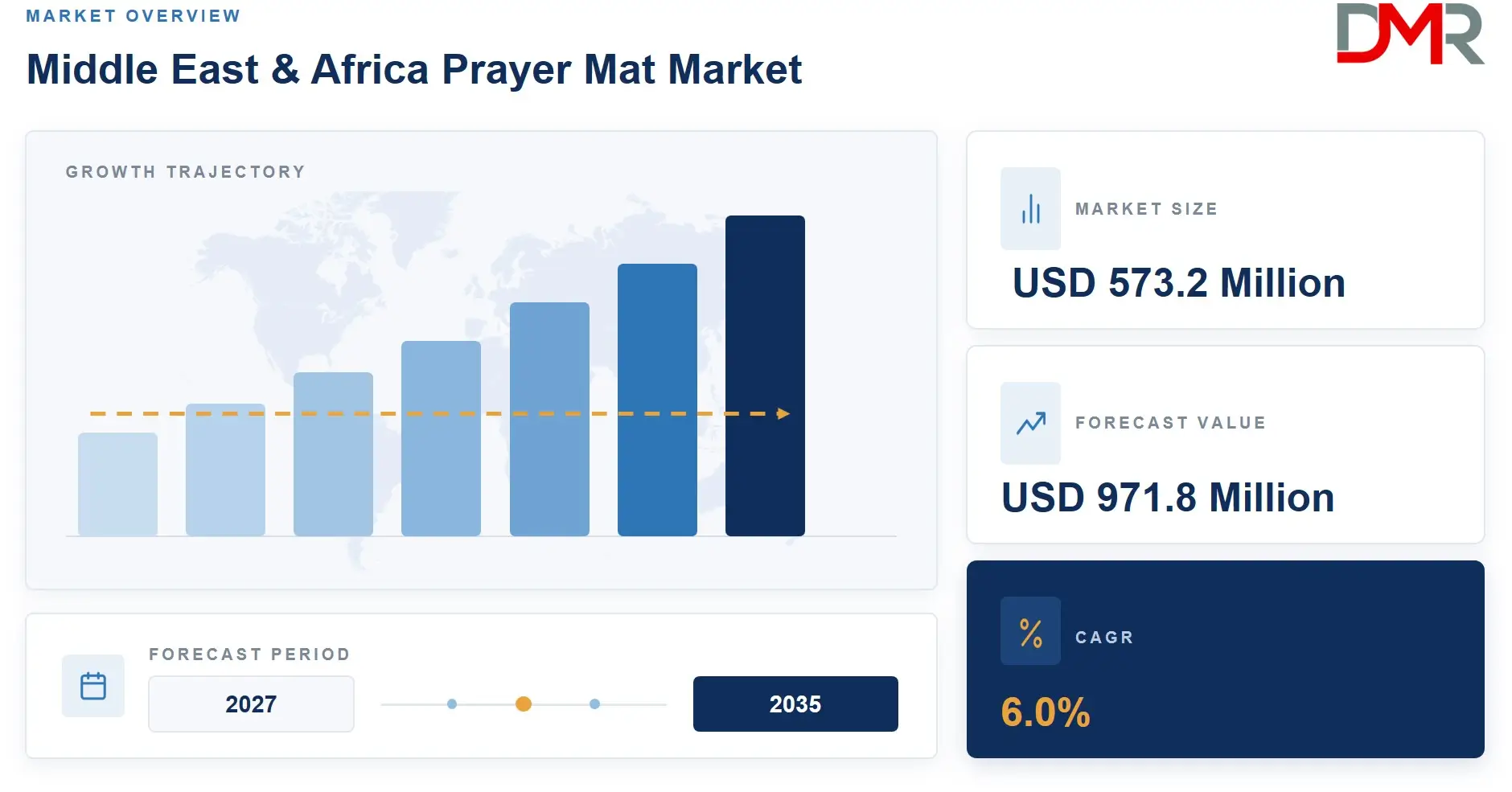
- Middle East & Africa Prayer Mat Market size in 2026 is: USD 573.2 Million
- Middle East & Africa Prayer Mat Market size in 2035 is: USD 971.8 Million
- Middle East & Africa CAGR from 2027 to 2035 is: 6.0%
- Flat is the leading product type segment: 67.7%
- Synthetic Fibers is the leading material segment: 58.9%
- Economy is the leading price range segment: 46.9%
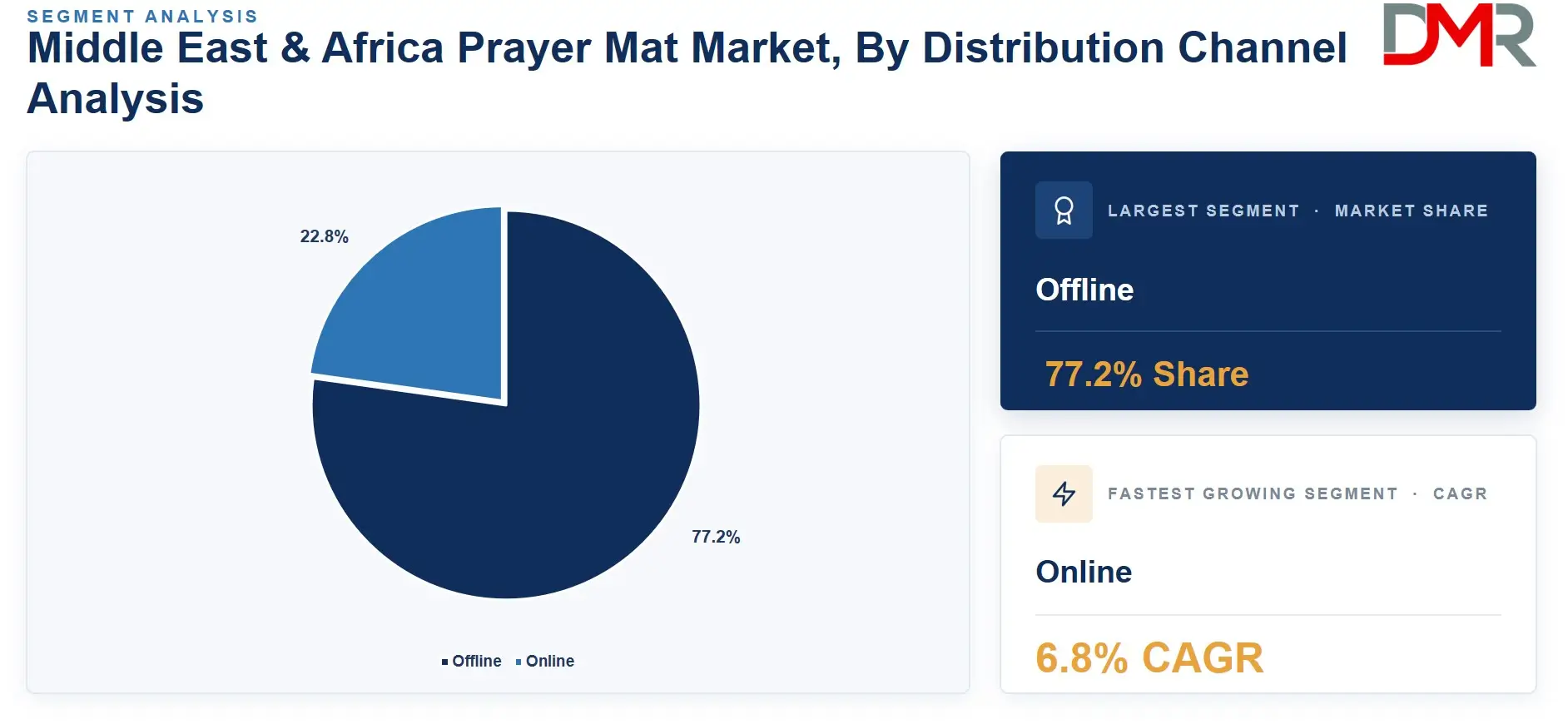
- Offline is the leading distribution channel segment: 77.2%
- Residential is the leading end user segment: 82.1%
- Cushioned is the fastest-growing product type segment: 6.6% CAGR
- Natural Fibers is the fastest-growing material segment: 6.9% CAGR
- Premium is the fastest-growing price range segment: 7.1% CAGR
- Online is the fastest-growing distribution channel segment: 6.8% CAGR
- Commercial & Institutional is the fastest-growing End User segment: 7.2% CAGR
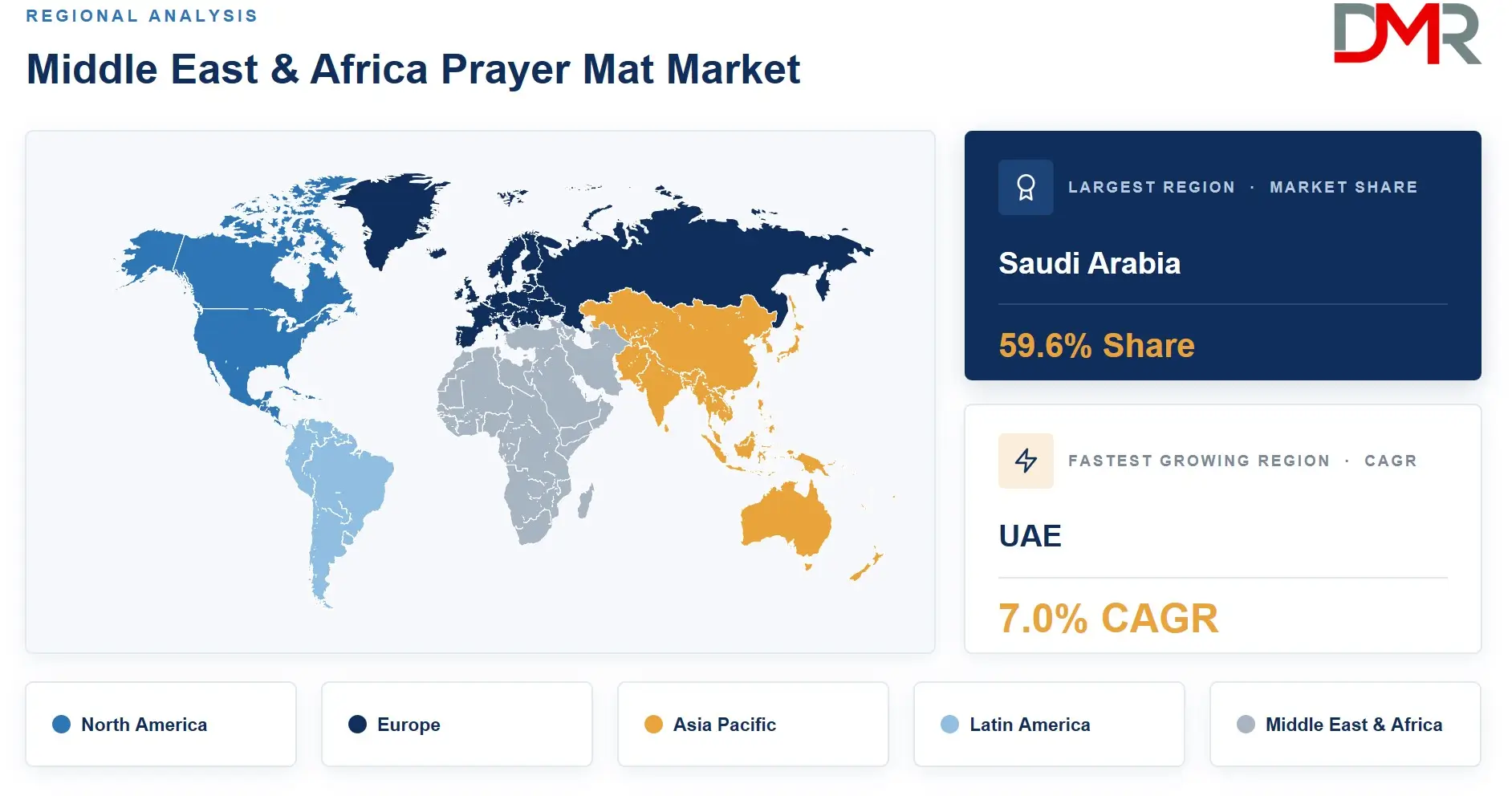
- Saudi Arabia is the leading country in the Middle East & Africa Prayer Mat Market: 59.6%
- UAE is the fastest-growing region in the Middle East & Africa Prayer Mat Market: 7.0% CAGR
What is the Middle East & Africa Prayer Mat Market? Middle East & Africa Prayer Mat Market size.
The Middle East & Africa Prayer Mat Market size is valued at USD 573.2 Million in 2026, and it is further anticipated to reach a market value of USD 971.8 Million by 2035 at a CAGR of 6.0%.
ℹ
To learn more about this report –
Download Your Free Sample Report Here
The Middle East & Africa Prayer Mat Market is witnessing steady growth on the back of religious traditions, growing demand for individual prayer accessories, and growth in distribution channels. The usage of prayer mats in houses, mosques, and other religious places ensures continuous demand for conventional as well as contemporary prayer mat designs. The growing preference for comfortable, light weight, and high-quality prayer mats has encouraged product innovations. Moreover, the growing availability of e-commerce channels, religious tourism, and preference among consumers for long-lasting, attractive, and convenient prayer accessories is helping the market grow.
Use Cases
- Personal & Household Prayer
- Prayer mats are commonly found in many households in the Middle East and Africa, where they are utilized for prayer activities. These prayer mats offer an appropriate, clean, and comfortable surface for performing Salah. The buyers look for prayer mats which are tough, soft, and can be easily maintained on a regular basis. The increasing demand for cushioned, light-weight, and attractive prayer mats is motivating companies to innovate new prayer mats.
- Hajj & Umrah Pilgrimage
- Pilgrims that make a journey to Saudi Arabia for Hajj and Umrah often make use of prayer mats in large numbers. Lightweight and compact prayer mats that can easily be carried are quite useful for travelers who perform their prayers in various places. A wide range of prayer mats, both cheap and expensive, is available from sellers situated close to pilgrim spots for tourists coming from both domestic and foreign nations.
- Mosques & Religious Institutions
- Places of worship such as mosques, Islamic learning centers, and other places of religious worship use prayer rugs in order to offer a clean and comfortable space for praying. The individual prayer mat is especially helpful in situations where a makeshift prayer place is needed, in classrooms, or where there are no carpets installed. Bulk purchasing is usually done based on durability, cost-effectiveness, ease of maintenance, and ability to withstand heavy usage.
- Religious Gifting & Special Occasions
- Prayer mats are often bought as religious gifts during Ramadan, Eid, weddings, and other special events in the Middle East and Africa. The customers' preferences are shifting towards decorative and luxurious prayer mats with unique designs and packaging. Sets consisting of prayer mats and prayer beads along with other religious items have also become popular among consumers. This creates potential for both retailers and manufacturers in the area through customization and gifting services.
Key Takeaways
- Market Growth: The Middle East & Africa Prayer Mat Market will grow from USD 573.2 million in 2026 to USD 971.8 million in 2035 at a CAGR of 6.0% from 2027 to 2035. Strong religious traditions, increasing demand for personal prayer accessories, expanding retail distribution networks, and growing interest in comfortable, durable, and premium prayer mats are supporting market growth.
- Flat Dominates the Product Type Segment: Flat Prayer Mats account for 67.7% of the market in 2026, supported by their affordability, lightweight construction, traditional usage, and widespread availability across households and religious retail stores. Cushioned Prayer Mats are the fastest-growing product type segment, with a CAGR of 6.6%, driven by increasing consumer preference for enhanced comfort, additional knee support, and padded designs suitable for regular prayer.
- Synthetic Fibers Dominate the Material Segment: Synthetic Fibers hold 58.9% of the market in 2026, supported by their affordability, durability, ease of maintenance, and widespread use in mass-produced prayer mats. Natural Fibers are the fastest-growing material segment, with a CAGR of 6.9%, driven by increasing demand for cotton, wool, and other natural materials, alongside growing consumer interest in sustainable, breathable, and premium-quality prayer accessories.
- Economy Dominates the Price Range Segment: Economy Prayer Mats account for 46.9% of the market in 2026, supported by their affordability, widespread household consumption, and accessibility through traditional retail outlets. Premium Prayer Mats are the fastest-growing price range segment, with a CAGR of 7.1%, driven by increasing demand for luxury designs, personalized products, decorative patterns, and high-quality prayer mats used for religious gifting and special occasions.
- Offline Dominates the Distribution Channel Segment: Offline distribution accounts for 77.2% of the market in 2026, supported by established religious specialty stores, local markets, supermarkets, and consumer preference for physically examining prayer mat materials and designs before purchasing. Online distribution is the fastest-growing segment, with a CAGR of 6.8%, supported by expanding e-commerce platforms, increasing smartphone penetration, wider product selection, and growing demand for convenient home delivery services.
- Residential Dominates the End User Segment: Residential consumers account for 82.1% of the market in 2026, supported by the widespread use of prayer mats for daily religious practices, household purchases, and regular replacement of personal prayer accessories. Commercial & Institutional is the fastest-growing End User segment, with a CAGR of 7.2%, driven by increasing purchases from mosques, hotels, educational institutions, workplaces, and other facilities providing dedicated prayer spaces.
- Saudi Arabia Leads the Market: Saudi Arabia accounts for 59.6% of the Middle East & Africa Prayer Mat Market in 2026, supported by established religious practices, strong household consumption, Hajj and Umrah activities in Saudi Arabia, and demand for traditional and premium prayer accessories. The presence of religious specialty retailers, expanding shopping malls, and growing e-commerce platforms further supports prayer mat sales Across Saudi Arabia.
- Growth Opportunity for UAE: UAE is expected to witness the highest CAGR of 7.0% from 2027 to 2035. Expanding retail distribution networks, increasing availability of affordable prayer mats, growing urban consumer markets, and improvements in e-commerce accessibility are creating opportunities for regional manufacturers and distributors. Rising demand for durable, lightweight, and decorative prayer mats across emerging markets is also supporting growth throughout the region.
How AI/Gen AI Is Transforming the Middle East & Africa Prayer Mat Market?
The Middle East & Africa Prayer Mat Market is undergoing a transformation due to Artificial Intelligence (AI) and Generative AI (Gen AI). This technology can be used in the design of the products, production efficiency, engagement of the consumers, and sales and operations management of retailers. The use of AI in the design of the products will help the manufacturers come up with innovative designs, personalizing the products with embroidery and cultural design according to the preferences of the consumer. Gen AI will help the manufacturers in customizing their products by coming up with unique colors, textures, and designs for the premium prayer mats. AI-based demand forecasts assist the manufacturers in managing the inventory, forecast the seasonal demand for the products during Ramadan, Hajj, and Umrah and also minimize wastage in production.
Key Drivers
Strong Religious Practices and Consistent Household Demand for Prayer Mats
The frequent practice of daily prayers in Muslim families within the Middle East and Africa region is a big factor in the prayer mat industry. Prayer mats are usually used by the households to pray on and hence, there is a constant demand for the traditional and cheap mats. Usage of the prayer mats, wearing out of fabrics, and household needs lead to repeated purchase of prayer mats. Households purchase the prayer mats for their children and other members of the household thus creating demand for the product among other generations. Cultural and religious significance of prayer mats makes the demand for them reliable.
Expanding Hajj and Umrah Activities Supporting Pilgrimage-Related Prayer Mat Sales
Activities involving Hajj and Umrah in Saudi Arabia lead to the development of a unique demand pipeline for prayer mats that are light, foldable, and easy to transport. Travelers from various countries buy portable prayer mats which they either use during their travels or give as gifts to their relatives. Merchants dealing in religious merchandise enjoy sales through such activities. The organizers of pilgrimage can also buy prayer mats as part of a travel package or necessities.
Restraints
Dependence on Imported Prayer Mats and Fluctuations in Procurement Costs
The dependence of imports of finished prayer mats poses problems for the distributors and retailers in some regions in the Middle East & Africa. Distributors usually obtain their products from factories situated abroad, putting them at risk of variations in freight cost, foreign exchange rate, import taxes, and procurement cost. This will increase their cost of selling and, consequently, increase their prices and cut down profit margins, especially for those selling in the economy category where buyers are very price-sensitive. Disruptions in transportation and delivery can be another problem for product availability and inventory management.
Product Similarity and Aggressive Price Competition in Traditional Flat Prayer Mats
Because of the availability of similar traditional prayer mats, there is aggressive price competition within the producers, wholesalers, and retailers who manufacture and sell them. Traditional designs together with simple synthetic material used in the products are easy to replicate, hence offering limited room for companies to differentiate themselves from their competitors. Customers buying normal traditional prayer mats will prefer cheaper products, hence making premium pricing not possible for the products. The unbranded items bought through local markets or small retailers are other factors that cause price competition in the market.
Growth Opportunities
Design and Development of Specialized Comfortable and Functional Orthopedic Praying Mats for Elderly Consumers
The design and development of cushioned praying mats will provide opportunities for manufacturers that focus on consumers that desire more comfort when praying. The design of cushions that incorporate memory foam, cushioned knee portions, non-slip surface, and other features may help cater for needs of the consumers that are not addressed by the traditional flat cushion mats. Elderly consumers and those that experience pain when kneeling will appreciate such features. The manufacturers can come up with cushioned mats of various cushioning levels, ergonomic design, and ease of cleaning material.
Expansion of Bulk Supply Partnerships with Religious and Commercial Institutions
Religious and commercial entities such as mosques, Islamic education institutions, hotels, office spaces, and charities present an opportunity for prayer mat companies to diversify their institutional supply network. Some of the buyers from such institutions could need prayer mats for use in temporary prayer spaces, guest services, religious events, or distribution programs within their communities. Manufacturers can package bulk purchase programs, standardize products, and provide bulk supply schemes that meet the needs of institutional purchases. Companies can benefit by developing business relationships with facilities management firms, hospitality companies, and religious entities that will enable them to secure bulk purchase orders.
Trends
Increasing Adoption of Personalized and Decorative Prayer Mat Designs
Personalization is one of the important trends in the product development segment for the Middle East & Africa Prayer Mat Market. The growing preference among consumers for unique and attractive designs of the prayer mat includes unique embroidery, engraving of names, geometrical shapes, unique borders, and coordinated packing of the prayer mat for religious gifts. Unique collections are being developed by the manufacturers and sellers to cater to specific events such as Ramadan, Eid, weddings, and others. Through digital printing and innovative textiles, unique designs can be created in small batches.
Increasing Demand for Eco-Friendly and Natural Fiber Praying Mats
The concerns about the environment and the use of natural fiber textiles are impacting the praying mats product line development. The manufacturers are looking into the materials like cotton, wool, recycled material, and others to develop the products with the alternatives to conventional synthetic textiles. Those who prefer breathable texture, softer surface, and natural material might be inclined to choose the products which have an emphasis on the quality of the material. The manufacturers are also looking into more durable products with better sewing and less packaging waste to make the products more sustainable.
Research Scope and Analysis
The Middle East & Africa Prayer Mat Market is segmented based on Product Type into Flat, Cushioned, and Others, Material into Natural Fibers, Synthetic Fibers, and Others, Price Range into Economy, Mid-Range, and Premium, Distribution Channel into Online and Offline, End User into Residential, Commercial & Institutional, and Others. Geographically, the market is segmented into Saudi Arabia, UAE, South Africa, and the rest of the MEA.
ℹ
To learn more about this report –
Download Your Free Sample Report Here
By Product Type Analysis
The Flat segment dominates the Middle East & Africa Prayer Mat Market with a share of 67.7% in 2026, supported by affordability, traditional usage, lightweight designs, and widespread household demand. The Cushioned segment is expected to grow at the fastest CAGR of 6.6% during 2027–2035, driven by increasing demand for comfort, padded support, and ergonomic prayer mats.
By Material Analysis
The Synthetic Fibers segment leads the market with a share of 58.9% in 2026, supported by durability, cost-effectiveness, easy maintenance, and widespread product availability. Natural Fibers are expected to register the highest CAGR of 6.9% during 2027–2035, driven by growing demand for breathable fabrics, cotton and wool materials, and natural textile products.
By Price Range Analysis
The Economy segment accounts for the largest market share of 46.9% in 2026, supported by affordability, consistent household consumption, and strong demand for traditional prayer mats. The Premium segment is projected to grow at the highest CAGR of 7.1% during 2027–2035, driven by increasing demand for luxury designs, personalized products, and religious gifting.
By Distribution Channel Analysis
The Offline segment dominates the market with a share of 77.2% in 2026, supported by established religious specialty stores, traditional markets, and consumer preference for examining products before purchasing. The Online segment is expected to register the fastest CAGR of 6.8% during 2027–2035, driven by expanding e-commerce platforms, wider product availability, and convenient home delivery.
By End User Analysis
The Residential segment holds the largest market share of 82.1% in 2026, supported by widespread household prayer practices and consistent demand for personal prayer accessories. Commercial & Institutional is projected to register the highest CAGR of 7.2% during 2027–2035, driven by increasing purchases from mosques, hotels, educational institutions, and workplaces.
The Middle East & Africa Prayer Mat Market Report is segmented based on the following:
By Product Type
By Material
- Natural Fibers
- Synthetic Fibers
- Others
By Price Range
- Economy
- Mid-Range
- Premium
By Distribution Channel
By End User
- Residential
- Commercial & Institutional
- Others
Country Analysis
Saudi Arabia is the Leading Country in the Middle East & Africa Prayer Mat Market
Saudi Arabia is projected to dominate the Middle East & Africa Prayer Mat Market, accounting for 59.6% of the total market share in 2026. This dominance is supported by deep-rooted Islamic traditions, widespread use of prayer mats in households and mosques, and growing demand for traditional and premium prayer accessories. Well-established retail networks, religious tourism, and increasing consumer preference for comfortable, durable, and aesthetically designed prayer mats further strengthen market growth. Additionally, the annual influx of Hajj and Umrah pilgrims significantly contributes to the demand for lightweight, portable, and travel-friendly prayer mats.
ℹ
To learn more about this report –
Download Your Free Sample Report Here
The UAE is the Fastest-Growing Country in the Middle East & Africa Prayer Mat Market
The UAE is expected to register the highest CAGR of 7.0% during 2027–2035, emerging as the fastest-growing country in the Middle East & Africa Prayer Mat Market. Growth is supported by expanding retail distribution networks, rising consumer purchasing power, increasing religious tourism, and growing demand for premium and customized prayer mats. Rapid urbanization, a substantial Muslim expatriate population, and the increasing adoption of e-commerce platforms are further improving product accessibility. Additionally, growing consumer preference for lightweight, durable, portable, and aesthetically appealing prayer mats is encouraging manufacturers and retailers to diversify their product portfolios and strengthen their presence across the country.
Investment and White Space Analysis
The Middle East & Africa Prayer Mat Market offers attractive investment opportunities as demand for traditional, comfortable, and high-quality prayer mats continues to grow. Countries such as Saudi Arabia, the UAE, and South Africa offer growth opportunities for manufacturers and retailers, supported by established Muslim communities, religious tourism in Saudi Arabia, expanding retail networks, and increasing demand for traditional and premium prayer accessories. There is considerable potential in cushioned and orthopedic prayer mats, personalized gifting products, natural-fiber materials, and bulk supplies for religious institutions. Expanding local manufacturing capabilities, improving product quality, and strengthening online and offline distribution networks can help businesses reach a wider customer base. However, competition from low-cost imports, fluctuating material prices, and limited product differentiation remain important challenges for investors.
Technology Analysis
The Middle East & Africa Prayer Mat Market is gradually adopting modern textile technologies to improve product quality, comfort, and manufacturing efficiency. Automated weaving and embroidery machines help manufacturers create detailed patterns and maintain consistent product quality while reducing production time. Digital printing makes it easier to introduce customized designs, attractive colors, and personalized prayer mats for individual consumers and gifting purposes. Manufacturers are also exploring memory foam, improved cushioning materials, and anti-slip backing to make prayer mats more comfortable and practical for daily use. AI-based design tools and automated fabric cutting offer further opportunities to improve production processes. However, high machinery costs, limited technical expertise, and price-sensitive consumers may slow the adoption of advanced technologies, particularly among smaller manufacturers.
By Country
Middle East and Africa
- Saudi Arabia
- The UAE
- South Africa
- Rest of MEA
Competitive Landscape
The Middle East & Africa Prayer Mat Market is moderately fragmented, with competition among regional manufacturers, textile suppliers, specialized prayer mat brands, and religious merchandise retailers. Companies compete based on product quality, pricing, durability, design, comfort, and distribution networks. Key market participants include Minwal, The Sabr Mat, My Salah Mat Limited, Segadty, Qurb, Urban Rugs, Sajada, Amaani, SUHAYLA, and Esskay. These players offer traditional, cushioned, portable, and premium prayer mats to meet diverse consumer preferences. Manufacturers are increasingly focusing on product customization, improved cushioning, attractive patterns, and durable materials to strengthen their market presence. Expanding e-commerce platforms, partnerships with religious specialty stores, and growing demand for personalized prayer accessories are creating opportunities for businesses to improve customer reach and competitive positioning across the region.
Some of the prominent players in the Middle East & Africa Prayer Mat Market are:
- Minwal
- The Sabr Mat
- My Salah Mat Limited
- Segadty
- Qurb
- Urban Rugs
- Sajada
- Amaani
- SUHAYLA
- Esskay
- Others
Recent Developments
- In October 2026, Dongsheng Carpet Group presented washable prayer rugs and reversible woven carpets designed for Middle Eastern markets. The company's prayer rug collection featured washable Axminster carpets, emphasizing comfort, durability, and refined finishes for premium consumers in Saudi Arabia and other Gulf countries. The initiative highlights opportunities for textile manufacturers to introduce high-quality prayer products, strengthen product differentiation, and expand their presence in the regional market.
- In October 2026, Saudi Arabian prayer mat brand Segadty showcased its carpet, prayer rug, and outdoor product collections at the International Saudi Falcons and Hunting Exhibition 2026. The company's participation highlighted its expanding product portfolio and focus on reaching consumers interested in traditional textiles and practical prayer accessories. The exhibition provided opportunities to strengthen brand visibility, engage potential customers, and promote specialized prayer mat products in Saudi Arabia's competitive retail market.
Report Details
| Report Characteristics |
| Market Size (2026) |
USD 573.2 Mn |
| Forecast Value (2035) |
USD 971.8 Bn |
| CAGR (2027–2035) |
6.0% |
| Historical Data |
2021 – 2025 |
| Forecast Data |
2027 – 2035 |
| Base Year |
2026 |
| Segments Covered |
By Product Type, By Material, By Price Range, By Distribution Channel, By End User |
| Regional Coverage |
Middle East & Africa – Saudi Arabia, The UAE, South Africa, Rest of MEA |
Frequently Asked Questions
How big is the Middle East & Africa Prayer Mat Market?
▾ The Middle East & Africa Prayer Mat Market is valued at USD 573.2 Million in 2026 and is projected to reach approximately USD 971.8 Million by 2035.
What is the CAGR of the Middle East & Africa Prayer Mat Market from 2027 to 2035?
▾ The Middle East & Africa Prayer Mat Market is anticipated to grow at a compound annual growth rate (CAGR) of 6.0% during the forecast period from 2027 to 2035.
What factors are driving the growth of the Middle East & Africa Prayer Mat Market?
▾ The Middle East & Africa Prayer Mat Market is driven by strong religious traditions, consistent household demand for daily prayers, and regular replacement purchases. Additionally, expanding Hajj and Umrah activities in Saudi Arabia are increasing demand for lightweight, portable, and foldable prayer mats among pilgrims, supporting sales through religious merchandise retailers and tourism-related channels.
What are the major trends in the Middle East & Africa Prayer Mat Market?
▾ The major trends in the Middle East & Africa Prayer Mat Market include growing demand for personalized and decorative prayer mats featuring customized embroidery, unique patterns, and premium designs for religious gifting. Additionally, increasing consumer preference for eco-friendly and natural-fiber prayer mats made from cotton, wool, and recycled materials is encouraging manufacturers to focus on sustainability, durability, and improved product quality.
Which country held the largest share of the Middle East & Africa Prayer Mat Market in 2026?
▾ Saudi Arabia holds the largest share of the Middle East & Africa Prayer Mat Market in 2026, accounting for 59.6% of the total market.
Which country is expected to grow the fastest in the Middle East & Africa Prayer Mat Market?
▾ Saudi Arabia holds the largest share of the Middle East & Africa Prayer Mat Market in 2026, accounting for 59.6% of the total market.
Who are the key players in the Middle East & Africa Prayer Mat Market?
▾ The key players in the Middle East & Africa Prayer Mat Market include Minwal, The Sabr Mat, My Salah Mat Limited, Segadty, Qurb, Urban Rugs, Sajada, Amaani, SUHAYLA, and Esskay, among others.
How is the Middle East & Africa Prayer Mat Market segmented?
▾ The Middle East & Africa Prayer Mat Market is segmented based on Product Type into Flat, Cushioned, and Others, Material into Natural Fibers, Synthetic Fibers, and Others, Price Range into Economy, Mid-Range, and Premium, Distribution Channel into Online and Offline, End User into Residential, Commercial & Institutional, and Others. Geographically, the market is segmented into Saudi Arabia, UAE, South Africa, and the rest of the MEA.