Middle East Camel Milk Powder Market snapshot
- Middle East Camel Milk Powder Market size in 2026 is: USD 1.5 Billion
- Middle East Camel Milk Powder Market size in 2035 is: USD 3.2 Billion
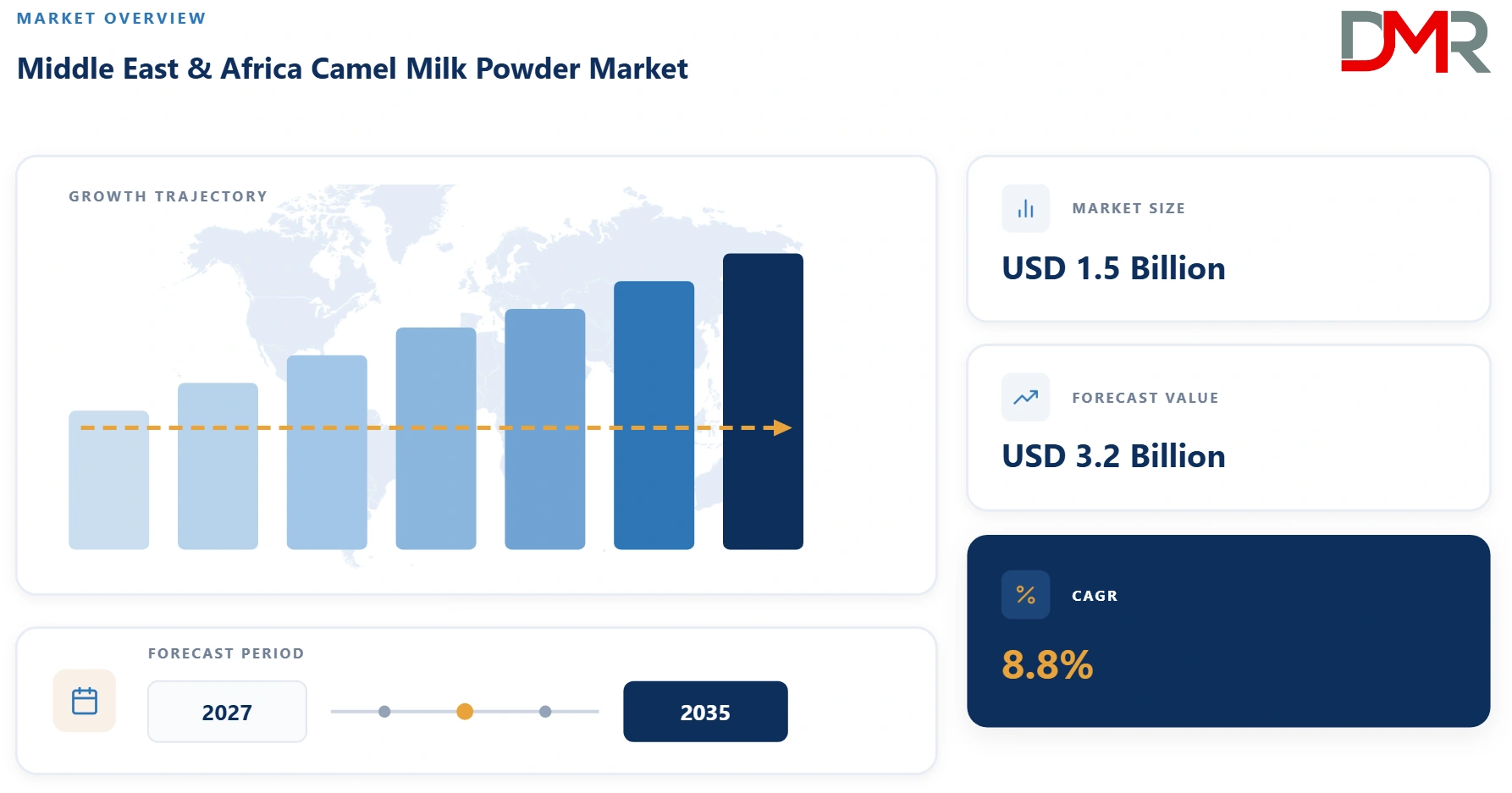
- Middle East CAGR from 2027 to 2035 is: 8.8%
- Whole is the leading type segment: 51.6%
- Spray Drying is the leading processing technology segment: 67.0%
- Beverages is the leading application segment: 32.9%
- Supermarkets is the leading distribution channel segment: 30.2%
- Skimmed is the fastest-growing type segment: 9.7%
- Freeze Drying is the fastest-growing processing technology segment: 10.1%
- Health Supplements is the fastest-growing application segment: 9.9%
- Online Retail is the fastest-growing distribution channel segment: 10.2%
- Saudi Arabia is the leading country in the Middle East Camel Milk Powder Market: 65.7%
- UAE is the fastest-growing country in the Middle East Camel Milk Powder Market: 9.8%
What is Middle East Camel Milk Powder and its Market Size?
The Middle East Camel Milk Powder Market size is valued at USD 1.5 Billion in 2026, and it is further anticipated to reach a market value of USD 3.2 Billion by 2035 at a CAGR of 8.8%.
ℹ
To learn more about this report –
Download Your Free Sample Report Here
The Middle East Camel Milk Powder Market encompasses the production, processing, distribution, and sale of powdered milk derived from fresh camel milk. The market includes whole and skimmed camel milk powder manufactured using spray drying, freeze drying, and other drying technologies. These products are used across beverages, dairy products, infant nutrition, health supplements, and other food applications. Increasing consumer awareness of camel milk's nutritional properties, expanding commercial camel farming, improvements in dairy processing technologies, and growing demand for alternative dairy products are supporting market growth. The market excludes fresh camel milk and finished camel milk-based products, except for the value of camel milk powder used as an ingredient.
Use Cases
- Infant and Child Nutrition: The powder form of camel’s milk is used in various foods prepared by manufacturers that focus on providing the nutritional requirements of the children. Being rich in proteins, vitamins, and minerals, camel milk powder is used in the preparation of such foods. The increasing consciousness about the nutrition of children in the Middle East is favoring the use of the powder in foods meant for children.
- Functional Foods and Dietary Supplements: There is an increased use of camel milk powder in the manufacture of functional foods and dietary supplements because of the nutritional value found in it. It is incorporated in the production of nutritional powders, protein mixes, and other food products for health-aware consumers. There has been rising interest in traditional foods and alternative sources of dairy products in the Middle East region that has provided new chances for the producers and regional dairy processors.
- Bakery and Confectionery Products: Powdered form of camel milk is used in bakery and confectionery products such as biscuits, chocolates, cakes, and processed food products. It helps to make use of camel milk in products without having any dependency on fresh milk. The companies that manufacture foods in the Middle East region are testing the potential of using camel milk in their products as a means of offering unique flavors. Moreover, increased shelf-life, easy transportation, and production of premium confectionery products have been encouraging the use of powdered camel milk.
- Dairy Beverages and Everyday Consumption: Powdered camel milk is utilized in the preparation of reconstituted milk, flavored beverages, milk beverages, and other types of dairy products to be consumed both at home and commercially. The extended shelf life and easy storage features make it ideal for use in places where fresh camel milk delivery services are still not available. In the Middle East region, awareness about camel milk along with the growing popularity of packed dairy products, is contributing to its usage.
Key Takeaways
- Market Growth: The Middle East Camel Milk Powder Market is expected to grow from USD 1.5 billion in 2026 to USD 3.2 billion in 2035 at a CAGR of 8.8% from 2027 to 2035. Increasing consumer awareness of camel milk's nutritional properties, growing demand for natural dairy alternatives, expanding camel farming activities, and improvements in milk processing technologies are supporting market growth.
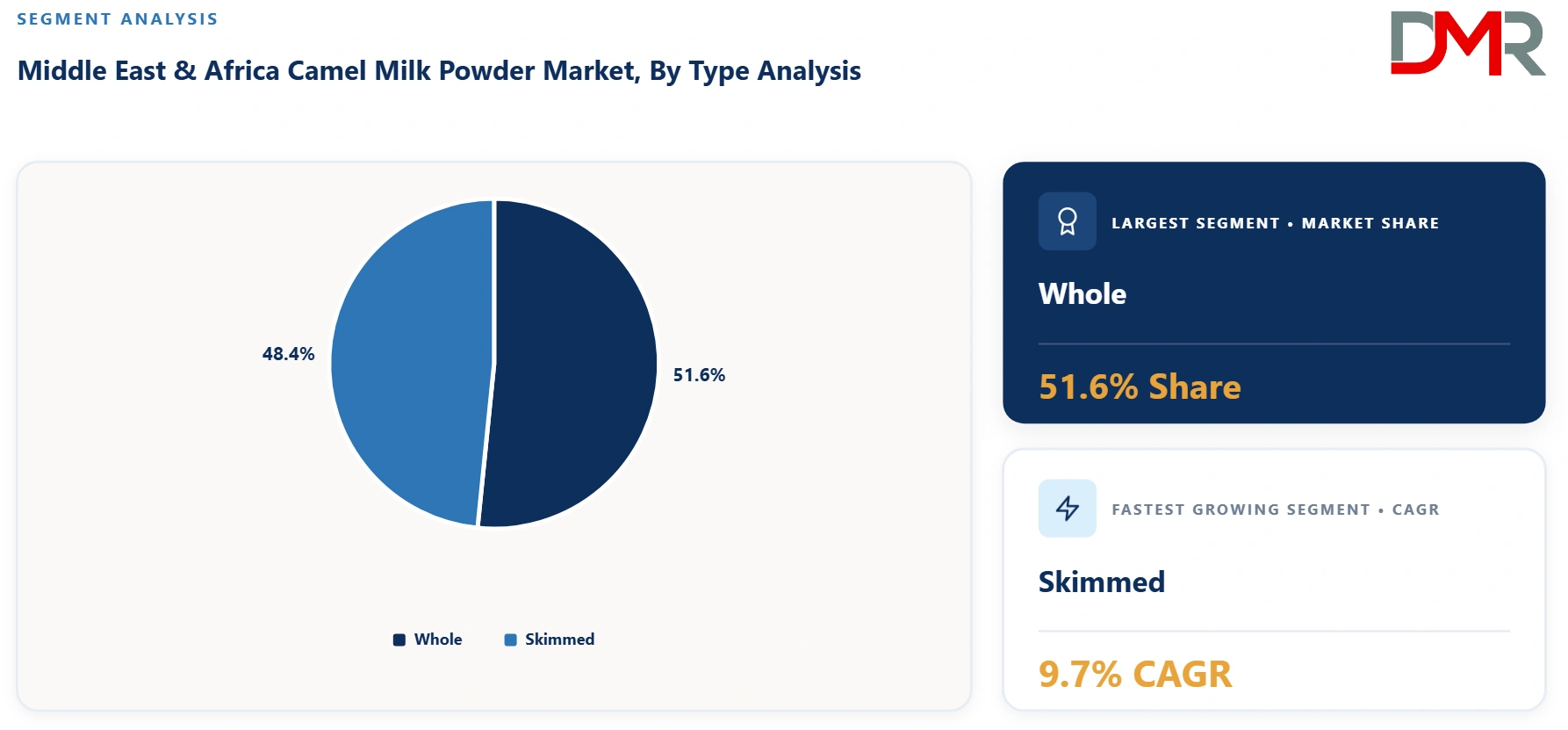
- Whole Dominates the Type Segment: Whole Camel Milk Powder holds 51.6% of the market in 2026, supported by its traditional consumption, nutritional content, and widespread use in beverages and dairy products. Skimmed Camel Milk Powder is the fastest-growing type segment, with a CAGR of 9.7%, driven by increasing demand for lower-fat dairy products.
- Spray Drying Dominates the Processing Technology Segment: Spray Drying holds 67.0% of the market in 2026, supported by its cost-effective production process, large-scale manufacturing capabilities, and ability to produce camel milk powder with consistent quality. Freeze Drying is the fastest-growing processing technology segment, with a CAGR of 10.1%, supported by growing demand for premium dairy products and nutrient-preserving processing methods.
- Beverages Dominate the Application Segment: Beverages account for 32.9% of the market in 2026, supported by increasing consumption of camel milk-based drinks, growing demand for convenient dairy beverages, and expanding product availability across retail channels. Health Supplements are the fastest-growing application segment, with a CAGR of 9.9%, driven by rising health awareness and interest in nutritional products.
- Supermarkets Dominate the Distribution Channel Segment: Supermarkets hold 30.2% of the market in 2026, supported by established retail networks, convenient product availability, and consumer preference for purchasing packaged dairy products through organized retail outlets. Online Retail is the fastest-growing distribution channel segment, with a CAGR of 10.2%, supported by expanding e-commerce platforms and increasing demand for home delivery services.
- The Saudi Arabia Dominates the Market: Saudi Arabia accounts for 65.7% of the Middle East Camel Milk Powder Market in 2026, supported by established camel farming activities, traditional camel milk consumption, growing investments in dairy processing facilities, and the presence of regional camel milk producers.
- Growth Opportunity for UAE: UAE is expected to witness the highest CAGR of 9.8% from 2027 to 2035. Increasing investments in camel milk processing, expanding retail distribution networks, growing demand for premium dairy products, and rising opportunities for camel milk powder exports are creating growth opportunities for regional manufacturers and market participants.
How AI/Gen AI Is Transforming the Middle East Camel Milk Powder Market?
AI and Generative AI are gradually changing the Middle East Camel Milk Powder Market by improving production efficiency, product quality, and supply chain management. AI-based monitoring systems help dairy producers track camel health, milk yield, and feeding patterns, supporting better farm management. In processing facilities, automated technologies assist in maintaining drying temperatures, monitoring moisture levels, and reducing product wastage. Predictive analytics also help manufacturers estimate consumer demand, manage inventory, and plan distribution activities. Moreover, Generative AI supports product development by helping companies explore new camel milk powder formulations, packaging concepts, and marketing strategies. Growing adoption of digital farming solutions and intelligent processing equipment is expected to create opportunities for regional camel milk powder manufacturers and distributors in the coming years.
Key Drivers
Growing Consumer Preference for Nutritional Dairy Products
The rising importance of nutrition and proper eating behavior is fueling the demand for camel milk powder in the Middle East region. There is growing consumer interest in the consumption of dairy products that have the ability to provide nutrition and serve as an alternative to regular cow milk. Camel milk powder comprises proteins, vitamins, and minerals and can thus be used for various applications. The significance of the product in some of the Middle Eastern countries is another factor encouraging its consumers.
Longer Shelf Life and Convenient Storage
Long-term storage of camel milk powder is one of the major factors behind market expansion. Refrigerated storage conditions are essential for fresh camel milk, but sometimes it becomes challenging to distribute fresh milk due to the lack of such conditions. Turning milk into powder makes it easier to distribute products in a large geographical area. Additionally, camel milk powder is easy to transport and prepare at any time. Such benefits contribute to the increasing popularity of camel milk powder.
Restraints
High Production and Processing Costs
The high cost involved in the production of camel milk powder is a serious impediment for the processors in the Middle East region. Camels produce milk in relatively lower quantities as compared to commercial dairy cattle. Moreover, high costs are incurred in the maintenance of camels due to feeding, medical treatment, and farming. Further, there are high processing costs incurred in the process of drying the milk and testing its quality. Such costs tend to increase the price of the product.
Limited Standardization of Milk Collection Practices
Variation in collecting practices of camel milk results in problems with achieving quality standards for the products. Small-sized farms, where camel milk is collected, do not have standardized milking, cleaning, and storage procedures. This can influence the quality of the raw milk that comes to the processing plant. Food manufacturers should provide training programs for their suppliers, perform tests, and have the right collection equipment. Lack of standardization does not allow producers to keep the same specifications of the product and meet the safety requirements.
Growth Opportunities
Expanding Camel Milk Powder Exports to International Markets
The rising global interest in camel milk products has presented the chance for food producers in the Middle East to exploit it. Food producers from countries like Saudi Arabia, the United Arab Emirates can look for foreign markets that have not seen camel milk powder before. There is an existing demand from specialized food retailers and people interested in dairy alternatives.
Development of Camel Milk-Based Functional Food Products
The development of new food products provides opportunities for camel milk powder producers in the area. Food firms can add camel milk powder to protein bars, nutritionally fortified products, and other functional food items. The nutritious nature of camel milk powder means that it is worth considering for food product manufacturers who want to venture into diverse products. Collaboration among dairy processors, food science firms, and research organizations could assist in developing functional foods.
Trends
Increasing Adoption of Freeze-Drying Technology
The freeze-drying technique is becoming popular amongst camel milk powder producers since it provides them with an option of using other than heating methods of milk powder production. The removal of moisture at low temperatures makes it possible to save some heat sensitive elements in camel milk. Those manufacturers who wish to produce a high-quality product are interested in this method for making their powder better. Despite the expensive costs of this method, there are many advantages of using it.
Growing Shift Toward Digital and Direct-to-Consumer Sales
The increasing use of digital shopping platforms is changing how camel milk powder reaches consumers across the Middle East. Manufacturers and specialty dairy brands are exploring online stores, e-commerce marketplaces, and direct-to-consumer channels to improve product accessibility. These platforms allow businesses to explain product ingredients, provide nutritional information, and introduce different packaging sizes. Online sales also offer smaller producers an alternative to traditional retail distribution. This shift is encouraging brands to strengthen their digital presence and develop more direct relationships with customers.
Research Scope and Analysis
The Middle East Camel Milk Powder Market is segmented based on Type into Whole and Skimmed, Processing Technology by Spray Drying, Freeze Drying, and Others, Application into Infant Nutrition, Dairy Products, Beverages, Health Supplements, and Others, Distribution Channel into Online Retail, Supermarkets, Specialty Stores, and Others.
ℹ
To learn more about this report –
Download Your Free Sample Report Here
By Type Analysis
The Whole segment holds the largest market share by value, accounting for 51.6% of the Middle East Camel Milk Powder Market in 2026. Its dominance is supported by its rich nutritional profile, higher fat content, natural taste, and increasing use in traditional beverages and dairy-based products. The Skimmed segment is forecasted to register the highest CAGR of 9.7% during 2027–2035, driven by growing consumer preference for low-fat dairy alternatives, increasing health awareness, and rising demand for nutritional products with reduced fat content.
By Processing Technology Analysis
The Spray Drying segment holds the largest market share, accounting for 67.0% of the Middle East Camel Milk Powder Market in 2026. Its leading position is attributed to cost-effective production, large-scale processing capabilities, extended product shelf life, and widespread adoption by commercial dairy manufacturers. The Freeze-Drying segment is forecasted to register the highest CAGR of 10.1% during 2027–2035, supported by increasing demand for premium camel milk powder, better preservation of heat-sensitive nutrients, and growing preference for minimally processed nutritional products.
By Application Analysis
The Beverages segment holds the largest market share, accounting for 32.9% of the Middle East Camel Milk Powder Market in 2026. Its dominance is driven by the increasing consumption of traditional camel milk beverages, growing demand for convenient powdered milk products, and expanding use of camel milk powder in flavored drinks and nutritional beverages. The Health Supplements segment is forecasted to register the highest CAGR of 9.9% during 2027–2035, driven by increasing consumer interest in functional nutrition, rising awareness of camel milk's nutritional properties, and growing demand for protein-rich and specialty dietary supplements.
By Distribution Channel Analysis
The Supermarkets segment holds the largest market share, accounting for 30.2% of the Middle East Camel Milk Powder Market in 2026. Its dominance is supported by widespread retail accessibility, established distribution networks, greater product visibility, and increasing consumer preference for purchasing packaged dairy products through organized retail outlets. The Online Retail segment is forecasted to register the highest CAGR of 10.2% during 2027–2035, driven by expanding e-commerce penetration, increasing smartphone usage, growing availability of specialty camel milk products, and rising consumer preference for convenient home delivery and online purchasing platforms.
The Middle East Camel Milk Powder Market Report is segmented based on the following:
By Type
By Processing Technology
- Spray Drying
- Freeze Drying
- Others
By Application
- Infant Nutrition
- Dairy Products
- Beverages
- Health Supplements
- Others
By Distribution Channel
- Online Retail
- Supermarkets
- Specialty Stores
- Others
Country Analysis
Saudi Arabia is the Leading Country in the Middle East Camel Milk Powder Market
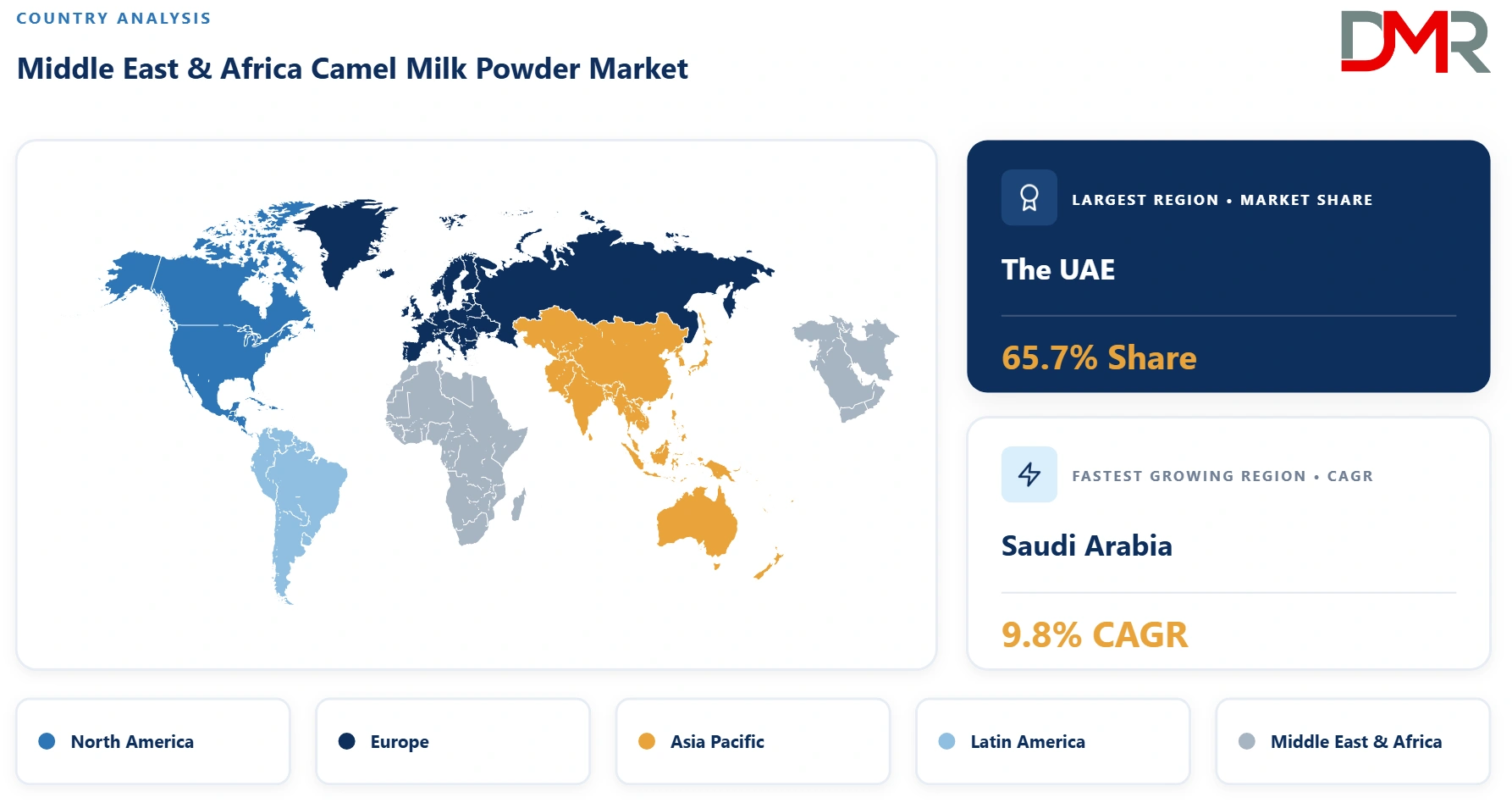
In 2026, the Saudi Arabia holds the largest share of the Middle East Camel Milk Powder Market, supported by its well-established camel dairy industry, advanced milk processing facilities, and strong commercial production capabilities. The presence of established manufacturers, such as Emirates Industry for Camel Milk & Products (Camelicious), contributes to the production and distribution of camel milk powder across domestic and international markets. Increasing consumer awareness of nutritional dairy products, growing demand for premium milk alternatives, and well-developed retail and export distribution networks further strengthen the country's market position.
ℹ
To learn more about this report –
Download Your Free Sample Report Here
UAE is the Fastest-Growing Country in the Middle East Camel Milk Powder Market
UAE is expected to register the highest CAGR during 2027–2035, supported by increasing investments in commercial camel farming, expanding dairy processing infrastructure, and government initiatives to develop the domestic camel dairy industry. The growing commercialization of camel milk products through companies such as Sawani is creating opportunities for camel milk powder manufacturers. Furthermore, rising consumer health awareness, increasing demand for nutritional dairy alternatives, expanding retail distribution networks, and growing investment in advanced milk processing technologies are expected to accelerate market growth in UAE.
Investment and White Space Analysis
The Middle East Camel Milk Powder Market offers substantial opportunities to make investments due to the rise in the consumption of functional dairy products, increase in camel herding operations, and commercialization of camel milk. Markets in Saudi Arabia, the United Arab Emirates (UAE), and others have become an attractive destination for investing in modern milk processing equipment and facilities, product development, and export-oriented manufacturing. Opportunities still lie in the field of infant nutrition products, health supplements, premium dairy products, and online sales channel. But investments in improving milk collection, automated processing techniques, and sustainable packaging will provide production efficiency and increased market access. High processing costs, fragmented supply chain, limited scalability of production, and lack of raw milk availability pose major threats.
Technology Analysis
The Middle East Camel Milk Powder Market is experiencing the benefits of innovative technologies like drying technology, automation processing, and better nutrition retention processes. The most prevalent method of processing used by many manufacturers is spray drying because of its economical and commercial feasibility. Freeze drying technology is getting popular because it helps in preserving the temperature sensitive nutrients and making premium products. Other emerging technologies like low temperature drying, membrane filtration, and packaging provide the potential for improving product quality, shelf life, and processing efficiency. But still, equipment cost, high energy utilization, temperature sensitivity, and difficult processing procedures are considered significant barriers.
By Country
- Saudi Arabia
- The UAE
- Rest of the Middle East
Competitive Landscape
The Middle East Camel Milk Powder Market is moderately competitive, with established dairy manufacturers and emerging regional producers focusing on product innovation, quality improvement, and distribution expansion. Key participants include Camel Milk & Products, Al Ain Farms, Al Zawaq Foods Factory, Best Wishes LLC, Aadvik Foods, HYE Foods, DEVAM’S, Foodfair Nutrition Products LLP, Desert Farms, and Amul. Companies are investing in advanced spray drying and freeze-drying technologies to improve nutritional preservation, product consistency, and shelf life. The GCC remains a major competitive hub, supported by established camel farming infrastructure and growing demand for premium dairy alternatives. Strategic partnerships, product diversification, e-commerce expansion, and export market development are creating growth opportunities, while high production costs, limited raw milk availability, and stringent food safety requirements remain significant competitive challenges.
Some of the prominent players in the Middle East Camel Milk Powder Market are:
- Emirates Industry for Camel Milk & Products
- Al Ain Farms
- Al Zawaq Foods Factory
- Best Wishes LLC
- Aadvik Foods
- HYE Foods
- DEVAM’S
- Foodfair Nutrition Products LLP
- Desert Farms
- Amul
- Others
Recent Developments
-
In October 2026, Al Ain Farms Group announced strategic agreements to expand its Camelait camel milk business into European and Chinese markets during Global Food Week in Abu Dhabi. The company also announced collaboration with Khalifa University and Khalifa University Enterprises Company to explore commercial applications of camel milk research and patented food innovations. The initiative is expected to strengthen the UAE's camel milk powder export opportunities, support product innovation, and expand access to international markets.
- In January 2026, Emirates Industry for Camel Milk & Products (EICMP), through its Camelicious brand, announced plans to introduce premium bulk camel milk powder for food and beverage manufacturers at Gulfood 2026 in Dubai. The product was developed for business-to-business applications, expanding the company's offerings beyond conventional consumer dairy products. The development is expected to support industrial applications of camel milk powder, strengthen supply opportunities for food manufacturers, and encourage greater adoption of camel milk ingredients in functional foods and beverages.
Report Details
| Report Characteristics |
| Market Size (2026) |
USD 1.5 Bn |
| Forecast Value (2035) |
USD 3.2 Bn |
| CAGR (2027–2035) |
8.8% |
| Historical Data |
2021 – 2026 |
| Forecast Data |
2027 – 2035 |
| Base Year |
2026 |
| Segments Covered |
By Type, By Processing Technology, By Application, By Distribution Channel |
| Regional Coverage |
Middle East – Saudi Arabia, The UAE, Rest of the Middle East |
Frequently Asked Questions
How big is the Middle East Camel Milk Powder Market?
▾ The Middle East Camel Milk Powder Market is valued at USD 1.5 Billion in 2026 and is projected to reach approximately USD 3.2 Billion by 2035.
What is the CAGR of the Middle East Camel Milk Powder Market from 2027 to 2035?
▾ The Middle East Camel Milk Powder Market is anticipated to grow at a compound annual growth rate (CAGR) of 8.8% during the forecast period from 2027 to 2035.
What factors are driving the growth of the Middle East Camel Milk Powder Market?
▾ The growth of the Middle East Camel Milk Powder Market is driven by rising demand for nutritious dairy alternatives, growing health awareness, longer shelf life, convenient storage, and easier transportation compared to fresh camel milk.
What are the major trends in the Middle East Camel Milk Powder Market?
▾ Major trends in the Middle East Camel Milk Powder Market include increasing adoption of freeze-drying technology to preserve nutritional quality and growing use of e-commerce and direct-to-consumer sales channels to improve product accessibility.
Which country hold the largest share of the Middle East Camel Milk Powder Market in 2026?
▾ The Saudi Arabia holds the largest share of the Middle East Camel Milk Powder Market in 2026, accounting for 65.7% of the total market.
Which country is expected to grow the fastest in the Middle East Camel Milk Powder Market?
▾ UAE is expected to be the fastest-growing country during the forecast period, registering a CAGR of 9.8%. Growth is supported by increasing investments in camel dairy processing facilities, rising demand for nutritious dairy alternatives, growing consumer health awareness, and expanding availability of camel milk powder through retail and e-commerce channels.
Who are the key players in the Middle East Camel Milk Powder Market?
▾ The key players in the Middle East Camel Milk Powder Market include Camel Milk & Products, Al Ain Farms, Al Zawaq Foods Factory, Best Wishes LLC, Aadvik Foods, HYE Foods, DEVAM’S, Foodfair Nutrition Products LLP, Desert Farms, Amul, among others.
How is the Middle East Camel Milk Powder Market segmented?
▾ The Middle East Camel Milk Powder Market is segmented based on Type into Whole and Skimmed, Processing Technology by Spray Drying, Freeze Drying, and Others, Application into Infant Nutrition, Dairy Products, Beverages, Health Supplements, and Others, Distribution Channel into Online Retail, Supermarkets, Specialty Stores, and Others. Geographically, the market includes the Middle East.