Middle East Iron Ore Market Snapshot
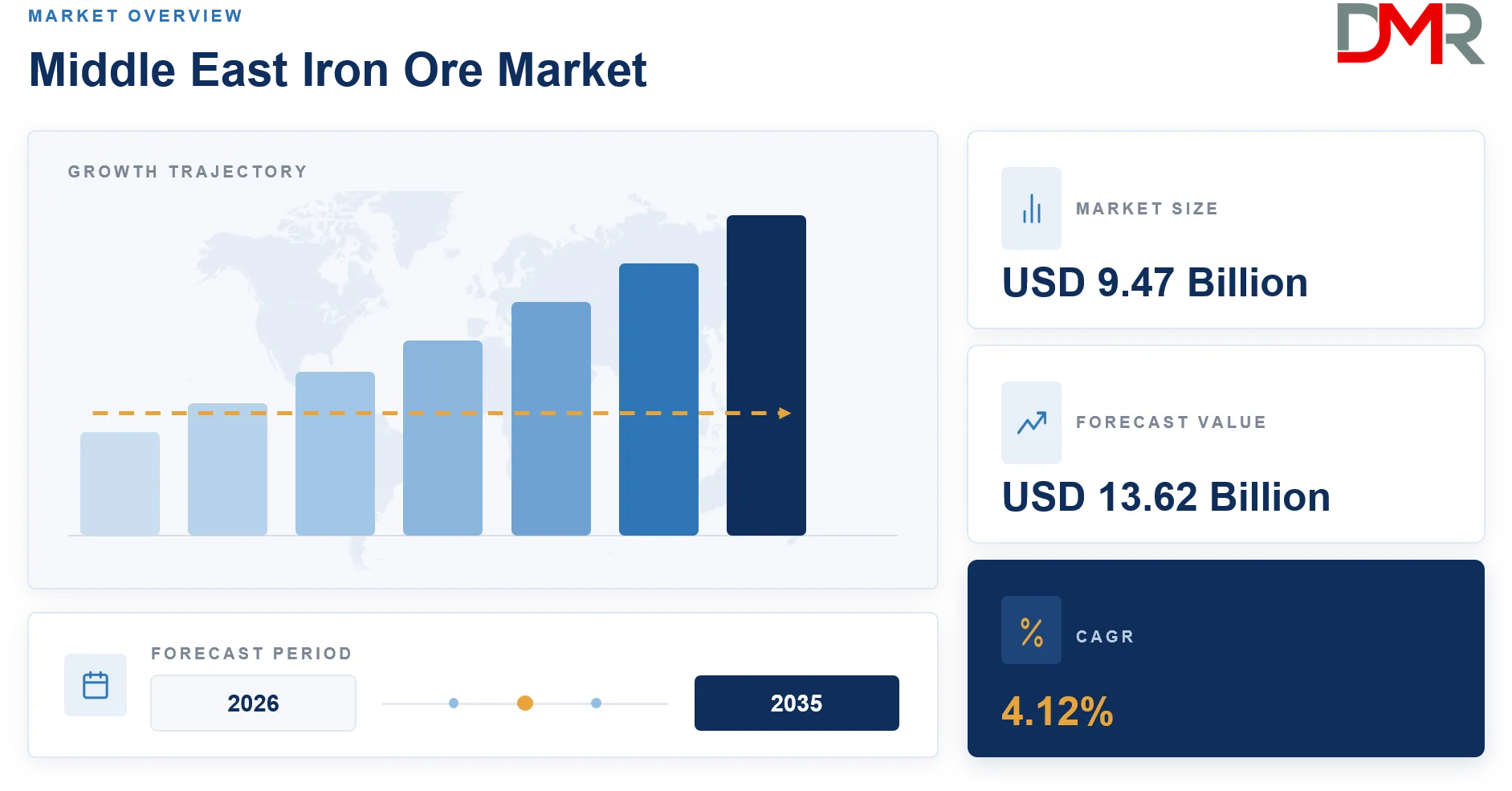
- Market Value: Middle East Iron Ore Market is valued at USD 9.47 billion in 2026 and is projected to reach USD 13.62 billion by 2035.
- CAGR: Middle East Iron Ore Market is expected to grow at a CAGR of 4.12% from 2026 to 2035.
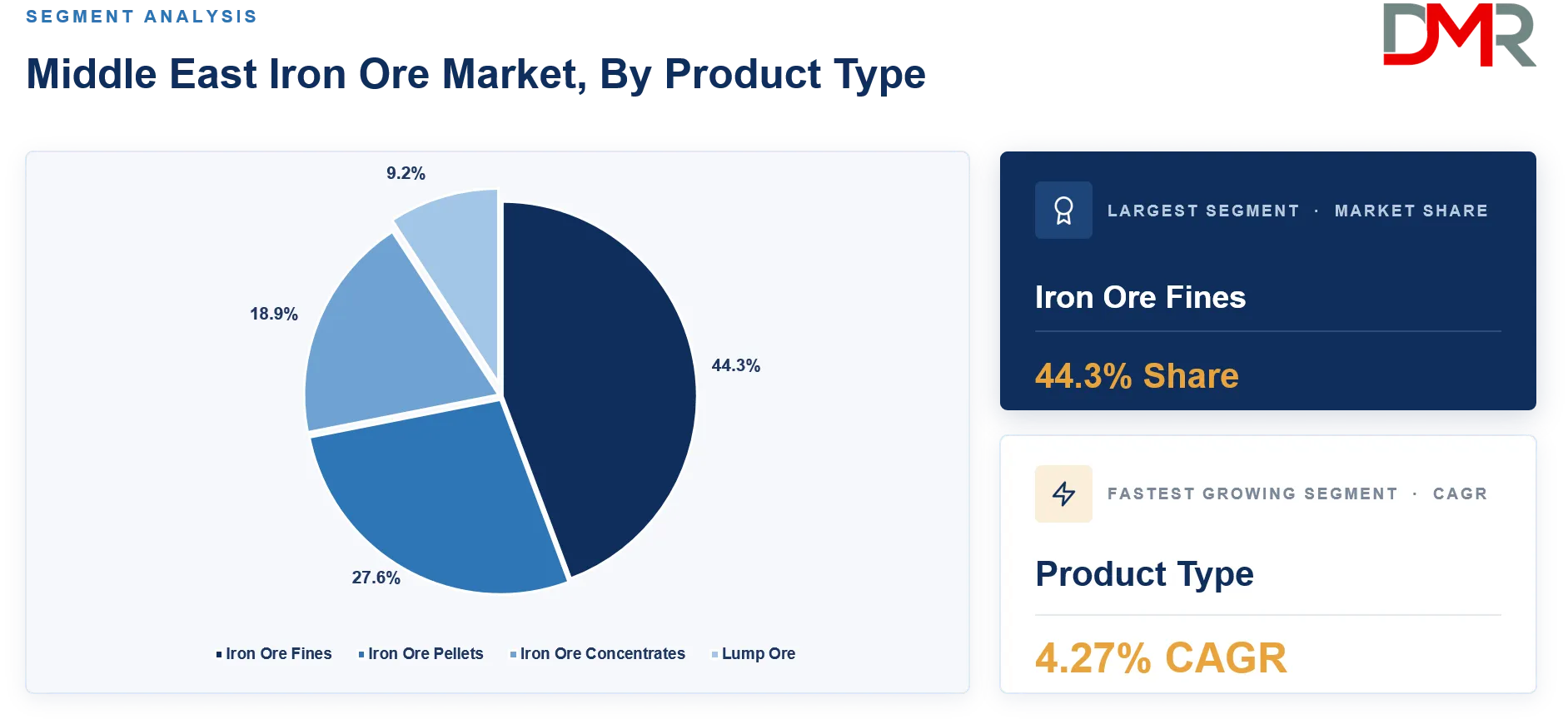
- By Product Type Analysis: Iron Ore Fines led the product type segment with a 44.3% share in 2026.
- By Grade Segment Analysis: Medium Grade Iron Ore (Fe 58-62%) led the grade segment with a 42.5% share in 2026.
- By End-User Industry Segment Analysis: Steel Manufacturing led the end-user segment with a 52.4% share in 2026.
- Regional Analysis: Iran led the Middle East Iron Ore Market with a 22.0% revenue share in 2026.
- Major Players: Gol Gohar Mining & Industrial Co., Chadormalu Mining & Industrial Co. (CMIC), Goharzamin Iron Ore Co., Sangan Mining Industries (Foolad Sangan), and Iran Central Iron Ore Co.
What is the Middle East Iron Ore Market and its Market Size?
The Middle East Iron Ore Market size is projected to be valued at USD 9.47 billion in 2026 and is expected to reach USD 13.62 billion by 2035, expanding at a CAGR of 4.12% during the forecast period. The market covers mined ore, fines, lumps, concentrates and pellets supplied to steel mills, direct reduction plants, pellet producers, foundries and other metal-processing industries across the region.
ℹ
To learn more about this report –
Download Your Free Sample Report Here
Unlike markets dominated mainly by domestic mine supply, the Middle East has two distinct iron ore business models. Iran has a large integrated mining and steel value chain supported by domestic deposits, concentration and pelletizing capacity. In contrast, several Gulf Cooperation Council steel producers rely more heavily on imported high-quality ore, concentrates and direct reduction-grade pellets. This creates a market shaped by both mine development and seaborne raw material procurement.
Steel capacity additions, direct reduced iron production, construction activity and investment in lower-carbon steelmaking are strengthening the Middle East iron ore demand outlook. The importance of ore quality is also rising. New DRI and electric arc furnace projects need consistent feed chemistry and higher iron content, increasing commercial interest in premium concentrates, pellets and beneficiated ore while creating new opportunities for suppliers able to meet tight metallurgical specifications.
Use Cases
- Steel Production: Iron ore is the principal metallic raw material supporting integrated and direct reduction steelmaking. Middle Eastern steelmakers use fines, pellets, concentrates and lump ore according to furnace configuration, metallurgical requirements and sourcing economics. Growth in long and flat steel capacity therefore directly influences regional iron ore consumption and procurement strategies.
- Direct Reduced Iron: DRI facilities require iron-bearing feed with controlled chemistry and strong metallurgical performance. The Middle East already has an established gas-based direct reduction industry, making DR-grade pellets and high-quality concentrates strategically important. Hydrogen-ready DRI investment is expected to raise the value of premium ore capable of supporting lower-emission ironmaking.
- Pellet Production: Concentrates and fine iron ore are upgraded into pellets used in DRI modules and blast furnaces. Oman and Bahrain have developed important pelletizing and distribution infrastructure serving regional and international customers. Pellet production creates demand for suitable feedstock while allowing producers to improve handling, permeability, productivity and ironmaking efficiency.
- Sintering and Blast Furnaces: Iron ore fines can be blended with fluxes and other materials to produce sinter for blast furnace operations. Buyers assess Fe content, alumina, silica, moisture and size distribution because these factors influence furnace productivity, coke consumption and slag volumes. This makes grade consistency an important purchasing criterion across the iron ore supply chain.
- Industrial and Foundry Applications: Iron-bearing materials also serve foundries, engineering industries, machinery manufacturing and specialized metallurgical processes. Demand from these applications is smaller than steelmaking demand but supports diversified consumption. Buyers typically select material according to purity, physical form, chemistry, processing performance and the specifications of finished metal products.
How AI/Gen AI is Transforming the Middle East Iron Ore Market?
Advanced analytics, machine learning and automated decision systems are changing how iron ore producers manage exploration, extraction, beneficiation and plant operations across the Middle East. Mining companies can combine geological models, drill information, equipment data and process measurements to improve ore-body interpretation and production planning. At beneficiation plants, intelligent control systems can monitor feed characteristics, recovery rates, grinding performance and concentrate grade to improve consistency. Predictive maintenance can also identify abnormal behavior in crushers, conveyors, mills, pumps and mobile equipment before failures disrupt production. These applications are particularly valuable where producers need to maintain stable Fe grades while controlling energy, water and operating costs.
Digital technologies are also becoming more important for traders, pellet producers and steelmakers purchasing iron ore from global suppliers. Forecasting tools can evaluate freight rates, benchmark prices, inventory levels, port congestion, supplier performance and steel demand when supporting procurement decisions. Generative systems can accelerate the review of contracts, technical specifications, supplier documentation and market intelligence, while human oversight remains essential for commercial decisions. As Gulf countries increase DRI and hydrogen-ready steel capacity, better data management will help buyers match ore chemistry with plant requirements, compare supply scenarios and manage exposure to disruptions in long-distance maritime trade.
Key Drivers in the Middle East Iron Ore Market
Expansion of Steelmaking and DRI Capacity
New steel and direct reduction capacity is creating a larger addressable market for iron ore, concentrates and DR-grade pellets. Middle Eastern producers benefit from established gas-based DRI expertise, while Saudi Arabia, Oman and the UAE are investing in industrial diversification and lower-carbon metals. Saudi crude steel production increased by 11% in 2025, illustrating the strength of regional steel investment. Greater steel output raises recurring requirements for iron-bearing feed and supports long-term supply agreements with global miners.
Infrastructure and Industrial Diversification
Transport systems, industrial cities, renewable energy projects, housing and manufacturing expansion are supporting steel consumption across major Middle Eastern economies. Saudi Arabia is particularly important because large industrial and infrastructure programs are stimulating requirements for structural steel, rebar, flat products and fabricated metal. Rising steel consumption moves upstream through the value chain, increasing demand for ore, pellets and concentrates while encouraging steel producers to secure reliable feedstock through diversified sourcing arrangements.
Restraints in the Middle East Iron Ore Market
Dependence on Seaborne Raw Material Supply
Several Gulf steelmaking markets have limited domestic iron ore resources and depend on imported ore or pellets from suppliers in Brazil and other producing countries. This exposes procurement costs to ocean freight, benchmark iron ore prices, vessel availability and maritime disruption. Regional DRI plants may also require specifications that cannot be substituted easily. Supply interruptions can therefore affect pellet plants and downstream ironmaking operations, making inventory planning and supplier diversification important commercial priorities.
Ore Quality and Beneficiation Requirements
Growth in DRI and lower-carbon steelmaking increases demand for cleaner, higher-grade iron units, while not every mined resource can meet these requirements without beneficiation. Producers may need additional crushing, grinding, concentration, filtration and pelletizing infrastructure to reduce impurities and raise Fe content. These processing stages increase capital requirements and operating costs. Constraints involving energy, water, logistics and suitable ore characteristics can also limit the pace at which lower-grade resources are converted into premium steelmaking feed.
Growth Opportunities in the Middle East Iron Ore Market
Premium Feedstock for Green Steel Projects
The transition toward hydrogen-ready DRI creates a high-value opportunity for suppliers of DR-grade pellets and high-grade concentrates. The Middle East has extensive experience with natural-gas-based direct reduction and can progressively integrate lower-carbon hydrogen where economics allow. Oman alone has attracted substantial announced DRI and HBI capacity, increasing the need for suitable iron units. Suppliers that provide consistent Fe content, low gangue levels and dependable volumes can gain stronger positions in this emerging procurement market.
Development of Regional Processing Hubs
Oman illustrates the opportunity to build an iron ore processing ecosystem even without relying solely on domestic mine output. Vale and Jinnan Iron & Steel Group announced an iron ore concentration plant in Sohar with initial investment exceeding USD 600 million to provide high-quality feed for pellets and briquettes. Such projects can strengthen regional beneficiation, storage and distribution capabilities while linking imported ore with Gulf DRI, HBI and steel production.
Trends in the Middle East Iron Ore Market
Shift Toward Higher-Grade Iron Units
Iron ore purchasing strategies are becoming more closely connected to carbon intensity and furnace productivity. DRI producers generally require tighter feed specifications than conventional sinter-based routes, supporting demand for high-quality pellets and concentrates. Bahrain already operates major pellet production infrastructure, while Oman is developing additional concentration and ironmaking capacity. As hydrogen-ready facilities enter the pipeline, premium ore availability is becoming an increasingly important factor in project economics and supply agreements.
Integration of Iron Ore, DRI and Green Steel Supply Chains
Companies are increasingly planning ore supply, pellet production, direct reduction and steelmaking as one connected value chain. Vale's Oman operations combine pellet production with distribution infrastructure, while emerging Gulf projects are linking premium raw material contracts directly to DRI capacity. Essar has arranged potential supply of about 4 million tonnes per year of iron ore agglomerates from Vale for its Saudi steel project, showing how long-term feed security is becoming integral to new capacity planning.
Research Scope and Analysis
The Middle East Iron Ore Market is segmented based on Product Type, Grade, Form, Mining Method, End-User, Application, and Country. The study assesses the role of each segment in regional iron ore demand, trade, mining activity, beneficiation, pellet production and steelmaking. It also considers differences between resource-rich producing markets and import-dependent steelmaking economies to provide a clearer view of commercial opportunities across the regional value chain.
ℹ
To learn more about this report –
Download Your Free Sample Report Here
By Product Type;
Iron Ore Fines accounted for 44.3% of the Middle East Iron Ore Market in 2026, making it the leading product type. Fines remain commercially important because they can be used as feed for sintering, concentration and pelletizing operations, giving processors flexibility in converting mined or imported ore into furnace-ready products. Their position is reinforced by the scale of Iran's mine-to-steel value chain and by Gulf processing hubs that import ore for further upgrading. At the same time, increasing DRI investment is changing the product mix. Buyers are placing more attention on Fe content, silica, alumina and other properties that determine whether fines can be efficiently upgraded into premium concentrate or pellets. This creates opportunities for beneficiation technology providers, pellet producers and miners able to deliver consistent feed characteristics.
By Grade;
Medium Grade Iron Ore containing Fe 58-62% held 42.5% of the market in 2026. Its leadership reflects the balance between availability, processing requirements and cost across the region's diverse steel value chain. Medium-grade material can serve conventional steelmaking applications directly or undergo beneficiation when higher Fe content and lower impurities are required. Iran's extensive domestic resource base supports substantial production across different ore grades, while Gulf steel producers frequently import products matched to DRI requirements. Future growth will increasingly depend on beneficiation economics because hydrogen-ready DRI and lower-carbon steelmaking favor cleaner iron units. This shift does not remove demand for medium-grade ore, but it raises the commercial value of processing technologies capable of upgrading feed while controlling energy, water and recovery costs.
By End-User Industry;
Steel Manufacturing represented 52.4% of Middle East iron ore revenue in 2026, confirming its role as the industry's principal demand center. Iron ore consumption is directly linked with crude steel, DRI, HBI, sinter and pellet production, making capacity expansion among regional steelmakers a critical demand indicator. The Middle East's established DRI base gives the region a distinct raw material profile because direct reduction typically relies on high-quality iron-bearing feed. This relationship is becoming stronger as Saudi Arabia, Oman and the UAE pursue new steel investments and decarbonization programs. For miners and traders, this means future competition will depend not only on tonnage but also on ore chemistry, pellet quality, supply reliability, shipping economics and the ability to support increasingly demanding steel production routes.
The Middle East Iron Ore Market Report is segmented on the basis of the following:
By Product Type
- Iron Ore Fines
- Iron Ore Pellets
- Iron Ore Concentrates
- Lump Ore
By Grade
- High Grade Iron Ore
- Medium Grade Iron Ore
- Low Grade Iron Ore
By Form
- Fines
- Lumps
- Pellets
- Concentrates
By Mining Method
- Open Pit Mining
- Underground Mining
By End-User
- Steel Manufacturing
- Foundries
- Construction Materials
- Engineering Industries
- Automotive Manufacturing
- Machinery Manufacturing
By Application
- Blast Furnace Feed
- Direct Reduced Iron
- Electric Arc Furnace
- Sinter Production
- Pellet Production
- Foundry Applications
Country Analysis
- Saudi Arabia
- United Arab Emirates
- Iran
- Oman
- Qatar
- Egypt
- Bahrain
- Kuwait
- Iraq
- Israel
- Jordan
- Turkey
- Yemen
- Lebanon
- Syria
- Palestine
Iran Iron Ore Market
Iran has the deepest domestic iron ore production base in the Middle East and supports an integrated chain covering mining, concentration, pelletizing, DRI and steelmaking. Gross-weight iron ore output reached 95.4 million tonnes in 2024, according to USGS data. Gol Gohar, Chadormalu and the Sangan mining complex are central industry assets. Domestic steel demand supports ore consumption, while investment in beneficiation and pellet capacity is important for converting available resources into feed suitable for higher-value steel production.
Saudi Arabia Iron Ore Market
Saudi Arabia is becoming an increasingly important iron ore demand center rather than a large domestic ore producer. The Kingdom relies substantially on imported iron-bearing materials to serve direct reduction and steel plants. Crude steel output increased by 11% in 2025, and further steel capacity tied to industrial diversification can expand raw material requirements. New DRI and flat steel projects are also supporting demand for DR-grade pellets and other premium feedstock, creating opportunities for global miners, pellet suppliers, traders and port logistics providers.
Oman Iron Ore Market
Oman occupies a strategic position between global seaborne ore suppliers and Middle Eastern steel consumers. Vale's Sohar operations combine pellet production with iron ore distribution, while proposed concentration capacity can provide higher-quality feed for pellets, briquettes and direct reduction. Duqm is developing a separate green iron and steel cluster supported by port infrastructure, renewable energy potential and hydrogen-ready projects. This combination is attracting investment across ore processing, DRI, HBI and steel production rather than mine development alone.
UAE Iron Ore Market
The UAE market is shaped by advanced direct reduction and electric steelmaking capacity, infrastructure demand and investment in low-carbon production. EMSTEEL and Masdar demonstrated the use of green hydrogen in extracting iron from ore at an Abu Dhabi pilot, highlighting how future steel decarbonization could influence raw material specifications. Premium pellets and concentrates that provide stable chemistry and high Fe content are therefore strategically relevant to UAE steelmakers seeking greater productivity while reducing the carbon intensity of ironmaking.
Bahrain Iron Ore Market
Bahrain plays a specialized role in the regional market through large-scale pellet production. Bahrain Steel reports annual production capacity exceeding 12 million tonnes and supplies both direct reduction and blast furnace pellets. Its position connects imported iron ore with DRI and steelmaking markets throughout the Gulf and beyond. Regional DRI expansion could strengthen utilization of this infrastructure, although long-distance ore sourcing also makes shipping reliability, raw material inventories and port continuity important factors for the country's pellet industry.
Turkey Iron Ore Market
Turkey remains a major regional steel producer with significant requirements for metallic raw materials. The country's large electric arc furnace base makes ferrous scrap highly important, yet integrated mills continue to consume iron ore and related products. Türkiye produced 3.4 million tonnes of crude steel in July 2026 alone, confirming the scale of downstream manufacturing activity. Construction, automotive, machinery, white goods and export-oriented steel production continue to shape demand for raw materials and influence procurement decisions across the wider regional market.
Competitive Landscape
The Middle East Iron Ore Market combines domestic mining groups, integrated steelmakers, pellet producers and global seaborne suppliers. Iranian companies such as Gol Gohar Mining & Industrial Co., Chadormalu Mining & Industrial Co., Goharzamin Iron Ore Co. and Sangan-linked operators compete through mine access, beneficiation capacity and integration with domestic steel production. Gulf competition is structurally different because companies place greater emphasis on imported premium feedstock, pelletizing, logistics and long-term supply security.
Vale has built a strategic position through its Oman pellet and distribution operations and is participating in new concentration capacity in Sohar. Bahrain Steel provides regional DR and blast furnace pellets, while Saudi and Omani steel projects are creating new outlets for high-grade feed. Competitive advantage through 2035 will increasingly depend on ore quality, beneficiation capability, access to DR-grade material, freight economics, long-term contracts and the ability to support hydrogen-ready ironmaking.
Some of the prominent players in the Middle East Iron Ore Industry are:
- Gol Gohar Mining & Industrial Co.
- Chadormalu Mining & Industrial Co. (CMIC)
- Goharzamin Iron Ore Co.
- Sangan Mining Industries (Foolad Sangan)
- Iran Central Iron Ore Co.
- Sirjan Iranian Steel Co.
- Opal Parsian Sangan
- Sanabad Comprehensive Development (Industrial & Mining)
- Foolad Shargh Kaveh
- Sabanour Mining & Industrial Development
- Zarand Iranian Steel Co.
- Middle East Mines & Mineral Industries Development Holding
- Ma'aden (Saudi Arabian Mining Co.)
- AMAK (Almasane Alkobra Mining Co.)
- Vale
- Foulath Holding
- Erdemir Group (OYAK)
- İsdemir (İskenderun Demir ve Çelik)
- Egyptian Iron & Steel Co.
- Özkoyuncu Mining
- Others
Export Import Analysis
The Middle East Iron Ore Market has a two-way trade structure shaped by domestic mining in Iran and import-dependent steelmaking hubs across the Gulf. Iran supplies a large share of its own ore, concentrates and pellets through integrated mining and steel operations, while Oman, Bahrain, Saudi Arabia and the UAE depend more on seaborne iron units for DRI, pelletizing and steel production. Oman is a major import and redistribution gateway because Vale’s Sohar complex includes a 9 million tonne annual pellet plant and a 40 million tonne distribution center.
Bahrain Steel also operates more than 12 million tonnes of annual pellet capacity and relies on imported high-grade pellet feed, including long-term supply from Anglo American’s Minas-Rio operation. These flows support regional re-export of pellets and processed iron units to steelmakers across the GCC and wider MENA. Future trade growth will depend on DRI expansion, availability of high-grade feed, freight costs, port capacity, long-term supply contracts and shipping security through key maritime routes.
Pricing Analysis
Iron ore pricing in the Middle East is influenced by global 62% Fe benchmark prices, ore grade premiums, pellet conversion costs, freight, energy expenses and the tighter specifications required by DRI producers. The 62% Fe benchmark averaged about USD 99.6 per tonne in July 2026, while the market traded near USD 99 per tonne in early September, showing that abundant seaborne supply has kept headline prices below earlier peaks. Regional buyers, however, do not purchase solely on benchmark value. High-grade concentrates and DR-grade pellets command differentials because higher Fe content and lower silica and alumina can improve furnace productivity and reduce slag and energy use.
Gulf buyers also absorb ocean freight from Brazil and other exporting regions, while pelletizers face natural gas, power, binder and conversion costs. As hydrogen-ready DRI projects expand in Oman, Saudi Arabia and the UAE, the premium for consistent high-grade feed could become more important than the underlying fines benchmark, making quality, freight and contract structure central to procurement economics.
Recent Developments
- August 2026: IMIDRO Iran inaugurated 37 mining and mineral projects worth $1.4 billion across 11 provinces, expanding iron ore production capacity and creating over 2,000 direct jobs to strengthen domestic steel supply chains.
- August 2026: Ma'aden Saudi Arabian Mining Co. signed a joint venture with Saudi Aramco to form a mineral exploration and hard-rock mining company, with Ma'aden holding 51% stake to unlock Kingdom's $2.5 trillion mineral wealth including iron ore deposits.
- February 2026: Gol Gohar, Chadormalu, Goharzamin Iran's top 10 iron ore producers including these key players achieved 9% rise in concentrate output and 44% surge in lump ore production in first nine months of Iranian year 2025, with new 2 million ton/year plants under development.
Report Details
| Report Characteristics |
| Market Size (2026) |
USD 9.47 Bn |
| Forecast Value (2035) |
USD 13.62 Bn |
| CAGR (2026–2035) |
4.12% |
| Historical Data |
2021 – 2025 |
| Forecast Data |
2027 – 2035 |
| Base Year |
2025 |
| Estimate Year |
2026 |
| Segments Covered |
By Product Type (Iron Ore Fines, Iron Ore Pellets, Iron Ore Concentrates, and Lump Ore), By Grade (High Grade Iron Ore, Medium Grade Iron Ore, and Low Grade Iron Ore), By Form (Fines, Lumps, Pellets, and Concentrates), By Mining Method (Open Pit Mining and Underground Mining), By End-User (Steel Manufacturing, Foundries, Construction Materials, Engineering Industries, Automotive Manufacturing, and Machinery Manufacturing), By Application (Blast Furnace Feed, Direct Reduced Iron, Electric Arc Furnace, Sinter Production, Pellet Production, and Foundry Applications), By Country (Saudi Arabia, United Arab Emirates, Iran, Oman, Qatar, Egypt, Bahrain, Kuwait, Iraq, Israel, Jordan, Turkey, Yemen, Lebanon, Syria, and Palestine) |
| Regional Coverage |
Middle East |
Frequently Asked Questions
What is the current size of the Middle East Iron Ore Market?
▾ The Middle East Iron Ore Market size is valued at USD 9.47 billion in 2026 and is forecast to reach USD 13.62 billion by 2035.
What is the growth rate of the Middle East Iron Ore Market during?
▾ The Middle East Iron Ore Market is expected to grow at a CAGR of 4.12% during the forecast period 2026-2035.
Which country dominates the Middle East Iron Ore Market?
▾ Iran leads the Middle East Iron Ore Market with a 22.0% revenue share in 2026, supported by its strong mining base.
What factors are driving the growth of the Middle East Iron Ore Market?
▾ Steel capacity expansion, DRI projects and infrastructure investment are driving Middle East Iron Ore Market growth.
What are the major challenges restraining the Middle East Iron Ore Market?
▾ Import dependence, freight volatility and high-grade ore requirements restrain Middle East Iron Ore Market growth.
Which segment holds the largest share of the Middle East Iron Ore Market?
▾ Iron Ore Fines lead the Middle East Iron Ore Market product type segment with a 44.3% market share in 2026.
Who are the leading companies in the global Middle East Iron Ore Market?
▾ Leading companies in the Middle East Iron Ore Market include Gol Gohar Mining & Industrial Co., Chadormalu Mining & Industrial Co. (CMIC), Goharzamin Iron Ore Co., Sangan Mining Industries (Foolad Sangan), Iran Central Iron Ore Co., Sirjan Iranian Steel Co., Opal Parsian Sangan, Sanabad Comprehensive Development (Industrial & Mining), Foolad Shargh Kaveh, Sabanour Mining & Industrial Development, Zarand Iranian Steel Co., Middle East Mines & Mineral Industries Development Holding (IMIDRO group), Ma'aden (Saudi Arabian Mining Co.), AMAK (Almasane Alkobra Mining Co.), Vale, Foulath Holding, Erdemir Group (OYAK), Isdemir (Iskenderun Demir ve Çelik), Egyptian Iron & Steel Co., and Özkoyuncu Mining.
How is AI influencing the Middle East Iron Ore Market?
▾ AI supports ore grading, predictive maintenance and process optimization across the Middle East Iron Ore Market.
What are the future opportunities and trends in the Middle East Iron Ore Market?
▾ Green steel, hydrogen-ready DRI and high-grade pellets offer opportunities in the Middle East Iron Ore Market.