Middle East Sewage & Wastewater Pump Market Snapshot
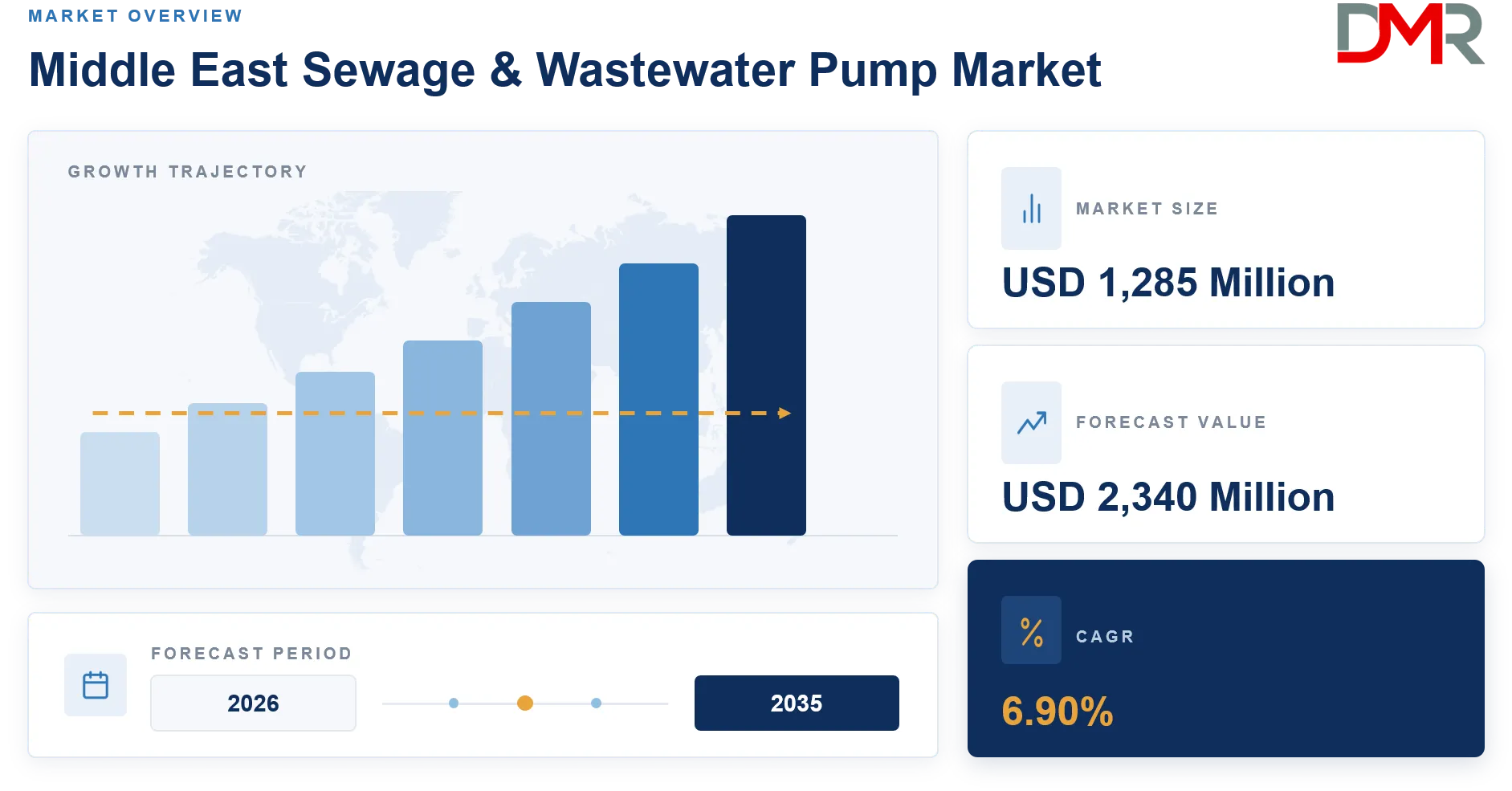
- Market Value: Middle East Sewage & Wastewater Pump Market is valued at USD 1,285 million in 2026 and is expected to reach USD 2,340 million by 2035.
- CAGR: Middle East Sewage & Wastewater Pump Market is expected to grow at a CAGR of 6.9% from 2026 to 2035.
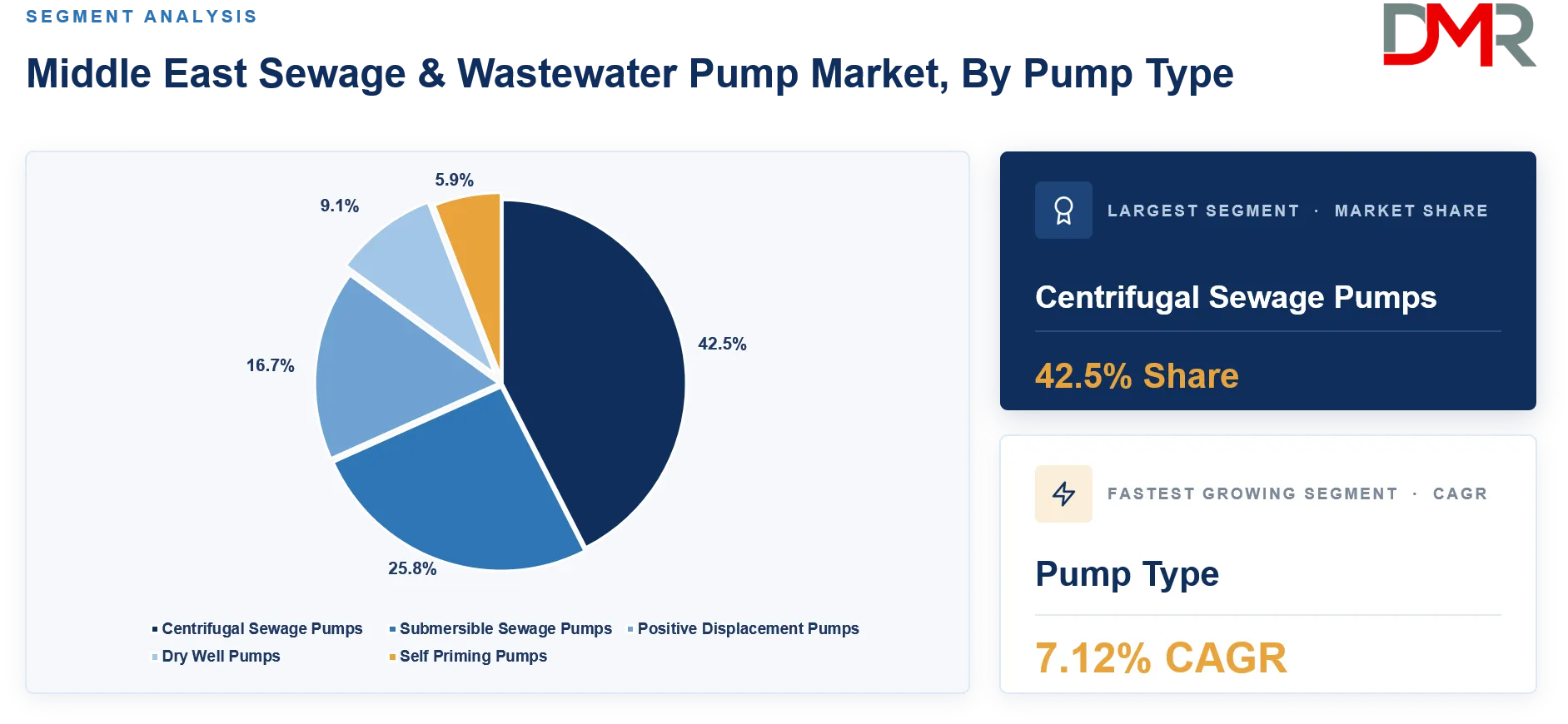
- By Pump Type Analysis: Centrifugal Sewage Pumps led the pump type segment with a 42.5% share in 2026.
- By Application Segment Analysis: Wastewater Treatment led the application segment with a 34.0% share in 2026.
- By End-User Industry Segment Analysis: Municipal Water Utilities held a 48.0% share in 2026.
- UAE Market Size: The UAE Sewage & Wastewater Pump Market size is expected to reach USD 527 million by 2035 from USD 289 million in 2026, at a CAGR of 6.9%.
- Saudi Arabia Market Size: The Saudi Arabia Sewage & Wastewater Pump Market size is expected to reach USD 655 million by 2035 from USD 360 million in 2026, at a CAGR of 6.9%.
- Kuwait Market Size: The Kuwait Sewage & Wastewater Pump Market size is expected to reach USD 198 million by 2035 from USD 109 million in 2026, at a CAGR of 6.9%.
- Major Players: Grundfos, Sulzer, Xylem (Flygt), KSB, Wilo and Others.
What is the Middle East Sewage & Wastewater Pump Market and its Market Size?
The Middle East Sewage & Wastewater Pump Market size is projected to be valued at USD 1,285 million in 2026 and is expected to reach USD 2,340 million by 2035, expanding at a CAGR of 6.9% during the forecast period. The market covers pumps used to collect, transfer, lift, circulate, drain, and process municipal sewage and industrial wastewater across treatment plants, sewer networks, pumping stations, commercial developments, residential projects, and industrial sites.
ℹ
To learn more about this report –
Download Your Free Sample Report Here
Demand is increasingly connected to large-scale wastewater treatment investments, urban expansion, water reuse programs, sewer network modernization, and the replacement of older pumping assets. For buyers, equipment selection is moving beyond initial pump cost toward energy consumption, solids-handling capability, corrosion resistance, maintenance frequency, service availability, and total lifecycle cost. These factors are especially important in high-temperature Middle Eastern operating environments and municipal systems where pump failure can disrupt essential public services.
Use Cases
- Municipal Sewage Collection: Sewage pumps move raw wastewater from residential and commercial catchments through collection networks, wet wells, and lift stations where gravity flow alone cannot maintain the required transfer rate.
- Wastewater Treatment Plants: Pumps support influent transfer, primary treatment, biological processes, sludge circulation, return activated sludge, treated effluent transfer, and discharge operations across municipal and industrial treatment facilities.
- Lift Stations: Submersible and centrifugal sewage pumps maintain wastewater movement in low-elevation zones, large urban developments, airports, industrial parks, and expanding municipal sewer networks.
- Industrial Wastewater: Heavy-duty pumps handle process effluent containing chemicals, abrasive particles, suspended solids, oils, fibrous material, and variable wastewater loads in manufacturing and process industries.
- Drainage and Flood Control: High-capacity drainage pumps remove stormwater, groundwater, and accumulated wastewater from infrastructure projects, underground facilities, construction sites, tunnels, and low-lying urban areas.
How AI/Gen AI is Transforming the Middle East Sewage & Wastewater Pump Market?
Digital monitoring is changing how wastewater utilities operate pumping stations. Sensors connected to pumps can track vibration, temperature, power consumption, operating hours, flow conditions, and motor performance. Analytical systems can use these operating signals to identify unusual patterns before a pump experiences severe clogging, seal damage, bearing deterioration, or motor failure. For municipal utilities managing large networks, condition-based maintenance can reduce emergency service calls and help maintenance teams prioritize assets with the highest operational risk.
Advanced automation is also supporting pump scheduling and energy management. Variable frequency drives can adjust motor speed according to wastewater inflow rather than running pumps continuously at fixed output. Digital control systems can coordinate multiple pumps, balance operating hours, detect changing hydraulic conditions, and improve station efficiency. Grundfos reported that a wastewater pumping optimization project in Ras Al Khaimah achieved more than 20% energy savings and a 12% reduction in total operating costs, illustrating the commercial value of intelligent pump control in the region.
Key Drivers in the Middle East Sewage & Wastewater Pump Market
Expansion of Municipal Wastewater Infrastructure
Rapid expansion of sewer networks and wastewater treatment capacity is increasing demand for sewage pumps, lift-station equipment, sludge pumps, and effluent transfer systems. Saudi Arabia's water project pipeline includes independent sewage treatment plants at Riyadh East, Al-Haier, Buraydah, Madinah, Najran South, Hafar Al Batin, and other locations. Each treatment facility creates demand not only for primary pumping equipment but also for replacement pumps, motors, controls, impellers, and long-term maintenance services.
Growing Focus on Treated Wastewater Reuse
Water scarcity makes treated wastewater increasingly valuable for irrigation, landscaping, industry, and other non-potable applications. Saudi Arabia previously expanded tertiary treatment through eight new plants with more than 925,000 cubic meters per day of treatment capacity. Wider reuse increases pumping requirements because treated water must be transferred from treatment facilities to storage systems, distribution networks, irrigation areas, and industrial consumers, creating demand across several pump categories.
Restraints in the Middle East Sewage & Wastewater Pump Market
High Lifecycle and Maintenance Requirements
Sewage pumping is mechanically demanding because pumps frequently handle solids, fibrous materials, grit, sludge, and chemically aggressive wastewater. These conditions raise wear, blockage, seal failure, and corrosion risks. Utilities therefore need maintenance teams, replacement parts, monitoring systems, and backup capacity. Buyers with limited operating budgets may extend equipment replacement cycles, particularly when premium pumps, stainless-steel components, specialized impellers, or advanced control systems carry a higher initial investment.
Complex Project Procurement and Long Approval Cycles
Large municipal wastewater projects often involve engineering consultants, utilities, municipalities, EPC contractors, financiers, developers, and equipment suppliers. Technical approvals may cover hydraulic performance, materials, motor efficiency, solids passage, installation configuration, service support, and compliance requirements. These multi-stage procurement processes can lengthen pump order cycles and create strong competition around approved-vendor status, project references, local service capability, and lifecycle cost rather than equipment price alone.
Growth Opportunities in the Middle East Sewage & Wastewater Pump Market
Smart Pumping Station Modernization
Existing pumping stations offer a substantial retrofit opportunity for variable frequency drives, high-efficiency motors, digital controls, condition monitoring, and redesigned non-clog hydraulics. Older stations can consume significant electricity when pumps operate away from their best efficiency point or experience repeated blockage. Suppliers able to combine pumps, automation, monitoring, commissioning, and maintenance can address utility demand for lower energy consumption and improved station availability without requiring complete infrastructure replacement.
Large Sewerage and Treatment Projects in Gulf Cities
Major infrastructure programs are creating opportunities for high-capacity pumps and related equipment. Dubai Municipality's strategic sewerage tunnel program involves an AED 80 billion investment, 75 km of deep tunnels, 242 km of link sewers, and wastewater processing capability of 2.5 million cubic meters per day. The program is intended to replace more than 100 existing pumping stations while developing a more centralized network, creating opportunities across treatment, terminal pumping, drainage, monitoring, and specialized high-head applications.
Trends in the Middle East Sewage & Wastewater Pump Market
Shift Toward Non-Clog and Solids-Handling Hydraulics
Municipal buyers are placing greater emphasis on impeller design because fibrous waste, suspended solids, and concentrated sewage increase blockage risks. Vortex, channel, cutter, screw, and non-clog impellers are being selected according to solids size, wastewater composition, flow requirements, and efficiency targets. Major suppliers increasingly promote large free passages, clog-resistant hydraulics, abrasion-resistant components, and service-friendly designs to reduce pump downtime in wastewater networks.
Energy Efficiency and Variable-Speed Operation
Energy consumption is becoming a stronger procurement criterion as wastewater pumping stations operate continuously and can represent a material portion of treatment-system electricity use. Variable frequency drives allow utilities to match pump speed with actual inflow, reduce unnecessary throttling, and improve operation across changing duty points. Pump suppliers are combining efficient motors, controls, monitoring, and optimized hydraulics as utilities increasingly evaluate equipment on total operating cost rather than purchase price alone.
Research Scope and Analysis
The Middle East Sewage & Wastewater Pump Market assessment evaluates equipment demand across municipal wastewater networks, sewage treatment facilities, industrial effluent systems, commercial developments, residential infrastructure, pumping stations, drainage systems, and major infrastructure projects. Market estimates consider new installations, replacement demand, modernization programs, water reuse infrastructure, treatment-capacity additions, technology adoption, and procurement activity.
ℹ
To learn more about this report –
Download Your Free Sample Report Here
By Pump Type
Centrifugal Sewage Pumps dominated the Middle East Sewage & Wastewater Pump Market with a 42.5% share in 2026. Their leading position reflects broad applicability across sewage collection, treatment plants, lift stations, drainage, and effluent transfer. Centrifugal designs can accommodate high flow rates and are available in submersible, dry-installed, horizontal, and vertical configurations. Municipal operators also have access to multiple impeller options for solids-laden wastewater. Continued investment in treatment capacity and sewer networks should sustain demand, while high-efficiency motors and improved clog-resistant hydraulics strengthen the segment's lifecycle-cost proposition.
By Application
Wastewater Treatment accounted for a leading 34.0% share in 2026. Treatment plants require pumps at several stages, including raw sewage intake, primary treatment, sludge transfer, biological circulation, recirculation, treated effluent movement, and final discharge. This creates demand for multiple pump sizes and hydraulic configurations within a single facility. New treatment projects in Saudi Arabia and capacity expansion in the UAE support equipment requirements, while greater use of treated wastewater adds transfer and distribution pumping after treatment. Reliability, solids passage, corrosion resistance, energy efficiency, and service support remain important purchasing factors.
By End-User
Municipal Water Utilities held 48.0% of the Middle East market in 2026, making the segment the largest end-user category. Utilities operate sewage collection networks, lift stations, treatment facilities, drainage assets, and treated-effluent systems that require continuous pump operation. Their large installed base also creates recurring aftermarket demand for replacement units, impellers, seals, motors, controls, and maintenance. Public-private partnership models and independent sewage treatment projects are widening opportunities for pump manufacturers that can support consultants, EPC contractors, operators, and long-term concession projects.
The Middle East Sewage & Wastewater Pump Market Report is segmented on the basis of the following:
By Pump Type
- Centrifugal Sewage Pumps
- Submersible Sewage Pumps
- Positive Displacement Pumps
- Dry Well Pumps
- Self Priming Pumps
By Pump Configuration
- Single Stage Pumps
- Multi Stage Pumps
- Vertical Pumps
- Horizontal Pumps
By Impeller Type
- Vortex Impellers
- Non Clog Impellers
- Cutter Impellers
- Channel Impellers
- Screw Impellers
By Drive Type
- Electric Motor Driven
- Diesel Engine Driven
- Variable Frequency Drive
By Material
- Cast Iron
- Stainless Steel
- Ductile Iron
- Engineered Plastics
- Duplex Stainless Steel
By Application
- Sewage Collection
- Wastewater Treatment
- Sludge Handling
- Drainage Systems
- Effluent Transfer
- Lift Stations
- Industrial Wastewater
By End-User
- Municipal Water Utilities
- Industrial Facilities
- Commercial Buildings
- Residential Buildings
- Infrastructure Projects
Major Countries Analysis
- Saudi Arabia
- United Arab Emirates
- Qatar
- Kuwait
- Oman
- Bahrain
- Turkey
- Iran
- Iraq
- Israel
- Jordan
- Egypt
- Rest of Middle East
Saudi Arabia Sewage & Wastewater Pump Market
The Saudi Arabia Sewage & Wastewater Pump Market size is expected to reach USD 655 million by 2035 from USD 360 million in 2026, registering a CAGR of 6.9%. Independent sewage treatment plants, wastewater reuse objectives, expanding municipal networks, and new urban development support equipment demand. The Al-Haier Independent Sewage Treatment Plant alone was designed for 200,000 cubic meters per day, while other projects are progressing across Riyadh, Buraydah, Madinah, Najran, and additional locations.
UAE Sewage & Wastewater Pump Market
The UAE market size is projected to reach USD 527 million by 2035 from USD 289 million in 2026 at a CAGR of 6.9%. Dubai's sewerage strategy, Jebel Ali treatment expansion, urban construction, drainage projects, and utility modernization create opportunities for submersible sewage pumps, centrifugal pumps, high-capacity transfer systems, variable-speed drives, and digital controls. Local evidence of measurable energy and operating-cost savings from wastewater pump optimization is also strengthening the business case for modernization.
Kuwait Sewage & Wastewater Pump Market
The Kuwait Sewage & Wastewater Pump Market size is expected to expand from USD 109 million in 2026 to USD 198 million by 2035 at a CAGR of 6.9%. Demand is concentrated around municipal sewage collection, wastewater treatment, pumping stations, drainage networks, infrastructure development, and replacement of aging assets. Opportunities are strongest for suppliers offering pumps designed for continuous operation, solids handling, corrosion resistance, energy-efficient motors, and dependable aftermarket service in large municipal and infrastructure applications.
Competitive Landscape
The Middle East Sewage & Wastewater Pump Market is competitive, with global pump manufacturers, regional distributors, EPC-linked suppliers, and specialist wastewater equipment companies competing for municipal and industrial projects. Grundfos, Sulzer, Xylem through Flygt, KSB, and Wilo have broad portfolios covering sewage collection, treatment, drainage, lift stations, and industrial wastewater. Competitive differentiation increasingly centers on non-clog hydraulics, motor efficiency, solids passage, corrosion resistance, digital monitoring, variable-speed control, project engineering, installed-base service, and spare-parts availability.
Sulzer offers submersible pumps for heavy-duty municipal wastewater with solids and fibrous material, while KSB positions non-clog pumps for wastewater transport and treatment. Wilo markets sewage pumping systems with intelligent controls and connectivity. Suppliers that combine equipment with system design, commissioning, monitoring, retrofit services, and lifecycle support are better positioned for utility and infrastructure contracts where operational reliability and total ownership cost influence procurement decisions.
Some of the prominent players in the Middle East Sewage & Wastewater Pump Industry are:
- Grundfos
- Sulzer
- Xylem (Flygt)
- KSB
- Wilo
- Ebara
- Tsurumi
- Gorman-Rupp
- Flowserve
- ITT Inc. (Goulds)
- Torishima
- HOMA Pumpen
- Zenit
- Caprari
- Faggiolati Pumps
- Hidrostal
- Jung Pumpen
- Vogelsang Wastewater Technology
- Kanzotech Pumps
- Rover Industry LLC
- Others
Investment and White Space Analysis
Investment opportunities in the Middle East Sewage & Wastewater Pump Market are expanding around wastewater reuse, lift-station modernization, new treatment capacity, and replacement of aging municipal pumping assets. Saudi Arabia and the UAE remain priority markets because utilities are investing in sewage treatment plants, sewer networks, and large urban infrastructure programs. White space is particularly visible in retrofit solutions that combine high-efficiency pumps, variable frequency drives, remote monitoring, non-clog impellers, and predictive maintenance services.
Suppliers can also target underserved opportunities in industrial wastewater, district-scale developments, decentralized treatment systems, and treated effluent transfer. Local service centers, spare-parts availability, and EPC partnerships can improve market access, as procurement decisions increasingly consider lifecycle cost and maintenance response. Companies that provide integrated pumping, automation, commissioning, and aftermarket support are better positioned to capture recurring revenue beyond initial equipment sales.
Regulatory Landscape
The regulatory environment for sewage and wastewater pumping in the Middle East is shaped by national water strategies, municipal discharge rules, treatment standards, environmental permits, and infrastructure procurement requirements. Governments are placing greater emphasis on wastewater collection, safe treatment, reuse, energy efficiency, and reduced environmental discharge, which directly influences pump specifications and operating standards. Municipal and utility projects commonly require equipment to meet hydraulic performance, motor efficiency, corrosion resistance, solids-handling, safety, and reliability criteria before vendor approval.
In Saudi Arabia, expanding private-sector participation in sewage treatment projects is increasing the importance of technical compliance and long-term operating performance. In the UAE, large sewerage and wastewater programs also favor equipment that supports efficient treatment and reuse. Manufacturers therefore need strong documentation, approved materials, local certification support, and reliable service networks to compete effectively in utility and EPC procurement.
Recent Developments
- August 2026: Xylem announced acquisition of Cornell Pump Company and Roper Pump Company for $1.46 billion, strengthening its municipal and industrial wastewater pumping portfolio with relevance to Middle East infrastructure modernization projects.
- June 2026: Tamas Projects won a $163 million EPC contract for wastewater pumping station rehabilitation in Abu Dhabi, extending facility life and supporting wastewater transmission; key pump suppliers like Xylem, Grundfos, or Sulzer likely involved.
- April 2026: Sulzer signed a five-year Corporate Procurement Agreement with Aramco for centrifugal pumps, spare parts, and aftermarket services across global operations, reinforcing its position in Middle East wastewater and industrial pump markets.
Report Details
| Report Characteristics |
| Market Size (2026) |
USD 1,285 Million |
| Forecast Value (2035) |
USD 2,340 Million |
| CAGR (2026–2035) |
6.9% |
| Historical Data |
2021 – 2025 |
| Forecast Data |
2027 – 2035 |
| Base Year |
2025 |
| Estimate Year |
2026 |
| Segments Covered |
By Pump Type (Centrifugal Sewage Pumps, Submersible Sewage Pumps, Positive Displacement Pumps, Dry Well Pumps, and Self Priming Pumps), By Pump Configuration (Single Stage Pumps, Multi Stage Pumps, Vertical Pumps, and Horizontal Pumps), By Impeller Type (Vortex Impellers, Non Clog Impellers, Cutter Impellers, Channel Impellers, and Screw Impellers), By Drive Type (Electric Motor Driven, Diesel Engine Driven, and Variable Frequency Drive), By Material (Cast Iron, Stainless Steel, Ductile Iron, Engineered Plastics, and Duplex Stainless Steel), By Application (Sewage Collection, Wastewater Treatment, Sludge Handling, Drainage Systems, Effluent Transfer, Lift Stations, and Industrial Wastewater), By End-User (Municipal Water Utilities, Industrial Facilities, Commercial Buildings, Residential Buildings, and Infrastructure Projects), By Country (Saudi Arabia, United Arab Emirates, Qatar, Kuwait, Oman, Bahrain, Turkey, Iran, Iraq, Israel, Jordan, Egypt, and Rest of Middle East) |
| Regional Coverage |
Middle East |
Frequently Asked Questions
What is the current size of the Middle East Sewage & Wastewater Pump Market?
▾ The Middle East Sewage & Wastewater Pump Market size is valued at USD 1,285 million in 2026 and is forecast to reach USD 2,340 million by 2035.
What is the growth rate of the Middle East Sewage & Wastewater Pump Market during?
▾ The Middle East Sewage & Wastewater Pump Market is expected to grow at a CAGR of 6.9% during the forecast period from 2026 to 2035.
Which country dominates the Middle East Sewage & Wastewater Pump Market?
▾ Saudi Arabia leads the Middle East Sewage & Wastewater Pump Market with a 28.0% revenue share in 2026, supported by wastewater infrastructure investment.
What factors are driving the growth of the Middle East Sewage & Wastewater Pump Market?
▾ Growth of the Middle East Sewage & Wastewater Pump Market is driven by sewer network expansion, wastewater treatment projects, water reuse, urban development, and pump modernization.
What are the major challenges restraining the Middle East Sewage & Wastewater Pump Market?
▾ High lifecycle costs, pump clogging, corrosion, maintenance needs, long procurement cycles, and demanding operating conditions restrain the Middle East Sewage & Wastewater Pump Market.
Which segment holds the largest share of the Middle East Sewage & Wastewater Pump Market?
▾ Centrifugal Sewage Pumps hold a 42.5% share of the Middle East Sewage & Wastewater Pump Market in 2026, supported by high-flow municipal and treatment applications.
Who are the leading companies in the global Middle East Sewage & Wastewater Pump Market?
▾ Grundfos, Sulzer, Xylem (Flygt), KSB, Wilo, Ebara, Tsurumi, Gorman-Rupp, Flowserve, ITT Inc. (Goulds), Torishima, HOMA Pumpen, Zenit, Caprari, Faggiolati Pumps, Hidrostal, Jung Pumpen, Vogelsang Wastewater Technology, Kanzotech Pumps, and Rover Industry LLC are prominent companies in the Middle East Sewage & Wastewater Pump Market.
How is AI influencing the Middle East Sewage & Wastewater Pump Market?
▾ AI is influencing the Middle East Sewage & Wastewater Pump Market through predictive maintenance, condition monitoring, fault detection, pump scheduling, and energy optimization.
What are the future opportunities and trends in the Middle East Sewage & Wastewater Pump Market?
▾ Future Middle East Sewage & Wastewater Pump Market opportunities include smart pumping stations, VFD retrofits, wastewater reuse, non-clog pumps, digital monitoring, and treatment capacity expansion.